


Overview
The Vijayanagara Empire was founded in 1336 by the brothers Harihara and Bukka of the Sangama family, with its capital at Vijayanagara, the city of victory, today's Hampi on the Tungabhadra in Karnataka. Within seventy years it had absorbed the Hoysala kingdom, ended the Sultanate of Madurai and reached Rameshwaram, while fighting the Bahmani kingdom for the Tungabhadra doab. Four dynasties ruled it, and with the Bahmanis it dominated India south of the Vindhyas for more than 200 years.
Vijayanagara Empire: The Founding of 1336
South India after the Tughlaq Conquest: Kampili, Madurai and the Hoysalas
The kingdoms that had ruled the south were broken in the early fourteenth century. Malik Kafur's raids under Alauddin Khalji and the conquests of Muhammad bin Tughlaq brought the Yadavas, the Kakatiyas and the Hoysalas under the power of Delhi, and Tughlaq rule soon proved hard to hold so far from the capital.
In the Tungabhadra basin, local commanders had set up the small kingdom of Kampili in the 1320s. It was overrun by Muhammad bin Tughlaq for giving refuge to a rebel, and fell around 1327 after its defenders performed jauhar. Elsewhere Delhi's grip was slipping. The Muslim governor of Madurai had declared himself independent, and the Hoysala ruler and the ruler of Warangal were trying to assert their independence too.
This vacuum on the Tungabhadra is where Vijayanagara began. Kampili lay close to the site the brothers chose for their capital, and historians regard it as the forerunner of the Vijayanagara Empire.
Who Founded the Vijayanagara Empire: Harihara and Bukka
The Vijayanagara kingdom was founded by Harihara and Bukka, two of a family of five brothers of the Sangama family. A well-known legend tells their story. They had been feudatories of the Kakatiyas of Warangal and then ministers in Kampili. When Muhammad bin Tughlaq overran Kampili, they were imprisoned, converted to Islam and sent back to deal with the rebellions there. After a short time they gave up their new master and their new faith, and at the instance of their guru, Vidyaranya, were readmitted to Hinduism.
Historians still debate where the brothers came from. One view makes them Kannada-speaking officers of the Hoysalas on the Tungabhadra frontier; another makes them Telugu commanders of the Kakatiyas captured in the Tughlaq conquest. Vidyaranya, an Advaita sage of Sringeri, is credited by later tradition with inspiring them, though contemporary inscriptions say little about his part in 1336.
By tradition and inscriptions alike, the empire was founded in 1336, when Harihara was crowned. Contemporaries called it the Karnataka samrajyamu, and its kings called themselves rayas.
Vijayanagara Empire Capital: Hampi on the Tungabhadra
Vijayanagara, the city of victory, was the name of both the capital and the empire. Its first seat was at Anegondi on the north bank of the Tungabhadra, and the capital moved across the river to Vijayanagara in Bukka's reign because it was easier to defend. People of the region later remembered the city as Hampi, after the local mother goddess Pampadevi.
The site was well chosen. The Tungabhadra forms a natural basin there, girdled by granite hills, and because this is one of the most arid zones of the peninsula, embankments were built along the streams to store rainwater for the city. The choice was probably also inspired by the old shrines of Virupaksha, a form of Shiva, and Pampadevi. The kings claimed to rule on behalf of the god Virupaksha, and royal orders were signed "Shri Virupaksha", usually in the Kannada script.
Harihara and Bukka: The Early Sangama Dynasty (1336 to 1377)
Harihara I and Bukka I: The Hoysalas and the Madurai Sultanate
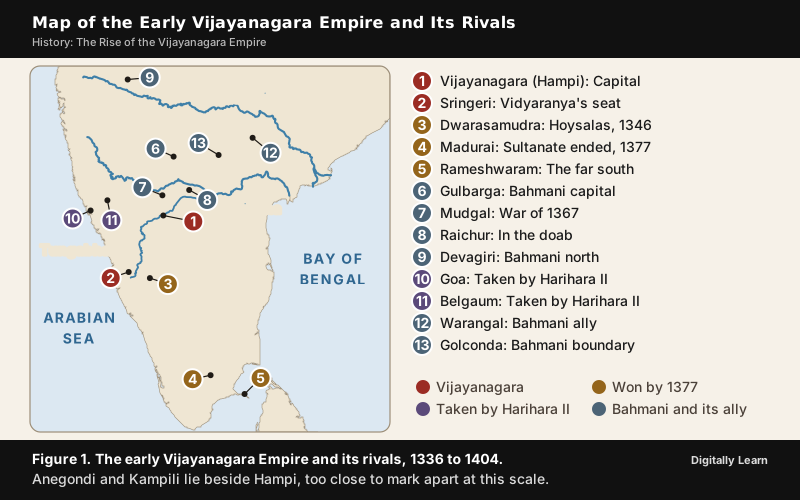
At first the young kingdom had to contend with two neighbours, the Hoysala ruler and the Sultan of Madurai. The Sultan was ambitious; in battle he defeated the Hoysala ruler, Ballala III, and had him killed in a barbarous manner in 1343. The fall of the Hoysala kingdom let Harihara and Bukka expand their small principality, and by 1346 the whole Hoysala kingdom had passed to Vijayanagara.
The brothers did not work alone. Their other brothers and relations took charge of the areas they conquered, so that at first Vijayanagara was a kind of cooperative commonwealth of the Sangama family. Within two decades Harihara held most of the land south of the Tungabhadra and took the title "master of the eastern and western seas".
Bukka succeeded his brother in 1356 and ruled until 1377. In the south his main rivals were the Sultans of Madurai, and the struggle with them lasted about four decades. Bukka's son Kumara Kampana led the armies of Vijayanagara against them, and by 1377 the Sultanate of Madurai had been wiped out.
The victory was celebrated in a Sanskrit poem, the Madhura Vijayam, the Victory of Madurai, written by Kumara Kampana's wife, the princess Gangadevi. With Madurai gone, the empire covered the whole of the south up to Rameshwaram, including the Tamil country and the land of the Cheras, Kerala.
Vijayanagara and the Bahmani Kingdom: The Long Rivalry
Bahmani Kingdom (1347) and the Three Zones of Conflict
To the north Vijayanagara faced a powerful enemy in the Bahmani kingdom, founded in 1347 by Alauddin Hasan, an Afghan adventurer. He had risen in the service of a brahmana named Gangu and so was known as Hasan Gangu, and he took the title Alauddin Hasan Bahman Shah, from which the kingdom took its name.
The two kingdoms clashed in three separate areas, each valuable for its own reason:
| Zone | Where it lay | Why it mattered |
|---|---|---|
| Tungabhadra doab (Raichur doab) | Between the Krishna and the Tungabhadra | Wealth and resources; fought over earlier by the Chalukyas and Cholas, then the Yadavas and Hoysalas |
| Krishna-Godavari delta | On the east coast | Very fertile, with many ports that controlled foreign trade |
| Maratha country | The Konkan, a fertile strip between the Western Ghats and the sea, and the land giving access to it | The port of Goa, an outlet for trade and for horses from Iran and Iraq |
Horses explain the third zone. Good horses were not bred in India, so the import of horses through Goa was of great importance to the southern states, whose armies depended on cavalry.
War of 1367: Mudgal, Artillery and a Treaty to Spare Civilians
Wars between Vijayanagara and the Bahmanis were almost a regular feature and lasted as long as the two kingdoms did. Both sides sacked towns and villages and enslaved men, women and children. The war of 1367 shows the pattern and its one good outcome.
- Mudgal: Bukka I attacked the fortress of Mudgal in the disputed doab and slaughtered the whole garrison except one man.
- Invasion: The enraged Bahmani Sultan crossed the Tungabhadra in the rainy season, the first time a Bahmani Sultan had in person entered Vijayanagara territory.
- Battle: The Vijayanagara king was defeated and withdrew into the jungle. Artillery was used by both sides for the first time, and the Bahmani guns and better cavalry decided the battle.
- Stalemate: The war dragged on for months, but the Sultan could capture neither the king nor his capital.
Exhausted, the two sides made a treaty that restored the old position, with the doab shared between them. More important, they agreed that since they would long remain neighbours, helpless and unarmed people should not be slaughtered in future wars. The accord was sometimes broken, but it helped to make warfare in south India more humane.
Harihara II and the Expansion of the Vijayanagara Empire (1377 to 1404)
Harihara II: The Eastern Coast, Goa and the Bahmani-Warangal Alliance
With the south secure after the end of the Madurai Sultanate, Vijayanagara turned to the eastern coast under Harihara II (1377 to 1404). The Krishna-Godavari delta was held by Hindu principalities, the Reddis on its upper reaches and the rulers of Warangal on the lower, and the Gajapati rulers of Orissa and the Bahmanis wanted it too.
Warangal tipped the balance against Vijayanagara. Attacked by the Bahmanis, Warangal accepted Golconda as the Bahmani boundary and sealed peace with a jewelled throne said to have been made for Muhammad bin Tughlaq. The Bahmani-Warangal alliance lasted over fifty years and kept Vijayanagara from overrunning the doab or stopping the Bahmani offensive there.
Harihara II held his ground against this combination. His greatest success was in the west, where he took Belgaum and Goa from the Bahmani kingdom, and he also sent an expedition to northern Sri Lanka. After a period of confusion, Deva Raya I succeeded him in 1404.
Vijayanagara Empire Kings List: The Four Dynasties
Sangama, Saluva, Tuluva and Aravidu: Dates and Rulers
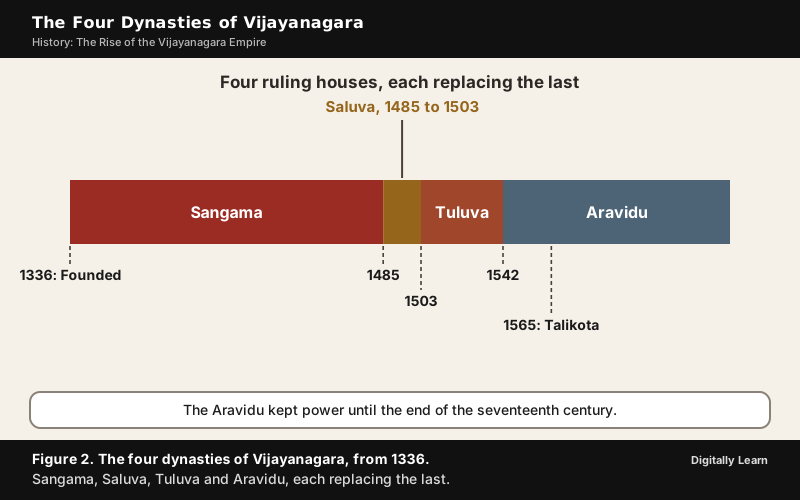
Four ruling houses held Vijayanagara in turn, each pushed aside by men from within the ruling lineage or the army. The Sangama dynasty ruled until 1485, when the Saluva dynasty, a line of military commanders, supplanted it. The Tuluva dynasty followed in 1503, and by 1542 control at the centre had passed to the Aravidu dynasty, which remained in power until the end of the seventeenth century.
| Dynasty | Years | Rulers to remember |
|---|---|---|
| Sangama | 1336 to 1485 | Harihara I, Bukka I, Harihara II, Deva Raya I and II |
| Saluva | 1485 to 1503 | Saluva Narasimha, who seized power in 1485 |
| Tuluva | 1503 to 1542 | Krishnadeva Raya (1509 to 1529) |
| Aravidu | From 1542 | Rama Raya, the chief minister who held real power, routed at Talikota in 1565 |
The empire's greatest age came under the Tuluva king Krishnadeva Raya, and its capital was sacked after the battle of Talikota in 1565.
Previous Year UPSC‑CSE Questions
Each question is explained option by option.
- UPSC Prelims 2015Who of the following founded a new city on the south bank of a tributary to river Krishna and undertook to rule his new kingdom as the agent of a deity to whom all the land south of the river Krishna was supposed to belong?
How to approach this Prelims question
Approach: Identify the city from the two clues, then its founder.
- Step 1: The new city on the south bank of a Krishna tributary is Vijayanagara, on the Tungabhadra.
- Step 2: Its founder, Harihara I, and the kings after him claimed to rule on behalf of the god Virupaksha, to whom the land was held to belong.
Trap to watch: Ballala II tempts because he was a Hoysala king of the same region, but he reigned in the twelfth century, long before Vijayanagara was founded in 1336.
Why each option is right or wrong:
- (a) Amoghavarsha I: Wrong. He was a Rashtrakuta king, centuries before Vijayanagara.
- (b) Ballala II: Wrong. He was a Hoysala king of Dwarasamudra.
- (c) Harihara I: Correct. He founded Vijayanagara on the Tungabhadra and ruled on behalf of Virupaksha.
- (d) Prataparudra II: Wrong. He was the last Kakatiya king of Warangal.
Answer: (c) Harihara I.
- UPSC Prelims 2009Where is the famous Virupaksha temple located ?
How to approach this Prelims question
Approach: Match the deity to the capital where his chief shrine stands.
- Step 1: Virupaksha, a form of Shiva, was the guardian deity of Vijayanagara.
- Step 2: His famous temple stands at Hampi, the old capital, where his marriage to Pampadevi is still celebrated.
Trap to watch: Srikalahasti tempts because it is a famous Shiva shrine in the south, but its temple is not the Virupaksha temple. A second Virupaksha temple, built by the Chalukyas at Pattadakal, is not among the options.
Why each option is right or wrong:
- (a) Bhadrachalam: Wrong. It is known for its Rama temple, not Virupaksha.
- (b) Chidambaram: Wrong. It is known for the Nataraja temple.
- (c) Hampi: Correct. The Virupaksha temple is the shrine of Vijayanagara's guardian deity.
- (d) Srikalahasti: Wrong. Its famous Shiva temple is not the Virupaksha temple.
Answer: (c) Hampi.
Sources
- NCERT: Themes in Indian History Part II (Class XII), An Imperial Capital: Vijayanagara
- NCERT: Exploring Society, India and Beyond (Class VIII, Part I), Reshaping India's Political Map
- District Vijayanagara (Govt of Karnataka): History
- District Hassan (Govt of Karnataka): History
- UNESCO World Heritage Centre: Group of Monuments at Hampi
- Wikipedia: Vijayanagara Empire
- Wikipedia: Harihara I
- Wikipedia: Bukka Raya I
- Wikipedia: Harihara II
- Wikipedia: Kampili
- Wikipedia: Vidyaranya
- Wikipedia: Madurai Sultanate
- Wikipedia: Madhura Vijayam
- Wikipedia: Gangadevi
- Wikipedia: Veera Ballala III
- Wikipedia: Hampi
- Wikipedia: Bahmani Sultanate
- Wikipedia: Mudgal
- UPSC: Civil Services Examination question papers
Editorial Disclaimer
This article draws on the current NCERT history textbooks, the Government of Karnataka's district histories, UNESCO's World Heritage listing for Hampi and Wikipedia. Some dates of this period differ by a year or more between sources; the current NCERT's dates are used.