

Overview
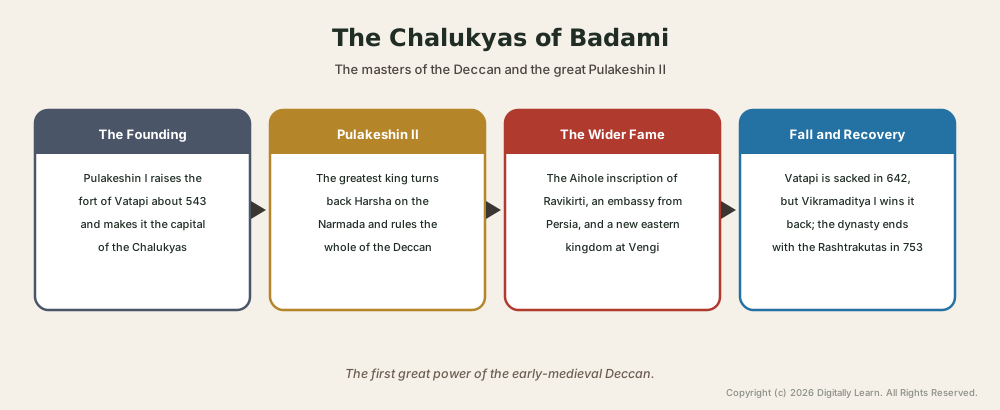
The Chalukyas of Badami were the first great power of the early-medieval Deccan. Founded by Pulakeshin I about 543 and ruling from Vatapi, the modern Badami, they rose to their height under the great Pulakeshin II, who turned back the emperor Harsha on the river Narmada and left a famous record of his deeds in the Aihole inscription. Though his capital was sacked by the Pallavas in 642, the dynasty recovered and ruled the Deccan until the Rashtrakutas overthrew it in 753. This part covers the founding, the great Pulakeshin II, the check of Harsha, the fall and recovery, and the exam focus.
The Rise of the Chalukyas of Badami
Pulakeshin I and the Founding at Vatapi
What is the significance of the Chalukyas: they were the first great power of the early-medieval Deccan, and from their rock-fort of Vatapi they ruled the plateau and contended for the mastery of the south.
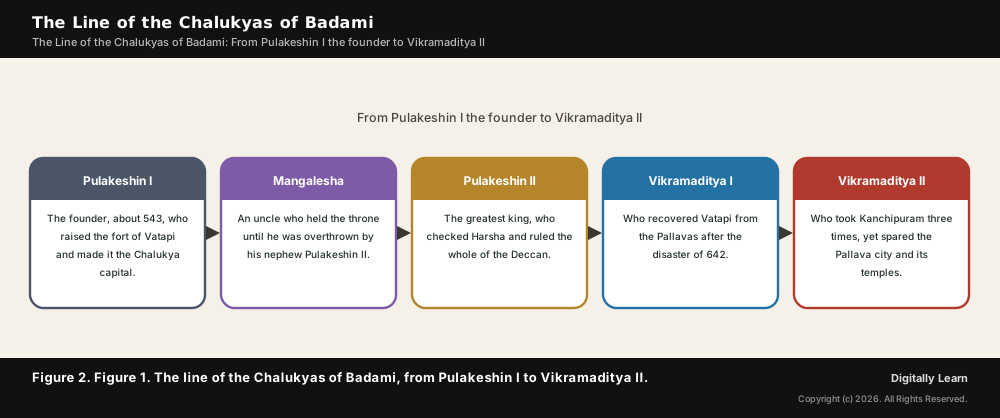
The Chalukyas of Badami rose in the sixth century in the western Deccan. Their founder, Pulakeshin I, about 543, raised a strong fort on the hill of Vatapi, the modern Badami in Karnataka, and made it the seat of his power; from this rock the dynasty took its strength.
His successors, Kirttivarman I and then his brother Mangalesha, extended the Chalukya power over the Deccan. But the dynasty found its greatest king when Mangalesha was overthrown by his own nephew, the famous Pulakeshin II.
The Chalukya Realm and the Eastern Branch of Vengi
Distinguishing the realm: the Chalukyas ruled the heart of the Deccan from Vatapi, and from this centre Pulakeshin II reached north, east and south against his neighbours.
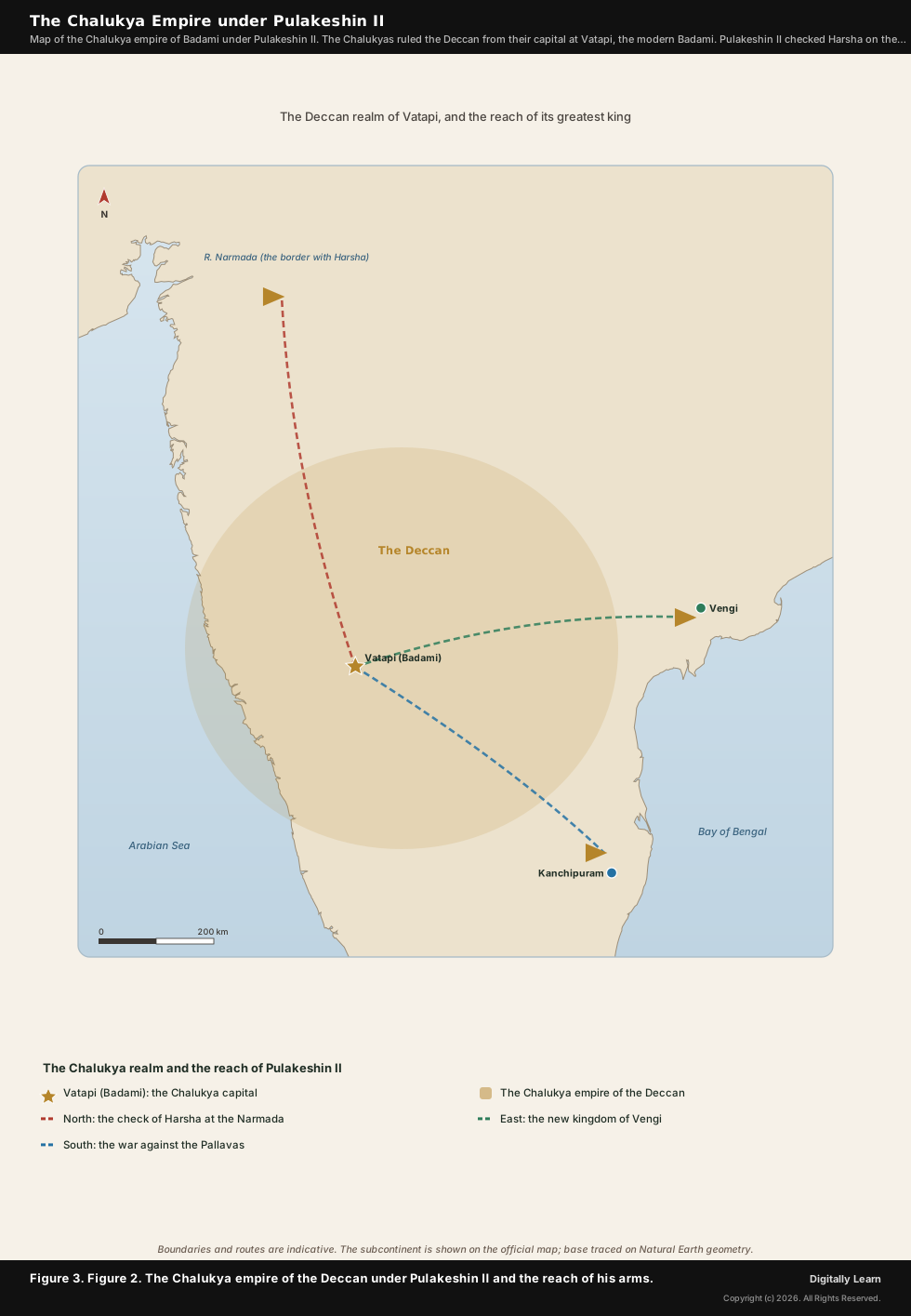
The realm lay across the western and central Deccan, a land of the Kannada tongue. Its frontier with the north ran along the Narmada, where Pulakeshin II checked Harsha; to the east, on the Andhra coast, he set his own brother over a new kingdom; and to the south he carried the war against the Pallavas.
That eastern kingdom became the line of the Eastern Chalukyas of Vengi, founded by Pulakeshin's brother Kubja Vishnuvardhana about 624; it would long outlast the main line at Vatapi. The map sets out the realm and the three directions of Pulakeshin's reach.
Pulakeshin II, the Greatest of the Chalukyas
The Conqueror of the Deccan
What is the significance of Pulakeshin II: he raised the Chalukyas to the first rank of Indian powers, master of the whole Deccan and the equal of the emperor of the north.
Pulakeshin II, who ruled from 609 to 642, won the throne by overthrowing his uncle and then set out to conquer. He subdued the Kadambas of Banavasi and the Gangas, beat the Mauryas of the Konkan, and humbled the Latas, Malavas and Gurjaras of the north-west, until the whole Deccan owned his power.
In the south he warred against the Pallavas, and in one campaign he drove the Pallava king Mahendravarman I behind the very walls of Kanchipuram. The table below sets out the chief wars of his reign and their direction.
| Direction | Opponent | Outcome |
|---|---|---|
| North | Harsha, emperor of the north. | Checked on the Narmada; the river became the border. |
| West | The Kadambas, Mauryas of Konkan. | Subdued; the western Deccan and coast won. |
| East | The Vishnukundins of the Andhra coast. | Conquered; the kingdom of Vengi set up under his brother. |
| South | The Pallavas of Kanchipuram. | Driven behind the walls of Kanchi, but later avenged. |
The Aihole Inscription, Harsha and the Persian Embassy
Distinguishing his wider fame: the greatness of Pulakeshin II is known from a famous inscription, from his check of Harsha, and from an embassy that reached him from Persia.
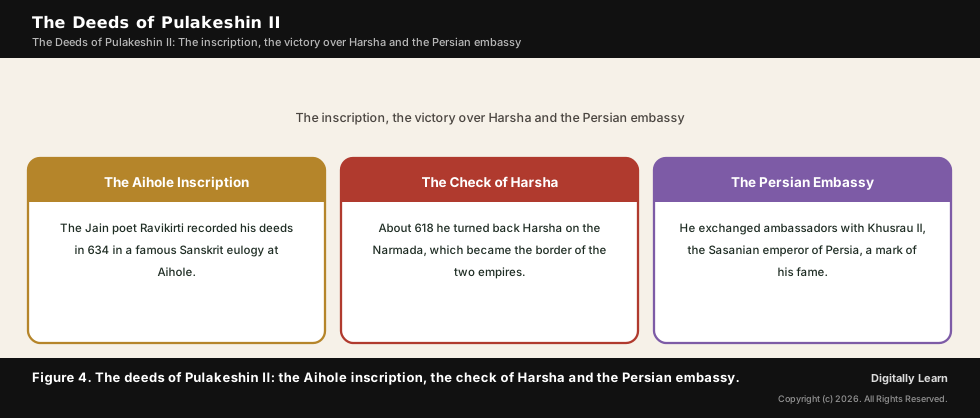
The Aihole inscription, a Sanskrit eulogy composed by the Jain poet Ravikirti in 634, records his deeds in fine verse and is one of the great inscriptions of India. Its most famous boast is the check of Harsha: about 618 Pulakeshin II turned back the emperor of the north on the river Narmada, which became the border of the two empires.
His fame reached far. He exchanged ambassadors with Khusrau II, the Sasanian emperor of Persia, a sign of the standing of the Chalukya court among the powers of the age. A famous painting at Ajanta was once thought to show this embassy, though scholars now read the scene otherwise.
The Fall and the Recovery of the Chalukyas
The Sack of Vatapi and the Chalukya Revival
What is the significance of the fall: the great Pulakeshin II met his match in the Pallavas, and the sack of his capital was the darkest hour of the dynasty, from which it nonetheless recovered.
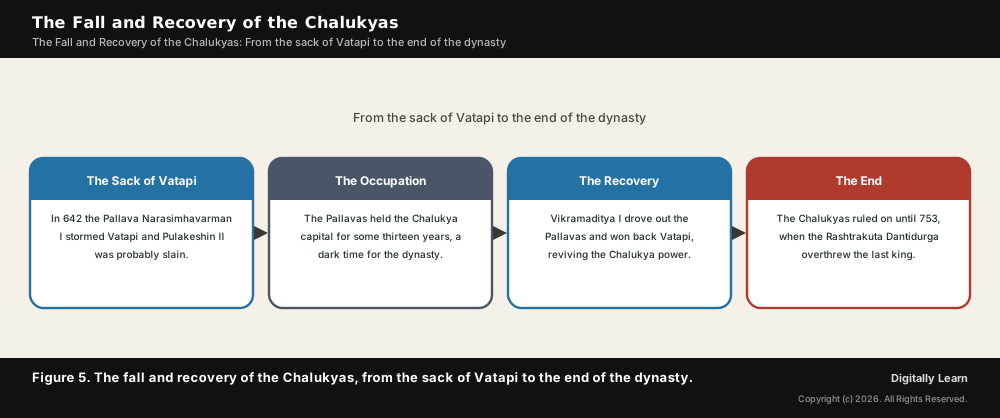
The reckoning came from the south. In 642 the Pallava king Narasimhavarman I marched on the Chalukya capital, stormed Vatapi, and in the fighting Pulakeshin II was probably slain; the Pallava took the proud title of Vatapikonda, the conqueror of Vatapi, and held the city for some thirteen years.
Yet the dynasty rose again. Vikramaditya I drove out the Pallavas and won back Vatapi, and his successors carried the war into the Pallava country; Vikramaditya II took Kanchipuram itself three times, yet spared the city and its temples. The Chalukyas of Badami ruled the Deccan until 753, when the Rashtrakuta Dantidurga overthrew the last of them.
UPSC Relevance and Exam Focus
Where the Chalukyas of Badami Fit in the UPSC-CSE Syllabus
This topic belongs to General Studies Paper I: ancient and early-medieval Indian history, and the Chalukyas of Badami, above all Pulakeshin II, are a regular ground for questions.
The questions most often test the great king and his deeds: Pulakeshin II, the check of Harsha at the Narmada, the Aihole inscription of Ravikirti, and the capital at Vatapi (Badami).
Several linked points recur and are worth holding in working memory:
- Vatapi (Badami): The capital of the Chalukyas, in the Deccan.
- Pulakeshin II: The greatest king, who checked Harsha at the Narmada.
- The Aihole inscription: Ravikirti’s eulogy of Pulakeshin II, of 634.
- The Eastern Chalukyas: The Vengi branch, founded by Kubja Vishnuvardhana.
- Narasimhavarman I: The Pallava who sacked Vatapi in 642.
A 1997 question matched dynasties to their seats, among them the Chalukyas with Badami, which is correct; the others were the Guptas with Deogarh, the Chandellas with Khajuraho and the Pallavas with Panamalai.
A common trap reverses the two great battles of Pulakeshin II; he defeated Harsha at the Narmada, but was himself defeated by the Pallava Narasimhavarman I, who sacked his capital. Another forgets that the Eastern Chalukyas of Vengi were a separate branch under his brother.
Previous Year UPSC-CSE Questions By the end you will be able to draft model answers for the following UPSC questions. Each question carries a collapsible framework showing how to approach it in the exam.
- UPSC Prelims 1997 GS-IMatch List I (dynasty) with List II (site): I. Gupta, II. Chandella, III. Chalukya, IV. Pallava; with the sites A) Badami, B) Panamalai, C) Khajuraho, D) Deogarh.
- Gupta
- Chandella
- Chalukya
- Pallava
Select the correct answer using the code given below the lists.
How to approach this Prelims question
Approach: Anchor on the certain pair, Chalukya-Badami (III-A); then fit Gupta-Deogarh (I-D), Chandella-Khajuraho (II-C) and Pallava-Panamalai (IV-B).
Trap to watch: Do not pair the Chalukyas with Khajuraho (that is the Chandellas) or with Deogarh (that is the Guptas); the Chalukya seat is Badami.
Key facts to recall:
- The Chalukyas of Badami ruled from Badami (Vatapi).
- The Guptas built the Dashavatara temple at Deogarh; the Chandellas Khajuraho.
- The Pallavas built the temple at Panamalai.
Answer signal: I-D, II-C, III-A, IV-B.
Prelims MCQ practice
Each question below tests one specific concept on the topic. Click to reveal the answer and a full option-wise explanation.
Q1. The founder of the Chalukyas of Badami, who raised the fort of Vatapi about 543, was which one of the following?
- Pulakeshin I
- Pulakeshin II
- Mangalesha
- Vikramaditya I
Show answer and explanation
Answer: Pulakeshin I
Explanation.
Option (a) is correct. Pulakeshin I founded the Chalukyas of Badami about 543 and raised the fort of Vatapi as his capital. Hence option (a).
Q2. With reference to Pulakeshin II, consider the following statements:
- He checked the emperor Harsha on the river Narmada about 618.
- His deeds were recorded in the Aihole inscription by the Jain poet Ravikirti.
Which of the statements given above is/are correct?
- 1 only
- 2 only
- Both 1 and 2
- Neither 1 nor 2
Show answer and explanation
Answer: Both 1 and 2
Explanation.
Both statements are correct. Pulakeshin II checked Harsha on the Narmada about 618, and his deeds were recorded by Ravikirti in the Aihole inscription of 634. Hence option (c).
Q3. The Aihole inscription, which praises Pulakeshin II, was composed by which one of the following?
- Banabhatta
- Ravikirti
- Harisena
- Nagarjuna
Show answer and explanation
Answer: Ravikirti
Explanation.
Option (b) is correct. The Aihole inscription was composed by the Jain poet Ravikirti in 634 in praise of Pulakeshin II; Harisena composed the Gupta-age Allahabad prashasti. Hence option (b).
Q4. The Pallava king who sacked the Chalukya capital Vatapi in 642 and took the title Vatapikonda was which one of the following?
- Mahendravarman I
- Narasimhavarman I
- Narasimhavarman II
- Nandivarman II
Show answer and explanation
Answer: Narasimhavarman I
Explanation.
Option (b) is correct. Narasimhavarman I sacked Vatapi in 642 and took the title Vatapikonda, the conqueror of Vatapi. Hence option (b).
Q5. The Eastern Chalukyas of Vengi were founded by which one of the following, a brother of Pulakeshin II?
- Mangalesha
- Kubja Vishnuvardhana
- Vikramaditya I
- Kirttivarman I
Show answer and explanation
Answer: Kubja Vishnuvardhana
Explanation.
Option (b) is correct. The Eastern Chalukyas of Vengi were founded by Kubja Vishnuvardhana, the brother of Pulakeshin II, about 624. Hence option (b).
Q6. With reference to the two great battles of Pulakeshin II, consider the following statements:
- He defeated the emperor Harsha at the Narmada.
- He was himself defeated by the Pallava Narasimhavarman I, who sacked Vatapi.
Which of the statements given above is/are correct?
- 1 only
- 2 only
- Both 1 and 2
- Neither 1 nor 2
Show answer and explanation
Answer: Both 1 and 2
Explanation.
Both statements are correct. Pulakeshin II defeated Harsha at the Narmada but was himself defeated by the Pallava Narasimhavarman I, who sacked Vatapi in 642; the two directions must not be swapped. Hence option (c).
Sources and Further Reading
Editorial Disclaimer
This article is for UPSC preparation. The dates of the Chalukya kings are approximate, and the account follows the standard scholarship on the early-medieval Deccan.


