

Overview
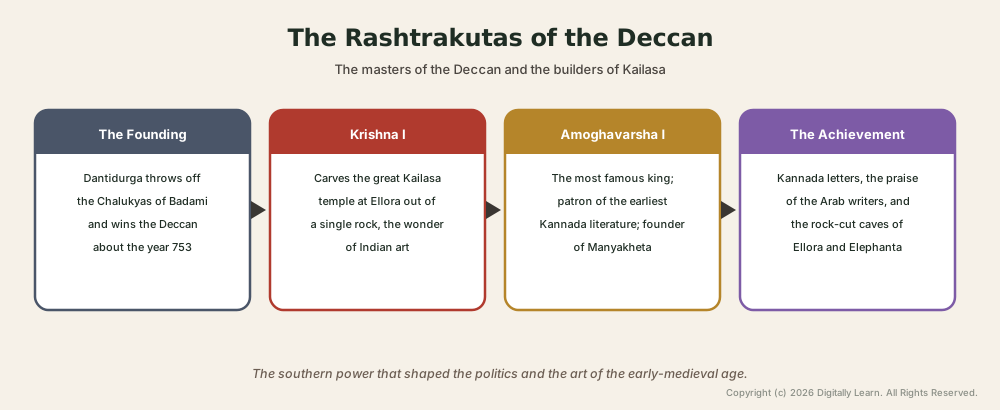
The Rashtrakutas were the great power of the Deccan in the tripartite age, ruling from their capital at Manyakheta and crossing the Narmada again and again to fight in the north. Their founder Dantidurga threw off the Chalukyas of Badami about 753; their king Krishna I carved the matchless Kailasa temple at Ellora out of a single rock; and their most famous ruler, Amoghavarsha I, gave the Kannada language its earliest literature. Arab writers counted them among the four great kings of the world. This part covers the founding, the great kings, the Kailasa temple, the Rashtrakuta achievement and the exam focus.
The Rise of the Rashtrakutas
Dantidurga and the Founding of the Empire
What is the significance of the Rashtrakutas: they were the great power of the Deccan in the tripartite age, the equals in arms of the Pratiharas and the Palas, and the masters of a brilliant art.
The Rashtrakutas had been feudatories of the Chalukyas of Badami, the old rulers of the Deccan. Their founder, Dantidurga, threw off that overlordship: his Samangadh copper-plate records that about 753 he defeated the Karnatic army of Kirtivarman II of Badami and made himself master of the Deccan.
From this beginning the Rashtrakutas grew into one of the great empires of India. Their kings ruled the plateau from the Narmada to the far south, and from this central seat they reached out, north into the contest for Kannauj and south against the Cholas and the Pallavas.
The Rashtrakuta Realm and the Deccan
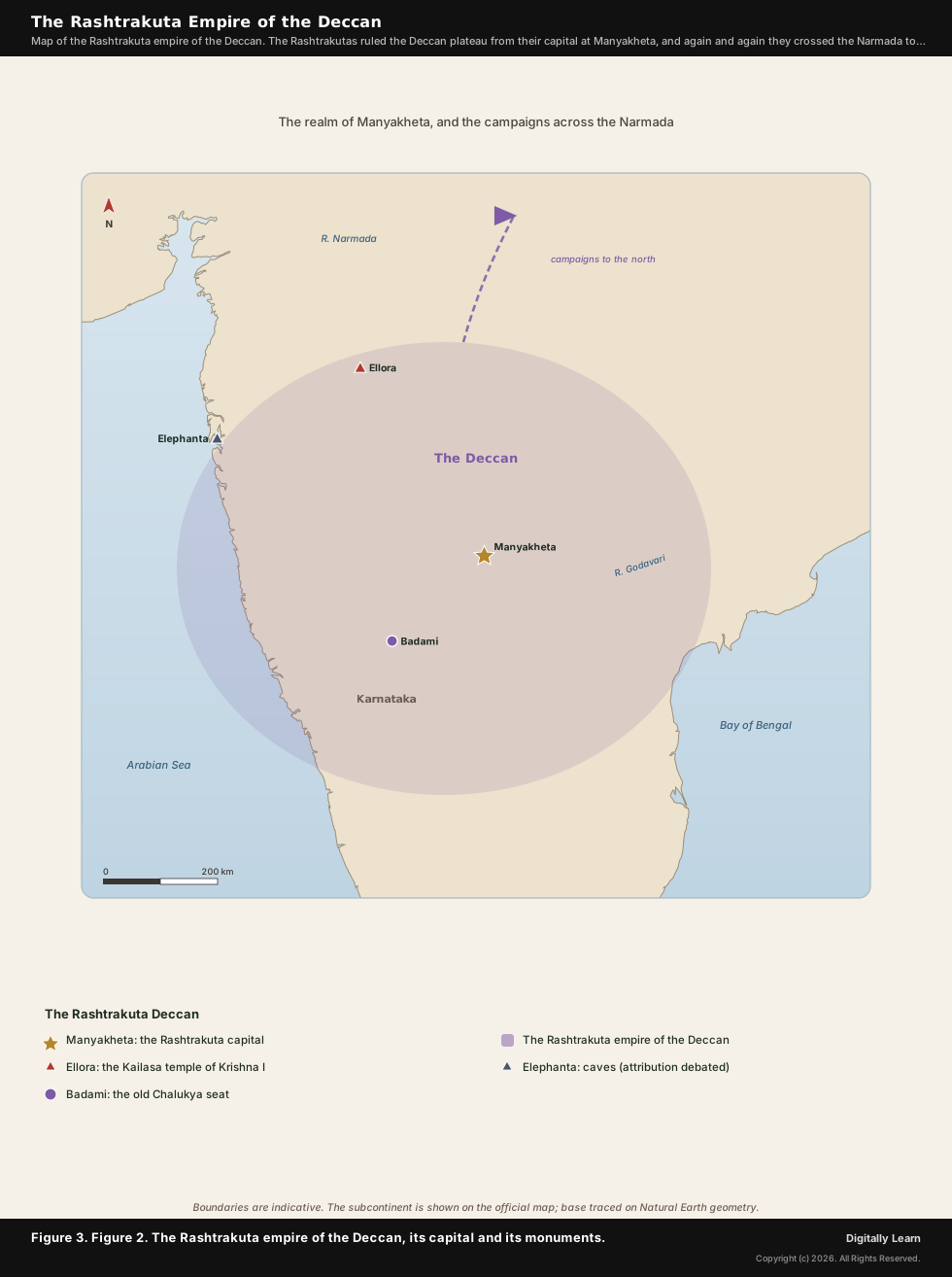
Distinguishing the Rashtrakuta country: the heart of the empire lay in the Deccan plateau, ruled from Manyakheta, and from there its armies marched across the Narmada into the north.
The Rashtrakuta realm was the Deccan, the high plateau between the Narmada and the Tungabhadra, with its capital at Manyakheta, the modern Malkhed. It was a southern power, and this shaped its part in the tripartite struggle: again and again its kings won battles in the north and then withdrew across the Narmada to their own country.
The map sets out the Deccan realm, the capital, the rock-cut temples at Ellora and Elephanta, the old Chalukya seat at Badami, and the road of the northern campaigns. From this base the Rashtrakutas were a power felt across the whole of India.
The Great Rashtrakuta Kings
Krishna I and the Kailasa Temple
What is the significance of Krishna I: he gave the world one of the wonders of Indian art, the Kailasa temple at Ellora, carved whole out of the living rock.
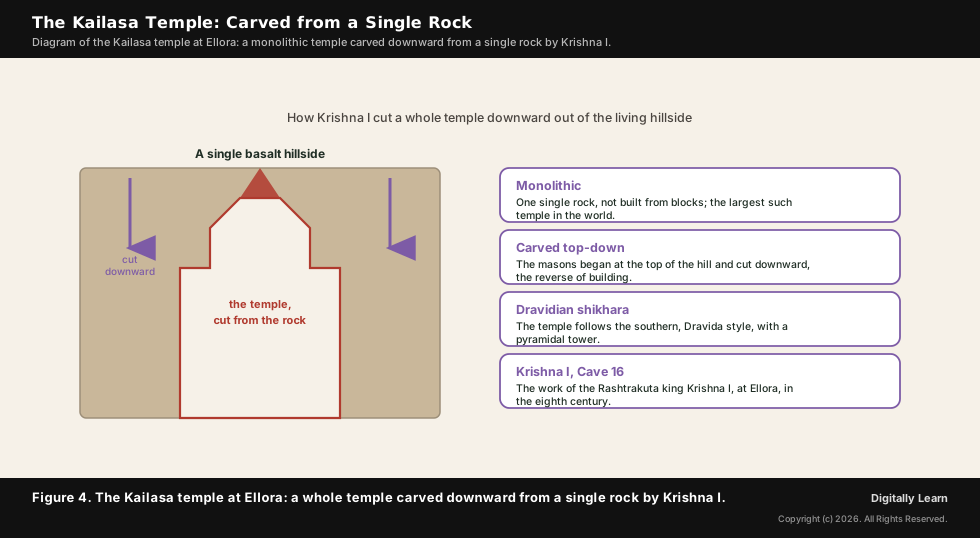
Krishna I, who ruled in the later eighth century, built the Kailasa temple, the sixteenth of the caves at Ellora. It is not built of stones laid one upon another but is monolithic, cut from a single mass of the basalt hillside. The masons began at the top and worked downward, the reverse of ordinary building, until a whole temple stood free of the rock around it.
The temple follows the Dravidian style of the south, with a pyramidal tower, and is covered in sculpture of gods and battles. It is the largest monolithic structure of its kind in the world, and the supreme achievement of the rock-cut art of the Deccan, the work of a Rashtrakuta king, not of the Cholas or Pallavas whose style it shares.
Govinda III and Amoghavarsha I
Distinguishing the two greatest kings: Govinda III was the great warrior of the line, and his son Amoghavarsha I the great patron of letters and the most famous of all.
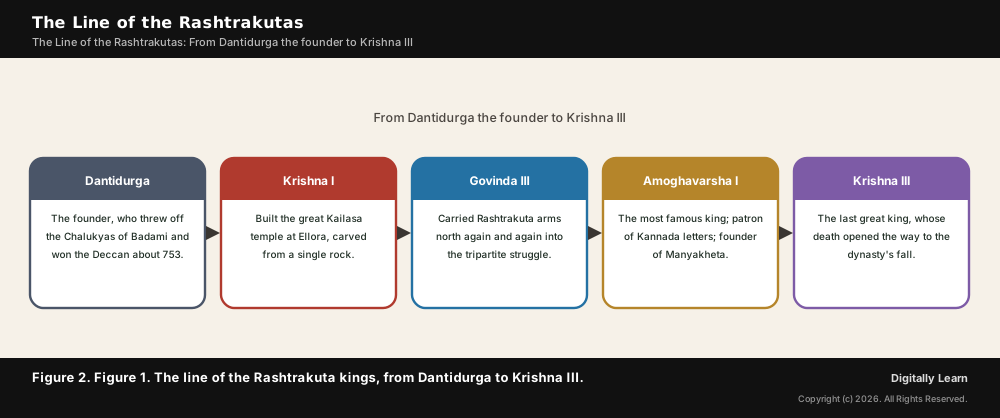
Govinda III carried Rashtrakuta arms to their widest reach: he marched into the north, defeated the Pratihara Nagabhata II, and his inscriptions boast of victories from the Himalaya to the far south. He was the warrior who made the Rashtrakutas the first power of the age.
Amoghavarsha I, his son, ruled long and is the most famous of the Rashtrakutas. He made Manyakheta his capital, and he gave Kannada its earliest surviving work, the Kavirajamarga, a treatise on poetry. A patron of the Jain faith and of learning, he is sometimes called the Ashoka of the South.
| Ruler | Note |
|---|---|
| Dantidurga | The founder; overthrew the Chalukyas of Badami about 753. |
| Krishna I | Carved the Kailasa temple at Ellora from a single rock. |
| Govinda III | The great warrior; defeated the Pratiharas in the north. |
| Amoghavarsha I | The most famous; the Kavirajamarga; founded Manyakheta. |
| Krishna III | The last great king; the empire fell soon after him. |
The Rashtrakuta Achievement
Kannada Letters, the Arab Witness and the Caves
What is the significance of the Rashtrakuta achievement: the dynasty's fame rests not only on arms but on its gifts to language, its standing in the wider world, and its rock-cut art.
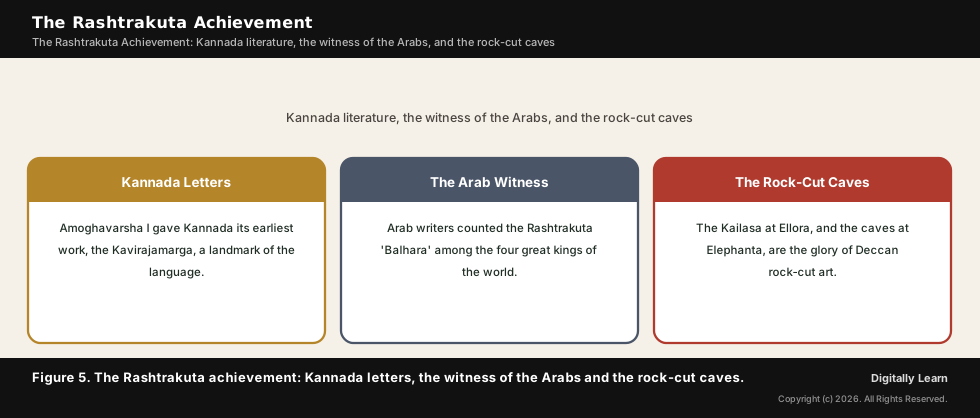
In letters, the Rashtrakutas were the makers of Kannada literature: the Kavirajamarga of Amoghavarsha's age is the earliest surviving work in the language, and the court drew the first great Kannada poets. In the wider world, the Arab writers, in the Silsilat al-Tawarikh and the work of Al-Masudi, counted the Rashtrakuta king, whom they called the Balhara, among the four great kings of the world.
In art, besides the Kailasa, the caves at Elephanta, near Mumbai, with their great image of the three-faced Shiva, belong to this age, though scholars debate whether they are the work of the Rashtrakutas or of the earlier Kalachuris. Together these monuments make the Deccan of the Rashtrakutas one of the high places of Indian rock-cut art.
The Decline and the Fall of Manyakheta
Distinguishing the end: the Rashtrakuta power, so long the first of the Deccan, fell at last to the very Chalukya line it had once displaced.
After Krishna III, the last of the great kings, the Rashtrakuta power weakened. About 973 the Western Chalukyas of Kalyani, under Tailapa II, overthrew the last Rashtrakuta king and seized Manyakheta, ending the dynasty that had ruled the Deccan for more than two centuries.
Yet their legacy endured. The Kailasa temple, the Kannada letters and the memory of an empire that bestrode the whole of India outlasted the dynasty, and the Rashtrakutas remained one of the brightest names in the history of the Deccan.
UPSC Relevance and Exam Focus
Where the Rashtrakutas Fit in the UPSC-CSE Syllabus
This topic belongs to General Studies Paper I: early-medieval Indian history and Indian art and culture, and the Rashtrakutas are important for both, above all for the Kailasa temple.
The questions most often test the founder and the monuments: Dantidurga the founder, the Kailasa temple of Krishna I at Ellora, and Amoghavarsha I with the Kavirajamarga and the capital Manyakheta.
Several linked points recur and are worth holding in working memory:
- Dantidurga: The founder, who overthrew the Chalukyas of Badami.
- Krishna I: Built the monolithic Kailasa temple at Ellora.
- Amoghavarsha I: The Kavirajamarga and the capital Manyakheta.
- The Balhara: The Rashtrakuta king in the Arab accounts.
- Elephanta: The caves of debated Rashtrakuta or Kalachuri origin.
A 2006 question asked who laid the foundation of the Rashtrakuta empire; the answer is Dantidurga, not Krishna I, Dhruva or Amoghavarsha I, who were his successors.
A common trap credits the Kailasa temple to the Cholas or Pallavas because it is in the Dravidian style; it is in truth the work of the Rashtrakuta Krishna I. Another assumes the Elephanta caves are certainly Rashtrakuta; their authorship is in fact debated between the Rashtrakutas and the Kalachuris.
Previous Year UPSC-CSE Questions By the end you will be able to draft model answers for the following UPSC questions. Each question carries a collapsible framework showing how to approach it in the exam.
- UPSC Prelims 2006 GS-IWho among the following laid the foundation of Rashtrakuta Empire?
How to approach this Prelims question
Approach: Recall that the Rashtrakuta empire was founded by Dantidurga, who threw off the Chalukyas of Badami about 753; the others named are later kings.
Trap to watch: Krishna I (Kailasa) and Amoghavarsha I (Kavirajamarga) are more famous, but neither founded the dynasty; the founder is Dantidurga.
Key facts to recall:
- Dantidurga founded the Rashtrakuta empire about 753 by defeating Kirtivarman II of Badami.
- Krishna I, Dhruva and Amoghavarsha I were his successors.
- The capital was later fixed at Manyakheta.
Answer signal: Dantidurga.
Prelims MCQ practice
Each question below tests one specific concept on the topic. Click to reveal the answer and a full option-wise explanation.
Q1. The Kailasa temple at Ellora, carved from a single rock, was built by which one of the following rulers?
- Dantidurga
- Krishna I
- Amoghavarsha I
- Govinda III
Show answer and explanation
Answer: Krishna I
Explanation.
Option (b) is correct. The monolithic Kailasa temple (Cave 16) at Ellora was built by the Rashtrakuta king Krishna I. Hence option (b).
Q2. The Kavirajamarga, the earliest surviving literary work in the Kannada language, is associated with which one of the following kings?
- Dantidurga
- Govinda III
- Amoghavarsha I
- Krishna III
Show answer and explanation
Answer: Amoghavarsha I
Explanation.
Option (c) is correct. The Kavirajamarga, the earliest extant Kannada work, belongs to the reign of Amoghavarsha I. Hence option (c).
Q3. With reference to the Kailasa temple at Ellora, consider the following statements:
- It is a monolithic temple, carved downward from a single rock.
- It was built by the Chola kings of the far south.
Which of the statements given above is/are correct?
- 1 only
- 2 only
- Both 1 and 2
- Neither 1 nor 2
Show answer and explanation
Answer: 1 only
Explanation.
Statement 1 is correct: the Kailasa is monolithic, carved top-down from a single rock. Statement 2 is wrong: it was built by the Rashtrakuta Krishna I, not the Cholas, though it is in the Dravidian style. Hence option (a).
Q4. The Rashtrakuta capital, from which the dynasty ruled the Deccan, was which one of the following?
- Badami
- Manyakheta
- Kanchipuram
- Dwarasamudra
Show answer and explanation
Answer: Manyakheta
Explanation.
Option (b) is correct. The Rashtrakutas ruled from Manyakheta (Malkhed); Badami was the seat of the earlier Chalukyas. Hence option (b).
Q5. With reference to the Rashtrakutas, consider the following statements:
- Arab writers counted the Rashtrakuta king, whom they called the Balhara, among the great kings of the world.
- The authorship of the Elephanta caves is debated between the Rashtrakutas and the Kalachuris.
Which of the statements given above is/are correct?
- 1 only
- 2 only
- Both 1 and 2
- Neither 1 nor 2
Show answer and explanation
Answer: Both 1 and 2
Explanation.
Both statements are correct. Arab writers ranked the Rashtrakuta Balhara among the great kings, and the Elephanta caves are of debated Rashtrakuta or Kalachuri origin. Hence option (c).
Q6. The Rashtrakuta dynasty was finally overthrown about 973 by which one of the following?
- The Cholas under Rajaraja I
- The Western Chalukyas of Kalyani under Tailapa II
- The Gurjara-Pratiharas
- The Hoysalas
Show answer and explanation
Answer: The Western Chalukyas of Kalyani under Tailapa II
Explanation.
Option (b) is correct. The Western Chalukyas of Kalyani, under Tailapa II, overthrew the Rashtrakutas about 973 and seized Manyakheta. Hence option (b).
Sources and Further Reading
Editorial Disclaimer
This article is for UPSC preparation. The dates of the Rashtrakuta kings are approximate, and the account follows the standard scholarship on the early-medieval Deccan.


