


Overview
The Kalinga War was Ashoka's conquest of Kalinga, the coastal land of present-day Odisha, in the eighth year of his reign, about 261 BCE. Ashoka himself recorded its cost in Rock Edict XIII: 1,50,000 people deported, 1,00,000 killed and many more dead. Remorse over the war turned him to Buddhism and to Dhamma, a code of moral conduct he preached to all his subjects through edicts, special officers and missions abroad, in place of conquest by war.
Kalinga War: Ashoka's Conquest of Kalinga
Ashoka's Reign and the Mauryan Empire Before Kalinga
Ashoka was the grandson of Chandragupta Maurya and the son of Bindusara, and the story of how he won the throne is told in Bindusara and the accession of Ashoka. He reigned from 268 to 232 BCE. At the start of his reign he was ambitious. He inherited a vast empire and pushed it over almost the whole subcontinent except the far south, including present-day Bangladesh and Pakistan and parts of Afghanistan.
In his inscriptions Ashoka rarely uses his own name. He calls himself Devanampiya Piyadasi, 'Beloved of the Gods' and 'one who regards others with kindness'. The language of the edicts shows a king who wanted to be seen as a benevolent and compassionate ruler, and almost everything we know of the Kalinga War and of Dhamma comes from these inscriptions, which are described in the edicts of Ashoka. They became readable again only in the 1830s, when James Prinsep, an officer in the East India Company's mint, deciphered the Brahmi and Kharosthi scripts.
Kalinga was the one great conquest of his reign. It was also the last, and that is why it matters.
Causes of the Kalinga War: Routes, Coast and Trade
Kalinga lay on the east coast, in present-day Odisha and the northern parts of Andhra Pradesh. It was an independent kingdom with a strong army of infantry, cavalry and elephants. The Nandas had ruled the region from Magadha until their fall in 321 BCE, and Chandragupta may have tried to conquer it and been driven back, so Kalinga had stayed outside the Mauryan Empire.
Ashoka set out to annex it as soon as his own position was secure. The reasons were strategic as well as a matter of pride:
- Routes: Kalinga could cut the communications between the capital, Pataliputra, and the Mauryan possessions in the central and southern peninsula, so it controlled the land route to the south.
- Coast and trade: It held the coastline of the Bay of Bengal and its sea trade, the sea route to the south and beyond.
- An unconquered neighbour: A strong independent kingdom on the flank of the empire, which an earlier Maurya had failed to take.
Battle of Kalinga at Dhauli: Kalinga War Year and Human Cost
The Kalinga War ended in the eighth year of Ashoka's reign, by his own count in the edicts, which is probably 261 BCE. The decisive battle is believed to have been fought on the Dhauli hills, on the banks of the Daya river, about 8 km south of Bhubaneswar. It was one of the largest and deadliest battles in Indian history, and the only major war Ashoka fought after coming to the throne.
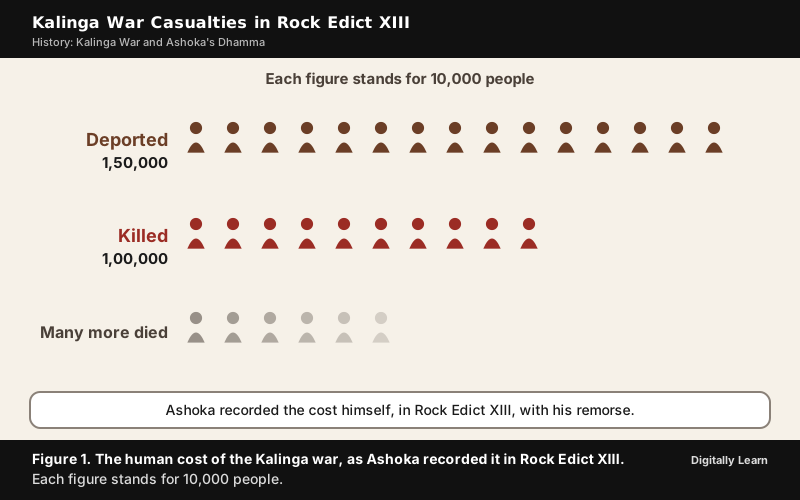
Its cost is known because Ashoka recorded it himself. In Rock Edict XIII he says that when he had been ruling for eight years the country of the Kalingas was conquered; one hundred and fifty thousand people were deported, a hundred thousand were killed, and many more died. He goes on to call the slaughter, death and deportation that conquest brings 'very painful and deplorable', and says that he has since turned to an intense study of Dhamma.
Dhauli still carries the memory of the war. On the rock that bears Ashoka's edicts, the head and forelegs of an elephant are carved emerging from the stone, said to mark the place of his change of heart and to be the oldest rock-cut sculpture in India. On the hill above the Daya, a white Shanti Stupa, the Peace Pagoda built in the 1970s, commemorates his turn to non-violence.
No other ruler of early India set down the suffering of his own victory in this way. A king who could have kept silent, and kept his image as a peaceful ruler, chose to admit to a destructive war on stone.
Results of the Kalinga War and the Separate Kalinga Edicts
Kalinga became a province of the empire, with its officials at Tosali, and the Mauryan Empire now held almost the whole subcontinent. The deeper result was in Ashoka himself. Seeing the death and destruction of the war, he chose to give up violence and, as far as possible, to follow the path of peace and non-violence that the Buddha taught.
- End of conquest by war: Kalinga marked the close of the empire-building and military campaigns of the Maurya dynasty; Ashoka fought no other major war.
- A new aim: He set out to win people by Dhamma rather than by arms, which he called the conquest by Dhamma.
- A new kind of record: He began to address his subjects directly through inscriptions on rocks and pillars.
In Kalinga itself the message was different. At Dhauli and Jaugada, in the newly conquered territory, Major Rock Edicts XI to XIII were left out of the usual set of fourteen, and two Separate Edicts were put in their place. The first is addressed to the local officials, from Tosali at Dhauli and Somapa at Jaugada, and asks them to be just and fair to the people. The second asks them to assure the unconquered tribes on the borders that the king means them well.
Ashoka's Dhamma: Meaning, Principles and Practice
Ashoka's Gradual Conversion to Buddhism
Ashoka's turn to Buddhism was gradual, not a single moment on the battlefield. In a Minor Rock Edict he says that he had been an upasaka, a lay Buddhist, for more than two and a half years without making much progress, and that in the past year he had drawn closer to the sangha, the community of monks, and become a more ardent follower.
The Minor Rock Edicts are his earliest inscriptions, from the eleventh year of his reign at the earliest, and they count from that conversion, at least two and a half years after the Kalinga conquest of the eighth year. In his twenty-first regnal year he visited Lumbini, the Buddha's birthplace, as the pillar inscription at Rummindei records.
Becoming a Buddhist did not make Ashoka a narrow patron of one faith. He continued to give to Brahmanas and to ascetics of every sect, and the Dhamma he preached to his subjects was not the Buddhist doctrine itself.
Dhamma of Ashoka: Meaning and Principles
Dhamma is the Prakrit form of the Sanskrit dharma. In simple terms dharma means moral law, or one's religious and ethical duties towards family, community and country. Ashoka used the word for a set of simple principles of conduct that people of every faith could accept, and he proclaimed them in his inscriptions on natural rocks and polished pillars.
- Respect: Respect towards elders.
- Generosity: Gifts to Brahmanas and to those who had renounced worldly life.
- Kindness: Fair treatment of slaves and servants.
- Tolerance: Respect for religions and traditions other than one's own.
- Non-violence: No killing of animals for sacrifice or feasts; in Rock Edict I he reduced the royal kitchen to two peacocks and one deer a day and wished to end even that.
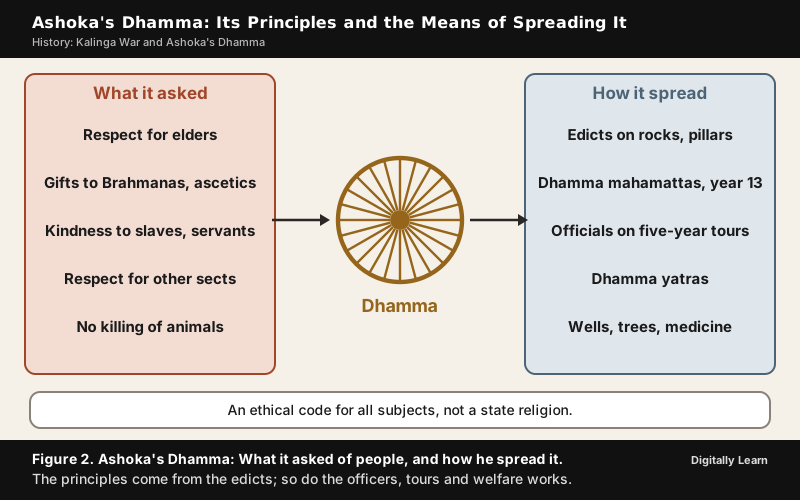
Ashoka believed that following these principles would ensure the well-being of people in this world and the next. The aim was social, to hold a vast and varied empire together by a shared ethic of restraint, respect and care, rather than by force or by one religion. That is why Dhamma is best understood as a moral code for society, not a state religion.
Religious Tolerance in Ashoka's Rock Edict XII
Ashoka returns to tolerance between sects more than once. In Rock Edict VII he wished that all sects might live everywhere, 'for all seek self-control and purity of mind'. Rock Edict XII goes further and explains why intolerance defeats itself.
Whoever praises his own sect or blames other sects out of devotion to his own, Ashoka says, with the aim of glorifying it, in fact injures his own sect very severely. Concord is meritorious, and the followers of each sect should listen to the teachings of others. He valued above all gifts and honours the growth of the essentials of all sects, so that all would be both learned and pure in doctrine.
The edict reached far beyond the Prakrit-speaking heartland. Its last part was also written in Greek in the Kandahar Greek Edict, for the Greek-speaking subjects of the north-west, which shows how seriously Ashoka meant the message for every part of the empire.
Dhamma Mahamattas, Dhamma Yatras and Welfare Works
Ashoka did not leave Dhamma to persuasion alone; he gave it an administration. Rock Edict V records that officers of a new kind, the dhamma mahamattas, were appointed when he had been anointed thirteen years. They worked among all sects, among servants and masters, Brahmanas, the destitute and the aged, and even among the Greeks, Kambojas and Gandharas of the western borders.
- Officials on tour: Rock Edict III orders the yuktas, the rajukas and the pradesikas to tour every part of the kingdom every five years to spread Dhamma.
- The sound of Dhamma: Rock Edict IV sets the dhammaghosa, the call of Dhamma, in place of the bherighosa, the drum of war.
- Dhamma yatras: Rock Edict VIII describes his first dhamma yatra, a pilgrimage to Sambodhi, that is Bodh Gaya, the place of the Buddha's enlightenment.
- Against empty ritual: Rock Edict IX condemns popular ceremonies and stresses the ceremony of Dhamma instead.
- Officials' duty: In the Separate Edicts at Dhauli and Jaugada he tells his officers that all men are his children and that they must be impartial.
Welfare works were part of the same policy. Rock Edict II says that he provided medical care for people and for animals, inside the empire and in the lands of his neighbours, and the edicts claim rest houses and wells at regular intervals along the main roads, with fruit and shade trees planted beside them. Hunting and cruelty to animals were prohibited. Not every claim need be taken literally, but the edicts show a king who saw the welfare of his subjects as his duty.
Dhamma Vijaya: Southern Kingdoms in Rock Edicts II and XIII
After Kalinga Ashoka spoke of a new kind of victory, dhamma vijaya, conquest by Dhamma, which he called the highest victory. Rock Edict XIII claims that this conquest had been won on his own borders and as far as six hundred yojanas away, among the Greek kings of the west and the kingdoms of the far south.
| Edict | Neighbours named | What it says |
|---|---|---|
| Rock Edict II | Cholas, Pandyas, Satiyaputra, Keralaputra, Tamraparni; the Greek king Antiochus and his neighbours | Medical care for people and animals established in their lands |
| Rock Edict XIII | Antiochus, Ptolemy, Antigonus, Magas and Alexander; Cholas and Pandyas as far as Tamraparni | Conquest by Dhamma won there, on the borders and up to six hundred yojanas away |
These two edicts name the kingdoms of the far south, which stayed outside the empire. The Greek names also date Ashoka: Antiochus II, Ptolemy II, Antigonus Gonatas, Magas of Cyrene and an Alexander were kings whose dates are known, which places him in the third century BCE.
Rock Edict XIII is not only gentle. It also warns the forest tribes that the king has power as well as remorse, and that they should repent or face punishment. Conquest by Dhamma did not mean the empire had given up force.
Spread of Buddhism Under Ashoka: Council and Missions
Third Buddhist Council at Pataliputra Under Moggaliputta Tissa
Ashoka's patronage drew many to the Buddhist order, and not all of them for good reasons. According to the Theravada commentaries and chronicles of Sri Lanka, he convened the Third Buddhist Council at Pataliputra under the elder Moggaliputta Tissa, to purify the order of opportunistic factions and of non-Buddhists who had joined only for the royal patronage.
The Kathavatthu, a book of the Abhidhamma that refutes the views of other schools, is traditionally linked with this council. The same chronicles say the council also decided to send missionaries to many countries to spread the Buddha's teaching. The council is known from the Sri Lankan tradition; the North Indian tradition tells Ashoka's story differently and does not give him this role.
Ashoka's Buddhist Missions: Mahinda, Sanghamitta and Others
Embracing Buddhist teachings, Ashoka sent emissaries to Sri Lanka, Southeast Asia, Central Asia and beyond. The Mahavamsa, the great chronicle of Sri Lanka, names the elders sent out after the council and the lands they went to:
| Elder | Region | Where it lies today |
|---|---|---|
| Majjhantika | Kashmir and Gandhara | Kashmir, north-west Pakistan |
| Mahadeva | Mahisamandala | Mysore, Karnataka |
| Rakkhita | Vanavasi | Banavasi, north Karnataka |
| Dharmaraksita, a Greek | Aparantaka | Gujarat, Kathiawar, Kachchh and Sindh |
| Mahadharmaraksita | Maharattha | Maharashtra |
| Maharakkhita | Land of the Yona | The Greek kingdoms of the north-west |
| Majjhima | Himavant | Himalayan foothills, Nepal |
| Sona and Uttara | Suvarnabhumi | Southeast Asia, perhaps Myanmar |
| Mahinda | Lanka | Sri Lanka |
The best-remembered mission went to Sri Lanka. Mahinda, by Sri Lankan tradition Ashoka's son, converted King Devanampiya Tissa and lived at Mihintale near Anuradhapura. His sister Sanghamitta followed at the king's request with other nuns, founded the order of nuns there, and brought a sapling of the Bodhi tree, which was planted at Anuradhapura and still survives.
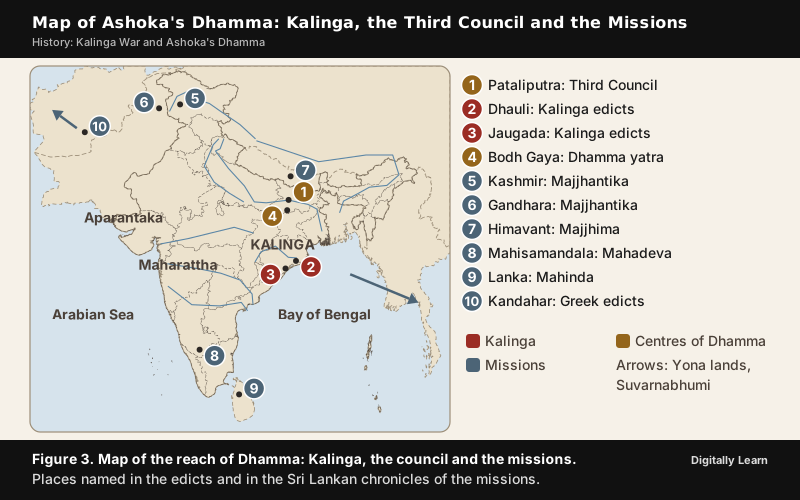
Some of these missions were very successful. Buddhism became the religion of Sri Lanka and spread into Southeast Asia, and Ashoka's inscriptions in Greek and Aramaic at Kandahar show that the message reached the Greek-speaking north-west as well.
Significance and Limits of Ashoka's Dhamma
Ashoka kept proclaiming Dhamma to the end of his reign. His last great series of inscriptions, the Major Pillar Edicts, were carved in the twenty-sixth and twenty-seventh years of his reign, and the seventh of them looks back on all that had been done so that people would follow Dhamma. In 1354 Firuz Shah Tughlaq brought two of these inscribed pillars to Delhi, from Meerut and from Topra near Ambala, and set one up at his citadel of Kotla Firoz Shah, where it still stands.
The best known of his pillars stood at Sarnath, near Varanasi, where the Buddha gave his first teaching. Its Lion Capital, four lions above a ring carrying the wheel of dharma, is the finest example of Mauryan sculpture and is today India's national emblem; its art is described in Mauryan society, art and architecture.
- A ruler accountable to his subjects: He addressed his people directly, admitted the cost of his war, and set duties for his officers.
- Tolerance as policy: Respect for all sects was made a matter of state, in an empire of many faiths and peoples.
- Welfare as duty: Medical care, roads, wells and the protection of animals were treated as the king's work.
- A world religion: The missions carried Buddhism beyond India, to Sri Lanka and Southeast Asia.
Dhamma also had limits. Ashoka did not return Kalinga, kept his army and warned the forest tribes of his power. Historians read the edicts as the king's own account, with the claims to be weighed and not taken literally.
Previous Year UPSC‑CSE Questions
Each question comes with an explanation of how to approach it.
- UPSC Prelims 2000
- Assertion (A): Ashoka annexed Kalinga to the Mauryan Empire.
- Reason (R): Kalinga controlled the land and sea routes to South India.
How to approach this Prelims question
Approach:
- Step 1: Test the Assertion. Ashoka did annex Kalinga, in the eighth year of his reign, and it became a province of the empire, so A is true.
- Step 2: Test the Reason. Kalinga lay across the communications between Pataliputra and the Mauryan lands of the peninsula and held the Bay of Bengal coast, so it controlled the land and sea routes to the south; R is true.
- Step 3: Link them. Control of those routes is the strategic reason the conquest was made, so R explains A.
Trap to watch: Remorse after the war explains what Ashoka did next, not why he attacked Kalinga.
Why each option is right or wrong:
- (a) Both A and R are true, and R is the correct explanation of A: Correct. Kalinga's hold on the routes to the south is the strategic cause of the annexation.
- (b) Both A and R are true, but R is not a correct explanation of A: Wrong. R gives the very reason for the conquest.
- (c) A is true, but R is false: Wrong. Kalinga did control the land and sea routes to the south.
- (d) A is false, but R is true: Wrong. Ashoka did annex Kalinga, in his eighth regnal year.
Answer: (a) Both A and R are true, and R is the correct explanation of A. Both true; the routes are why Ashoka took Kalinga.
- UPSC Prelims 1998
- Assertion (A): According to Asoka's edicts, social harmony among the people was more important than religious devotion.
- Reason (R): He spread ideas of equity instead of promotion of religion.
How to approach this Prelims question
Approach:
- Step 1: Test the Assertion. The edicts put respect for elders, kind treatment of slaves and servants and concord among sects ahead of the merits of any one faith; Rock Edict XII says that praising one's own sect out of devotion injures it. So social harmony mattered more than religious devotion; A is true.
- Step 2: Test the Reason. Dhamma was an ethic of fair and equal treatment for all, not the promotion of Buddhism; R is true.
- Step 3: Link them. Because he spread equity rather than a religion, harmony came first, so R explains A.
Trap to watch: Ashoka was a Buddhist, but Dhamma was not the promotion of Buddhism.
Why each option is right or wrong:
- (a) Both A and R are true, and R is the correct explanation of A: Correct. Spreading equity instead of a religion is why social harmony ranked above devotion.
- (b) Both A and R are true, but R is NOT a correct explanation of A: Wrong. R is the reason A holds.
- (c) A is true, but R is false: Wrong. Dhamma was a code of fair conduct for all, not the promotion of a religion.
- (d) A is false, but R is true: Wrong. The edicts do place harmony among people and sects above devotion to one sect.
Answer: (a) Both A and R are true, and R is the correct explanation of A. Both true; equity instead of religion explains the priority of harmony.
- UPSC Prelims 2020Who among the following rulers advised his subjects through this inscription? "Whosoever praises his religious sect or blames other sects out of excessive devotion to his own sect, with the view of glorifying his own sect, he rather injures his own sect very severely."
How to approach this Prelims question
Approach:
- Step 1: Recognise the passage. The warning that whoever praises his own sect and blames others out of devotion injures his own sect severely is from Ashoka's Rock Edict XII, his appeal for concord among sects.
- Step 2: Rule out the others. None of the later rulers issued this edict.
Trap to watch: Tolerant later rulers are tempting, but the wording is that of an Ashokan rock edict.
Why each option is right or wrong:
- (a) Ashoka: Correct. The passage is from his Rock Edict XII on tolerance among sects.
- (b) Samudragupta: Wrong. His Prayaga prashasti praises his conquests; it does not advise subjects on sects.
- (c) Harshavardhana: Wrong. This advice is not from any inscription of Harsha.
- (d) Krishnadeva Raya: Wrong. The Vijayanagara king of the sixteenth century issued no such edict.
Answer: (a) Ashoka. Rock Edict XII of Ashoka.
- UPSC Prelims 1998The Asokan major rock edicts which tell us about the Sangam Kingdom include rock edicts
How to approach this Prelims question
Approach:
- Step 1: Recall which rock edicts name the southern kingdoms. Rock Edict II names the Cholas, Pandyas, Satiyaputra and Keralaputra as lands where medical care was provided. Rock Edict XIII names the Cholas and Pandyas among the lands of conquest by Dhamma.
- Step 2: Only option (c) pairs II and XIII.
Trap to watch: Rock Edict I is about animal slaughter; XII is about sects; neither names the south.
Why each option is right or wrong:
- (a) I and X: Wrong. Rock Edict I forbids animal slaughter; X condemns the desire for fame.
- (b) I and XI: Wrong. Rock Edict XI explains Dhamma; neither names a southern kingdom.
- (c) II and XIII: Correct. Both name the Cholas and Pandyas; II adds the Satiyaputra and Keralaputra.
- (d) II and XIV: Wrong. Rock Edict II is right, but XIV, the closing edict, names no kingdom.
Answer: (c) II and XIII. Rock Edicts II and XIII.
Sources
- NCERT: Exploring Society, India and Beyond (Class 7, Part I, 2026‑27), The Rise of Empires
- NCERT: Themes in Indian History Part I (Class 12, 2026‑27), Kings, Farmers and Towns
- NCERT: An Introduction to Indian Art Part I (Class 11, 2026‑27), Mauryan Art
- Incredible India (Ministry of Tourism): Dhauligiri Hills
- Odisha Tourism (Govt of Odisha): Dhauli Shanti Stupa
- Delhi Tourism (Govt of NCT of Delhi): Firozabad
- Wikipedia: Ashoka
- Wikipedia: Kalinga War
- Wikipedia: Dhauli
- Wikipedia: Jaugada
- Wikipedia: Major Rock Edicts
- Wikipedia: Edicts of Ashoka
- Wikipedia: Minor Rock Edicts
- Wikipedia: Major Pillar Edicts
- Wikipedia: Third Buddhist council
- Wikipedia: Mahinda (Buddhist monk)
- Wikipedia: Sanghamitta
- Wikipedia: Banavasi
- UPSC: Civil Services Examination question papers
Editorial Disclaimer
This article draws on the NCERT history textbooks and the other sources listed in the Sources section. Dates of Ashoka's reign differ by a few years between sources; NCERT's are used.