


Overview
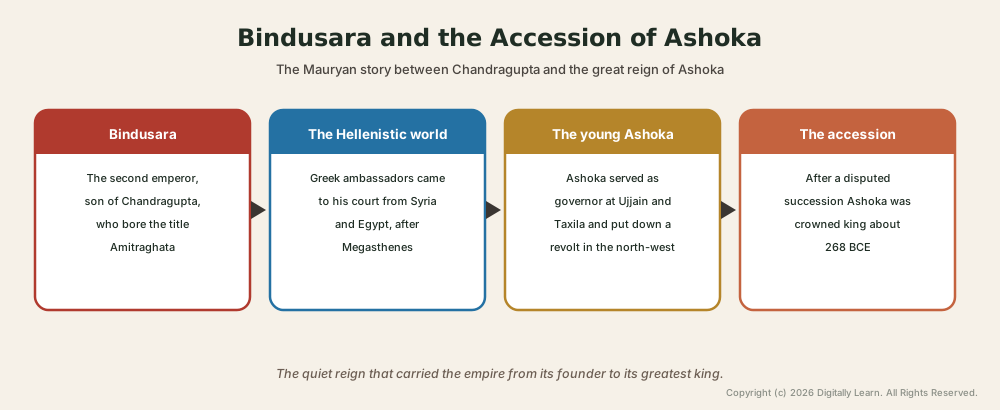
The second chapter of Mauryan history runs from Chandragupta's son to the crowning of the empire's greatest king, the accession of Ashoka. Bindusara, who took the throne about 297 BCE and bore the title Amitraghata, the slayer of enemies, held the great empire together and kept up the Mauryan ties with the Hellenistic kings of Syria and Egypt, whose ambassadors came to his court. His son Ashoka served as a provincial governor and put down a revolt in the north-west before winning a disputed succession to become king about 268 BCE. This part covers the reign of Bindusara, the Mauryan contacts with the Greek world, and the accession of Ashoka.
Bindusara Amitraghata: The Second Mauryan Emperor
The Reign and Consolidation of Bindusara
What is the significance of Bindusara: the second emperor is often overlooked between his famous father and his famous son, yet his quiet reign held the great empire together.
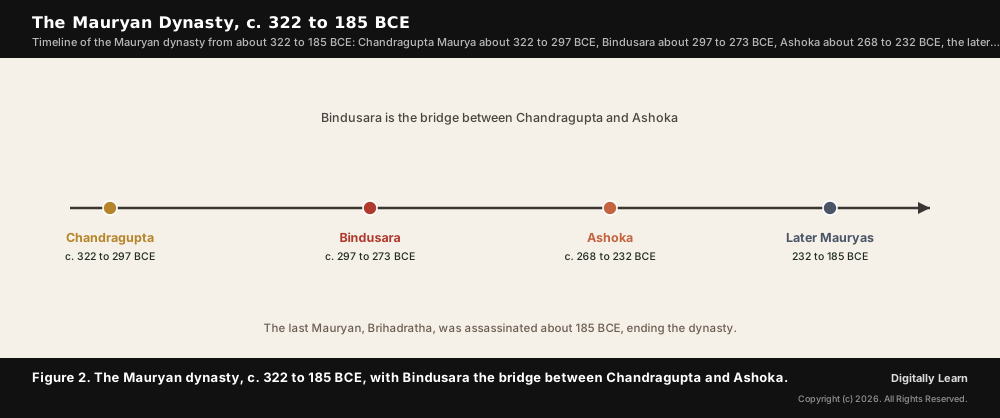
Bindusara, the son of Chandragupta, came to the throne about 297 BCE and ruled for some twenty-five years. The Greeks knew him as Amitrochates, from the Sanskrit Amitraghata, the slayer of enemies, a title that hints at military success, and a later tradition credits him with extending Mauryan power into the Deccan. Above all he kept the vast inheritance of Chandragupta intact and passed it on whole to Ashoka.
Bindusara and the Religious Sects
Distinguishing the religious leaning: like the other early Mauryas, Bindusara patronised more than one faith, and his own leaning is a small but telling detail.
Bindusara is remembered as a patron of the Ajivikas, one of the heterodox sects of the age, and tradition says an Ajivika ascetic foretold the greatness of his son. The Mauryan court was thus open to the brahmanical, Buddhist, Jain and Ajivika traditions alike, the religious plurality that Ashoka would later turn into a policy of tolerance.
The Mauryas and the Hellenistic World
The Greek Ambassadors: Deimachus and Dionysius
What is the significance of the Greek contacts: the Mauryan court kept up a lively exchange of ambassadors with the Hellenistic kingdoms, the successor states of Alexander's empire.
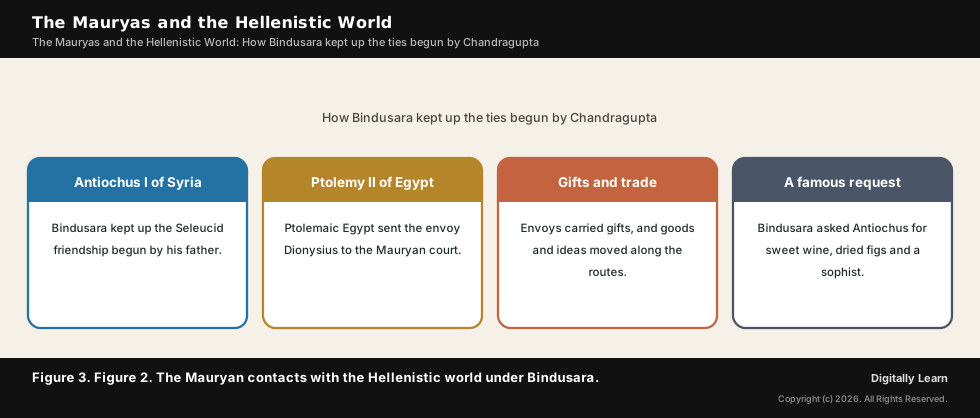
After Megasthenes, whom Seleucus had sent to Chandragupta, the exchange continued. Deimachus was sent by the Seleucid king Antiochus I to the court of Bindusara, and Dionysius was sent by Ptolemy II of Egypt to the Mauryan court. These envoys carried gifts and reports between two of the great powers of the ancient world.
| Ambassador | Sent by | To the court of |
|---|---|---|
| Megasthenes | Seleucus Nicator (Syria) | Chandragupta Maurya |
| Deimachus | Antiochus I (Syria) | Bindusara |
| Dionysius | Ptolemy II (Egypt) | The Mauryan court |
Gifts, Trade and the Famous Request to Antiochus
Distinguishing the nature of the contacts: the exchange was not only diplomatic but also commercial and personal, and one anecdote has long delighted readers.
Goods and ideas moved along the routes between the Mauryan and the Greek worlds, and the courts exchanged gifts. A famous story, preserved by the classical writers, tells that Bindusara asked Antiochus to send him sweet wine, dried figs and a Greek sophist (a philosopher); Antiochus sent the wine and the figs but replied that Greek law did not allow a philosopher to be sold.
The Accession of Ashoka
Ashoka as Governor of Ujjain and Taxila
What is the significance of Ashoka's apprenticeship: before he was king, Ashoka learned the work of government as a provincial governor, the training that prepared him for empire.
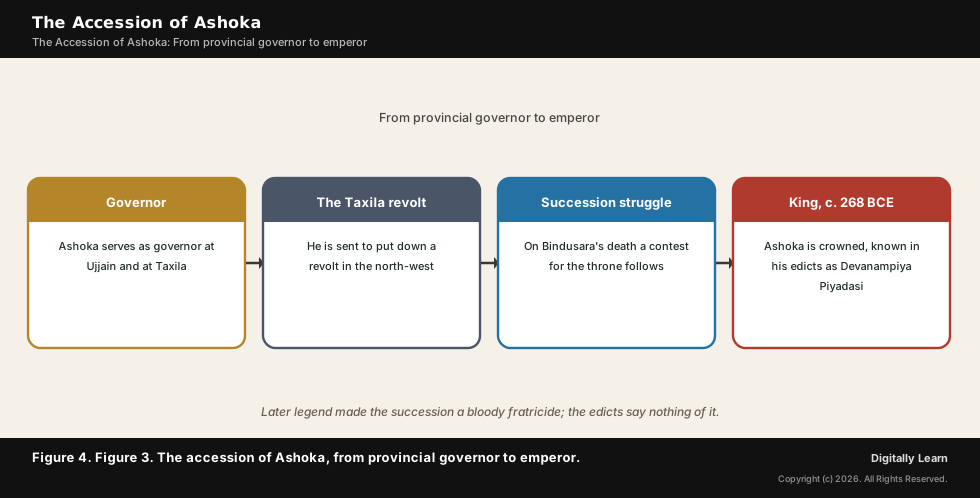
As a prince, Ashoka served as the governor of Ujjain, the capital of the western province of Avanti, and is also linked with Taxila in the north-west. Tradition holds that he was sent to put down a revolt at Taxila, a service that marked him out as a capable ruler and gave him experience of the far frontiers of the empire.
The Disputed Succession and Ashoka's Inscriptional Titles
Distinguishing the accession: the path to the throne was contested, and a careful student separates the firm facts from the later legends.
On the death of Bindusara, about 273 BCE, there was a contest for the throne, and Ashoka was crowned only about 268 BCE, after a gap that suggests a struggle with his brothers, one of whom tradition names Susima. Later Buddhist legend turned this into a bloody fratricide, but his own edicts say nothing of it, and the story is best treated as embellishment.
In his own inscriptions Ashoka is referred to not by the name Ashoka but by his titles, Devanampiya (Beloved of the Gods) and Piyadasi or Priyadarshin (of gracious mien). It was these titles, not the name Ashoka, that the edicts carried, and the connection of the two was only recovered much later, as the next part of this cluster, on the edicts, explains.
UPSC Relevance and Exam Focus
Where Bindusara and Ashoka's Accession Fit in the UPSC-CSE Syllabus
This topic belongs to General Studies Paper I: ancient Indian history and culture, and the Mauryan rulers, with the contacts with the Hellenistic world, are a reliable area for the Prelims.
For Prelims, hold the firm facts: Bindusara, the second emperor, bore the title Amitraghata; the Greek envoys Deimachus and Dionysius came to the Mauryan court; Ashoka was a governor at Ujjain and Taxila; he became king about 268 BCE; and in his inscriptions he is called Devanampiya Piyadasi, not Ashoka.
For Mains, the reign of Bindusara and the accession of Ashoka show the continuity and the diplomacy of the Mauryan state between its two greatest rulers.
Recurring linked concepts an aspirant should keep in working memory:
- Bindusara: The second emperor; title Amitraghata; patron of the Ajivikas.
- The ambassadors: Megasthenes, then Deimachus and Dionysius.
- The famous request: Bindusara asks Antiochus for wine, figs and a sophist.
- Ashoka the governor: At Ujjain and Taxila before his accession.
- His titles: Devanampiya Piyadasi (Priyadarshin), the names in his edicts.
A common Prelims trap is to look for the name Ashoka in the edicts. The edicts call him Devanampiya Piyadasi; the personal name Ashoka appears only in a few minor edicts, treated in the part on the inscriptions.
Another trap is to treat the fratricide legend as fact. The bloody-succession story is late Buddhist embellishment; the edicts do not mention it.
Previous Year UPSC-CSE Questions
Previous Year UPSC-CSE Questions By the end you will be able to draft model answers for the following UPSC questions. Each question carries a collapsible framework showing how to approach it in the exam.
- UPSC Prelims 1995 GS-IThe name by which Asoka is generally referred to in his inscriptions is
How to approach this Prelims question
Approach: Recall the title by which the edicts refer to Ashoka.
Trap to watch: The edicts do not use the name Ashoka; they use Devanampiya Piyadasi (Priyadarshin). Chakravarti is a general imperial title, not his inscriptional name.
Key facts to recall:
- Ashoka is called Devanampiya Piyadasi (Priyadarshin) in his inscriptions.
- The personal name Ashoka appears only in a few minor edicts (e.g. Maski).
Answer signal: Priyadarshini (Priyadarshin / Piyadasi).
Sources and Further Reading
Editorial Disclaimer
This article is for UPSC preparation. The regnal dates of Bindusara and Ashoka are given in the conventional ranges used by historians, and several details of the accession survive only in later tradition.