


Overview
Nuclear fission and fusion are the two ways a nucleus can release energy: fission splits a heavy nucleus such as uranium-235, and fusion joins light nuclei such as hydrogen, in each case leaving products more tightly bound. Radioactivity is the spontaneous decay of unstable nuclei, timed by their half-life. Controlled fission runs India's reactors and its three-stage programme, while fusion powers the Sun and is the goal of ITER.
The Atomic Nucleus: Protons, Neutrons and Binding Energy
Nucleons, Isotopes and the Nuclear Force
Every nucleus is built from protons and neutrons, which together are called nucleons. The number of protons is the atomic number Z, and the total number of nucleons is the mass number A. James Chadwick found the neutron in 1932, a particle with no charge and almost the mass of a proton, and won the 1935 Nobel Prize in Physics for it. A free neutron is unstable, yet inside a nucleus it lasts.
Atoms of the same element can differ in mass. These are isotopes: their nuclei hold the same number of protons but different numbers of neutrons, and since the electrons are arranged in the same way, they behave alike in chemical reactions. Hydrogen has three of them: ordinary hydrogen with a lone proton, deuterium with a proton and a neutron, and tritium with a proton and two neutrons. The structure of the atom itself is explained in atomic structure and isotopes.
- Isobars: Nuclides with the same mass number, such as hydrogen-3 and helium-3.
- Isotones: Nuclides with the same number of neutrons but different atomic numbers.
- Nuclear density: About 2.3 × 10¹⁷ kg per cubic metre, the same for every nucleus and vastly more than water’s 103 kg per cubic metre.
What holds the nucleus together, when its protons push each other apart? A strong attraction called the nuclear force. It is far stronger than the electrical repulsion between charges, but it reaches only a few femtometres, and it pulls on neutrons and protons alike because it does not depend on charge.
Mass Defect and Binding Energy: E = mc²
Weigh a nucleus and it always comes out lighter than the protons and neutrons that make it. For oxygen-16 the shortfall, called the mass defect, is 0.13691 atomic mass units. Einstein's relation E = mc2 explains where the mass went: when the nucleons came together to form the nucleus, that much mass left as energy. The same energy therefore has to be supplied to pull the nucleus apart into separate nucleons.
That energy is the binding energy. Divided by the number of nucleons, it shows how tightly a nucleus holds together. It stays close to 8 MeV for mass numbers between 30 and 170, peaks at about 8.75 MeV near A = 56, and is lower at both ends, falling to 7.6 MeV at A = 238. The curve at the top of this page draws that shape.
Radioactivity and Half-Life
Discovery of Radioactivity: Becquerel and the Curies
Radioactivity was discovered by A. H. Becquerel in 1896, purely by accident. Pieces of uranium-potassium sulphate wrapped in black paper blackened a photographic plate, even with a sheet of silver in between, so something was coming out of the uranium salt that could pass through both. Marie and Pierre Curie followed his lead and isolated radium and polonium, and Marie Curie became the first person to win two Nobel Prizes, for Physics in 1903 and for Chemistry in 1911.
How radioactive a sample is depends on its activity, the number of decays per second, which is measured in becquerels: one becquerel is one decay per second. The older unit, the curie, equals 3.7 × 10¹⁰ becquerels. Some radioactive elements, such as tritium and plutonium, decay quickly compared with the age of the universe, so none of them is left in nature in any quantity and they are made in laboratories and reactors.
Alpha, Beta and Gamma Decay
An unstable nucleus can decay in three ways, and each changes it differently. An alpha particle is a helium nucleus, two protons and two neutrons bound together, so it carries two positive charges and almost exactly the mass of a helium atom.
- Alpha decay: The nucleus throws out a helium nucleus, so its mass number falls by 4 and its atomic number by 2; uranium-238 becomes thorium-234.
- Beta decay: A neutron turns into a proton and an electron leaves the nucleus (beta-minus), or a proton turns into a neutron and a positron leaves; either way the mass number stays the same.
- Gamma decay: An excited nucleus drops to a lower energy level and gives off a high-energy photon, with no change in mass number or atomic number.
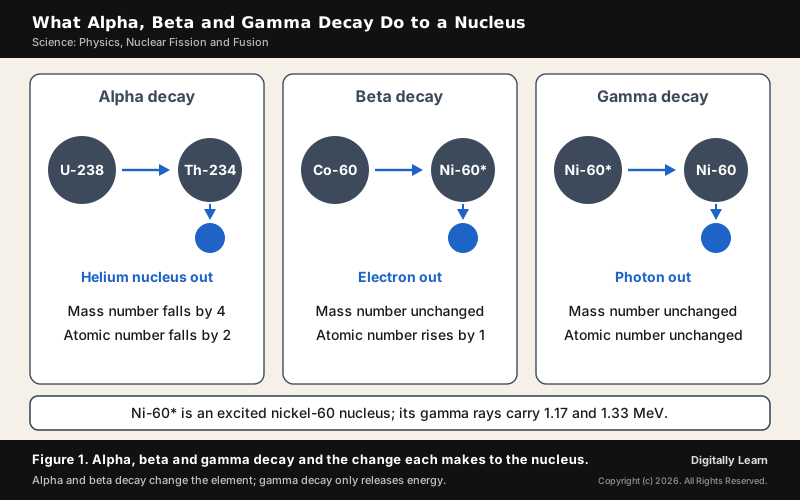
Gamma rays usually follow an alpha or beta decay. Cobalt-60 shows the sequence: it beta-decays into an excited nickel-60 nucleus, which then settles by giving off gamma rays of 1.17 and 1.33 MeV. Beta decay also releases a second particle with the electron or positron: an antineutrino in beta-minus decay and a neutrino in positron decay. Both are neutral, with very little or no mass, and they interact so weakly with matter that they can pass through the whole Earth.
Half-Life, Radioactive Decay and Carbon Dating
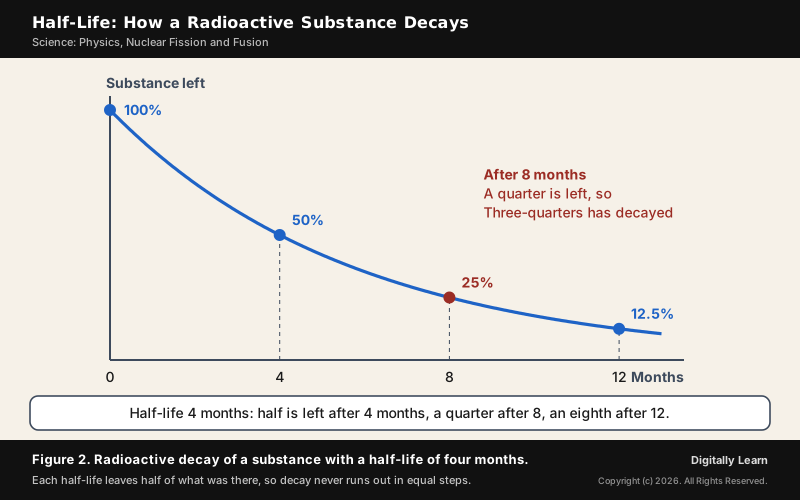
The number of nuclei decaying each second is proportional to the number still present, so radioactive decay follows an exponential law. Light bulbs behave nothing like this: a batch of them burns out at about the same time. The half-life is fixed for each radionuclide, 12.5 years for tritium, 14.3 days for phosphorus-32 and 4.5 × 10⁹ years for uranium-238.
This regularity is put to work in carbon dating. A living plant or animal keeps taking in carbon-14; once it dies, the carbon-14 it holds decays with a half-life of about 5,730 years, so the amount left in wood or bone tells how long ago it died. The method reaches back reliably to about 50,000 years.
Nuclear Energy: Nuclear Fission and Nuclear Fusion
Nuclear Fission and the Chain Reaction
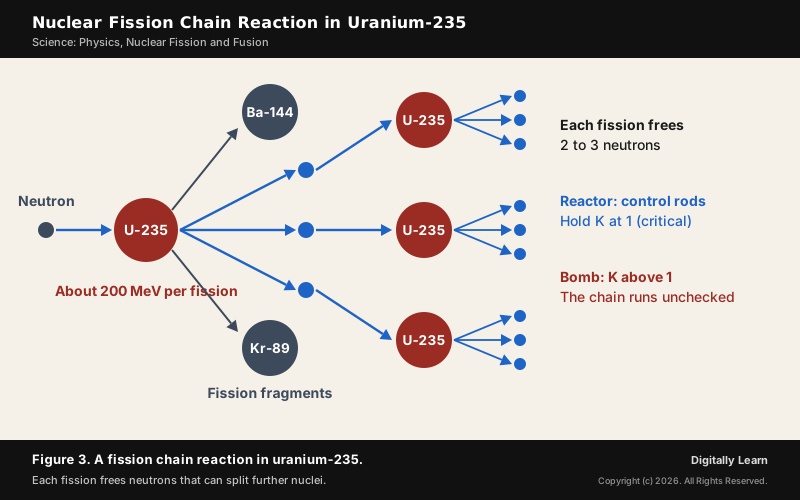
Enrico Fermi found that neutrons fired at different elements produce new radioactive elements. When a neutron strikes a uranium-235 nucleus, the nucleus breaks into two nearly equal fragments, for example barium-144 and krypton-89, and sends out three neutrons. This is nuclear fission, and each such split releases about 200 MeV, first as the speed of the fragments and finally as heat in the surrounding material.
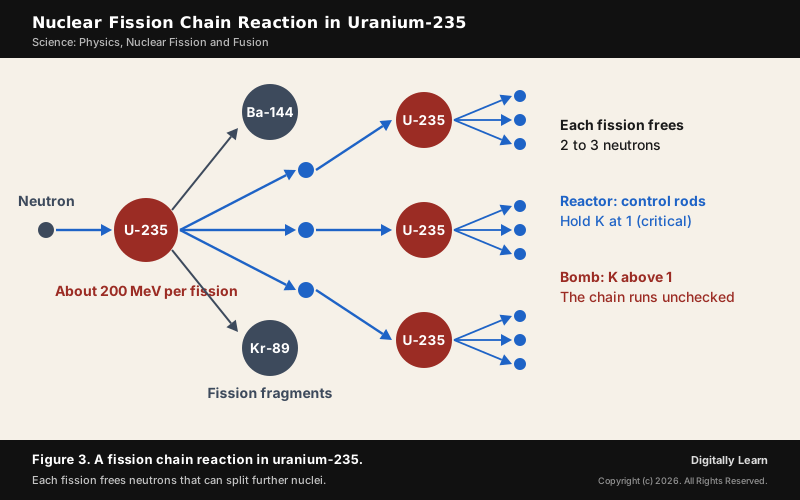
Each fission releases two and a half neutrons on average, more than it used, so one fission can set off others. Fermi first suggested this chain reaction in 1939. Left uncontrolled and rapid, it is a nuclear bomb; kept controlled and steady, it is a nuclear reactor. The energy is enormous for the mass involved: a kilogram of coal gives about 107 joules when burnt, while a kilogram of uranium gives about 1014 joules through fission, so for the same quantity of matter nuclear sources give millions of times more energy than chemical ones.
Nuclear Fusion in the Sun and in ITER
Fusion runs the other way: nuclear fusion joins light nuclei into a heavier one. Because two nuclei are both positively charged and push each other away, fusion needs extreme temperature and pressure, which exist naturally only inside stars. The Sun turns hydrogen into helium through the proton-proton cycle, in which four hydrogen atoms end up as one helium atom and release 26.7 MeV. It has been shining this way for about 5 billion years and has enough hydrogen for about as long again.
Controlled fusion on Earth is far harder, and many countries, India among them, pursue it because a fusion reactor is seen as a future source of power. The largest such project is ITER, the International Thermonuclear Experimental Reactor, a tokamak being built near the Cadarache research centre in southern France. It aims to produce 500 MW of fusion heat from 50 MW of heating, a tenfold gain, and is expected to reach first plasma in 2033 to 2034.
- ITER members: China, the European Union, India, Japan, Russia, South Korea and the United States; India formally joined in 2005.
- India’s share: 9.1 per cent of construction, delivered in kind through ITER-India at the Institute for Plasma Research, Ahmedabad.
- India’s components: The cryostat, the cryolines, the in-vessel shielding, and the cooling and cooling water systems.
- People and industry: About 200 Indian scientists and associates, with firms such as L&T, Inox India, TCS, TCE and HCL Technologies.
India's own fusion research grew at the Institute for Plasma Research. Its ADITYA tokamak, commissioned in 1989, began full tokamak experiments in the country, and a 1995 decision led to SST-1, a superconducting steady-state tokamak built for 1,000-second operation. The prize is a dense fuel: one gram of deuterium-tritium mixture yields 90,000 kilowatt hours through fusion, the energy of about 11 tonnes of coal.
Difference Between Nuclear Fission and Fusion
| Point | Fission | Fusion |
|---|---|---|
| What happens | A heavy nucleus splits | Light nuclei join |
| Typical fuel | Uranium-235, plutonium-239 | Hydrogen isotopes |
| Trigger | A slow neutron | Extreme heat and pressure |
| Where it happens | Reactors and atom bombs | The Sun, stars, hydrogen bombs |
| What is left | Highly radioactive spent fuel | Helium, in the Sun's cycle |
| Use for power | Runs today's nuclear plants | Experimental, as in ITER |
The two meet in the hydrogen bomb, which uses a fission bomb to reach the temperature at which deuterium and tritium fuse; the first such device was exploded at Eniwetok Atoll on 1 November 1952. For power, the contrast that matters most is what each leaves behind: fission leaves highly radioactive spent fuel, while the Sun's fusion ends in helium.
How a Nuclear Reactor Works and India's Nuclear Programme
How a Nuclear Reactor Works: Fuel, Heavy Water Moderator, Control Rods and Coolant
A nuclear reactor runs a fission chain reaction at a steady pace and takes away its heat. The neutrons that fission releases are fast, about 2 MeV on average, and fast neutrons tend to escape without splitting another uranium-235 nucleus, while slow neutrons are far more likely to cause fission. So the reactor slows its neutrons with a moderator made of light nuclei, much as a marble that hits an identical marble head-on stops and hands over its energy.
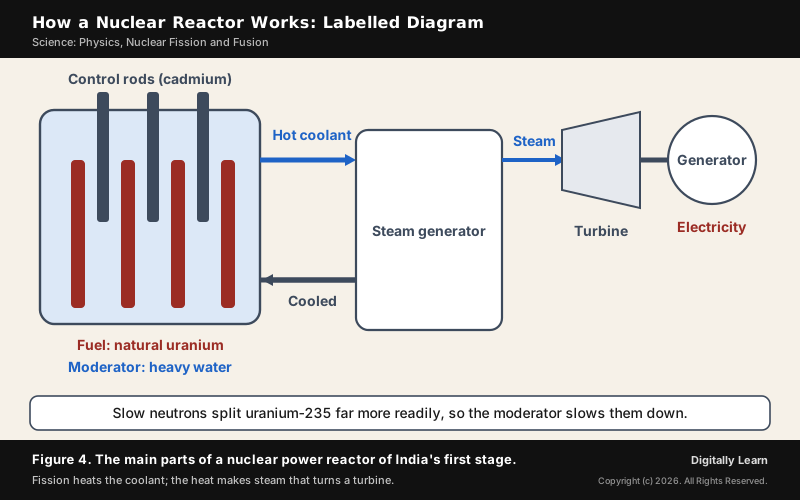
- Fuel: Uranium-235 or plutonium; India’s first-stage reactors burn natural uranium.
- Moderator: Water, heavy water or graphite. India’s power reactors use heavy water (D2O), while the Apsara research reactor at BARC uses ordinary water. Heavy water captures very few neutrons, which is why a heavy water or carbon (graphite) moderator lets even natural uranium sustain a chain reaction.
- Control rods: Rods of cadmium or another neutron absorber that set the reaction rate; separate safety rods can drop in to shut the reactor down quickly.
- Coolant: Carries the heat to a steam generator; in a pressurised water reactor, water at about 600 K and 150 atmospheres does this job, and the steam drives a turbine.
The moderator in India's power reactors, heavy water, is water in which the hydrogen is deuterium, the isotope that Harold Urey discovered in 1931. The reactor's state is read from its multiplication factor K, the ratio of fissions in one generation of neutrons to those in the generation before. At K = 1 the reactor is critical, steady and self-sustaining; above 1 the power rises exponentially, as at Chernobyl in 1986; below 1 the reaction dies away.
Thermal and Fast Breeder Reactors: Prototype Fast Breeder Reactor at Kalpakkam
A thermal reactor, like India's pressurised heavy water reactors, slows its neutrons with a moderator. A fast breeder reactor keeps the chain reaction going with fast neutrons, so it needs no moderator, and besides making power it breeds more fissile fuel than it burns. It does this by turning uranium-238, which does not fission, into plutonium-239.
| Point | Thermal reactor | Fast breeder |
|---|---|---|
| Neutrons | Slowed by a moderator | Fast, no moderator |
| Fuel in India | Natural uranium | Uranium-plutonium mixed oxide |
| Coolant | Heavy water | Liquid sodium |
| Fuel made | Plutonium in spent fuel | More fissile fuel than it uses |
India's 500 MWe Prototype Fast Breeder Reactor at Kalpakkam, designed by the Indira Gandhi Centre for Atomic Research and built by BHAVINI, attained first criticality, the start of its controlled chain reaction, on 6 April 2026. Its core of mixed oxide fuel sits inside a blanket of uranium-238 that fast neutrons turn into plutonium-239, and the blanket is designed to take thorium-232 later and breed uranium-233. The event itself is covered in PFBR first criticality at Kalpakkam.
Thorium and the Three Stages of India's Nuclear Programme
India has little uranium but some of the largest thorium reserves in the world, so the country adopted a three-stage strategy, in which each stage makes the fuel for the next. Thorium cannot be used as fuel straight away: it is a fertile element, not a fissile one, and has to be turned into uranium-233 in a reactor first. The beach sands of Kerala and Odisha are rich in monazite, which contains about 8 to 10 per cent thorium.
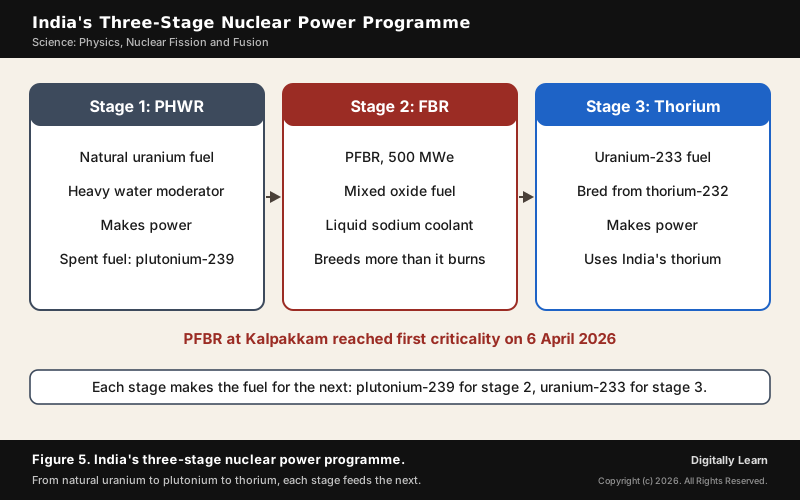
- First stage: Pressurised heavy water reactors burn natural uranium with heavy water as moderator, and their spent fuel yields plutonium-239.
- Second stage: Fast breeder reactors burn that plutonium and breed more fuel, including uranium-233 from thorium-232.
- Third stage: Reactors fuelled by uranium-233 draw on India’s thorium reserves at scale.
Thorium is about three times as abundant as uranium in the Earth's crust, a thorium fuel cycle is expected to leave less nuclear waste, and the uranium-233 it breeds is hard to turn into a weapon. The KAMINI research reactor at Kalpakkam runs on uranium-233 fuel.
Nuclear Power Plants in India: Reactors, Capacity and Map

| Plant | State | Worth knowing |
|---|---|---|
| Tarapur | Maharashtra | India's first commercial plant |
| Rawatbhata | Rajasthan | The Rajasthan plant |
| Narora | Uttar Pradesh | Bulandshahr district |
| Kakrapar | Gujarat | Near the Tapi river |
| Kaiga | Karnataka | Near the Kali river |
| Kalpakkam | Tamil Nadu | Includes the PFBR |
| Kudankulam | Tamil Nadu | Largest; built with Russia |
Nuclear power is still a small part of India's electricity, the fifth-largest source after coal, hydro, solar and wind, and coal dominates the generation mix. The reactors at these plants are mostly pressurised heavy water reactors that burn natural uranium, which is why India's first stage needs no enriched fuel. Light-water reactors, which make up most nuclear power reactors worldwide, use uranium enriched to only 3 to 5 per cent uranium-235.
The programme began around the time of independence under Homi J. Bhabha, who became the first chairman of the Atomic Energy Commission when it was set up on 3 August 1948. Apsara went critical on 4 August 1956 and CIRUS followed in 1960. The plutonium plant at Trombay, designed and built in India, brought in the technology of reprocessing, which separates useful fissile and fertile material from spent fuel, and the research reactors commissioned later include ZERLINA, PURNIMA, DHRUVA and KAMINI. India is now more than self-sufficient in heavy water.
Nuclear Policy: SHANTI Act, Small Modular Reactors and IAEA Safeguards
The government wants nuclear power to grow fast. Under the Nuclear Energy Mission of the Union Budget 2025-26, the target is 100 GW by 2047, as part of the path to net zero by 2070, with 22.38 GW expected by 2031-32. Two changes carry that plan: new law and new kinds of reactor.
- SHANTI Act, 2025: The Sustainable Harnessing and Advancement of Nuclear Energy for Transforming India Act brings nuclear law together, allows limited private participation under regulation, and gives the Atomic Energy Regulatory Board statutory recognition.
- Small modular reactors: ₹20,000 crore for their design and deployment, with at least five indigenous units to run by 2033; BARC is designing the 200 MWe Bharat Small Modular Reactor and the 55 MWe SMR-55.
- Liability: The Civil Liability for Nuclear Damage Act, 2010 set up no-fault liability so that victims are compensated after a nuclear incident.
Imported fuel shaped the rules on inspection. India agreed in 2005 to separate its civil and military nuclear facilities and to place its civil facilities under IAEA safeguards, the inspections of the International Atomic Energy Agency. The Nuclear Suppliers Group's waiver of 6 September 2008 then opened access to nuclear fuel and technology from other countries, and reactors that run on imported uranium are under safeguards. Small reactors are followed up in small modular reactors and India's Bharat Small Reactor.
Uses and Hazards of Radiation
Radioisotopes in Medicine, Agriculture and Industry; RTGs
Research reactors are built for research rather than power, and they are also an excellent source of radioisotopes, radioactive isotopes of an element. A radioisotope behaves chemically like the ordinary atom of that element, yet sensitive radiation detectors can pick it up in very small amounts. That is why it serves both as a tracer, following the path of a substance, and as a source of radiation. In India the Board of Radiation and Isotope Technology (BRIT), a unit of the Department of Atomic Energy in Navi Mumbai, develops these applications.
- Medicine: Gamma rays from cobalt-60 treat cancer (cobalt therapy) and sterilise medical equipment. Iodine-131, with a half-life of about eight days, is used to treat thyroid disease, and scans such as PET and SPECT are built on radioactive tracers.
- Agriculture and food: Food irradiation with gamma rays stops potatoes, onions and garlic from sprouting and extends shelf life. Radiation is also used to sterilise pest insects, and radioisotopes of carbon and phosphorus trace the path of biochemical reactions in plants.
- Industry and research: Cobalt-60 is a radiation source for industrial radiography, and naturally occurring carbon-14 dates old wood and bone.
A radioisotope thermoelectric generator, or RTG, is a nuclear battery with no moving parts. Thermocouples turn the heat of radioactive decay into electricity, so it is not a fission reactor at all, and with nothing to fail or wear out it is highly reliable. That makes it the power source of choice in remote, harsh places, above all spacecraft travelling far from the Sun, where solar panels are of little use.
- Fuel: Plutonium-238, with a half-life of 87.7 years and low gamma and neutron emission.
- Where the fuel comes from: Most plutonium-238 was made by irradiating neptunium-237, a by-product of making weapons-grade plutonium-239.
- Missions: Pioneer 10 and 11, Voyager 1 and 2, Galileo, Cassini and New Horizons.
Is Nuclear Energy Renewable? Safety, Nuclear Waste and Accidents
Nuclear energy is not counted as renewable, because it depends on uranium, a fuel that is mined and does not replenish itself. It is, however, a low-carbon source: it needs about a million times less fuel by mass than chemical fuels, and its plants make electricity without producing the greenhouse gases that come from burning coal, oil or gas.
Its central problem is the spent fuel, which is highly radioactive and extremely hazardous to life. Every reactor builds up nuclear waste, both fission products and heavy elements such as plutonium and americium, which needs careful handling and reprocessing.
- Chernobyl, 1986: Reactor 4 near Pripyat in Ukraine exploded on 26 April 1986, a reminder of how badly a reactor accident can go.
- Fukushima, 2011: On 11 March 2011 the Tohoku earthquake and tsunami knocked out the Fukushima Daiichi plant’s power and nearly all its backups, the reactors could not be cooled, and radioactive material escaped.
- Local opposition: The Kudankulam plant in Tamil Nadu was delayed several times by the opposition of local fishermen.
Previous Year UPSC-CSE Questions
Previous Year UPSC-CSE Questions By the end you will be able to draft model answers for the following UPSC questions. Each question carries a collapsible framework showing how to approach it in the exam.
- UPSC Mains 2026 GS-IIIDistinguish between a Fast Breeder Reactor (FBR) and a thermal nuclear reactor. In the context of first indigenously developed prototype FBR at Kalpakkam, explain the term 'criticality'. What are its implications for clean energy future of our country?
Answer outline: how to structure the answer
What the question asks, the main arguments, relevant examples and the direction of the conclusion. This is not a full model answer.
Introduction: Introduce the PFBR at Kalpakkam, 500 MWe, designed by IGCAR and built by BHAVINI, which attained first criticality on 6 April 2026.
Body (sub-themes to develop):
- Thermal reactor: neutrons slowed by a moderator; natural uranium; heavy water.
- FBR: fast neutrons, no moderator; MOX fuel; liquid sodium coolant; breeds more fuel than it burns.
- Criticality: multiplication factor K = 1, a steady, self-sustaining controlled chain reaction.
- Implications: entry into stage 2; bridge to thorium; closed fuel cycle; second country after Russia.
- Clean energy: low-carbon base-load power; 100 GW by 2047; net zero by 2070.
Conclusion: Conclude that the PFBR turns India's limited uranium and abundant thorium into a long-term clean energy path.
- UPSC Mains 2025 GS-IIIThe fusion energy programme in India has steadily evolved over the past few decades. Mention India's contributions to the international fusion energy project – International Thermonuclear Experimental Reactor (ITER). What will be the implications of the success of this project for the future of global energy?
Answer outline: how to structure the answer
What the question asks, the main arguments, relevant examples and the direction of the conclusion. This is not a full model answer.
Introduction: Introduce fusion as the Sun's energy source and ITER, a tokamak near Cadarache, France, as the largest effort to control it.
Body (sub-themes to develop):
- India's programme: Institute for Plasma Research; ADITYA tokamak (1989); SST-1 steady-state tokamak.
- ITER membership: joined 2005; 9.1 per cent of construction, delivered in kind by ITER-India.
- Components: cryostat, cryolines, in-vessel shielding, cooling and cooling water systems; about 200 scientists; firms such as L&T and Inox India.
- Implications: 500 MW fusion from 50 MW heating (tenfold gain); light hydrogen fuel; no long-lived fission waste; a route to abundant clean power.
Conclusion: Conclude that ITER's success would move fusion from experiment to a future energy source, with India a contributor to its technology.
- UPSC Mains 2018 GS-IIIWith growing energy needs should India keep on expanding its nuclear energy programme? Discuss the facts and fears associated with nuclear energy.
Answer outline: how to structure the answer
What the question asks, the main arguments, relevant examples and the direction of the conclusion. This is not a full model answer.
Introduction: Introduce India's growing energy needs and nuclear power's share of about 3 per cent from 8.78 GW.
Body (sub-themes to develop):
- Facts: low-carbon, reliable base-load power; million times less fuel by mass than chemical fuels.
- Facts: three-stage programme and thorium for energy security; PFBR; 100 GW by 2047.
- Fears: accidents (Chernobyl 1986, Fukushima 2011); highly radioactive spent fuel and waste.
- Fears: liability for accidents; local opposition, as at Kudankulam; dependence on imported uranium.
- Answers: AERB's statutory role under the SHANTI Act; safety rods and design; reprocessing.
Conclusion: Conclude that expansion is justified if matched by strict regulation, waste management and public trust.
- UPSC Mains 2017 GS-IIIGive an account of the growth and development of nuclear science and technology in India. What is the advantage of fast breeder reactor programme in India?
Answer outline: how to structure the answer
What the question asks, the main arguments, relevant examples and the direction of the conclusion. This is not a full model answer.
Introduction: Introduce the programme launched around independence under Homi J. Bhabha.
Body (sub-themes to develop):
- Milestones: Apsara critical on 4 August 1956; CIRUS 1960; plutonium plant at Trombay; DHRUVA, KAMINI.
- Capabilities: fuel fabrication, heavy water production, reactor design, reprocessing; PHWRs.
- Three-stage strategy built on limited uranium and abundant thorium.
- FBR advantages: breeds more fuel than it burns; uses uranium-238; bridge to thorium; closed fuel cycle.
- PFBR first criticality in 2026 as the start of stage 2.
Conclusion: Conclude that fast breeders are the link that lets India's thorium sustain nuclear power for the long term.
- UPSC Prelims 2011 Prelims-GSThe function of heavy water in a nuclear reactor is to
How to approach this Prelims question
Approach: Step 1: fission neutrons are fast and tend to escape. Step 2: slow neutrons are far more likely to split uranium-235, so reactors add a moderator of light nuclei. Step 3: heavy water is India's moderator in its power reactors, so its job is to slow the neutrons.
Trap to watch: Heavy water can also carry heat, but its defining role as a moderator is to slow neutrons.
Key facts to recall:
- (a) Slow down the speed of neutrons: right. Heavy water is a moderator.
- (b) Increase the speed of neutrons: wrong. The aim is the opposite, to slow them.
- (c) Cool down the reactor: wrong as the answer. Heavy water can also carry heat, but its defining job in sustaining the chain reaction is to slow neutrons as the moderator.
- (d) Stop the nuclear reaction: wrong. Control rods and safety rods of neutron absorbers such as cadmium do that.
Answer signal: Slow down neutrons: option (a), the official answer, because heavy water is the moderator.
- UPSC Prelims 2001 Prelims-GSConsider the following statements: In a nuclear reactor, self-sustained chain reaction is possible, because
- I. More neutrons are released in each of the fission reactions.
- II. The neutrons immediately take part in the fission process.
- III. The fast neutrons are slowed down by Graphite.
- IV. Every neutron released in the fission reaction initiates further fission.
Which of these statements are correct?
How to approach this Prelims question
Approach: Step 1: statement I: each fission releases more neutrons than it uses (2.5 on average), so it is correct. Step 2: statement II: fission neutrons are fast and must first be slowed, so they do not take part immediately; incorrect. Step 3: statement III: moderators such as graphite slow the fast neutrons; correct. Step 4: statement IV: not every neutron causes a fission, many escape or are absorbed, and the reactor is held at K = 1; incorrect. Step 5: I and III, option (b).
Trap to watch: Statement IV would make the reaction run away, not stay steady.
Key facts to recall:
- (a) I, II and III: wrong. Statement II is incorrect; the neutrons must be slowed first.
- (b) I and III: right. More neutrons per fission, and a graphite moderator slows them.
- (c) II and IV: wrong. Both statements are incorrect.
- (d) II, III and IV: wrong. Statements II and IV are incorrect.
Answer signal: I and III: option (b), the official answer, because only these two describe how the chain reaction is sustained.
- UPSC Prelims 2001 Prelims-GSA radioactive substance has a half-life of four months. Three fourth of the substance would decay in
How to approach this Prelims question
Approach: Step 1: three-quarters decayed means one-quarter is left. Step 2: after one half-life one-half is left; after two half-lives one-quarter is left. Step 3: two half-lives of 4 months each are 2 × 4 = 8 months.
Trap to watch: Decay is not linear: three-quarters does not take three-quarters of some fixed time.
Key facts to recall:
- (a) 3 months: wrong. Less than one half-life leaves more than half the substance.
- (b) 4 months: wrong. One half-life leaves half, so only half has decayed.
- (c) 8 months: right. Two half-lives leave a quarter, so three-quarters has decayed.
- (d) 12 months: wrong. Three half-lives leave an eighth, so seven-eighths would have decayed.
Answer signal: 8 months: option (c), the official answer, because two half-lives leave one-quarter.
- UPSC Prelims 1996 Prelims-GSThe alpha particle carries two positive charges. Its mass is very nearly equal to that of
How to approach this Prelims question
Approach: Step 1: an alpha particle is a helium nucleus of two protons and two neutrons. Step 2: its mass is therefore about four nucleon masses, very nearly the mass of a helium atom. Step 3: check which option matches that mass.
Trap to watch: Two positive charges do not mean the mass of two protons: the two neutrons add mass too.
Key facts to recall:
- (a) Two protons: wrong. It also has two neutrons, so its mass is about twice that of two protons.
- (b) An atom of helium: right. An alpha particle is a helium nucleus.
- (c) Two positrons and two neutrons: wrong. A positron has only the mass of an electron, so this falls short.
- (d) Two positrons: wrong. Positrons have the mass of electrons, far too little.
Answer signal: An atom of helium: option (b), the official answer, because an alpha particle is a helium nucleus.
- UPSC Prelims 1995 Prelims-GSThe difference between a nuclear reactor and an atomic bomb is that
How to approach this Prelims question
Approach: Step 1: both a reactor and an atomic bomb run on a fission chain reaction. Step 2: in a reactor, control rods keep it steady at K = 1; in a bomb it is uncontrolled. Step 3: the difference is control.
Trap to watch: Options that deny a chain reaction to either device are both false.
Key facts to recall:
- (a) No chain reaction in a reactor: wrong. A reactor runs on a controlled chain reaction.
- (b) The chain reaction in a reactor is controlled: right. Control rods hold K at 1.
- (c) The chain reaction in a reactor is not controlled: wrong. That describes a bomb.
- (d) No chain reaction in a bomb: wrong. A bomb's energy comes from an uncontrolled chain reaction.
Answer signal: Controlled chain reaction: option (b), the official answer.
- UPSC Prelims 2024 Prelims-GSWith reference to radioisotope thermoelectric generators (RTGs), consider the following statements:
- RTGs are miniature fission reactors.
- RTGs are used for powering the onboard systems of spacecrafts.
- RTGs can use Plutonium-238, which is a by-product of weapons development.
Which of the statements given above are correct?
How to approach this Prelims question
Approach: Step 1: statement 1: an RTG uses the heat of radioactive decay, not a fission chain reaction, so it is not a miniature fission reactor; incorrect. Step 2: statement 2: RTGs power spacecraft far from the Sun; correct. Step 3: statement 3: RTGs use plutonium-238, made mostly from neptunium-237, a by-product of weapons-grade plutonium production; correct. Step 4: 2 and 3 only, option (b).
Trap to watch: Nuclear in both, but an RTG uses decay heat, not fission.
Key facts to recall:
- (a) 1 and 2 only: wrong. Statement 1 is incorrect; an RTG is not a fission reactor.
- (b) 2 and 3 only: right. RTGs power spacecraft and can use plutonium-238.
- (c) 1 and 3 only: wrong. Statement 1 is incorrect.
- (d) 1, 2 and 3: wrong. Statement 1 is incorrect.
Answer signal: 2 and 3 only: option (b), the official answer, because an RTG runs on decay heat, not fission.
- UPSC Prelims 2020 Prelims-GSIn India, why are some nuclear reactors kept under “IAEA Safeguards” while others are not?
How to approach this Prelims question
Approach: Step 1: India separated civil and military facilities and put the civil ones under IAEA safeguards in return for access to foreign fuel after the 2008 NSG waiver. Step 2: reactors burning imported uranium are under safeguards. Step 3: the dividing line is the source of the fuel.
Trap to watch: The fuel type (uranium or thorium) and ownership are not what decide safeguards.
Key facts to recall:
- (a) Some use uranium and others thorium: wrong. Safeguards follow the separation of civil facilities and imported fuel, not the fuel element.
- (b) Some use imported uranium and others domestic supplies: right. Reactors running on imported uranium are under IAEA safeguards.
- (c) Operated by foreign or domestic enterprises: wrong. What decides safeguards is civil use and imported fuel, not who operates the reactor.
- (d) State-owned or privately owned: wrong. Safeguards follow civil use and imported fuel, not ownership.
Answer signal: Imported against domestic uranium: option (b), the official answer.
- UPSC Prelims 2016 Prelims-GSIndia is an important member of the ‘International Thermonuclear Experimental Reactor’. If this experiment succeeds, what is the immediate advantage for India?
How to approach this Prelims question
Approach: Step 1: ITER is a fusion experiment, a tokamak aiming at 500 MW of fusion heat. Step 2: its success would prove that fusion can be harnessed for power. Step 3: so the immediate gain for a member such as India is the ability to build fusion reactors; options about thorium, navigation and fission efficiency describe other technologies.
Trap to watch: Thorium belongs to India's three-stage fission programme, not to ITER.
Key facts to recall:
- (a) Use thorium in place of uranium: wrong. Thorium is the third stage of India's fission programme; ITER does not use it.
- (b) A global role in satellite navigation: wrong. ITER is a fusion reactor, unrelated to navigation.
- (c) Improve the efficiency of fission reactors: wrong. ITER studies fusion, not fission.
- (d) Build fusion reactors for power generation: right. Proving controlled fusion is ITER's purpose.
Answer signal: Fusion reactors for power: option (d), the official answer, because ITER is a fusion experiment.
- UPSC Prelims 2008 Prelims-GSIn which one of the following locations is the International Thermonuclear Experimental Reactor (ITER) project to be built?
How to approach this Prelims question
Approach: Step 1: recall where ITER is under construction: near Cadarache. Step 2: Cadarache is in southern France. Step 3: pick southern France.
Trap to watch: ITER is a European-hosted project, which makes every European option look plausible.
Key facts to recall:
- (a) Northern Spain: wrong. ITER is being built in France.
- (b) Southern France: right. The site is near the Cadarache research centre.
- (c) Eastern Germany: wrong. Germany is not the host.
- (d) Southern Italy: wrong. Italy is not the host.
Answer signal: Southern France: option (b), the official answer.
- UPSC Prelims 2007 Prelims-GSRecently, the European Union and six other countries including India signed the International Thermonuclear Experimental Reactor (ITER) Project. Which one of the following was NOT a signatory to it?
How to approach this Prelims question
Approach: Step 1: list ITER's members: China, the European Union, India, Japan, Russia, South Korea and the United States. Step 2: check each option against the list. Step 3: the one missing is Canada.
Trap to watch: A NOT question: pick the country that is absent from the list.
Key facts to recall:
- (a) Canada: right. Canada is not one of ITER's seven members, so it is the answer.
- (b) China: wrong. China is a member.
- (c) Japan: wrong. Japan is a member.
- (d) USA: wrong. The United States is a member.
Answer signal: Canada: option (a), the official answer, because it is the only non-member listed.
- UPSC Prelims 2023 Prelims-GSConsider the following statements:
- Statement-I: India, despite having uranium deposits, depends on coal for most of its electricity production.
- Statement-II: Uranium, enriched to the extent of at least 60%, is required for the production of electricity.
Which one of the following is correct in respect of the above statements?
How to approach this Prelims question
Approach: Step 1: Statement I: coal dominates India's generation mix and nuclear gives about 3 per cent, so India depends on coal despite its uranium; correct. Step 2: Statement II: India's pressurised heavy water reactors run on natural uranium, and light-water reactors need uranium enriched to only 3 to 5 per cent, so 60 per cent is not required; incorrect. Step 3: I correct, II incorrect, option (c).
Trap to watch: Highly enriched uranium is for weapons and special reactors; power reactors need little or none.
Key facts to recall:
- (a) Both correct, II explains I: wrong. Statement II is incorrect.
- (b) Both correct, II does not explain I: wrong. Statement II is incorrect.
- (c) I correct, II incorrect: right. Coal dominates; power reactors need natural or 3 to 5 per cent enriched uranium.
- (d) I incorrect, II correct: wrong. Statement I is correct and Statement II is not.
Answer signal: Statement I correct, Statement II incorrect: option (c), the official answer.
- UPSC Prelims 2008 Prelims-GSWho among the following discovered heavy water?
How to approach this Prelims question
Approach: Step 1: heavy water is water made with deuterium. Step 2: deuterium was discovered by Harold Urey in 1931, who later concentrated it in water. Step 3: pick H. C. Urey.
Trap to watch: The other names are famous scientists from unrelated fields.
Key facts to recall:
- (a) Heinrich Hertz: wrong. Hertz worked on electromagnetic waves.
- (b) H. C. Urey: right. Urey discovered deuterium, the hydrogen of heavy water, in 1931.
- (c) G. Mendel: wrong. Mendel founded the study of heredity.
- (d) Joseph Priestley: wrong. Priestley is known for discovering oxygen.
Answer signal: H. C. Urey: option (b), the official answer.
Sources
- NCERT: Physics Part II (Class XII), Nuclei
- PIB: Prototype Fast Breeder Reactor at Kalpakkam attains first criticality (7 April 2026)
- PIB: A New Chapter in India's Nuclear Journey (7 April 2026)
- PIB: Prime Minister and President of France visit ITER (12 February 2025)
- PIB: The SHANTI Bill, 2025 (19 December 2025)
- PIB: Parliament question, enhancing nuclear power capacity
- NASA Science: Radioisotope Thermoelectric Generators
- Bhabha Atomic Research Centre: Thorium Fuel Cycle
- Wikipedia: ITER
- Wikipedia: Institute for Plasma Research
- Wikipedia: Radioisotope thermoelectric generator
- Wikipedia: Plutonium-238
- Wikipedia: Thorium-based nuclear power
- Wikipedia: Nuclear power in India
- Wikipedia: India–United States Civil Nuclear Agreement
- Wikipedia: Radiocarbon dating
- Wikipedia: Alpha particle
- Wikipedia: Heavy water
- Wikipedia: Enriched uranium
- Wikipedia: Electricity sector in India
- Wikipedia: Renewable energy
- Wikipedia: Tarapur Atomic Power Station
- Wikipedia: Rajasthan Atomic Power Station
- Wikipedia: Narora Atomic Power Station
- Wikipedia: Kakrapar Atomic Power Station
- Wikipedia: Kaiga Atomic Power Station
- Wikipedia: Madras Atomic Power Station
- Wikipedia: Kudankulam Nuclear Power Plant
- Wikipedia: Chernobyl disaster
- Wikipedia: Fukushima nuclear accident
- UPSC: Civil Services Examination question papers
Editorial Disclaimer
This article draws on the NCERT textbooks and the other sources listed on this page.