


Overview
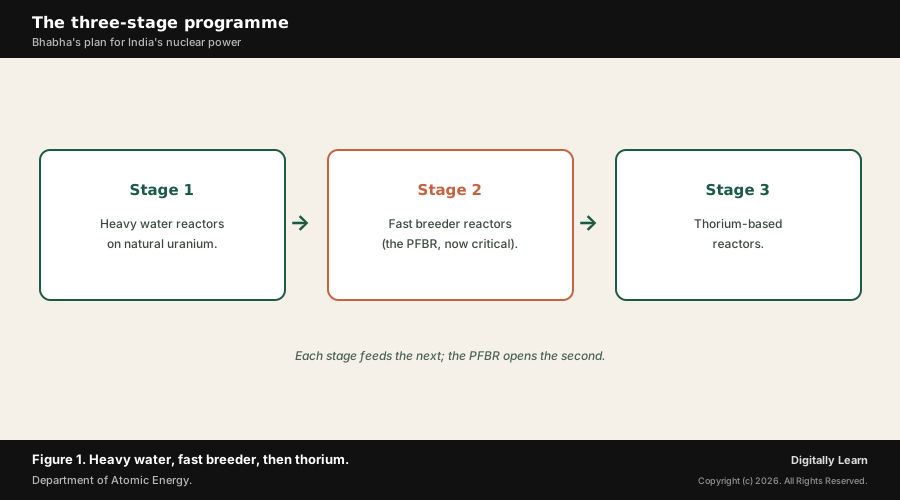
A fast breeder reactor is a nuclear reactor that produces, or breeds, more fissile fuel than it consumes, using fast neutrons. The Prototype Fast Breeder Reactor (PFBR) is a 500 MWe reactor at Kalpakkam, designed by the Indira Gandhi Centre for Atomic Research and built by BHAVINI under the Department of Atomic Energy. It attained first criticality on 6 April 2026, the point at which a self-sustaining nuclear chain reaction begins. With this, India formally enters the second stage of its three-stage nuclear power programme.
Why the PFBR milestone is in focus
A breeder reactor reaches first criticality
India's Prototype Fast Breeder Reactor, a 500 MWe reactor at Kalpakkam, attained first criticality on 6 April 2026. It is designed by IGCAR and built by BHAVINI under the Department of Atomic Energy.
First criticality is the moment a reactor first sustains a controlled nuclear chain reaction on its own. A fast breeder reactor is one that produces more fissile fuel than it uses.
The milestone matters because it formally takes India into the second stage of its three-stage nuclear power programme, the vision set out by Homi Bhabha decades ago.
The key elements of the development are:
- Milestone: the PFBR attained first criticality on 6 April 2026.
- Capacity: a 500 MWe reactor at Kalpakkam.
- Builders: designed by IGCAR, built by BHAVINI, under the DAE.
- Significance: India enters the second stage of its nuclear programme.
Why the milestone matters
Stretching scarce fuel and bridging to thorium
India has limited uranium but vast thorium reserves. A breeder reactor stretches scarce fuel by making more fissile material than it burns, which is central to long-term energy security.
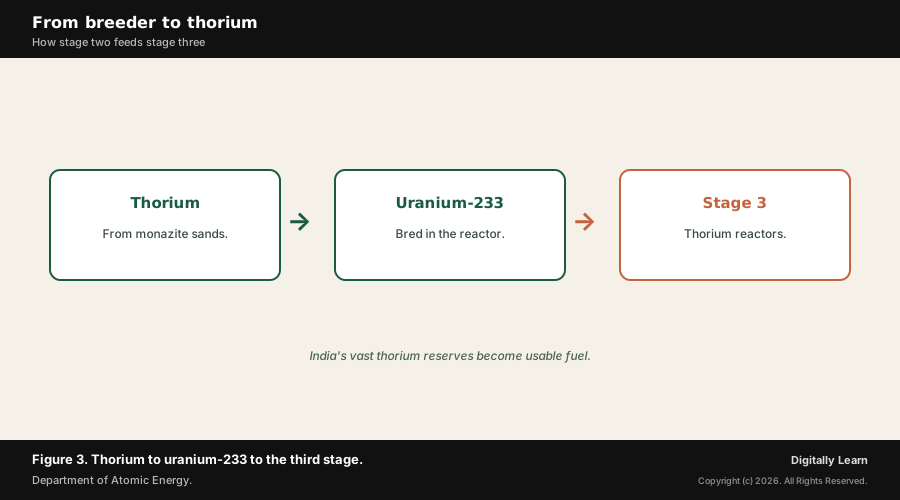
The second stage uses plutonium and uranium to breed fuel, and can wrap the core in a thorium blanket to make uranium-233, the fuel for the planned third stage.
It also marks a rare global achievement. Once fully operational, India will become only the second country after Russia to run a commercial-scale fast breeder reactor.
What the milestone signifies
Fuel security, self-reliance, and a path to thorium
Three threads carry the weight: long-term fuel security, indigenous capability, and the path towards thorium.
First, fuel security. By breeding more fuel than it consumes, the reactor multiplies the energy India can draw from a limited stock of uranium and plutonium.
Second, indigenous capability. The reactor was designed and built at home, by IGCAR and BHAVINI, placing India among very few countries with this technology.
Third, the path to thorium. The second stage is the bridge that will eventually let India run reactors on thorium, of which it holds some of the world's largest reserves.
Distinguishing features of the reactor
The reactor at a glance
The table sets out the key facts, so the identity and role of the PFBR are visible at a glance.
| Feature | Detail |
|---|---|
| Reactor | Prototype Fast Breeder Reactor (PFBR) |
| Capacity | 500 MWe |
| Location | Kalpakkam, Tamil Nadu |
| Milestone | First criticality on 6 April 2026 |
| Designed / built by | IGCAR / BHAVINI, under the DAE |
Three features that define a breeder
Three traits set a fast breeder reactor apart from an ordinary one:
- (i) Fast neutrons. It works without slowing neutrons down, which lets it breed new fuel efficiently.
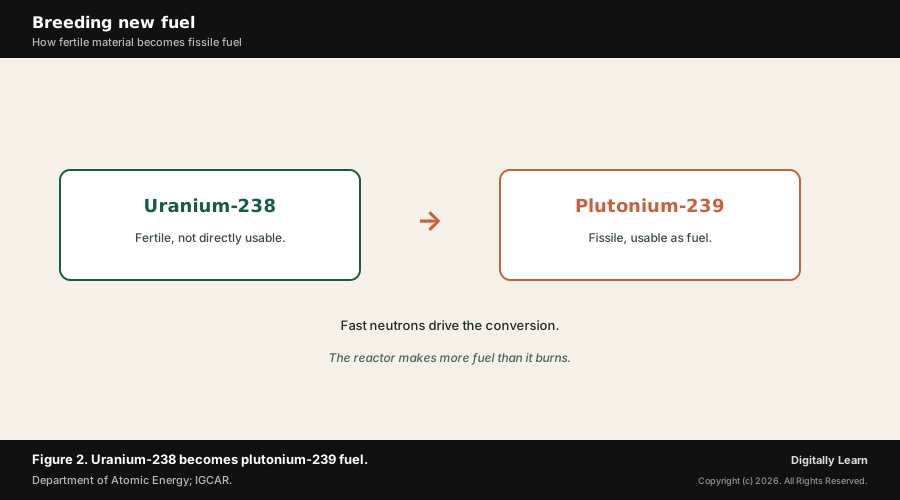
- (ii) Breeds fuel. It converts fertile uranium-238 into fissile plutonium-239, making more fuel than it burns.
- (iii) Mixed-oxide fuel and a blanket. It runs on uranium-plutonium mixed-oxide fuel, wrapped in a uranium-238 blanket that breeds fresh plutonium.
Observable outcomes
Three trackable outcomes
The criticality milestone translates into three developments to watch in the nuclear programme.
- (a) Grid power. After tests, the reactor is expected to begin commercial electricity generation later in 2026.
- (b) More breeders. Additional fast breeder reactors are planned, building on the PFBR’s performance.
- (c) Towards thorium. Success here moves India closer to the thorium-based third stage.
Criticality is a beginning, not the finish. Steady, safe operation at full power over time is what will prove the technology.
Thorium, energy security and the climate goal
Thorium reserves, the third stage and clean energy
The programme rests on India's large thorium reserves, found in beach sands as the mineral monazite, which the third stage is meant to use as fuel.
It supports energy security, since breeding fuel at home reduces dependence on imported uranium and on fossil fuels for electricity.
It also aids the climate goal, because nuclear power is low-carbon and can provide steady base-load electricity alongside solar and wind.
UPSC relevance and exam focus
Where this fits in the UPSC-CSE syllabus
This topic maps to General Studies Paper III: science and technology, energy, and indigenisation of technology, with links to environment and energy security.
For Prelims, hold the high-yield facts: what a fast breeder reactor does, the three-stage programme, the roles of IGCAR and BHAVINI, and thorium as the third-stage fuel.
For Mains, two framings recur: the advantage of the fast breeder programme, and nuclear energy in India's clean-energy mix.
Recurring linked concepts an aspirant should keep in working memory:
- Three-stage programme: heavy water, fast breeder, then thorium.
- Fast breeder reactor: makes more fissile fuel than it consumes.
- IGCAR and BHAVINI: the design and build agencies under the DAE.
- Thorium and monazite: India’s large reserves for the third stage.
A breeder reactor produces more fissile fuel than it consumes; it does not create energy from nothing. Misreading this as perpetual energy is an error.
Do not present nuclear power as risk-free. A balanced answer weighs energy security against safety, cost and waste.
Previous Year UPSC-CSE Questions By the end you will be able to draft model answers for the following UPSC questions. Each question carries a collapsible framework showing how to approach it in the exam.
- UPSC Mains 2017 GS-IIIGive an account of the growth and development of nuclear science and technology in India. What is the advantage of fast breeder reactor programme in India?
How to structure the answer in the exam
Introduction: Open with the three-stage programme as the spine of India's nuclear effort.
Body (sub-themes to develop):
- Growth: from the first reactors to indigenous design.
- The three stages and where breeders fit.
- Advantage: breeding fuel and stretching scarce uranium.
- Bridge to thorium and long-term energy security.
- The PFBR at Kalpakkam as the realised milestone.
Conclusion: Conclude that the breeder programme is key to India's self-reliant, long-term energy security.
- UPSC Prelims 2022With reference to India, consider the following statements:
- Monazite is a source of rare earths.
- Monazite contains thorium.
- Monazite occurs naturally in the entire Indian coastal sands in India.
- In India, Government bodies only can process or export monazite.
Which of the statements given above are correct?
How to approach this Prelims question
Approach: Test each statement about monazite and its handling in India.
Trap to watch: Monazite is a source of rare earths and contains thorium, and only government bodies may process or export it; but it does not occur in the entire coastal sands, so statement 3 is wrong, giving 1, 2 and 4 only.
Key facts to recall:
- Monazite is a source of rare earths and contains thorium.
- Its processing and export are restricted to government bodies.
- It is found in specific beach-sand deposits, not all coastal sands.
Answer signal: Statements 1, 2 and 4 hold. Correct answer: 1, 2 and 4 only.
Sources and Further Reading
- Department of Atomic Energy: Prototype Fast Breeder Reactor at Kalpakkam attains First Criticality
- Press Information Bureau: PFBR at Kalpakkam attains First Criticality
- Department of Atomic Energy: Commencement of Core Loading at India's first indigenous Fast Breeder Reactor (500 MWe), Kalpakkam
- Press Information Bureau: India to be the second country operating a commercial-level Fast Breeder Reactor
- Wikipedia: Prototype Fast Breeder Reactor
- Wikipedia: India's three-stage nuclear power programme
Editorial Disclaimer
This briefing explains the Prototype Fast Breeder Reactor milestone for UPSC preparation. The facts are drawn from the Department of Atomic Energy and the Press Information Bureau. It is an explainer, not a substitute for official communications.


