


Overview
The Union Budget 2024-25 push for compact nuclear power
Small Modular Reactors are compact, factory-built nuclear reactors of up to 300 MWe per module; the Union Budget 2024-25 announced a private-sector partnership for Bharat Small Reactors and research on the Bharat Small Modular Reactor.
A Small Modular Reactor (SMR) is an advanced nuclear reactor that, as the International Atomic Energy Agency defines it, produces electricity of up to 300 MWe per module, roughly a third of a conventional large reactor. What sets these reactors apart is how they are made and deployed: they are designed to be factory-built as standard modules, shipped to the site, and added one module at a time as demand grows, which is the modular and scalable idea at the heart of the concept. Being smaller, they need less land and cooling water and carry stronger inherent and passive safety features, so they can be sited where a large plant cannot. India has taken up this technology as the Bharat Small Reactor and the Bharat Small Modular Reactor, and the Union Budget 2024-25 announced a private-sector partnership to develop them.
What a Small Modular Reactor Is and Why It Is in the News
Compact, factory-built nuclear reactors of up to 300 MWe per module
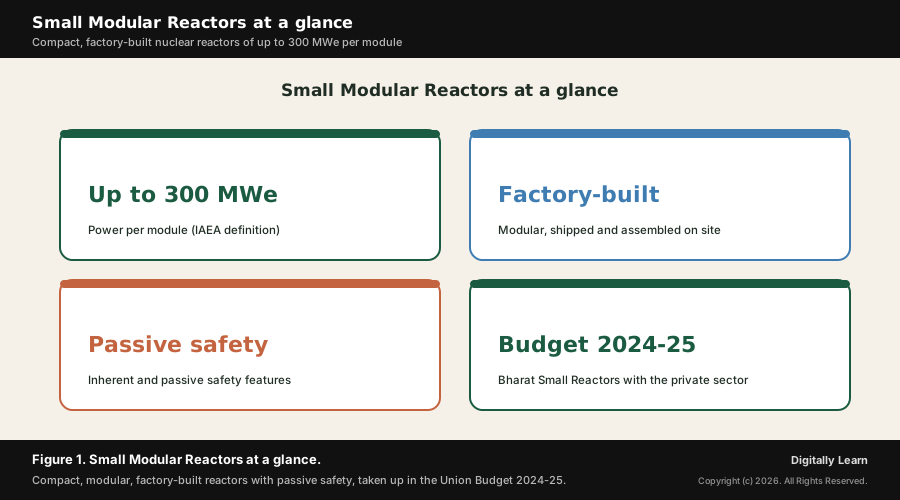
A Small Modular Reactor (SMR) is a nuclear reactor that is much smaller than the large reactors that run today. The International Atomic Energy Agency defines an SMR as an advanced reactor that produces electricity of up to 300 MWe per module, which is around a third of the capacity of a conventional large unit. The word small refers to this lower power per module, not to any cut in nuclear safety or rigour.
The defining idea is in the second word, modular. An SMR is designed to be built as a standard module in a factory, shipped to the site and assembled there, rather than constructed piece by piece on site like a large plant. Because the modules are standardised, a station can start with one and add more as demand grows. This factory-build and add-as-you-go approach is meant to cut construction time, reduce cost overruns and make the technology easier to finance.
SMRs also tend to carry stronger inherent and passive safety features, which use natural forces such as gravity and natural circulation to cool the reactor and need less operator action or external power in an emergency. Worldwide the IAEA counts more than 80 SMR designs and concepts under development, spanning many reactor types. The figure below sets out the headline facts that an aspirant should hold.
Why SMRs are in the news: the Union Budget 2024-25 announcement
Why it matters now is a policy decision. In the Union Budget 2024-25, presented on 23 July 2024, the government stated that nuclear energy is expected to form a very significant part of the energy mix for a developed India, and announced that it will partner with the private sector on nuclear power. This marked a notable shift for a sector that India has run almost entirely through the state.
The Budget set out three linked steps. The government will partner with the private sector for setting up Bharat Small Reactors, for the research and development of the Bharat Small Modular Reactor, and for newer nuclear technologies. These steps put small reactors at the centre of India's nuclear plans and opened the door, at this scale for the first time, to private participation, which is why the topic became live for the exam.
Features of SMRs Compared with Conventional Large Reactors
Size, modular construction, passive safety, siting and end-use
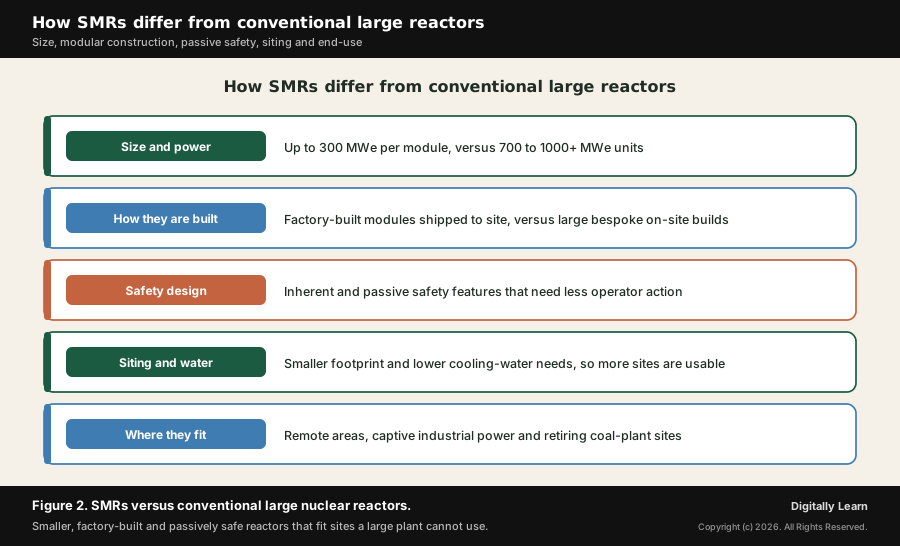
The first difference is size and power. A conventional Indian reactor produces several hundred to over a thousand megawatts, while an SMR produces up to 300 MWe per module. The smaller output means a smaller and simpler plant, which lowers the upfront capital a single unit needs and makes the investment easier to stage and to finance, an important advantage given how costly large nuclear projects are.
The second difference is how they are built. A large plant is a bespoke construction project, built mostly on site over many years. An SMR is meant to be factory-built as a repeatable module and shipped to the site, so the same design can be produced again and again. This standardisation aims to shorten construction, reduce the cost overruns that plague big projects, and let a station add modules one at a time as demand rises.
The third difference is safety design. Many SMRs rely on inherent and passive safety: they use natural forces such as gravity, natural circulation and large heat sinks to keep the core cool, so that in an emergency the reactor can shut down and cool itself with little or no operator action or outside power. This passive approach is one of the main reasons SMRs are presented as a safer generation of reactors.
The fourth difference is siting and water. Their smaller footprint and lower cooling-water needs let SMRs be placed where a large plant cannot, including remote areas and sites with limited grid or water. The fifth difference is where they fit: SMRs suit captive power for industry, power for remote regions, and building on or near retiring coal-plant sites that leave usable land and grid links. The table and figure below contrast the two.
| Feature | Conventional large reactor | Small Modular Reactor |
|---|---|---|
| Power per unit | Several hundred to over 1000 MWe | Up to 300 MWe per module |
| Construction | Bespoke, built on site over years | Factory-built modules shipped to site |
| Scaling | One large unit at a time | Add modules as demand grows |
| Safety | Largely active safety systems | Inherent and passive safety features |
| Siting and water | Large footprint, high cooling water | Smaller footprint, lower cooling water |
| Best fit | Large grid-connected base load | Captive industry, remote sites, coal sites |
Reading the rows together shows the pattern: an SMR trades the scale of a large plant for flexibility, standardised construction and passive safety, which is what lets it reach sites and uses the big reactors cannot serve.
India's Two Tracks: Bharat Small Reactor and Bharat Small Modular Reactor
The Bharat Small Reactor: a 220 MW PHWR for captive industrial use
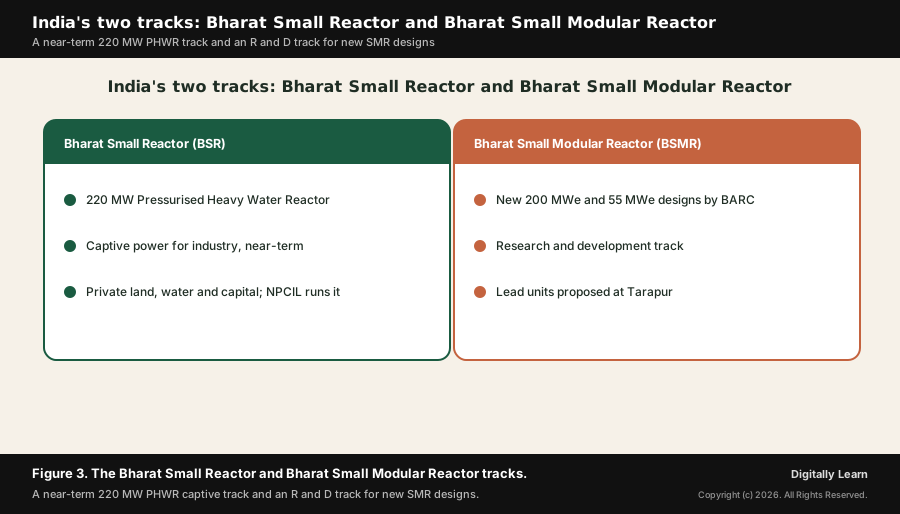
India is pursuing small reactors along two distinct tracks, and it is important to keep them apart. The first is the Bharat Small Reactor (BSR). A BSR is a 220 MW Pressurised Heavy Water Reactor, a smaller version of the proven PHWR design that India has built and operated for decades, with a well-established safety and performance record. It is the near-term track because it rests on technology India already masters.
The BSR is being adapted for a new purpose. The reactors are being upgraded to reduce land requirements so they can sit near energy-hungry industries such as steel, aluminium and metals, and run as captive plants supplying firm, low-carbon power to help those industries decarbonise.
To bring in private capital, the Nuclear Power Corporation of India Limited has invited proposals under which a private entity provides the land, cooling water and capital, while NPCIL keeps the design, quality assurance and operation in its own hands, all within the existing legal framework.
The Bharat Small Modular Reactor: new designs under research and development
The second track is the Bharat Small Modular Reactor (BSMR), which is a research and development effort to design genuinely new small modular reactors rather than to shrink an existing one. Here the Bhabha Atomic Research Centre is leading the design of next-generation reactors, including a 200 MWe Bharat Small Modular Reactor (BSMR-200) and a smaller 55 MWe SMR (SMR-55), alongside a high-temperature gas-cooled reactor intended for hydrogen production.
This track is at an earlier stage than the BSR. Lead units of the BSMR-200 and the SMR-55 are proposed to be built at the Tarapur Atomic Power Station in Maharashtra, and India has set a goal of having at least five indigenously designed SMRs operational over the coming years. Key materials and components, such as a specially developed reactor-vessel alloy, are being produced indigenously with Indian industry, which keeps the technology domestic. The figure below separates the two tracks.
The Institutional Architecture: DAE, NPCIL, BHAVINI and BARC
The Department of Atomic Energy and the Nuclear Power Corporation
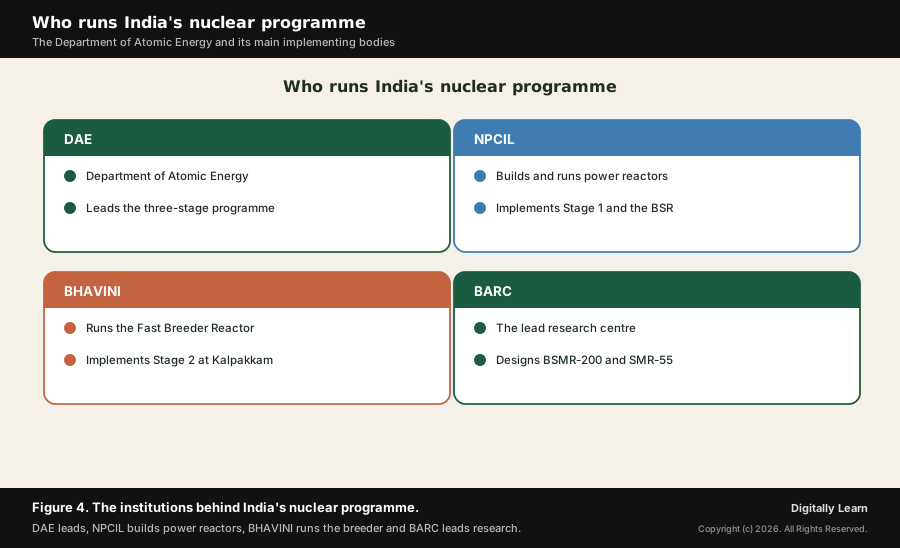
India's nuclear programme is run by a small set of specialised bodies, and the exam rewards knowing exactly what each does. At the apex is the Department of Atomic Energy (DAE), which works directly under the Prime Minister and steers the whole programme, from research and fuel to power generation and regulation of the supply chain. It is the DAE that owns India's three-stage nuclear programme and the small-reactor push within it.
The Nuclear Power Corporation of India Limited (NPCIL) is the public-sector company that actually builds and operates India's nuclear power plants. NPCIL implements the first stage of the programme, the fleet of Pressurised Heavy Water Reactors, and it is NPCIL that is delivering the Bharat Small Reactor, inviting private partners and retaining design, quality assurance and operation in its own hands. In effect NPCIL is the operator on whom the law places responsibility for a plant's safe running.
BHAVINI and the Bhabha Atomic Research Centre
Bharatiya Nabhikiya Vidyut Nigam Limited (BHAVINI) is the company set up to implement the second stage of the programme, the Fast Breeder Reactors. BHAVINI built and is commissioning India's Prototype Fast Breeder Reactor at Kalpakkam, whose technology was developed by the Indira Gandhi Centre for Atomic Research. The breeder stage is central to the long-term plan because it makes more fuel than it consumes and bridges to thorium.
The Bhabha Atomic Research Centre (BARC) is the lead research and development institution of the DAE. BARC designs and develops new reactor technology, and it is BARC that is creating the Bharat Small Modular Reactor designs, the BSMR-200 and the SMR-55, together with the high-temperature reactor for hydrogen. In short, the DAE leads, NPCIL builds and runs the power reactors, BHAVINI runs the breeder, and BARC does the research that produces the new designs. The figure below maps these roles.
The Three-Stage Programme and the Net-Zero-2070 and Energy-Security Link
Where SMRs sit in India's three-stage nuclear programme
To place SMRs correctly, an aspirant must know India's three-stage nuclear programme, conceived by Dr Homi Jehangir Bhabha to make the most of India's modest uranium reserves and very large thorium reserves. The first stage uses Pressurised Heavy Water Reactors fuelled by natural uranium, whose spent fuel yields plutonium. The second stage uses that plutonium in Fast Breeder Reactors, which produce more fuel than they consume and breed uranium-233 from thorium.
The third stage would then use that uranium-233 with India's abundant thorium to deliver large-scale, long-term power and underpin the country's energy security. Small reactors do not replace this three-stage design; they sit alongside it. The Bharat Small Reactor builds on the mature first-stage PHWR, while the Bharat Small Modular Reactor research widens the toolkit, adding compact, flexible reactors that can serve places and uses the big three-stage fleet was never meant to reach.
The clean-energy, net-zero-2070 and energy-security case
SMRs matter so much now because of India's climate and energy goals. At the Glasgow climate conference in 2021 India announced its Panchamrit commitments, including reaching 500 GW of non-fossil capacity by 2030 and net-zero emissions by 2070. Meeting a net-zero target on a growing economy is widely held to need large amounts of firm, low-carbon power to complement variable solar and wind, and nuclear power is the principal clean source that can run around the clock.
This is where small reactors fit the strategy. Their ability to provide captive clean power to heavy industry helps decarbonise the steel, aluminium and metals sectors that are otherwise hard to green. Their suitability for retiring coal-plant sites lets India reuse land, water and grid links as it shifts away from coal. And by adding firm, dispatchable clean electricity, SMRs strengthen both the net-zero pathway and India's wider energy security, reducing dependence on imported fuels.
The Legal and Regulatory Context: Atomic Energy Act and Nuclear-Liability Law
The Atomic Energy Act 1962 and the question of private participation
Opening nuclear power to private firms runs into India's legal framework, which an answer must engage. The foundation is the Atomic Energy Act, 1962, under which all activities concerning nuclear facilities and radioactive material are carried out. The Act vests the production, development, control and use of atomic energy in the Central Government, which is why nuclear power has effectively been a state monopoly, run by government bodies such as NPCIL and BHAVINI.
The Act has been amended over time, including in 2015, to let government companies form joint ventures with other public undertakings, but it has not allowed a private company to own and operate a nuclear plant on its own. The government has stated that fuller private participation of the kind the Budget envisages would need amending the Atomic Energy Act, 1962, and a DAE task force has examined the changes.
The Atomic Energy Regulatory Board (AERB) remains the independent regulator of nuclear and radiation safety. It would license any new reactor and oversee its safe operation, so opening the sector to private firms would widen the regulator's task rather than reduce it, which is itself one of the practical questions reform must settle.
The Civil Liability for Nuclear Damage Act 2010 and the supplier-liability debate
The second legal pillar is the Civil Liability for Nuclear Damage Act, 2010, passed to provide prompt compensation to victims of a nuclear incident. Under Section 4(4) the liability of the operator of a nuclear installation is strict and based on no-fault liability, so victims need not prove negligence, and the law channels liability primarily to the operator, who must hold financial cover. This design follows the international pattern for nuclear-damage compensation.
The much-debated feature is supplier liability. Through Section 17 and the related rules, the Act gives the operator, in defined circumstances, a right of recourse against the supplier of the reactor or its equipment, which is unusual internationally and a long-standing concern for vendors.
As India opens nuclear power to private operators and suppliers, the government has indicated the CLND Act too may need amendment. The debate over balancing victims' protection, investor confidence and supplier comfort is genuine, and a UPSC answer should present it in neutral, attributed terms rather than taking a side.
Challenges and the Facts and Fears of Nuclear Expansion
Financing, regulation, the fuel cycle, public acceptance and liability
A balanced view must weigh the challenges, which are also the fears that any nuclear expansion raises. The first is financing and first-of-a-kind cost. New SMR designs are not yet proven at commercial scale, so the early units carry high first-of-a-kind costs, and the economics depend on building many standardised modules to bring the price down, a market that does not yet exist. Until that scale arrives, the cost advantage remains a promise rather than a fact.
The second is regulation and law. Licensing a fleet of small reactors, possibly at many sites and run by private operators, is a new task for the regulator, and the reforms to the Atomic Energy Act and the nuclear-liability law are still being worked out. The third is the fuel cycle and waste: more reactors of greater variety mean more diverse spent fuel to manage and store safely, adding to the nuclear-waste question.
The fourth is public acceptance and safety. Memories of past nuclear accidents make communities wary, and siting reactors closer to industry or towns can sharpen those concerns, so transparent safety regulation and public trust are essential. These are the genuine fears that any nuclear expansion must answer.
Set against the fears are the facts in favour of expansion: nuclear power is clean, firm and dispatchable, it supports net-zero and energy security, and SMRs add flexibility to serve industry and remote regions. The honest position is that the case for cautious, well-regulated expansion is strong, while the fears around cost, waste, liability and safety are real and must be addressed, not dismissed.
Significance and the Road Ahead for India's Small-Reactor Programme
Firm clean power, private capital and the steps to deployment
What is the significance of this small-reactor push is that it could change how India adds clean power. Small reactors promise firm, low-carbon electricity that can be sited flexibly, supplied to industry as captive power, and built where retiring coal plants leave usable land and grid links. By drawing in private capital, the Budget 2024-25 approach also aims to speed a programme the state alone expanded slowly, while keeping safety and operation in public hands through NPCIL.
The way forward has clear steps. India can complete the legal reforms to the Atomic Energy Act and the nuclear-liability law so that private participation opens up while victims and public safety stay protected. It can prove the Bharat Small Reactor at a first captive site, push the Bharat Small Modular Reactor designs from research to deployment, strengthen the regulator, and keep waste management robust. Handled carefully, the programme can become a real pillar of India's clean-energy and energy-security strategy.
UPSC Relevance and Exam Focus
Where SMRs and the Bharat Small Reactor fit in the UPSC-CSE syllabus
This topic maps most directly to General Studies Paper III: science and technology developments and their applications, and awareness in the field of energy, with a strong overlap into nuclear energy, infrastructure and the environment-and-climate parts of the syllabus. It also connects to economic-development themes through energy security and the role of the private sector in a strategic industry.
For Prelims, hold the high-yield facts: an SMR is an advanced reactor of up to 300 MWe per module, factory-built, modular and passively safe; the Bharat Small Reactor is a 220 MW PHWR for captive industrial use, while the Bharat Small Modular Reactor is a new BARC design under research.
Also hold the institutions and the law: the Budget 2024-25 opened private-sector partnership; the implementing bodies are DAE, NPCIL, BHAVINI and BARC; and the governing laws are the Atomic Energy Act, 1962 and the Civil Liability for Nuclear Damage Act, 2010, with the AERB as the safety regulator. The recurring linked concepts below are worth holding in working memory:
- Three-stage nuclear programme: India’s PHWR, Fast Breeder and thorium roadmap, within which small reactors are placed.
- Net-zero 2070 and Panchamrit: India’s climate commitments, including 500 GW of non-fossil capacity by 2030, that drive the clean-energy case.
- Atomic Energy Act 1962 and CLND Act 2010: India’s laws that govern who may run a nuclear plant and who is liable for nuclear damage.
- Energy security and the energy mix: India’s need for firm, low-carbon nuclear power alongside solar and wind in the future grid.
For Mains, the recurring framing is whether and how India should expand nuclear power, weighing the facts and fears, and assessing the role of new tools such as SMRs and private participation. A strong answer ties SMRs to the net-zero-2070 and energy-security goals, sets them within the three-stage programme, and handles the legal and liability reforms and the safety, cost and waste concerns in measured, attributed terms.
A common Prelims trap is to confuse the Bharat Small Reactor with the Bharat Small Modular Reactor, or to mix up which body does what; hold that the BSR is a 220 MW PHWR delivered by NPCIL while the BSMR is a new BARC design, and that DAE leads, NPCIL and BHAVINI build and operate, and BARC researches.
A common Mains trap is to treat nuclear expansion as either wholly good or wholly bad. Its exam value lies in a balanced judgment: the genuine facts of clean, firm power for net-zero and industry, set honestly against the fears around first-of-a-kind cost, the fuel cycle and waste, public acceptance, and the unresolved legal and liability reforms, with a cautious, well-regulated path recommended.
Previous Year UPSC-CSE Questions By the end you will be able to draft model answers for the following UPSC questions. Each question carries a collapsible framework showing how to approach it in the exam.
- UPSC Mains 2018 GS-IIITake a position on whether India should keep expanding its nuclear energy programme, and discuss the facts and the fears associated with nuclear energy.
How to structure the answer in the exam
Body (sub-themes to develop):
- The case for expansion (the facts): nuclear power is clean, firm and dispatchable, complements variable solar and wind, supports net-zero 2070 and 500 GW of non-fossil capacity by 2030, and underpins energy security by cutting import dependence.
- Why new tools help: small modular reactors and the Bharat Small Reactor add flexibility, can supply captive clean power to hard-to-decarbonise industry and can reuse retiring coal-plant sites, while the three-stage programme and thorium offer long-term fuel security.
- The fears: high first-of-a-kind cost and an unproven SMR market, the licensing and regulatory burden, the fuel cycle and spent-fuel and waste management, public acceptance and safety concerns after past accidents.
- The legal and liability dimension: opening the sector to private firms needs amendments to the Atomic Energy Act, 1962 and the Civil Liability for Nuclear Damage Act, 2010, where the supplier-liability provision is contested and must be balanced against victims' protection.
- A measured position: continue expansion but in a cautious, well-regulated way, completing the legal reforms, proving the first Bharat Small Reactor, strengthening the regulator and keeping waste management and public trust robust.
Sources and Further Reading
- Press Information Bureau: India taking steps for development of Small Modular Reactors with up to 300 MW capacity
- Press Information Bureau: Small Modular Reactors (Department of Atomic Energy)
- Wikipedia: Bharat Small Modular Reactor
- Press Information Bureau: Highlights of the Union Budget 2024-25
- Press Information Bureau: NPCIL Invites Proposals for Setting Up 220 MW Bharat Small Reactors (BSR) for Captive Use
- Department of Atomic Energy: Prototype Fast Breeder Reactor at Kalpakkam and the three-stage programme
- Bhabha Atomic Research Centre: BARC activities for the Indian Nuclear Power Programme
- Nuclear Power Corporation of India Limited: Frequently Asked Questions
- India Code: The Atomic Energy Act, 1962
- India Code: The Civil Liability for Nuclear Damage Act, 2010
- Atomic Energy Regulatory Board: Acts and Regulations
- Wikipedia: Small modular reactor
Editorial Disclaimer
This briefing is for UPSC preparation. Verify the facts and provisions against the official IAEA, PIB and DAE sources before relying on them.


