


Overview
States of matter, atomic models, isotopes and electronic configuration
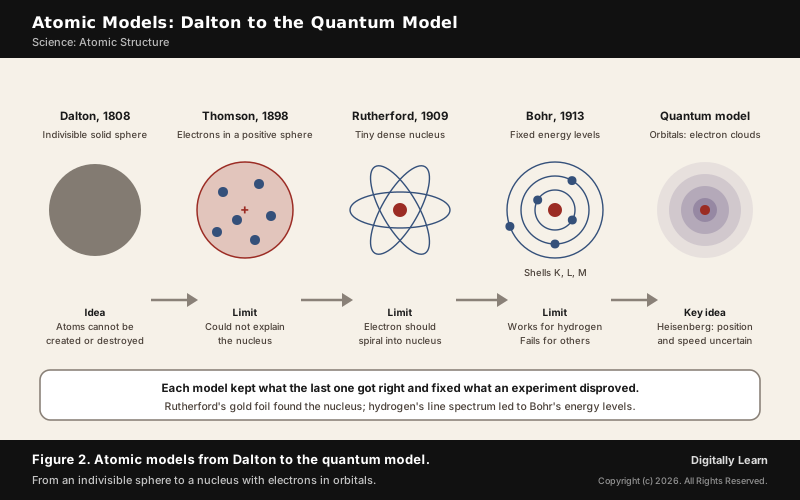
Atomic structure is the arrangement of the particles inside an atom: a tiny, dense nucleus of protons and neutrons, with electrons in orbitals around it. The number of protons fixes the element, the neutrons fix its isotope, and the way the electrons are arranged, its electronic configuration, decides how it reacts.
Matter, Its Classification and Changes of State
What Is Matter: Elements, Compounds and Mixtures
Everything that occupies space and has mass is matter: the air we breathe, the food we eat, stones, clouds and stars. Early Indian philosophers grouped matter into five basic elements, the Panch Tatva of air, earth, fire, sky and water. Modern science classifies it instead by its physical properties and its chemical nature.
- Element: A basic form of matter that cannot be broken into simpler substances by chemical reactions, the definition Antoine Lavoisier established. Elements are divided into metals, non-metals and metalloids such as boron, silicon and germanium.
- Compound: Two or more elements chemically combined in a fixed proportion; its properties differ from those of the elements that form it.
- Mixture: Two or more substances mixed without forming a new compound; its composition can vary and it keeps the properties of its parts.
- A few numbers: Mercury is the only metal that is liquid at room temperature; mercury and bromine are the two liquid elements, and eleven elements are gases at room temperature.
The same idea separates a physical change from a chemical change. Mixing iron filings with sulphur and crushing them gives a mixture that a magnet can still separate: a physical change. Heating the same mixture until it glows gives iron sulphide, a new compound with new properties: a chemical change, or chemical reaction.
States of Matter: Solid, Liquid, Gas, Plasma and Bose-Einstein Condensate
Matter is made of tiny particles that have space between them, attract one another and are always moving. How strongly they attract and how fast they move decides the state. The forces of attraction are greatest in solids, intermediate in liquids and least in gases, while the space between particles and their kinetic energy rise in the same order.
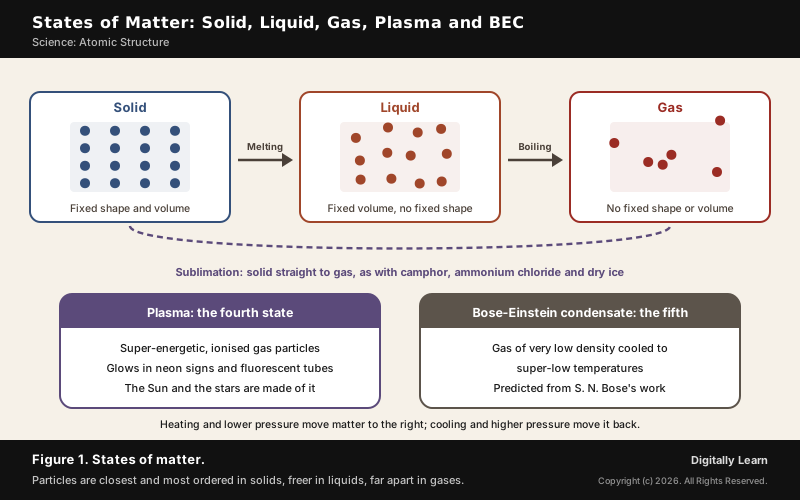
- Solid: A definite shape, distinct boundaries and a fixed volume, with negligible compressibility.
- Liquid: No fixed shape but a fixed volume; liquids flow and take the shape of their container.
- Gas: Highly compressible and fills its container; the pressure of a gas is the force its particles exert per unit area on the walls. LPG, medical oxygen and CNG are compressed gases.
- Plasma: Super-energetic, ionised gas particles. It glows in neon signs and fluorescent tubes, and the Sun and the stars glow because they are made of plasma; about 99.9 per cent of ordinary matter in the universe is estimated to be plasma.
- Bose-Einstein condensate: Formed by cooling a gas of extremely low density, about one hundred-thousandth the density of air, to super-low temperatures, close to absolute zero.
The fifth state carries an Indian name. Satyendra Nath Bose did the calculations for it: NCERT dates them to 1920, while other accounts date his decisive paper to 1924. Bose derived Planck's radiation law by counting particles of light as identical and indistinguishable; Albert Einstein translated the paper, extended the idea to atoms and predicted the Bose-Einstein condensate.
- Bosons: Paul Dirac named particles that obey Bose’s statistics bosons. They have whole-number spin; the other class, fermions, have half-number spin.
- Made in a laboratory: Eric Cornell and Carl Wieman created the first condensate in 1995 with rubidium atoms, and Wolfgang Ketterle made one with sodium atoms; the three shared the 2001 Nobel Prize in Physics.
- Wider reach: The Higgs boson, recognised in the 2013 Nobel Prize, belongs to the same class, and Bose’s statistics underlie superfluidity and superconductivity.
Changes of State: Melting, Boiling, Sublimation and Latent Heat
Heating gives particles more kinetic energy until they overcome the forces holding them. The temperature at which a solid melts at atmospheric pressure is its melting point; ice melts at 273.16 K. The temperature at which a liquid boils is its boiling point; for water it is 373 K, or 100 °C.
- Latent heat: While ice melts, its temperature stays the same even though heat keeps flowing in. That hidden heat breaks the forces between particles. The latent heat of fusion changes 1 kg of solid to liquid at its melting point; the latent heat of vaporisation changes 1 kg of liquid to gas at its boiling point.
- Why steam burns more: Particles in steam at 100 °C carry extra energy, the latent heat of vaporisation, compared with water at the same temperature. Vaporising water takes far more heat than melting ice, which is why steam is also the more hazardous.
- Sublimation: Some substances pass straight from solid to gas, such as camphor and ammonium chloride. Solid carbon dioxide, dry ice, sublimes at −78.5 °C at normal pressure.
- Evaporation: A surface process at any temperature below boiling, faster with more surface area, heat and wind and slower in humid air; it causes cooling, which is why sweating cools the body.
Pressure matters as much as temperature. Applying pressure and cooling can liquefy a gas. A liquid boils when its vapour pressure equals the pressure outside, so at high altitudes, where air pressure is low, water boils below 100 °C; that is why a pressure cooker is needed in the hills.
Atomic Structure: Electron, Proton, Neutron and the Nucleus
Dalton's Atomic Theory and the Laws of Chemical Combination
Atomic structure begins with two laws. The law of conservation of mass says mass can neither be created nor destroyed in a chemical reaction. The law of constant proportions, stated by Proust, says a compound always has its elements in the same proportion by mass: hydrogen and oxygen in water are always in the ratio 1:8.
John Dalton explained both laws in 1808 with his atomic theory. Atoms are extremely small: their radii are measured in nanometres, and the atom of hydrogen has a radius of about 10⁻¹⁰ m.
- Tiny particles: All matter is made of atoms.
- Indivisible: Atoms cannot be created or destroyed in a chemical reaction.
- Same element, same atoms: Atoms of an element are identical in mass and chemical properties; atoms of different elements differ.
- Whole numbers: Atoms combine in small whole-number ratios, and a given compound always has the same relative number and kinds of atoms.
Discovery of the Electron, Proton and Neutron
The atom turned out to be made of smaller particles. In cathode ray tubes, a stream of particles moved from the negative electrode to the positive one and behaved like negative charges whatever the gas or the metal used, so these electrons had to be part of every atom. J. J. Thomson measured their charge-to-mass ratio in 1897, and R. A. Millikan's oil drop experiment found their charge.
| Particle | Charge and mass | Discovery |
|---|---|---|
| Electron | Negative; about 1/2000 of the mass of a hydrogen atom | J. J. Thomson, from cathode rays |
| Proton | Positive; mass taken as one unit | Canal rays found by E. Goldstein in 1886 |
| Neutron | No charge; mass nearly equal to a proton | J. Chadwick in 1932, by bombarding beryllium |
Protons and neutrons sit together in the nucleus and are called nucleons. Neutrons are present in the nucleus of every atom except ordinary hydrogen, whose nucleus is a single proton.
Atomic Number, Mass Number and Nucleons
Two numbers describe every atom. The atomic number, Z, is the number of protons in the nucleus; in a neutral atom it equals the number of electrons. Elements are defined by it: every hydrogen atom has Z = 1 and every carbon atom Z = 6. The mass number, A, is the total of protons and neutrons.
- Carbon: 6 protons and 6 neutrons give a mass of 12 u.
- Aluminium: 13 protons and 14 neutrons give 27 u.
- Notation: Nitrogen is written with mass number 14 above and atomic number 7 below its symbol, N.
- Average mass: Chlorine occurs as 35 u and 37 u atoms in the ratio 3:1, so its average atomic mass is 35.5 u, though no single atom weighs that.
Atomic Models: From Thomson to the Bohr Model
Thomson Model and Rutherford Model of the Atom
The first picture came from J. J. Thomson, who compared the atom to a Christmas pudding: electrons studded in a sphere of positive charge, like seeds in a watermelon. It explained why an atom is neutral, but not what Ernest Rutherford saw when he fired fast alpha particles at a thin gold foil.
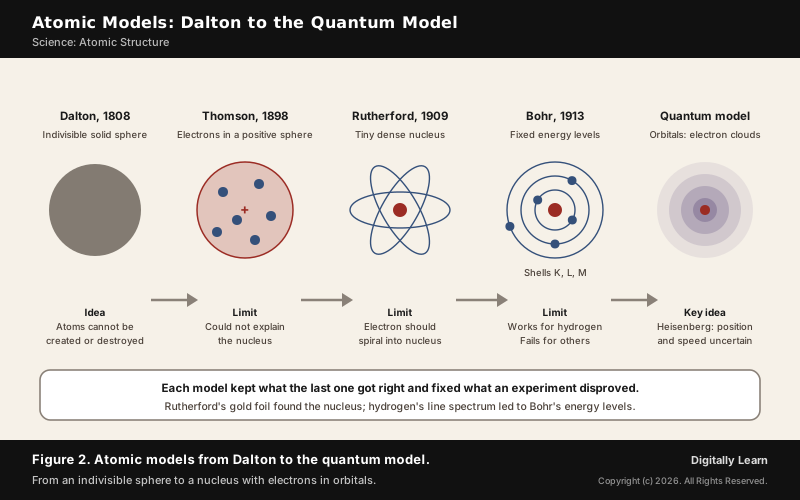
- Most went straight through: So most of the atom is empty space.
- A few were deflected: So the positive charge occupies very little space.
- About 1 in 12,000 bounced back: So the positive charge and nearly all the mass sit in a tiny centre, the nucleus. The radius of an atom is about 10⁻¹⁰ m and that of its nucleus about 10⁻¹⁵ m.
Rutherford's nuclear model put a small positive nucleus at the centre with electrons revolving round it, like planets round the Sun. It had one fatal flaw: an electron moving in a circle is accelerating, and an accelerating charge should radiate energy and spiral into the nucleus, so atoms could not be stable.
Bohr Model of the Atom: Energy Levels and Line Spectra
Niels Bohr fixed the flaw in 1913. His Bohr model keeps Rutherford's nucleus but allows electrons only certain orbits, and an electron in one of these orbits does not radiate energy.
- Stationary orbits: Electrons move in orbits of fixed radius and energy, called energy levels or shells and labelled K, L, M, N or n = 1, 2, 3, 4.
- Jumps: An electron absorbs energy to move to a higher orbit and gives out energy when it falls to a lower one; the energy changes in steps, not continuously.
- Spectra: These jumps explain the line spectrum of hydrogen, the Lyman, Balmer and Paschen series.
- Shell capacity: The Bohr-Bury scheme puts at most 2n² electrons in a shell (2, 8, 18, 32) and at most 8 in the outermost shell.
Quantum Numbers and Orbitals: The Quantum Mechanical Model
Two ideas replaced fixed orbits. Louis de Broglie proposed in 1924 that matter, like light, behaves as both particle and wave, an idea used in the electron microscope. Werner Heisenberg's uncertainty principle of 1927 says the exact position and exact momentum of an electron cannot be known at the same time.
Quantum mechanics, developed by Heisenberg and Erwin Schrödinger in 1926, therefore describes an electron by an orbital: a region where it is likely to be found, not a fixed path. Each orbital is labelled by quantum numbers.
| Quantum number | What it tells |
|---|---|
| Principal, n | The shell, and the size and largely the energy of the orbital |
| Azimuthal, l | The subshell and the shape of the orbital: s, p, d, f |
| Magnetic, mₗ | The orientation of the orbital in space |
| Spin, mₛ | The spin of the electron: +½ or −½ |
- Orbitals per subshell: One s, three p, five d and seven f orbitals.
- Orbitals per shell: The number is n², so the third shell has nine.
Isotopes, Isobars and Isotones
Isotopes of Hydrogen: Protium, Deuterium, Tritium and Heavy Water
Atoms of the same element with the same atomic number but different mass numbers are called isotopes; they carry different numbers of neutrons. Hydrogen shows all three kinds: protium, with no neutron, makes up 99.985 per cent of hydrogen; deuterium, with one neutron, 0.015 per cent; and tritium, with two, occurs only in trace amounts.
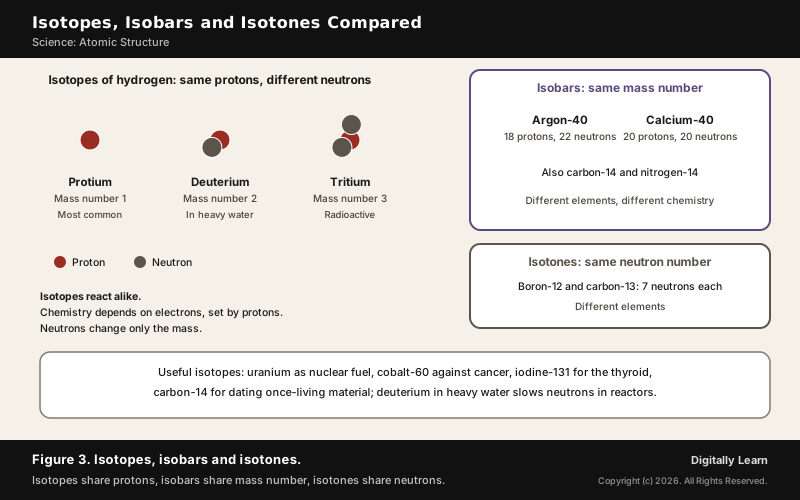
- Heavy water: Water in which the hydrogen atoms are deuterium. It is about 10.6 per cent denser than ordinary water.
- In reactors: Pressurised heavy water reactors use heavy water as coolant and as the moderator that slows neutrons down, which lets them run on natural uranium.
- Discovery: Harold Urey discovered deuterium in 1931 and later concentrated it in water.
- Tritium: Radioactive, with a half-life of 12.32 years; it is used in self-luminous lights and, with deuterium, as fuel in fusion research.
Difference Between Isotopes and Isobars
Isotopes share protons; isobars share a mass number instead. Argon, atomic number 18, and calcium, atomic number 20, both have atoms of mass number 40, so argon-40 and calcium-40 are isobars; carbon-14 and nitrogen-14 are another pair. A third term, isotones, means atoms with the same number of neutrons, such as boron-12 and carbon-13, which have seven each.
| Feature | Isotopes | Isobars |
|---|---|---|
| Same | Atomic number (protons) | Mass number |
| Different | Mass number (neutrons) | Atomic number |
| Element | Same element | Different elements |
| Chemistry | Same chemical properties | Different chemical properties |
| Example | Chlorine-35 and chlorine-37 | Argon-40 and calcium-40 |
Isotopes behave alike in chemistry because chemical properties depend on electrons, and the number of electrons follows the number of protons; neutrons change the mass and the physical properties, such as density, but hardly the chemistry.
Uses of Isotopes in Medicine, Dating, Industry and Nuclear Power
Some isotopes are radioactive, and their radiation is useful. An isotope of uranium is the fuel of nuclear reactors, an isotope of cobalt treats cancer and an isotope of iodine treats goitre.
- Cobalt-60: A synthetic isotope with a half-life of about 5.27 years, made in reactors; its gamma rays are used for radiation therapy and, at the Vadodara plant, to make sewage sludge safe for farms.
- Iodine-131: Half-life about eight days; used to diagnose and treat thyroid disease.
- Carbon-14 dating: Living things take in carbon-14 until they die, after which it decays with a half-life of about 5,730 years; the method, developed by Willard Libby, dates organic material up to about 50,000 years old.
- Industry and water: Isotopes are used to test materials without damaging them and to trace water resources and industrial processes.
India makes most of its medical isotopes through the Board of Radiation and Isotope Technology (BRIT), a unit of the Department of Atomic Energy that supplies isotopes for healthcare, agriculture, research and industry. BRIT meets about 85 to 90 per cent of the country's demand for lutetium-177, used in cancer treatment, while imports still cover part of the need for iodine-131 and molybdenum-99.
Electronic Configuration of Atoms
Aufbau Principle, Pauli Exclusion Principle and Hund's Rule
Electronic configuration is the way an atom's electrons are distributed among its orbitals. It is written as a list of subshells with the number of electrons in each, so sodium is 1s² 2s² 2p⁶ 3s¹. Three rules decide it.
![Diagram of the order in which orbitals fill, read along diagonals from top right to bottom left: 1s, 2s, 2p, 3s, 3p, 4s, 3d, 4p, 5s, 4d, 5p, 4f, 5d, 6p, 7s. The three rules: the aufbau principle, lowest-energy orbitals fill first; the Pauli exclusion principle, at most two electrons per orbital with opposite spins; Hund's rule, each orbital of a subshell takes one electron before any pair up. Worked examples: sodium 1s2 2s2 2p6 3s1; chlorine 1s2 2s2 2p6 3s2 3p5; chromium [Ar] 3d5 4s1 with a half-filled d subshell; copper [Ar] 3d10 4s1 with a filled d subshell.](/wp-content/uploads/dl-figures/atomic-structure-states-of-matter-isotopes/fig-fill-7f65ab793d.svg)
- Aufbau principle: Orbitals fill in order of increasing energy: 1s, 2s, 2p, 3s, 3p, 4s, 3d, 4p, 5s, 4d, 5p, 4f, 5d, 6p, 7s. Aufbau is German for building up.
- Pauli exclusion principle: No two electrons in an atom can have the same four quantum numbers, so an orbital holds at most two electrons, with opposite spins.
- Hund’s rule: Electrons enter each orbital of a subshell singly before any pairing, so pairing in p, d and f subshells begins with the 4th, 6th and 8th electron.
Valence Electrons and Valency: Why Configuration Decides Chemistry
The electrons in the outermost shell are the valence electrons, and they decide how an atom reacts. Atoms with a full outer shell, eight electrons or two in helium, show little chemical activity. Other atoms react to reach such an octet by losing, gaining or sharing electrons, and the number involved is their valency, or combining capacity.
| Element | Electrons in shells | Valency |
|---|---|---|
| Sodium (11) | 2, 8, 1: loses one | 1 |
| Magnesium (12) | 2, 8, 2: loses two | 2 |
| Oxygen (8) | 2, 6: gains two | 2 |
| Chlorine (17) | 2, 8, 7: gains one | 1 |
| Neon (10) | 2, 8: full | 0 |
This is why configuration is the key to the rest of chemistry: it explains why some elements are metals and others non-metals, why helium and argon hardly react and why the halogens are so reactive. Arranged by configuration, the elements fall into the modern periodic table.
Previous Year UPSC-CSE Questions
Previous Year UPSC-CSE Questions By the end you will be able to draft model answers for the following UPSC questions. Each question carries a collapsible framework showing how to approach it in the exam.
- UPSC Prelims 2014 Prelims-GSWhich of the following is/are the example/examples of chemical change?
- Crystallization of sodium chloride
- Melting of ice
- Souring of milk
Select the correct answer using the code given below.
How to approach this Prelims question
Approach: Ask of each case whether a new substance is formed. Crystallisation of salt and melting of ice change form or state only; souring of milk makes new substances, so only statement 3 is a chemical change.
Trap to watch: Crystallisation and melting look dramatic but make nothing new.
Key facts to recall:
- (a) 1 and 2 only: wrong. Crystallising salt and melting ice make no new substance, so neither is a chemical change.
- (b) 3 only: right. Souring of milk forms new substances.
- (c) 1, 2 and 3: wrong. Crystallisation and melting change only form or state.
- (d) None: wrong. The souring of milk is a chemical change.
Answer signal: 3 only, option (b).
- UPSC Prelims 1999 Prelims-GSMatch List I (Naturally occurring substances) with List II (Elements) and select the correct answer using the codes given below the Lists. List II: A) Calcium, B) Silicon, C) Aluminium, D) Carbon.
- I. Diamond
- II. Marble
- III. Sand
- IV. Ruby
Codes:
How to approach this Prelims question
Approach: Recall the key element in each substance: diamond is pure carbon, marble is calcium carbonate, sand is mostly silica, a silicon compound, and ruby is aluminium oxide. Only one code matches all four.
Trap to watch: Sand is silicon-based and ruby aluminium-based; do not swap them.
Key facts to recall:
- (a) I-C, II-A, III-B, IV-D: wrong. Diamond is carbon, not aluminium, and ruby is aluminium-based, not carbon.
- (b) I-D, II-B, III-A, IV-C: wrong. It swaps marble (calcium) and sand (silicon).
- (c) I-B, II-A, III-C, IV-D: wrong. Diamond is not silicon, sand is not aluminium and ruby is not carbon.
- (d) I-D, II-A, III-B, IV-C: right. Diamond is carbon, marble calcium-based, sand silicon-based and ruby aluminium-based.
Answer signal: I-D, II-A, III-B, IV-C, option (d).
- UPSC Prelims 2001 Prelims-GSConsider the following Assertion (A) and Reason (R):
- Assertion (A): The boiling point of water decreases as the altitude increases.
- Reason (R): The atmospheric pressure increases with altitude.
Select the correct answer using the codes given below.
How to approach this Prelims question
Approach: Test A and R separately. The boiling point falls as the pressure on the liquid falls, and atmospheric pressure falls with altitude, so A is true and R, which says pressure rises, is false.
Trap to watch: R reverses the trend: pressure decreases with altitude.
Key facts to recall:
- (a) A and R true, R explains A: wrong. R is false; pressure falls with altitude.
- (b) A and R true, R does not explain A: wrong. R is false, so this cannot hold.
- (c) A true, R false: right. Water boils at a lower temperature higher up because the pressure there is lower.
- (d) A false, R true: wrong. The boiling point does fall with altitude, and pressure does not rise.
Answer signal: A true, R false, option (c).
- UPSC Prelims 2003 Prelims-GSConsider the following statements:
- Steam at 100 °C and boiling water at 100 °C contain the same amount of heat.
- Latent heat of fusion of ice is equal to the latent heat of vaporization of water.
- In an air-conditioner, heat is extracted from the room air at the evaporator coils and is rejected out at the condenser coils.
Which of these statements is/are correct?
How to approach this Prelims question
Approach: Statement 1 ignores the latent heat that steam carries, so it is false. The latent heat of vaporisation of water is far larger than the latent heat of fusion of ice, so statement 2 is false. An air conditioner absorbs heat at the evaporator coils and rejects it at the condenser coils, so statement 3 is true.
Trap to watch: Statement 1 ignores the latent heat carried by steam.
Key facts to recall:
- (a) 1 and 2: wrong. Steam holds more heat than boiling water, and the two latent heats are very different.
- (b) 2 and 3: wrong. Statement 3 is true, but the latent heats of fusion and vaporisation are not equal.
- (c) Only 2: wrong. Statement 2 is false, and it leaves out the true statement 3.
- (d) Only 3: right. The evaporator takes heat from the room and the condenser rejects it outside.
Answer signal: Only 3, option (d).
- UPSC Prelims 2003 Prelims-GSRegarding the atom of a chemical element, the magnetic quantum number refers to
How to approach this Prelims question
Approach: Match each quantum number to what it describes: n gives size and energy, l shape, ml orientation and ms spin. The magnetic quantum number is ml.
Trap to watch: Shape belongs to the azimuthal number, spin to the spin number.
Key facts to recall:
- (a) orientation: right. The magnetic quantum number gives the orientation of an orbital in space.
- (b) shape: wrong. Shape comes from the azimuthal quantum number.
- (c) size: wrong. Size and energy come from the principal quantum number.
- (d) spin: wrong. Spin is given by the spin quantum number.
Answer signal: Orientation, option (a).
- UPSC Prelims 2011 Prelims-GSThe function of heavy water in a nuclear reactor is to
How to approach this Prelims question
Approach: Recall what a moderator does. In a pressurised heavy water reactor, heavy water slows neutrons down so that they can split uranium-235 in natural uranium. It also carries heat away, but its defining function is moderation.
Trap to watch: Heavy water is also a coolant, but the question asks its defining function.
Key facts to recall:
- (a) Slow down the speed of neutrons: right. Heavy water is the moderator that slows neutrons so natural uranium can sustain the chain reaction.
- (b) Increase the speed of neutrons: wrong. A moderator does the opposite; slow neutrons cause fission more readily.
- (c) Cool down the reactor: wrong as the defining function. Heavy water does serve as a coolant too, but its distinctive job is moderation.
- (d) Stop the nuclear reaction: wrong. The rate of reaction is controlled by control rods of neutron-absorbing material such as cadmium.
Answer signal: Slow down the speed of neutrons, option (a).
- UPSC Prelims 2008 Prelims-GSWho among the following discovered heavy water?
How to approach this Prelims question
Approach: Heavy water is water made with deuterium, the heavy isotope of hydrogen, so its discoverer is the discoverer of deuterium: Harold Urey, in 1931.
Trap to watch: Priestley discovered oxygen, not heavy water.
Key facts to recall:
- (a) Heinrich Hertz: wrong. Hertz is known for his work on radio waves.
- (b) H. C. Urey: right. Harold Urey discovered deuterium in 1931 and later concentrated it in water.
- (c) G. Mendel: wrong. Mendel studied heredity.
- (d) Joseph Priestley: wrong. Priestley discovered oxygen, in 1774.
Answer signal: H. C. Urey, option (b).
- UPSC Mains 2018 GS-IIIDiscuss the work of ‘Bose-Einstein Statistics’ done by Prof. Satyendra Nath Bose and show how it revolutionized the field of Physics.
Answer outline: how to structure the answer
What the question asks, the main arguments, relevant examples and the direction of the conclusion. This is not a full model answer.
Introduction: In the 1920s S. N. Bose derived Planck's radiation law by counting particles of light as identical and indistinguishable, the start of quantum statistics.
Body (sub-themes to develop):
- The work: a new way of counting indistinguishable particles; Einstein translated and extended it to atoms.
- Bosons: Dirac named particles obeying Bose statistics; the Higgs boson is one.
- A new state of matter: the Bose-Einstein condensate, predicted then, made in 1995; Nobel Prize 2001.
- Wider reach: superfluidity and superconductivity follow the same statistics.
Conclusion: Conclude that Bose's counting defined one of the two classes of particles in physics, bosons beside fermions, and led to a new state of matter.
Sources
- NCERT: Science (Class IX), Matter in Our Surroundings; Is Matter Around Us Pure; Atoms and Molecules; Structure of the Atom
- NCERT: Chemistry Part I (Class XI), Structure of Atom and States of Matter
- Bhabha Atomic Research Centre: isotope and radiation technology applications
- PIB: Parliament question on medical radioisotopes (Department of Atomic Energy, 6 August 2025)
- India Science, Technology and Innovation portal: Satyendra Nath Bose
- Wikipedia: Atom
- Wikipedia: Bohr model
- Wikipedia: Isotope
- Wikipedia: Bose-Einstein condensate
- Wikipedia: Satyendra Nath Bose
- Wikipedia: Heavy water
- Wikipedia: Radiocarbon dating
- Wikipedia: Dry ice
- UPSC: Civil Services Examination question papers
Editorial Disclaimer
This article draws on the NCERT science and chemistry textbooks, the Department of Atomic Energy and the other sources listed on this page. Some dates in the history of the atom differ slightly between sources.


