


Overview
Reflection and refraction of light are the two ways light changes direction at a surface: reflection sends it back into the same medium, obeying the laws of reflection, and refraction bends it into a new medium because its speed changes, obeying Snell's law. Together with total internal reflection, dispersion and scattering they explain mirrors, lenses, optical fibres, rainbows, the blue sky and the working of the human eye.
Reflection of Light: Plane, Concave and Convex Mirrors
Nature of Light and the Laws of Reflection
Light seems to travel in straight lines: a small source of light casts a sharp shadow of an opaque object, and this straight-line path is drawn as a ray. When an obstacle is very small, light bends around it, an effect called diffraction, and it is then treated as a wave. At other times light behaves like a stream of particles, and modern quantum theory reconciles the two pictures.
We see an object because it reflects the light falling on it into our eyes, and a highly polished surface such as a mirror reflects most of that light. Reflection obeys two laws: the angle of incidence equals the angle of reflection, and the incident ray, the normal at the point of incidence and the reflected ray all lie in the same plane. These laws of reflection hold for every reflecting surface, curved ones included.
- Virtual and erect: The image in a plane mirror cannot be caught on a screen and stands upright.
- Same size: The image is as large as the object.
- Same distance: It is as far behind the mirror as the object is in front.
- Laterally inverted: Left and right are swapped.
Spherical Mirrors: Concave Mirror Image Formation and Uses
A spherical mirror is one whose reflecting surface is part of a sphere. If the surface curves inwards, facing the centre of the sphere, it is a concave mirror; if it bulges outwards, it is a convex mirror. The centre of the mirror's surface is its pole P, the centre of the sphere is its centre of curvature C, and the line through them is the principal axis.
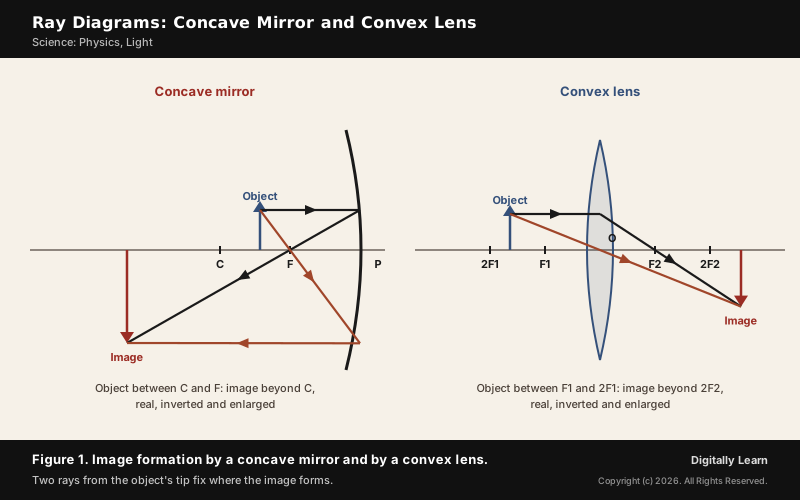
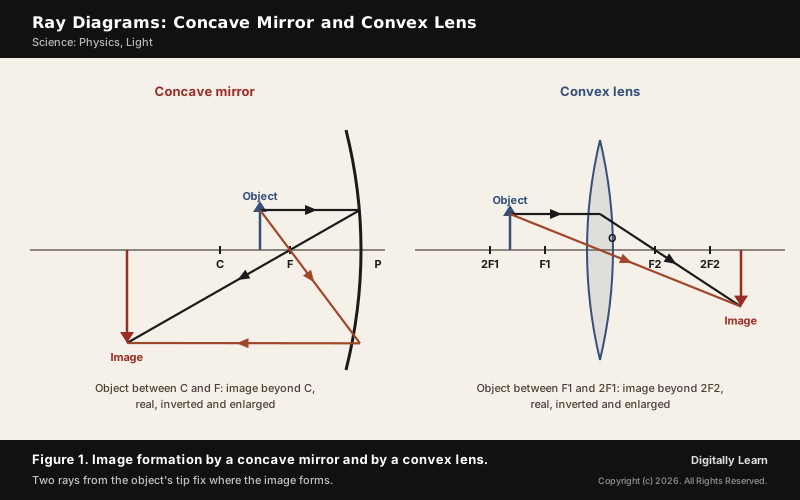
Rays parallel to the principal axis meet, after reflection from a concave mirror, at a point called the principal focus F, and the distance from the pole to F is the focal length. For mirrors of small aperture the radius of curvature is twice the focal length, so F lies midway between P and C. Point a concave mirror at the Sun and the converged light can set a sheet of paper on fire.
| Object at | Image at | Nature of image |
|---|---|---|
| Infinity | Focus F | Real, inverted, point-sized |
| Beyond C | Between F and C | Real, inverted, diminished |
| C | C | Real, inverted, same size |
| Between C and F | Beyond C | Real, inverted, enlarged |
| F | Infinity | Real, inverted, highly enlarged |
| Between P and F | Behind the mirror | Virtual, erect, enlarged |
- Parallel beams: Torches, search-lights and vehicle headlights.
- Enlarged images: Shaving mirrors, and dentists’ mirrors for seeing large images of teeth.
- Solar furnaces: Large concave mirrors concentrate sunlight to produce heat.
Convex Mirror, Mirror Formula and Magnification
A convex mirror always forms a virtual, erect and diminished image behind the mirror, between the pole and the focus, wherever the object is. Because it curves outwards it has a wider field of view, so convex mirrors are used as the rear-view or wing mirrors of vehicles. A small convex mirror can show the full-length image of a tall building, and one such mirror is fitted in a wall of the Agra Fort.
Distances are measured from the pole under the New Cartesian sign convention: the object is placed to the left, distances to the right of the pole are positive and those to the left negative. The mirror formula links the object distance u, the image distance v and the focal length f: one over v plus one over u equals one over f. Magnification is the height of the image divided by the height of the object, which also equals minus v divided by u.
- Negative magnification: The image is real and inverted.
- Positive magnification: The image is virtual and erect.
- Worked example: A rear-view convex mirror of radius of curvature 3.00 m shows a bus 5.00 m away as an image 1.15 m behind the mirror, virtual, erect and 0.23 times the size.
Refraction of Light and Lenses
Laws of Refraction, Snell's Law and Refractive Index
The bottom of a pond looks raised, a pencil dipped in water looks bent at the surface, and a lemon in a glass of water looks bigger from the side. In each case light travelling obliquely from one medium into another changes direction. This is the refraction of light, and it happens because the speed of light changes from one medium to the next.
Refraction follows two laws. The incident ray, the refracted ray and the normal at the point of incidence lie in the same plane; and for light of a given colour and a given pair of media, the sine of the angle of incidence divided by the sine of the angle of refraction is a constant. The second law is Snell's law, and the constant is the refractive index of the second medium with respect to the first.
The refractive index is the ratio of the speeds of light in the two media. Light is fastest in vacuum, at 3 × 10⁸ metres per second, and the absolute refractive index of a medium is that speed divided by the speed in the medium: 1.33 for water, 1.52 for crown glass and 2.42 for diamond. A ray passing into an optically denser medium slows down and bends towards the normal; passing into a rarer one, it speeds up and bends away.
A ray passing through a rectangular glass slab bends at both faces by equal and opposite amounts, so it comes out parallel to its original direction, shifted slightly sideways. Seen from straight above, a tank of water looks shallower than it is: the apparent depth is the real depth divided by the refractive index of water.
Convex Lens, Concave Lens and Power of a Lens
A lens is a transparent material bound by two surfaces, at least one of them spherical. A convex lens is thicker at the middle than at the edges and converges light, so it is called a converging lens; a concave lens is thicker at the edges and diverges light. Rays parallel to the principal axis meet at the principal focus of a convex lens, and a ray through the optical centre passes on without deviation.
- Object beyond 2F1: Image between F2 and 2F2, real, inverted and diminished.
- Object at 2F1: Image at 2F2, real, inverted and of the same size.
- Object between F1 and 2F1: Image beyond 2F2, real, inverted and enlarged.
- Object between F1 and the optical centre: Image on the same side, virtual, erect and enlarged, which is how a magnifying glass works.
- Concave lens: Always a virtual, erect and diminished image, wherever the object is.
The lens formula is one over v minus one over u equals one over f, and the magnification of a lens is v divided by u. The power of a lens is the reciprocal of its focal length in metres, measured in dioptres: a convex lens has positive power and a concave lens negative power. A lens of power +2.0 D is convex with a focal length of 0.50 m, and one of power −2.5 D is concave with a focal length of 0.40 m.
Difference Between Reflection and Refraction of Light
Reflection and refraction often happen together at the same surface, since part of the light is reflected and part enters the second medium. They differ in where the light goes, in the law it obeys and in the devices that use them, as the table sets out.
| Point | Reflection | Refraction |
|---|---|---|
| Where light goes | Back into the same medium | Into a second medium |
| Law | Angle of incidence equals angle of reflection | Snell's law: sine i over sine r is constant |
| Cause | Light meets a reflecting surface | Speed of light changes between media |
| Devices | Plane and spherical mirrors | Lenses, glass slabs and prisms |
| Everyday sign | Image in a mirror | Bent pencil in water |
Total Internal Reflection and Its Applications
Critical Angle and Total Internal Reflection
Light passing from water into air bends away from the normal, so the angle of refraction is larger than the angle of incidence. As the angle of incidence grows, the refracted ray bends further until, at one angle, it grazes along the surface at 90 degrees to the normal. That angle of incidence is the critical angle; beyond it refraction is impossible and the light is totally reflected.
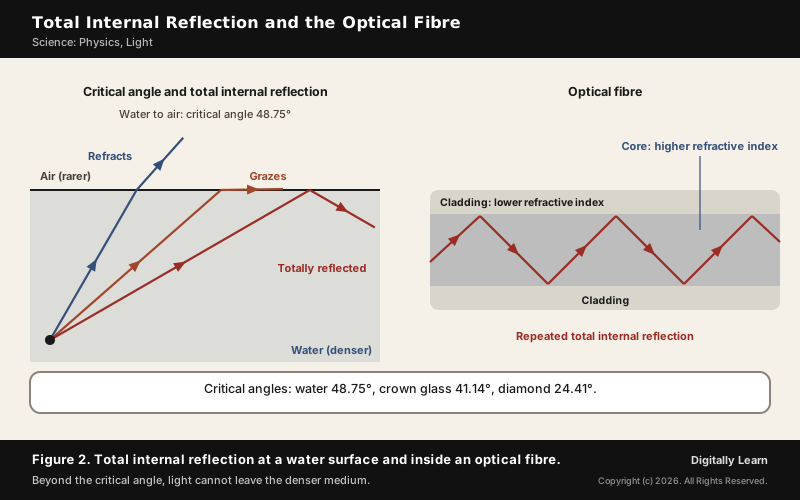
Ordinary reflection always lets some light through, so the reflected ray is weaker than the incident one however smooth the surface. In total internal reflection no light is transmitted. The critical angle depends on the pair of media: the refractive index of the denser medium with respect to the rarer is one divided by the sine of the critical angle, so the higher the refractive index, the smaller the critical angle.
- Water to air: Refractive index of water 1.33, critical angle 48.75 degrees.
- Crown glass to air: Refractive index 1.52, critical angle 41.14 degrees.
- Dense flint glass to air: Refractive index 1.62, critical angle 37.31 degrees.
- Diamond to air: Refractive index 2.42, critical angle 24.41 degrees.
Optical Fibre and Its Uses
Optical fibres are made so that light reflected at one side of the core strikes the other side at more than the critical angle. Since the light is totally reflected each time, there is no appreciable loss of intensity, and the fibre acts as a light pipe. The main difficulty in making fibres is keeping absorption very low over long distances; purified silica glass fibres transmit more than 95 per cent of the light over a length of 1 km.
- Communication: Audio and video signals, converted into light, are carried over long distances.
- Medicine: Bundles of fibres act as a light pipe for looking at internal organs such as the oesophagus, stomach and intestines.
- Decoration: Lamps with a fountain of fine plastic fibres glow at every tip.
Mirage, Diamonds and Totally Reflecting Prisms
On a hot day the air near the ground is hotter, less dense and of lower refractive index than the air above it. Light from a tall tree bends further and further away from the normal as it passes down through these layers, and if its angle of incidence near the ground exceeds the critical angle it is totally reflected upwards. A distant observer sees an inverted image as if reflected from a pool of water: a mirage, common in hot deserts and seen as a wet-looking patch on a hot highway.
Diamonds sparkle mainly because of total internal reflection. The critical angle at a diamond-air surface is only about 24.4 degrees, so light that enters a diamond is very likely to be totally reflected inside it. Natural diamonds rarely show this brilliance; it is the cutter's skill that shapes the faces so that light undergoes multiple total internal reflections before it comes out.
Prisms designed to bend light through 90 or 180 degrees, or to invert an image without changing its size, also use total internal reflection. For this the critical angle of the prism's material must be less than 45 degrees, which holds for crown glass and dense flint glass.
Dispersion and Scattering of Light
Dispersion of Light Through a Prism
A triangular glass prism has two triangular bases and three rectangular faces inclined to one another; the angle between its two refracting faces is the angle of the prism. Unlike a glass slab, a prism turns the emerging ray at an angle to the incident ray, the angle of deviation. A beam of white light comes out as a band of colours in the order violet, indigo, blue, green, yellow, orange and red, remembered as VIBGYOR.
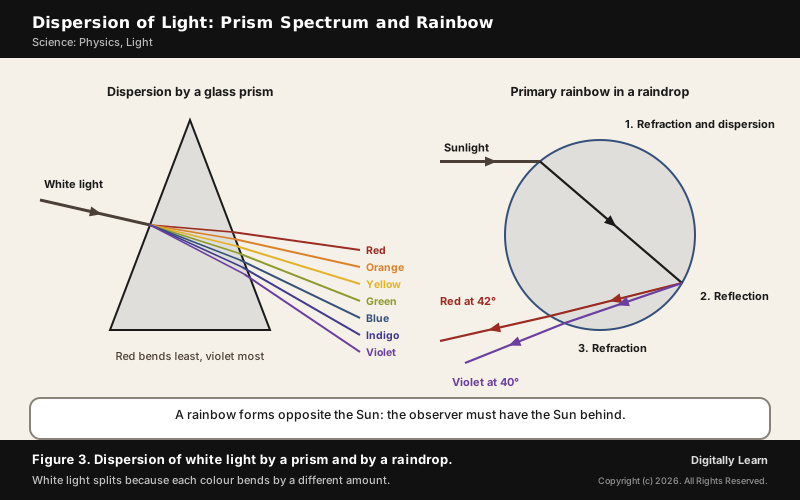
Dispersion happens because the refractive index of glass is different for different colours. Red light, at the long-wavelength end of the spectrum near 700 nanometres, bends the least and travels fastest in glass; violet, near 400 nanometres, bends the most. Isaac Newton was the first to obtain the spectrum of sunlight with a prism. A second identical prism placed upside down recombined the colours into white light, which showed that sunlight is made up of these colours and that the prism only separates them.
Rainbow Formation: Primary and Secondary Rainbows
A rainbow is a natural spectrum in the sky after a shower, produced by the dispersion of sunlight by tiny water droplets. It always forms in the direction opposite to the Sun, so the Sun must be shining in one part of the sky while rain falls in the other, and a rainbow can also be seen through a waterfall or a fountain with the Sun behind the viewer. Each droplet acts like a small prism: light slows down as it passes from air into the denser water, and so it bends.
- Sunlight is refracted as it enters a raindrop, and the colours separate.
- The colours are reflected from the inner surface at the back of the drop.
- They are refracted again as they leave the drop, violet emerging at 40 degrees to the incoming sunlight and red at 42 degrees.
Red light from higher drops and violet from lower drops reach the eye, so the primary rainbow has red on the top and violet at the bottom. When light is reflected twice inside the drops, a secondary rainbow forms; it is fainter, because light is lost at the second reflection, and its order of colours is reversed.
Scattering of Light: Why Is the Sky Blue, and the Tyndall Effect
The earth's atmosphere holds fine particles of smoke, dust and water, and molecules of air. When a beam of light strikes such particles its path becomes visible, as when sunlight enters a smoke-filled room through a small hole or passes through the misty canopy of a dense forest. This scattering by colloidal particles is the Tyndall effect, and the colour of the scattered light depends on the size of the particles.
For particles much smaller than the wavelength, scattering is inversely proportional to the fourth power of the wavelength, which is Rayleigh scattering. Red light has a wavelength about 1.8 times that of blue. Violet is scattered even more than blue, but our eyes are more sensitive to blue, so the sky looks blue. Without an atmosphere there would be no scattering and the sky would look dark, as it does to passengers flying very high. Near the horizon the sky fades to a paler blue or white, because light from low in the sky passes through more air and repeated scattering mixes the colours together again.
- White clouds: Water droplets much larger than the wavelength scatter all colours nearly equally.
- Red danger signals: Red is scattered least by fog or smoke, so it is seen in the same colour from a distance.
- Red Sun at sunrise and sunset: Light from the Sun near the horizon travels through much more air, and most of the blue is scattered away before it reaches us; at noon the Sun looks white.
Atmospheric Refraction: Twinkling of Stars, Advance Sunrise and Halos
Objects seen through the hot air rising above a fire seem to waver, because the hotter air has a slightly lower refractive index and the conditions keep changing. Starlight entering the atmosphere is refracted in the same way, continuously, so a star appears slightly higher than it really is near the horizon, and its apparent position and brightness keep changing. Stars are so distant that they are point sources, and this flickering is twinkling.
Planets are much closer and appear as extended sources, a collection of many point sources whose variations average out, so planets do not twinkle. Atmospheric refraction also makes the Sun visible about 2 minutes before actual sunrise and about 2 minutes after actual sunset: the refractive index of air is 1.00029, which shifts the Sun's apparent direction by about half a degree. The apparent flattening of the Sun's disc at sunrise and sunset has the same cause.
A halo is a ring of light around the Sun or the Moon produced by ice crystals in the atmosphere. One of the commonest, the 22-degree halo, forms when sunlight or moonlight is refracted by millions of hexagonal ice crystals, typically in thin cirrus or cirrostratus clouds high in the troposphere.
Human Eye, Defects of Vision and LASIK
Structure of the Human Eye and Accommodation
The human eye works like a camera: its lens system forms an image on a light-sensitive screen, the retina. Light enters through the cornea, a thin transparent bulge at the front of an eyeball about 2.3 cm across, and most of the refraction happens at the cornea's outer surface. The iris, a dark muscular diaphragm, controls the size of the pupil and so the light entering; the eye lens then forms a real, inverted image on the retina.
The retina's light-sensitive cells, rods for intensity and cones for colour, send electrical signals through the optic nerve to the brain. The ciliary muscles change the curvature of the jelly-like eye lens: relaxed, the lens is thin and focuses distant objects; contracted, it is thicker and focuses near ones. This ability to adjust the focal length is accommodation.
- Near point: The least distance of distinct vision, about 25 cm for a young adult; about 7 to 8 cm at the age of ten, and as much as 200 cm at sixty.
- Far point: Infinity for a normal eye.
- Two eyes: A field of view of about 180 degrees against 150 with one eye, and a sense of depth.
Myopia, Hypermetropia, Presbyopia and Astigmatism
Refractive defects blur vision when the eye cannot bring an image to focus on the retina, and suitable lenses correct them. A myopic eye focuses too strongly, a hypermetropic eye too weakly, and an ageing eye loses its power of accommodation; the corrective lens adds or removes exactly the focusing power the eye lacks.
| Defect | Cause and correction |
|---|---|
| Myopia | Near-sightedness: the image of a distant object forms in front of the retina, as the lens is too curved or the eyeball too long. Corrected with a concave lens. |
| Hypermetropia | Far-sightedness: the image of a near object forms behind the retina, as the focal length is too long or the eyeball too small. Corrected with a convex lens. |
| Presbyopia | The near point recedes with age as the ciliary muscles weaken and the lens stiffens. Corrected with a convex lens, or bifocals if the eye is also myopic. |
| Astigmatism | The cornea is not spherical, so lines in one direction blur. Corrected with a cylindrical lens. |
| Cataract | The eye lens turns milky and cloudy in old age. Vision is restored by cataract surgery. |
A common bifocal lens has a concave upper part for distant vision and a convex lower part for reading. A myopic person whose far point is 80 cm needs a concave lens of focal length 80 cm, a power of −1.25 dioptres. The lens does not magnify distant objects; it forms their image at the eye's far point, where the eye can focus it.
Lasers and LASIK Surgery
A laser emits light through optical amplification based on the stimulated emission of radiation, and the word is an acronym for light amplification by stimulated emission of radiation. Theodore Maiman built the first laser in 1960. Laser light is coherent, so it can be focused to a tight spot and stays narrow over long distances; lasers are used in fibre-optic communication, barcode scanners, cutting and welding, and surgery.
LASIK, laser-assisted in situ keratomileusis, is refractive surgery for myopia, hypermetropia and astigmatism. A femtosecond laser or a blade device cuts a flap in the cornea, an excimer laser reshapes the tissue beneath, and the flap is laid back. It permanently changes the shape of the cornea, and some patients still need glasses or contact lenses afterwards.
- Age: In the United States it is approved for people aged 18 and older, and ophthalmologists advise waiting until 21 because vision needs to stabilise.
- Stable prescription: The prescription should be stable for at least a year before surgery.
- Dry eyes: Reported by most patients afterwards, though usually temporary.
Hearing, the other sense that turns waves into signals for the brain, is explained with the structure of the ear in the article on sound waves.
Previous Year UPSC-CSE Questions
Previous Year UPSC-CSE Questions By the end you will be able to draft model answers for the following UPSC questions. Each question carries a collapsible framework showing how to approach it in the exam.
- UPSC Prelims 2013 Prelims-GSRainbow is produced when sunlight falls on drops of rain. Which of the following physical phenomena are responsible for this?
- Dispersion
- Refraction
- Internal reflection
Select the correct answer using the codes given below.
How to approach this Prelims question
Approach: Trace one ray of sunlight through a raindrop. On entering, it is refracted and, because each colour bends by a different amount, dispersed. At the back of the drop it is internally reflected. On leaving, it is refracted again. All three processes are needed, so statements 1, 2 and 3 are all correct.
Trap to watch: Leaving out internal reflection: without it the light would not return towards the observer.
Key facts to recall:
- (a) 1 and 2 only: wrong. Without internal reflection at the back of the drop the light would not come back towards the observer.
- (b) 2 and 3 only: wrong. Without dispersion the light would come back white; the colours separate because each bends by a different amount.
- (c) 1 and 3 only: wrong. Dispersion happens only through refraction, on entering and leaving the drop, so refraction cannot be left out.
- (d) 1, 2 and 3: right. Refraction with dispersion on entry, internal reflection at the back and refraction on leaving together make the rainbow.
Answer signal: 1, 2 and 3: option (d), the official answer.
- UPSC Prelims 1995 Prelims-GS111. Optical fibre works on the principle of
How to approach this Prelims question
Approach: Ask what keeps light inside the fibre as it travels and bends. The core has a higher refractive index than the cladding, and light inside meets the wall at more than the critical angle, so it is totally reflected each time.
Trap to watch: Refraction happens at entry, but it is not what carries the light along.
Key facts to recall:
- (a) total internal reflection: right. Light meets the core's wall at more than the critical angle and is reflected again and again along the fibre.
- (b) refraction: wrong. Light is refracted as it enters the fibre, but refraction out through the wall would lose it; it is not what carries the light along.
- (c) scattering: wrong. Scattering by impurities is a loss in a fibre, which is why the glass is highly purified.
- (d) interference: wrong. Interference is the meeting of waves; it plays no part in guiding light along a fibre.
Answer signal: Total internal reflection: option (a), the official answer.
- UPSC Prelims 1996 Prelims-GSTotal internal reflection can take place when light travels from
How to approach this Prelims question
Approach: Total internal reflection needs light going from an optically denser medium to a rarer one. Compare the refractive indices in each option (diamond 2.42, crown glass 1.52, water 1.33, air about 1) and keep only the pair where the first is the larger.
Trap to watch: Air to water or air to glass goes from rarer to denser, where total internal reflection cannot occur.
Key facts to recall:
- (a) diamond to glass: right. Diamond's refractive index of 2.42 is higher than glass's 1.52, so light goes from denser to rarer.
- (b) water to glass: wrong. Water at 1.33 is optically rarer than glass at 1.52, so light bends towards the normal and cannot be totally reflected.
- (c) air to water: wrong. Air is rarer than water; going from rarer to denser, total internal reflection cannot occur.
- (d) air to glass: wrong. Air is rarer than glass, so this too goes from rarer to denser.
Answer signal: Diamond to glass: option (a), the official answer.
- UPSC Prelims 2001 Prelims-GSAssertion and Reason:
- Assertion (A): A stick is dipped in water in a slanting position. If observed sideways, the stick appears short and bent at the surface of water.
- Reason (R): The light coming from the stick undergoes scattering from water molecules giving the stick a short and bent appearance.
How to approach this Prelims question
Approach: Test the assertion, then the reason. A stick dipped slanting in water does look short and bent, so A is true. The cause is refraction at the water surface: light from the part under water changes direction as it leaves, so that part seems higher than it is. Scattering only makes a beam's path visible, so R is false.
Trap to watch: Scattering makes a beam's path visible; it does not bend the image of a stick.
Key facts to recall:
- (a) A and R true, R explains A: wrong. R is false; scattering does not bend the image of a stick.
- (b) A and R true, R does not explain A: wrong. R is not true at all, so this cannot hold.
- (c) A true, R false: right. The stick does look short and bent, and the cause is refraction, not scattering.
- (d) A false, R true: wrong. The bent appearance is a real observation, the same effect that makes a pond look shallower than it is.
Answer signal: A true, R false: option (c), the official answer.
- UPSC Prelims 2002 Prelims-GSSun’s halo is produced by the refraction of light in
How to approach this Prelims question
Approach: A halo is a ring of light formed when sunlight is refracted by hexagonal ice crystals. Rule out the options without ice crystals, then match the crystals to the thin, high cirrus clouds that hold them.
Trap to watch: Water vapour and dust do not form a halo; ice crystals do.
Key facts to recall:
- (a) water vapour, in stratus clouds: wrong. A halo is formed by ice crystals, not by water vapour.
- (b) ice crystals in cirrocumulus clouds: wrong. The halo forms in the thin, veil-like cirrus and cirrostratus clouds, which the official answer names as cirrus.
- (c) ice crystals in cirrus clouds: right. Sunlight refracted through hexagonal ice crystals in cirrus clouds forms the 22-degree halo.
- (d) dust particles in stratus clouds: wrong. Dust scatters light; it does not refract it into a ring.
Answer signal: Ice crystals in cirrus clouds: option (c), the official answer.
- UPSC Prelims 2010 Prelims-GSRecently, LASIK (Laser Assisted In-Situ Keratomileusis) procedure is being made popular for vision correction. Which one of the following statements in this context is not correct?
How to approach this Prelims question
Approach: The question asks for the statement that is not correct. LASIK reshapes the cornea with a laser to correct refractive errors, permanently, and reduces dependence on glasses. It is approved only for adults, from 18 in the United States, with a prescription stable for a year, so it cannot be done at any age.
Trap to watch: The question asks for the statement that is NOT correct.
Key facts to recall:
- (a) corrects refractive errors: correct, so not the answer. LASIK treats myopia, hypermetropia and astigmatism.
- (b) permanently changes the shape of the cornea: correct, so not the answer. An excimer laser reshapes the tissue under a flap.
- (c) reduces dependence on glasses or contact lenses: correct, so not the answer, though some patients still need them afterwards.
- (d) can be done at any age: not correct, so this is the answer. It is approved from 18, and doctors advise waiting till 21 for vision to stabilise.
Answer signal: Any age: option (d), the official answer.
Sources
- NCERT: Science (Class X), Light: Reflection and Refraction
- NCERT: Science (Class X), The Human Eye and the Colourful World
- NCERT: Physics Part II (Class XII), Ray Optics and Optical Instruments
- NASA Space Place: Why Is the Sky Blue?
- NOAA NESDIS: What Causes a Rainbow?
- PIB: 41st National Eye Donation Fortnight (25 August 2026)
- PIB: Update on National Programme for Control of Blindness and Visual Impairment (1 August 2023)
- Wikipedia: Total internal reflection
- Wikipedia: Optical fiber
- Wikipedia: Rainbow
- Wikipedia: Halo (optical phenomenon)
- Wikipedia: 22° halo
- Wikipedia: Laser
- Wikipedia: LASIK
- Wikipedia: Visible light communication
- Wikipedia: Li-Fi
- UPSC: Civil Services Examination question papers
Editorial Disclaimer
This article draws on the NCERT textbooks and the other sources listed on this page.