


Overview
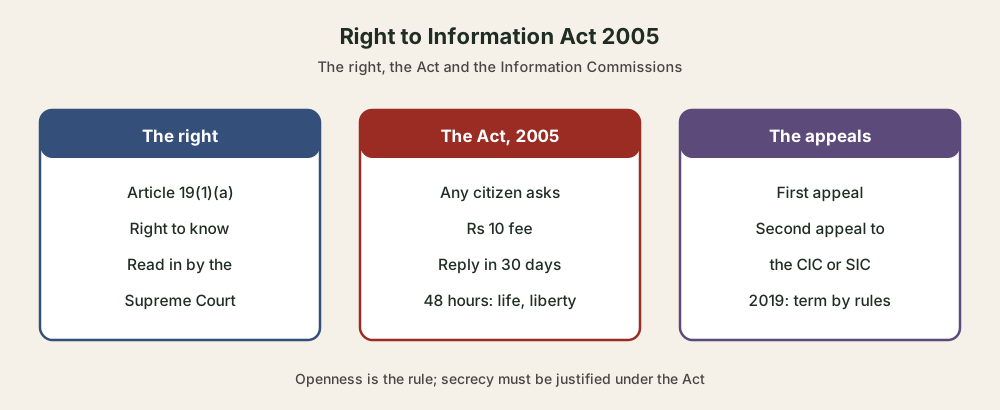
The Right to Information Act 2005 gives every citizen of India the legal right to ask any public authority for information it holds and to get a reply within 30 days. It replaced a culture of official secrecy with openness as the rule: public bodies must disclose information on their own, refuse only on the grounds the Act lists, and answer to independent Information Commissions.
Right to Information Act 2005: Meaning and Constitutional Basis
What Is the Right to Information Act, 2005?
The Right to Information Act, 2005 (Act No. 22 of 2005) is a law of Parliament that sets out a practical regime through which citizens can get information held by public authorities. Its heading is dated 15 June 2005, the day it was enacted, and it came into force in October 2005. It replaced the Freedom of Information Act, 2002. Subject to the Act, all citizens have the right to information.
- Information: Any material in any form, including records, documents, e-mails, opinions, advices, press releases, circulars, orders, contracts, reports, samples, models and data held in electronic form.
- Right to information: Includes inspecting work, documents and records; taking notes, extracts or certified copies; taking certified samples of material; and getting information in electronic form or printouts.
- Public authority: Any body set up by or under the Constitution, by a law of Parliament or a State Legislature, or by government notification, and bodies owned, controlled or substantially financed by government, including NGOs substantially funded by it.
RTI in the Constitution: Article 19(1)(a) and the Right to Know
The right to information is not listed as a Fundamental Right by name. The Supreme Court has read it into Article 19(1)(a): among the rights it has held to be part of the freedom of speech and expression is the right to know about government activities. The right also protects the right to life and personal liberty under Article 21. The RTI Act gives this implied right a working machinery: officers, deadlines, appeals and penalties.
The case for the right rests on good governance. Good governance has four elements, transparency, accountability, predictability and participation, and transparency means that information is available to the general public and that the working of government institutions is clear. Without information, citizens cannot hold power to account or take part in decisions.
Origins of the RTI Act: From Official Secrecy to Openness
The RTI Movement: MKSS, Beawar and the Road to 2005
For decades, information in India was locked away under the colonial Official Secrets Act, 1923, which was a convenient smokescreen to deny the public access to information, and public functioning was traditionally shrouded in secrecy. The demand for openness came from the grassroots, above all from the Mazdoor Kisan Shakti Sangathan (MKSS) in Rajasthan, whose demand for the right to information grew out of a demand for minimum wages for workers.
- Public hearings: A series of public hearings exposed systemic corruption across Rajasthan, and the protesters demanded local expenditure records.
- Beawar, 1996: On 6 April 1996 the MKSS began a forty-day dharna in Beawar in Ajmer district, supported by over one hundred and fifty villages; the novelty was that the poor demanded information rather than food or shelter.
- Slogan: A newspaper editorial titled ‘Hum Jaanenge, Hum Jiyenge’ (We will know, we will live) gave the movement its slogan: the right to know is the right to live.
- Towards a law: A working group under H. D. Shourie on Right to Information and Transparency reported in 1997; the Freedom of Information Act, 2002 followed, and the RTI Act of 2005 replaced it.
Key Provisions of the RTI Act 2005
Public Authorities, Information Officers and Proactive Disclosure
Every public authority carries duties under Section 4. It must keep all its records catalogued and indexed in a form that makes the right to information easy to exercise, and computerise records where appropriate. It had to publish a set of particulars about itself, its functions, officers, budgets and decisions, within 120 days of the Act's enactment, and it must give reasons for administrative or quasi-judicial decisions to affected persons.
- Suo motu disclosure: Section 4(2) asks every public authority to publish as much information as possible on its own, including through the internet, so that the public need minimum resort to formal requests.
- Public Information Officers: Every public authority designates Central or State Public Information Officers (PIOs), and Assistant PIOs at sub-divisional level who receive applications and pass them on.
- Third-party information: Where a request concerns information supplied by a third party and treated as confidential, the PIO must give that party a chance to be heard (Section 11).
Disclosure on the department's own initiative is the heart of the Act's design. The more a department publishes on its own, the fewer requests it receives, and the less room there is for delay or discretion.
Scope of the RTI Act: Judiciary, Private Bodies and Political Parties
The Act extends to the whole of India and covers all constitutional authorities, including the executive, legislature and judiciary, along with bodies set up by law or notification and bodies owned, controlled or substantially financed by government. Private bodies are not directly within its purview, but information about a private body that a public authority can access under any other law counts as information under Section 2(f).
- Privatised utilities: In Sarbjit Roy v. Delhi Electricity Regulatory Commission, the CIC reaffirmed that privatised public utility companies fall within the RTI Act.
- Aided bodies: Private institutions and NGOs substantially financed by government come under the Act.
- Political parties: The CIC held that national political parties, substantially funded indirectly by the Central Government and performing public functions, are public authorities; in August 2013 the government introduced a bill to remove them from the law’s scope, and no party is under the Act today, with a case pending to bring them in.
- The judiciary: The Act covers the courts as public authorities, and the office of the Chief Justice of India is within it.
How to File an RTI Application: Fee, Time Limits and Appeals
Filing an RTI application is simple by design. Under Section 6, a request is made in writing or through electronic means, in English, Hindi or the official language of the area, to the PIO of the public authority, with the prescribed fee, which is Rs 10 for central public authorities, with Rs 2 a page for copies; States set their own fees. If a person cannot write, the PIO must help put the request in writing. The applicant need not give any reason for seeking the information.
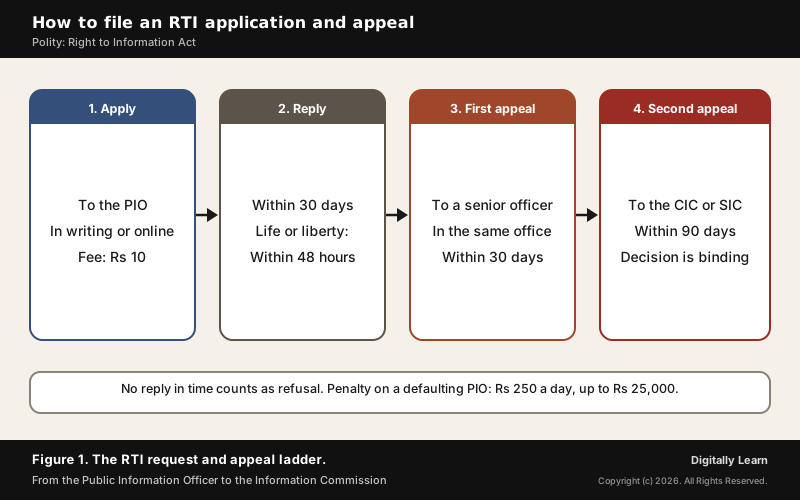
- Reply (Section 7): Within 30 days of the request; within 48 hours where the information concerns the life or liberty of a person.
- Deemed refusal: If the PIO fails to decide within the time limit, the request is deemed to have been refused.
- First appeal: Within 30 days, to an officer senior in rank to the PIO in the same public authority.
- Second appeal: Within 90 days, to the Central Information Commission or the State Information Commission, whose decision is binding.
- Penalty: A PIO who refuses or delays without reasonable cause can be fined Rs 250 a day, up to Rs 25,000, and recommended for disciplinary action.
- Bar on courts: No court can entertain a suit against an order under the Act; the remedy is appeal under the Act itself.
Exemptions Under Section 8 of the RTI Act
Openness is the rule, and refusal must fit one of the grounds in the Act. Section 8(1) lists the information that need not be given to any citizen:
| Clause | Information exempt from disclosure |
|---|---|
| 8(1)(a) | Affects the sovereignty and integrity of India, security, strategic, scientific or economic interests, relations with foreign States, or would incite an offence |
| 8(1)(b) | Expressly forbidden to be published by a court or tribunal, or would be contempt of court |
| 8(1)(c) | Would breach the privilege of Parliament or a State Legislature |
| 8(1)(d) | Commercial confidence, trade secrets or intellectual property that would harm a third party's competitive position |
| 8(1)(e) | Held in a fiduciary relationship |
| 8(1)(f) | Received in confidence from a foreign government |
| 8(1)(g) | Would endanger a person's life or safety, or reveal a confidential source |
| 8(1)(h) | Would impede investigation, apprehension or prosecution of offenders |
| 8(1)(i) | Cabinet papers, though decisions and the reasons for them are made public once the matter is complete |
| 8(1)(j) | Personal information with no relation to any public activity or interest, or an unwarranted invasion of privacy |
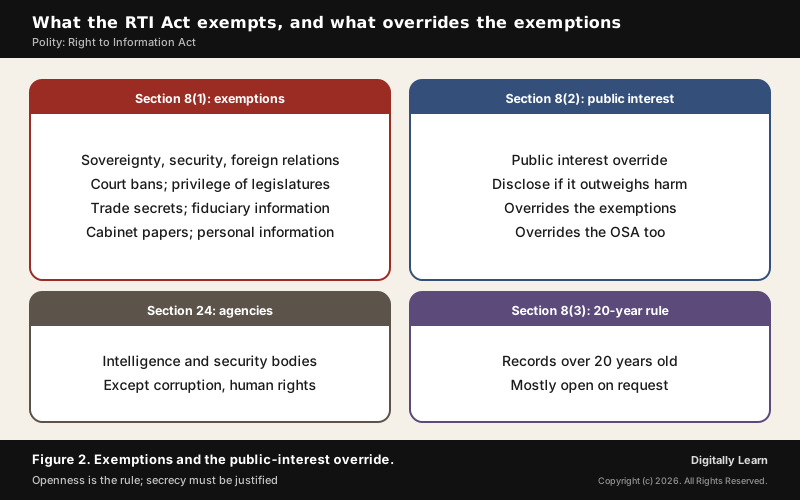
- Parliament test: Information that cannot be denied to Parliament or a State Legislature cannot be denied to any person.
- Twenty-year rule: Under Section 8(3), information about any event that happened twenty years before the request must be given, except for clauses (a), (c) and (i).
- Section 24: Intelligence and security organisations in the Second Schedule are outside the Act, except for information about allegations of corruption and human rights violations; the Schedule has been amended four times.
Official Secrets Act and the RTI Act: The Overriding Effect
The Official Secrets Act, 1923 (OSA), enacted in the colonial era, governs secrecy in government and deals largely with security. The RTI Act settles the conflict in its own favour in two places. Section 8(2) lets a public authority allow access to information, notwithstanding the OSA or the Section 8(1) exemptions, if public interest in disclosure outweighs the harm to the protected interests. Section 22 gives the RTI Act effect notwithstanding anything inconsistent in the OSA or any other law.
So the OSA does not stand in the way of disclosure that the RTI Act otherwise permits. The difficulty lies in its catch-all Section 5, which punishes the unauthorised disclosure of official secrets without defining what a secret is; this breeds a habit of secrecy among officials.
- Shourie Committee (1997): Recommended amending Section 5 so that its penalties apply only to violations affecting national security.
- Second ARC (2006): Recommended that the OSA be repealed and replaced by a chapter on official secrets in the National Security Act.
Central and State Information Commissions
Central Information Commission: Composition, Appointment and Powers
The Central Information Commission (CIC) was set up in 2005 by an official gazette notification under the RTI Act, so it is a statutory body, not a constitutional one. It hears complaints and second appeals about central public authorities. It consists of a Chief Information Commissioner and not more than ten Information Commissioners, appointed by the President on the recommendation of a committee of the Prime Minister (chair), the Leader of Opposition in the Lok Sabha and a Union Cabinet Minister nominated by the Prime Minister.
- Eligibility: Persons of eminence in public life with knowledge of law, science and technology, social service, management, journalism, mass media or administration; not a legislator, and holding no office of profit or party connection.
- Removal: The President can remove them on grounds such as insolvency or conviction for an offence involving moral turpitude, and for proved misbehaviour or incapacity after an inquiry by the Supreme Court.
- Powers of the Commission: It inquires into complaints, including refusal, delay, unreasonable fees and misleading replies, and while inquiring has the powers of a civil court to summon persons and require documents.
- Compliance and reporting: It can direct public authorities to appoint PIOs, publish information and compensate applicants, and it sends an annual report that is laid before each House of Parliament.
- State Information Commissions: Each State has a State Information Commission, appointed by the Governor on the recommendation of a committee of the Chief Minister, the Leader of Opposition in the Assembly and a State Cabinet Minister.
RTI Amendments: 2019 Act, Commission Independence and DPDP 2023
The Right to Information (Amendment) Act, 2019, passed by the Rajya Sabha on 25 July 2019 after the Lok Sabha on 22 July, amended Sections 13, 16 and 27. Under the original Act, the Chief Information Commissioner and Information Commissioners held office for five years or until the age of 65, with salaries and service conditions like those of the Chief Election Commissioner and Election Commissioners. The amendment provided that their term, salaries and conditions of service shall be such as may be prescribed by the Central Government, and Rules to that effect were made in 2019.
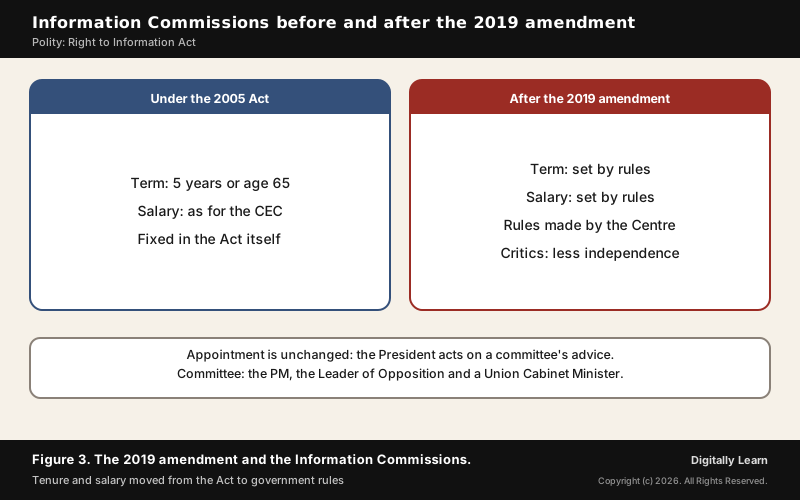
- Government’s case: The Election Commission is a constitutional body while the Information Commissions are statutory, so their mandates and service terms need not be the same; the Rules do not affect citizens’ rights or the Commissions’ powers.
- Critics’ case: Letting the government fix the term and salary of the officials who rule against it has been criticised as watering down the Commissions’ independence.
The Digital Personal Data Protection Act, 2023 amended Section 8(1)(j) of the RTI Act, the exemption for personal information. In its original form the clause allowed personal information to be disclosed where the larger public interest justified it. The government's position is that the amendment balances the fundamental right to privacy, affirmed by the Supreme Court in Justice K. S. Puttaswamy v. Union of India, with the right to information, codifies existing judicial reasoning, and does not restrict the disclosure of personal information.
The key safeguard that remains is Section 8(2): a public authority may still allow access to information if the public interest in disclosure outweighs the harm to the protected interests. How that balance is struck, case by case, will decide whether transparency about public officials is preserved.
Significance, Challenges and Reforms of the RTI Act
RTI and Accountability: Why the Act Matters for Good Governance
The Second Administrative Reforms Commission called the right to information the master key to good governance. It enables the weaker sections of society to demand and get information about public policies and actions. Its effective implementation, the Commission said, depends on three shifts in how the state works:
- From the prevailing culture of secrecy to a new culture of openness.
- From personalised despotism to authority coupled with accountability.
- From unilateral decision making to participative governance.
The Act is used on a vast scale: over 4,800 applications are filed on an average day, and over 17,500,000 were filed in its first ten years. Its reach has grown too: on 13 November 2019 the Supreme Court upheld the Delhi High Court's decision bringing the office of the Chief Justice of India under the Act. The Act does not only empower citizens; it redefines accountability, because official decisions can now be examined by any citizen, not only by superiors.
Challenges to RTI: Misuse, Attacks on Users and Remedies
The Act's openness can be abused. The Second ARC recorded requests that were patently frivolous or vexatious, and public servants facing grave disciplinary charges using the Act to intimidate or harass their seniors. It warned of three dangers:
- Frivolous or vexatious requests may overwhelm the system and defeat the purpose of the Act.
- The even tenor of administration may be paralysed, undermining the delivery of services.
- Public servants under charges using the Act through proxies may cause a breakdown of discipline.
The remedy it proposed was safeguards against vexatious and malicious requests, without any fetters on citizens seeking information in good faith, since the Act deliberately asks for no reasons. Wider proactive disclosure under Section 4 reduces the need for requests, and better record management helps officers reply quickly.
- Attacks on RTI users: Data of the Commonwealth Human Rights Initiative point to over 310 cases of people attacked, harassed or with property damaged over information they sought, including over 50 alleged murders.
- Bans on applicants: Some State Information Commissions have barred individuals from filing requests for harassing officials, a practice criticised because the Act contains no such power.
- Practical barriers: Formal rules on how requests are written make the right harder to use for those without higher education, and many citizens turn to NGOs, activists or lawyers to file.
Previous Year UPSC-CSE Questions
Previous Year UPSC-CSE Questions By the end you will be able to draft model answers for the following UPSC questions. Each question carries a collapsible framework showing how to approach it in the exam.
- UPSC Mains 2020 GS-II“Recent amendments to the Right to Information Act will have profound impact on the autonomy and independence of the Information Commission”. Discuss.
Answer outline: how to structure the answer
What the question asks, the main arguments, relevant examples and the direction of the conclusion. This is not a full model answer.
Introduction: The 2019 amendment moved the term and salary of Information Commissioners from the Act to government rules.
Body (sub-themes to develop):
- Before: five years or age 65; status and salary like the Election Commission, fixed by law.
- After: term, salary and conditions as prescribed by the Central Government; Rules of 2019.
- Impact: security of tenure now depends on the executive, the party whose records are sought; the government argues the Commissions' powers are untouched.
Conclusion: Conclude that powers are intact but independence depends on security of tenure, which the amendment weakened.
- UPSC Mains 2018 GS-IV“The Right to Information Act is not all about citizens’ empowerment alone, it essentially redefines the concept of accountability.” Discuss.
Answer outline: how to structure the answer
What the question asks, the main arguments, relevant examples and the direction of the conclusion. This is not a full model answer.
Introduction: The RTI Act empowers citizens, but its deeper effect is on how officials answer for decisions.
Body (sub-themes to develop):
- Empowerment: any citizen, no reasons, 30 days, low fee.
- Accountability: reasons for decisions, proactive disclosure, penalties on PIOs, answerability to any citizen.
- Governance: transparency, accountability, predictability and participation.
Conclusion: Conclude that accountability moves from inside the hierarchy to the public.
- UPSC Mains 2019 GS-IVThere is a view that the Official Secrets Act is an obstacle to the implementation of Right to Information Act. Do you agree with the view? Discuss.
Answer outline: how to structure the answer
What the question asks, the main arguments, relevant examples and the direction of the conclusion. This is not a full model answer.
Introduction: The OSA of 1923 and the RTI Act of 2005 reflect opposite starting points: secrecy and openness.
Body (sub-themes to develop):
- Legally, the RTI Act prevails: Section 22 overriding effect; Section 8(2) public interest.
- In practice, OSA Section 5 does not define secrets and breeds a habit of secrecy.
- Reform: Shourie Committee amendment; ARC recommendation to repeal the OSA and add a chapter to the National Security Act.
Conclusion: Conclude that the OSA is a cultural more than a legal obstacle, which reform should remove.
- UPSC Mains 2017 GS-IVYou are a Public Information Officer (PIO) in a government department. You are aware that the RTI Act, 2005 envisages transparency and accountability in administration. The act has functioned as a check on the supposedly arbitrarily administrative behaviour and actions. However, as a PIO you have observed that there are citizens who filed RTI applications not for themselves but on behalf of such stakeholders who purportedly want to have access to information to further their own interests. At the same time there are those RTI activists who routinely file RTI applications and attempt to extort money from the decision makers. This type of RTI activism has affected the functioning of the administration adversely and also possibly jeopardizes the genuineness of the applications which are essentially aimed at getting justice. What measures would you suggest to separate genuine and non-genuine applications? Give merits and demerits of your suggestions.
Answer outline: how to structure the answer
What the question asks, the main arguments, relevant examples and the direction of the conclusion. This is not a full model answer.
Introduction: The RTI Act asks for no reasons, which protects genuine applicants but also allows misuse.
Body (sub-themes to develop):
- Measures: more proactive disclosure; standard formats; safeguards against vexatious requests as the ARC suggested.
- Merits: less burden on offices; fewer extortion attempts.
- Demerits: any filter risks deterring genuine applicants; the Act forbids demanding reasons.
Conclusion: Conclude that disclosure, not restriction, is the safest cure for misuse.
- UPSC Mains 2015 GS-IVSome recent developments such as introduction of RTI Act, media and judicial activism, etc., are proving helpful in bringing about greater transparency and accountability in the functioning of the government. However, it is also being observed that at times the mechanisms are misused. Another negative effect is that the officers are now afraid to take prompt decisions. Analyze this situation in detail and suggest how this dichotomy can be resolved. Suggest how these negative impacts can be minimized.
Answer outline: how to structure the answer
What the question asks, the main arguments, relevant examples and the direction of the conclusion. This is not a full model answer.
Introduction: RTI has made government more transparent, but misuse can make officers cautious.
Body (sub-themes to develop):
- Benefits: accountability and participation.
- Problems: vexatious requests, harassment of seniors, delayed decisions.
- Remedies: proactive disclosure, record management, safeguards against vexatious requests, protection for honest decisions.
Conclusion: Conclude that clear rules and open records protect honest officers.
Sources and Further Reading
- Central Information Commission: The Right to Information Act, 2005 (text of the Act)
- DARPG: Reports of the Second Administrative Reforms Commission (First Report, Right to Information: Master Key to Good Governance, 2006)
- NCERT: Indian Society (Class XII Sociology), Chapter 6, Box 6.10 on the Right to Information Act
- PIB: Rajya Sabha passes RTI Amendment Bill, 2019 (25 July 2019)
- PIB: New Rules under RTI (11 December 2019)
- PIB: DPDP Act, 2023 upholds privacy while preserving transparency under RTI (20 August 2025)
- The Hindu (Delhi): How has the BCCI resisted RTI scrutiny?, 24 May 2026
- The Hindu (Delhi): Is data protection law crippling RTI, asks SC, 8 August 2026
- The Hindu (Delhi): Light on truth (editorial), 29 September 2026
- Wikipedia: Right to Information Act, 2005
- Wikipedia: Mazdoor Kisan Shakti Sangathan
- UPSC: Previous year question papers
Editorial Disclaimer
This article explains the Right to Information Act from the text of the Act, the Second Administrative Reforms Commission's report on the subject, official releases and the other sources listed below. It is not legal advice.


