


Overview
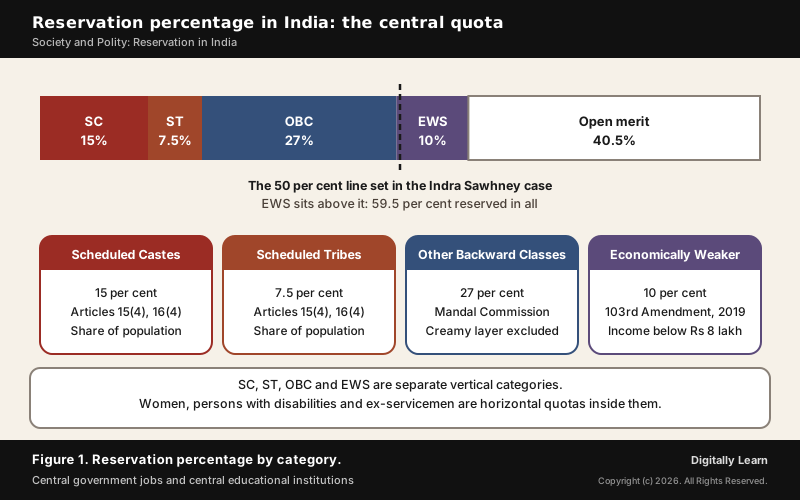
Reservation in India is the system of affirmative action under which a fixed share of seats in government jobs, public educational institutions and legislatures is set aside for groups that have faced discrimination and exclusion. The Constitution enables it mainly through Articles 15(4) and 16(4), and it covers four categories: the Scheduled Castes, the Scheduled Tribes, the Other Backward Classes and, since 2019, the Economically Weaker Sections. In central government jobs and central institutions the shares are 15, 7.5, 27 and 10 per cent, or 59.5 per cent in all.
What Is Reservation? Meaning, Basis and Types of Quota
Reservation Is Given on What Basis: Backwardness and Representation
The reservation policy in India works by setting aside, or reserving, positions that only members of an eligible group can fill, whether a post, a college seat or a constituency. It is the country's main form of affirmative action: instead of only forbidding discrimination, the State actively makes room for groups that equal rules alone would not lift.
Reservation is given on the basis of social and educational backwardness and inadequate representation in the services of the State. That is the test for the Scheduled Castes, the Scheduled Tribes and the Other Backward Classes. The fourth category, the Economically Weaker Sections, is the one exception: it rests on family income and assets, not on caste.
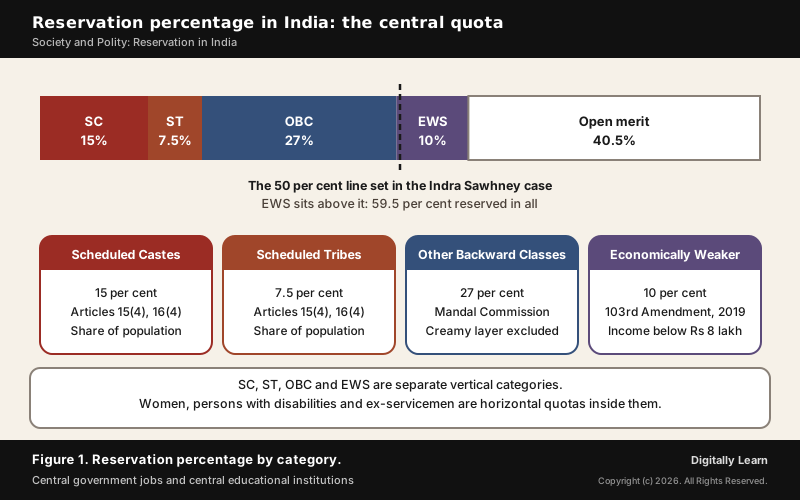
Figure 1 shows how the shares add up for the Union government: 15 per cent for the Scheduled Castes, 7.5 per cent for the Scheduled Tribes, 27 per cent for the OBCs and 10 per cent for the EWS. The first three together come to 49.5 per cent, just under the 50 per cent ceiling set by the Supreme Court; the EWS quota lifts the total to 59.5 per cent.
Types of Reservation: Jobs, Education and Legislatures
The reservation system in India works in three spheres of public life, and each has its own constitutional source. Knowing which sphere a question is about is the quickest way to find the right article.
- Government jobs: Posts in government service and public sector companies are reserved under Article 16(4), with promotion quotas for SCs and STs under Article 16(4A).
- Educational institutions: Seats in admission are reserved under Articles 15(4) and 15(5), which since 2006 can extend to private colleges too, except minority institutions.
- Legislatures: Seats in the Lok Sabha and the State Assemblies are reserved for SCs and STs under Articles 330 and 332, and seats in panchayats and municipalities under Articles 243D and 243T.
- Development programmes: The same principle extends to other government programmes, some meant only for SCs and STs and others giving them preference.
Political reservation works differently from job reservation. A reserved constituency is one where only a member of the Scheduled Castes or Scheduled Tribes can contest, but every voter in the constituency votes. The number of such seats in each state bears, as nearly as may be, the same proportion to its total seats as the SC or ST share of its population. After the Delimitation Order of 2008, the Lok Sabha has 84 seats for Scheduled Castes and 47 for Scheduled Tribes out of 543. There is no reserved seat for OBCs in Parliament; panchayats may reserve seats for backward classes if a State law provides for it.
Reservation for women follows the same logic. Panchayats and municipalities have reserved at least one-third of their seats for women since the 73rd and 74th Amendments, and the 106th Amendment of 2023 reserves one-third of seats in the Lok Sabha and the Assemblies for women, including SC and ST women, once a delimitation after the next census is done. The details are in the Women’s Reservation Act, 2023.
Vertical and Horizontal Reservation Explained
Vertical reservation is the reservation for the social categories themselves: SC, ST, OBC and EWS. Each is a separate block of seats, and a candidate falls into only one of them. Horizontal reservation cuts across these blocks. It is given to groups such as women, persons with disabilities and ex-servicemen, and a selected candidate is counted inside whichever vertical category he or she belongs to.
| Point | Vertical | Horizontal |
|---|---|---|
| Who gets it | SC, ST, OBC and EWS | Women, persons with disabilities, ex-servicemen |
| Basis | Articles 15(4), 16(4), 15(6), 16(6) | Article 15(3) for women; laws and service rules for others |
| How it is filled | A separate block for each category | Adjusted within each vertical block |
An example makes the difference clear. Uttarakhand reserves seats vertically for SCs, STs, OBCs and the EWS, and on top of that gives 30 per cent horizontal reservation to women, 5 per cent to ex-servicemen and 4 per cent to persons with disabilities. A woman from the Scheduled Castes selected under the women's quota fills an SC seat, so the vertical total does not rise.
History of Reservation in India: Who Introduced It
Reservation Before Independence: Kolhapur to the Poona Pact
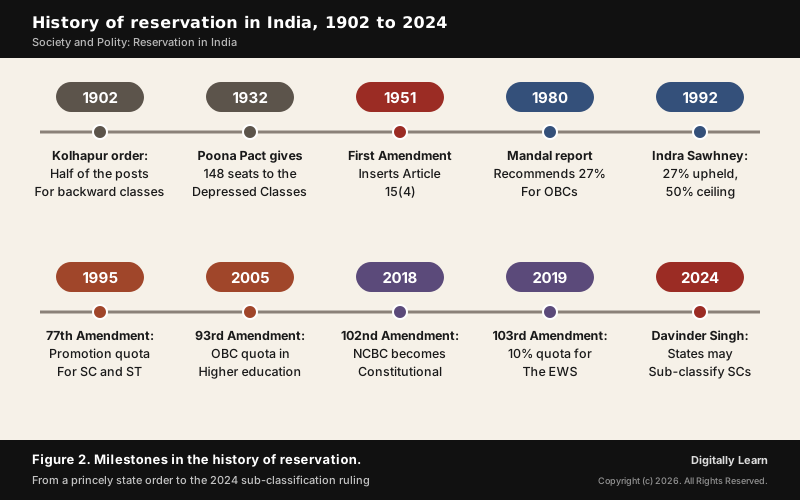
Reservation in India is older than the Constitution. It was first introduced by Shahu Maharaj, the ruler of the princely state of Kolhapur, whose order of 26 July 1902 reserved 50 per cent of government jobs for backward classes. Other governments followed over the next four decades:
- 1918, Mysore: The Maharaja set up a committee to implement reservation for non-Brahmins in government jobs and education.
- 1921, Madras Presidency: The first Justice Party government passed a Communal Government Order on 16 September 1921, the first elected body in India to legislate reservation.
- 1932, Communal Award: The British offered the Depressed Classes 71 reserved seats, to be filled through separate electorates.
- 1932, Poona Pact: After Gandhi fasted against separate electorates, Ambedkar and Hindu leaders signed the Poona Pact on 24 September 1932: a joint electorate, with 148 seats reserved for the Depressed Classes in the legislative assemblies.
- 1935 to 1936: The Government of India Act, 1935 introduced the term Scheduled Castes, and a 1936 order listed them.
- 1942: Scheduled Castes got 8.5 per cent reservation in central services for the first time.
The Poona Pact settled the question that shapes political reservation to this day: reserved seats inside a common electorate, not separate electorates. The fast and the negotiations are covered in Gandhi and social reform: the Poona Pact.
Reservation After 1950: The First Amendment and Mandal Commission
The Constitution came into force in 1950 with reservation for the Scheduled Castes and Scheduled Tribes in legislatures and in government jobs. Education was not yet covered. In State of Madras v. Champakam Dorairajan (1951), the Supreme Court struck down a caste-based order for college seats as a violation of Article 29(2). Parliament responded with the First Amendment, which inserted Article 15(4) from 18 June 1951 and allowed special provisions for backward classes, SCs and STs.
The OBC question took far longer. The First Backward Classes Commission under Kaka Kalelkar, set up in 1953, was sidelined, and backward-class reservation stayed a state matter, strongest in the south. The Janata Party government then appointed the Second Backward Classes Commission under B. P. Mandal, announced in 1978 and established in 1979.
- Mandal Commission’s method: It used eleven indicators, social, educational and economic, weighted 3, 2 and 1 points, and treated any caste scoring 11 of 22 as backward.
- Finding: Using the 1931 census, it estimated that OBCs made up 52 per cent of the population and identified 3,743 castes.
- Recommendation: 27 per cent reservation for OBCs in central government jobs, public undertakings and higher education, kept that low so that with 22.5 per cent for SCs and STs the total stayed below 50 per cent.
- Other advice: It also recommended land reform and other steps to improve the condition of the OBCs.
The report of 1980 lay unused for a decade. On 7 August 1990 the V. P. Singh government declared that it would give 27 per cent of central jobs to the socially and educationally backward classes, and the order followed on 13 August. The anti-Mandal protests that followed grew into a large student movement. The OBC share in higher education came later, through the 93rd Amendment of 2005.
Constitutional Provisions: Which Articles Give Reservation
Article 15(4), 15(5) and 15(6): Reservation in Education
Reservation in India rests on the equality code of Articles 14 to 17. Article 14 guarantees equality before the law, Article 15 forbids discrimination on grounds of religion, race, caste, sex or place of birth, Article 16 guarantees equality of opportunity in public employment and Article 17 abolishes untouchability. Reservation is written into Articles 15 and 16 as exceptions that serve the same goal of equality.
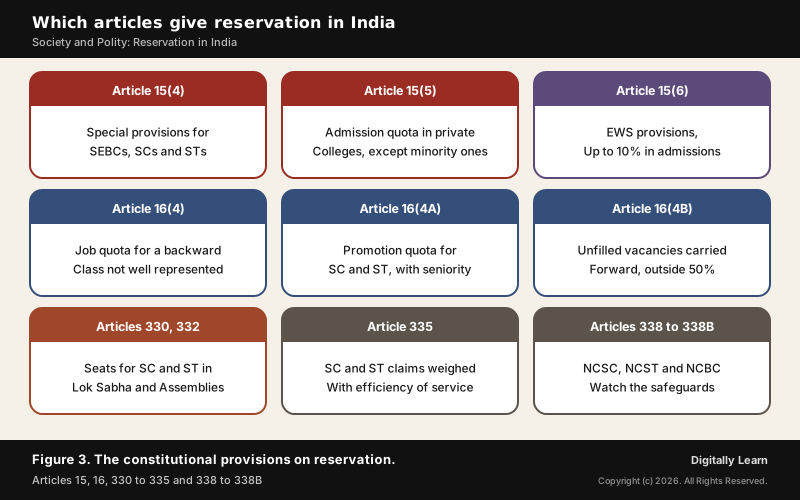
- Article 15(4): Nothing in Article 15 or in Article 29(2) prevents the State from making special provisions for the advancement of socially and educationally backward classes, SCs and STs. Added by the First Amendment, 1951.
- Article 15(5): Such special provisions may cover admission to educational institutions, including private ones, aided or unaided, but not the minority institutions of Article 30(1). Added by the 93rd Amendment, in force from 20 January 2006.
- Article 15(6): The State may make special provisions for economically weaker sections other than those in clauses (4) and (5), and reserve up to 10 per cent of seats in admissions, in addition to existing reservation. Added by the 103rd Amendment, 2019.
The exclusion of minority institutions in Article 15(5) has a practical result. Since the Constitution itself exempts minority educational institutions from the admission quota, no commission can require them to reserve seats for Scheduled Castes. The Ashoka Kumar Thakur case (10 April 2008) upheld the 93rd Amendment and the 27 per cent OBC quota in central institutions such as the IITs, IIMs and AIIMS, with the creamy layer excluded.
Article 16(4), 16(4A), 16(4B) and 16(6): Reservation in Government Jobs
Article 16 carries the job quota. Its clauses grew over time as Parliament answered the courts:
- Article 16(4): The State may reserve appointments or posts for any backward class of citizens which, in its opinion, is not adequately represented in its services. In force since 1950.
- Article 16(4A): The State may reserve posts in promotion, with consequential seniority, for SCs and STs not adequately represented. Added by the 77th Amendment (1995); the words on seniority came from the 85th Amendment (2001).
- Article 16(4B): Unfilled reserved vacancies of a year may be carried forward as a separate class, and are not counted against the 50 per cent ceiling of the year in which they are filled. Added by the 81st Amendment (2000).
- Article 16(6): The State may reserve up to 10 per cent of posts for the EWS, in addition to existing reservation. Added by the 103rd Amendment (2019).
Two words in Article 16(4) do most of the work: "backward class" and "adequately represented". The first is wider than caste but, as the Supreme Court accepted in 1992, caste can be a valid indicator of it. The second means that reservation in jobs is a remedy for under-representation, which is why the courts keep asking the State for data on representation.
Articles 46, 330, 332, 334 and 335: Welfare, Seats and Efficiency
Outside Part III, five articles complete the framework. They set the goal, fix the seats in legislatures and balance reservation against the needs of administration.
- Article 46: A Directive Principle: the State shall promote with special care the educational and economic interests of the weaker sections, in particular SCs and STs, and protect them from social injustice and all forms of exploitation.
- Articles 330 and 332: Seats are reserved for SCs and STs in the Lok Sabha and in every State Assembly, in proportion to their share of the population.
- Article 334: Reserved seats in legislatures were meant to lapse after ten years. They have been extended by ten years at a time; the 104th Amendment extended them to eighty years, that is, to 25 January 2030, and let the nomination of Anglo-Indians lapse.
- Article 335: The claims of SCs and STs to posts are to be considered consistently with the maintenance of efficiency of administration. A proviso added by the 82nd Amendment (2000) allows relaxed qualifying marks and lower standards of evaluation for them.
Article 335 is often misread. It names "efficiency of administration" as a limit on reservation for SCs and STs, and the Supreme Court has read reservation under Article 16(4) together with it, but the article does not define the term. How Article 46 fits the other Directive Principles is covered in Directive Principles of State Policy.
Reservation Percentage in India: SC, ST, OBC and EWS
SC and ST Reservation in India: 15 and 7.5 Per Cent
SC and ST reservation in India follows population. In central government jobs and central institutions, 15 per cent is reserved for the Scheduled Castes and 7.5 per cent for the Scheduled Tribes, the shares specified in 1982. By the 2011 Census, SCs formed about 16.6 per cent and STs about 8.6 per cent of India's people, and states fix their own SC and ST shares by their own population figures.
- Who decides the list: The President notifies the Scheduled Castes (Article 341) and Scheduled Tribes (Article 342) for each state after consulting the Governor; only Parliament can add or remove a community by law.
- Size of the lists: The Constitution (Scheduled Castes) Order, 1950 lists 1,108 castes across 28 states, and the Scheduled Tribes Order lists 744 tribes across 22 states.
- Religion and SC status: Scheduled Caste status was first limited to Hindus, then extended to Sikhs in 1956 and to Buddhists in 1990. Dalit converts to Christianity or Islam are not Scheduled Castes, though many fall in OBC lists.
- No income test: SCs and STs get reservation whatever their income, because their disadvantage came from untouchability and isolation, not from poverty alone.
OBC Reservation: 27 Per Cent and the Central List
OBC reservation in India is 27 per cent in central government jobs and central educational institutions. The Other Backward Classes are the socially and educationally backward classes of Articles 15(4) and 16(4): communities other than SCs and STs that suffer educational and social backwardness. The jobs quota came from the Mandal Commission in 1990 and the education quota from the 93rd Amendment and the Central Educational Institutions (Reservation in Admission) Act, 2006.
There are two kinds of OBC list. The Central List is notified by the President under Article 342A and applies to Union jobs and institutions; Parliament alone can change it. Each state keeps its State List for its own jobs and colleges, and the entries may differ, so a community can be OBC in a state but not in the Central List. By 2006, the Central List had grown to about 5,013 castes from the 3,743 the Mandal Commission identified.
- Creamy layer excluded: OBC families above the income limit, now Rs 8 lakh a year, do not get the quota; this rule does not apply to SCs and STs.
- Unequal within: The upper OBCs are largely landed castes that dominate rural society in many regions, while the lower OBCs are very poor and often little different from Dalits in their condition.
- Sub-categorisation: The Rohini Commission, set up under Article 340 in October 2017, examined dividing the 27 per cent among OBC sub-groups.
EWS Reservation: 103rd Amendment and Eligibility Criteria
EWS reservation gives 10 per cent of central government jobs and seats in educational institutions to the economically weaker sections of people who are not covered by any caste-based quota. The 103rd Amendment received assent on 12 January 2019 and came into force on 14 January 2019. It added Articles 15(6) and 16(6), and it is in addition to the existing 49.5 per cent.
- EWS income limit: Annual family income below Rs 8 lakh.
- Agricultural land: The family must not own 5 acres or more.
- House: A residential flat must be below 1,000 square feet.
- Plot: A residential plot must be below 100 square yards in a notified municipality, or 200 square yards elsewhere.
- Family: The applicant, parents and siblings under 18, spouse and children under 18.
- Excluded: Anyone from the SC, ST or central-list OBC categories.
The amendment enables but does not force the states. A state may adopt the quota for its own jobs and colleges and set its own criteria: Gujarat was the first to implement it, from 14 January 2019, while Kerala uses an income limit of Rs 4 lakh. Category-wise age limits and the number of attempts are set out in age limit and number of attempts.
| Category | Central share | Basis of the quota |
|---|---|---|
| Scheduled Castes | 15 per cent | Untouchability; share of population |
| Scheduled Tribes | 7.5 per cent | Isolation and backwardness; share of population |
| Other Backward Classes | 27 per cent | Social and educational backwardness; creamy layer excluded |
| Economically Weaker Sections | 10 per cent | Family income and assets |
| Total | 59.5 per cent | Open merit: 40.5 per cent |
Reservation in the States: Tamil Nadu and the North-East
Reservation percentage differs from state to state, because each state sets its quotas for its own jobs and colleges. The highest shares are in the north-east: Arunachal Pradesh, Meghalaya, Nagaland and Mizoram reserve 80 per cent of state government jobs for Scheduled Tribes. Among the larger states, Tamil Nadu has reserved 69 per cent since 1990.
Tamil Nadu kept its 69 per cent above the 50 per cent ceiling by a constitutional route. Its 1993 law on reservation (Tamil Nadu Act 45 of 1994) was placed in the Ninth Schedule by the 76th Amendment in 1994. Article 31B protects laws in that schedule from being declared void for violating fundamental rights. Maharashtra reserves 62 per cent in education and jobs, including 10 per cent for the EWS.
Creamy Layer, 50 Per Cent Ceiling and Landmark Judgments
Indra Sawhney Case (1992): The Mandal Judgment
The Indra Sawhney case is the foundation of reservation law in India. The 1990 order giving 27 per cent of central jobs to OBCs was challenged on three grounds: that it broke the guarantee of equal opportunity, that caste was not a reliable test of backwardness and that it would harm efficiency. A nine-judge bench of the Supreme Court decided the case on 16 November 1992.
- 27 per cent upheld: The OBC quota in central government jobs was valid, and caste was an acceptable indicator of backwardness.
- Social backwardness: The Constitution recognises social and educational backwardness, not economic backwardness alone.
- 50 per cent ceiling: Total reservation should not exceed 50 per cent.
- Creamy layer: The advanced members of backward classes must be excluded from the OBC quota.
- No quota in promotion: Reservation was confined to initial appointments, though existing promotion quotas could continue for five years.
- Permanent body: Governments were told to set up a standing commission to examine inclusion and exclusion in the OBC lists, which led to the NCBC in 1993.
Each of these holdings started a later chapter. The promotion ruling produced the 77th Amendment, the creamy layer produced the 1993 income limit, and the 50 per cent ceiling became the benchmark against which every later quota, from Tamil Nadu's 69 per cent to the EWS, has been judged.
Creamy Layer: Meaning and the OBC Income Limit
The creamy layer means the members of a backward class who have become socially, economically and educationally advanced, as forward as any member of a forward class. They are excluded from reservation so that the benefit reaches the weaker members of the class. The idea goes back to Justice V. R. Krishna Iyer in State of Kerala v. N. M. Thomas, who warned that the top layer would "snatch away" the benefits of reservation, and it was laid down as law in Indra Sawhney.
- Office memorandum: The Union government defined the creamy layer in an office memorandum of 8 September 1993.
- Status tests: Children of constitutional office-holders such as the President and judges of the Supreme Court and High Courts, of senior government officers, and of armed forces officers of the rank of colonel and above are excluded.
- Income test: Families with gross annual income above the limit for three consecutive years are excluded.
| Year | Creamy layer income limit |
|---|---|
| 1993 | Rs 1 lakh |
| 2004 | Rs 2.5 lakh |
| 2008 | Rs 4.5 lakh |
| 2013 | Rs 6 lakh |
| 2017 | Rs 8 lakh |
The creamy layer applies to OBCs, not to SCs and STs. In the 2024 Davinder Singh case the majority endorsed applying it to SCs and STs as well, but the Union government has said it will not do so, holding that discrimination against these communities does not depend on income.
Reservation in Promotion: 77th, 81st, 82nd and 85th Amendments
Reservation in promotion is the most litigated part of the system. After Indra Sawhney ruled out quotas in promotion, Parliament restored them for SCs and STs step by step:
- 77th Amendment, 1995: Inserted Article 16(4A), allowing reservation in promotion for SCs and STs.
- 81st Amendment, 2000: Inserted Article 16(4B), so that backlog vacancies are carried forward outside the 50 per cent ceiling.
- 82nd Amendment, 2000: Added a proviso to Article 335 allowing relaxed marks and standards for SCs and STs.
- 85th Amendment, 2001: Added consequential seniority, so that a person promoted on reservation keeps the seniority that comes with it.
All four amendments were challenged in M. Nagaraj v. Union of India. In 2006 the Supreme Court upheld them but set conditions. Before giving promotion quotas, a state must show compelling reasons: the backwardness of the class, its inadequate representation and the overall efficiency of administration, backed by quantifiable data. Uttar Pradesh's promotion quota of 2007 fell on exactly this point: the Supreme Court rejected it in 2012 because the state had not produced valid data.
EWS and the 50 Per Cent Ceiling: Janhit Abhiyan (2022)
The EWS quota raised a direct question: can reservation rest on economic criteria alone, and can it go above 50 per cent? In Janhit Abhiyan v. Union of India, decided on 7 November 2022, a five-judge bench upheld the 103rd Amendment by 3 to 2.
| Point | Majority (3 judges) | Dissent (2 judges) |
|---|---|---|
| Economic criteria | A valid basis: poverty is also a disadvantage | Article 16 cannot rest on economic criteria alone |
| Excluding SC, ST, OBC | A valid classification | Violates the equality code |
| 50 per cent ceiling | Not inviolable | Breach harms the basic structure |
The majority was written by Justices Dinesh Maheshwari, Bela M. Trivedi and J. B. Pardiwala; Chief Justice U. U. Lalit and Justice S. Ravindra Bhat dissented. The practical result is that reservation in central jobs and institutions now stands at 59.5 per cent, and the 50 per cent ceiling of 1992 is no longer an absolute bar.
Sub-classification of SCs and STs: Davinder Singh (2024)
Sub-classification means dividing a reserved category so that its most backward groups get a share of their own. Punjab had done this in 1975, giving half of the SC seats first to the Valmiki and Mazhabi Sikh communities. In E. V. Chinnaiah v. State of Andhra Pradesh (2004), five judges held that the Scheduled Castes are one homogeneous group that cannot be divided.
In State of Punjab v. Davinder Singh, decided on 1 August 2024, a seven-judge bench overruled Chinnaiah by 6 to 1. States may sub-classify SCs and STs under Articles 15 and 16, because the President's power under Article 341 only decides who is in the list, not how benefits are shared. Any sub-classification must rest on quantifiable data showing the relative backwardness and inadequate representation of a sub-group. Justice Bela M. Trivedi dissented, holding that states would be tampering with the Presidential list.
NCSC, NCST and NCBC: Institutions That Protect Reservation
National Commission for Backward Classes: Statutory to Constitutional Body
The National Commission for Backward Classes was first a statutory body. It was set up in 1993 under the NCBC Act, following the direction in Indra Sawhney, with one main job: to examine requests for inclusion in the Central List of OBCs and complaints of over-inclusion or under-inclusion, and to advise the government. It could not hear the grievances of OBCs; those went to the National Commission for Scheduled Castes.
The 102nd Amendment of 2018 made the NCBC a constitutional body under Article 338B and inserted Article 342A on the Central List. Its role widened in four ways:
- Safeguards: It investigates and monitors all safeguards for the socially and educationally backward classes and evaluates how they work.
- Complaints: It inquires into specific complaints about the denial of their rights, with the powers of a civil court to summon people and require documents.
- Advice on development: It advises on their socio-economic development and reports to the President every year; the reports are laid before Parliament.
- Consultation: The Union and every state must consult it on all major policy matters affecting these classes.
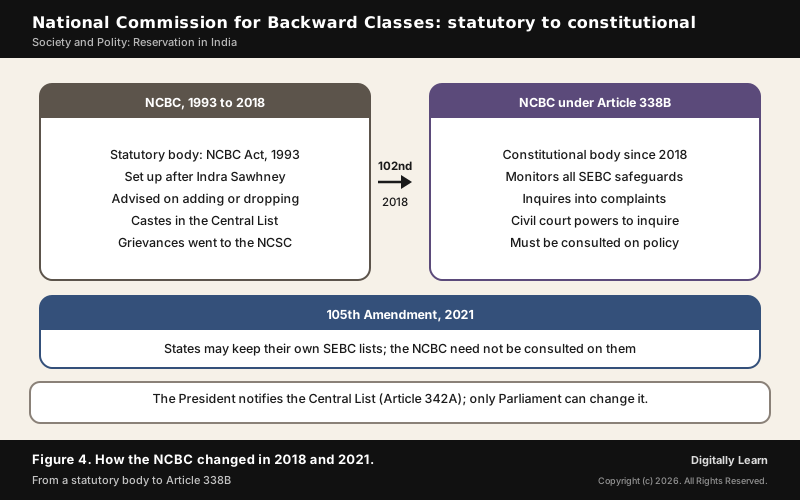
The amendment then caused an unexpected problem. In the Maratha reservation case of 5 May 2021, the Supreme Court held by 3 to 2 that after the 102nd Amendment only the President could identify backward classes, so states had lost the power to keep their own lists. Parliament passed the 105th Amendment within three days in August 2021, with assent on 18 August, restoring the states' power to prepare their own lists; the NCBC need not be consulted on a state list.
NCSC and NCST: Powers and Limits of Enforcement
The National Commission for Scheduled Castes (Article 338) and the National Commission for Scheduled Tribes (Article 338A) guard the safeguards for these communities, including reservation. A single constitutional commission for SCs and STs was created by the 65th Amendment in 1990 and split into two by the 89th Amendment, with the two commissions working from 2004. Each has a Chairperson, a Vice-Chairperson and three members appointed by the President.
- What they can do: Investigate and monitor safeguards, inquire into complaints, advise on development planning and report to the President.
- Their strongest power: While investigating or inquiring, they have the powers of a civil court: summoning witnesses, requiring documents, receiving evidence on affidavits and requisitioning public records.
- Where they stop: Their reports are recommendations. The government lays them before Parliament with a memorandum on the action taken and the reasons for not accepting any recommendation, so it may decline them.
- Consultation: The Union and state governments must consult them on all major policy matters affecting SCs and STs.
These limits answer a question the examination has asked. The NCSC cannot enforce SC reservation in religious minority institutions, first because Article 15(5) itself exempts minority educational institutions from the admission quota, and second because the Commission can investigate and recommend but cannot compel.
Reservation in India: Arguments For and Against
Why Reservation Is Important in India
The makers of the Constitution believed that the mere granting of the right to equality was not enough to overcome age-old injustices suffered by the Scheduled Castes and Scheduled Tribes. Formal equality treats unequal people as equals; reservation corrects for the start they never had. Reservation is the clearest example of how Indian liberalism has always been linked to social justice.
- Substantive equality: Equal rules applied to unequal starting points keep old hierarchies in place; reservation gives excluded groups a real chance.
- Representation: Quotas in legislatures and services put SC, ST and OBC voices where decisions are made.
- Merit in context: Merit in an unequal society mixes ability with inherited advantage, so a child from a deprived background is not running the same race.
- Political voice: The Mandal debate brought OBCs, about 41 per cent of the population in recent surveys, into national politics.
Criticisms of Reservation: Merit, Capture and Agitations
Reservation has also drawn sustained criticism, both of the principle and of how it works in practice. The main arguments against, and the problems in practice, are these:
- Capture by the better-off: Benefits are often cornered by a few advanced castes within each category, leaving the most marginalised behind; this is what the creamy layer and sub-classification try to correct.
- Old data: The Mandal estimate of OBCs rested on the 1931 census, and there has been no full caste count since, which weakens every claim about representation.
- Merit and efficiency: Critics argue that quotas lower standards; Article 335 and the courts’ demand for data are the constitutional answer to this concern.
- Caste consciousness: Critics argue that caste reservation in India, by using caste as the unit of benefit, keeps caste identity alive in public life.
- Demands for inclusion: Dominant communities have agitated for backward status: the Jats in Haryana in 2016, the Patidars in Gujarat from 2015 and the Marathas in Maharashtra, whose 16 per cent SEBC quota the Supreme Court struck down.
- A limited base: Reservation in jobs applies only to the State, so employment in the private sector lies outside it.
The demand for fresh data has led to the question of counting caste in the census. The decision and the debate around it are explained in caste enumeration in the Census 2027.
Making Reservation Reach the Underprivileged: Way Forward
The examination's recurring question is why affirmative action has not reached all the underprivileged, despite comprehensive policies. The answer runs through every section above: the design is sound, but benefits are unevenly spread, data is thin and the bodies that watch over it can only recommend.
- Better targeting: Sub-classification of SCs, STs and OBCs on the basis of quantifiable data, as Davinder Singh allows and the Rohini Commission proposed for OBCs.
- Reviewing the creamy layer: Updating the income limit regularly so that it separates the advanced from the deprived.
- Filling vacancies: Clearing reserved backlog posts, which Article 16(4B) already carries forward.
- Reliable data: Regular information on the representation of each group in each service.
- Beyond quotas: School education, scholarships and skills, so that more people from reserved groups can compete for the seats.
Previous Year UPSC-CSE Questions
Previous Year UPSC-CSE Questions By the end you will be able to draft model answers for the following UPSC questions. Each question carries a collapsible framework showing how to approach it in the exam.
- UPSC Mains 2024 GS-IDespite comprehensive policies for equity and social justice, underprivileged sections are not yet getting the full benefits of affirmative action envisaged by the Constitution. Comment.
Answer outline: how to structure the answer
What the question asks, the main arguments, relevant examples and the direction of the conclusion. This is not a full model answer.
Introduction: Articles 15(4), 16(4) and 46 promise special provisions and protection for SCs, STs and backward classes.
Body (sub-themes to develop):
- Design: quotas in jobs, education and legislatures; commissions under Articles 338 to 338B.
- Capture: benefits cornered by advanced groups within categories; creamy layer only for OBCs.
- Data and delivery: 1931-based OBC estimates, backlog vacancies, promotion quotas needing quantifiable data.
- Limited base: quotas cover only State jobs and institutions.
- Reforms: sub-classification (Davinder Singh, Rohini Commission), creamy layer review, education and data.
Conclusion: Conclude that the intent is sound but needs better targeting, reliable data and investment beyond quotas.
- UPSC Mains 2022 GS-IIDiscuss the role of the National Commission for Backward Classes in the wake of its transformation from a statutory body to a constitutional body.
Answer outline: how to structure the answer
What the question asks, the main arguments, relevant examples and the direction of the conclusion. This is not a full model answer.
Introduction: The NCBC was set up in 1993 under the NCBC Act after Indra Sawhney; the 102nd Amendment made it constitutional under Article 338B.
Body (sub-themes to develop):
- Before 2018: advised only on inclusion and exclusion in the Central List; grievances went to the NCSC.
- After 2018: monitors safeguards, inquires into complaints with civil court powers, advises on development, reports to the President.
- Mandatory consultation on major policy matters; Central List under Article 342A changed only by Parliament.
- Maratha case (2021) and the 105th Amendment: states keep their own lists without consulting the NCBC.
Conclusion: Conclude that constitutional status widened its mandate, but its recommendations still depend on government action.
- UPSC Mains 2018 GS-IIWhether National Commission for Scheduled Castes (NCSC) can enforce the implementation of constitutional reservation for the Scheduled Castes in the religious minority institutions? Examine.
Answer outline: how to structure the answer
What the question asks, the main arguments, relevant examples and the direction of the conclusion. This is not a full model answer.
Introduction: The NCSC under Article 338 monitors all safeguards for Scheduled Castes, including reservation.
Body (sub-themes to develop):
- Powers: investigate, inquire into complaints with civil court powers, report and be consulted.
- Article 15(5) excludes minority educational institutions of Article 30(1) from admission quotas.
- Its reports are recommendations; the government may decline them with reasons.
Conclusion: Conclude that the NCSC cannot enforce SC reservation in minority institutions, because the Constitution exempts them.
- UPSC Prelims 2023 Prelims-GSConsider the following statements:
- Statement-I: The Supreme Court of India has held in some judgements that the reservation policies made under Article 16(4) of the Constitution of India would be limited by Article 335 for maintenance of efficiency of administration.
- Statement-II: Article 335 of the Constitution of India defines the term 'efficiency of administration'.
Which one of the following is correct in respect of the above statements?
How to approach this Prelims question
Approach: Test each statement on its own, then ask whether the second explains the first. The Supreme Court has held that reservation under Article 16(4) must be consistent with the efficiency of administration that Article 335 mentions, so Statement I is correct. Article 335 only names that consideration; it does not define it, so Statement II is incorrect.
Trap to watch: Article 335 names efficiency of administration but gives no definition.
Key facts to recall:
- (a) Both correct, II explains I: wrong. Statement II is incorrect.
- (b) Both correct, II does not explain I: wrong. Statement II is incorrect.
- (c) I correct, II incorrect: right. The limit exists, but Article 335 defines nothing.
- (d) I incorrect, II correct: wrong. Statement I is correct and Statement II is not.
Answer signal: Option (c): Statement I is correct and Statement II is incorrect.
- UPSC Prelims 2004 Prelims-GSMatch List I (Articles of the Constitution of India) with List II (Provision) and select the correct answer using the codes given below the lists:
- List I (A) Article 14 (B) Article 15 (C) Article 16 (D) Article 17
- List II 1. The State shall not discriminate against any citizen on grounds only of religion, race, caste, sex, place of birth or any of them 2. The State shall not deny to any person equality before the law or the equal protection of laws within the territory of India 3. “Untouchability” is abolished and its practice in any form is forbidden 4. There shall be equality of opportunity for all citizens in matters relating to employment or appointment to any office under the State
Codes: A B C D
How to approach this Prelims question
Approach: Match each Article to its guarantee. Article 14 is equality before the law (2), Article 15 bars discrimination on grounds such as religion, race and caste (1), Article 16 is equality of opportunity in public employment (4), and Article 17 abolishes untouchability (3). The code is 2, 1, 4, 3.
Trap to watch: Article 14 is equality before law; Article 16 is equal opportunity in public employment.
Key facts to recall:
- (a) 2 4 1 3: wrong. It swaps Articles 15 and 16.
- (b) 3 1 4 2: wrong. It gives Article 14 the abolition of untouchability.
- (c) 2 1 4 3: right. Equality before law, non-discrimination, equal opportunity in employment, untouchability.
- (d) 3 4 1 2: wrong. It gives Article 14 the abolition of untouchability and Article 16 non-discrimination.
Answer signal: Option (c): A-2, B-1, C-4, D-3.
Sources and Further Reading
- Constitution of India (Legislative Department, 2024 edition): Articles 15, 16, 31B, 46, 243D, 243T, 330 to 342A and the Ninth Schedule
- NCERT: Indian Society (Class XII), Chapter 5, Patterns of Social Inequality and Exclusion
- NCERT: Politics in India since Independence (Class XII), Chapter 8, Recent Developments in Indian Politics
- NCERT: Indian Constitution at Work (Class XI), Chapter 9, Constitution as a Living Document
- NCERT: Indian Constitution at Work (Class XI), Chapter 10, The Philosophy of the Constitution
- PIB: Right to identify and list backward classes (28 July 2021)
- National Commission for Backward Classes
- National Commission for Scheduled Castes
- Wikipedia: Reservation in India
- Wikipedia: Indra Sawhney and Others v. Union of India
- Wikipedia: Mandal Commission
- Wikipedia: Creamy layer
- Wikipedia: Economically Weaker Section
- Wikipedia: Janhit Abhiyan v. Union of India
- Wikipedia: State of Punjab v. Davinder Singh
- Wikipedia: One Hundred and Fifth Amendment of the Constitution of India
- Wikipedia: Poona Pact
- Wikipedia: Shahu of Kolhapur
- Wikipedia: Reservation policy in Tamil Nadu
- UPSC: Previous year question papers
Editorial Disclaimer
This article explains reservation in India for UPSC preparation, from the Constitution, NCERT textbooks and Supreme Court judgments. It is not legal advice; for a claim to reservation, check the current notification of the government or institution concerned.


