


Overview
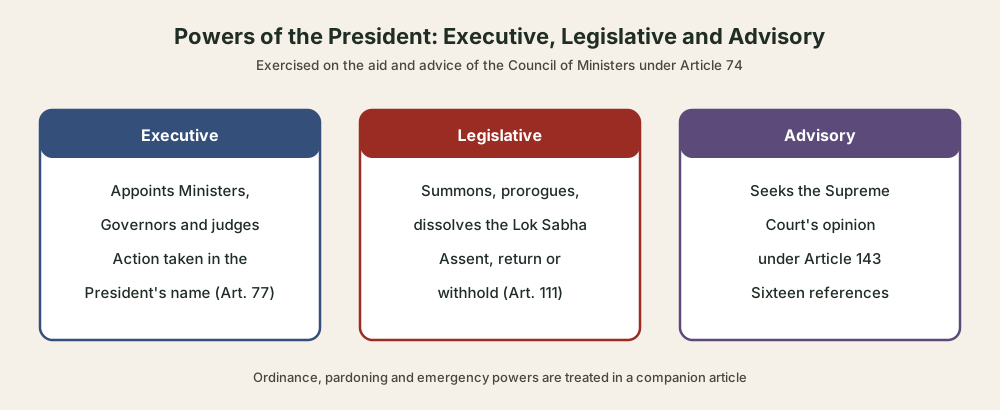
The powers of the President of India are the executive, legislative, financial, advisory and emergency functions vested in the head of the Union. Under Article 74 they are exercised on the advice of the Council of Ministers, but the President may seek reconsideration once, return a Bill once, and refer questions to the Supreme Court under Article 143.
Powers of the President of India: Scope, Advice and Discretion
Formal Powers of the President and the Real Executive
The powers of the President of India are the executive, legislative, financial, advisory and emergency functions that the Constitution vests in the head of the Union. Article 53 vests the executive power of the Union in the President, and Article 74 requires the President to exercise it on the aid and advice of the Council of Ministers headed by the Prime Minister.
These powers matter because nearly every act of the Union passes through the President. Executive action is taken in the President's name, Parliament is summoned and prorogued by the President, and a Bill becomes law only with assent, so knowing where the real decision lies is central to the parliamentary system.
The significance of the President's powers lies in three functions they perform in the constitutional scheme:
- Formal authority: The Union acts in the President’s name, which gives every order a single constitutional source.
- Continuity: The President appoints governments, summons Parliament and fills constitutional offices, so the Union never stands without a head.
- Constitutional check: The President can ask the Council of Ministers to reconsider its advice, return a Bill once and seek the Supreme Court’s opinion.
| Type of power | Main Articles | Examples |
|---|---|---|
| Executive | 53, 75, 77, 155, 239 | Appoints the Prime Minister, Ministers and Governors; administers Union territories through administrators |
| Legislative | 80, 85, 86, 87, 108, 111 | Summons and prorogues Parliament, dissolves the Lok Sabha, addresses both Houses, assents to Bills |
| Financial | 112, 117, 267, 280 | Lays the annual financial statement, recommends money Bills, holds the Contingency Fund, constitutes the Finance Commission |
| Advisory and pardoning | 72, 143 | Grants pardons; refers questions to the Supreme Court |
| Military | 53(2) | Supreme command of the Defence Forces, regulated by law |
| Emergency | 352, 356, 360 | Proclaims national, State and financial emergencies |
The ordinance, pardoning and emergency powers are examined in Ordinance, Pardoning and Emergency Powers of the President, and the election and tenure of the office in President of India: Election, Qualifications, Term and Impeachment. This article covers the executive, legislative and advisory powers.
Aid and Advice Under Article 74: The 42nd and 44th Amendments
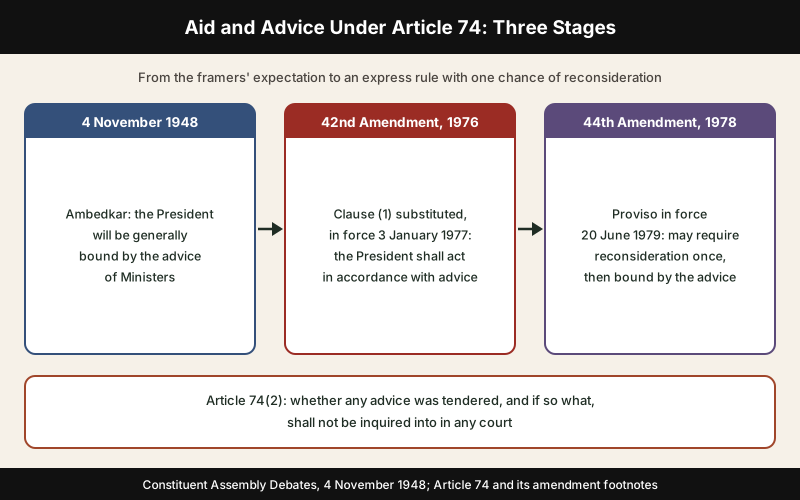
Article 74(1) provides a Council of Ministers with the Prime Minister at its head to aid and advise the President, who shall, in the exercise of the office's functions, act in accordance with such advice. These binding words came with the Forty-second Amendment, which substituted clause (1) with effect from 3 January 1977.
The Forty-fourth Amendment, in force from 20 June 1979, added a proviso: the President may require the Council to reconsider its advice, generally or otherwise, but must act in accordance with the advice tendered after reconsideration. The Council may send back the same advice, and the President is then bound by it.
Article 74(2) adds that the question whether any, and if so what, advice was tendered shall not be inquired into in any court. The provision turns Ambedkar's description of 1948, a President generally bound by the advice of Ministers, into an express constitutional rule.
Situational Discretion: When the President Chooses
The President still exercises discretion in a few situations. The first is the right to be informed: under Article 78 the Prime Minister must furnish information the President calls for, and the President often writes to the Prime Minister with views on matters confronting the country. Three further openings exist:
- Reconsideration: Sending advice back once, a request that naturally carries weight.
- Veto: Withholding or delaying assent to Bills other than Money Bills, including the pocket veto.
- Hung House: When no party has a clear majority in the Lok Sabha, choosing and appointing the Prime Minister.
Practice shows how this works. After the March 1998 election, in which no party or coalition won a majority, President K. R. Narayanan asked Atal Behari Vajpayee to furnish documents supporting his claim and to secure a vote of confidence within ten days of being sworn in.
Such situations also arise when a Prime Minister who cannot prove a majority requests dissolution of the Lok Sabha. Discretion is thus tied to political conditions: it widens when governments are unstable and coalitions hold power, and narrows to formal action when a government commands a clear majority.
Executive Powers: Ministers and Conduct of Business (Articles 75 to 78)
Appointing the Prime Minister and Ministers Under Article 75
Under Article 75(1), the President appoints the Prime Minister and appoints the other Ministers on the Prime Minister's advice. Clause (1A), inserted by the Ninety-first Amendment with effect from 1 January 2004, caps the Council of Ministers, including the Prime Minister, at fifteen per cent of the total members of the Lok Sabha.
Ministers hold office during the pleasure of the President under clause (2), but clause (3) makes the Council collectively responsible to the House of the People, not to Parliament as a whole. The President administers the oaths of office and secrecy, and a Minister who is not a member of either House for six consecutive months ceases to be a Minister.
The two rules work together. A parliamentary government, as Ambedkar put it, must resign the moment it loses the confidence of a majority, so the President's own choice of Prime Minister matters mainly when no leader commands a majority in the Lok Sabha.
Conduct of Business: Article 77 and the Business Rules of 1961
Article 77(1) requires all executive action of the Government of India to be expressed to be taken in the name of the President. Clause (2) protects orders authenticated under the President's rules from challenge on the ground that the President did not personally make or execute them.
Under clause (3) the President makes rules for the more convenient transaction of business and for its allocation among Ministers. Both sets of rules were made on 14 January 1961: the Government of India (Allocation of Business) Rules and the Government of India (Transaction of Business) Rules.
The Allocation Rules specify the Ministries and Departments in their First Schedule, and the President, on the advice of the Prime Minister, allocates business among Ministers by assigning one or more departments to each. Ministries are therefore created through the President's rules, not by the Prime Minister acting on the Cabinet Secretary's advice.
The Prime Minister's Duties to the President Under Article 78
Article 78 places three duties on the Prime Minister. The first is to communicate to the President all decisions of the Council of Ministers relating to the administration of the affairs of the Union and proposals for legislation.
The second is to furnish such information on administration and proposals for legislation as the President may call for. The third, if the President so requires, is to submit to the Council any matter decided by a single Minister but not considered by the Council, which lets the President secure collective consideration.
Appointments and Removals Made by the President
Constitutional Offices Filled by Presidential Appointment
The President appoints most constitutional functionaries of the Union. Several appointments, including those of Governors, the Comptroller and Auditor-General and the judges, are made by warrant under the President's hand and seal, and all follow the advice or procedure that the Constitution and the law lay down.
| Office | Article | Tenure or removal |
|---|---|---|
| Prime Minister and Ministers | 75 | Ministers hold office during the pleasure of the President |
| Attorney-General for India | 76 | During the pleasure of the President; must be qualified to be a Supreme Court judge |
| Comptroller and Auditor-General | 148 | Removable only like a Supreme Court judge |
| Governor of a State | 155, 156 | During the pleasure of the President; term of five years |
| Judges of the Supreme Court | 124 | Removable only after an address by each House of Parliament |
| Chief Election Commissioner and Election Commissioners | 324 | Chief Election Commissioner removable only like a Supreme Court judge |
| Chairman and members of the Union Public Service Commission | 316, 317 | Removal for misbehaviour only after a Supreme Court inquiry |
| Finance Commission | 280 | Constituted every fifth year, or earlier, by the President's order |
| Administrators of Union territories | 239 | Act for the President, to such extent as the President thinks fit |
The table shows that appointment is a single formal act, but the terms of office differ sharply. That difference, not the appointment itself, decides how independent each office is.
Removal: Pleasure of the President and Protected Tenures
The Attorney-General, the Governors and the Ministers hold office during the pleasure of the President. Because the President acts on ministerial advice, these offices can in practice be ended by the government of the day.
Offices that must check the government enjoy protected tenure. A Supreme Court judge can be removed only by the President's order after an address by each House, supported by a majority of its total membership and two-thirds of those present and voting; the Comptroller and Auditor-General and the Chief Election Commissioner can be removed only in the same manner.
Members of the Union Public Service Commission are removed for misbehaviour only after the Supreme Court, on a reference by the President, has inquired and reported. Appointment stays formal, but removal of these watchdog offices is made difficult.
Legislative Powers: Sessions, Addresses and Bills Before Parliament
Summoning Parliament Under Article 85(1)
Under Article 85(1), the President summons each House of Parliament to meet at such time and place as the President thinks fit. The only limit is that six months shall not intervene between the last sitting in one session and the date appointed for the first sitting of the next.
The Constitution fixes neither the number of sessions nor a minimum number of sitting days. Three sessions a year, Budget, Monsoon and Winter, are a matter of practice: the Lok Sabha normally meets in three, while until 1994 the Rajya Sabha normally met in four, with five in some years and only three in 1975 and 1984.
Prorogation, Adjournment Sine Die and Dissolution of the Lok Sabha
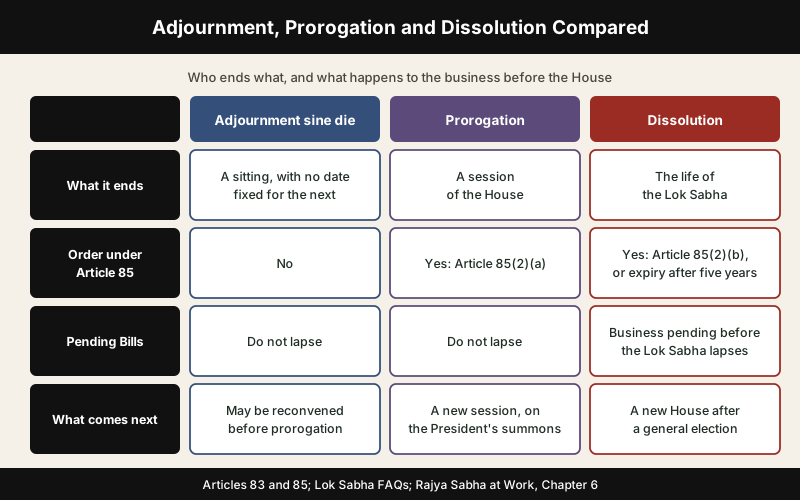
Under Article 85(2), the President may prorogue the Houses or either House and may dissolve the House of the People. Prorogation ends a session; adjournment, including adjournment sine die, only ends a sitting, and adjournment sine die leaves no date fixed for the next sitting.
Prorogation may take place at any time, even while the House is sitting, but it usually follows adjournment sine die. The President's orders summoning or proroguing Parliament carry out the decision of the Prime Minister or the Cabinet, so prorogation is not a discretionary power.
Dissolution ends the life of the Lok Sabha, either by the President's order under Article 85(2)(b) or on the expiry of five years from its first meeting, which operates as a dissolution under Article 83(2). Bills pending in either House do not lapse on prorogation, but all business pending before the Lok Sabha lapses on dissolution.
The Rajya Sabha is not subject to dissolution; as nearly as possible one-third of its members retire every second year. When the Lok Sabha is dissolved, the Speaker does not vacate office until immediately before the first meeting of the new House.
Addresses and Messages Under Articles 86 and 87
Article 86 allows the President to address either House or both together and to send messages about a pending Bill or otherwise, which a House must consider with all convenient despatch. Since the commencement of the Constitution, however, the President has not addressed either House under Article 86(1).
Article 87(1) requires a special address to both Houses assembled together at the start of the first session after each general election and of the first session of each year. Being a statement of government policy, the address is drafted by the government, reviews the previous year and indicates the main legislative business ahead.
Nominations, Joint Sittings and Prior Recommendation of Bills
The President nominates twelve members of the Rajya Sabha, chosen from persons with special knowledge or practical experience of literature, science, art and social service. Under Article 108, the President may summon a joint sitting of the two Houses when, after a Bill passed by one House reaches the other:
- The other House rejects the Bill.
- The Houses finally disagree on the amendments to be made.
- More than six months pass without the other House passing the Bill.
Joint sittings do not apply to Money Bills. The Lok Sabha records three joint sittings so far:
- 6 May 1961: The Dowry Prohibition Bill, 1959, after the Houses disagreed on amendments.
- 16 May 1978: The Banking Service Commission (Repeal) Bill, 1977, after the Rajya Sabha rejected it.
- 26 March 2002: The Prevention of Terrorism Bill, 2002, after the Rajya Sabha rejected the motion to consider it.
Some Bills need the President's prior recommendation before they can be introduced:
- Bills forming new States or altering State areas, boundaries or names under Article 3.
- Bills on the matters listed in Article 110(1), under Article 117(1).
- Bills affecting taxes in which States are interested, under Article 274(1).
Assent to Bills and the Veto Powers of the President
Assent, Withholding or Return Under Article 111
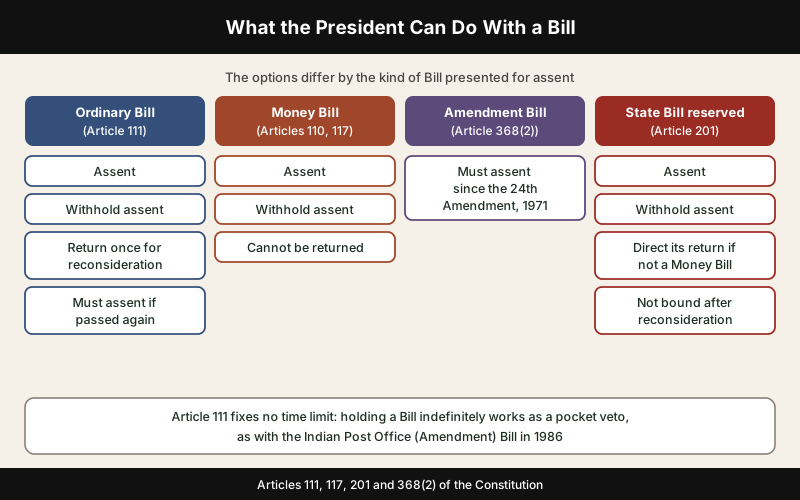
When a Bill passed by both Houses is presented, Article 111 requires the President to declare either assent or the withholding of assent. For a Bill other than a Money Bill, the President may instead, as soon as possible, return it with a message asking the Houses to reconsider it or any provision, and may recommend amendments.
If the Houses pass the returned Bill again, with or without amendment, the President shall not withhold assent. The return is therefore a suspensive veto: it delays and invites reconsideration, but Parliament has the last word. In giving assent, the President acts on the advice of Ministers.
Absolute, Suspensive and Pocket Veto
| Type | Constitutional basis | Effect |
|---|---|---|
| Absolute veto | Withholding assent under Article 111 | The Bill does not become law |
| Suspensive veto | Returning a Bill other than a Money Bill, once | Parliament may pass it again; assent cannot then be withheld |
| Pocket veto | No time limit in Article 111 | The Bill stays pending without a decision |
The pocket veto exists because Article 111 fixes no time for the decision. In 1986 President Zail Singh neither assented to nor returned the Indian Post Office (Amendment) Bill, which would have let governments intercept, inspect and detain items in the post, and the Bill did not become law.
Because the Constitution never mentions it, the pocket veto is an informal power, yet it can be used very effectively. It shows that the absence of a time limit, rather than any express grant, gives the office an effective check on legislation.
Money Bills, Constitutional Amendments and Reserved State Bills
Three classes of Bill narrow the President's choices:
- Money Bills: They cannot be returned, because the proviso to Article 111 applies only to other Bills, and they are introduced only on the President’s recommendation.
- Constitutional amendment Bills: Since the Twenty-fourth Amendment of 1971, Article 368(2) says the President shall give assent, so neither form of veto applies.
- State Bills reserved by a Governor: Under Article 201 the President may assent or withhold assent, and for a Bill other than a Money Bill may direct its return; the President is not bound to assent after the State legislature reconsiders it.
The Money Bill rule reflects the financial primacy of the Lok Sabha: such a Bill cannot be introduced in the Council of States, and the President's prior recommendation means the government has already endorsed it before introduction.
Timelines for Assent: The 2025 Tamil Nadu Judgment and Reference
In State of Tamil Nadu v. Governor of Tamil Nadu, decided on 8 April 2025, a two-judge bench held that Governors cannot exercise an absolute or pocket veto. Adopting a Home Ministry guideline, it prescribed that the President decide on Bills reserved by a Governor within three months of receiving them, recording reasons for any longer delay.
On 13 May 2025 President Droupadi Murmu referred fourteen questions to the Supreme Court under Article 143(1). On 20 November 2025 a five-judge bench led by Chief Justice B. R. Gavai gave its opinion in Special Reference No. 1 of 2025, reported as 2025 INSC 1333.
The Court's opinion on the President can be summarised in three holdings:
- No judicial timelines: The President cannot be bound by judicially prescribed timelines under Article 201.
- No merits review: The President’s assent under Article 201 is not justiciable.
- No deemed assent: The Constitution, including Article 142, does not allow a Bill to be treated as assented to.
For prolonged, unexplained and indefinite inaction by a Governor, the Court allowed only a limited mandamus to decide within a reasonable time, without any comment on the merits of the decision.
The opinion also held that the President need not seek the Court's advice every time a Governor reserves a Bill, since the President's subjective satisfaction is sufficient. It returned the question on the composition of benches and the question on Union-State disputes outside Article 131 unanswered.
Advisory, Financial, Military and Union Territory Powers
Seeking the Supreme Court's Opinion Under Article 143
Under Article 143(1), if it appears to the President that a question of law or fact of public importance has arisen or is likely to arise, the President may refer it to the Supreme Court, which may report its opinion after such hearing as it thinks fit. The Court acts only on a reference; it does not advise on its own initiative.
Under clause (2), the President may refer disputes of the kind excluded from the Court's original jurisdiction by the proviso to Article 131, and there the Court shall report its opinion. The contrast between may in clause (1) and shall in clause (2) is a frequent examination point.
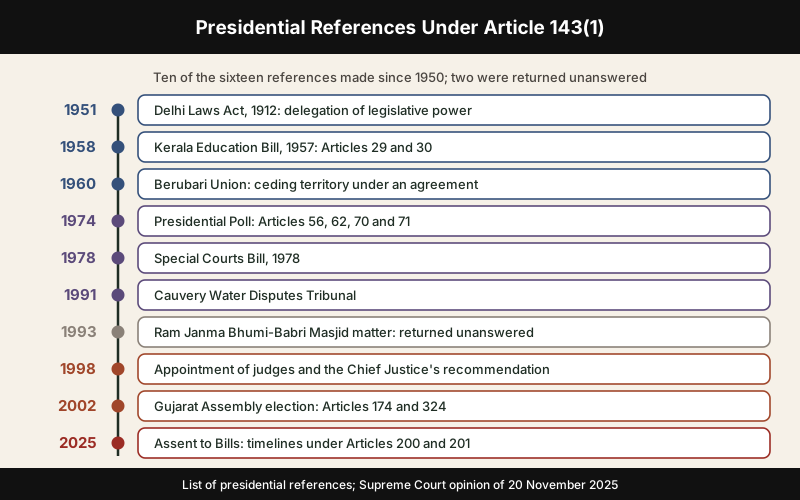
By August 2002, the Law Ministry recorded, the President had referred questions on more than ten occasions. The reference filed on 19 August 2002 concerned the constitutionality of the Election Commission's orders on the Gujarat elections. Of the sixteen references made since 1950, two were returned unanswered, and the latest came in 2025.
Financial Powers and Reports the President Lays Before Parliament
The President's financial powers are exercised on advice but are indispensable to Parliament's control of money:
- Article 112: The President causes the annual financial statement to be laid before both Houses for every financial year.
- Article 267: The Contingency Fund of India is placed at the President’s disposal for unforeseen expenditure pending authorisation by Parliament.
- Article 280: The President constitutes a Finance Commission at the expiration of every fifth year, or earlier if necessary.
The Constitution also makes the President the channel through which certain reports reach Parliament, usually with a memorandum on the action taken:
| Report | Article | What accompanies it |
|---|---|---|
| Recommendations of the Finance Commission | 281 | Explanatory memorandum on the action taken |
| Reports of the Comptroller and Auditor-General on Union accounts | 151(1) | Laid before each House |
| Annual report of the Union Public Service Commission | 323(1) | Memorandum on cases where advice was not accepted |
| Reports of the National Commission for Scheduled Castes | 338(6) | Memorandum on action taken and reasons for non-acceptance |
| Reports of the National Commission for Scheduled Tribes | 338A(6) | Memorandum on action taken and reasons for non-acceptance |
The report of the Public Accounts Committee does not appear among these; the Constitution assigns the President no duty to lay it. The distinction between reports that pass through the President and those of parliamentary committees is a common test point.
Military Command and Administration of Union Territories
Under Article 53(2), the supreme command of the Defence Forces vests in the President, and its exercise is regulated by law. Like the other powers, it is exercised on ministerial advice under Article 74, so command decisions rest with the elected government, answerable to the Lok Sabha.
Under Article 239(1), save as Parliament provides by law, every Union territory is administered by the President acting, to such extent as the President thinks fit, through an administrator appointed with such designation as the President specifies.
Assessment of the President's Powers in Practice
Distinguishing Features and Observable Outcomes
Three features distinguish the President's powers from those of an executive president, and each follows from the constitutional text examined above:
- Formal but not empty: The powers are exercised on advice under Article 74, yet reconsideration, return of Bills and references to the Court remain real checks.
- Delay rather than denial: The President’s checks on Parliament are mostly suspensive, and a re-passed Bill must receive assent.
- Protected officers: The President appoints the watchdog offices, but removal needs special procedures that the government alone cannot trigger.
Three observable outcomes follow from these features in the practice of the office since 1950:
- The pocket veto of 1986 showed that an undefined time for assent can stop a Bill passed by both Houses.
- In 1998, the demand for documents and a confidence vote showed discretion widening in a hung Lok Sabha.
- Sixteen references since 1950, the latest in 2025, show the advisory power used to settle constitutional doubts.
Together these features and outcomes explain why the office is described as a constitutional head with real but limited checks: the President cannot govern, yet can delay, question and refer.
Assent Timelines, Federal Friction and the Office Today
The contemporary linkage is the dispute over delayed assent to State Bills. The 2025 opinion leaves the timing of the President's decision under Article 201 without a judicial deadline, while allowing courts a limited mandamus against a Governor's prolonged and unexplained inaction.
The result places the burden on political accountability and constitutional convention rather than on fixed deadlines. For aspirants, the episode links Articles 111, 143, 200 and 201 and shows the President's office at the centre of Union-State relations.
UPSC Relevance and Previous-Year Questions on Presidential Powers
Where the President's Powers Fit in the UPSC-CSE Syllabus
This topic belongs to General Studies Paper II, under the structure, organisation and functioning of the Executive and Parliament. The linked questions from the preliminary examination test exact textual points:
- Sessions: The President summons Parliament at any place, and the Constitution fixes no number of sessions or minimum sitting days.
- Prorogation and dissolution: Both are done on advice, and prorogation usually follows adjournment sine die.
- Business rules: Article 77 rules, action in the President’s name, and ministries set out in the Allocation Rules.
- Articles 74, 75 and 78: Reconsideration under the 44th Amendment, pleasure, responsibility to the Lok Sabha, and the Prime Minister’s duties.
- Article 143 and the reports the President must lay before Parliament.
For the main examination, the 2025 opinion on assent timelines gives Mains questions on Articles 111, 143 and 201 fresh relevance. The sections on veto, reserved Bills and the reference supply the material for such an answer, and the section on Article 74 supplies the frame of ministerial responsibility.
Previous Year UPSC-CSE Questions
Previous Year UPSC-CSE Questions By the end you will be able to draft model answers for the following UPSC questions. Each question carries a collapsible framework showing how to approach it in the exam.
- UPSC Prelims 2024 GS-IWith reference to the Parliament of India, consider the following statements :
- Prorogation of a House by the President of India does not require the advice of the Council of Ministers.
- Prorogation of a House is generally done after the House is adjourned sine die but there is no bar to the President of India prorogating the House which is in session.
- Dissolution of the Lok Sabha is done by the President of India who, save in exceptional circumstances, does so on the advice of the Council of Ministers.
Which of the statements given above is/are correct?
How to approach this Prelims question
Approach: Apply Article 74 to Article 85: every order under Article 85 is made on advice unless the political situation leaves no government with a majority.
Trap to watch: Statement 1 treats prorogation as a personal power; it is not.
Key facts to recall:
- Prorogation: Article 85(2)(a), on advice.
- Usually after adjournment sine die, but possible during a sitting.
- Dissolution: Article 85(2)(b), on advice save in exceptional cases.
Answer signal: Statements 2 and 3 are correct, so option (c) is the answer.
- UPSC Prelims 2020 GS-IConsider the following statements :
- The President of India can summon a session of the Parliament at such place as he/she thinks fit.
- The Constitution of India provides for three sessions of the Parliament in a year, but it is not mandatory to conduct all three sessions.
- There is no minimum number of days that the Parliament is required to meet in a year.
Which of the statements given above is/are correct ?
How to approach this Prelims question
Approach: Read Article 85(1) closely: it sets a place, a time and a six-month limit, nothing else.
Trap to watch: Budget, Monsoon and Winter sessions are practice, not constitutional text.
Key facts to recall:
- Summon at such time and place as the President thinks fit.
- Six months shall not intervene between sessions.
- No constitutional number of sessions or minimum sitting days.
Answer signal: Statements 1 and 3 are correct, so option (c) is the answer.
- UPSC Prelims 2014 GS-IConsider the following statements:
- The President shall make rules for the more convenient transaction of the business of the Government of India, and for the allocation among Ministers of the said business.
- All executive actions of the Government of India shall be expressed to be taken in the name of the Prime Minister.
Which of the statements given above is/are correct?
How to approach this Prelims question
Approach: Recall that the Union acts in the name of its formal head.
Trap to watch: The Prime Minister is the real executive, which makes statement 2 tempting.
Key facts to recall:
- Article 77(1): action in the name of the President.
- Article 77(3): the President makes the business rules.
- Both sets of rules date from 14 January 1961.
Answer signal: Only statement 1 is correct, so option (a) is the answer.
- UPSC Prelims 2013 GS-IConsider the following statements :
- The Council of Ministers in the Centre shall be collectively responsible to the Parliament.
- The Union Ministers shall hold the office during the pleasure of the President of India.
- The Prime Minister shall communicate to the President about the proposals for legislation.
Which of the statements given above is/are correct?
How to approach this Prelims question
Approach: Check the exact body named in Article 75(3).
Trap to watch: Parliament includes the Rajya Sabha, to which the Council is not responsible.
Key facts to recall:
- Article 75(3): responsible to the House of the People.
- Article 75(2): pleasure of the President.
- Article 78(a): decisions and proposals for legislation communicated.
Answer signal: Statements 2 and 3 are correct, so option (b) is the answer.
- UPSC Prelims 2012 GS-IAccording to the Constitution of India, it is the duty of the President of India to cause to be laid before the Parliament which of the following?
- The Recommendations of the Union Finance Commission
- The Report of the Public Accounts Committee
- The Report of the Comptroller and Auditor General
- The Report of the National Commission for Scheduled Castes
Select the correct answer from the options below.
How to approach this Prelims question
Approach: Separate constitutional bodies that report to the President from committees of Parliament.
Trap to watch: The Public Accounts Committee examines the CAG's reports, which makes item 2 look connected to item 3.
Key facts to recall:
- Article 281: Finance Commission.
- Article 151(1): CAG reports on Union accounts.
- Article 338(6): NCSC reports.
Answer signal: Items 1, 3 and 4 are laid by the President, so option (c) is the answer.
- UPSC Prelims 2010 GSConsider the following statements: The Supreme Court of India tenders advice to the President of India on matters of law or fact
- On its own initiative (on any matter of larger public interest).
- If he seeks such an advice.
- Only if the matters relate to the Fundamental Rights of the citizens.
Which of the statements given above is/are correct?
How to approach this Prelims question
Approach: Read Article 143(1): the trigger is the President's reference, and the subject is any question of law or fact of public importance.
Trap to watch: Statement 3 narrows the subject matter; the Article has no such limit.
Key facts to recall:
- Reference by the President only.
- Any question of law or fact of public importance.
- Court may report under clause (1).
Answer signal: Only statement 2 is correct, so option (b) is the answer.
- UPSC Prelims 2003 GSUnder which Article of the Indian Constitution did the President make a reference to the Supreme Court to seek the Court’s opinion on the constitutional validity of the Election Commission’s decision on deferring the Gujarat Assembly elections (in the year 2002)?
How to approach this Prelims question
Approach: Any opinion sought by the President from the Supreme Court is sought under Article 143.
Trap to watch: Article 142 concerns the Court's power to do complete justice, a common distractor.
Key facts to recall:
- Article 143: advisory jurisdiction.
- 2002: Gujarat Assembly election reference.
- Article 142: complete justice.
Answer signal: The reference was under Article 143, so option (b) is the answer.
- UPSC Prelims 2002 GSWhich one of the following amendments to the Indian Constitution empowers the President to send back any matter for reconsideration by the Council of Ministers?
How to approach this Prelims question
Approach: Pair the two amendments with their changes: the 42nd bound the President, the 44th added reconsideration.
Trap to watch: The 42nd Amendment is the famous change to Article 74, which makes option (c) attractive.
Key facts to recall:
- 42nd: clause (1) substituted, in force 3 January 1977.
- 44th: proviso inserted, in force 20 June 1979.
Answer signal: The 44th Amendment added reconsideration, so option (d) is the answer.
- UPSC Prelims 2009 GSWith reference to Union Government, consider the following statements :
- The Ministries/Departments of the Government of India are created by the Prime Minister on the advice of the Cabinet Secretary.
- Each of the Ministries is assigned to a Minister by the President of India on the advice of the Prime Minister.
Which of the statements given above is/are correct ?
How to approach this Prelims question
Approach: Trace both acts to Article 77(3): the President makes the rules and allocates business on the Prime Minister's advice.
Trap to watch: The Cabinet Secretary advises on administration but does not create Ministries.
Key facts to recall:
- Allocation of Business Rules, 14 January 1961.
- Ministries listed in the First Schedule.
- Departments assigned by the President on the Prime Minister's advice.
Answer signal: Only statement 2 is correct, so option (b) is the answer.
Sources and Further Reading
- Legislative Department, Ministry of Law and Justice: The Constitution of India
- Lok Sabha Secretariat: Constituent Assembly Debates, Official Report, Volume VII (4 November 1948)
- NCERT: Indian Constitution at Work, Class 11, Chapter 4, Executive
- Cabinet Secretariat: Government of India (Allocation of Business) Rules, 1961
- Cabinet Secretariat: Government of India (Transaction of Business) Rules, 1961
- Rajya Sabha Secretariat: Rajya Sabha at Work, Chapter 6, Sessions of Rajya Sabha
- Lok Sabha: Frequently Asked Questions
- Lok Sabha Secretariat: President's Address and Motion of Thanks
- Press Information Bureau: Power of President to consult Supreme Court (21 August 2002)
- Supreme Court of India: Special Reference No. 1 of 2025, opinion of 20 November 2025 (2025 INSC 1333)
- Wikipedia: State of Tamil Nadu v. Governor of Tamil Nadu
- Wikipedia: List of presidential references
- Wikipedia: Pocket veto
- Wikipedia: Zail Singh
- Wikipedia: President of India
Editorial Disclaimer
This article is for UPSC preparation and explains the powers of the President. Summaries of court opinions follow the published text of the judgments, and the official text of the Constitution governs any question of law.


