


Overview
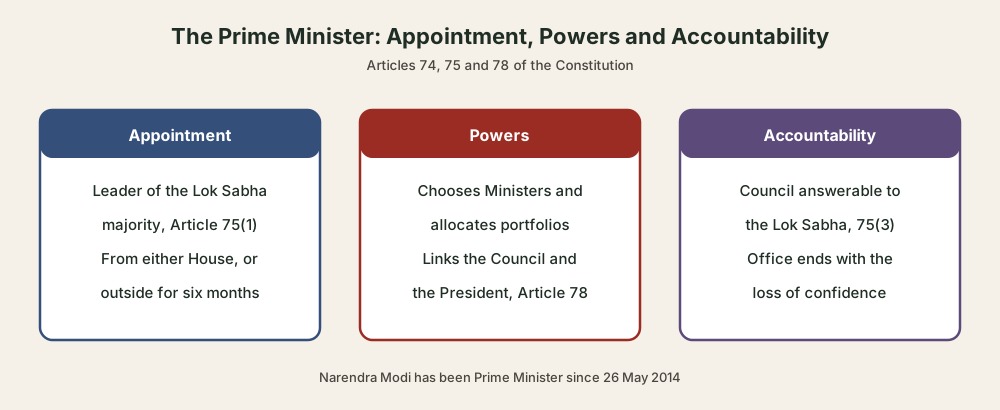
The Prime Minister of India is the head of the Council of Ministers that aids and advises the President under Article 74. Appointed by the President as the leader who commands the Lok Sabha majority, the Prime Minister chooses the other Ministers, links the Council with the President under Article 78, and holds office only while the Lok Sabha's confidence lasts.
Prime Minister in India's Parliamentary Executive
Real Executive and Nominal Head Under Articles 74 and 75
The Prime Minister of India heads the Council of Ministers that, under Article 74(1), aids and advises the President, who in the exercise of the President's functions must act in accordance with that advice. Article 75(1) provides that the President appoints the Prime Minister and appoints the other Ministers on the Prime Minister's advice.
The office matters because the executive power of the Union, which Article 53 vests in the President, is exercised on the advice of a Council that the Prime Minister leads. The President remains the formal head of the State, while the Prime Minister, with the Cabinet, wields effective power over policy, legislation and administration.
The significance of the Prime Minister lies in three roles:
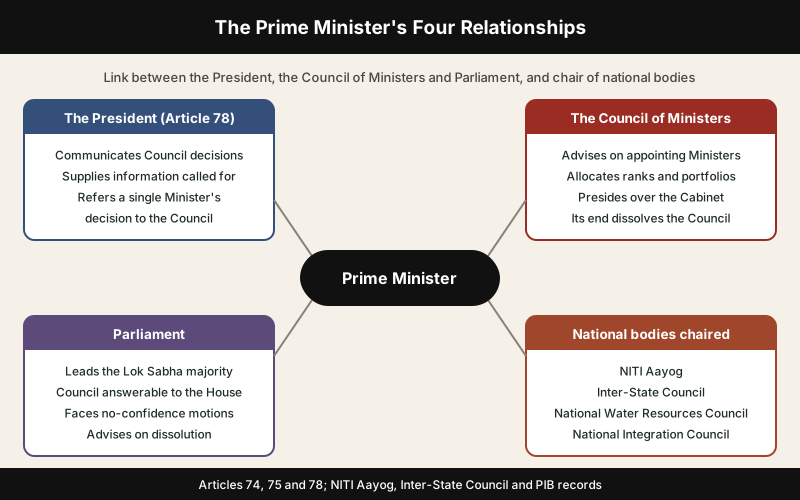
- Head of government: The Prime Minister chooses the ministers, allocates their portfolios and leads the Council of Ministers.
- Link: The Prime Minister communicates the Council’s decisions to the President under Article 78 and leads the government in Parliament.
- Chair of national bodies: The Prime Minister presides over NITI Aayog, the Inter-State Council, the National Water Resources Council and the National Integration Council.
The President's side of this relationship is explained in Powers of the President of India: Executive, Legislative, Assent and Veto, and the President's election in President of India: Election, Qualifications, Term and Impeachment. The Council of Ministers as a body, with the Attorney-General, is covered in Union Council of Ministers: Cabinet, Collective Responsibility and the Attorney-General.
Why the Constitution Chose a Parliamentary Executive
When the Constitution was framed, India already had experience of the parliamentary system under the Acts of 1919 and 1935, and that experience showed that the representatives of the people could control the executive effectively. The framers wanted a strong executive, but with safeguards against a personality cult, a danger they saw in a presidential system where the president is the source of all executive power.
Some members preferred another model. On 17 July 1947, Begum Aizaz Rasul told the Constituent Assembly that the Swiss system, in which the legislature elects the executive by the single transferable vote, would let every interest be represented. The Assembly instead kept a Prime Minister who selects the ministers and answers, together with them, to the Lok Sabha.
| System | Head of State | Head of government | Examples |
|---|---|---|---|
| Parliamentary | President or monarch, largely ceremonial | Prime Minister with the Cabinet | India, Germany, Italy, Japan, United Kingdom |
| Presidential | President | The same President | United States, Brazil |
| Semi-presidential | President with significant day-to-day powers | Prime Minister | France, Russia, Sri Lanka |
Conventions That Shape the Prime Minister's Office
Article 75(1) says only that the President appoints the Prime Minister; it does not say whom. The rule that the President appoints the leader who has the support of the majority in the Lok Sabha comes from the working of the parliamentary system, as does the expectation that the Prime Minister leads the government in that House.
Other rules follow from the text. Because the Council is collectively responsible to the House of the People under Article 75(3), a Prime Minister who loses its confidence resigns, and the Council cannot exist without a Prime Minister: it comes into existence only after the Prime Minister takes the oath. Under Article 75(2) Ministers hold office during the President's pleasure, so the office has no fixed term.
Appointment of the Prime Minister: Majority and Presidential Discretion
Leader of the Lok Sabha Majority and Coalition Choice
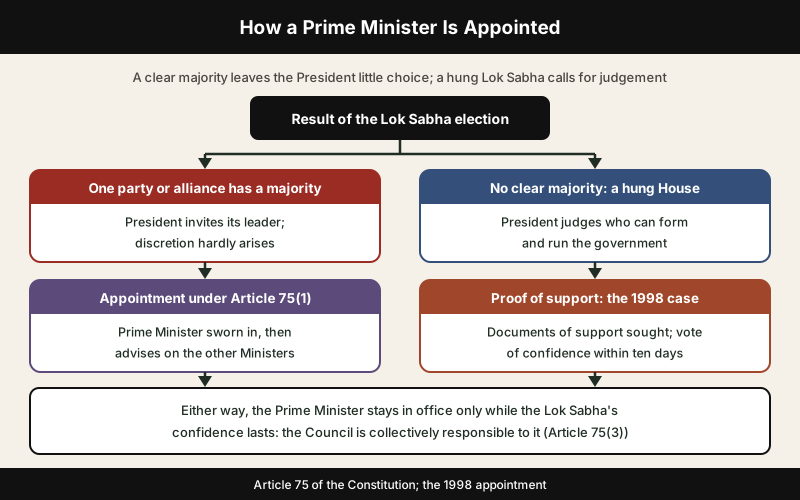
Formally, the President appoints as Prime Minister the leader who has the support of the majority in the Lok Sabha. For many years after independence the Congress held that majority and its leader became Prime Minister, so the President's choice was a formality.
Since 1989 there have been many occasions when no party had a majority. Parties then came together in a coalition, and a leader acceptable to most of the coalition partners became Prime Minister. In that situation, the President's own judgement of who can form and run the government becomes the decisive step.
Hung Lok Sabha, Presidential Discretion and the Floor Test
When no leader clearly commands a majority and two or three leaders claim support, the President must use discretion to judge who really has it. In the four general elections from 1989 to 1998 no single party or coalition won a majority, and the President had to intervene both to constitute governments and to decide requests for dissolution from Prime Ministers who could not prove a majority.
The 1998 election shows the procedure. The BJP and its allies won 251 seats, 21 short of a majority. President K. R. Narayanan asked Atal Bihari Vajpayee to furnish documents in support of his claim from the parties concerned, and advised him to secure a vote of confidence within ten days of being sworn in. The President thus left the final test of the majority to a vote on the floor of the House.
Prime Minister From the Rajya Sabha or From Outside Parliament
The Prime Minister need not be a member of Parliament when appointed. Article 75(5) provides that a Minister who for six consecutive months is not a member of either House ceases to be a Minister at the end of that period, so a person from outside may be appointed but must enter either House within six months.
The Prime Minister may also belong to the Rajya Sabha. Indira Gandhi was a Rajya Sabha member in 1966 and 1967, and H. D. Deve Gowda, I. K. Gujral and Manmohan Singh sat in the Rajya Sabha as Prime Ministers.
Under Article 88 every Minister may speak in and take part in the proceedings of either House, but that article gives no right to vote, so a Prime Minister from the Rajya Sabha cannot vote in the Lok Sabha, even on a motion of no confidence in the Prime Minister's own government.
To sit in Parliament, a person must be a citizen and, under Article 84, at least twenty-five years of age for the Lok Sabha and thirty for the Rajya Sabha. The Prime Minister also chooses the other ministers freely: Article 75(1) requires the President to appoint them on the Prime Minister's advice, and Article 75(5) allows even a non-member to be appointed for up to six months.
Oath, Term and Removal of the Prime Minister
Oaths of Office and Secrecy and the President's Pleasure
Before entering office, the Prime Minister, like every Minister, takes two oaths administered by the President under Article 75(4), in the forms set out in the Third Schedule. The oath of office binds the Minister to the Constitution and to the sovereignty and integrity of India, and to act without fear or favour; the oath of secrecy forbids revealing any matter that comes before the Minister, except as the duties require.
Under Article 75(2), Ministers hold office during the pleasure of the President, but the majority in the Lok Sabha is what keeps a Prime Minister in office: the moment that support is lost, the office is lost. Salaries and allowances are fixed by Parliament under Article 75(6), through the Salaries and Allowances of Ministers Act, 1952, and the Prime Minister ranks third in the Order of Precedence.
Collective Responsibility and the Life of the Council
Article 75(3) makes the Council of Ministers collectively responsible to the House of the People. A ministry that loses the Lok Sabha's confidence is obliged to resign, because it is in effect an executive committee of Parliament that governs on its behalf; a vote of no confidence even against a single Minister leads to the resignation of the whole Council.
The Prime Minister's own fate decides the Council's. The death or resignation of the Prime Minister automatically dissolves the Council of Ministers, whereas the death, dismissal or resignation of any other Minister only creates a vacancy. After the deaths of Jawaharlal Nehru in 1964 and Lal Bahadur Shastri in 1966, Gulzarilal Nanda served as acting Prime Minister for 13 days each time.
Confidence and No-Confidence Votes in Practice
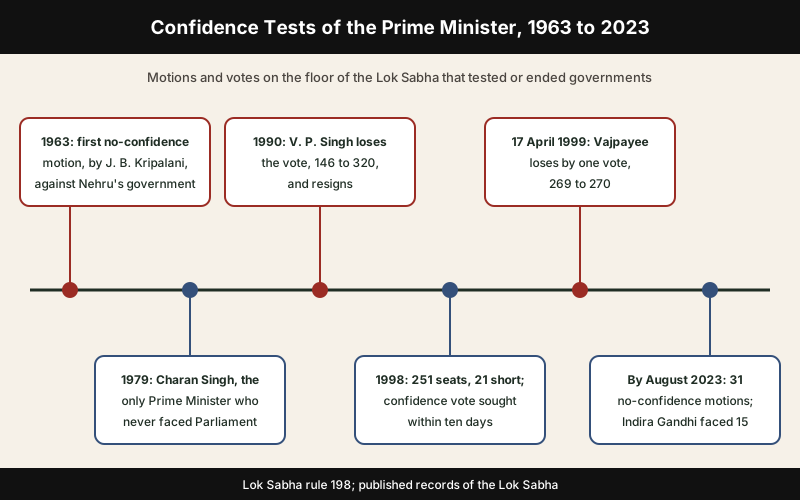
A motion of no confidence can be moved only in the Lok Sabha, and only when at least 50 members support it, after which the Speaker allots time for it under rule 198 of the Lok Sabha's rules. J. B. Kripalani moved the first such motion in August 1963, against Nehru's government, and by August 2023, 31 motions had been moved; Indira Gandhi faced the most, fifteen.
While a government keeps its majority, the Lok Sabha's power to dismiss it exists more in form than in fact. After 1989, however, several governments had to resign because they lost the support of coalition partners. Three cases show how the confidence of the House has decided the fate of Prime Ministers:
- V. P. Singh: Lost the vote in the Lok Sabha by 146 to 320 in November 1990, after the BJP withdrew its outside support, and resigned.
- Charan Singh: Took office on 28 July 1979, resigned, and is the only Prime Minister who never faced Parliament.
- Atal Bihari Vajpayee: Lost a vote on 17 April 1999 by a single vote, 269 to 270.
Article 329A: The Emergency Shield Over the Prime Minister's Election
The 39th Amendment, enacted on 10 August 1975 during the Emergency, placed the elections of the President, the Vice-President, the Prime Minister and the Speaker beyond the scrutiny of the courts; for the Prime Minister and the Speaker it did so through a new Article 329A. It was moved to pre-empt the Supreme Court's hearing of Indira Gandhi's appeal after the Allahabad High Court set aside her election on grounds of corrupt electoral practices.
The 44th Amendment of 1978 omitted Article 329A with effect from 20 June 1979, so the 44th Amendment removed the shield rather than creating it. Amendments touching the judiciary remain open to review: on 16 October 2015 a five-judge bench, by a 4 to 1 majority, struck down the 99th Amendment of 2014, which had set up the National Judicial Appointments Commission, holding that it impinged on the independence of the judiciary.
Powers and Functions of the Prime Minister
Head of the Council of Ministers: Choice, Ranks and Portfolios
The Prime Minister decides who will be the ministers and allocates ranks and portfolios: depending on seniority and political importance, a minister becomes a Cabinet Minister, a Minister of State or a Deputy Minister. Because Article 75(1) requires the President to appoint ministers on the Prime Minister's advice, the Prime Minister has full discretion in law in the choice of colleagues, although coalition politics can limit it in practice, as a later sub-section explains.
The Prime Minister controls the dismissal of ministers as well as their selection, and a minister who disagrees with a Cabinet decision must either accept it or resign. The Prime Minister presides over the Cabinet, whose meetings, and those of its committees, the Cabinet Secretariat convenes on the Prime Minister's orders.
Link Between the Council and the President Under Article 78
Article 78 makes the Prime Minister the channel between the Council of Ministers and the President. It lays three duties on the Prime Minister:
- Communicate: Tell the President all decisions of the Council of Ministers on the administration of the Union’s affairs and on proposals for legislation.
- Inform: Furnish such information on those matters as the President may call for.
- Refer: If the President so requires, place before the Council any matter decided by a single Minister but not considered by the Council.
This linking role led Jawaharlal Nehru to describe the Prime Minister as 'the linchpin of Government'. Under the proviso to Article 74(1), added by the 44th Amendment, the President may require the Council to reconsider its advice but must act on the advice given after reconsideration, and under Article 74(2) no court may inquire whether, or what, advice was tendered.
Leader of the Government in Parliament and in the Nation
The Prime Minister's power flows from several sources: control over the Council of Ministers, leadership of the Lok Sabha, command over the bureaucratic machine, access to the media, the projection of personality in elections, and a role as national leader at international summits and on foreign visits.
In Parliament, the Prime Minister leads the government's majority, and no major Bill is introduced without the approval of the Cabinet the Prime Minister heads. The President dissolves the Lok Sabha under Article 85(2)(b) on ministerial advice, and a request for dissolution from a Prime Minister who could not prove a majority is one of the situations in which the President has had to weigh that advice with care.
Chair of NITI Aayog, the Inter-State Council and Other National Bodies
The Prime Minister chairs several national bodies that bring the Union and the States together. NITI Aayog, set up on 1 January 2015, has the Prime Minister as Chairperson; its business under the Allocation of Business Rules includes evolving a shared vision of national development priorities with the active involvement of the States.
The Inter-State Council, which Article 263 allows the President to establish, was constituted on 28 May 1990 with the Prime Minister as Chairman, and its members include the Chief Ministers of all States and six Union Cabinet Ministers nominated by the Prime Minister.
The National Water Resources Council is chaired by the Prime Minister, with the Union Minister for Water Resources as Vice-Chairman and the Chief Ministers as members; it adopted the first National Water Policy in September 1987. The Zonal Councils, by contrast, are chaired by the Union Home Minister.
| Body | Key date | Other members | Role |
|---|---|---|---|
| NITI Aayog | Set up on 1 January 2015 | Vice Chairperson and CEO | Public policy think tank; shared vision of development with the States |
| Inter-State Council | Constituted on 28 May 1990 under Article 263 | Chief Ministers; six Union Cabinet Ministers | Coordination of Centre-State and inter-State policy |
| National Water Resources Council | First National Water Policy adopted in September 1987 | Water Resources Minister as Vice-Chairman; Chief Ministers | Apex body for national water policy |
| National Integration Council | Set up in 1961 after a conference convened by Nehru | Union Ministers, Chief Ministers, opposition leaders, public figures | Addresses communalism, casteism and regionalism |
Prime Minister's Office and the Cabinet Secretariat
Prime Minister's Office: Secretarial Support to the Prime Minister
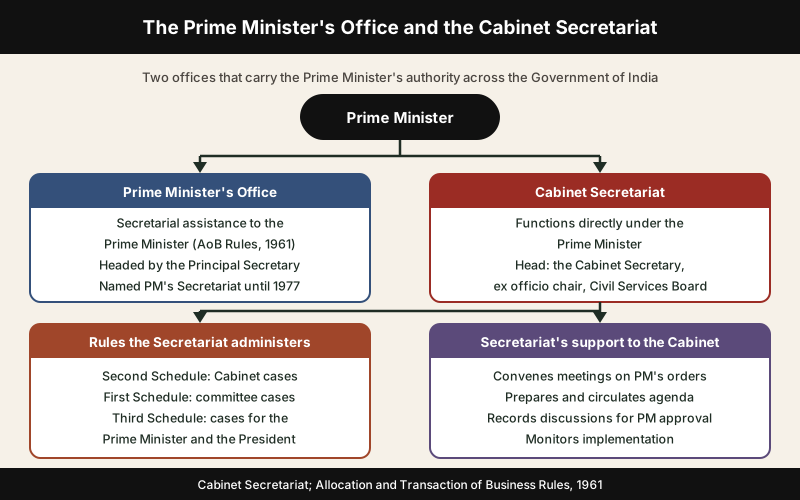
Under the Allocation of Business Rules, 1961, the Prime Minister's Office has a single item of business: to provide secretarial assistance to the Prime Minister. It was called the Prime Minister's Secretariat until 1977, when it was renamed during the premiership of Morarji Desai.
The office consists of the Prime Minister's immediate staff and several levels of support staff, and is headed by the Principal Secretary to the Prime Minister. The Prime Minister also holds the Ministry of Personnel, Public Grievances and Pensions, with a Minister of State for that Ministry as deputy.
Cabinet Secretary, Civil Services Board and Support to the Cabinet
The Cabinet Secretariat functions directly under the Prime Minister. Its administrative head is the Cabinet Secretary, who is also the ex officio Chairman of the Civil Services Board and the senior-most civil servant of the Government of India. The office is older than the Republic: on 5 September 1946, when the Interim Government was formed, the Secretariat of the Executive Council was renamed the Cabinet Secretariat.
After independence the Secretariat grew from a body circulating papers into an organisation for coordination between Ministries. Its secretarial assistance to the Cabinet and its committees covers four tasks:
- Meetings: Convening the Cabinet and its committees on the orders of the Prime Minister.
- Agenda: Preparing and circulating the agenda and the papers on it.
- Record: Preparing the record of discussions and circulating it after the Prime Minister approves it.
- Follow-up: Monitoring implementation of decisions, and keeping the papers of Cabinet meetings.
Allocation of financial resources to Ministries is not one of these functions. The Allocation of Business Rules place financial sanction for Ministries with the Department of Expenditure and the preparation of the Central Budget with the Department of Economic Affairs, both in the Ministry of Finance.
Article 77 and the Business Rules of 1961
Article 77 requires all executive action of the Government of India to be expressed as taken in the name of the President, and lets the President make rules for the more convenient transaction of business and its allocation among Ministers. The two sets of rules, both of 1961, are the Allocation of Business Rules, which assign subjects to Ministries and Departments, and the Transaction of Business Rules, which lay down how decisions are taken.
Most business is disposed of within Ministries by or under the Minister-in-charge. The Transaction of Business Rules list the cases that need the Cabinet's approval in the Second Schedule, those for Cabinet committees in the First Schedule, and those to be submitted to the Prime Minister and the President in the Third Schedule, and the Cabinet Secretariat administers both sets of rules.
Deputy Prime Minister and Prime-Ministerial Government
Deputy Prime Minister: An Office Outside the Constitution
The Deputy Prime Minister is not a constitutional post, and the Constitution does not mention it. The holder is a senior member of the Council of Ministers, nominated by the Prime Minister and appointed by the President, who deputises for the Prime Minister in the Prime Minister's absence.
The first and longest-serving Deputy Prime Minister was Vallabhbhai Patel, for 3 years and 122 days. Morarji Desai, Charan Singh, Jagjivan Ram, Yashwantrao Chavan, Devi Lal and L. K. Advani followed, and the office has been filled only intermittently, with Advani the last holder.
Cabinet Government Versus Prime-Ministerial Government
In theory the Prime Minister is first among equals in a Cabinet that decides collectively. In practice, legislatures in most democracies are losing their central place to the executive: in India the Cabinet initiates policies, sets the agenda for governance and carries it through, which has led critics to argue that Parliament has declined.
Four features concentrate power in the Cabinet that the Prime Minister leads:
- Legislation: The bureaucracy drafts Bills under the Minister, the Cabinet decides their substance and timing, and no major Bill is introduced without Cabinet approval.
- Private members: Bills from members other than Ministers have no chance of passing without the government’s support.
- Party discipline: Under the anti-defection amendment of 1985, a member who votes against the party’s instructions is deemed to have defected and loses the seat.
- Fewer sittings: Sessions of the Lok Sabha and the time spent on debate have declined, weakening control through discussion.
Yet even very strong cabinets must keep their majority in the Lok Sabha, and a strong leader must still answer to the House. Question Hour, held every day of a session, financial control over the budget, through which the legislature controls the government's policy, the no-confidence motion and the committees, described as miniature legislatures, remain the instruments through which Parliament holds the Cabinet to account.
Coalition Constraints on Prime-Ministerial Authority
The position of the Prime Minister has been unassailable whenever a single party held a majority in the Lok Sabha, but not when coalitions governed. Since 1989 many coalition governments could not complete the Lok Sabha's term, and four effects on the parliamentary executive followed:
- Presidential discretion: A growing role for the President in selecting the Prime Minister.
- Consultation: More consultation among partners, eroding prime-ministerial authority.
- Prerogatives: Limits on choosing ministers and deciding their ranks and portfolios.
- Policy: Programmes negotiated among allies, so that the Prime Minister acts more as a negotiator than as leader.
A similar parliamentary executive works in the States, where the Chief Minister, like the Prime Minister, is the leader of the majority in the Assembly. The most important difference is that the Governor has more discretionary powers than the President, although the main principles of the parliamentary system operate at the State level too.
Prime Ministers of India and Assessment of the Office
Prime Ministers of India: Office-Holders and Firsts
Jawaharlal Nehru was the first and longest-serving Prime Minister, for 16 years and 286 days from 15 August 1947 until his death on 27 May 1964, by which time he led his fourth ministry, formed after the 1962 general election. He represented Phulpur in the Lok Sabha; Rae Bareli was later Indira Gandhi's constituency.
Among other firsts, Indira Gandhi was the first and only woman Prime Minister; Morarji Desai, leader of the Janata Party, became the first non-Congress Prime Minister in 1977; Rajiv Gandhi was the youngest; Atal Bihari Vajpayee was the first non-Congress Prime Minister to complete a full five-year term; and Narendra Modi is the only Prime Minister born in independent India.
| Prime Minister | Term | Note |
|---|---|---|
| Jawaharlal Nehru | 1947 to 1964 | Died in office; four ministries |
| Gulzarilal Nanda | 1964 and 1966 | Acting, 13 days each time |
| Lal Bahadur Shastri | 1964 to 1966 | Died in office |
| Indira Gandhi | 1966 to 1977 | First woman Prime Minister |
| Morarji Desai | 1977 to 1979 | First non-Congress Prime Minister |
| Charan Singh | 1979 to 1980 | Never faced Parliament |
| Indira Gandhi | 1980 to 1984 | Second tenure; assassinated |
| Rajiv Gandhi | 1984 to 1989 | Youngest Prime Minister |
| V. P. Singh | 1989 to 1990 | Lost a vote in the Lok Sabha |
| Chandra Shekhar | 1990 to 1991 | Resigned |
| P. V. Narasimha Rao | 1991 to 1996 | Completed a full term |
| Atal Bihari Vajpayee | 1996; 1998 to 2004 | 16 days in 1996; first full non-Congress term |
| H. D. Deve Gowda | 1996 to 1997 | Rajya Sabha member |
| I. K. Gujral | 1997 to 1998 | Rajya Sabha member |
| Manmohan Singh | 2004 to 2014 | Rajya Sabha member |
| Narendra Modi | Since 2014 | First born in independent India |
Distinguishing Features, Observable Outcomes and Current Debates
Three features distinguish the office from the presidency:
- Political base: The Prime Minister holds office on the Lok Sabha’s confidence, while the President has a fixed five-year term.
- Real power: Executive authority vested in the President is exercised on the advice of the Council the Prime Minister heads.
- Few written rules: The Constitution says little about the office, and the working of the parliamentary system fills in the rest.
Three observable outcomes follow:
- Dominance with a majority: A single-party majority has made the Prime Minister’s position unassailable.
- Instability without one: Between 1989 and 1998 no party or coalition won a majority and several governments fell.
- An institutional base: The PMO and the Cabinet Secretariat carry the Prime Minister’s authority across the government.
The current debate concerns whether Cabinet government has become prime-ministerial government, and whether fewer sittings and strict party discipline still let Parliament hold the executive to account. The Constitution's answer remains the Lok Sabha's confidence, without which no Prime Minister can govern.
UPSC Relevance and Previous-Year Questions on the Prime Minister
Where the Prime Minister Fits in the UPSC-CSE Syllabus
This topic belongs to General Studies Paper II, under the structure and functioning of the Executive. The linked questions from the preliminary examination test precise textual points:
- Membership: A Prime Minister may be appointed from outside Parliament and must enter either House within six months.
- Voting: A Prime Minister from the Rajya Sabha cannot vote in the Lok Sabha.
- Executive power: Article 53 vests it in the President, not the Prime Minister.
- Institutions: The Cabinet Secretary chairs the Civil Services Board; the Prime Minister chairs the National Water Resources Council.
- History: The 39th Amendment inserted Article 329A, and Nehru died in his fourth term.
The linked question from the main examination asks whether the growth of the cabinet system has marginalised parliamentary supremacy. The sub-sections on Cabinet and prime-ministerial government, on coalition constraints and on confidence votes supply the material for that answer.
Previous Year UPSC-CSE Questions
Previous Year UPSC-CSE Questions By the end you will be able to draft model answers for the following UPSC questions. Each question carries a collapsible framework showing how to approach it in the exam.
- UPSC Prelims 2012 GS-IThe Prime Minister of India, at the time of his/her appointment
How to approach this Prelims question
Approach: Separate two points: membership at appointment, and which House must be joined.
Trap to watch: Option (b) swaps 'either House' for 'the Lok Sabha'.
Key facts to recall:
- Article 75(5): six consecutive months.
- Either House qualifies.
- Rajya Sabha Prime Ministers: Deve Gowda, Gujral, Manmohan Singh.
Answer signal: Membership is not needed at appointment and either House suffices, so option (a) is the answer.
- UPSC Prelims 1997 GSIf the Prime Minister of India belonged to the Upper House of Parliament
How to approach this Prelims question
Approach: Distinguish the right to speak in both Houses from the right to vote in one's own House.
Trap to watch: Option (d) borrows the six-month rule, which concerns non-members, not Rajya Sabha members.
Key facts to recall:
- Article 88: speak in either House, no vote by virtue of it.
- No-confidence motions: Lok Sabha only.
- Article 75(5) applies to non-members.
Answer signal: The Prime Minister cannot vote in the Lok Sabha, so option (a) is the answer.
- UPSC Prelims 1996 GSWhich one of the following statements is correct? The Prime Minister of India
How to approach this Prelims question
Approach: Test each option against the rule that ministers are appointed on the Prime Minister's advice.
Trap to watch: Option (a) looks safe but ignores the six-month rule for non-members.
Key facts to recall:
- Article 75(1): advice of the Prime Minister.
- Article 75(5): non-members for six months.
- President acts on advice under Article 74(1).
Answer signal: The Prime Minister has full discretion, so option (c) is the answer.
- UPSC Prelims 2015 GS-IConsider the following statements :
- The Executive Power of the Union of India is vested in the Prime Minister.
- The Prime Minister is the ex officio Chairman of the Civil Services Board.
Which of the statements given above is/are correct?
How to approach this Prelims question
Approach: Check statement 1 against Article 53 and statement 2 against the Cabinet Secretariat's own description.
Trap to watch: The Prime Minister's real power makes statement 1 sound right.
Key facts to recall:
- Article 53: executive power vested in the President.
- Cabinet Secretary: ex officio Chairman, Civil Services Board.
- Cabinet Secretariat works directly under the Prime Minister.
Answer signal: Both statements are incorrect, so option (d) is the answer.
- UPSC Prelims 2019 GS-IConsider the following statements :
- The 44th Amendment to the Constitution of India introduced an Article placing the election of the Prime Minister beyond judicial review.
- The Supreme Court of India struck down the 99th Amendment to the Constitution of India as being violative of the independence of judiciary.
Which of the statements given above is/are correct?
How to approach this Prelims question
Approach: Fix which amendment inserted Article 329A and which removed it.
Trap to watch: The 44th Amendment is linked to Article 329A, but as its remover.
Key facts to recall:
- 39th Amendment, 10 August 1975: inserted Article 329A.
- 44th Amendment: omitted it, from 20 June 1979.
- 99th Amendment (NJAC): struck down, 16 October 2015.
Answer signal: Only statement 2 is correct, so option (b) is the answer.
- UPSC Prelims 2007 GSConsider the following statements:
- Jawaharlal Nehru was in his fourth term as the Prime Minister of India at the time of his death.
- Jawaharlal Nehru represented Rae Bareilly constituency as a member of Parliament.
- The first non-Congress Prime Minister of India assumed office in the year 1977.
Which of the statements given above is/are correct?
How to approach this Prelims question
Approach: Check each statement against the table of office-holders.
Trap to watch: Rae Bareli is associated with the Nehru-Gandhi family but was Indira Gandhi's seat.
Key facts to recall:
- Nehru: four ministries, died 27 May 1964.
- Nehru's constituency: Phulpur.
- Morarji Desai: 1977, Janata Party.
Answer signal: Statements 1 and 3 are correct, so option (d) is the answer.
- UPSC Prelims 2014 GS-IWhich of the following is/are the function/functions of the Cabinet Secretariat?
- Preparation of agenda for Cabinet Meetings
- Secretarial assistance to Cabinet Committees
- Allocation of financial resources to the Ministries
Select the correct answer using the code given below.
How to approach this Prelims question
Approach: Match each item against the Secretariat's allocated business and its listed tasks.
Trap to watch: Item 3 sounds like coordination, which the Secretariat does, but money is the Ministry of Finance's business.
Key facts to recall:
- Allocated business: secretarial assistance to the Cabinet and its committees; rules of business.
- Tasks: agenda, papers, record, follow-up.
- Financial sanction: Department of Expenditure.
Answer signal: Items 1 and 2 are functions of the Secretariat, so option (c) is the answer.
- UPSC Prelims 2009 GSIn India, who is the Chairman of the National Water Resources Council ?
How to approach this Prelims question
Approach: Recall that apex councils joining the Union and the States are chaired by the Prime Minister.
Trap to watch: The subject Minister is the Vice-Chairman, which makes option (b) tempting.
Key facts to recall:
- Chairman: the Prime Minister.
- Vice-Chairman: Union Minister for Water Resources.
- Members: Chief Ministers; first National Water Policy, 1987.
Answer signal: The Prime Minister chairs the Council, so option (a) is the answer.
- UPSC Mains 2024 GS-II“The growth of cabinet system has practically resulted in the marginalisation of the parliamentary supremacy.” Elucidate.
How to structure the answer in the exam
Introduction: Under Article 75(3) the Council of Ministers is collectively responsible to the Lok Sabha, which makes Parliament supreme in form; in practice the Cabinet led by the Prime Minister sets the agenda of governance.
Body (sub-themes to develop):
- Legislative dominance: Bills drafted under Ministers, substance and timing decided by the Cabinet, private members' Bills rarely pass.
- Party discipline: the anti-defection amendment of 1985 makes voting against party instructions a ground for losing the seat.
- Declining deliberation: fewer sittings and less time on debate.
- Continuing control: Question Hour, committees as miniature legislatures, financial control and the no-confidence motion.
- Coalition years: after 1989 governments resigned after losing partners, as in 1990 and 1999.
Conclusion: The Cabinet dominates when it commands a stable majority, but parliamentary supremacy survives in the Lok Sabha's power to withdraw confidence; strengthening committees and sittings would restore the balance.
Sources and Further Reading
- Legislative Department, Ministry of Law and Justice: The Constitution of India
- Cabinet Secretariat: Functions
- Cabinet Secretariat: Origin
- Cabinet Secretariat: Government of India (Allocation of Business) Rules, 1961
- Press Information Bureau: National Water Resources Council meets on Monday (30 March 2002)
- Inter-State Council Secretariat, Ministry of Home Affairs
- NCERT: Indian Constitution at Work, Class 11, Chapter 4, Executive
- NCERT: Indian Constitution at Work, Class 11, Chapter 5, Legislature
- Wikipedia: Prime Minister of India
- Wikipedia: List of prime ministers of India
- Wikipedia: Deputy Prime Minister of India
- Wikipedia: Prime Minister's Office (India)
- Wikipedia: Cabinet Secretary (India)
- Wikipedia: Jawaharlal Nehru
- Wikipedia: Motion of no confidence
- Wikipedia: NITI Aayog
- Wikipedia: Inter-State Council
- Wikipedia: National Integration Council
- Wikipedia: Department of Personnel and Training
- Wikipedia: Thirty-ninth Amendment of the Constitution of India
- Wikipedia: Ninety-ninth Amendment of the Constitution of India
Editorial Disclaimer
This article is for UPSC preparation and explains the office of the Prime Minister. Dates and figures follow official and published records, and the official text of the Constitution governs any question of law.


