


Overview
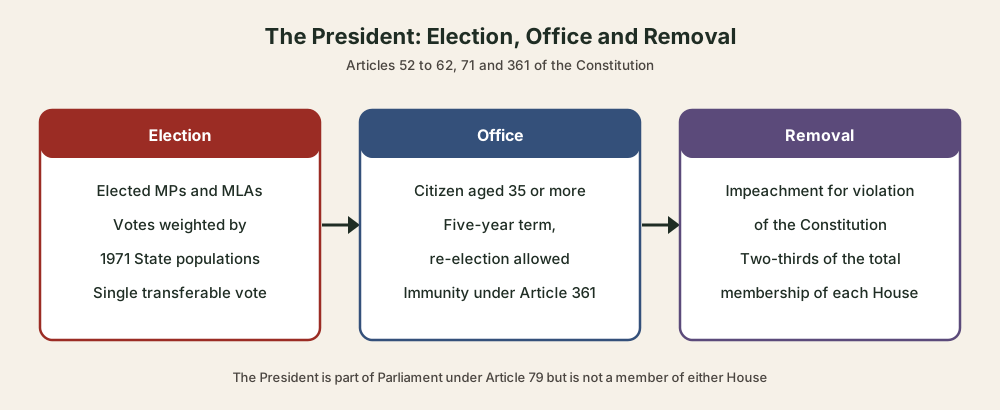
The President of India is the constitutional head of the Union, in whom Article 53 vests its executive power. The President is elected indirectly by an electoral college of elected MPs and MLAs whose votes are weighted by population, serves a five-year term, and can be removed only by impeachment for violation of the Constitution under Article 61.
President of India: Head of the Union Under Articles 52 and 53
Office of the President and the Executive Power of the Union
The President of India is the constitutional head of the Union. Article 52 declares that there shall be a President, and Article 53 vests the executive power of the Union in the President, to be exercised directly or through subordinate officers in accordance with the Constitution. The supreme command of the Defence Forces also vests in the President, regulated by law.
The office matters because the Union's institutions meet in it. The President is part of Parliament under Article 79, the supreme commander of the Defence Forces under Article 53(2), and an authority whose election, oath, term and removal are set out in detail in Articles 54 to 62.
The significance of the President of India lies in four roles that the Constitution assigns to the office:
- Head of State: The executive power of the Union vests in the President, in whose name the Union acts.
- Part of Parliament: Parliament consists of the President and two Houses, so a Bill passed by both Houses still needs the President’s assent.
- Guardian by oath: The President swears to preserve, protect and defend the Constitution and the law.
- Federal link: State legislators help elect the President, so the office rests on a base wider than Parliament.
Nominal Head in a Parliamentary System: The Framers' Design
The framers chose a parliamentary system, not the American presidential one. Introducing the Draft Constitution on 4 November 1948, B. R. Ambedkar said that the President 'occupies the same position as the King under the English Constitution' and is 'the head of the State but not of the Executive'.
Ambedkar added that the President 'represents the Nation but does not rule the Nation' and would be generally bound by the advice of Ministers. The real executive is the Council of Ministers headed by the Prime Minister, and the aid-and-advice rule of Article 74 is examined in Powers of the President of India, with the ordinance, pardoning and emergency powers in Ordinance, Pardoning and Emergency Powers of the President.
Jawaharlal Nehru told the Constituent Assembly that the office had been given no real power but a position of authority and dignity, neither a real executive nor a mere figurehead. A head of State without executive power has little need of a separate popular mandate, which helps explain the indirect method of election described next.
Election of the President: The Electoral College Under Article 54
Members of the Electoral College: Elected MPs and Elected MLAs
Under Article 54, the President is elected by an electoral college of the elected members of both Houses of Parliament and the elected members of the Legislative Assemblies of the States. An Explanation inserted by the Seventieth Amendment of 1992, in force from 1 June 1995, treats the National Capital Territory of Delhi and Puducherry as States for this purpose.
Three groups stay outside the college, as the Election Commission's press note of 2022 confirms:
- Nominated members of the Lok Sabha and the Rajya Sabha.
- Nominated members of the State Legislative Assemblies.
- Members of the State Legislative Councils, elected or nominated.
The Election Commission keeps the list of electors under Rule 40 of the Presidential and Vice-Presidential Elections Rules, 1974.
| Item | 2022 figure | What it shows |
|---|---|---|
| Electors in the list | 4,796 (771 MPs and 4,025 MLAs) | Full strength less vacancies and two disqualifications |
| Electors who voted | 4,754 (763 MPs and 3,991 MLAs) | Over 99 per cent of electors voted |
| Total value of MLAs' votes | 543,231 | Set by State populations under Article 55(2)(a) |
| Total value of MPs' votes | 543,200 | 776 elected MPs at 700 votes each |
| Total value of all votes | 1,086,431 | Near parity between the States and the Union |
The table shows the design at work. Polling took place at 31 locations, Parliament House and the Assembly secretariats, and the two halves of the college carried almost equal weight.
Why the President Is Elected Indirectly
The Constitution provides no direct election by the people. The President is elected indirectly, by elected MLAs and MPs, in accordance with proportional representation by the single transferable vote. Two features of the constitutional design support this method:
- Consistency with a nominal head: A head of State who acts on ministerial advice gains little from a popular mandate, and a direct mandate could rival that of the Prime Minister, whom the Lok Sabha sustains.
- Federal base: Including State legislators gives the States a voice in choosing the head of the Union, and Article 55(2) balances the States as a whole against the Union.
The design also carries costs. The outcome usually follows the strength of parties in the legislatures, so a candidate backed by the ruling alliance starts with an advantage. These trade-offs are weighed in the comparison with France later in this article.
Value of Votes Under Article 55: Uniformity and Parity
Uniformity Among States: How an MLA's Vote Is Valued
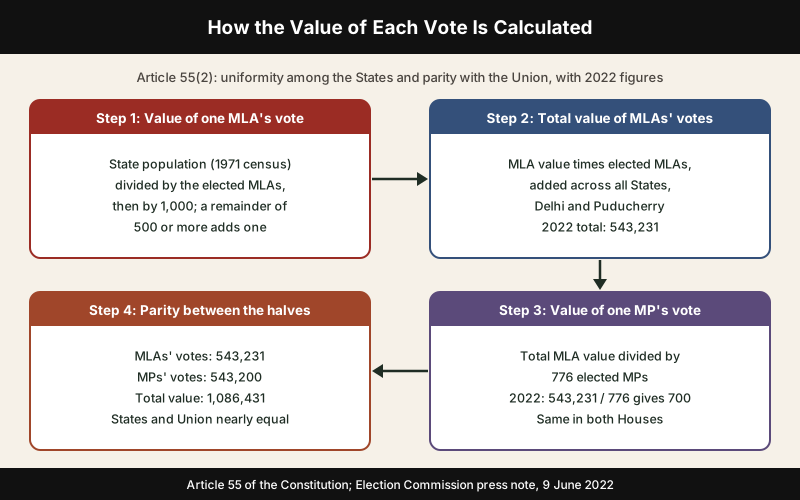
Article 55(1) requires uniformity in the scale of representation of the States. Under clause (2)(a), each elected MLA has as many votes as there are multiples of one thousand in the quotient obtained by dividing the population of the State by the total number of elected members of its Assembly.
Clause (2)(b) rounds the result: if the remainder after taking those multiples is at least five hundred, each vote rises by one. Take a hypothetical State with a population of 50,00,000 and 60 elected MLAs: the quotient is 83,333, which holds 83 thousands and a remainder of 333, so each MLA's vote is worth 83.
Because the quotient depends on each State's population and Assembly size, the value of an MLA's vote varies from State to State. An MLA who represents more people on average casts a heavier vote, so a State's total weight, the value per MLA multiplied by its elected MLAs, stays roughly proportional to its population.
Population Base Frozen at the 1971 Census
The Explanation to Article 55 defines population as the figure at the last census whose relevant figures have been published. The Forty-second Amendment of 1976 read this as the 1971 census, and the Eighty-fourth Amendment, in force from 21 February 2002, extended that reading until the figures of the first census taken after 2026 are published.
The freeze means that the values used in 2022 still reflected 1971 populations, not current ones. Once the first census after 2026 is published, the values will be recalculated, and the relative weight of each State in the presidential election will change with it.
Parity With the Union: Value of an MP's Vote
Clause (2)(c) secures parity between the States as a whole and the Union. The total value of all MLAs' votes is divided by the total number of elected members of both Houses, fractions above one-half counting as one and smaller fractions being dropped. Every elected MP, of either House, therefore casts a vote of the same value.
In 2022 the MLAs' votes were worth 543,231 in all. Dividing by 776 elected MPs, 543 from the Lok Sabha and 233 from the Rajya Sabha, gives 700 per MP, so the MPs' total came to 543,200. The grand total of 1,086,431 was split almost equally between the two halves.
Two errors are common here. A Lok Sabha member's vote is not worth more than a Rajya Sabha member's, and nominated MPs have no vote at all. Only MLA values differ, and they differ between States, not within one.
Proportional Representation, Secret Ballot and No Party Whip
Article 55(3) requires proportional representation by means of the single transferable vote and a secret ballot. Electors mark preferences in figures against the candidates; the first preference is compulsory for a valid ballot, and further preferences are optional. Votes are marked only with a special pen supplied by the Commission.
At the count, a candidate must secure more than half of the valid votes polled. If no one reaches this quota on first preferences, the candidate with the fewest votes is eliminated and those ballots pass to their next preferences, until a candidate crosses the quota.
Secrecy is strict: showing the ballot to anyone is prohibited, and the Commission has clarified that parties cannot issue a whip to their MPs and MLAs. In 1969, after Indira Gandhi asked Congress legislators to vote according to conscience, V. V. Giri won with 420,077 votes against Neelam Sanjiva Reddy's 405,427.
Conduct of the Presidential Election: Nomination, Schedule and Disputes
Election Commission, Returning Officer and Nomination Rules
Article 324, read with the Presidential and Vice-Presidential Elections Act, 1952 and the Rules of 1974, vests the superintendence, direction and control of the election in the Election Commission of India. The notification may issue on or after the sixtieth day before the outgoing President's term expires.
The Commission appoints the Secretary-General of the Lok Sabha or the Rajya Sabha, by rotation, as Returning Officer. The nomination rules are strict:
- Proposers and seconders: At least fifty electors must propose the candidate and at least fifty others must second.
- Papers: A candidate may file at most four nomination papers, delivered to the Returning Officer in New Delhi.
- Deposit: A security deposit of Rs 15,000 accompanies the nomination.
Scrutiny of these requirements can be decisive. In 1977, 37 candidates filed nominations and 36 of them were rejected, so Neelam Sanjiva Reddy became one of the two Presidents to be elected unopposed.
The 2022 Presidential Election: Schedule, Turnout and Result
The sixteenth presidential election filled the vacancy at the end of Ram Nath Kovind's term on 24 July 2022. The Commission fixed the schedule as follows:
- Notification calling the election: 15 June 2022.
- Last date for nominations: 29 June 2022, with scrutiny on 30 June.
- Poll: 18 July 2022, at Parliament House and the State Assemblies.
- Counting: 21 July 2022, in New Delhi.
Of 4,796 eligible electors, 4,754 voted. The Returning Officer declared Droupadi Murmu elected on 21 July 2022, and she was sworn in as the 15th President on 25 July 2022. Published results give her 676,803 votes by value against 380,177 for Yashwant Sinha.
Murmu, born in 1958 to a Santhal tribal family in Mayurbhanj district of Odisha, is the first tribal person and the second woman to hold the office. She had served two terms in the Odisha Legislative Assembly and as Governor of Jharkhand from 2015 to 2021.
Election Disputes and Vacancies in the Electoral College (Article 71)
Under Article 71(1), all doubts and disputes arising out of the election of a President or Vice-President are inquired into and decided by the Supreme Court, whose decision is final. Clause (3) lets Parliament regulate other matters connected with the election by law.
Clause (2) protects continuity: if the Court declares an election void, acts done before the decision are not invalidated. Clause (4), first inserted by the Eleventh Amendment of 1961, bars any challenge on the ground of a vacancy in the electoral college, so a dissolved Assembly cannot postpone or void the election.
The 2022 election shows the rule at work. The Jammu and Kashmir seats in the college were vacant because its Legislative Assembly had been dissolved, yet the poll went ahead. Article 71 itself was substituted by the Thirty-ninth Amendment in 1975 and again by the Forty-fourth Amendment, with effect from 20 June 1979.
Qualifications, Conditions of Office, Oath and Immunities of the President
Eligibility Under Article 58: Citizenship, Age and Office of Profit
Article 58(1) sets three conditions. A candidate must be a citizen of India, must have completed the age of thirty-five years, and must be qualified for election as a member of the House of the People. The rules on citizenship are explained in Citizenship in India.
Article 58(2) bars anyone holding an office of profit under the Union, a State, or a local or other authority controlled by either government. The Explanation exempts the offices of President, Vice-President, Governor and Minister, so a sitting Vice-President, Governor or Minister is not disqualified on that ground.
Article 57 makes a present or former President eligible for re-election, with no limit on the number of terms. In practice only Rajendra Prasad, the first President, has held the office for two terms.
Conditions of Office Under Article 59 and Emoluments
Under Article 59(1), the President cannot be a member of either House of Parliament or of a State Legislature; a legislator elected President is deemed to have vacated the seat on entering office. Clause (2) bars the President from holding any other office of profit.
Clause (3) gives the President official residences without rent, and emoluments, allowances and privileges fixed by Parliament by law, until then those in the Second Schedule. Clause (4) forbids any reduction of emoluments during the term. The salary has been Rs 5 lakh a month since 1 February 2018.
Two textual rules are often confused. The President is not a member of Parliament, yet under Article 79 Parliament consists of the President and the two Houses. The President completes law-making by assent, and the text of Article 111 prescribes no time limit for that decision; the 2025 litigation on timelines is examined in Powers of the President of India.
Oath Under Article 60: To Preserve, Protect and Defend
Before entering office, every President, and every person acting as President, makes an oath or affirmation in the presence of the Chief Justice of India, or in his absence the senior-most Supreme Court judge available. The President swears to preserve, protect and defend the Constitution and the law and to serve the well-being of the people.
The wording differs from the Vice-President's oath. Under Article 69 the Vice-President swears, before the President or a person the President appoints, to bear true faith and allegiance to the Constitution; only the President's oath carries the duty to defend the Constitution and the law.
Immunities of the President Under Article 361
Article 361(1) provides that the President is not answerable to any court for the exercise of the powers and duties of the office. The first proviso keeps one route open: the President's conduct may be reviewed by the body designated by either House to investigate an impeachment charge under Article 61.
During the term, no criminal proceedings may be instituted or continued and no process for arrest or imprisonment may issue from any court. Civil proceedings for personal acts need two months' written notice, and the second proviso preserves proceedings against the Government of India, so the immunity protects the person, not the government.
Term of Office, Resignation and Filling Vacancies (Articles 56, 62 and 65)
Five-Year Term, Resignation and Continuance in Office
Under Article 56(1), the President holds office for five years from the date of entering upon it. The President may resign by writing addressed to the Vice-President, who must forthwith communicate the resignation to the Speaker of the Lok Sabha, and may be removed by impeachment for violation of the Constitution.
Proviso (c) prevents a gap at the top: the President continues in office, despite the expiry of the term, until the successor enters upon office. In 1969 V. V. Giri, then Vice-President and acting President after Zakir Husain's death, resigned to contest the presidential election.
Filling a Vacancy: Before Expiry or Within Six Months
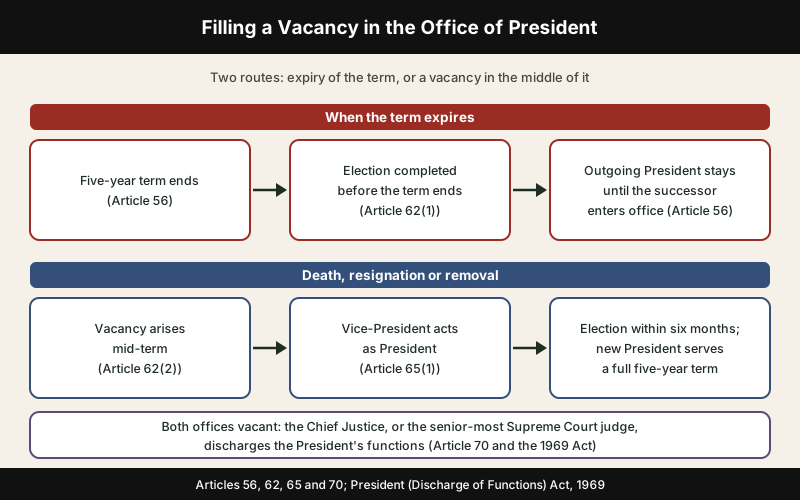
Article 62 sets two deadlines. An election to fill a vacancy caused by the expiration of the term must be completed before the term ends. A vacancy caused by death, resignation, removal or otherwise must be filled as soon as possible and in no case later than six months from its occurrence.
The person elected to a mid-term vacancy serves a full term of five years from entering office, not the remainder of the predecessor's term. Until then, under Article 65(1), the Vice-President acts as President; that role is explained in Vice-President of India.
Article 70 lets Parliament provide for contingencies the Constitution does not cover. Under the President (Discharge of Functions) Act, 1969, if both offices fall vacant, the Chief Justice of India, or in his absence the senior-most Supreme Court judge available, discharges the President's functions.
| Year | Event | Who acted | How it ended |
|---|---|---|---|
| 1969 | Zakir Husain died in office on 3 May 1969 | V. V. Giri, Vice-President, from 3 May to 19 July 1969 | Giri resigned to contest the election |
| 1969 | Both offices vacant after Giri's resignation | Mohammad Hidayatullah, Chief Justice, from 20 July to 24 August 1969 | V. V. Giri took office as President on 24 August 1969 |
| 1977 | Fakhruddin Ali Ahmed died in office on 11 February 1977 | B. D. Jatti, Vice-President, from 11 February to 24 July 1977 | Neelam Sanjiva Reddy, elected unopposed, took office on 25 July 1977 |
Impeachment of the President Under Article 61
Ground and Initiation: A Charge of Violating the Constitution
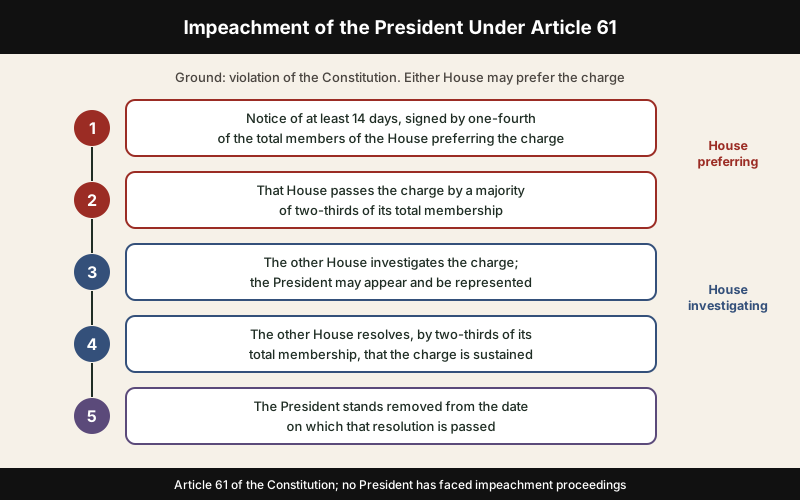
The only ground for impeachment is violation of the Constitution, a phrase the Constitution does not define. The charge may be preferred by either House of Parliament, and the proposal must be contained in a resolution moved after at least fourteen days' written notice.
The notice must be signed by not less than one-fourth of the total number of members of the House, and the resolution must be passed by not less than two-thirds of the total membership of that House. Counting total membership, not members present and voting, sets a high bar.
Investigation by the Other House and Removal From Office
Once a charge is preferred, the other House investigates it or causes it to be investigated, and the President has the right to appear and to be represented. If that House then resolves by two-thirds of its total membership that the charge is sustained, the President stands removed from the date the resolution is passed.
The procedure is quasi-judicial: one House accuses and the other investigates, and Article 361 allows the investigating body to review the President's conduct. No President has faced impeachment proceedings, so these provisions have never been used.
Election Versus Impeachment: Who Takes Part
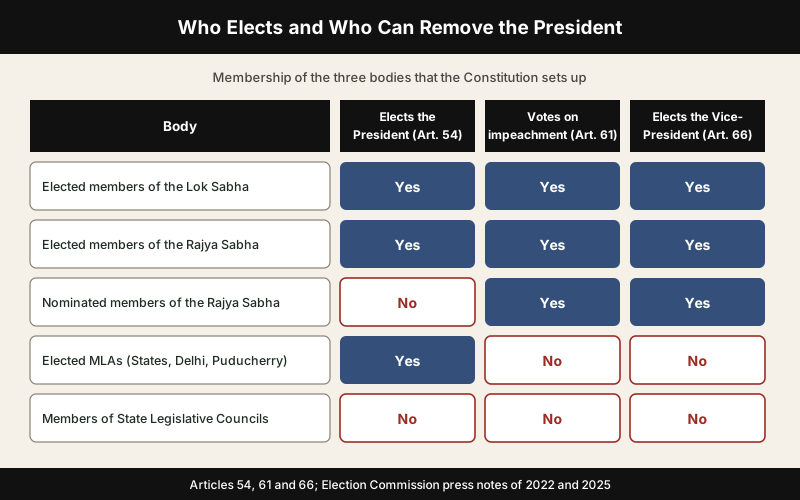
The bodies that elect and remove the President are not the same. Elected MLAs of the States, Delhi and Puducherry vote in the election but have no role in impeachment, which is confined to the two Houses of Parliament.
Nominated members of Parliament are the reverse case. They cannot vote in the election, but as members of their House they count in the total membership used by Article 61 and can vote on an impeachment resolution. Members of State Legislative Councils have no role in either.
Presidential Election in India and France: A Critical Comparison
Direct Election in France Versus Indirect Election in India
France offers the sharpest contrast. Since a 1962 referendum, its President has been elected directly by universal suffrage, replacing an electoral college set up in 1958, and the election uses two-round runoff voting, with up to fifteen days between the first and second rounds.
A referendum in 2000 cut the French term from seven years to five, and a 2008 constitutional reform imposed a maximum of two consecutive terms. Candidates must collect signed sponsorships from more than 500 elected officials, mostly mayors, drawn from at least 30 departments or overseas collectivities.
The difference follows the form of government. France has a semi-presidential system in which the President appoints the Prime Minister and the ministers, while the President of India is a nominal head in a parliamentary system. A personal popular mandate fits the first design, not the second.
| Feature | India | France |
|---|---|---|
| Method | Indirect: elected MPs and MLAs | Direct: universal suffrage since 1962 |
| Voting system | Proportional representation by single transferable vote | Two-round runoff voting |
| Weight of votes | Weighted by State populations of 1971 | Equal votes for all voters |
| Term | Five years, re-election without limit | Five years since the 2000 referendum |
| Term limit | None | Two consecutive terms since 2008 |
| Nomination | 50 proposers and 50 seconders from the electors | Sponsorship by more than 500 elected officials |
| Role of the office | Nominal head in a parliamentary system | President who appoints the government in a semi-presidential system |
Critical Assessment of the Indian Method
Three features distinguish the Indian method and anchor any assessment of it:
- Federal weighting: MLAs and MPs carry nearly equal total weight, so neither Parliament alone nor the States alone can choose the President.
- Majority by transfer: The single transferable vote requires more than half of the valid vote value, so the winner has majority support after transfers.
- Indirect mandate: The President owes the office to legislators rather than voters, which matches a head who acts on ministerial advice.
Critics point to weaknesses. The result usually mirrors party strength in the legislatures, as the unopposed election of 1977 and the wide margin of 2022 suggest, and the 1971 population base means that vote values lag behind demographic change. Vacancies, as in 2022, can leave part of the electorate unrepresented.
Three observable outcomes follow from the design:
- Continuity: Acting arrangements under Article 65 and the 1969 Act covered each mid-term vacancy, in 1969 and 1977.
- Consensus and contest: Two Presidents were elected unopposed, while the contest of 1969 was decided narrowly after conscience voting.
- Representation: The college chose Pratibha Patil in 2007 as the first woman President and Droupadi Murmu in 2022 as the first tribal President.
Census After 2026 and the Rules for Amending the Election
The contemporary linkage is the population base. Once figures from the first census taken after 2026 are published, vote values will be recalculated, shifting weight towards States whose populations have grown faster since 1971.
Changing the election itself needs a special procedure. The proviso to Article 368(2) requires ratification by the legislatures of not less than one-half of the States for amendments that change, among other federal provisions:
- Articles 54 and 55, which govern the election of the President.
- Any of the Lists in the Seventh Schedule.
- The representation of States in Parliament.
- Article 368 itself; the proviso also covers Articles 73, 162, 241 and 279A and the chapters on the Union judiciary, the High Courts and legislative relations.
By contrast, a law abolishing or creating a Legislative Council under Article 169 is not deemed an amendment for the purposes of Article 368, so it needs no ratification. The rule shows that the election of the President is treated as a federal matter.
UPSC Relevance and Previous-Year Questions on the President
Where the President's Election Fits in the UPSC-CSE Syllabus
This topic belongs to General Studies Paper II, under the structure and functioning of the Executive. The linked questions from the preliminary examination test precise textual points:
- Vote values: MLA values vary between States, while every MP’s vote carries the same value.
- Membership of bodies: State Assemblies elect the President but have no part in impeachment.
- Article 71: Acts done before an election is voided remain valid, and vacancies do not postpone the election.
- Articles 59 and 79: The President is not a member of Parliament but is part of it.
- Article 368(2): Amendments to Articles 54 and 55 need ratification by half the States.
The linked question from the main examination asks for a critical comparison of the Indian and French methods. The sections on the electoral college, the value of votes and the comparison with France supply the evidence for both sides of that answer.
Previous Year UPSC-CSE Questions
Previous Year UPSC-CSE Questions By the end you will be able to draft model answers for the following UPSC questions. Each question carries a collapsible framework showing how to approach it in the exam.
- UPSC Prelims 2023 GS-IConsider the following statements:
- If the election of the President of India is declared void by the Supreme Court of India, all acts done by him/her in the performance of duties of his/her office of President before the date of decision become invalid.
- Election for the post of the President of India can be postponed on the ground that some Legislative Assemblies have been dissolved and elections are yet to take place.
- When a Bill is presented to the President of India, the Constitution prescribes time limits within which he/she has to declare his/her assent.
How many of the above statements are correct?
How to approach this Prelims question
Approach: Test each statement against the text: Article 71(2), Article 71(4) and the silence of Article 111 on time.
Trap to watch: Statement 2 sounds reasonable because a dissolved Assembly means missing electors, but Article 71(4) makes vacancies irrelevant.
Key facts to recall:
- Article 71(2): prior acts are not invalidated.
- Article 71(4): vacancies in the college are no ground of challenge.
- No time limit for assent is prescribed.
Answer signal: All three statements are incorrect, so option (d) is the answer.
- UPSC Prelims 2018 GS-IWith reference to the election of the President of India, consider the following statements:
- The value of the vote of each MLA varies from State to State.
- The value of the vote of MPs of the Lok Sabha is more than the value of the vote of MPs of the Rajya Sabha.
Which of the statements given above is/are correct?
How to approach this Prelims question
Approach: Separate the MLA formula, which uses State population, from the MP formula, which divides the total MLA value equally among all elected MPs.
Trap to watch: The Lok Sabha is directly elected and larger, but that does not raise the value of its members' votes.
Key facts to recall:
- MLA value: State population divided by elected MLAs, then by 1,000.
- MP value: total MLA value divided by elected MPs.
- 2022: 700 per MP.
Answer signal: Only statement 1 is correct, so option (a) is the answer.
- UPSC Prelims 1997 GSWhich one of the following are/is stated in the Constitution of India?
- I. The President shall not be a member of either House of Parliament.
- II. The Parliament shall consist of the President and two Houses.
Choose the correct answer from the codes given below:
How to approach this Prelims question
Approach: Recall that both statements restate rules written into the Constitution, in different Articles.
Trap to watch: The two statements look contradictory, but being part of Parliament does not require membership of a House.
Key facts to recall:
- Article 59(1): not a member of either House.
- Article 79: Parliament is the President and two Houses.
Answer signal: Both are stated in the Constitution, so option (b) is the answer.
- UPSC Prelims 1996 GSWhich one of the following is part of the electoral college for the election of the President of India but does not form part of the forum for his impeachment?
How to approach this Prelims question
Approach: List who elects (elected MPs and elected MLAs) and who impeaches (the two Houses), then find the body in the first list only.
Trap to watch: Legislative Councils take part in neither, so they fail the first half of the question.
Key facts to recall:
- Election: elected MPs and MLAs.
- Impeachment: both Houses of Parliament.
- Councils: no role in either.
Answer signal: State Legislative Assemblies elect but do not impeach, so option (d) is the answer.
- UPSC Prelims 1995 GSWhich of the following are matters on which a constitutional amendment is possible only with the ratification of the legislatures of not less than one-half of the States?
- I. Election of the President
- II. Representation of States in Parliament
- III. Any of the Lists in the 7th Schedule
- IV. Abolition of the Legislative Council of a State
Choose the correct answer from the codes given below:
How to approach this Prelims question
Approach: Match each item to the proviso to Article 368(2); remove anything handled by an ordinary law of Parliament.
Trap to watch: Abolishing a Legislative Council changes the Constitution's working but is done under Article 169 without ratification.
Key facts to recall:
- Proviso covers Articles 54 and 55.
- Proviso covers the Lists and representation of States.
- Article 169(3): not an amendment for Article 368.
Answer signal: Items I, II and III need ratification, so option (a) is the answer.
- UPSC Mains 2022 GS-IICritically examine the procedures through which the Presidents of India and France are elected.
How to structure the answer in the exam
Introduction: The President of India is chosen indirectly by an electoral college of elected MPs and MLAs under Articles 54 and 55, while the President of France has been elected directly by universal suffrage since a 1962 referendum.
Body (sub-themes to develop):
- Indian procedure: electoral college, weighted votes under Article 55(2), single transferable vote, secret ballot, no whip, 50 proposers and 50 seconders, disputes before the Supreme Court.
- French procedure: direct election by two-round runoff voting, more than 500 sponsoring officials, five-year term since 2000, two consecutive terms since 2008.
- Merits of the Indian method: federal parity between the States and the Union, majority support after transfers, fit with a nominal head who acts on advice.
- Weaknesses: outcomes follow party strength, vote values rest on 1971 populations, vacancies such as Jammu and Kashmir in 2022 leave electors out.
- Fit with the system: a semi-presidential President who appoints the government needs a popular mandate; a parliamentary head does not.
Conclusion: Each procedure suits its system: the indirect and federally weighted Indian election fits a head who acts on ministerial advice, while direct election fits the French President's executive role.
Sources and Further Reading
- Legislative Department, Ministry of Law and Justice: The Constitution of India
- Lok Sabha Secretariat: Constituent Assembly Debates, Official Report, Volume VII (4 November 1948)
- NCERT: Indian Constitution at Work, Class 11, Chapter 4, Executive
- Election Commission of India: Press note on the election to the office of President, 2022 (9 June 2022)
- Press Information Bureau: Presidential Election, 2022, schedule and public notice (16 June 2022)
- Press Information Bureau: Polling for Presidential Elections 2022 held peacefully (18 July 2022)
- Press Information Bureau: Shrimati Droupadi Murmu elected as the President of India (22 July 2022)
- Press Information Bureau: Election to the Office of the Vice-President of India, 2025 (1 August 2025)
- President's Secretariat: Profile of the President
- Rajya Sabha Secretariat: Rajya Sabha at Work, Chapter 4, Presiding Officers
- Wikipedia: President of India
- Wikipedia: List of presidents of India
- Wikipedia: Indian presidential election
- Wikipedia: 2022 Indian presidential election
- Wikipedia: 1969 Indian presidential election
- Wikipedia: 1977 Indian presidential election
- Wikipedia: Eleventh Amendment of the Constitution of India
- Wikipedia: Mohammad Hidayatullah
- Wikipedia: President of France
- Wikipedia: State of Tamil Nadu v. Governor of Tamil Nadu
Editorial Disclaimer
This article is for UPSC preparation and explains the election and tenure of the President. Election figures are those published by the Election Commission and in published results, and the official text of the Constitution governs any question of law.


