


Overview
The Vice-President of India is the second-highest constitutional office of the Republic, created by Article 63 of the Constitution. The Vice-President is elected by the members of both Houses of Parliament, serves as the ex officio Chairman of the Rajya Sabha under Article 64, and steps in for the President under Article 65 when the presidency falls vacant or the President cannot act. The term is five years, and the office-holder can be removed by a resolution of the Rajya Sabha to which the Lok Sabha agrees. As of November 2026 the office is held by C. P. Radhakrishnan, who took the oath on 12 September 2025.
Office of the Vice-President Under Articles 63 to 71
Constitutional Position and the Two Roles of the Office
Chapter I of Part V of the Constitution, on the Union executive, places the Vice-President's office in Articles 63 to 71. Article 63 simply says that there shall be a Vice-President of India, and Article 64 attaches the office to Parliament by making its holder the ex officio Chairman of the Council of States, the Rajya Sabha. The same rule appears a second time in Article 89(1), among the provisions on the officers of Parliament, which shows how closely the office is tied to the upper House.
The office therefore has two roles:
- Presiding role: As Chairman, the Vice-President conducts the business of the Rajya Sabha, keeps order and decides questions that shape its work.
- Stand-in role: Under Article 65, the Vice-President acts as President in a vacancy and discharges the President's functions during the President's absence or illness.
Article 64 also bars the Vice-President from holding any other office of profit. Article 70 lets Parliament make such provision as it thinks fit for the discharge of the President's functions in any contingency that the chapter does not provide for.
Indian and American Vice-Presidents Compared
The Indian office resembles the American vice-presidency in one respect. The Vice-President of the United States is president of the Senate and may vote there only to break a tie, much as the Indian Chairman has only a casting vote in the Rajya Sabha. The two offices part ways on election and succession. The American Vice-President is elected with the President, as a running mate, for a four-year term and ranks first in the presidential line of succession, so a Vice-President who succeeds serves out the rest of the President's term. The Indian Vice-President is elected separately by Parliament and, when the presidency falls vacant, only acts as President until a new President is elected.
| Feature | India | United States |
|---|---|---|
| How elected | Separately, by members of both Houses of Parliament | With the President, as a running mate, through the Electoral College |
| Term | Five years; re-election allowed | Four years, concurrent with the President's |
| Role in the legislature | Ex officio Chairman of the Rajya Sabha; casting vote only | President of the Senate; tie-breaking vote only |
| When the presidency falls vacant | Acts as President until a new President enters office | First in the line of succession; serves the rest of the term |
Election of the Vice-President Under Article 66
Electoral College of Both Houses of Parliament
The Vice-President is not appointed by anyone. Under Article 66(1), the Vice-President is elected by an electoral college consisting of the members of both Houses of Parliament, in accordance with the system of proportional representation by means of the single transferable vote, and the voting is by secret ballot. The original Constitution required the two Houses to elect the Vice-President at a joint meeting. When Sarvepalli Radhakrishnan was elected unopposed in 1952 and 1957, no such sitting was held, and the Constitution (Eleventh Amendment) Act, 1961, replaced the joint meeting with the present electoral college because a joint sitting had proved needless and could cause practical difficulties.
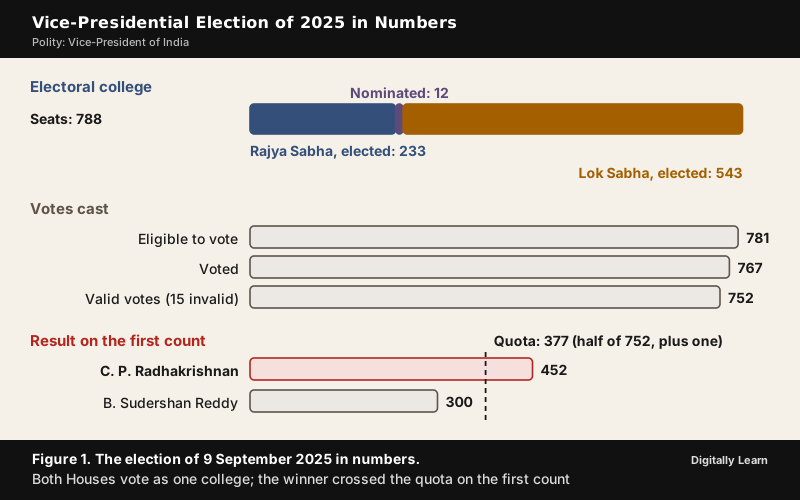
This electoral college differs from the President's in two ways. It includes the nominated members of both Houses, who have no vote in the presidential election, and it leaves out the members of the State Legislative Assemblies. Because every elector is a member of Parliament, every vote has the same value of one, with none of the population-based weighting used for the President. When every seat is filled, the college has 788 members: 233 elected and 12 nominated members of the Rajya Sabha and 543 elected members of the Lok Sabha.
Qualifications, Nomination and Oath of the Vice-President
Article 66(3) lays down three qualifications. A candidate must be a citizen of India, must have completed the age of 35 years, and must be qualified for election as a member of the Council of States. The last condition differs from the rule for the President, who must be qualified for election to the Lok Sabha.
Under Article 66(4), a person holding an office of profit under the Union or a State Government, or under a local or other authority they control, is not eligible. The offices of President, Vice-President, Governor and Union or State Minister are not offices of profit for this purpose. The Vice-President cannot be a member of either House of Parliament or of a State Legislature, and a legislator who is elected vacates the seat on the date of entering office.
The Presidential and Vice-Presidential Elections Act, 1952, and the rules made under it fill in the procedure:
- Proposers and seconders: Each nomination paper must be subscribed by at least 20 electors as proposers and at least 20 others as seconders, and no elector may subscribe more than one paper.
- Papers and deposit: A candidate may file at most four nomination papers and makes one security deposit of ₹15,000, whatever the number of papers.
- Poll: The poll is taken in Parliament House, and political parties cannot issue a whip to their members on how to vote.
Until 1974 a single proposer and a single seconder were enough, and no deposit was required.
Before entering office, the Vice-President makes and subscribes an oath or affirmation before the President, or a person the President appoints, to bear true faith and allegiance to the Constitution and to faithfully discharge the duty of the office. The President, by contrast, swears before the Chief Justice of India to preserve, protect and defend the Constitution.
| Feature | President | Vice-President |
|---|---|---|
| Electoral college | Elected members of both Houses and of the State Legislative Assemblies | All members of both Houses of Parliament, nominated members included |
| Value of a vote | Weighted by population | One for every elector |
| Must be qualified for | Election to the Lok Sabha | Election to the Rajya Sabha |
| Oath taken before | The Chief Justice of India | The President, or a person appointed by the President |
| Election after a mid-term vacancy | As soon as possible, and within six months | As soon as possible, with no outer limit |
| Removal | Impeachment for violation of the Constitution | Rajya Sabha resolution agreed to by the Lok Sabha, with no ground stated |
Election Schedule, Returning Officer and Counting by Quota
Article 324, read with the 1952 Act and the Presidential and Vice-Presidential Elections Rules, 1974, vests the superintendence, direction and control of the election in the Election Commission of India. When a term is about to expire, the Commission issues its notification on or as soon as convenient after the sixtieth day before the expiry, so that the new Vice-President can take office on the day after the outgoing one leaves. For any other vacancy the notification is issued as soon as may be. The stages then follow a fixed sequence:
- Nominations: The last date is the fourteenth day after the notification.
- Scrutiny: Nominations are scrutinised on the day immediately after that last date.
- Withdrawal: Candidatures may be withdrawn until the second day after scrutiny.
- Poll: The poll, if one is needed, is held not earlier than the fifteenth day after the last date for withdrawal.
By established practice, the Secretary-General of the Lok Sabha or of the Rajya Sabha is appointed Returning Officer by rotation. At the eleventh election, in 1997, the Secretary of the Ministry of Parliamentary Affairs served instead, a departure from that practice.
The single transferable vote decides the result through a quota. Each elector marks preferences in figures, 1 for the first choice and 2, 3 and so on for the others; the first preference is compulsory and the rest are optional. The quota is half the total of valid first-preference votes, plus one, with any remainder disregarded. A candidate who reaches the quota is elected.
If no one does, the candidate with the fewest votes is excluded, and each of that candidate's ballots passes to the continuing candidate marked as second preference on it; a ballot with no second preference is treated as exhausted and is not counted further, even if it carries a third. Exclusions continue until a continuing candidate reaches the quota. The Returning Officer declares the result, and the Central Government publishes the name of the person elected in the Official Gazette.
Election Disputes Under Article 71
Article 71(1) gives the Supreme Court the power to inquire into and decide all doubts and disputes arising out of or in connection with the election, and its decision is final. A petition is heard by a bench of five judges and must be accompanied by a security deposit of ₹20,000. It may be presented by any candidate, or by 10 or more electors together, within 30 days of the publication of the declaration naming the returned candidate. The election is declared void on any of three grounds:
- Corrupt practice: Bribery or undue influence by the returned candidate or with the candidate's consent, now defined in Sections 170 and 171 of the Bharatiya Nyaya Sanhita.
- Result materially affected: The improper reception or refusal of a vote, non-compliance with the Constitution, the 1952 Act or the rules under it, or the wrongful acceptance of the nomination of a losing candidate who did not withdraw.
- Nomination wrongly decided: The wrongful rejection of any candidate's nomination, or the wrongful acceptance of the winner's nomination, which needs no proof that the result was affected.
Two further rules protect the office. Under Article 71(2), if the Supreme Court declares an election void, acts done by the Vice-President before that decision remain valid. Under Article 71(4), an election cannot be called in question because of a vacancy among the members of the electoral college.
Article 71 has a history of its own. After the Allahabad High Court's ruling in the Indira Gandhi case, the Constitution (Thirty-ninth Amendment) Act, 1975, passed during the Emergency, substituted Article 71 and declared that the elections of the Prime Minister, the President and the Vice-President could not be challenged in a court. Its present text, which gives the Supreme Court the power to decide these disputes, comes from the Constitution (Forty-fourth Amendment) Act, 1978.
Vice-Presidential Election of 2025
The election of 2025 was held to fill a mid-term vacancy. Jagdeep Dhankhar, who had taken office on 11 August 2022, resigned on 21 July 2025, citing health concerns. The Ministry of Home Affairs notified the vacancy on 22 July 2025, and on 1 August the Election Commission announced the schedule for the seventeenth vice-presidential election, with the Secretary-General of the Rajya Sabha as Returning Officer. The Commission's notification was published on 7 August, nominations closed on 21 August, scrutiny followed on 22 August and the last date for withdrawal was 25 August. The poll and the count both took place on 9 September 2025 in Parliament House.
With some seats vacant, 781 of the 788 electors were eligible to vote on polling day; 767 voted and 15 ballot papers were declared invalid, which left 752 valid votes and a quota of 377. C. P. Radhakrishnan, then Governor of Maharashtra, polled 452 votes against 300 for B. Sudershan Reddy, a margin of 152, and so crossed the quota on the first count. President Droupadi Murmu administered the oath to him at Rashtrapati Bhavan on 12 September 2025, and he became the fifteenth Vice-President of India. Because Article 68(2) gives the person elected to fill a mid-term vacancy a full term of five years from entering office, his term runs to September 2030.
Term, Vacancy, Removal and Salary of the Vice-President
Five-Year Term, Resignation and Filling a Vacancy
Under Article 67, the Vice-President holds office for five years from the date of entering office, may resign at any time by writing addressed to the President, and continues to hold office after the term ends until a successor enters office. The Constitution sets no limit on re-election. Sarvepalli Radhakrishnan (1952‑1962) and Mohammad Hamid Ansari (2007‑2017) were each elected twice.
Article 68 deals with vacancies. An election for a vacancy caused by the end of a term must be completed before the term expires. An election for a vacancy caused by death, resignation, removal or otherwise must be held as soon as possible, but, unlike Article 62 for the President, Article 68 sets no six-month outer limit. While the office of Chairman is vacant, the Deputy Chairman performs the Chairman's duties under Article 91(1). Krishan Kant is the only Vice-President to have died in office, in 2002.
Removal of the Vice-President Under Article 67(b)
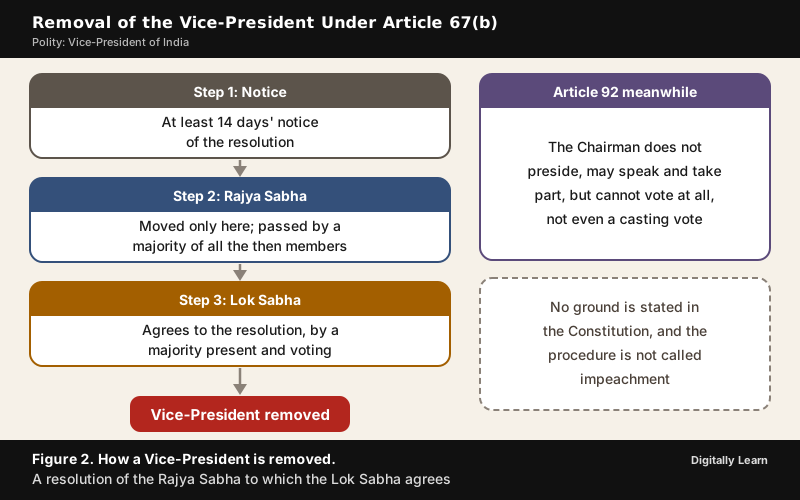
The removal of the Vice-President follows a procedure written into Article 67(b), and it is deliberately simpler than the impeachment of the President:
- Notice: Members give at least 14 days' notice of the intention to move the resolution.
- Rajya Sabha: The resolution can be moved only in the Rajya Sabha, and it must be passed by a majority of all the then members of that House, not merely of those present and voting.
- Lok Sabha: The resolution must then be agreed to by the Lok Sabha. Because the Constitution sets no special majority for this step, the general rule of Article 100(1), a majority of members present and voting, applies.
The Constitution states no ground for removal, and the procedure is not called impeachment; the Rajya Sabha's resolution needs no finding that the Constitution was violated. While the resolution is under consideration, Article 92 bars the Chairman from presiding. The Chairman may speak and take part in the proceedings but, notwithstanding Article 100, may not vote at all on the resolution or on any other matter during those proceedings. The Speaker of the Lok Sabha is treated differently under Article 96(2), which lets the Speaker vote in the first instance during a resolution for the Speaker's own removal, though not in the case of a tie.
No Vice-President has ever been removed. On 10 December 2024, opposition members of the Rajya Sabha gave notice of a resolution against Jagdeep Dhankhar, accusing him of partisanship as Chairman. The notice was not accepted, and the resolution never came before the House.
Salary of the Vice-President and Other Emoluments
The Vice-President draws no salary as Vice-President. The salary is paid for the office of Chairman of the Rajya Sabha under the Salaries and Allowances of Officers of Parliament Act, 1953, which Article 97 allows Parliament to make, and it is charged on the Consolidated Fund of India. Parliament raised it from ₹40,000 to ₹1.25 lakh a month in 2008 and to ₹4 lakh a month in 2018. The Vice-President is also entitled to a free furnished residence and to medical, travel and other facilities.
While acting as President or discharging the President's functions, the Vice-President receives the emoluments, allowances and privileges of the President under Article 65(3), and, under the proviso to Article 64, receives no salary or allowance as Chairman for that period.
Chairman of the Rajya Sabha: Powers and Role
Casting Vote, Quorum, Defection and Other Powers of the Chairman
The Vice-President of India is the Chairman of the Rajya Sabha under Article 89(1) without being a member of the House, while the Deputy Chairman is a member chosen by the House. The Constitution itself gives the Chairman five specific powers:
- Casting vote: Under Article 100(1), the Chairman does not vote in the first instance but has a casting vote when the votes are equal.
- Quorum: Under Article 100(4), the Chairman must adjourn the House or suspend the sitting when there is no quorum of one-tenth of the members.
- Resignations: Under Article 101(3), the Chairman must not accept a member's resignation if satisfied, after inquiry, that it is not voluntary or genuine.
- Defection: Under paragraph 6 of the Tenth Schedule, the Chairman decides whether a member of the Rajya Sabha is disqualified on the ground of defection, and the Chairman also makes the rules that give effect to that Schedule.
- Language: Under Article 120, the Chairman may permit a member who cannot express himself or herself in Hindi or English to address the House in the mother tongue.
The Tenth Schedule calls the Chairman's defection decision final. In the Kihoto Hollohan case, however, the Supreme Court held that a presiding officer deciding such a question functions as a tribunal, so the decision is open to judicial review on grounds such as mala fides and perversity. The Court did not hold that giving this power to the presiding officer was invalid in itself.
Presiding Officer: Rulings, Order and Privilege
As presiding officer, the Chairman is the guardian of the prestige and dignity of the House and the custodian of the rights and privileges of its members. The Vice-President has other engagements and so usually takes the Chair only during Question Hour and for important debates such as those on Constitution Amendment Bills. It is the Chairman's right to interpret the Constitution and the rules in matters relating to the House. The Chairman's rulings are binding precedents, the Chairman is not bound to give reasons for them, and protesting against a ruling is a contempt of the House.
Maintaining order is a fundamental duty of the Chairman, and the Rules of Procedure supply the disciplinary powers for it:
- Debate: The Chairman checks irrelevance or repetition in a member's speech and may order unparliamentary or undignified words to be expunged.
- Discipline: The Chairman may direct a disorderly member to withdraw from the House and may name a member for suspension.
- Grave disorder: The Chairman may adjourn or suspend the sitting of the House.
A question of breach of privilege can be raised in the House only with the Chairman's consent, and the Chairman may also refer such a question to the Committee of Privileges on the Chairman's own motion.
Committees, Bills and the Chairman as Spokesman of the House
Parliamentary committees of the Rajya Sabha work under the Chairman's guidance. The Chairman appoints their chairpersons, nominates members to the standing committees and the department-related committees, and personally heads three of them, the Business Advisory Committee, the Rules Committee and the General Purposes Committee. When a Bill passed by both Houses is in the Rajya Sabha's possession, the Chairman authenticates it with a signature before it goes to the President for assent.
The Chairman is also the principal spokesman of the House. Messages from the President are received and read out by the Chairman, and the House's Motion of Thanks on the President's Address is conveyed to the President by the Chairman.
Several statutes add duties. On receiving a motion for the removal of a judge of the Supreme Court or a High Court, the Chairman constitutes an inquiry committee under the Judges (Inquiry) Act, 1968. The Chairman is a member of the committee that nominates the Chairman of the Press Council under the Press Council Act, 1978, and nominates members of the Rajya Sabha to the courts of several central universities and to other statutory bodies.
Impartiality of the Chair and the Debate Over Neutrality
The authority of the Chair rests on the House's trust that it is used fairly. The Rajya Sabha's own record holds a clear example. On 20 April 1987, before a discussion on the government's decision to inquire into commission agents in certain defence deals, Chairman R. Venkataraman told the House that he had been Defence Minister from 15 January 1982 to the middle of June 1984 and that it would not be proper for him to preside. He vacated the Chair and the Deputy Chairman conducted the proceedings.
The Chairman's position differs from the Speaker's. The Speaker is chosen by the Lok Sabha from among its own members, while the Chairman is elected by both Houses together and is not a member of the House over which the Chairman presides.
Because the whole of Parliament elects the Vice-President, the winner is in practice the candidate of its majority, as in 2025, and the Chair's standing with the opposition rests on conventions such as stepping aside from debates touching the Chairman's own record. The notice of December 2024 against Jagdeep Dhankhar, the first attempt to remove a Vice-President, showed how questions about the Chair's conduct can turn into a constitutional contest, and the absence of any stated ground for removal means that such a contest is settled by numbers in the House.
Deputy Chairman and the Panel of Vice-Chairmen
The Deputy Chairman supports and, when needed, replaces the Chairman. Under Article 89(2), the Rajya Sabha chooses one of its members as Deputy Chairman, and under Article 90 the Deputy Chairman vacates office on ceasing to be a member, may resign by writing to the Chairman, and may be removed by a resolution passed by a majority of all the then members after 14 days' notice. The Rajya Sabha has no separate oath for the Deputy Chairman. Article 91 then settles who presides:
- Office of Chairman vacant, or Vice-President acting as President: The Deputy Chairman performs the duties of the Chairman's office, and if that office is also vacant, a member appointed by the President does so.
- Chairman absent from a sitting: The Deputy Chairman presides, or, if also absent, a person determined by the rules of procedure, which in practice means a member of the panel of Vice-Chairmen.
- Resolution to remove the Vice-President under consideration: Article 92 keeps the Chairman out of the Chair, and the same arrangement as for an absent Chairman applies.
A panel of six Vice-Chairmen is constituted every year, and one of them presides in the absence of both the Chairman and the Deputy Chairman. A Secretariat headed by the Secretary-General works under the Chairman's control and direction.
Vice-President as Acting President Under Article 65
Acting as President and Discharging the President's Functions
Article 65 provides for two different situations, and the difference is easy to miss:
- Vacancy: When the presidency falls vacant through death, resignation, removal or otherwise, the Vice-President acts as President until a newly elected President enters office, and the new election must be held within six months under Article 62.
- Absence or illness: When the President is unable to discharge the functions owing to absence, illness or any other cause, the Vice-President discharges those functions until the President resumes duty.
In both cases the Vice-President has all the powers and immunities of the President for that period. Under the proviso to Article 64, the Vice-President does not perform the Chairman's duties meanwhile, and the Deputy Chairman presides over the Rajya Sabha.
Vice-Presidents Who Acted as President
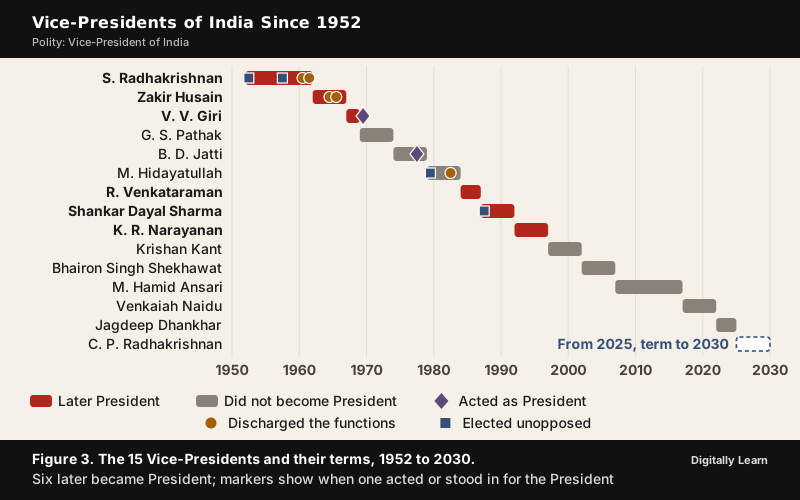
Two Vice-Presidents have acted as President in a vacancy, both after the death of a President in office. V. V. Giri was sworn in as acting President after Zakir Husain died on 3 May 1969, and later resigned to contest the presidential election as an independent candidate. B. D. Jatti acted as President after Fakhruddin Ali Ahmed died on 11 February 1977, until 24 July 1977. As acting President, Jatti delivered the President's Address to Parliament on 28 March 1977 and appointed a Chairman pro tem for the Rajya Sabha.
Vice-Presidents have more often discharged the functions of a President who was absent or ill:
- Sarvepalli Radhakrishnan: From 20 June to 5 July 1960, during President Rajendra Prasad's State visit to the Soviet Union, and from 25 July to 19 December 1961, during his illness.
- Zakir Husain: From 5 to 21 February 1964 and from 16 March to 18 April 1965, while President Radhakrishnan underwent eye operations; he delivered the President's Address on 10 February 1964.
- Mohammad Hidayatullah: From 6 to 31 October 1982, during President Zail Singh's medical treatment abroad, when he also conveyed recommendations on Bills to the Rajya Sabha under Article 117(3).
Hidayatullah officiated as President twice, in two different capacities. As Chief Justice of India he acted as President from 20 July to 24 August 1969, after Giri had resigned both as Vice-President and as acting President, and as Vice-President he discharged the functions again in 1982.
List of Vice-Presidents of India Since 1952
Vice-Presidents, Their Terms and Later Presidencies
India has had 15 Vice-Presidents since the first, Sarvepalli Radhakrishnan, took office on 13 May 1952. Four elections were won unopposed, Radhakrishnan's in 1952 and 1957, Mohammad Hidayatullah's in 1979 and Shankar Dayal Sharma's in 1987. Six of the 15 later became President: Sarvepalli Radhakrishnan, Zakir Husain, V. V. Giri, R. Venkataraman, Shankar Dayal Sharma and K. R. Narayanan. Other Presidents, among them Fakhruddin Ali Ahmed and Neelam Sanjiva Reddy, never held the office of Vice-President.
| No. | Vice-President | Term | How the term ended | Later President |
|---|---|---|---|---|
| 1 | Sarvepalli Radhakrishnan | 1952‑1962 (two terms) | Completed | Yes |
| 2 | Zakir Husain | 1962‑1967 | Completed | Yes |
| 3 | V. V. Giri | 1967‑1969 | Resigned | Yes |
| 4 | Gopal Swarup Pathak | 1969‑1974 | Completed | No |
| 5 | B. D. Jatti | 1974‑1979 | Completed | No |
| 6 | Mohammad Hidayatullah | 1979‑1984 | Completed | No |
| 7 | R. Venkataraman | 1984‑1987 | Resigned | Yes |
| 8 | Shankar Dayal Sharma | 1987‑1992 | Resigned | Yes |
| 9 | K. R. Narayanan | 1992‑1997 | Resigned | Yes |
| 10 | Krishan Kant | 1997‑2002 | Died in office | No |
| 11 | Bhairon Singh Shekhawat | 2002‑2007 | Resigned | No |
| 12 | Mohammad Hamid Ansari | 2007‑2017 (two terms) | Completed | No |
| 13 | Venkaiah Naidu | 2017‑2022 | Completed | No |
| 14 | Jagdeep Dhankhar | 2022‑2025 | Resigned | No |
| 15 | C. P. Radhakrishnan | Since 12 September 2025 | In office | Not applicable |
Assessment of the Office of Vice-President
Continuity of the State and Criticism of the Office
The office was created to keep the Indian State politically continuous. Whatever happens to the President, there is always a constitutional authority ready to act, and in 1969, 1977 and 1982 a Vice-President acted as President or discharged the President's functions without a break. The office also gives the Rajya Sabha a presiding officer who is not one of its members.
The office has its critics. The Constitution gives the Vice-President no significant function in that capacity alone, and some scholars have called the holder "His Superfluous Highness" for that reason. The text also leaves two matters to practice. Removal needs no stated ground, and Article 68 sets no outer limit for filling a mid-term vacancy; in 2025 the vacancy left by the resignation of 21 July was filled by an election within two months.
Previous Year UPSC‑CSE Questions
Each Prelims question is explained option by option, and each Mains question comes with an answer outline.
- UPSC Prelims 2013Consider the following statements:
- The Chairman and the Deputy Chairman of the Rajya Sabha are not the members of that House.
- While the nominated members of the two Houses of the Parliament have no voting right in the presidential election, they have the right to vote in the election of the Vice President.
Which of the statements given above is/are correct?
How to approach this Prelims question
Approach: Test each statement against the article of the Constitution that governs it.
- Statement 1 joins two officers, so check them separately. Under Article 89(1) the Chairman is the Vice-President, who cannot be a member of either House under Article 66(2), but under Article 89(2) the Deputy Chairman is chosen from among the members of the Rajya Sabha, so statement 1 fails.
- Statement 2 compares two electoral colleges. Article 54 limits the President's college to the elected members of Parliament and of the State Assemblies, while Article 66(1) gives the vote to all members of both Houses, so nominated members vote only for the Vice-President and statement 2 holds.
Trap to watch: Students who know that the Chairman is not a member extend the same rule to the Deputy Chairman, because the statement pairs the two officers.
Why each option is right or wrong:
- (a) 1 only: Wrong. The Deputy Chairman is a member of the Rajya Sabha under Article 89(2), so statement 1 is false.
- (b) 2 only: Correct. Nominated members are excluded from the President's electoral college under Article 54 and included in the Vice-President's under Article 66(1).
- (c) Both 1 and 2: Wrong. Statement 1 fails because the Deputy Chairman must be a member of the House.
- (d) Neither 1 nor 2: Wrong. Statement 2 is true, since nominated members of both Houses vote in the vice-presidential election.
Answer: (b) 2 only. The Deputy Chairman is a member of the Rajya Sabha, and nominated members vote for the Vice-President but not for the President.
- UPSC Prelims 2008Who among the following have held the office of the Vice-President of India?
- Mohammad Hidayatullah
- Fakhruddin Ali Ahmed
- Neelam Sanjiva Reddy
- Shankar Dayal Sharma
Select the correct answer using the code given below:
How to approach this Prelims question
Approach: Check each name against the list of Vice-Presidents, not against the list of Presidents, because all four names are linked with the presidency.
- Mohammad Hidayatullah: Vice-President from 1979 to 1984; correct.
- Fakhruddin Ali Ahmed: President from 1974 until his death in 1977, never Vice-President; wrong.
- Neelam Sanjiva Reddy: Elected President in 1977 after Ahmed's death, never Vice-President; wrong.
- Shankar Dayal Sharma: Vice-President from 1987 to 1992, before becoming President; correct.
Trap to watch: Every name in the list became President or acted as President, so students who remember only the presidency tick all four and choose option (a).
Why each option is right or wrong:
- (a) 1, 2, 3 and 4: Wrong. Fakhruddin Ali Ahmed and Neelam Sanjiva Reddy were never Vice-President.
- (b) 1 and 4 only: Correct. Mohammad Hidayatullah (1979 to 1984) and Shankar Dayal Sharma (1987 to 1992) were the sixth and eighth Vice-Presidents.
- (c) 2 and 3 only: Wrong. Ahmed and Reddy held the presidency, not the vice-presidency.
- (d) 3 and 4 only: Wrong. Reddy was never Vice-President, and the option leaves out Hidayatullah.
Answer: (b) 1 and 4 only. Hidayatullah and Shankar Dayal Sharma served as Vice-President, while Ahmed and Reddy became President directly.
- UPSC Prelims 2004The resolution for removing the Vice-President of India can be moved in the
How to approach this Prelims question
Approach: Read the wording of Article 67(b) and ask which House passes the resolution and which House merely agrees to it. The Vice-President may be removed by a resolution of the Council of States passed by a majority of all its then members and agreed to by the House of the People, after 14 days' notice. The Rajya Sabha is therefore the only House in which the resolution can be moved; the Lok Sabha's role comes afterwards, and the Constitution provides no joint sitting for this purpose.
Trap to watch: The impeachment of the President under Article 61 can begin in either House, and students carry that rule over to the Vice-President and pick option (b).
Why each option is right or wrong:
- (a) Lok Sabha alone: Wrong. The Lok Sabha only agrees to a resolution that the Rajya Sabha has already passed.
- (b) Either House of Parliament: Wrong. This is the rule for the President's impeachment under Article 61, not for the Vice-President's removal.
- (c) Joint Sitting of Parliament: Wrong. A joint sitting under Article 108 is for deadlocks on Bills; removal is by resolution of each House separately.
- (d) Rajya Sabha alone: Correct. Article 67(b) makes the removal a resolution of the Council of States.
Answer: (d) Rajya Sabha alone. Article 67(b) requires a resolution of the Council of States, to which the House of the People only agrees.
- UPSC Mains 2022 GS‑IIDiscuss the role of the Vice-President of India as the Chairman of Rajya Sabha.
Answer outline
The outline sets out what the question asks, the main arguments, relevant examples and the direction of the conclusion; it is not a full model answer.
Introduction: Under Articles 64 and 89(1), the Vice-President is the ex officio Chairman of the Rajya Sabha and presides over a House of which the Vice-President is not a member.
Body (sub-themes to develop):
- Constitutional powers: The Chairman has only a casting vote under Article 100, adjourns the House for want of quorum, refuses resignations that are not voluntary or genuine, and decides defection cases under the Tenth Schedule, subject to judicial review since the Kihoto Hollohan case.
- Presiding officer: The Chairman's rulings are binding precedents that cannot be questioned, and the Chairman maintains order through expunction, withdrawal, naming for suspension and adjournment in grave disorder, and controls the raising of privilege questions.
- Committees and Bills: The Chairman appoints committee chairpersons, nominates members, heads the Business Advisory, Rules and General Purposes Committees, and authenticates Bills in the Rajya Sabha's possession before assent.
- Spokesman and statutory duties: The Chairman receives the President's messages, conveys the Motion of Thanks and constitutes inquiry committees under the Judges (Inquiry) Act, 1968.
- Continuity of the Chair: The Deputy Chairman and a panel of six Vice-Chairmen preside when the Chairman is absent, acting as President or facing a removal resolution, during which Article 92 bars the Chairman from voting at all.
- Neutrality: R. Venkataraman's recusal of 1987 set a standard of impartiality, while the notice of December 2024 against Jagdeep Dhankhar showed how the Chair's conduct can become a political contest when removal needs no stated ground.
Conclusion: The Chairman's authority comes from the Constitution and the rules, but its legitimacy depends on the Chair being seen as fair by every side of the Rajya Sabha.
Sources
- Legislative Department, Ministry of Law and Justice: The Constitution of India
- Rajya Sabha Secretariat: Rajya Sabha at Work, Chapter 4, Presiding Officers and Other Parliamentary Functionaries
- Rajya Sabha Secretariat: Powers and Functions as Chairman
- Vice President's Secretariat: Election of the Vice President
- Vice President's Secretariat: Profile of Shri C. P. Radhakrishnan
- PIB: Election to the Office of the Vice-President of India, 2025, schedule
- PIB: Vice-Presidential Election 2025, result
- PIB: President administers the oath of office of Vice-President to Shri C. P. Radhakrishnan
- PIB: Shri C. P. Radhakrishnan sworn in as the 15th Vice-President of India
- PIB: Rajya Sabha Chairman administers oath to Shri Harivansh
- PIB: Chairman's remarks on the election of Shri Harivansh as Deputy Chairman
- NCERT: Indian Constitution at Work, Class XI, Chapter 4, Executive
- NCERT: Indian Constitution at Work, Class XI, Chapter 5, Legislature
- Wikipedia: Vice President of India
- Wikipedia: List of vice presidents of India
- Wikipedia: 2025 Indian vice presidential election
- Wikipedia: Jagdeep Dhankhar
- Wikipedia: Mohammad Hidayatullah
- Wikipedia: Vice President of the United States
- Wikipedia: Deputy Chairman of the Rajya Sabha
- Wikipedia: Anti-defection law
- UPSC: Civil Services Examination question papers
Editorial Disclaimer
This article draws on the text of the Constitution, the publications of the Rajya Sabha Secretariat and the other sources listed above. Constitutional provisions are given as currently in force.
See more of our UPSC articles in Google Search
Add to Preferred Sources

