


Overview
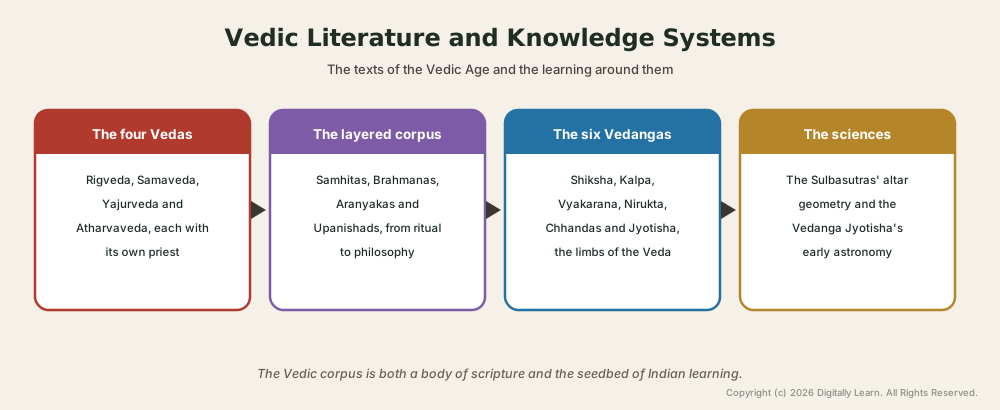
The literature of the Vedic Age is the oldest body of texts in the subcontinent, and it grew into a vast and layered corpus. At its heart are the four Vedas, the Rigveda, Samaveda, Yajurveda and Atharvaveda, each of which gathered around itself four layers: the hymns (Samhitas), the ritual manuals (Brahmanas), the forest books (Aranyakas) and the philosophy (Upanishads). Around the Vedas grew six auxiliary sciences, the Vedangas, and from the need to build the fire altar came the geometry of the Sulbasutras and the early astronomy of the Vedanga Jyotisha. This part surveys that whole corpus and the knowledge systems it carried, which together are the seedbed of much later Indian learning.
The Four Vedas: Rigveda, Samaveda, Yajurveda and Atharvaveda
The Rigveda: The Oldest Text and Its Hymns
What is the significance of the four Vedas: the Vedas are the foundation of the whole age and of much that came after, and the examiner expects a clear grasp of what each one contains and which is the oldest.
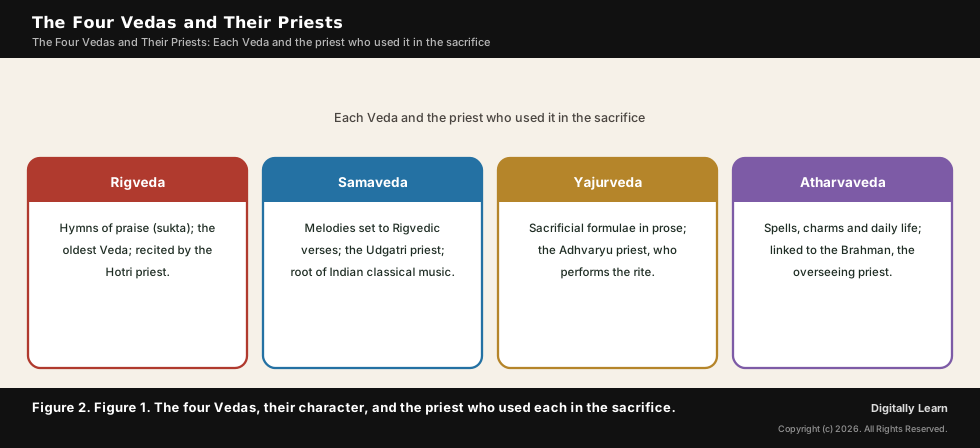
The Rigveda is the oldest of the four and the oldest text of the subcontinent, a collection of more than a thousand hymns, the sukta, in praise of the gods, composed by sages, the rishis. It was the source from which the other Vedas drew. In the sacrifice its verses were recited by the priest called the Hotri.
The Sama, Yajur and Atharva Vedas: Chant, Ritual and Daily Life
Distinguishing the other three: the Samaveda set the verses of the Rigveda to melody for the chant of the sacrifice, sung by the Udgatri, and it is regarded as having laid the foundation of Indian classical music.
The Yajurveda gave the sacrificial formulae in prose, used by the Adhvaryu who actually performed the rite. The Atharvaveda, the latest, is different in spirit: a collection of spells, charms and remedies for everyday life, linked to the Brahman, the priest who oversaw the whole sacrifice.
The Layered Corpus: Samhitas, Brahmanas, Aranyakas and Upanishads
The Four Layers of Each Veda
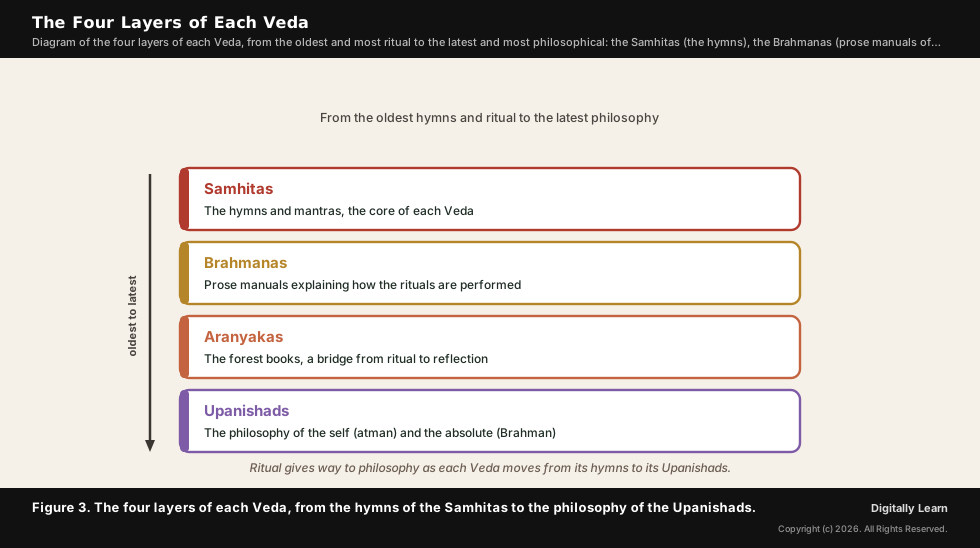
What is the significance of the layers: each Veda is not a single book but a growing library, and knowing its four layers, and that they run from ritual to philosophy, is a standard examination point.
Around each Veda gathered four layers of text. The Samhitas are the hymns themselves, the core. The Brahmanas are prose manuals that explain how the rituals are to be performed. The Aranyakas, the forest books, were meant to be studied away from the village and form a bridge from ritual to reflection. The Upanishads, last and latest, turn from ritual to philosophy. The whole moves from the oldest and most ritual to the latest and most thoughtful.
The Upanishads as the Philosophical Close of the Veda
Distinguishing the Upanishads: the Upanishads, whose name means sitting near, as a pupil sits near a teacher, are the philosophical close of the Veda, recording dialogues on the deepest questions. They are traditionally counted as about 108, of which about thirteen are held to be the principal ones, the oldest being the Brihadaranyaka and the Chhandogya.
They are full of parables and dialogues, not dry doctrine, and they were composed well before the much later Puranas. Their great themes, the atman and the Brahman, are treated in full in the part of this series on religion; here it is enough to note their place as the end of the Vedic corpus. From the Mundaka Upanishad comes the phrase Satyameva Jayate, truth alone triumphs, which is the national motto of India.
The Vedangas: The Six Limbs of Vedic Learning
Shiksha, Kalpa, Vyakarana, Nirukta, Chhandas and Jyotisha
What is the significance of the Vedangas: to use the Vedas correctly the priests needed a set of helping sciences, the six Vedangas or limbs of the Veda, and the examiner often asks for the six and their subjects.
Distinguishing the six limbs: Shiksha is phonetics, the correct pronunciation of the sacred words; Kalpa is ritual, the rules for performing the sacrifices; Vyakarana is grammar; Nirukta is etymology, the meaning of difficult words; Chhandas is metre, the rhythm of the hymns; and Jyotisha is astronomy, used to fix the right time for the rites. Together they preserved the Vedas and made them usable.
| Vedanga | Subject |
|---|---|
| Shiksha | Phonetics and pronunciation |
| Kalpa | Ritual procedure |
| Vyakarana | Grammar |
| Nirukta | Etymology |
| Chhandas | Metre and prosody |
| Jyotisha | Astronomy and the calendar |
Vedic Knowledge Systems: Mathematics and Astronomy
The Sulbasutras: Geometry of the Fire Altar
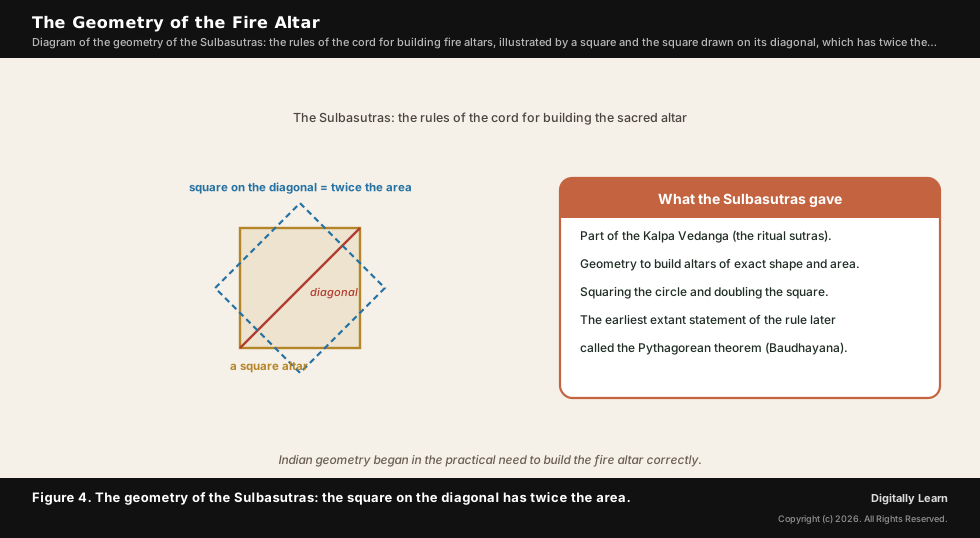
What is the significance of the Sulbasutras: Indian geometry begins not as abstract theory but in the very practical need to build the fire altar to exact shape and size, and the texts that gave the rules are the Sulbasutras.
The Sulbasutras, whose name means the rules of the cord, are part of the Kalpa Vedanga. They set out how to build altars of precise area and form, including how to make a square equal in area to a circle and how to double a square.
The oldest, the Baudhayana Sulbasutra, contains the earliest extant verbal statement of the rule later known as the Pythagorean theorem, that the square on the diagonal of a rectangle equals the sum of the squares on its two sides.
Vedanga Jyotisha: The Earliest Indian Astronomy
Distinguishing the Jyotisha: the Vedanga Jyotisha, attributed to Lagadha, is the earliest known Indian text on astronomy. Its purpose was practical and religious: to work out the calendar and so to fix the correct times for the sacrifices, by tracking the movements of the sun and the moon.
Its concern was the luni-solar calendar, reckoning the months and seasons from the sun and the moon so that each rite fell on its appointed day. Modest though it is, it stands at the head of the long line of Indian astronomy that later produced Aryabhata and Varahamihira.
Oral Transmission and the Preservation of the Vedas
Shruti, the Heard Word, and the Methods of Memorisation
What is the significance of oral transmission: the Vedas were not, for most of their history, read from a book; they were heard and memorised, and the way they were preserved is itself a remarkable achievement that the examiner sometimes tests.
The Vedas are shruti, that which is heard, set apart from the later smriti, that which is remembered. For many centuries they were carried by memory alone, recited and learned syllable by syllable, and written down only much later. To guard against the smallest error, the teachers devised elaborate methods of recitation, repeating the words in different fixed orders, so that the text was preserved with extraordinary fidelity across the generations.
UPSC Relevance and Exam Focus
Where Vedic Literature Fits in the UPSC-CSE Syllabus
This topic belongs to General Studies Paper I: ancient Indian history and culture, and Vedic literature, especially the four Vedas, the Upanishads and the Vedangas, is among the most reliably examined areas of the period.
For Prelims, hold the firm facts: the four Vedas and their priests; the four layers of each Veda; that the Upanishads contain parables and were composed earlier than the Puranas; the six Vedangas; the Sulbasutras as altar geometry; and Satyameva Jayate from the Mundaka Upanishad.
For Mains, the corpus shows how a religion of ritual grew a philosophy and a body of science, the Sulbasutras and Vedic astronomy being early roots of Indian mathematics and the calendar.
Recurring linked concepts an aspirant should keep in working memory:
- The four Vedas: Rigveda, Samaveda, Yajurveda, Atharvaveda; Rigveda the oldest.
- The four priests: Hotri, Udgatri, Adhvaryu and the overseeing Brahman.
- The four layers: Samhitas, Brahmanas, Aranyakas, Upanishads.
- The six Vedangas: Shiksha, Kalpa, Vyakarana, Nirukta, Chhandas, Jyotisha.
- The sciences: the Sulbasutras’ geometry and the Vedanga Jyotisha’s astronomy.
A common Prelims trap is to claim the Upanishads have no parables. They are full of parables and dialogues, and they were composed earlier than the Puranas.
Another trap is to muddle the priests: the Hotri recites the Rigveda, the Udgatri chants the Samaveda, and the Adhvaryu performs with the Yajurveda.
Previous Year UPSC-CSE Questions
Previous Year UPSC-CSE Questions By the end you will be able to draft model answers for the following UPSC questions. Each question carries a collapsible framework showing how to approach it in the exam.
- UPSC Prelims 2024 GS-IConsider the following statements:
- There are no parables in Upanishads.
- Upanishads were composed earlier than the Puranas.
Which of the statements given above is/are correct?
How to approach this Prelims question
Approach: Judge each statement against the character and dating of the Upanishads.
Trap to watch: Statement 1 is wrong: the Upanishads are rich in parables and teacher-pupil dialogues.
Key facts to recall:
- The Upanishads contain many parables and dialogues.
- The Upanishads (c. 800-500 BCE onward) predate the Puranas (later).
Answer signal: 2 only.
Sources and Further Reading
Editorial Disclaimer
This article is for UPSC preparation. The dating of the Vedic texts is given in the conventional ranges used by historians. Verify specific details before relying on them.