


Overview
Vedic polity is the way the people of the Vedic Age governed themselves, from the tribes of the Rigveda to the territorial kingdoms of the later Vedic texts. In the Rig Vedic period, about 1500 to 1000 BCE, the unit of government was the jana, a people bound by kinship, led by a chief called the rajan and advised by assemblies such as the sabha and the samiti. In the later Vedic period, about 1000 to 600 BCE, the jana settled on land and became the janapada, a territory ruled by an increasingly hereditary king who was served by officials, received compulsory tribute and displayed his power through great royal sacrifices. NCERT's Class 9 timeline gives about 2000 to 500 BCE for the Vedic period as a whole, and dates the composition of the Rigveda to about 1500 to 1000 BCE.
Rig Vedic Polity: Jana, Rajan and Tribal Government
Kula, Grama, Vish and Jana: Units of the Rig Vedic Tribe
Rig Vedic society was organised into janas, groups of people bound by kinship ties. The Rigveda alone mentions about 30 janas. Five of them, the Yadu, Turvasha, Puru, Anu and Druhyu, were known together as the panchajana, the "five peoples". The name Bharata also first appears in the Rigveda, for the Bharata jana, the people ruled by the family of the Bharatas.
Each jana was built up from smaller units, and each unit had its own head.
- Kula: The family, living under one roof, was the basic unit.
- Grama: Several families made up a village, whose headman was the gramani.
- Vish: Families bound by ties of kinship formed a clan, the vish, under a head called the vishpati.
- Jana: The tribe was the highest political unit, and the people gave it their first loyalty; its ruler was the rajan.
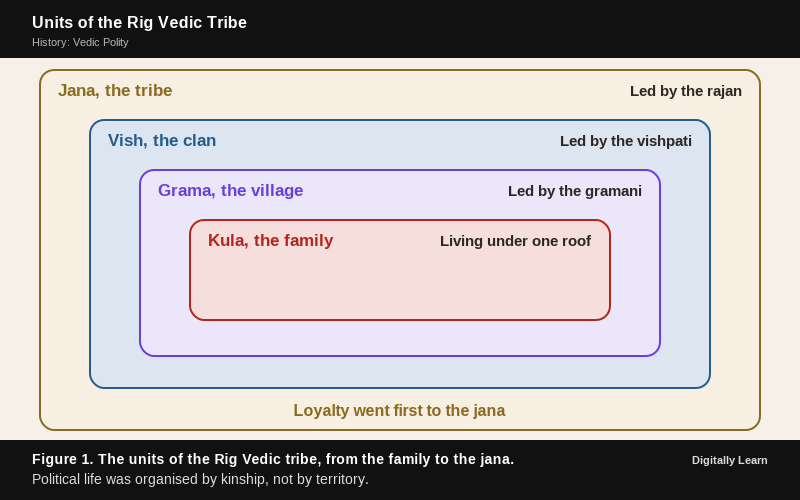
Political life was therefore a matter of people, not of land. Membership of a jana came through kinship, and the janas were semi-nomadic pastoral communities, so nothing in this order yet tied government to a fixed territory.
The Rajan as Tribal Chief: Duties, Bali and Limits
The rajan was the chief of a tribe, not the king of a territory. He was above all a war leader: He led the tribe in battle, and protecting its members was his main duty.
The rajan was supported by gifts rather than taxes. His own people gave him bali, a voluntary gift in return for his services, and tribes he had defeated also paid it to him. No tax collectors appear in the Rigveda, and war bounty was a major source of wealth; regular tribute had to wait for the later Vedic kingdoms.
The rajan's power had limits. The tribal councils, the sabha and the samiti, restricted his autonomy, and he could not take office without their approval. Some tribes had no hereditary chief at all and were governed directly by their councils. A hymn found in the Atharvaveda, a later Vedic collection that keeps older material, and with small changes in the Rigveda (X.173), asks that the rajan of the people remain firm and says that the assembly appoints him for firmness.
Officials of the Rig Vedic Rajan: Purohita, Senani and Gramani
The rajan kept a rudimentary court, attended by the sabhasad, the members of the sabha, and by the gramanis, the heads of villages. A few functionaries helped him govern.
- Purohita: The chaplain performed ceremonies and spells for success in war and prosperity in peace, and advised the rajan on justice.
- Senani: The army chief commanded in war and probably performed civic duties in peace.
- Gramani: The village headman exercised both civil and military functions.
- Duta and spasha: Envoys carried messages between tribes, and spies gathered information.
The purohita and the senani were the most important of these functionaries. The purohita's place rested on the belief that victory in battle depended on the favour of the gods, secured through proper sacrifice, and the priests of the Bharata court are part of the story of the Battle of the Ten Kings.
Sabha, Samiti and Vidhata: The Assemblies of the Vedic Tribe
Membership and Work of the Three Vedic Assemblies
The sabha and samiti first appear in the Vedas, the oldest Indian texts. The Vedic texts, particularly the Rigveda and the Atharvaveda, refer to three assemblies, the sabha, the samiti and the vidhata (also written vidatha), and each played a significant role in early Vedic polity. The same two texts also name the sansad, a word still used today for Parliament.
| Assembly | Membership | Main work | Later history |
|---|---|---|---|
| Sabha | A smaller body of select elites | Mainly judicial; advised the rajan | Continued in the later Vedic period; also met as a court of justice |
| Samiti | A larger assembly representing the broader population | Policy decisions and political affairs | Continued in the later Vedic period with less influence |
| Vidhata | A popular gathering of members of the community; women were admitted | Discussions on warfare and other political matters, and socio-religious rites | Lost its importance and ceased to function in the later Vedic period |
The vidhata seems to have been the earliest institution of the age. It was a tribal gathering with several purposes, deciding important matters of religion and warfare and performing socio-religious rites for the well-being of the people.
Difference Between Sabha and Samiti
The sabha was a smaller body of elders with mainly judicial work, while the samiti was a larger assembly of the people that dealt with policy and political matters. The exact line between them is not clear in the texts. One interpretation holds that the sabha was a meeting of the great men of the tribe and the samiti a meeting of all free tribesmen.
The samiti was the more political body. The rajan was expected to attend it regularly, and a Rigveda hymn says that a true king (raja) goes to the samiti. The last hymn of the Rigveda calls for a common assembly and a common mind, stressing harmony among the members of the assembly and between the rajan and the assembly.
Powers of the Assemblies and the Question of Election
The assemblies were a real check on the chief. In the later janapadas a good ruler was supposed to take the advice of the assembly, and some texts say that an incompetent ruler could be removed by it. Such mentions are significant, but they do not show an established law, because the evidence for so remote a period is incomplete.
Whether the samiti actually elected the rajan is debated. Some accounts give the assembly of the Kuru kingdom the power to elect or remove the ruler, and some read the hymn of appointment as an election. Others hold only that the rajan needed the approval of the assemblies to take office.
Battle of the Ten Kings (Dasarajna): Sudas and the Bharatas
Sudas, the Bharatas and the Ten-Tribe Confederation
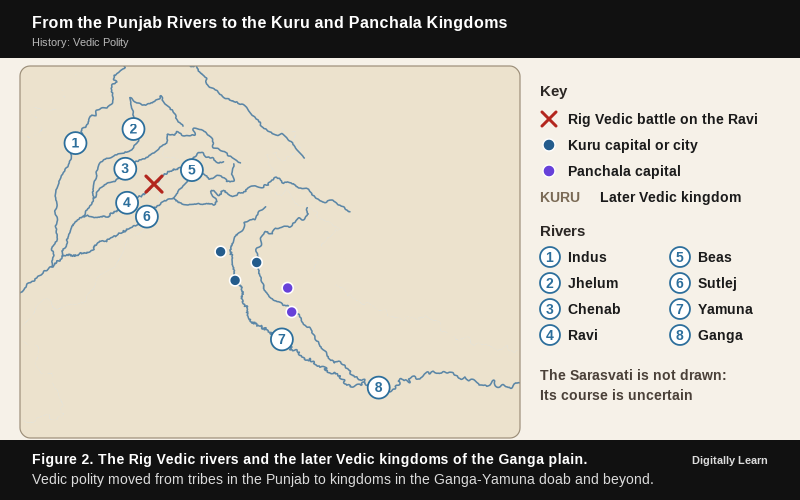
The Battle of the Ten Kings, the Dasarajna, is a war between Vedic tribes alluded to in the seventh mandala of the Rigveda. It was fought on the bank of the Parushni, the modern Ravi, between Sudas, king of the Bharata tribe, and a confederation of 10 tribes. The confederation included the Purus, Yadus, Turvashas, Anus, Druhyus, Alinas, Pakthas, Bhalanas, Shivas and Vishanins.
Under Sudas and his purohita Vishvamitra, the Bharatas had crossed the Beas and the Sutlej, moving towards the future Kurukshetra. Vishvamitra was later replaced by Vasishtha, and Vasishtha is the priest named with Sudas in the battle hymns. The Bharatas lived around the upper Sarasvati, while the Purus, their western neighbours, lived along its lower course.
The cause of the war is not certain. Division of the waters of the Ravi could have been one reason, and the hymns also speak of the allied tribes trying to steal the cattle of the Bharatas. By one account Sudas breached a dyke on the river so that its waters drowned many of his enemies, and he won a decisive victory.
Results of the Battle: Bharata Dominance and the Kuru Union
The battle settled the leadership of the Vedic tribes in favour of the Bharatas. After the war the Bharatas and the Purus merged into a new tribe, the Kuru, and the land they held would later become the heart of the first Vedic kingdom. Bharatavarsha, a name used in the Mahabharata for the whole subcontinent, means the country of the Bharatas.
The battle also shows what Rig Vedic politics was like. Wars were fought between tribes and alliances of tribes over cattle and river water, a chief's success was believed to depend on his priest and his god as much as on his warriors, and rival tribes could merge into a larger people once the fighting ended.
Later Vedic Polity: Territorial Kingdoms and Royal Power
From Jana to Janapada and Rashtra
The later Vedic period changed the basis of government from kinship to land. Each jana came to be associated with a territory, the janapada, led by a rajan. The word janapada literally means where a people (jana) first set its feet, and the change from kinship-based to territorial identity took place between about 1000 and 600 BCE. People were now bound not only by kinship but also by belonging to a land, and control over land, agricultural production and trade routes became increasingly important.
The idea of the rashtra, the territorial state, grew in the same period, and the king came to be seen as the custodian of social order and the protector of the rashtra. The ruling lineage of the Rig Vedic period, the rajanya, became the kshatriya, a class with the authority to rule over a territory. The king was now the protector of a territory, not only of the tribe's cattle.
The economic change went with the political one. Iron tools let the Vedic people clear forests for settled farming in the Ganga valley, and settled farming increased trade and competition for resources.
Kuru and Panchala: The First Vedic Kingdoms
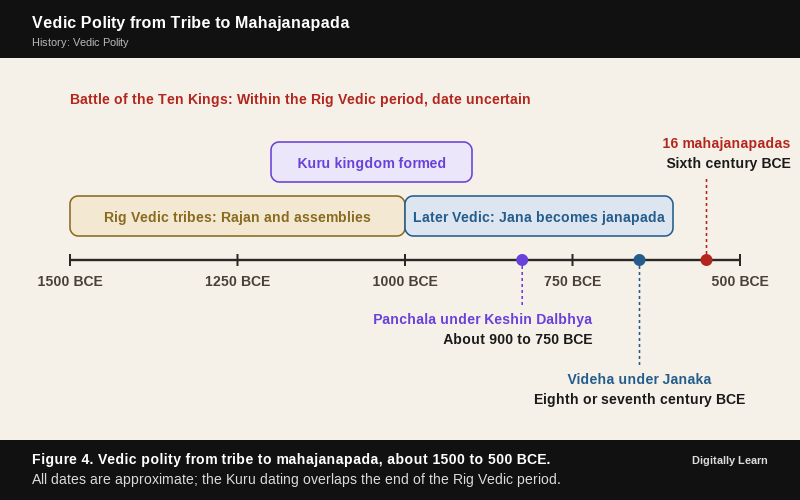
The Kuru kingdom was the first recorded state-level society in the subcontinent. It took shape in what some historians call the middle Vedic period, dated about 1200 to 900 BCE, through the alliance and merger of the Bharata and Puru tribes after the Battle of the Ten Kings, and it joined several tribes into a new "super-tribe". This dating overlaps the end of the Rig Vedic period, because the Kuru state grew out of the late Rig Vedic tribes; it belongs with the later Vedic kingdoms because its kingship and rituals look forward to them. Its first capital was Asandivat, identified with modern Assandh in Haryana; later literature names Indraprastha and Hastinapura as the main Kuru cities.
Two kings shaped the Kuru state. Parikshit is praised in the Atharvaveda as the great king of a prosperous realm, and his son Janamejaya is remembered in the Shatapatha Brahmana as a conqueror who performed the ashvamedha. Under them Vedic hymns were collected and a new set of rituals was developed to support the king and the social order.
Whether the Kuru polity was a true state or a complex chiefdom is hard to settle. Power centred on the royal court rather than on a city. The Kurus declined after their defeat by the non-Vedic Salva tribe, and the political centre of Vedic culture moved east to the Panchala kingdom on the Ganga under King Keshin Dalbhya, between about 900 and 750 BCE. Later, in the eighth or seventh century BCE, Videha in north Bihar became a political centre under King Janaka. The later Vedic texts name the Panchalas as close allies of the Kurus, and the Kuru-Panchala region of the upper Ganga plain was the heartland of later Vedic society.
Hereditary Kingship, Royal Titles and Types of State
Hereditary kingship started emerging in the later Vedic period. Chariot races, cattle raids and games of dice, which had once decided who was worthy of becoming king, became nominal, and rituals now raised the king above his people. Powerful kings took titles such as adhiraja, rajadhiraja, samrat and ekrat, and the Atharvaveda defines the ekrat as the paramount sovereign.
The later Vedic texts also name several kinds of state. The Aitareya Brahmana mentions rajya, vairajya, bhaujya, svarajya and samrajya in different regions of the country, and three of these terms show how varied later Vedic government was.
- Rajya: Probably a smaller but independent kingdom.
- Samrajya: A higher form of rule, in which a prince became samrat when all the princes and people within his territory obeyed him.
- Vairajya: A state with no king, recorded for peoples near the Himalayas such as the Uttarakurus and Uttaramadras.
Royal power was still not absolute. Tyranny could cost a king the allegiance of his assemblies and people, and the Brahmana texts and epics record princes deposed as unfit to rule. The Shatapatha Brahmana tells of a later Vedic king, Srnjaya Dushtaritu Paumsayana, who was expelled from his ancestral kingdom after 10 generations of his family had ruled it.
Ratnins and the King's Administration
A growing body of officials marks the later Vedic state. The Yajurveda Samhitas and the Brahmanas mention high officials called ratnins, the "jewels", who formed part of the king's council and held high status. They were most likely royal relatives, ministers, heads of departments and courtiers, and the king went to the residence of each ratnin to make an offering there. The crowned queen and the favourite queen were counted among the ratnins.
| Official | Role |
|---|---|
| Purohita | Chief priest and adviser on affairs of state |
| Senani | Commander of the army |
| Gramani | Head of the village and the main channel of royal authority in local administration |
| Sangrihitri | Treasurer, custodian of the king's revenues |
| Bhagadugha | Collector of the king's share of the produce |
| Suta | Charioteer |
| Kshatri | Chamberlain |
| Palagala | Messenger |
| Mahishi | Chief queen |
The duties of these officials show government taking a new shape. A treasurer and a collector of revenue mean that the king now had tribute to receive and store, and a village headman who served as the channel of royal authority means that the king's rule reached down to the villages of his territory.
Bali, Bhaga and Royal Revenue
The king's income changed with his power. The voluntary bali of the Rig Vedic period became compulsory tribute, taken from the king's own commoners and also from weaker neighbouring tribes. Bali and bhaga became regular tributes, and the bhagadugha collected them.
An organised system of taxes belongs to the next stage of Indian polity, the age of the mahajanapadas.
Decline of the Assemblies in the Later Vedic Period
The sabha and the samiti survived into the later Vedic period, but their character changed. Both are still mentioned in the later texts, including the Atharvaveda and the Chandogya Upanishad, yet their influence declined as the power of the king grew. The vidhata lost its importance and no longer functioned.
The sabha in particular became more of a court. Its head was the sabhapati, and the word sabha came to denote a law court as well as an assembly for public matters. Under the influence of ritual, the approval of the people took a new form, and the sabha and the samiti became part of the ceremony that inaugurated the king.
The decline of the assemblies is one of the clearest signs of the move from tribe to territory. Authority that the Rig Vedic chief had shared with his people now rested with a king, his priest and his officials.
Royal Sacrifices: Rajasuya, Vajapeya and Ashvamedha
Rajasuya: The Royal Consecration
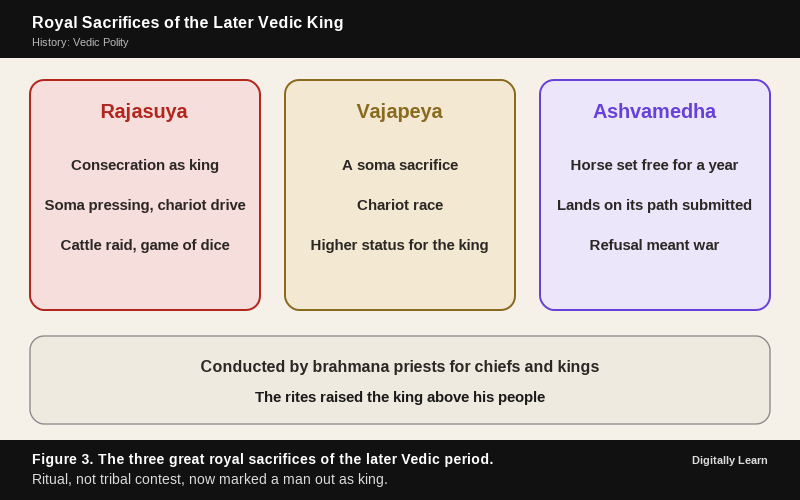
The rajasuya was the ceremony that consecrated a king and established his sovereignty. Its rites included the pressing of soma, a chariot drive, the king shooting arrows from his bow and a symbolic cattle raid, in which the newly anointed king seized cattle belonging to a relative and then gave part of his own property to that relative. The king also played a game of dice with a priest and won a cow, a ritual win that marked his enthronement. The Shatapatha Brahmana states that the rajasuya was the means by which a kshatriya could become king and was not suitable for brahmanas.
Vajapeya and Ashvamedha: Status and Paramountcy
The vajapeya, counted among the soma sacrifices, combined a chariot race with soma offerings and was believed to give the sacrificer a higher status. The ashvamedha, the horse sacrifice, was the best known of the new royal rites. A consecrated horse was set free to roam for a year, followed by a chosen band of warriors, and the kingdoms and chiefdoms through which it wandered had to pay homage or prepare to fight the king to whom the horse belonged. Only a powerful, victorious king could perform it, and its aim was power, glory and sovereignty over neighbouring lands.
These sacrifices had a political purpose. Elaborate rites such as the rajasuya and the ashvamedha were performed by chiefs and kings who depended on brahmana priests to conduct them, so the rituals bound kingship to the priesthood. The ashvamedha in particular was enormously expensive, needing hundreds of people and hundreds of animals. On one reading, Vedic state formation stayed in a condition of arrested development, because local chiefs remained relatively autonomous and the surplus wealth that could have built the state went instead into ever grander rituals.
Rig Vedic and Later Vedic Polity Compared
Polity, Society and Economy in the Two Vedic Periods
The change in polity was one strand of a wider change in Vedic life, and each strand supported the others. The Rig Vedic people were semi-nomadic and lived mainly by cattle-keeping in the Punjab; the later Vedic people had settled into agriculture in the Ganga valley, using iron tools that let them clear forests. The settled economy increased trade and competition for resources, which made control of land worth fighting for.
Society changed with the polity. The emergence of monarchical states led to a distancing of the rajan from the people and the emergence of a varna hierarchy, in which society was divided into four groups, the brahmanas, kshatriyas, vaishyas and shudras. The later Vedic texts fixed the boundaries, roles and status of each group, and the household headed by a grihapati became an important unit.
| Feature | Rig Vedic period (c. 1500 to 1000 BCE) | Later Vedic period (c. 1000 to 600 BCE) |
|---|---|---|
| Unit of government | Jana, a tribe bound by kinship | Janapada and rashtra, a territory |
| Region | Sapta Sindhu, the Punjab | Ganga-Yamuna doab and the Ganga plain |
| Ruler | Rajan, a tribal chief and war leader | Hereditary king, sometimes styled samrat or ekrat |
| Revenue | Voluntary bali and war bounty | Compulsory tribute, bali and bhaga, collected by the bhagadugha |
| Officials | Purohita, senani, gramani, envoys and spies | Ratnins, including a treasurer and a collector of revenue |
| Assemblies | Sabha, samiti and vidhata share in decisions | Sabha and samiti decline; vidhata ceases to function |
| Sacrifice | Rites in the tribal gathering, the vidhata; no great royal sacrifices | Elaborate royal rites such as the rajasuya and ashvamedha, conducted by brahmana priests for chiefs and kings |
| Society | Flexible occupations, ranking only beginning | Varna hierarchy of four groups |
From Janapadas to Mahajanapadas: Monarchies and Gana-Sanghas
Monarchies and Gana-Sanghas at the Close of the Vedic Age
The janapadas grew as trade networks expanded and connected them, and some of these early states merged into larger units, the mahajanapadas. Early Buddhist and Jaina texts list 16 of them for the sixth century BCE, though the lists vary; names such as Vajji, Magadha, Kosala, Kuru, Panchala, Gandhara and Avanti occur often. By the end of the later Vedic age, monarchical states (rajya), oligarchical states (gana or sangha) and tribal principalities had all emerged.
Most mahajanapadas were monarchies. The king was the ultimate authority, supported by ministers and an assembly of elders; his position was hereditary, in the sense that a king would usually be the son of the previous one; and he collected taxes, kept order, fortified his capital and maintained an army.
Some states kept the older principle of rule by assembly. In the gana-sanghas, power was shared by a number of men, often collectively called rajas. In at least two mahajanapadas, the Vajji and its neighbour the Malla, the sabha or samiti had more power, took important decisions through discussion and, if necessary, through a vote, and selected the raja.
Previous Year UPSC‑CSE Questions
Each question comes with an answer outline.
- UPSC Mains 2024 GS‑IUnderline the changes in the field of society and economy from the Rig Vedic to the later Vedic period.
Answer outline
The outline sets out what the question asks, the main arguments, relevant examples and the direction of the conclusion; it is not a full model answer.
Introduction: The Rig Vedic period (about 1500 to 1000 BCE) was the age of semi-nomadic, cattle-keeping tribes in the Punjab, while the later Vedic period (about 1000 to 600 BCE) was an age of settled farming and territorial kingdoms in the Ganga plain.
Body (sub-themes to develop):
- Economy, from herds to fields: Cattle-keeping by semi-nomadic tribes gave way to settled agriculture in the Ganga valley, helped by iron tools that cleared forests.
- Economy, from gifts to tribute: The voluntary bali and war bounty of the Rig Vedic rajan became compulsory tribute, bali and bhaga, collected by the bhagadugha.
- Economy, trade and competition: Settled farming increased trade and competition for resources, and control over land and trade routes became important.
- Society, varna: Flexible occupations gave way to a varna hierarchy of brahmanas, kshatriyas, vaishyas and shudras, with roles and status fixed by the later Vedic texts.
- Society, kingship and the people: The emergence of monarchical states distanced the rajan from the people, and the rajanya became the kshatriya, a class with authority over territory.
- Society, household: The household headed by a grihapati became an important unit.
Conclusion: Settled farming, territorial kingship and a graded society advanced together in the later Vedic period and prepared the way for the mahajanapadas.
Sources
- NCERT: Class 6 Exploring Society: India and Beyond, Chapter 5
- NCERT: Class 7 Exploring Society: India and Beyond Book 1, Chapter 4
- NCERT: Class 9 Understanding Society: India and Beyond Book 1, Chapter 5
- NCERT: Class 12 Themes in Indian History Book 1, Chapter 2
- NCERT: Class 12 Themes in Indian History Book 1, Chapter 4
- Capacity Building Commission: Early Vedic Age, Origin of Kingship
- Capacity Building Commission: Later Vedic Age, Nature of Kingship
- Capacity Building Commission: Later Vedic Age, 1000 to 600 BCE
- PIB, Ministry of Culture: Bharat, the Mother of Democracy
- Vedic Heritage Portal (Ministry of Culture): Rituals
- Wikipedia: Vedic period
- Wikipedia: Battle of the Ten Kings
- Wikipedia: Bharatas (Vedic tribe)
- Wikipedia: Kuru kingdom
- Wikipedia: Panchala
- Wikipedia: Janapada
- Wikipedia: Rajasuya
- Wikipedia: Ashvamedha
- Wikipedia: Yajna
- UPSC: Civil Services Examination question papers
Editorial Disclaimer
This article draws on the current NCERT textbooks and the other sources listed above. Dates for the Vedic Age are approximate.
See more of our UPSC articles in Google Search
Add to Preferred Sources