


Overview
Naxalism in India is the armed movement of Maoist groups that began with the Naxalbari uprising of 1967 in West Bengal and sought to capture state power through a protracted people's war. The Ministry of Home Affairs calls it Left-Wing Extremism (LWE), and the belt of forested districts in which it was active is known as the Red Corridor. The movement reached its peak in the late 2000s and then declined, unevenly at first and sharply after 2024. In the Ministry's latest figures, of July 2026, no district is categorised as LWE affected, although 37 districts remain under watch as Legacy and Thrust districts and one is classified as a District of Concern.
Left-Wing Extremism: Meaning, Maoist Ideology and Aims
Naxalism and Maoism: Protracted People's War Doctrine
Left-Wing Extremism means the use of armed violence by groups that follow a communist ideology to overthrow the existing political and economic order. In India the groups are called Naxalites, after the village of Naxalbari, and are described as Maoist because they follow the ideas of the Chinese leader Mao Zedong. The Naxalites claim to fight on behalf of the rural poor and describe their campaign as a people's war against the state.
The method comes from Mao's doctrine of protracted people's war. The revolutionary force retains the support of the local population and draws the state's forces into the countryside, where guerrilla warfare exhausts them. The strategy proceeds in three phases. In the first, the force starts in a remote mountainous or forested area where the state is weak and builds a revolutionary base area. In the second, it creates more base areas and spreads through the surrounding countryside. In the third, it grows strong enough to encircle and capture small cities and then larger ones.
The CPI (Maoist) adopted Marxism-Leninism-Maoism as its guiding ideology and committed itself to protracted armed struggle to seize power from the state. It describes the Indian state as run by "a collaboration of imperialists, the comprador bourgeoisie and feudal lords". The People's War Group, one of the two organisations that merged to form it, characterised Indian society as semi-feudal and semi-colonial and rejected participation in elections. The Home Ministry describes the movement's guiding principle as the belief that power flows from the barrel of the gun.
Left-Wing Extremism Versus Other Insurgencies in India
India's three major insurgencies differ in their roots. Left-Wing Extremism is driven by ideology and class, while the insurgencies of the North-East and of Jammu and Kashmir are driven by questions of identity, autonomy and separation.
| Feature | Left-Wing Extremism | North-East insurgencies | Jammu and Kashmir |
|---|---|---|---|
| Basis of the conflict | Communist ideology and a stated aim of overthrowing the state | Ethnic identity, autonomy and secession demands of many communities | Separatism, with militancy backed from across the border |
| Where it operated | Forested central and eastern India, the Red Corridor | Assam and the hill States of the North-East | Jammu and Kashmir |
| Spread in 2009 | Exceeded Kashmir and the North-East in geographic spread, as the government acknowledged | Several States of one region | One region |
The North-East is India's most ethnically diverse region, and many of its tribal communities resist being absorbed into the mainstream for fear of losing their distinct identity. In Jammu and Kashmir, Pakistan's Inter-Services Intelligence has encouraged and aided the insurgency. Left-Wing Extremism, by contrast, claims to speak for a class, the rural poor, across many States and communities.
Evolution of the Naxalite Movement Since Naxalbari 1967
Naxalbari Uprising and the CPI (Marxist-Leninist), 1967 to 1972
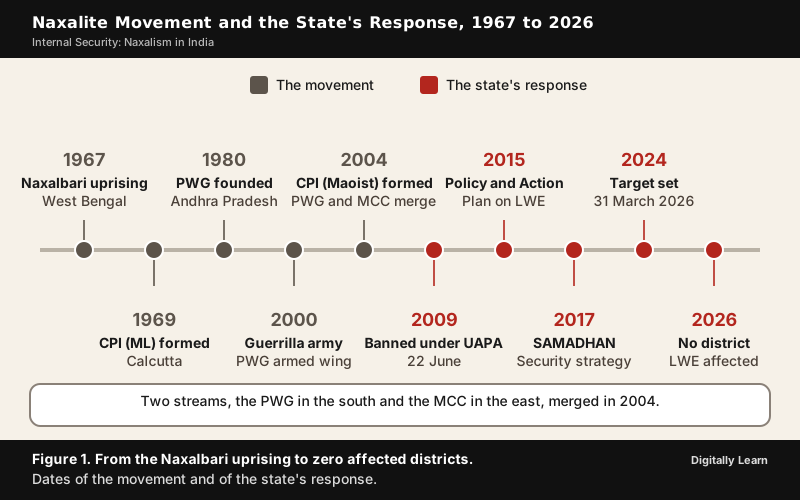
The Naxalbari uprising was an armed peasant revolt of 1967 in the Naxalbari block of the Siliguri subdivision of Darjeeling district, West Bengal. A radical section of the Communist Party of India (Marxist) led by Charu Majumdar, Kanu Sanyal and Jangal Santhal, known as the Siliguri group, advocated an armed people's war on the Chinese model. Majumdar wrote the Historic Eight Documents, which became the foundation of the movement.
On 3 March 1967 about 150 peasants armed with bows and spears took paddy from landlords and began seizing land. Peasant committees spread through Naxalbari, Kharibari and Phansidewa. A police inspector was killed, and on 25 May 1967 police firing killed nine women and a child. Paramilitary forces were sent in on 19 July and Jangal Santhal was arrested. The rising was suppressed within months, yet it gave the movement its name.
Expelled CPI (Marxist) members formed the All India Coordination Committee of Communist Revolutionaries in November 1967. Out of it came the Communist Party of India (Marxist-Leninist), or CPI (ML), formed in April 1969 and announced by Kanu Sanyal at a mass meeting in Calcutta. Majumdar declared an "annihilation line" that called for killing individual "class enemies" such as landlords and police officers.
The West Bengal government responded forcefully, and Operation Steeplechase was launched with central support. Majumdar was arrested in July 1972 and died in police custody. By 1973 most of the main leaders had been killed or arrested, and the party broke into more than 40 small groups.
Splits, the People's War Group and the MCC in the 1980s and 1990s
After the collapse of the first wave, the movement revived in two separate streams. In the south, the Communist Party of India (Marxist-Leninist) People's War, known as the People's War Group (PWG), was founded on 22 April 1980 by Kondapalli Seetharamaiah. Its cadres kidnapped landlords and forced them to return what they had extorted from villagers. By the early 1980s it had a stronghold along the border of Andhra Pradesh and Odisha, and it later spread into Maharashtra and Madhya Pradesh. On 2 December 2000 it brought its separate armed squads into one guerrilla army, which after 2004 served the CPI (Maoist) as the People's Liberation Guerrilla Army (PLGA).
In the east, the Maoist Communist Centre (MCC) grew from the Dakshin Desh group, which had stayed outside the CPI (ML) in 1969. It took the name Maoist Communist Centre in 1975 and from 1976 expanded into eastern Bihar. In Bihar in the 1990s, Maoists killed members of the land-owning Bhumihar community in a series of massacres, and the landowners retaliated through militias such as the Ranvir Sena.
The States responded with specialised forces and with special laws that enabled the police to detain Naxalite cadres and suspected supporters. In Andhra Pradesh, Naxalites began ambushing the police in 1985 and killed a sub-inspector in Warangal district; in 1989 the State formed the Greyhounds, a special police force for operations against them. The States also set up rehabilitation programmes for those who surrendered.
Formation of the CPI (Maoist) in 2004 and Its Ban Under UAPA
On 21 September 2004 the People's War Group and the Maoist Communist Centre of India merged to form the CPI (Maoist). The merger was announced publicly on 14 October 2004, and Muppala Lakshmana Rao, known as Ganapathy, became general secretary. The new party kept Marxism-Leninism-Maoism as its ideology and the People's Liberation Guerrilla Army as its armed wing. Andhra Pradesh outlawed the party in August 2005 after peace talks between the State government and the Maoists broke down in January 2005.
The years from 2004 to 2014 were among the most violent in the movement's history, and the Home Ministry recorded 17,542 violent incidents in that decade. In 2006 Prime Minister Manmohan Singh called the Maoists "the single biggest internal security challenge" for India, and in 2009 the government acknowledged that the movement exceeded Kashmir and the North-East in geographic spread. The Union Government banned the CPI (Maoist) under the Unlawful Activities (Prevention) Act, 1967 (UAPA), on 22 June 2009.
The same year the Union Government launched Operation Green Hunt, which planned to deploy nearly 50,000 security personnel over two years. An Integrated Action Plan for selected States followed, combining additional funding for the police with grass-roots development projects.
Governments also turned to armed militias. The Chhattisgarh government supported Salwa Judum, a force of local tribal youth, from 2005. On 5 July 2011 the Supreme Court declared such militias illegal and unconstitutional and ordered their disbandment and the recovery of their weapons.
The Red Corridor: Geography of Left-Wing Extremism
Dandakaranya, Bastar and the Jharkhand-Bihar Belt
The Red Corridor refers to the regions of India where Naxalite-Maoist insurgents had an active presence and influence. Home Minister Amit Shah told the Lok Sabha on 30 March 2026 that it had stretched from Tirupati in Andhra Pradesh to Pashupatinath in Nepal. At the peak in the late 2000s it covered nearly 180 districts. The affected States included Chhattisgarh, Jharkhand, Bihar, Odisha, Maharashtra, West Bengal, Madhya Pradesh, Kerala and undivided Andhra Pradesh, which then included today's Telangana.
By the early 2020s activity was concentrated in two clusters. The first was the forested hill country of Dandakaranya, which spreads across Chhattisgarh and Odisha and includes Bastar and Abujhmad. The second was the border region of Jharkhand, Bihar and West Bengal. The Maoists had reorganised Dandakaranya into 10 divisions, each with three area committees.
By April 2024 the list of affected districts had narrowed to 38 in nine States, and Chhattisgarh alone had 15 of them.
| State | Districts in the April 2024 list | Names |
|---|---|---|
| Chhattisgarh | 15 | Bijapur, Bastar, Dantewada, Dhamtari, Gariyaband, Kanker, Kondagaon, Mahasamund, Narayanpur, Rajnandgaon, Mohla-Manpur-Ambagarh Chowki, Khairagarh-Chhuikhadan-Gandai, Sukma, Kabirdham, Mungeli |
| Odisha | 7 | Kalahandi, Kandhamal, Bolangir, Malkangiri, Nabrangpur, Nuapada, Rayagada |
| Jharkhand | 5 | Giridih, Gumla, Latehar, Lohardaga, West Singhbhum |
| Madhya Pradesh | 3 | Balaghat, Mandla, Dindori |
| Kerala | 2 | Wayanad, Kannur |
| Maharashtra | 2 | Gadchiroli, Gondia |
| Telangana | 2 | Bhadradri-Kothagudem, Mulugu |
| Andhra Pradesh | 1 | Alluri Sitarama Raju |
| West Bengal | 1 | Jhargram |
In April 2025 the Home Ministry classified the remaining 18 districts into three categories. Six were most affected: Bijapur, Kanker, Narayanpur and Sukma in Chhattisgarh, West Singhbhum in Jharkhand and Gadchiroli in Maharashtra. Six were Districts of Concern, where additional resources had to be provided intensively, and six were other LWE-affected districts. Under the Special Central Assistance scheme, each most affected district was given ₹30 crore and each District of Concern ₹10 crore to fill gaps in public infrastructure.
Forested Tribal Heartland as the Base of the Insurgency
The Red Corridor followed the forests because the first phase of Mao's strategy requires remote hilly or forested terrain where the state is weak. The districts that formed the belt were forested and mineral-rich, and States such as Chhattisgarh, Jharkhand and Odisha have historically had a low Human Development Index and a high poverty rate. The population relies on primary-sector activities such as agriculture, and most of it owns no land. Before 2014 many villages in these districts were cut off from roads and schools.
The movement began in the late 1960s as a conflict between tribal peasants and landowners over land ownership and control of natural resources, and many scholars interpret it in that light. The political scientist G. Haragopal argues that tribal resistance predates the Naxalite movement by more than a century and that Maoism intersected with it rather than created it. The Bhumkal rebellion of 1910 in Bastar is the best-known earlier example. The government's position, stated in Parliament in March 2026, is that the movement spread where the reach of the state was weak and that ideology, not poverty, was its root cause.
The response nonetheless gave land and forest entitlements a central place. By July 2026 the Home Ministry reported that 21,26,268 title deeds had been distributed in the erstwhile affected areas: 20,20,268 individual titles and 1,06,000 community titles. Critics of the official view trace the deeper causes to land and forests and to the weak working of the safeguards for tribal areas, such as the Fifth Schedule and the Forest Rights Act.
Organisation and Tactics of the CPI (Maoist)
Central Committee, PLGA and Front Organisations
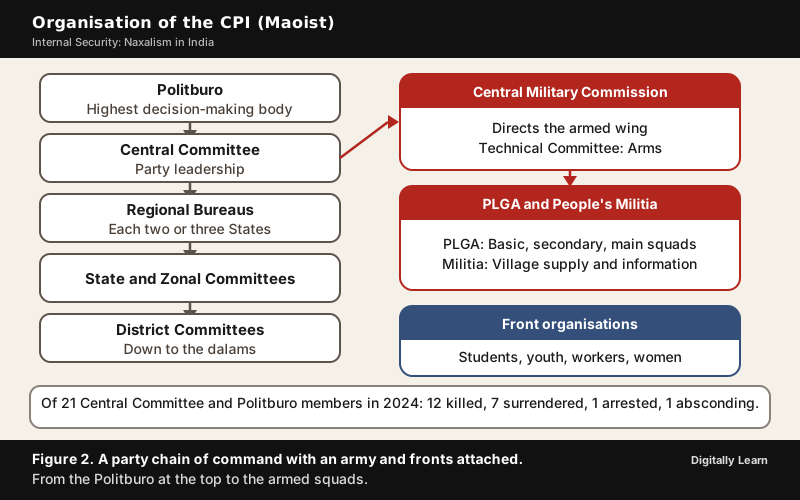
The CPI (Maoist) was organised as a communist party with an armed wing attached to it. At the top sat the Politburo, its highest decision-making body, and below it the Central Committee. The Central Military Commission, formed from Central Committee members, directed the armed wing, and a Central Technical Committee made weapons and explosives. Below the central bodies were Regional Bureaus, each covering two or three States, then State Committees, Zonal Committees, District Committees and the armed squads called dalams. Three bodies worked alongside this party structure:
- People's Liberation Guerrilla Army (PLGA): The armed wing, grouped into basic, secondary and main squads. Its members were volunteers who drew no wages.
- People's Militia: A village-level force armed with bows, arrows and machetes that helped the PLGA with supplies and information.
- Front organisations: Bodies such as the Radical Youth League, the Radical Students Union and the Krantikari Adivasi Mahila Sangathan, which worked in the open among students, workers and women.
The leadership was dismantled between 2024 and 2026. Nambala Keshava Rao, known as Basavaraj, the general secretary, was killed in Abujhmad in Chhattisgarh on 21 May 2025. In the same reply of 30 March 2026, the Home Minister told the Lok Sabha that the party's central structure had been completely broken. Of the 21 members of the Central Committee and Politburo at the beginning of 2024, 12 had been killed, seven had surrendered and one had been arrested; one was still absconding.
Guerrilla Tactics, IEDs and Liberated Zones
The Maoists relied on guerrilla warfare. They ambushed police and paramilitary columns with automatic weapons and improvised explosive devices (IEDs), attacked police stations and prisons, and looted weapons. About 92 per cent of their weapons were looted from police armouries, so major ambushes also served to replenish their arsenal.
Notable attacks include the Silda camp attack in West Bengal on 15 February 2010, which killed 24 personnel of the Eastern Frontier Rifles, and the Jhiram Ghati attack of 25 May 2013 in the Darbha valley of southern Chhattisgarh, in which Maoists ambushed a Congress convoy and killed at least 27 people, among them the former State minister Mahendra Karma. The Home Ministry says the party's 2024 Tactical Counter Offensive Campaign failed completely.
Where the state's presence was weak, the Maoists built a parallel administration. The party organised a Janatana Sarkar, a "people's government" with nine departments including agriculture, justice, defence, health and education. It ran "public courts" and its own schools. Its declared aim was a Compact Revolutionary Zone from which the war could spread, the practical form of Mao's base area.
Impact on Civilians and Tribal Communities
The people of the Red Corridor suffered at the hands of both sides. The Maoists abducted and killed alleged "class enemies" such as government officials, and in places required every family to supply one member to the cadre. Public courts imposed summary punishments. The Maoists also destroyed school buildings and railway tracks that security forces might use, and the Home Minister says that the armed cadres themselves obstructed development. The Home Ministry records 5,019 civilian deaths in the decade from 2004 to 2014.
Villagers were also affected by security operations and by state-backed militias; the Salwa Judum militia was the subject of the Supreme Court's judgment of 2011. In 2010 the Home Secretary acknowledged that the local people had legitimate grievances about access to forest land and produce and about the sharing of benefits from mining and hydropower. Such grievances explain why the Maoists found recruits, but they did not alter the government's insistence that the movement's long-term goal was a communist state.
Funding Through Levy and Extortion, and the Drive to Choke It
The Maoists financed themselves mainly from the areas they controlled, through extortion, abductions and taxes that their parallel administrations collected where the government was absent. Poppy grown among maize in Gumla district of Jharkhand and in Kishanganj and Purnia districts of Bihar, and hemp grown in Debagarh district of Odisha, were suspected additional sources.
Cutting off these funds became a pillar of the government's strategy. The National Investigation Agency (NIA) set up a dedicated unit on the financing of LWE. By December 2025 the NIA had seized assets worth over ₹40 crore, the Enforcement Directorate had attached assets worth ₹12 crore, and State agencies had confiscated another ₹40 crore. The NIA had by then investigated 111 LWE cases and filed 98 charge sheets; by June 2026 the figures were 112 cases and 100 charge sheets.
Decline of Left-Wing Extremism: Districts, Violence and the 2026 Target
Shrinking LWE-Affected Districts and the April 2026 Reclassification
The number of LWE-affected districts fell steadily from the peak of nearly 180 in the late 2000s.
| Date | LWE-affected districts |
|---|---|
| 2014 | 126 |
| April 2018 | 90 |
| July 2021 | 70 |
| April 2024 | 38 |
| December 2025 | 8 |
| March-April 2026 | 0 |
On 24 August 2024 the government set a target of making the country free of Naxalism by 31 March 2026. On 30 March 2026 the Home Minister told the Lok Sabha that the country had become Naxal-free, adding that the country would be informed once the process was formally completed. The Home Ministry's backgrounder of 1 August 2026 records that on 31 March 2026 the country became effectively free from Naxalism.
The category of Legacy and Thrust districts already existed in December 2025, when 27 districts were kept in it under the Security Related Expenditure Scheme so that the CPI (Maoist) could not return to areas recently freed from its influence. The reclassification of March-April 2026 ended the old tiers of most affected, District of Concern and other LWE-affected districts. As of July 2026, 37 districts are Legacy and Thrust districts, which are no longer LWE affected but still need security and development support to consolidate the position.
One district is now a District of Concern. The name was kept but its meaning changed: In 2025 it marked a district that needed extra resources, while since 2026 it marks a district where violent activity has been totally contained and the organisation completely dismantled, but surveillance continues.
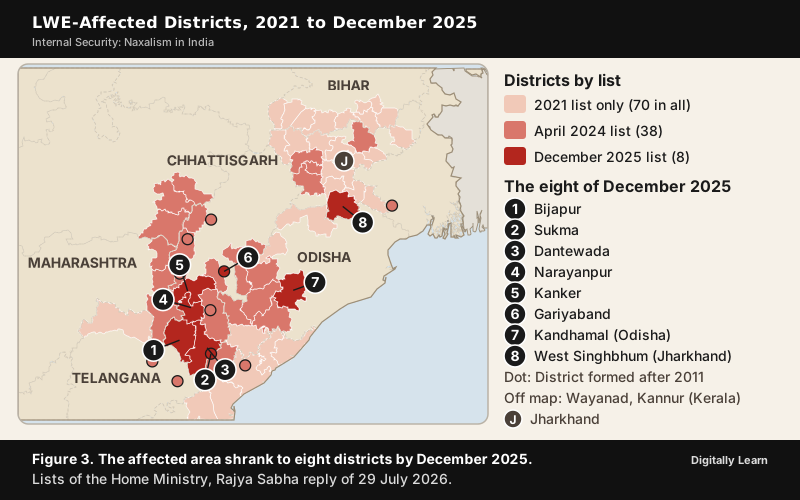
For the last months before April 2026 the official counts differ with the date of each release: 11 districts in a backgrounder of December 2025, 8 for December 2025 in the Rajya Sabha reply of July 2026, and 2 in the Home Minister's reply in the Lok Sabha on 30 March 2026. All of them agree that no district remained LWE affected after the reclassification of April 2026.
The end of the category is not the end of every risk. The Ministry still keeps 38 districts under watch, one top leader was described as absconding on 30 March 2026, and arrests and surrenders continued through July 2026. Haragopal argues that if the underlying contradictions remain unresolved, the decline of the armed struggle may mark a change in the form of the conflict rather than its end. The questioning of students and activists in several States over alleged ideological links to banned organisations has also raised civil-liberties concerns.
Fall in Violence, Security Force Deaths and Surrenders
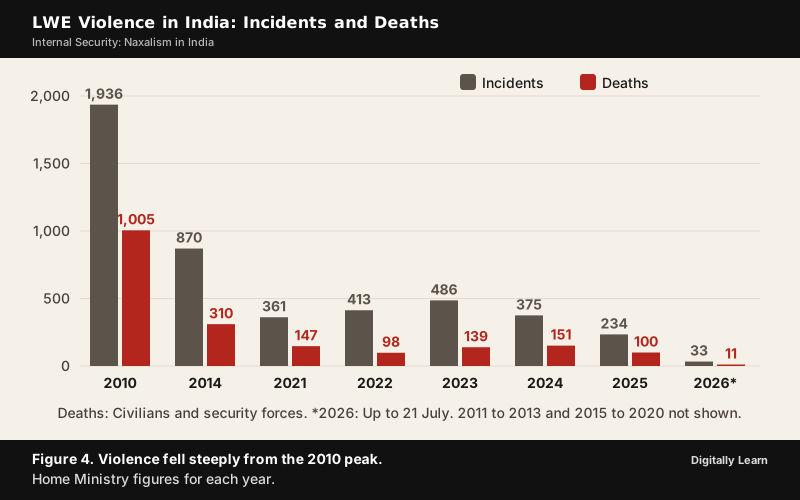
Violence peaked in 2010, when the Home Ministry counted 1,936 incidents and 1,005 deaths of civilians and security personnel. By 2014 incidents had fallen to 870 and fatalities to 310. The decline then accelerated, though not evenly.
| Year | Incidents | Civilians killed | Security forces killed |
|---|---|---|---|
| 2021 | 361 | 97 | 50 |
| 2022 | 413 | 82 | 16 |
| 2023 | 486 | 107 | 32 |
| 2024 | 375 | 132 | 19 |
| 2025 | 234 | 64 | 36 |
| 2026 | 33 | 6 | 5 |
Incidents rose to 486 in 2023 and civilian deaths reached 132 in 2024; both then fell sharply in 2025 and 2026.
Surrenders rose as the cadre base contracted. In 2025 alone 2,337 Naxalites laid down their arms. The rehabilitation package gives ₹5 lakh to higher-ranked cadres and ₹2.5 lakh to others, a stipend of ₹10,000 a month for 36 months and an additional incentive for surrendering weapons. Former cadres are also offered housing under the Pradhan Mantri Awas Yojana, skill development and livelihood assistance, and free education for their children up to Class XII.
In Parliament the Home Minister stated that between 2024 and March 2026, 706 Maoists were killed, 2,218 were arrested and 4,839 surrendered. A Maoist surrender in Ranchi on 28 July 2026 and the arrest of a Politburo member carrying a ₹1 crore reward on 29 July 2026 show that operations continued after the declaration.
Government Measures Behind the Decline: Policy 2015, SAMADHAN and Development
Under the Seventh Schedule of the Constitution, police and public order are State subjects. The Union Government therefore supported the affected States with Central Armed Police Forces (CAPFs), funds, helicopters and intelligence sharing instead of running the operations itself, and every strategy against LWE has required action by both the Union and the State governments.
In the Home Ministry's account, three decisions explain the decline. The first was the National Policy and Action Plan to address LWE, approved in 2015, which replaced an incident-driven approach with a whole-of-government strategy of security measures, development interventions and protection of the rights and entitlements of local communities. The second was the SAMADHAN doctrine, announced by Home Minister Rajnath Singh on 8 May 2017 for use in security operations. The name SAMADHAN stands for the doctrine's eight elements:
- Smart Leadership
- Aggressive Strategy
- Motivation and Training
- Actionable Intelligence
- Dashboard-based Key Result Areas and Key Performance Indicators
- Harnessing Technology
- Action Plan for Each Theatre
- No access to Financing
The third was the extension of the state's physical presence. The number of fortified police stations rose from 66 before 2014 to 663 by 2026, 408 new CAPF camps were set up over seven years, and drones, satellite imagery and call-record analysis supported operations. The Special Central Assistance, Security Related Expenditure and Special Infrastructure schemes provided the funds. Development followed security: 15,189 km of roads under two LWE-specific schemes, 9,497 mobile towers, 1,804 bank branches, 1,321 ATMs and 6,025 post offices. Education and skill facilities included 179 functional Eklavya Model Residential Schools, 47 Industrial Training Institutes and 49 Skill Development Centres.
In May 2026 the first Jan Suvidha Kendra, a public service centre, was opened at Netanar in Bastar as the Shaheed Veer Gundadhur Seva Dera. Netanar is the birthplace of Veer Gundadhur, who led the tribals of Bastar in the Bhumkal rebellion of 1910. One-third of the security camps in the freed areas are being converted into such centres.
Previous Year UPSC‑CSE Questions
Each question comes with an answer outline.
- UPSC Mains 2025 GS‑IIIThe Government of India recently stated that Left Wing Extremism (LWE) will be eliminated by 2026. What do you understand by LWE and how are the people affected by it? What measures have been taken by the government to eliminate LWE?
Answer outline
The outline sets out what the question asks, the main arguments, relevant examples and the direction of the conclusion; it is not a full model answer.
Introduction: Left-Wing Extremism is armed violence by Maoist groups that seek to capture state power through protracted people's war; it began at Naxalbari in 1967.
Body (sub-themes to develop):
- Actors: The CPI (Maoist), formed on 21 September 2004 from the People's War Group and the Maoist Communist Centre, with the PLGA as its armed wing.
- Effect on people: Levies and extortion, killing of alleged class enemies, public courts, destruction of schools and roads, and 5,019 civilian deaths from 2004 to 2014; grievances over forest land and mining, and the Salwa Judum judgment of 2011.
- Measures: The National Policy and Action Plan of 2015, SAMADHAN of 2017, fortified police stations and CAPF camps, roads, mobile towers and banks, the surrender policy, the NIA's unit on Maoist financing, and forest land titles.
Conclusion: By 2026 no district was classed as LWE affected, but 37 Legacy and Thrust districts still need support to hold the gains.
- UPSC Mains 2018 GS‑IIILeft Wing Extremism (LWE) is showing a downward trend, but still affects many parts of the country. Briefly explain the Government of India's approach to counter the challenges posed by LWE.
Answer outline
Introduction: LWE-affected districts fell from 126 in 2014 to 90 in April 2018, with violence far below the 2010 peak.
Body (sub-themes to develop):
- National Policy and Action Plan, 2015: Combines security measures, development interventions and the rights and entitlements of local communities.
- Federal division: Police and public order are State subjects, so the Union supplements the States with CAPFs, funds and intelligence.
- Security and development: Fortified police stations, SAMADHAN, roads, mobile towers, banking, schools and skill centres, surrender and rehabilitation.
Conclusion: The gains need consolidation through governance and the trust of tribal communities.
Sources
- Press Information Bureau: Naxal-Free India backgrounder (1 August 2026)
- Press Information Bureau: Status of Naxalism in the Country, Rajya Sabha reply (29 July 2026)
- Press Information Bureau: Home Minister's reply in the Lok Sabha (30 March 2026)
- Press Information Bureau: From Red Corridor to Naxal-Free Bharat (13 December 2025)
- Press Information Bureau: Scheme related to security infrastructure in LWE affected areas (9 December 2025)
- Press Information Bureau: Most affected districts reduced to 6 (1 April 2025)
- Press Information Bureau: LWE affected districts (6 August 2024)
- Press Information Bureau: Review meeting on LWE and the SAMADHAN doctrine (8 May 2017)
- Press Information Bureau: Home Minister at Jagdalpur (19 May 2026)
- Press Information Bureau: Shaheed Veer Gundadhur Seva Dera Jan Suvidha Kendra inaugurated in Bastar (18 May 2026)
- NCERT: Class 12 Politics in India since Independence, Chapter 6
- The Hindu: Number of left-wing extremism districts reduced to 6 from 12 (2 April 2025)
- Frontline: The war on naxals opens a new front (1 April 2026)
- Wikipedia: Naxalite-Maoist insurgency
- Wikipedia: Communist Party of India (Maoist)
- Wikipedia: Naxalbari uprising
- Wikipedia: Red Corridor
- Wikipedia: Protracted war
- Wikipedia: People's War Group
- Wikipedia: Maoist Communist Centre of India
- Wikipedia: Insurgency in Northeast India
- Wikipedia: Insurgency in Jammu and Kashmir
- Wikipedia: 2013 Naxal attack in Darbha valley
- Wikipedia: Greyhounds (police)
- UPSC: Civil Services Examination question papers
Editorial Disclaimer
This article draws on Home Ministry releases, the current NCERT textbook, The Hindu, Frontline and Wikipedia. District counts and violence figures are as the dated official releases give them.
See more of our UPSC articles in Google Search
Add to Preferred Sources

