


Overview
Terror financing is the raising, moving and holding of money or other assets for terrorist acts, terrorist organisations or individual terrorists. Indian law punishes it whether the money comes from a legitimate or an illegitimate source, and whether or not it is finally spent on an attack. A bomb, a training camp or a recruitment drive needs cash, transport and communication, so cutting off funds weakens a terrorist network even when its members are out of reach. India acts against it through the Unlawful Activities (Prevention) Act, 1967 (UAPA), the National Investigation Agency (NIA), the Financial Intelligence Unit, India (FIU‑IND), and the standards of the Financial Action Task Force (FATF).
Sources of Terror Funding in India
Six Theatres, State Sponsorship and Organised Crime
India faces terrorism in six theatres. They are groups linked to the Islamic State of Iraq and the Levant (ISIL) or Al Qaeda active in and around Jammu and Kashmir, other separatist movements in that region, other ISIL and Al Qaeda cells or radicalised individuals in India, regional insurgencies in the North-East, regional insurgencies in the North of India, and left-wing extremist groups; the most serious threats come from the groups in and around Jammu and Kashmir. Each theatre raises and moves money differently. India's terrorist-financing risk assessment of 2022, which studied cases from 2011 to 2022, found that funds from outside the country and arms trafficking are the highest-risk sources across the theatres.
Two further sources work above the level of any single group. Some countries support terrorism as part of their foreign policy and give terrorists political, ideological and financial backing. Organised crime is the other. Money made in gun-running, drugs and smuggling is pumped into terrorism, and the same gangs help terrorists with logistics and communication.
Hawala, Cross-Border Couriers and Diaspora Donations
Hawala is an informal system of transferring value through a network of brokers, called hawaladars, without actually moving money. A sender gives cash to a broker in one city, usually abroad; a partner broker in the receiving city pays the same sum, less a commission, to the person who gives an agreed password. The two brokers settle their account later, often in goods or services, and the system runs on trust rather than written instruments. Because the transfer bypasses banks and official exchange rates, it leaves almost no record for investigators. The related Indian instrument, the hundi, is a written order directing another person to pay a sum of money to a person named in it.
India's 2022 risk assessment rates hawala and cash couriers as the highest-risk methods of moving terrorist funds. Of the terror-financing cases prosecuted between 2018 and October 2023, about two-thirds involved cash couriers or hawala, and the rest were routed through banks and money transfer services. Cash moves across India's long land and sea borders, and a significant part of the population still lives outside the formal banking system. Trade across the Line of Control in Jammu and Kashmir, which was found to be moving funds for terrorism, was suspended in April 2019.
India has the world's largest diaspora and receives large inward remittances. Under the Money Transfer Service Scheme, banks and authorised dealers act as Indian agents of foreign remittance companies, and this scheme is rated the next-highest terror-financing threat across the theatres, after cash couriers and hawala. Its weak points are occasional customers about whom little is known, frequent cash payments and long chains of agents. The FATF also warns that controls on terror financing must not disrupt or discourage legitimate remittances.
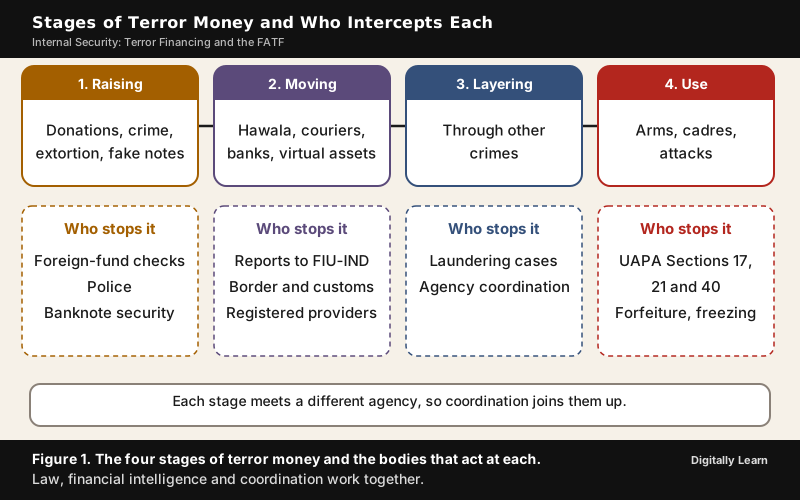
Money laundering links these channels to terrorism. Proceeds of crime are laundered through hawala, cash couriers, shell companies and trade transactions, and the same networks can carry money to terrorist groups. Laundering is also one of the four stages through which terror money passes. Money is first raised, then moved, then layered through other transactions or crimes to hide where it came from, and finally used for terrorist activity.
Narcotics, Extortion and Misuse of Non-Profit Organisations
Drug trafficking finances terrorism where both run through the same border networks. In 2019 the Punjab Police found suspects carrying 500 grams of heroin and ₹1.2 lakh in cash. The investigation, later taken over by the NIA, showed that a commander of the Khalistan Liberation Force, an organisation listed as terrorist under the UAPA, ran a drug-smuggling network and sent its proceeds through hawala operators to fund the organisation's activities; 14 suspects were prosecuted for terror financing.
Extortion and abduction fund groups in the left-wing extremist theatre. In a case taken over by the NIA in 2020, a banned Maoist organisation raised money through abductions and extortion, and a partner in a construction firm kept assets in the firm for its use. States where extortion funds terrorism protect the contractors who are targeted and search vehicles at checkpoints; one such search found ₹1.2 crore in a vehicle along with detonators, meant for a Maoist group's planned attacks. Companies are also used to hold money from extortion and other crimes, and the NIA has prosecuted 51 legal persons on terror-financing charges since 2018.
Non-profit organisations (NPOs) can be misused to raise money for terrorism, to different extents in different theatres. India has more than 30 lakh NPOs, of which 2,86,000 fall within the FATF's definition of an NPO. An NPO must register under the Foreign Contribution (Regulation) Act, 2010 (FCRA) before it accepts foreign money.
In the five years covered by the FATF's 2024 evaluation, 1,828 FCRA registrations were suspended or cancelled and 1,260 were not renewed; 21 of these NPOs lost registration for involvement with terror or radical activities. The FATF rated India partially compliant on its NPO standard and found that the controls are not matched to the subset of NPOs at real risk; it also noted that the FCRA amendments of 2020 were made without adequate consultation with NPOs.
Crypto Assets and Crowdfunding
Virtual assets give terrorists anonymity, cross-border reach and speed. India's risk assessment lists their dangers as anonymity, weak compliance in parts of the sector, the use of nominees, fraudulent schemes, ransomware and laundering through virtual assets, and it found that cases of virtual assets carrying money linked to terrorism have been increasing. The NIA has investigated one terror-financing case carried out through virtual assets. India is the second-largest virtual-asset market in the world by raw transaction volume, so the risk is material.
India has regulated the sector in stages. The Reserve Bank of India (RBI) barred the entities it regulates from dealing in virtual assets in 2018, but the Supreme Court quashed that circular in 2020 as disproportionate. A 1 per cent tax deducted at source on transfers of virtual assets began in July 2022, and since March 2023 virtual asset service providers have been subject to registration and to anti-money-laundering and counter-terror-financing obligations. Internationally, the FATF extended its Recommendation 15 to virtual assets in October 2018 and asked countries to license or register their service providers.
Online payment services and e-commerce platforms are a further channel, and online payments leave less of a trail than bank wire transfers. In the suicide bombing of a security forces convoy at Pulwama in Jammu and Kashmir on 14 February 2019, which killed 40 personnel, a key part of the explosive device, aluminium powder, was bought through the e-commerce platform Amazon; 19 persons were charged under the UAPA, including its terror-financing provisions. In April 2022 a man influenced by ISIL attacked security personnel at the Gorakhnath Temple; investigators found that he had sent ₹6,69,841 abroad through PayPal to support ISIL and had used virtual private network (VPN) services to hide his internet address.
Crowdfunding, the funding of a project by raising money from a large number of people, typically over the internet, is open to the same abuse. Terrorist fund-raising campaigns are often presented as appeals for humanitarian relief or other charitable causes, spread through social media and messaging apps, and can be set up and closed quickly to avoid detection. Social media, virtual assets and crowdfunding are most often used together with traditional methods of terror financing, and the technologies most abused are rarely the most advanced ones but those most widely used by the public.
Counterfeit Currency as a Source of Terror Funding
Fake Indian Currency Notes in Law and the RBI Count
Fake Indian Currency Notes (FICN) serve terrorism in two ways. They are a source of money for the networks that print and circulate them, and they are a weapon against the economy, because circulation on a large scale damages the monetary stability of India. The UAPA therefore treats the production, smuggling or circulation of high-quality counterfeit Indian currency, whether paper or coin, as a terrorist act when it damages the monetary stability of India. This clause, Section 15(1)(a)(iiia), came into force on 1 February 2013, and the same amendment made raising funds through such currency an offence under Section 17.
A note is high-quality counterfeit when an authorised forensic authority finds that it imitates the key security features listed in the Third Schedule of the UAPA. These are the watermark, the security thread and any one of a list of further features, such as the latent image, see-through registration, raised effect, fluorescence or the colour shift in the optically variable ink.
Section 113 of the Bharatiya Nyaya Sanhita, 2023 (BNS), which brings the terrorist act into the general criminal law, also covers counterfeit Indian currency. Ordinary counterfeiting falls under Sections 178 to 182 of the BNS. Making fake currency, or knowingly using it as genuine, is punishable with imprisonment for life or up to ten years, and possessing it knowingly with up to seven years.
Counterfeit notes detected in the banking system rose to 2,29,746 pieces in 2025‑26 from 2,17,396 in 2024‑25. The ₹500 note accounted for 1,41,907 of them, a rise of 20.5 per cent in a year, while fakes of the withdrawn ₹2000 note fell to 824. Banks other than the Reserve Bank detected 97.6 per cent of the total.
| Note | 2023‑24 | 2024‑25 | 2025‑26 |
|---|---|---|---|
| ₹10 | 235 | 159 | 133 |
| ₹20 | 297 | 253 | 373 |
| ₹50 | 15,366 | 12,015 | 10,274 |
| ₹100 | 66,310 | 51,069 | 45,621 |
| ₹200 | 28,672 | 32,660 | 30,591 |
| ₹500 | 85,711 | 1,17,722 | 1,41,907 |
| ₹2000 | 26,035 | 3,508 | 824 |
| Total | 2,22,639 | 2,17,396 | 2,29,746 |
The total also includes the ₹2 and ₹5 notes and the old ₹500 and ₹1000 notes, which are not shown separately.
FICN Routes Through Neighbouring Countries
Fake Indian notes have flowed into India mainly from Nepal, Pakistan and Bangladesh. The best of them have been reported to match 10 of 14 security parameters of genuine notes, which has led to suggestions that only a government could produce fakes of that quality. Locally made fakes are cruder. Their watermark is drawn with opaque ink or white paint and given a translucent look with oil or wax, and their security thread is imitated with a pencil or grey-ink line or an aluminium strip pasted between two thin sheets.
Nepal is also under scrutiny for informal money transfers. In February 2025 the FATF placed Nepal under increased monitoring, and one of the actions Nepal must complete is to identify and penalise significant illegal money transfer and hundi operators.
Response: FICN Coordination Group, NIA and Security Features
On 8 November 2016 India withdrew the old ₹500 and ₹1000 notes to tackle corruption, black money, terrorism and the circulation of fake currency, and the FATF found that the fake-currency threat fell after that withdrawal.
The FICN Coordination Group (FCORD) is a forum coordinated by the Ministry of Home Affairs that brings together the NIA, the Intelligence Bureau, the Enforcement Directorate (ED), the counter-terrorism nodal officers of the States, the FIU‑IND and the Reserve Bank. It was set up to tackle the circulation of fake currency and now coordinates action on all terror-financing matters in the different theatres. Because State police, central agencies, the FIU‑IND and the Reserve Bank sit in one group, their financial information and intelligence can be combined to identify terror financing.
Detection and investigation follow a chain. Banks and other reporting entities file counterfeit currency reports with the FIU‑IND for cash transactions in which forged or counterfeit notes are used, and the FIU‑IND shares its analysis of these reports with the Department of Revenue, the Directorate of Revenue Intelligence and the Intelligence Bureau. Offences relating to counterfeit currency are among the offences the NIA is empowered to investigate, so a fake-currency case with inter-State or cross-border links can go to the national agency.
The Reserve Bank works on the note itself. It is improving the paper base of notes for greater durability under its Utkarsh 2029 strategy. Print trials of varnished notes were held at the Mysuru press of Bharatiya Reserve Bank Note Mudran Private Limited. To help the public check notes, the Reserve Bank launched the Indian Currency microsite on 10 September 2025, which shows the security features of each note in a 360-degree view, and it runs awareness campaigns on the Mobile Aided Note Identifier (MANI) app.
Indian Measures to Curb Terror Financing
UAPA Terror-Funding Offences and NIA Financial Investigations
India's measures work at three levels. The criminal law makes funding terrorism an offence and lets the State seize terrorist property; the financial system screens and reports suspicious money; and coordination bodies bring the intelligence, investigating and regulatory agencies together.
Chapter IV of the UAPA punishes terrorist activities, and Section 17 makes raising funds for a terrorist act a separate offence. It covers anyone, in India or abroad, who raises, collects or provides funds from a legitimate or illegitimate source knowing that they are likely to be used for a terrorist act, whether or not the funds are actually used. Funding an individual terrorist, a terrorist gang or a terrorist organisation for any other purpose is also an offence. Section 40 punishes raising funds for a listed terrorist organisation, and Section 21 punishes knowingly holding property obtained from terrorism.
| Section | Offence | Punishment |
|---|---|---|
| 17 | Raising, collecting or providing funds for a terrorist act, including through high-quality counterfeit Indian currency | Five years to life imprisonment, with fine |
| 21 | Knowingly holding property derived from a terrorist act or acquired through terrorist funds | Up to life imprisonment, with fine |
| 40 | Inviting, receiving or providing money or property for a terrorist organisation | Up to 14 years, or fine, or both |
Under Sections 22A to 22C, companies, societies and trusts, and the persons in charge of them, are also liable for offences committed in their name.
The Act also strips terrorists of their assets. Proceeds of terrorism include property derived from a terrorist act, property acquired through funds traceable to one, and property meant to be used for terrorism. Chapter V provides for its forfeiture whether or not anyone is prosecuted or convicted.
Under Section 25, an investigating officer may seize or attach such property with the written approval of the State's Director General of Police, or of the Director General of the NIA where the NIA investigates; the officer must inform the Designated Authority within 48 hours, and that authority must confirm or revoke the order within 60 days. Section 51A lets the Central Government freeze the funds of persons on the UN Security Council's sanctions lists, which India applies through an order under that Section, and of others engaged in terrorism, and bar anyone from making funds available to them.
The NIA, set up after the Mumbai terrorist attacks of 26 November 2008, investigates terror-financing cases with inter-State or cross-border links, while simpler local cases stay with State police. Between 2018 and October 2023 the NIA investigated 345 terrorism cases and brought terror-financing charges in 27 per cent of them. Convictions are the weak point: The NIA prosecuted 1,095 persons for terror financing and secured 75 convictions, and State police prosecuted 435 and secured 14. With cases against 1,432 persons still pending, the FATF could not conclude that India was successfully convicting terror financiers.
FCRA, PMLA and Banking Controls
The FCRA controls foreign money reaching NPOs. An organisation must have existed for three years and spent at least ₹15 lakh on welfare activities before it can apply for FCRA registration; foreign funds may be received only in a specified bank account and must be reported to the Ministry of Home Affairs, and they cannot be handed on to another local organisation. The FATF found the law useful against terror financing through foreign donations but noted that it is not risk-based, since it applies equally to every NPO that receives foreign money.
The PMLA adds a second track. Terror financing is a predicate offence for money laundering, so the ED can run a money-laundering case alongside the NIA's terror-financing case; the NIA keeps a nodal officer in the ED, and the two agencies coordinated 48 times during the period the FATF reviewed. Banks and other reporting entities also file suspicious transaction reports, cash transaction reports for cash above ₹10 lakh, counterfeit currency reports and reports on receipts by NPOs above ₹10 lakh with the FIU‑IND.
Banks are the front line of this reporting. The FATF found that the Reserve Bank, which supervises banks and the larger financial institutions, has a good understanding of money-laundering risk and a reasonable understanding of terror-financing risk, and that established reporting entities use sanction-screening software to find and freeze the assets of persons listed by the United Nations. It also found that supervision of the Money Transfer Service Scheme was not yet matched to its terror-financing risk, and that cash limits on dealers in precious metals and stones need stronger enforcement.
Coordination closes the gaps between agencies. The Multi Agency Centre and its subsidiary centres share intelligence on terrorism and terror financing, FCORD coordinates counter-terror-financing work, and the FIU‑IND sends suspicious transaction reports that are not linked to open cases to the Intelligence Bureau, the NIA and other agencies at the same time.
Financial Action Task Force
FATF Origin, Membership and Related UN Instruments
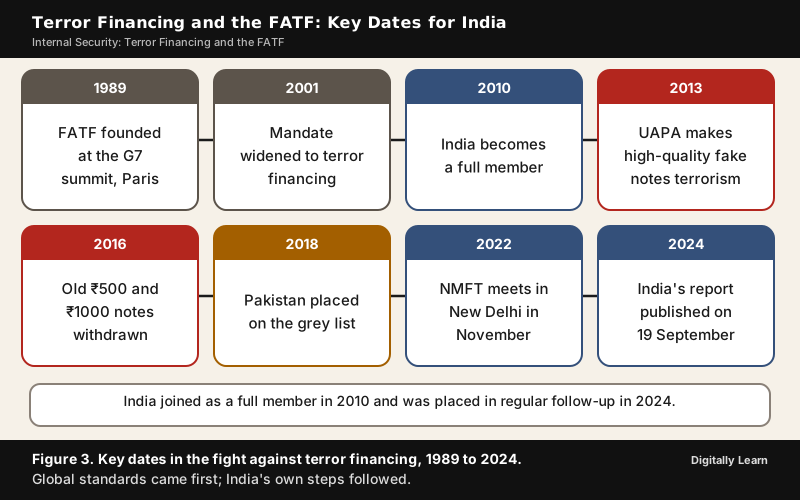
The Financial Action Task Force is an inter-governmental body that sets international standards against money laundering, terrorist financing and the financing of weapons proliferation, and checks how well countries apply them. It was founded in 1989 on the initiative of the G7, at its summit in Paris, and its secretariat is housed at the Organisation for Economic Co-operation and Development (OECD) in Paris, although the two bodies are separate. Its mandate was widened to terrorist financing in 2001, after the attacks of 11 September. The FATF has 40 members: 38 jurisdictions and two regional organisations, the European Commission and the Gulf Co-operation Council. Russia's membership has been suspended since 24 February 2023. India became a full member in 2010.
The FATF works through a wider network. Nine FATF-style regional bodies are its associate members, among them the Asia/Pacific Group on Money Laundering (APG) and the Eurasian Group (EAG), and more than 200 countries and jurisdictions have committed to its standards. Its Plenary, the decision-making body, meets three times a year, around February, June and October.
Other international instruments work alongside the FATF. The International Convention for the Suppression of the Financing of Terrorism was adopted by the UN General Assembly on 9 December 1999, came into force on 10 April 2002 and has been ratified by 191 states. UN Security Council Resolution 1373, adopted on 28 September 2001, requires all countries to take measures against international terrorism, and the Council's 1267 sanctions regime against ISIL (Da'esh), Al-Qaida and associated persons imposes an assets freeze, a travel ban and an arms embargo on those it lists. Financial intelligence units, India's among them, exchange information through the Egmont Group.
FATF Recommendations, Grey and Black Lists
The FATF Recommendations are 40 standards that countries adapt to their own legal and financial systems, and their cornerstone is the risk-based approach, under which each country must identify the money-laundering and terrorist-financing risks it faces and put its resources where the risk is highest. In its first year the FATF issued 40 recommendations on money laundering; it later added eight, and then nine, Special Recommendations on terrorist financing, and in February 2012 it merged them into one document.
The 40 Recommendations fall into seven areas:
- Policies and coordination against money laundering and terrorist financing.
- Money laundering and confiscation.
- Terrorist financing and the financing of proliferation.
- Preventive measures.
- Transparency and beneficial ownership of legal persons and arrangements.
- Powers and responsibilities of competent authorities.
- International cooperation.
Several Recommendations deal directly with terror funding:
- Recommendation 5: Countries must make terrorist financing a criminal offence.
- Recommendation 6: Countries must apply targeted financial sanctions against terrorism and terrorist financing, freezing listed persons' assets without delay.
- Recommendation 8: Countries must protect non-profit organisations from abuse through measures matched to risk.
- Recommendation 15: Countries must manage the risks of new technologies, including virtual assets since October 2018.
- Recommendation 16: Countries must regulate wire transfers; this rule is known as the travel rule.
- Recommendation 32: Countries must control cash couriers who carry currency across borders.
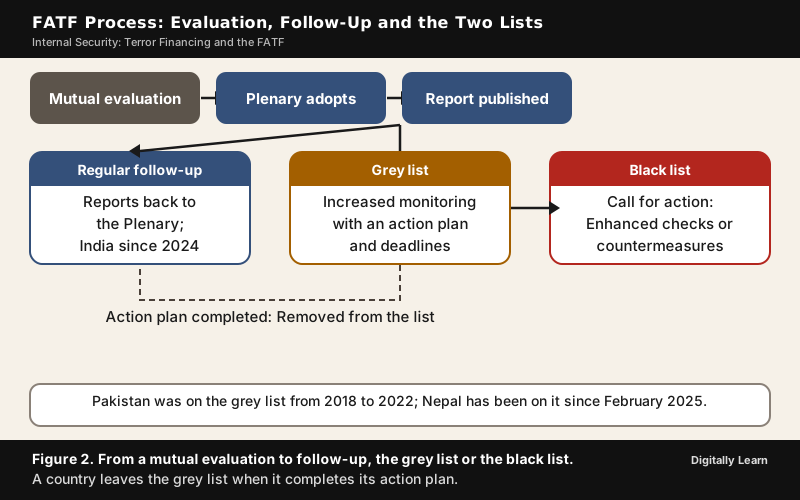
The FATF names countries whose systems fall short in two public lists. Jurisdictions under increased monitoring, often called the grey list, have strategic deficiencies but have committed to resolve them swiftly within agreed timeframes. The FATF does not ask other countries to apply enhanced checks to them, and it warns that money for humanitarian aid, legitimate NPO work and remittances should not be disrupted. High-risk jurisdictions subject to a call for action, often called the black list, have significant strategic deficiencies; the FATF asks all countries to apply enhanced due diligence to them and, in the most serious cases, countermeasures to protect the international financial system.
| Country | Position | Reason or effect |
|---|---|---|
| Democratic People's Republic of Korea | Black list, with countermeasures | Countries are asked to end correspondent relationships with its banks and close their branches |
| Iran | Black list, with countermeasures | Its legal framework does not adequately criminalise terrorist financing |
| Myanmar | Black list, with enhanced due diligence | The FATF will consider countermeasures if there is no further progress by February 2027 |
| Nepal | Grey list, since February 2025 | Must act against illegal money transfer and hundi operators |
| Pakistan | On neither list | Removed from the grey list in October 2022 |
| India | Member in regular follow-up | Reports back to the Plenary three years after its 2024 evaluation |
The grey list of 30 October 2026 has 22 jurisdictions: Angola, Bolivia, Bosnia and Herzegovina, Bulgaria, Cameroon, Côte d'Ivoire, the Democratic Republic of the Congo, Haiti, Iraq, Kenya, Kuwait, Lao PDR, Lebanon, Monaco, Nepal, Papua New Guinea, South Sudan, Syria, Venezuela, Vietnam, the Virgin Islands (UK) and Yemen.
Compliance by Member States: Mutual Evaluations and Follow-Up
Countries show their compliance through mutual evaluations, peer reviews in which assessors from other members examine a country's laws and their results. Each evaluation has two parts. Technical compliance rates each of the 40 Recommendations as compliant, largely compliant, partially compliant or non-compliant. Effectiveness rates 11 immediate outcomes, the results that a working system should achieve, such as investigating and prosecuting terror financing (Immediate Outcome 9) and applying preventive measures and financial sanctions against it (Immediate Outcome 10), each at a high, substantial, moderate or low level.
The process runs in set steps:
- The FATF selects a team of trained assessors; the assessed country has no say in the choice.
- The assessors analyse the country's laws and regulations, which takes about four months, and rate technical compliance on all 40 Recommendations.
- The assessors visit the country to verify whether its system works in all 11 areas of effectiveness.
- The assessors draft the report; the country may comment, and independent reviewers check it.
- The Plenary discusses the findings and ratings; only a consensus of members, without the assessed country's vote, can overrule the assessors.
- After a final quality review by the Global Network, the report is published, usually two months after the Plenary approves it.
- The country must then fix the shortcomings under post-assessment monitoring, which ranges from regular reporting for a largely compliant country to a public warning for one that makes too little progress.
A country with strategic deficiencies makes a high-level political commitment, agrees an action plan with deadlines and is placed under increased monitoring until it completes the plan. A country that still fails to act can be named among the high-risk jurisdictions, to which other countries apply enhanced due diligence or countermeasures.
The FATF-style regional bodies run the same process for their members, and joint evaluations combine them; India's 2024 evaluation was conducted jointly by the FATF, the APG and the EAG. Member countries also comply through their own laws. They make terror financing a crime, freeze the assets of UN-listed terrorists, oversee NPOs, money transfer services and virtual asset providers, and set up financial intelligence units, which India has done through the UAPA, the PMLA, the FCRA and the FIU‑IND.
India's Mutual Evaluation 2024 and Regular Follow-Up
India's mutual evaluation assessed its system as it stood at the on-site visit of 6 to 24 November 2023. The FATF Plenary held in Singapore from 26 to 28 June 2024 discussed and adopted the report, and the FATF published it on 19 September 2024. India was placed in regular follow-up and will report back to the Plenary in three years.
India achieved a high level of technical compliance. It was rated partially compliant on only three Recommendations, those on non-profit organisations (Recommendation 8), politically exposed persons (Recommendation 12) and the regulation and supervision of designated non-financial businesses and professions (Recommendation 28); every other Recommendation was rated compliant or largely compliant. On effectiveness it received six substantial and five moderate ratings.
| Rating | Immediate outcomes |
|---|---|
| Substantial | Risk, policy and coordination (1); international cooperation (2); legal persons and arrangements (5); financial intelligence (6); confiscation (8); proliferation financing sanctions (11) |
| Moderate | Supervision (3); preventive measures (4); money-laundering investigation and prosecution (7); terror-financing investigation and prosecution (9); terror-financing preventive measures and financial sanctions (10) |
The report found that India's system achieves good results in understanding risk, using financial intelligence, coordinating between agencies and depriving criminals of their assets. It asked India to complete money-laundering and terror-financing trials and punish offenders, to apply a risk-based approach to NPOs and reach out to them, to cover domestic politically exposed persons, and to enforce cash limits on dealers in precious metals and stones.
Pakistan's Grey-Listing and India's Pressure
Pakistan was placed on the FATF grey list in 2018 for deficiencies in countering money laundering and terrorist financing, and it was removed in October 2022. While listed it worked through an action plan of 27 items; by 24 October 2019 it had met only five of them. The listing made it harder for Pakistan to obtain financial help from international institutions such as the International Monetary Fund.
India has long pressed for action against countries that back terrorism. At the No Money for Terror conference of 2022 the Prime Minister said that some countries back terrorism as part of their foreign policy and must be made to bear a cost for it.
After the attack at Pahalgam on 22 April 2025, in which 26 people were killed, the FATF condemned the attack in June 2025 and said that this and other recent attacks could not have happened without money and the means to move funds between terrorist supporters. It was only the third time in a decade that the FATF had condemned a terrorist attack. In July 2025 its Comprehensive Update on Terrorist Financing Risks listed state sponsorship among the sources of terrorist funding; the support reported ranged from direct financial and logistical help to training.
No Money for Terror Conference, New Delhi 2022
Aim and Objectives of NMFT
The No Money for Terror (NMFT) conference is a ministerial meeting of countries and international bodies on countering the financing of terrorism. India's Ministry of Home Affairs hosted the third conference in New Delhi on 18 and 19 November 2022; the first two were held in Paris in 2018 and Melbourne in 2019. The Prime Minister opened it on 18 November, and the Union Home Minister addressed its closing session the next day.
The conference aimed to carry forward the discussions of Paris and Melbourne and to cover the technical, legal, regulatory and cooperation aspects of every form of terrorist financing. Its discussions focused on four themes:
- Global trends: Trends in terrorism and in terrorist financing.
- Funding channels: The use of formal and informal channels of funds for terrorism.
- Emerging technologies: The use of new financial technologies for terrorist financing.
- International cooperation: The cooperation among countries needed to meet these challenges.
The conference was planned for representatives of 75 countries and international bodies over two days, and delegations from countries and multilateral organisations around the world took part. It followed two other global events India hosted in October 2022, the General Assembly of Interpol in Delhi and a special session of the UN Security Council's Counter-Terrorism Committee in Mumbai and Delhi.
Outcomes and Follow-Up Meetings
The Home Minister set out five pillars for countering terror financing:
- A comprehensive monitoring framework built on cooperation, coordination and collaboration among all intelligence and investigating agencies.
- A strategy of "Trace, Target, and Terminate", applied from low-level economic offences to organised economic crime.
- Stronger and harmonised legal structures on terror finance.
- A robust mechanism against the misuse of next-generation technology.
- A stronger legal and regulatory framework for asset recovery.
He also listed priority issues, among them fighting anonymity in financial networks, stopping the use of proceeds of other crimes for terrorism, preventing the misuse of virtual assets such as crypto-currencies and wallets, ending the use of illegal channels, cash couriers and hawala by terror networks, and preventing the use of NPOs to spread terror ideology. India proposed a permanent NMFT secretariat in the country and said it would circulate a discussion paper and a Chair's Statement to all participating jurisdictions.
The series has continued. The fourth NMFT conference was held in Munich, Germany; its ministerial segment met on 13 February 2025, alongside the Munich Security Conference.
Previous Year UPSC‑CSE Questions
Each question comes with an answer outline.
- UPSC Mains 2026 GS‑IIIDiscuss counterfeit currency and money laundering as major sources of terror funding in India. State the actions being taken at International level to check these menaces. Highlight the role of Financial Action Task Force (FATF) and methods of compliance by its member states in preventing terror funding.
Answer outline
The outline sets out what the question asks, the main arguments, relevant examples and the direction of the conclusion; it is not a full model answer.
Introduction: Counterfeit currency and laundered money give terrorist groups funds that are hard to trace, and the UAPA treats high-quality fake Indian currency as a terrorist act.
Body (sub-themes to develop):
- Counterfeit currency: Fake notes have flowed in mainly from Nepal, Pakistan and Bangladesh, the best of them copying 10 of 14 security features, and 2,29,746 counterfeit notes were detected in the banking system in 2025‑26.
- Money laundering: Hawala, cash couriers, shell companies and trade transactions carry crime proceeds that can fund terrorism, and terror financing is a predicate offence for money laundering.
- International action: The International Convention for the Suppression of the Financing of Terrorism (1999), Security Council Resolution 1373 (2001), the 1267 sanctions regime, the Egmont Group and the NMFT conferences.
- Role of the FATF: Forty Recommendations, including Recommendations 5, 6, 8, 15, 16 and 32, and the grey and black lists that push countries to act.
- Methods of compliance: National laws, mutual evaluations of technical compliance and 11 immediate outcomes, follow-up reporting, action plans and listing.
- India's record: Regular follow-up in 2024, with gaps in terror-financing convictions and NPO oversight.
Conclusion: The FATF turns shared standards into pressure through peer review and listing, and India's strong rating gives it weight in pressing for action against the sources of terror money beyond its borders.
- UPSC Mains 2023 GS‑IIIGive out the major sources of terror funding in India and the efforts being made to curtail these sources. In the light of this, also discuss the aim and objective of the 'No Money for Terror (NMFT)' Conference recently held at New Delhi in November 2022.
Answer outline
Introduction: Terror financing is the raising, moving and holding of funds for terrorism, and India treats it as a separate offence under Section 17 of the UAPA.
Body (sub-themes to develop):
- Major sources: Funds from abroad and arms trafficking, hawala and cash couriers, narcotics, extortion in the left-wing extremist belt, misused NPOs, fake currency and virtual assets.
- Efforts through law: UAPA offences and forfeiture, BNS Sections 113 and 178 to 182, the FCRA and the PMLA.
- Efforts through institutions: NIA investigations, FIU‑IND reporting, FCORD, Reserve Bank security features and the suspension of trade across the Line of Control in Jammu and Kashmir in 2019.
- Results and gaps: Regular follow-up in the FATF's 2024 evaluation, set against few terror-financing convictions.
- Aim of NMFT: Carrying forward the Paris and Melbourne discussions across the technical, legal, regulatory and cooperation aspects of terror financing.
- Objectives of NMFT: Global trends, formal and informal channels, emerging technologies and international cooperation, with the five pillars and the proposal for a permanent secretariat as outcomes.
Conclusion: India's sources of terror money are varied and often cross-border, so domestic law and agencies must be matched by international cooperation, which the NMFT process was created to build.
- UPSC Mains 2017 GS‑IIIThe scourge of terrorism is a grave challenge to national security. What solutions do you suggest to curb this growing menace? What are the major sources of terrorist funding?
Answer outline
Introduction: Terrorism threatens India in six theatres, from Jammu and Kashmir to the left-wing extremist belt, and every attack depends on money to plan and carry it out.
Body (sub-themes to develop):
- Sources of funding: Money from abroad and arms trafficking, hawala and cash couriers, drug money, extortion, misused NPOs, counterfeit currency and virtual assets.
- Legal solutions: UAPA Sections 17, 21 and 40, forfeiture of the proceeds of terrorism, and the freezing of UN-listed assets under Section 51A.
- Institutional solutions: NIA financial investigations, FIU‑IND reports, FCORD and the Multi Agency Centre, and parallel PMLA cases by the ED.
- Financial controls: FCRA conditions on foreign money for NPOs, reporting by banks, obligations on virtual asset service providers since March 2023, and new security features on banknotes.
- Gaps to fix: Slow trials and few terror-financing convictions, NPO oversight that is not risk-based, and weak supervision of money transfer services.
- International solutions: FATF standards and listing, UN conventions and sanctions, and the No Money for Terror conferences.
Conclusion: Cutting the money supply through faster trials, targeted financial intelligence and pressure on countries that back terrorism weakens terrorist groups more lastingly than force alone.
Sources
- NCERT: Introductory Macroeconomics (Class XII, reprint 2026‑27), Chapter 3, Money and Banking
- India Code: Unlawful Activities (Prevention) Act, 1967
- PIB: Union Home Minister's concluding remarks at the No Money for Terror Conference (19 November 2022)
- FATF: Who We Are
- PIB: Prime Minister's address at the No Money for Terror Conference (18 November 2022)
- Wikipedia: Hawala
- PIB: Suspension of LoC Trade between J&K and PoJK (18 April 2019)
- FATF: Anti-money laundering and counter-terrorist financing measures, India, Mutual Evaluation Report 2024
- FATF: Jurisdictions under Increased Monitoring, October 2026
- Wikipedia: Financial Action Task Force
- Gazette of India: Bharatiya Nyaya Sanhita, 2023
- Reserve Bank of India: Annual Report 2025‑26, Currency Management
- Wikipedia: Fake Indian currency note
- Wikipedia: 2016 Indian banknote demonetisation
- Wikipedia: National Investigation Agency
- Directorate of Enforcement: Financial Action Task Force
- Wikipedia: FATF blacklist
- Wikipedia: International Convention for the Suppression of the Financing of Terrorism
- United Nations Security Council: ISIL (Da'esh) and Al-Qaida Sanctions Committee
- PIB: India elected Vice-President of the FATF (19 June 2026)
- FATF: High-Risk Jurisdictions subject to a Call for Action, October 2026
- FATF: Outcomes of the FATF Plenary, June 2024
- Wikipedia: Terrorism financing
- Wikipedia: 2025 Pahalgam attack
- All India Radio: FATF condemns the Pahalgam terror attack (June 2025)
- FATF: Comprehensive Update on Terrorist Financing Risks, 2025
- PIB: Curtain raiser, No Money for Terror Ministerial Conference (12 November 2022)
- United Nations Security Council: Fourth No Money for Terror Conference, Munich
- FATF: Mutual Evaluations
- FATF: The FATF Recommendations
- Wikipedia: 2019 Pulwama attack
- Wikipedia: Crowdfunding
- Wikipedia: Pakistan and state-sponsored terrorism
- UPSC: Civil Services Examination question papers
Editorial Disclaimer
FATF lists, counterfeit-note counts and case figures change; where this article and the official record differ, the FATF's own pages, the RBI and the Act on India Code prevail.
See more of our UPSC articles in Google Search
Add to Preferred Sources

