


Overview
Gunda Dhur and the Bastar uprising
How a Bastar tribal uprising resisted British forest policy and won a partial rollback of reserved-forest plans.
The Bhumkal Rebellion (literally earth-tremor in the Halbi-Gondi vernacular) was a coordinated tribal uprising that broke out in the princely state of Bastar in February 1910 against British colonial forest policies and the indirect administrative apparatus they imposed through the diwanship. Veer Gundadhur, also known as Gunda Dhur, was the overt tribal leader of the rebellion, a Duruwa (Dhurwa) community headman from Nethanar village in Bastar.
Why this is in the news in May 2026
The Bastar inauguration and the historical recall
On 18 May 2026, the Union Home Minister inaugurated the Shaheed Veer Gundadhur Seva Dera Jan Suvidha Kendra in Netanar village, Bastar, Chhattisgarh. The dedicated public-services centre carries the name of the tribal leader who led the Bhumkal Rebellion of 1910 against British colonial forest policy and the indirect administration of the princely state of Bastar. The inauguration brought renewed attention to a rebellion that is canonical in tribal-resistance historiography but often under-represented in the standard syllabus framing of pre-1947 anti-colonial movements.
Definition: The Bhumkal Rebellion, literally earth-tremor in the Halbi-Gondi vernacular of central India, was a coordinated tribal uprising that broke out in the princely state of Bastar in February 1910. The covert leadership rested with Lal Karendra Singh, a former diwan and cousin of the royal family with backing from the senior queen Kumari Devi, and the overt mobilisation was led by Gunda Dhur, a Duruwa community headman from Nethanar village.
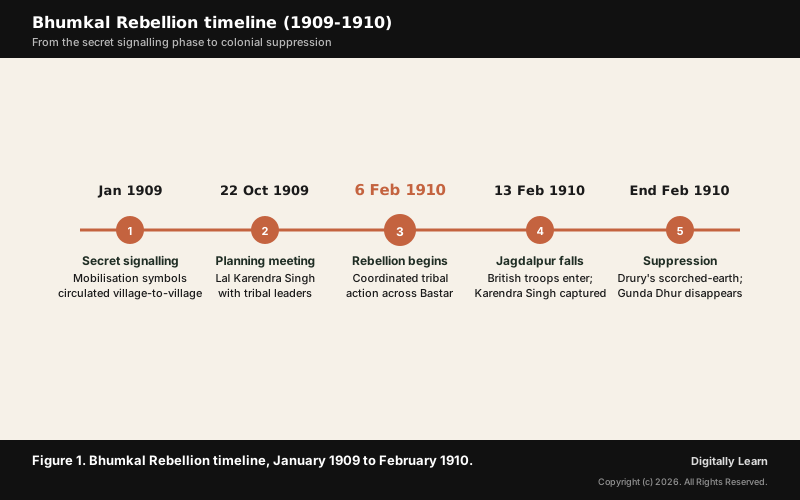
Preparations were so secret that ordinary villagers were told only to prepare for a bhumkal, an earth-tremor, without knowing the political content of the action. A planning meeting on 22 October 1909 set the architecture, and active engagements began on 6 February 1910 across the southern and central regions of Bastar.
Rebellion timeline at a glance
Why the Bhumkal Rebellion matters in the tribal-resistance canon
The Bastar uprising in the wider tribal-rebellion sequence
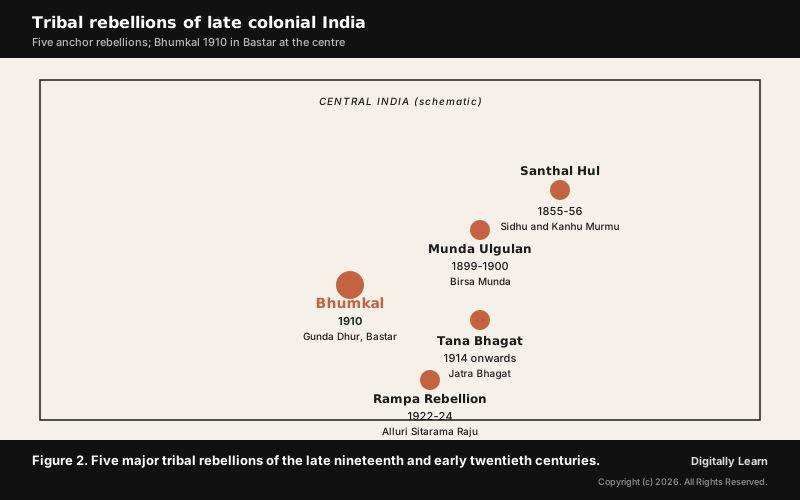
Why it matters: The Bhumkal of 1910 belongs to a sequence of nineteenth and early twentieth-century tribal rebellions that the standard syllabus organises by region and grievance. The Santhal Rebellion of 1855-56 in eastern India, the Munda Ulgulan of 1899-1900 led by Birsa Munda in Chota Nagpur, the Tana Bhagat movement after 1914 in the same Jharkhand belt, the Rampa Rebellion of 1922-24 led by Alluri Sitarama Raju in the Eastern Ghats, and the Bhumkal of 1910 in Bastar together form the spine of pre-1947 tribal anti-colonial action.
Each rebellion shares three structural features: The first is a colonial intrusion into customary forest and land relationships through new statutory instruments. The second is a charismatic tribal leader who fuses political mobilisation with religious or millenarian framing. The third is a coordinated communication channel that operates outside literate administrative channels: the chapati and lotus relays of 1857, the Birsa-era preaching circuit, and in Bastar the silent passage of red chillies, clay bows and arrows, and mango branches from one village headman to the next.
Significance for the colonial-policy history of central India
The significance of this event
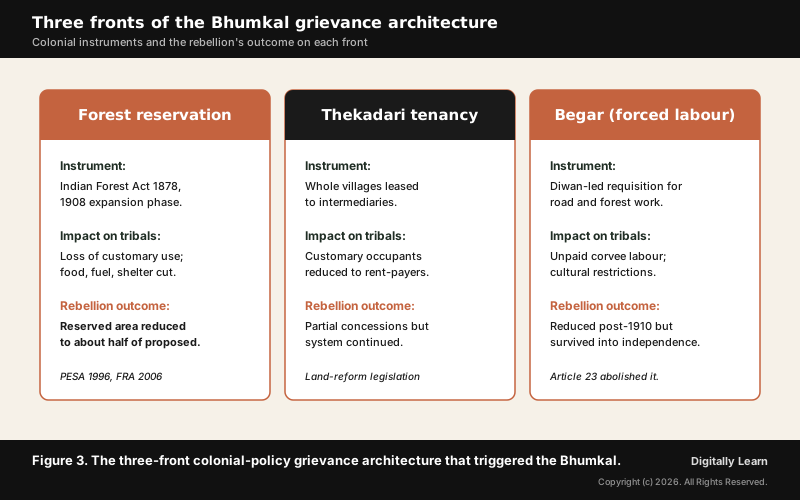
What is the significance of this event: The Bhumkal forced a reckoning between the colonial state and the tribal economy on three fronts that the British administration had treated as one-way reforms. The first front was forest reservation: the Indian Forest Act of 1878 and its 1908 expansion classified large stretches of Bastar as reserved forest, converting customary use rights into administrative permissions and excluding the Duruwa, Madia Gond, Muria, Halba, Bhatra, and Dorla communities from the land that supplied their food, fuel, and shelter.
Structural reading: The second front was the thekadari tenancy system, under which whole villages were leased to intermediaries who extracted rent from the very tribal cultivators who had previously held customary occupancy. The third front was begar, the regime of forced labour that diwan-led administration imposed for road, building, and forest-clearance work. The rebellion's outcome on the first front was decisive: the reserved-forest area in Bastar was reduced to approximately half of the territory the administration had originally proposed.
Distinguishing features of the Bhumkal mobilisation
What set the 1910 Bhumkal apart from earlier tribal uprisings
Distinguishing features: Three structural features separate the Bhumkal from the surrounding tribal rebellions of the same era and each rewards close reading.
- (i) Dual leadership across the princely-state interface. The rebellion was led at two levels: Lal Karendra Singh, a former diwan and royal cousin who provided political legitimacy from within the princely architecture, and Gunda Dhur, the Duruwa headman who supplied tribal mobilisational reach. The covert support of Senior Queen Kumari Devi linked the two tiers. The combination explains why the rebellion could plan for eight months without the diwan’s intelligence channel detecting it.
- (ii) The earthquake-signal mobilisation grammar. Three symbolic objects circulated from village to village: red chillies signalling urgency, clay bows and arrows signalling preparation for armed action, and mango branches signalling solidarity to defend tribal identity. The grammar borrowed nothing from the literate administrative world. Ordinary villagers prepared for an earth-tremor without knowing the political target, which preserved operational security across an eight-month build-up.
- (iii) The princely-state setting under British paramountcy. Bastar was not directly administered British territory but a princely state under the Central Provinces Agency. Power had drifted from the young Raja Rudra Pratap Deo to Extra Commissioner Panda Bajinath, who held the diwanship. The rebellion therefore targeted the diwan-led colonial-collaborator structure rather than the British provincial administration directly, which is why the analytical framing rewards comparison with the Bengal indigo rebellion’s targeting of European planters under Permanent Settlement.
The Bhumkal rebellion of 1910 at a glance
The core facts that an aspirant will reproduce in any answer on this topic are best held together in a single table.
| Rebellion element | What it was | Why it matters for the exam |
|---|---|---|
| Year of rebellion | 1910 (active phase 6 February to end February) | Key date in tribal-rebellion chronology |
| Princely state | Bastar (under Central Provinces Agency, British paramountcy) | Indirect-rule setting; rebellion against diwan-led colonial collaborator |
| Overt leader | Gunda Dhur (Veer Gundadhur), Duruwa community, Nethanar village | Tribal headman; never captured by British |
| Covert leader | Lal Karendra Singh, former diwan, cousin of royal family | Captured 13 February 1910 at Jagdalpur |
| Reigning ruler | Raja Rudra Pratap Deo (1891-onwards, gained maturity 1908) | Real authority held by Extra Commissioner Panda Bajinath as diwan |
| Tribal communities | Duruwa, Madia Gond, Muria, Halba, Bhatra, Dorla | Cross-community coalition; rare in tribal-rebellion historiography |
| Trigger | Indian Forest Act 1878 with 1908 forest-reservation expansion; thekadari tenancy; begar forced labour | Classic three-grievance bundle of late-colonial tribal rebellion |
| Mobilisation symbols | Red chillies, clay bows and arrows, mango branches | Pre-literate communication grammar |
| Suppression commander | Commander Drury; troops from Jeypore and Bengal | Used scorched-earth tactics against Abhujmarias |
| Outcome | Forest-reserve area reduced to approximately half of proposed extent | Decisive concession on first front; tenancy and begar continued |
| Modern commemoration | Shaheed Veer Gundadhur Seva Dera Kendra (Netanar, Bastar, 18 May 2026); annual Shaheed Gundadhur Archery Award (Chhattisgarh) | Twenty-first-century recognition of the tribal-resistance canon |
Observable outcomes and modern commemoration
How the Bhumkal legacy shaped later Adivasi-rights movements
Observable outcomes: Six outcomes connect the rebellion of 1910 to the modern commemoration of 2026 and to the wider canon of tribal-rights jurisprudence.
- (a) Reduction of the reserved-forest area. Colonial administration reduced the forest area to be brought under reservation to approximately half of the originally proposed extent in the years following the rebellion.
- (b) The Jagdalpur suppression. British and princely-state troops entered Jagdalpur on 13 February 1910; Lal Karendra Singh was captured the same day; Gunda Dhur was never traced.
- (c) Continuity of forest-reservation policy. Post-independence governments continued the forest-reservation framework, which fed the conditions that the 1996 PESA Act (Panchayats Extension to Scheduled Areas) and the 2006 Forest Rights Act later sought to redress.
- (d) The Shaheed Veer Gundadhur Seva Dera. Inaugurated by the Union Home Minister in Netanar village, Bastar, on 18 May 2026 as a public-services centre carrying the leader’s name.
- (e) The Shaheed Gundadhur Archery Award. Conferred annually by the Government of Chhattisgarh in recognition of sporting and cultural excellence linked to the Bastar tribal heritage.
- (f) Inclusion in the tribal-resistance canon. The rebellion is now standard reference material alongside Santhal Hul, Munda Ulgulan, Rampa, and Tana Bhagat in modern-history undergraduate and competitive-examination syllabi.
Contemporary linkages
PESA, Forest Rights Act, and the tribal-rights trajectory
Contemporary linkages: Three threads connect the Bhumkal of 1910 to the present tribal-rights debate. The first is the legislative track: the Provisions of the Panchayats (Extension to Scheduled Areas) Act, 1996, the Scheduled Tribes and Other Traditional Forest Dwellers (Recognition of Forest Rights) Act, 2006, and the related Wildlife (Protection) Amendment Acts together attempt to restore the customary rights that colonial forest reservation had displaced. The second is the constitutional track: the Fifth Schedule regime that governs Scheduled Areas, the Sixth Schedule regime that governs autonomous councils in the North-East, and the larger framework under Articles 244 and 244A. The third is the executive track: the National Commission for Scheduled Tribes, the Ministry of Tribal Affairs, and the Tribal Sub-Plan budget mechanism.
Three-fronts grievance architecture in one figure
UPSC Relevance
Where the Bhumkal Rebellion sits in the UPSC syllabus
UPSC context: The Bhumkal Rebellion of 1910 falls within General Studies Paper I under the syllabus heads on modern Indian history from about the middle of the eighteenth century until the present, significant events, personalities, issues, and on the Freedom Struggle, its various stages and important contributors / contributions from different parts of the country. The topic also touches the Indian society head through the tribal-community dimension and the contemporary PESA and Forest Rights Act jurisprudence.
Prelims relevance: The factual surface that Prelims tests on this topic includes the precise year of the rebellion (1910), the active dates (6 February to end February 1910), the leader names (Gunda Dhur and Lal Karendra Singh), the tribal communities involved (Duruwa, Madia Gond, Muria, Halba, Bhatra, Dorla), the three mobilisation symbols (red chillies, clay bows and arrows, mango branches), the trigger instrument (Indian Forest Act 1878 with 1908 expansion), the suppression commander (Drury) and his scorched-earth tactics, and the modern commemoration (Shaheed Veer Gundadhur Seva Dera Kendra, Shaheed Gundadhur Archery Award).
Mains relevance: The strongest Mains framing is the comparative tribal-rebellion question: how do the Santhal Hul, the Munda Ulgulan, the Bhumkal, the Tana Bhagat, and the Rampa Rebellion compare on their leadership architecture, mobilisation grammar, and colonial-policy targets. A second framing is the indirect-rule paradox: how did princely-state administration under British paramountcy generate distinctively different rebellion patterns from those in directly administered presidencies. A third framing is the continuity track: how do the colonial-era forest-reservation grievances feed the constitutional and legislative architecture of PESA 1996, FRA 2006, and the Fifth Schedule regime.
Mains practice question: A focused fifteen-mark question on this topic would read: Examine the Bhumkal Rebellion of 1910 as a case study in tribal resistance to colonial forest policy in princely-state India. How does its leadership architecture and mobilisation grammar compare with contemporary tribal rebellions, and what is its continuity into the present tribal-rights regime? The answer should treat the three-front grievance architecture, the dual leadership of Gunda Dhur and Lal Karendra Singh, the symbolic communication of red chillies, clay bows, and mango branches, and the PESA and FRA continuity as the four spokes.
- Past Mains linkage 1. 2018 GS-I: The 1857 Uprising was a turning point in the policy of the East India Company towards Indian States. Discuss. The 1910 Bhumkal sits in the post-1857 phase where Crown rule had already replaced Company rule; the rebellion shows how the new direct-rule plus princely-paramountcy architecture continued to generate the same grievance bundle.
- Past Mains linkage 2. 2015 GS-I: Examine the causes and significance of the peasant and tribal uprisings of the nineteenth century. The Bhumkal is the canonical early-twentieth-century successor to that nineteenth-century sequence and rewards the same analytical apparatus.
- Past Prelims linkage. Prelims questions on the Bhumkal name the year 1910, identify Gunda Dhur as the leader, and test the recognition of the Duruwa tribal community of Bastar.
Previous Year UPSC-CSE Questions By the end you will be able to draft model answers for the following UPSC questions. Each question carries a collapsible framework showing how to approach it in the exam.
- UPSC Mains 2018 GS-IThe 1857 Uprising was a turning point in the policy of the East India Company towards Indian States. Discuss.
How to structure the answer in the exam
Introduction: Open with the Charter Act of 1813 and the Subsidiary Alliance system as the pre-1857 architecture, name 1857 as the inflection point, and frame the post-1857 policy shift through three lenses: paramountcy doctrine, princely-state preservation, and indirect-rule administrative architecture.
Body (sub-themes to develop):
- Pre-1857 policy: Subsidiary Alliance (1798 onwards under Wellesley), Doctrine of Lapse (1848-1856 under Dalhousie), annexations of Satara 1848, Jhansi 1853, Nagpur 1854, Awadh 1856.
- 1857 inflection: Government of India Act 1858 (Queen Victoria Proclamation), Crown takeover, Doctrine of Lapse abandoned, princely succession protected, treaties honoured.
- Paramountcy doctrine consolidation: residency system; the 1869 Mayo Treaty template; the Imperial Assemblage of 1877; Curzon's 1903 Coronation Durbar reinforcing the framework.
- Indirect rule architecture: the Central Provinces Agency, Rajputana Agency, and other agencies; diwan-led administration in princely states; the case of Bastar under Diwan Panda Bajinath as the structural template that later rebellions like the Bhumkal 1910 would target.
- Long-term implications: 565 princely states at independence; the 1947 accession architecture; the Sardar Patel integration framework; the contemporary statutory legacy in Articles 244, 371A-J, and the Fifth/Sixth Schedules.
Conclusion: Conclude that 1857 redrew Company-to-state relations from one of progressive annexation to one of paramountcy-with-autonomy, that the resulting indirect-rule machinery generated distinctive grievance patterns in princely states (the Bhumkal of 1910 in Bastar being a canonical example), and that the 1947 accession terms inherited and resolved the architecture the 1858 Proclamation had set in motion.
The Bhumkal of 1910 is a direct successor manifestation of the indirect-rule architecture that 1857 set up. Bastar was a princely state under the Central Provinces Agency, with the Raja Rudra Pratap Deo as a nominal sovereign and the diwan (Extra Commissioner Panda Bajinath) as the effective ruler. The rebellion therefore targeted the diwan-led colonial-collaborator structure rather than the British provincial administration directly. The body sub-theme on indirect-rule architecture supplies the load-bearing connection from the 1858 Proclamation to the 1910 grievance bundle.
- UPSC Mains 2015 GS-IExamine the causes and significance of the peasant and tribal uprisings of the nineteenth century.
How to structure the answer in the exam
Introduction: Open with the structural transformation of the colonial economy in the nineteenth century (Permanent Settlement 1793, Ryotwari, the Forest Acts), name the major peasant and tribal uprisings (Sannyasi-Fakir 1763-1800, Indigo 1859-60, Deccan riots 1875, Mappila 1836-1921, Santhal Hul 1855-56, Munda Ulgulan 1899-1900), and frame the question through cause-typology and significance.
Body (sub-themes to develop):
- Land-alienation causes: Permanent Settlement zamindari, Ryotwari over-assessment, alien moneylender encroachment, the Bengal indigo planter system.
- Forest-displacement causes: Indian Forest Act 1865 and 1878 (with 1908 expansion); reservation of customary lands; loss of minor forest produce rights; the Santhal Hul and Munda Ulgulan as direct responses; the Bhumkal of 1910 as the early-twentieth-century successor in Bastar.
- Religious-cultural intrusion causes: missionary expansion in tribal zones; restrictions on traditional practices (ghotul in Bastar; alcohol-brewing prohibitions); the Birsa Munda preaching of dharti aaba (father of the earth).
- Common mobilisation grammar: charismatic leadership; symbolic communication (chapatis and lotuses in 1857, Birsa preaching circuit, the Bhumkal red chillies and mango branches); millenarian framing of a coming new world.
- Significance for the anti-colonial struggle: prefiguring the mass-base of the Gandhian phase; supplying the moral grounding for post-independence tribal-rights jurisprudence (Fifth Schedule, PESA 1996, FRA 2006); fixing the regional memory that the Shaheed Veer Gundadhur Seva Dera Kendra of May 2026 commemorates.
Conclusion: Conclude that the nineteenth-century peasant and tribal uprisings established the analytical template (land, forest, and cultural-intrusion as the common-cause triad), that the early-twentieth-century Bhumkal of 1910 in Bastar is the canonical successor within this tradition, and that the legislative trajectory through PESA 1996 and FRA 2006 represents the post-independence settlement of grievances first articulated in this sequence.
This question is directly answered by the Bhumkal as a case study. The three-front grievance architecture in the article (forest reservation, thekadari tenancy, begar) maps precisely onto the common-cause typology that the question asks for. The mobilisation-grammar discussion in the article (red chillies, clay bows, mango branches) supplies the body sub-theme on symbolic communication. The article's Contemporary linkages section on PESA 1996 and FRA 2006 supports the significance argument that the question's second clause asks for.
Sources
- Bastar rebellion
- Government of Chhattisgarh: Shaheed Veer Gundadhur Award and tribal heritage programmes
- Ministry of Tribal Affairs, Government of India
- Press Information Bureau release on Shaheed Veer Gundadhur Seva Dera Jan Suvidha Kendra inauguration in Bastar
- Indian Forest Act, 1878 (statutory text)
- Constitution of India: Fifth Schedule and Article 244
- Scheduled Tribes and Other Traditional Forest Dwellers (Recognition of Forest Rights) Act, 2006
- Provisions of the Panchayats (Extension to Scheduled Areas) Act, 1996
- Wikipedia: Birsa Munda and the Munda Ulgulan
Editorial Disclaimer
This article is compiled from the reference materials listed in the Sources section. It is an explainer for UPSC preparation and is not a substitute for primary documents (NCERTs, GoI ministry releases, IMD bulletins, RBI / CEA / MoEFCC publications, and Standing-Committee reports).


