


Overview
The Unlawful Activities (Prevention) Act, 1967, commonly known as the UAPA Act, is India's principal anti-terror law. It empowers the Central Government to declare associations unlawful and to list terrorist organisations and, since 2019, individual terrorists, and it punishes terrorist acts, the financing of terrorism and membership of terrorist groups. Two other statutes complete the framework. The National Investigation Agency Act, 2008, establishes the agency that investigates terror offences and the Special Courts that try them, and Section 113 of the Bharatiya Nyaya Sanhita, 2023, defines a terrorist act within the general criminal law.
UAPA Act: Full Form, Constitutional Basis and Related Laws
What Is the UAPA Act and Its Full Form
UAPA stands for the Unlawful Activities (Prevention) Act, which received assent on 30 December 1967. Its long title says that it provides for the more effective prevention of certain unlawful activities of individuals and associations and, since the amendment of 2004, for dealing with terrorist activities.
The Act rests on the Constitution (Sixteenth Amendment) Act, 1963, which added the sovereignty and integrity of India to Articles 19(2), 19(3) and 19(4) as a ground for reasonable restrictions on the freedoms of speech, assembly and association.
The Act covers two subjects. Chapters II and III deal with associations declared unlawful, while Chapters IV to VI deal with terrorism, covering the offence itself, the forfeiture of its proceeds, and the listing of terrorist organisations and individuals.
How the Three Laws Fit Together
In a terror case, three statutes are usually read together. The UAPA supplies the special offences, the special bail provision and the lists of banned organisations. The National Investigation Agency Act, 2008 (NIA Act) provides the investigating agency, the Special Courts and the route of appeal. The Bharatiya Nyaya Sanhita, 2023 (BNS), in force since 1 July 2024, replaced the Indian Penal Code as the general criminal law and contains its own provisions on terrorism and organised crime.
Evolution of Anti-Terror Laws in India
TADA 1985 and POTA 2002: Why They Were Repealed
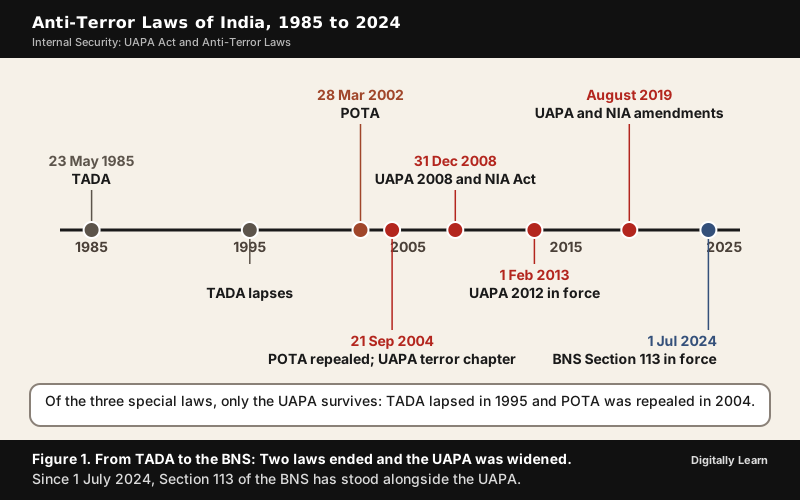
The Terrorist and Disruptive Activities (Prevention) Act (TADA) was India's first law directed specifically at terrorism. It received assent on 23 May 1985, during the Punjab insurgency, and carried a two-year sunset clause. A replacement Act of 1987 was renewed in 1989, 1991 and 1993 and was allowed to lapse in 1995 amid widespread allegations of abuse.
TADA departed from the ordinary criminal law in four ways.
- Detention: A person could be held for up to one year.
- Confession: A confession made to a police officer was admissible as evidence.
- Burden of proof: The burden of proving innocence fell on the accused.
- Secret trials: Trials could be held in camera, with the identities of witnesses kept secret.
The record of enforcement explains why the Act lapsed. More than 76,000 people had been arrested under it by 30 June 1994. The police dropped a quarter of the cases without charges, and fewer than 2 per cent of those arrested were convicted.
The Prevention of Terrorism Act, 2002 (POTA) was enacted after the attack on Parliament. The Rajya Sabha defeated the Bill, and it was then passed at a joint sitting of both Houses on 26 March 2002 by 425 votes to 296; it received assent on 28 March 2002. POTA permitted detention for up to 180 days without a charge-sheet and made a confession to a police officer admissible, but it omitted the provision for preventive detention that TADA had contained. Every bail order and every verdict of a special court could be appealed to a division bench of the High Court, and review committees were provided.
Reports of misuse soon followed. Within eight months of its enactment, more than 940 people had been arrested under it in the seven States that had invoked it. POTA was repealed on 21 September 2004 by the Prevention of Terrorism (Repeal) Act, 2004.
TADA, POTA, the UAPA and Section 113 of the BNS differ on detention, confessions and safeguards.
| Law | Years in force | Detention before charge-sheet | Confession to a police officer | Appeal, review and other rules |
|---|---|---|---|---|
| TADA | 1985 to 1995 | Up to one year without formal charges | Admissible as evidence | Appeals only to the Supreme Court; burden of proof on the accused |
| POTA | 2002 to 2004 | Up to 180 days without a charge-sheet | Admissible as evidence | Appeal to a High Court division bench; central and State review committees |
| UAPA after 2008 | 1967 onwards; terrorism chapters from 2004 | Police custody of up to 30 days; 90 days to complete investigation, extendable to 180 days by the court on the Public Prosecutor's report | No special provision in the Act | Review Committee for delisting; independent review of evidence before sanction |
| BNS Section 113 | From 1 July 2024 | No rule of its own in the section | No rule of its own in the section | Case registered under it or the UAPA at the discretion of a Superintendent of Police |
UAPA 1967 and the Amendments of 2004, 2008 and 2012
The Act of 1967 originally dealt only with unlawful associations. Provisions on terrorism were added in stages, each amendment responding to a particular event or international obligation.
- 2004: The Unlawful Activities (Prevention) Amendment Act, 2004, came into force on 21 September 2004, the day POTA was repealed. It added the chapter on terrorist activities and carried most of POTA's provisions into the UAPA.
- 2008: The Unlawful Activities (Prevention) Amendment Act, 2008, took effect on 31 December 2008, after the Mumbai attacks. It substituted a new Section 15 on the terrorist act, added Section 18A on terrorist camps and Section 18B on recruitment, and inserted Sections 43A to 43F on arrest, search, bail and presumption.
- 2012: The Amendment Act of 2012, published as Act 3 of 2013, came into force on 1 February 2013. It added threats to "economic security" and high-quality counterfeit Indian currency to the definition of a terrorist act, widened Section 17 on raising funds, and required the Central Government's notifications on the Schedules to be laid before Parliament.
- 2019: The Unlawful Activities (Prevention) Amendment Act, 2019, permits individuals to be designated as terrorists.
The preamble inserted in 2008 states that the Act gives effect to United Nations Security Council Resolution 1373 (2001), which requires all states to act against international terrorism, and to Resolution 1267 (1999) and the later resolutions that require action against listed terrorists and terrorist organisations.
Unlawful Activities (Prevention) Act: Key Provisions
Unlawful Association and Terrorist Organisation
The Act defines an unlawful activity as any action, whether by words spoken or written or by signs, that supports or incites the cession or secession of any part of India, that disclaims, questions or disrupts the sovereignty and territorial integrity of India, or that causes or is intended to cause disaffection against India. An unlawful association is one whose object is an unlawful activity or whose members undertake such activity; the definition also extends to an association whose object is an act punishable as promoting enmity between groups.
The Central Government declares an association unlawful by a notification under Section 3, which must state the grounds. The notification takes effect only after the Unlawful Activities (Prevention) Tribunal, a one-member body presided over by a High Court judge, confirms it. The Government must refer the notification to the Tribunal within thirty days, and the Tribunal must decide within six months. Where circumstances make it necessary, the Government may direct, for reasons recorded in writing, that the notification take effect at once. A confirmed declaration remains in force for five years unless it is cancelled earlier.
A terrorist organisation is a separate category. It is an organisation listed in the First Schedule, to which the Central Government may add a name by notification under Section 35 only if it believes the organisation to be involved in terrorism. An organisation is deemed to be so involved if it commits or participates in acts of terrorism, prepares for terrorism, promotes or encourages it, or is otherwise involved in it. The list issued by the Ministry of Home Affairs on 10 March 2023 names 44 organisations, beginning with Babbar Khalsa International and including Lashkar-e-Taiba, Jaish-e-Mohammed, Hizb-ul‑Mujahideen, the Islamic State and the Khalistan Tiger Force. Hizb-ut-Tahrir was added in October 2024.
Associations declared unlawful under Section 3 appear on a separate list, which includes the Students Islamic Movement of India, the United Liberation Front of Asom (ULFA), the Liberation Tigers of Tamil Eelam and the Popular Front of India with its associates.

An organisation, or any person affected by its listing, may apply to the Central Government for removal from the list. An applicant whose request is rejected may, within one month, seek review by a Review Committee chaired by a serving or former High Court judge, with up to three other members. The Committee may interfere only if the rejection was flawed when judged by the principles of judicial review, which examine how a decision was made, not whether it was right on the merits.
Offences and Punishments Under Chapters III to VI
Section 15 defines a terrorist act. The act must be done with intent to threaten, or be likely to threaten, the unity, integrity, security, economic security or sovereignty of India, or with intent to strike terror among the people in India or abroad.
The section then specifies the means and their consequences. They include the use of explosives, firearms, poisonous substances or any other means that cause, or are likely to cause, death, injury, damage to property, disruption of essential supplies, damage to the monetary stability of India through high-quality counterfeit currency, or damage to property used for defence. The section also covers overawing or killing a public functionary and abducting a person to compel a government to act. Acts that are offences under the treaties listed in the Second Schedule are included as well; since 2019, that Schedule has also included the International Convention for the Suppression of Acts of Nuclear Terrorism (2005).
Each offence under the Act carries its own penalty, from up to two years for membership of an unlawful association to death where a terrorist act causes a death.
| Section | Conduct | Punishment |
|---|---|---|
| 10 | Membership of, taking part in, or assisting an association declared unlawful | Up to two years and fine; death or life imprisonment where a member holding unlicensed arms or explosives causes a death |
| 13 | Taking part in, advocating or inciting an unlawful activity | Up to seven years and fine |
| 16 | A terrorist act | Death or life imprisonment if a death results; otherwise five years to life, with fine |
| 17 | Raising or providing funds for a terrorist act | Five years to life, with fine |
| 18 | Conspiring, attempting, advocating, abetting or facilitating a terrorist act | Five years to life, with fine |
| 18A and 18B | Organising a terrorist training camp; recruiting for a terrorist act | Five years to life, with fine |
| 19 | Harbouring a terrorist (spouse excepted) | Three years to life, with fine |
| 20 | Membership of a terrorist gang or organisation involved in a terrorist act | Up to life, with fine |
| 21 | Knowingly holding proceeds of terrorism | Up to life, with fine |
| 38 | Associating with a terrorist organisation to further its activities | Up to ten years or fine or both |
| 39 | Inviting support for a terrorist organisation | Up to ten years or fine or both |
| 40 | Raising funds for a terrorist organisation | Up to fourteen years or fine or both |
Two provisions on evidence set the Act apart from the ordinary criminal law. Under Section 46, evidence gathered through the lawful interception of communications is admissible. Under Section 43E, where arms or explosives are recovered from the accused, or fingerprints or other definitive evidence place the accused at the scene, the court shall presume that the accused committed the offence unless the contrary is shown.
Bail Under Section 43D(5) and the Watali Judgment
Bail is the most litigated subject under the Act. Section 43D(2) allows the court to extend the ordinary 90-day period for completing an investigation to 180 days if it is satisfied with the Public Prosecutor's report on the progress of the investigation and the reasons for continued detention. Section 43D(4) bars anticipatory bail, and Section 43D(7) bars bail to a foreign national who has entered India unlawfully, except in very exceptional circumstances.
Section 43D(5) is the central provision. A person accused of an offence under Chapter IV or Chapter VI who is in custody cannot be released on bail without the Public Prosecutor being heard, and cannot be released at all if the court, on reading the case diary or the police report, finds reasonable grounds for believing that the accusation is prima facie true. Section 43D(6) makes these restrictions additional to those in the ordinary law.
In NIA v Zahoor Ahmad Shah Watali (2019), the Supreme Court held that an accusation is prima facie true if the material collected by the investigating agency and placed in the charge-sheet shows, on its face, the complicity of the accused and is not overcome or disproved by other evidence. Three later judgments have qualified this reading.
- Union of India v K. A. Najeeb (Supreme Court, 1 February 2021): A three-judge bench held that Section 43D(5) does not take away the power of constitutional courts to grant bail where the rights in Part III of the Constitution are violated. The accused had been in jail for over five years, and 276 witnesses were still to be examined; the Court observed that the rigours of such provisions "melt down" where a timely trial is not possible and a substantial part of the sentence has already been served.
- Vernon v State of Maharashtra (2023 INSC 655, 28 July 2023): The Court held that the prima facie test is not met without at least a surface analysis of the probative value of the evidence, and granted bail to appellants who had been held for almost five years.
- Sheikh Javed Iqbal v State of Uttar Pradesh (2024 INSC 534, 18 July 2024): The Court followed Najeeb and held that Watali must be read in its own context and is not a precedent for denying bail to an undertrial held for a long period with no end to the trial in sight.

UAPA Amendment 2019: Designating Individuals as Terrorists
The Unlawful Activities (Prevention) Amendment Act, 2019 (Act 28 of 2019) received assent on 8 August 2019 and came into force on 14 August 2019. Until then, only organisations could be listed. The amendment made five main changes.
- Individuals as terrorists: Section 35 now empowers the Central Government to add the name of an individual to a new Fourth Schedule if it believes that person to be involved in terrorism, on the same four grounds that apply to organisations. The heading of Chapter VI now reads "Terrorist Organisations and Individuals".
- Remedy for the individual: A person included in the Fourth Schedule may apply for removal under Section 36, with review by the Review Committee.
- Seizure of property: Under Section 25, where an NIA officer investigates the case, the approval of the Director General of the NIA is sufficient, in place of that of the State's Director General of Police.
- Rank of the investigating officer: Section 43 now permits NIA officers of the rank of Inspector or above to investigate; the earlier minimum was Deputy Superintendent of Police or Assistant Commissioner of Police.
- Treaties: The International Convention for the Suppression of Acts of Nuclear Terrorism (2005) was added to the Second Schedule.
The first four individuals, notified on 4 September 2019, were Masood Azhar, Hafiz Muhammad Saeed, Zaki-ur-Rehman Lakhvi and Dawood Ibrahim Kaskar. Further names were added by notifications from 2020 to 2024, and by March 2024 the Fourth Schedule listed 57 individuals.
National Investigation Agency Act 2008 and the 2019 Amendment
Scheduled Offences and Concurrent Jurisdiction With States
The NIA Act received assent on 31 December 2008, and the National Investigation Agency (NIA) was constituted on 20 January 2009. Parliament enacted it together with the UAPA amendment of 2008, after the Mumbai attacks of November 2008.
The Agency investigates scheduled offences, that is, offences under the laws listed in the Schedule to the Act, anywhere in India. Its officers exercise the powers of police officers throughout the country, and an NIA officer of the rank of Sub-Inspector or above may exercise the powers of an officer in charge of a police station. Superintendence of the Agency vests in the Central Government, and the Agency is headed by a Director General.
Section 6 lays down how a case reaches the Agency.
- The officer in charge of the police station records the information and forwards a report to the State Government at once.
- The State Government sends the report to the Central Government as quickly as possible.
- Within fifteen days, the Central Government decides whether the offence is a scheduled offence and, given its gravity, a fit case for the Agency.
- If it is, the Agency is directed to investigate, and the State police must hand over the records. The Central Government may also act on its own motion.
The Act does not remove the powers of the States. Section 10 preserves the power of the State police to investigate and prosecute scheduled offences, and Section 9 requires the State Government to assist the Agency. Section 7 allows the Agency to associate the State Government in an investigation or, with the Central Government's approval, to transfer a case back to the State, and Section 8 empowers it to investigate connected offences. Until the Agency takes up a case, the local police must continue the investigation.
The Schedule lists the Explosive Substances Act, 1908, the Atomic Energy Act, 1962, the UAPA, the Anti-Hijacking Act, 2016, the Suppression of Unlawful Acts against Safety of Civil Aviation Act, 1982, the SAARC Convention (Suppression of Terrorism) Act, 1993, the Suppression of Unlawful Acts against Safety of Maritime Navigation and Fixed Platforms on Continental Shelf Act, 2002, and the Weapons of Mass Destruction Act, 2005.
The Schedule also lists offences under the Indian Penal Code relating to waging war against the State, human trafficking and counterfeit currency, offences under the Arms Act, and cyber terrorism under the Information Technology Act. The BNS replaced the Indian Penal Code from 1 July 2024. The 2019 amendment added the Atomic Energy Act, human trafficking, prohibited arms and cyber terrorism to the Schedule.
Extra-Territorial Jurisdiction and Special Courts
The 2019 amendment, passed by the Lok Sabha by 278 votes to six in July 2019, widened the Act in two respects. First, under Section 1 the Act now applies to persons who commit a scheduled offence outside India against Indian citizens or affecting the interests of India, and Section 6(8) permits the Central Government to direct the Agency to register and investigate such an offence as if it had been committed in India. The Special Court at New Delhi has jurisdiction over these cases. The change enabled the Agency to investigate attacks on Indians and Indian interests abroad, such as the Easter bombings in Sri Lanka and the bombing of a gurdwara in Kabul.
Second, the amendment provided for existing Courts of Session to be designated as Special Courts, in place of new courts being constituted. The Central Government designates them for scheduled offences, in consultation with the Chief Justice of the High Court, and the State Government may do the same for offences under the Acts in the Schedule. Under the Act, these courts follow special rules.
- Exclusive trial: A scheduled offence investigated by the Agency is tried only by the Special Court within whose area it was committed.
- Day-to-day trial: The trial is held on every working day and takes precedence over other cases against the accused.
- Procedure: A Special Court may take cognizance without committal and may, for reasons recorded, proceed in the absence of the accused, subject to the right to recall witnesses for cross-examination.
- Witness protection: Proceedings may be held in camera, and the identity and address of a witness may be kept secret if the witness's life is in danger.
- Appeal: An appeal lies from the judgment to the High Court on facts and on law; it must be filed within thirty days, and no appeal is entertained after ninety days. A bench of two judges hears it and should decide it within three months. An order granting or refusing bail is also appealable.
Terrorism Under the Bharatiya Nyaya Sanhita 2023
Section 113 and Its Relation to UAPA
The BNS received assent on 25 December 2023 and came into force on 1 July 2024, bringing terrorism within the general criminal code for the first time. Section 113 reproduces the language of Section 15 of the UAPA, except that it refers to "counterfeit Indian currency" where the UAPA refers to "high quality" counterfeit currency. Sub-sections (2) to (7) prescribe the punishments.
- Committing the act: Death or imprisonment for life if death results; otherwise five years to life, with fine.
- Conspiracy, abetment and incitement: Five years to life, with fine.
- Camps and recruitment: Five years to life, with fine.
- Membership of an organisation involved in a terrorist act: Up to life, with fine.
- Harbouring: Three years to life, with fine.
- Possessing proceeds of a terrorist act: Up to life, with fine.
An Explanation at the end of the section deals with the overlap between the two laws. An officer not below the rank of Superintendent of Police decides whether a case is to be registered under Section 113 or under the UAPA. The same act may therefore be prosecuted under either law, and the special bail provision and the Special Courts apply only when the case is registered under the UAPA.
Organised Crime and Terror in the New Criminal Laws
Section 111 creates a new and separate offence of organised crime. It covers any continuing unlawful activity, such as kidnapping, robbery, vehicle theft, extortion, contract killing, cyber-crime, or trafficking in persons, drugs, weapons or illicit goods. The activity must be carried out by a person or group acting in concert as a member of an organised crime syndicate, through violence, threats, intimidation or coercion, to obtain a material benefit. Economic offences such as hawala transactions and the counterfeiting of currency are included.
A syndicate is a group of two or more persons engaged in continuing unlawful activity. Continuing unlawful activity means a cognizable offence punishable with imprisonment of three years or more, in respect of which more than one charge-sheet has been filed within the preceding ten years and a court has taken cognizance.
Section 111 sets two scales of penalty.
- Where a death results: Death or imprisonment for life, with a fine of at least ten lakh rupees.
- In other cases: Imprisonment of five years to life, with a fine of at least five lakh rupees.
The section also punishes membership of a syndicate, abetment, harbouring, and holding unexplained property on behalf of a member.
The two offences overlap. Counterfeit currency falls within both Section 111 and the definition of a terrorist act, so a single case may involve both offences.
The BNS also drops the offence of sedition. In its place, Section 152 punishes acts that endanger the sovereignty, unity and integrity of India, including exciting secession, armed rebellion or subversive activities, with imprisonment for life or for up to seven years, and fine. An Explanation protects comments that express disapprobation of government measures by lawful means. Critics nonetheless describe the phrase "endangers sovereignty or unity and integrity" as ambiguous.
Criticism of UAPA and NIA: Convictions, Bail and Federalism
Low Conviction Rate and Long Pre-Trial Custody
The principal criticism of the UAPA is that it is invoked far more often than it secures convictions. Union Government figures show that 5,027 cases were registered under the Act from 2016 to 2020, while 212 persons were convicted and 386 acquitted. Critics argue that the process itself becomes the punishment, because bail is difficult to obtain and trials are slow.
Human rights organisations and legal commentators raise four further objections.
- Broad definitions: The phrases "likely to threaten" and "likely to strike terror" in Section 15 are said to give the police wide discretion.
- Designation without trial: The power to designate an individual, added in 2019, is exercised by the executive. In 2020, United Nations special rapporteurs stated that the 2019 provisions contravene articles of the Universal Declaration of Human Rights and the International Covenant on Civil and Political Rights.
- Bail: The statutory bar in Section 43D(5), combined with long trials, can lead to prolonged detention, as the Supreme Court itself recognised in Najeeb.
- Stretching the definition: In June 2021 the Delhi High Court observed that the State had broadened the scope of "terrorist activity" to include ordinary penal offences.
The Government's position is that the 2019 amendment made the Act more effective in preventing unlawful activities and met India's commitments to the Financial Action Task Force. The Act also contains its own safeguards: The Tribunal for associations, the Review Committee for listings, the requirement that sanction for prosecution be given only after an authority appointed by the Central or State Government has independently reviewed the evidence, and judicial control over extended detention.
Detention under the UAPA is often confused with preventive detention, which holds a person to prevent future action against public order or the security of the State, without trial for an offence already committed. Under Article 22(3)(b), a person held under a preventive detention law does not have the safeguards of clauses (1) and (2), such as the right to consult a lawyer and to be produced before a magistrate within twenty-four hours; clause (5) instead gives the right to be told the grounds of detention and to make a representation.
Federal Concerns Over the NIA Act
Because police and public order are in the State List, while criminal law and criminal procedure are concurrent, the Central Government's power to take over a case raises a federal question.
Three features of the NIA Act concern the States.
- No State consent: Under Section 6, the Central Government alone decides whether a case goes to the Agency, and the State police must hand over the records.
- Suo motu power: The Central Government may order an NIA investigation without waiting for a report from the State.
- Control over Special Courts: The Central Government designates Special Courts in consultation with the Chief Justice of the High Court, and any question about the jurisdiction of a Special Court is referred to the Central Government, whose decision is final.
Against these concerns, Article 355 places on the Union a duty to protect every State against external aggression and internal disturbance, which supports the case for a central agency. The NIA Act also preserves the State's own power to investigate scheduled offences, requires the Agency to associate the State Government, and allows a case to be transferred back to the State.
Previous Year UPSC‑CSE Questions
Each Prelims question is explained option by option, and each Mains question comes with an answer outline.
- UPSC Mains 2019 GS‑IIIIndian Government has recently strengthened the anti-terrorism laws by amending the Unlawful Activities (Prevention) Act (UAPA), 1967 and the NIA Act. Analyse the changes in the context of prevailing security environment while discussing the scope and reasons for opposing the UAPA by human rights organizations.
Answer outline
The outline sets out what the question asks, the main arguments, relevant examples and the direction of the conclusion; it is not a full model answer.
Introduction: The UAPA of 1967 is India's principal anti-terror law, and the NIA Act of 2008 provides the agency and the courts that investigate and try terror offences; Parliament amended both in 2019.
Body (sub-themes to develop):
- UAPA 2019: Individuals can be designated terrorists in a Fourth Schedule, with removal by application and review by the Review Committee; NIA officers of Inspector rank can investigate; the NIA Director General can approve seizure of property.
- NIA Act 2019: Scheduled offences widened to the Atomic Energy Act, human trafficking, prohibited arms and cyber terrorism; jurisdiction over scheduled offences committed outside India against Indians or Indian interests; existing Courts of Session designated as Special Courts.
- Security situation: Cross-border and international terrorism, the United Nations Security Council resolutions 1267 and 1373, commitments to the Financial Action Task Force, and attacks on Indians abroad such as the Sri Lanka Easter bombings.
- Scope of the UAPA: The terrorist act in Section 15, offences relating to funds, camps, recruitment and membership, and the lists of terrorist organisations and individuals.
- Reasons for opposition: Designation without trial, broad definitions such as "likely to threaten", the bar on bail in Section 43D(5), long custody set against 5,027 cases registered and 212 persons convicted from 2016 to 2020, and federal concerns over the NIA.
- Safeguards: The Tribunal for associations, the Review Committee for listings, independent review before sanction, and the Najeeb, Vernon and Sheikh Javed Iqbal bail rulings.
Conclusion: The 2019 changes respond to a real threat, but their legitimacy depends on speedy trials and on the courts reading Article 21 together with the bar on bail.
- UPSC Prelims 2003Which one of the following Articles of the Indian Constitution provides that 'It shall be the duty of the Union to protect every State against external aggression and internal disturbance'?
How to approach this Prelims question
Approach: The quoted words open Article 355, which sits in Part XVIII on Emergency Provisions under the heading "Duty of the Union to protect States against external aggression and internal disturbance". Match the subject of each option against that duty.
Why each option is right or wrong:
- (a) Article 215: Wrong. It makes High Courts courts of record.
- (b) Article 275: Wrong. It deals with grants from the Union to certain States.
- (c) Article 325: Wrong. It provides for one general electoral roll for every territorial constituency and bars any person from being excluded from it, or from claiming inclusion in a special roll, on grounds only of religion, race, caste or sex.
- (d) Article 355: Right. It places the duty on the Union to protect every State against external aggression and internal disturbance and to ensure that every State government is carried on in accordance with the Constitution.
Answer: The answer is (d) Article 355, which carries the duty of the Union to protect States against external aggression and internal disturbance.
Sources
- Unlawful Activities (Prevention) Act, 1967, as amended, with Schedules (National Investigation Agency, MHA)
- Unlawful Activities (Prevention) Amendment Act, 2019 (Gazette of India)
- National Investigation Agency Act, 2008, as amended in 2019 (NIA, MHA)
- MHA: List of terrorist organisations under the UAPA (10 March 2023)
- MHA: Names of unlawful associations under Section 3 of the UAPA (20 January 2023)
- Bharatiya Nyaya Sanhita, 2023 (Gazette of India)
- Supreme Court of India: Vernon v State of Maharashtra, 2023 INSC 655 (28 July 2023)
- Supreme Court of India: Sheikh Javed Iqbal v State of Uttar Pradesh, 2024 INSC 534 (18 July 2024)
- Constitution of India (Legislative Department): Articles 19, 22 and 355; Seventh Schedule
- NCERT: Indian Constitution at Work (Class XI, revised edition, reprint 2026‑27), Chapter 2, Rights in the Indian Constitution
- Wikipedia: Unlawful Activities (Prevention) Act
- Wikipedia: National Investigation Agency
- Wikipedia: Terrorist and Disruptive Activities (Prevention) Act
- Wikipedia: Prevention of Terrorism Act, 2002
- Wikipedia: Bharatiya Nyaya Sanhita
- UPSC: Civil Services Examination question papers
Editorial Disclaimer
This article draws on the text of the Acts, the Gazette, Supreme Court judgments and the other sources listed in the Sources section. Lists of banned organisations and individuals change by notification; check the Ministry of Home Affairs for the latest list.

