


Overview
Militancy in Kashmir is the armed violence that began in the Kashmir Valley in 1989, when a militant movement for a separate Kashmiri nation took hold of the State with moral, material and military support from Pakistan. It has three strands, which are best studied separately. Terrorism is the use of violence against civilians and security forces by organised groups, most of them based across the Line of Control (LoC). Separatism is the political demand, voiced by organisations such as the All Parties Hurriyat Conference, that rejects the State's place in the Indian Union. Over-ground support is the network of people who lead ordinary lives but sustain the militants without carrying weapons themselves.
Roots of Militancy in Jammu and Kashmir
Accession of 1947, Article 370 and the Line of Control
India's position is that Jammu and Kashmir and Ladakh are integral parts of the country, and that the territory held by Pakistan since 1947 is under illegal occupation (Pakistan-occupied Jammu and Kashmir). In January 2025 Home Minister Amit Shah put it in these words: "Kashmir was, Kashmir is, and Kashmir will always be an integral part of India."
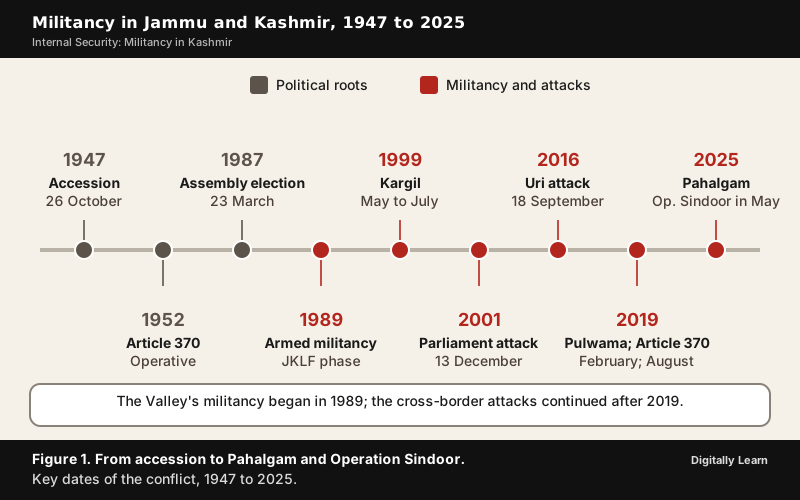
On 20 October 1947 the so-called Azad Kashmir forces, supported by the Pakistan Army, attacked the frontiers of Jammu and Kashmir. The ruler, Maharaja Hari Singh, who had until then held out for independence, acceded to India. The Instrument of Accession, signed on 26 October 1947, transferred three subjects to the Dominion of India: Defence, external affairs and communications. Indian troops drove the raiders out of the Valley, but Pakistan continued to occupy a sizeable part of the State, and the matter was taken to the United Nations.
The Security Council's resolution of 21 April 1948 on the India-Pakistan question, Resolution 47, recommended three steps. Pakistan was to withdraw its nationals, India was to reduce its forces progressively, and a plebiscite was to be held in a free and impartial manner. None of these steps was carried out. The frontier, now the Line of Control, took its present form through the ceasefire of 1949 and the Shimla Agreement of 3 July 1972. It runs north from the Chenab near Akhnoor; south of Akhnoor the boundary with Pakistan is the International Border.
Within the Union, the State was given a special position under Article 370, which became operative on 17 November 1952. The years from 1947 to 1952 thus left an unsettled frontier with Pakistan-occupied Jammu and Kashmir and an internal debate about how far the State was integrated, and both shaped the security problem that followed.
The 1987 Election and the Rise of Armed Separatism in 1989
The 1987 Assembly election is widely seen as the turning point. Sheikh Abdullah, who led the National Conference, died in 1982. His son Farooq Abdullah became Chief Minister, was dismissed by the Governor, and in 1986 formed an alliance between the National Conference and the Congress. The alliance strengthened the feeling that the Centre was interfering in the politics of the State.
The election was held on 23 March 1987, with a turnout of nearly 75 per cent. The alliance of the National Conference and the Congress won 66 seats. The Muslim United Front, a platform of anti-establishment groups that included Jamaat-e-Islami, won four seats although it polled 31 per cent of the votes. The results were widely believed not to reflect the popular choice. Scholars still debate how many seats were affected, but the loss of faith in elections is not disputed. Some defeated candidates and party workers, and many young people who had hoped for a democratic path, turned to arms.
Events then moved quickly:
- July 1988: The Jammu and Kashmir Liberation Front (JKLF) launched its first bomb attack in Srinagar.
- December 1989: Rubaiya Sayeed, daughter of the then Union Home Minister, was kidnapped; she was released after the government freed jailed JKLF militants, and the release was followed by mass celebrations across the Valley.
- January 1990: Farooq Abdullah resigned after Jagmohan was appointed Governor, and the State was placed under Governor's rule.
- Early 1990: Targeted killings and threats led between 90,000 and 1,00,000 of the 1,20,000 to 1,40,000 Kashmiri Pandits to leave the Valley by the middle of 1990. The reasons for the exodus are contested, but its scale is not.
Assembly elections were not held again until 1996. Government data show that about 41,000 people, comprising 14,000 civilians, 5,000 security personnel and 22,000 militants, had died in the violence as of March 2017, with most deaths in the 1990s and early 2000s.
Phases of Militancy in Jammu and Kashmir, 1989 to Today
JKLF and the Indigenous Phase
The first phase, from 1989 to the early 1990s, was led by the JKLF, whose first bomb attack had come in July 1988 and whose stated goal was an independent and secular Kashmir free of both India and Pakistan. It received weapons and training from the Pakistani military, yet it described Pakistan, too, as an occupying power in Pakistan-occupied Jammu and Kashmir. Many smaller groups emerged alongside it, and weapons were smuggled in from Pakistan on a large scale.
This phase was short-lived. From the early 1990s Pakistan-backed hardline Islamist groups largely displaced the JKLF, and the movement lost its secular, pro-independence character. In 1994 the JKLF in the Valley, under Yasin Malik, declared an indefinite ceasefire and moved into politics. The JKLF (Mohd. Yasin Malik faction) has since been declared an unlawful association under the UAPA.
Pakistan-Based Tanzeems: Lashkar-e-Taiba, Jaish-e-Mohammed, Hizbul Mujahideen
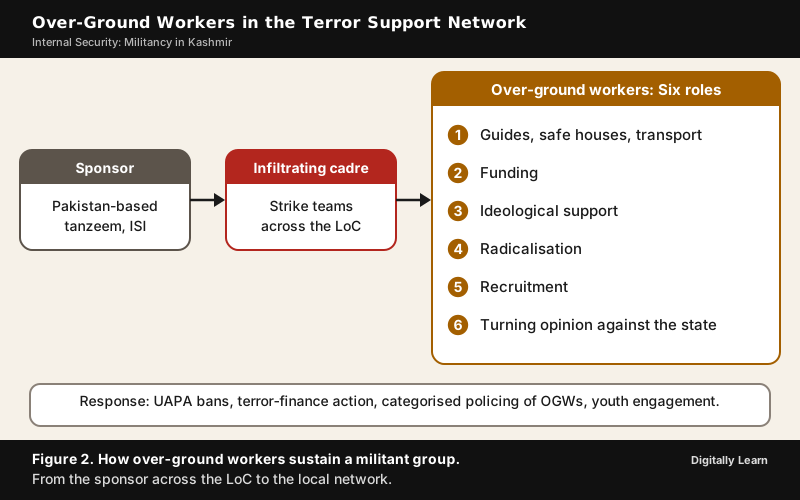
The second phase was dominated by the tanzeems (organisations) whose leadership, funding and training are based across the LoC. Pakistan's Inter-Services Intelligence (ISI) provides training, arms and financial support to designated terrorist organisations including Lashkar-e-Taiba, Jaish-e-Mohammed and Hizbul Mujahideen.
| Group | Origin and base | Aim and character | Key facts |
|---|---|---|---|
| Hizbul Mujahideen | Founded in September 1989 as an umbrella group; headquartered in Muzaffarabad | Seeks to separate Kashmir from India and merge it with Pakistan | Considered the military wing of Jamaat-e-Islami Jammu Kashmir; its commander Burhan Wani was killed on 8 July 2016 |
| Lashkar-e-Taiba | Founded in 1985‑86; based in Pakistan | Its stated primary objective is to merge the whole of Kashmir with Pakistan | Responsible for the Mumbai attacks of 2008, which killed 166; its front, The Resistance Front, claimed the Pahalgam attack |
| Jaish-e-Mohammed | Founded in 2000; based in Pakistan | Its primary aim is to separate Jammu and Kashmir from India and integrate it into Pakistan | Linked to the Parliament attack (2001), Uri (2016) and Pulwama (2019) |
All three have been designated as terrorist organisations under the UAPA. On 5 and 6 January 2023 two fronts, The Resistance Front (TRF) and the People's Anti-Fascist Front (PAFF), were added to the First Schedule as terrorist organisations. In February 2023 the Jammu and Kashmir Ghaznavi Force was added, bringing the number of organisations in the First Schedule at that time to 44.
Local Recruitment and Shadow Fronts After 2016
The third phase opened with the killing of Burhan Wani, a Hizbul Mujahideen commander, on 8 July 2016. Wani had used a strong presence on social media to draw young people into the movement. His death led to large-scale protests across the Valley, and the State was placed under 53 consecutive days of curfew. A growing number of young locals joined the militancy, and most of the militants active in the Valley came to be local recruits. The earlier phase was different: Of the militants killed between 1989 and 2002, about 3,000 came from outside Jammu and Kashmir, mostly from Pakistan.
After the abrogation of Article 370 in 2019 the groups changed their names but not their sponsors. TRF emerged as an offshoot of Lashkar-e-Taiba, drawing cadres from Lashkar and Hizbul Mujahideen, and adopted a non-religious name to project a secular image. PAFF, which Indian police describe as an offshoot of Jaish-e-Mohammed, was created in the same period. Such groups are shadow fronts: The sponsor remains in Pakistan while the name is local, which makes an attack harder to attribute and easier to deny.
Cross-Border Terrorism and Pakistan's Proxy War
Infiltration Across the Line of Control and the Jammu Region
Infiltration is the movement of trained cadres across the Line of Control into India, and it is the main means by which the external element of the conflict is sustained. It is countered by the Army's counter-infiltration grid along the LoC. Estimated net infiltration by militants fell from 143 in 2018 and 141 in 2019 to 51 in 2020 and 28 in the ten months to 31 October 2021. In October 2025 the Home Minister directed the security forces to remain fully prepared as winter set in, so that terrorists could not use snowfall as cover to infiltrate.
Early in 1999 the Pakistan Army sent troops, presented as Mujahideen, to occupy positions on the Indian side of the LoC in the Mashkoh, Dras, Kaksar and Batalik areas. India's counter-offensive in the Kargil conflict brought nearly all the high ground back under Indian control, and the fighting ended on 26 July 1999, which India marks as Kargil Vijay Diwas.
The violence was never confined to the Valley. Poonch and Doda in the Jammu region were among the districts with the most killings, alongside Kupwara, Baramulla, Anantnag and Pulwama in the Valley. The Jammu region suffered attacks such as the Kishtwar bus killings of August 1993, when 16 Hindu passengers were killed, and the Doda and Udhampur killings of May 2006, when 35 Hindus were killed. Militants also built bases in its hills, and in April and May 2003 the Army's Operation Sarp Vinash destroyed their shelters in the Pir Panjal range, killing more than 60 militants.
Major Attacks: Parliament 2001, Uri 2016, Pulwama 2019, Pahalgam 2025
Four attacks show how cross-border terrorism and India's response to it changed over 24 years.
| Attack | Date | What happened | India's response |
|---|---|---|---|
| Parliament | 13 December 2001 | Five Jaish-e-Mohammed militants entered the complex; nine people were killed, and all five attackers died | The attack led to the India-Pakistan military standoff of 2001‑02 |
| Uri | 18 September 2016 | Four Jaish-e-Mohammed terrorists attacked an Army brigade headquarters; 19 soldiers were killed | Surgical strikes on launch pads on 28 September 2016 |
| Pulwama | 14 February 2019 | A vehicle-borne suicide bomber, a local youth, attacked a convoy of the Central Reserve Police Force (CRPF) at Lethpora; 40 personnel were killed; Jaish-e-Mohammed claimed responsibility | Air strike at Balakot on 26 February 2019 |
| Pahalgam | 22 April 2025 | Terrorists attacked tourists in the Baisaran meadow and killed 26 people, 25 Indians and a Nepali citizen; TRF, a front of Lashkar-e-Taiba, claimed responsibility | Diplomatic and border measures, then Operation Sindoor from 7 May 2025 |
India's response to Pahalgam went beyond military action. India placed the Indus Waters Treaty of 1960 in abeyance with immediate effect, until Pakistan credibly and irrevocably abjures its support for cross-border terrorism, and closed the Integrated Check Post at Attari.
On 7 May 2025 the armed forces launched Operation Sindoor against terrorist infrastructure in Pakistan and Pakistan-occupied Jammu and Kashmir, striking nine sites; the Ministry of Defence stated that no Pakistani military facilities were targeted. On 10 May 2025 Pakistan's Director General of Military Operations called his Indian counterpart, and a cessation of firing took effect that evening.
In July 2025 Operation Mahadev, a joint operation of the Army, the CRPF and the Jammu and Kashmir Police near Dachigam, killed the three terrorists involved in the Pahalgam attack; the National Investigation Agency (NIA) had already arrested those who had sheltered them.
Over-Ground Workers and the Support Network of Terror
Six Roles of OGWs: Logistics, Funding, Radicalisation and Recruitment
In the usage of the security forces, an over-ground worker (OGW) is a person who provides militants with logistics, cash, shelter and other support while appearing to lead an ordinary life. The term is an operational one used by the security agencies; it is not defined in any law.
The roles of OGWs fall into six groups:
- Logistics: Support for strike teams, such as guides, vehicles and safe houses.
- Funding: Managing the money that sustains a group.
- Ideology: Spreading the group's ideas.
- Radicalisation: Preparing young people to accept violence.
- Recruitment: Drawing new cadres into the groups.
- Perception: Turning local opinion against the state and the security forces.
OGWs pass real-time information to militant units and help move arms, ammunition and explosives. They also file false complaints against the security forces to tie up their units, and after August 2019 some OGWs used violence to force shops to close. Many children under 18 were also recruited as OGWs by several groups. The term is not confined to Kashmir: It is also used in areas affected by Left-Wing Extremism and in Meghalaya in relation to the Garo National Liberation Army, and the Sashastra Seema Bal reported arresting 84 linkmen or OGWs in 2017 in the anti-Naxal campaign.
Ban on Jamaat-e-Islami and Action Against Terror Ecosystems
Measures against OGWs act on four fronts, namely the organisations behind the network, its finances, the individuals involved and the young people at risk of recruitment.
- Organisation: Jamaat-e-Islami Jammu Kashmir was declared an unlawful association on 28 February 2019 under section 3(1) of the UAPA by Gazette Notification S.O. 1069(E). The government states that the organisation continues to foment terrorism and anti-India propaganda to fuel secessionism, and on 27 February 2024 it extended the ban for a further five years. Later bans under the same provision covered the Jammu and Kashmir Democratic Freedom Party (5 October 2023), the Muslim League Jammu Kashmir, Masarat Alam faction (27 December 2023), Tehreek-e-Hurriyat Jammu and Kashmir (31 December 2023), and the Jammu and Kashmir Ittihadul Muslimeen and the Awami Action Committee (11 March 2025).
- Terror finance: The government's strategy includes a crackdown on terror financing, the seizure and attachment under law of properties belonging to terrorists and their associates, and the banning of organisations.
- Individuals: Preventive operations identify the strategic supporters of terrorism and investigate how they aid and abet it. Since August 2019 the UAPA also allows an individual to be designated a terrorist. The police classify OGWs into three categories: Those in the most serious category are detained under the Jammu and Kashmir Public Safety Act, those in the next category are arrested, and those in the least serious category are released after their parents are counselled.
- Youth: In February 2026 the Home Minister said that de-radicalisation efforts had achieved considerable success, and he directed further measures to engage young people through start-ups, sports and income-generating work.
Because the term has no legal definition, action against OGWs must rest on evidence and follow the law; arbitrary detention would cost the state the local trust on which counter-terrorism depends.
Separatist Politics and Its Decline
All Parties Hurriyat Conference and Separatist Mobilisation
The All Parties Hurriyat Conference (APHC) was formed in 1993 as an alliance of several political, social and religious organisations. Its seven-member executive council included Syed Ali Shah Geelani of Jamaat-e-Islami, Mirwaiz Umar Farooq of the Awami Action Committee, Yasin Malik of the JKLF and Abdul Gani Lone of the People's Conference. The Hurriyat held that Jammu and Kashmir is a disputed territory and that the issue should be resolved in line with the aspirations of the people, a position that favoured Pakistan's claim and that India rejects. The alliance later split into two main factions, led by the Mirwaiz and by Geelani.
The Home Minister has said that the Hurriyat was once treated as an intermediary for talks with Pakistan, and in July 2025 he told the Lok Sabha that the government would not hold talks with it. In March 2025 he told the Rajya Sabha that 14 of the most serious organisations linked to the Hurriyat had been banned between 2019 and 2024. The government has also reported that Hurriyat-linked organisations are renouncing secessionism; by 11 April 2025, 12 had done so.
Stone-Pelting, Hartals and Their Fall After 2019
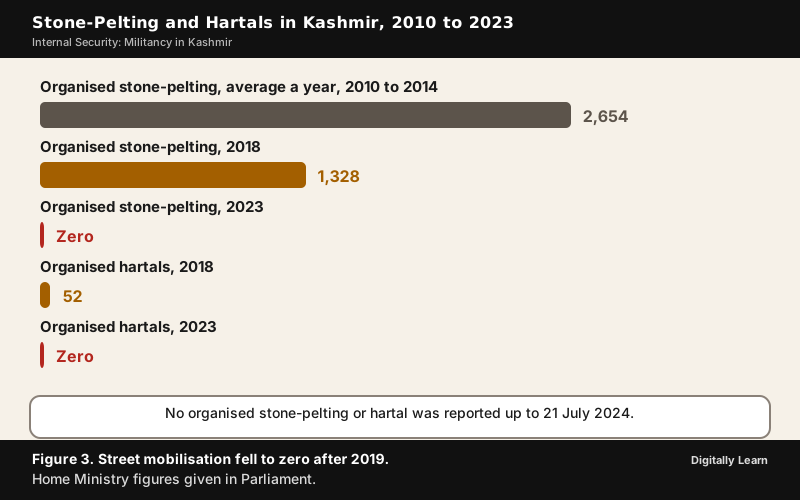
Street mobilisation was the visible face of separatism. From 2010 to 2014 an average of 2,654 incidents of organised stone-pelting took place each year. In 2018 there were still 1,328 incidents of organised stone-pelting and 52 organised hartals. Both stood at zero in 2023, and no organised stone-pelting or hartal was reported up to 21 July 2024. In March 2025 the Home Minister told the Rajya Sabha that stone-pelting had killed 112 civilians and injured 6,000 before it stopped.
Crowd control raised its own questions of rights. After the killing of Burhan Wani in 2016, the widespread use of pellet guns was criticised for causing eye injuries among civilians, and human rights organisations have long questioned the conduct of the security forces. Both points stand: The decline in street violence is clear from the official data, and the credibility of the state also depends on accountable policing.
Mainstreaming Jammu and Kashmir After 2019
Articles 370 and 35A Before and After August 2019
Before August 2019 Article 370 gave the State its own constitution, its own flag and autonomy in internal administration. Parliament's power to make laws was limited to those matters in the Union and Concurrent Lists that the President, in consultation with the State government, declared to correspond to the Instrument of Accession. Article 35A, added through the Presidential Order of 1954, empowered the State legislature to define the privileges of permanent residents in immovable property, settlement and employment.
On 5 August 2019 a Presidential Order, issued with the concurrence of the State government, superseded the 1954 order and made all provisions of the Constitution applicable to the State. Both Houses of Parliament then adopted a resolution recommending that the President make Article 370 inoperative, and an order of 6 August made all its clauses except clause 1 inoperative. The Jammu and Kashmir Reorganisation Act, 2019, divided the State into two Union Territories, Jammu and Kashmir and Ladakh, both of which came into existence on 31 October 2019. Article 35A was abrogated along with Article 370, and the permanent-resident privileges it protected ended. On 11 December 2023 a five-judge Constitution Bench of the Supreme Court unanimously upheld the abrogation.
The government's case is that the old arrangement was a structural cause of separatism; the Home Minister called Article 370 the root cause of separatism in Kashmir. The earlier debate had two sides. One section of opinion held that the special status prevented the full integration of the State and wanted Article 370 revoked. Another section, mostly in Kashmir, held that the autonomy was insufficient, citing the unfulfilled promise of a reference to the people, the erosion of the State's special federal status in practice, and the feeling that democracy had not been institutionalised there.
Governance, Elections and Development Since 2019
The steps taken to bring Jammu and Kashmir into the national mainstream fall into three groups:
- Constitutional and legal integration: All national laws were adopted in the region, an Anti-Corruption Bureau was established, and the Jammu and Kashmir Official Languages Act, 2020, made Kashmiri, Dogri, Hindi, Urdu and English the five official languages of the Union Territory.
- Democratic process: In December 2023 the Supreme Court directed the Election Commission to restore the democratic process by 30 September 2024, and the Assembly election, the first in more than a decade, followed in three phases from 18 September to 1 October 2024. The results were declared on 8 October 2024; the National Conference won 42 of the 90 seats, and Omar Abdullah took office as the first Chief Minister of the Union Territory. The Home Minister has reported that the region now has 34,262 elected representatives.
- Development and employment: A new Central Sector Scheme with an outlay of ₹28,400 crore was notified on 19 February 2021 to promote industry. In 2015 the Prime Minister approved 63 major projects worth about ₹80,000 crore for Jammu and Kashmir; more than ₹51,000 crore has been invested and 53 projects have been completed. More than 41,000 government jobs were created between 2019 and May 2026. Jammu and Kashmir recorded more than 2.3 crore tourist arrivals in 2024, the highest in its history.
Emotional integration has also been part of the effort, for example through the Watan Ko Jano programme, under which 250 children from Jammu and Kashmir travelled to experience the country's cultural diversity.
Counter-Terror Operations in Jammu and Kashmir
Chinar Corps, Rashtriya Rifles, CRPF and Jammu and Kashmir Police
Counter-terror operations depend on several forces working together as a single grid. The Army's Chinar Corps, based in Srinagar, is responsible for military operations in the Kashmir Valley, and Kilo Force and Victor Force of the Rashtriya Rifles are under its operational control. Most counter-terror operations are led by the Army, with the CRPF and the Special Operations Group, the anti-insurgency force of the Jammu and Kashmir Police created in the early 1990s, providing perimeter security and crowd control. Other Central Armed Police Forces, such as the Border Security Force, are also deployed, and the NIA investigates major cases. Operation Mahadev of July 2025 is a recent example of this joint working.
The government's declared methods include:
- Nakas: Round-the-clock checkpoints at strategic locations, and group security in the form of static guards.
- Cordon and search: Intensified Cordon and Search Operations (CASO), with day and night area domination.
- Intelligence: Real-time sharing among all security forces.
- Counter-infiltration: A multi-pronged strategy to prevent infiltration, an enhanced counter-insurgency grid and modernised equipment.
- Area Domination Plan and Zero Terror Plan: The Home Minister directed in April 2025 that both be implemented in mission mode.
The Armed Forces (Jammu and Kashmir) Special Powers Act, 1990, applies in the Union Territory. The Army holds that revoking it would harm security in the Valley, while human rights organisations such as Amnesty International have criticised it.
LoC Ceasefire and the Fall in Terror Violence Since 2018
The LoC is the front line of the grid, and its quiet depends on ceasefire understandings. On 25 February 2021 the Directors General of Military Operations of India and Pakistan agreed to observe all agreements and understandings strictly and to cease firing along the Line of Control and in all other sectors from the midnight of 24‑25 February 2021. They also agreed to use the hotline and border flag meetings to resolve any unforeseen situation. The hostilities of May 2025 after the Pahalgam attack showed how quickly that quiet can break.
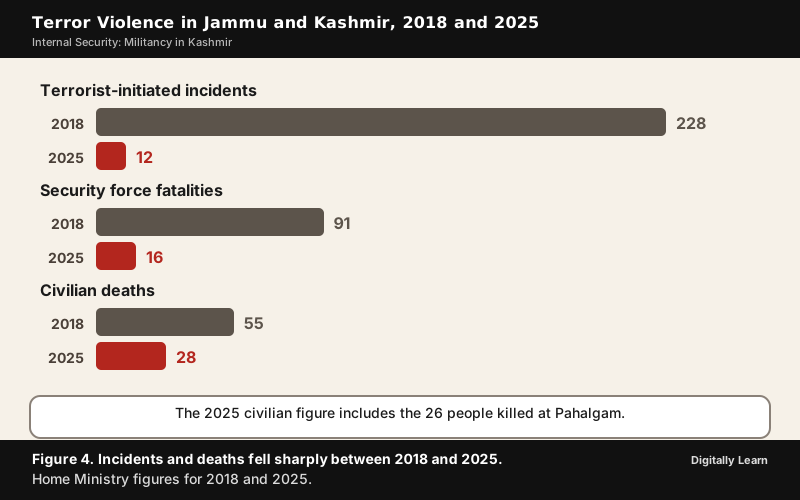
Terrorist-initiated incidents fell from 228 in 2018 to 12 in 2025, and security-force fatalities from 91 in 2018 to 16 in 2025. Civilian deaths in terror-related incidents were 28 in 2025, compared with 55 in 2018; the 2025 figure includes the victims of Pahalgam. In February 2026 the Home Minister said that the terror ecosystem had been almost crippled and set the goal of a terror-free Jammu and Kashmir, which shows that the government itself does not regard the task as complete.
Previous Year UPSC‑CSE Questions
Each question comes with an answer outline.
- UPSC Mains 2026 GS‑IIISeparatist movements have been one of the major factors contributing to militancy and instability in Jammu & Kashmir (J & K). Bring out actions taken by the Government to bring J & K into national mainstream. Discuss pre and post abrogation status of Articles 370 and 35A. Also bring out positive impacts of abrogation of both articles in mainstreaming the state.
Answer outline
The outline sets out what the question asks, the main arguments, relevant examples and the direction of the conclusion; it is not a full model answer.
Introduction: Separatist politics, led by the Hurriyat, and Pakistan-backed militancy fed each other from 1989.
Body (sub-themes to develop):
- Actions: UAPA bans on separatist bodies, action on terror finance and OGWs, the security grid, the 2021 ceasefire understanding, constitutional integration in 2019, Assembly elections in 2024.
- Before 2019: A separate constitution; Parliament limited to Instrument of Accession matters; Article 35A (1954) on permanent residents' privileges.
- After 2019: Presidential Orders of 5 and 6 August, the Reorganisation Act, two Union Territories from 31 October 2019, upheld by the Supreme Court on 11 December 2023.
- Impacts: Fall in violence, end of organised stone-pelting and hartals, elections, the ₹28,400 crore industry scheme, jobs and record tourist arrivals.
Conclusion: Mainstreaming has advanced, but the Pahalgam attack shows that the security task is not finished.
- UPSC Mains 2019 GS‑IIIThe banning of 'Jamaat-e-Islami' in Jammu and Kashmir brought into focus the role of over-ground workers (OGWs) in assisting terrorist organizations. Examine the role played by OGWs in assisting terrorist organizations in insurgency affected areas. Discuss measures to neutralize influence of OGWs.
Answer outline
Introduction: Over-ground workers help militants with logistics, cash, shelter and information while appearing to lead ordinary lives; the term is operational, not legal.
Body (sub-themes to develop):
- Role: Guides and safe houses, funding, ideological and radicalisation support, recruitment, real-time information, false allegations against forces.
- Measures: UAPA declarations (Jamaat-e-Islami on 28 February 2019, extended on 27 February 2024), attachment of property and terror-finance action, categorised policing with Public Safety Act detention for the most serious, de-radicalisation and youth engagement.
Conclusion: Action must follow the law and evidence so that local trust is not lost.
Sources
- NCERT: Politics in India since Independence, Class 12, Chapter 7, Regional Aspirations (Reprint 2026‑27)
- NCERT: Politics in India since Independence, Class 12, Chapter 4, India's External Relations (Reprint 2026‑27)
- Press Information Bureau: Terrorism in Jammu and Kashmir (30 July 2024)
- Press Information Bureau: Home Minister chairs a high-level security review meeting on Jammu and Kashmir in Srinagar (8 April 2025)
- Press Information Bureau: Home Minister chairs a high-level meeting in New Delhi to review the security situation in Jammu and Kashmir (9 October 2025)
- Press Information Bureau: Securing the Nation, 12 Years of India's Zero Tolerance Against Terror, a PIB backgrounder (19 June 2026)
- Press Information Bureau: Army Chief Reviews Security Situation in Kashmir (21 May 2022)
- Press Information Bureau: Decline in Terror Incidents in Jammu and Kashmir (19 December 2023)
- Press Information Bureau: Designation of Organisations and Individuals as Terrorist Organisations and Terrorists under the Unlawful Activities (Prevention) Act, 1967 (17 February 2023)
- Press Information Bureau: Joint Statement of the Directors General of Military Operations of India and Pakistan (25 February 2021)
- Press Information Bureau: Infiltration and Terrorist Attacks in Jammu and Kashmir (1 December 2021)
- Press Information Bureau: Government declares Jamaat-e-Islami Jammu Kashmir an Unlawful Association for a Further Period of Five Years (27 February 2024)
- Press Information Bureau: Government declares Jammu and Kashmir Ittihadul Muslimeen and Awami Action Committee Unlawful Associations (11 March 2025)
- Press Information Bureau: Ministry of Home Affairs declares Muslim League Jammu Kashmir (Masarat Alam faction) an Unlawful Association (27 December 2023)
- Press Information Bureau: Home Minister chairs a high-level security review meeting on Jammu and Kashmir in Jammu (6 February 2026)
- Press Information Bureau: Home Minister replies to the discussion on the working of the Ministry of Home Affairs in the Rajya Sabha (21 March 2025)
- Press Information Bureau: Home Minister in the Lok Sabha special discussion on India's response to the Pahalgam terrorist attack through Operation Sindoor (29 July 2025)
- Press Information Bureau: Operation Sindoor, India's Strategic Clarity and Calculated Force (14 May 2025)
- Press Information Bureau: Operation Sindoor, Indian Armed Forces Carried Out Precision Strike at Terrorist Camps (7 May 2025)
- Press Information Bureau: Unlawful Organizations, written reply in the Lok Sabha (6 February 2024)
- Press Information Bureau: Year End Review 2023 of the Ministry of Home Affairs (31 December 2023)
- Press Information Bureau: Year End Review 2025 of the Ministry of Home Affairs (31 December 2025)
- Wikipedia: 1987 Jammu and Kashmir Legislative Assembly election
- Wikipedia: Armed Forces (Special Powers) Act
- Wikipedia: Akhnoor
- Wikipedia: All Parties Hurriyat Conference
- Wikipedia: Indian Armed Forces in Jammu and Kashmir
- Wikipedia: Indian Army operations in Jammu and Kashmir
- Wikipedia: Article 370 of the Constitution of India
- Wikipedia: Burhan Wani
- Wikipedia: Dogri language
- Wikipedia: 2024 Jammu and Kashmir Legislative Assembly election
- Wikipedia: Hizbul Mujahideen
- Wikipedia: Insurgency in Jammu and Kashmir
- Wikipedia: Jaish-e-Mohammed
- Wikipedia: Jammu Kashmir Liberation Front
- Wikipedia: Kargil War
- Wikipedia: Lashkar-e-Taiba
- Wikipedia: Line of Control
- Wikipedia: Over ground worker
- Wikipedia: 2025 Pahalgam attack
- Wikipedia: Exodus of Kashmiri Hindus
- Wikipedia: 2001 Indian Parliament attack
- Wikipedia: 2019 Pulwama attack
- Wikipedia: Kidnapping of Rubaiya Sayeed
- Wikipedia: The Resistance Front
- Wikipedia: 2016 Uri attack
- Wikipedia: XV Corps (India)
- United Nations Security Council: Resolution 47, The India-Pakistan Question (21 April 1948)
- The Hindu: J&K Assembly passes resolution on Statehood, BJP MLAs stage walkout (29 September 2026)
- The Hindu: State of Anticipation, editorial (30 September 2026)
- UPSC: Civil Services Examination Question Papers
Editorial Disclaimer
This article draws on the current NCERT textbook, Home Ministry and Defence Ministry releases, the United Nations and Wikipedia. It follows India's official position on Jammu and Kashmir. Figures are as the dated official releases give them.
See more of our UPSC articles in Google Search
Add to Preferred Sources

