


Overview
Naxalism took root in the forested, mineral-rich and largely tribal districts of central and eastern India, and the causes of Naxalism lie in what happened there. Land passed out of tribal hands, forests were closed to the people who lived in them, and the administration arrived late or not at all. Naxalism, also called Left-Wing Extremism (LWE), is an armed movement inspired by Maoist ideology. It began at Naxalbari in West Bengal in 1967 and spread across a belt of States known as the Red Corridor. The government describes it as rooted in socio-economic inequality and sustained by Maoist ideology.
Linkage Between Development and the Spread of Extremism
Relative Deprivation, Governance Deficit and Violent Mobilisation
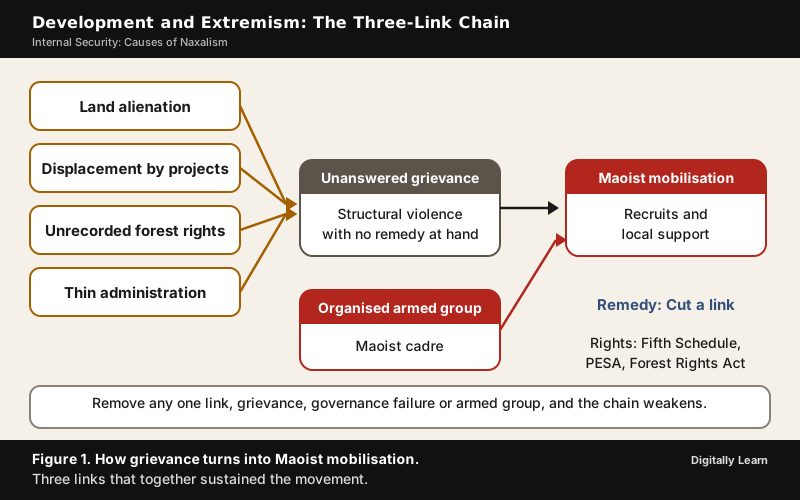
Extremism takes root in some places and not in others. The difference is usually explained as a chain of three links, namely a deep grievance, a failure of governance that leaves the grievance unaddressed, and an organised group that offers to redress it by force. If any one link is removed, the chain weakens. The same chain runs through India's other regional and separatist insurgencies, but in the tribal districts of central India each link was unusually strong.
The grievance is relative deprivation, the gap between what a community believes it is entitled to and what it actually receives. In the tribal districts the gap was wide. The Planning Commission's Expert Group recorded in 2008 that about 40 per cent of rural households had no land or less than half an acre of it, and tribal communities lost land and forest to non-tribals and to projects. The failure of governance compounded the grievance. The Group found that the districts then classed as Naxal-affected suffered from a lack of proper governance and appropriate implementation of poverty amelioration programmes.
The third link is the armed group. The Marxist-Leninist (now Maoist) groups, or Naxalites, took to arms and insurgent techniques to overthrow the established political system. The same Expert Group describes the Naxalite movement as principally a political action for armed conquest of State power, and records that it has popular support in many areas. Radical groups justify their violence by pointing to structural violence, the harm built into an unequal social and economic order. The Group therefore advised that an honest response to radical violence must begin by reducing that structural violence, without condoning the violence itself.
Expert Group of the Planning Commission, 2008, on Development Challenges in Extremist Areas
In May 2006 the Planning Commission set up an Expert Group to examine the development issues behind discontent, unrest and extremism. The Group had 16 members, was chaired by D. Bandopadhyay and submitted its report, Development Challenges in Extremist Affected Areas, in April 2008. Its terms of reference named displacement, forest issues, insecure tenancies, usury, land alienation and the strengthening of PESA. Field visits covered Andhra Pradesh, Chhattisgarh, Bihar, Jharkhand and Odisha.
Its findings explain the grievances behind the movement. At the time, the Government of India had identified about 125 districts in 12 States as Naxal-affected. The Group identified land acquisition as the single largest cause of the involuntary displacement of tribal people and of their loss of land. Among the causes of tribal unrest it listed the absence of self-governance, forest policy, excise policy, land-related issues, multifaceted forms of exploitation, cultural humiliation and political marginalisation.
The Group also set out how the state should respond. Since the state cannot adopt the methods of armed cadres, it must act through the law, by implementing existing laws effectively and removing the basic causes of discontent. The law was weakest in matters of land, forests and the tribal safeguards that went unused.
Land, Forests and Displacement in the Tribal Heartland
Land Alienation and Tenancy Grievances
Land is the oldest grievance behind the movement; the Naxalbari uprising itself began in 1967 when peasants seized a plot of land from a jotedar, a wealthy landholder who let land to sharecroppers. Independent India's land reforms had three components, namely the abolition of intermediaries such as zamindars, security of tenure for tenants, and a ceiling on landholdings. The Expert Group found that the commitment weakened over time and that the effort to implement ceiling laws stopped two to three decades before its report.
The Group also recorded that nearly 40 per cent of land across India was cultivated by tenants, who lacked access to institutional credit and markets, and in most States tenancy laws failed to protect them.
In Scheduled Areas the problem is the transfer of land from tribal persons to non-tribals. Alienation occurs through threat, coercion, fraud, forgery and the general indebtedness of tribal persons to money-lenders. The Fifth Schedule allows the Governor to prohibit or restrict such transfers, and the Fifth Schedule States have laws against alienation that also provide for restoration. Yet the Group observed that these laws were riddled with loopholes, that the States had not amended them to remove those loopholes, and that pressure was growing to dilute them to allow private companies to lease mineral-bearing land.
Debt is usually the first step towards the loss of land. The Group named usury and indebtedness, along with land alienation and bonded labour, as chief causes of acute distress and exploitation. A tribal family that borrows for food or a ceremony, repays on unfair terms and finally loses its field is the typical case that the Fifth Schedule's regulation of money-lending was meant to prevent.
Mining, Industrial Projects and Development-Induced Displacement
Development-induced displacement is the second major cause. Displacement means enforced eviction from land and natural habitat, and it has followed large irrigation projects, industrial and mining projects, power plants, sanctuaries and national parks, and firing ranges. Unofficial studies, notably by Walter Fernandes, put the number displaced at around 6 crore people (60 million) for 1947 to 2004, involving 25 million hectares, which includes 7 million hectares of forest and 6 million of other common property resources.
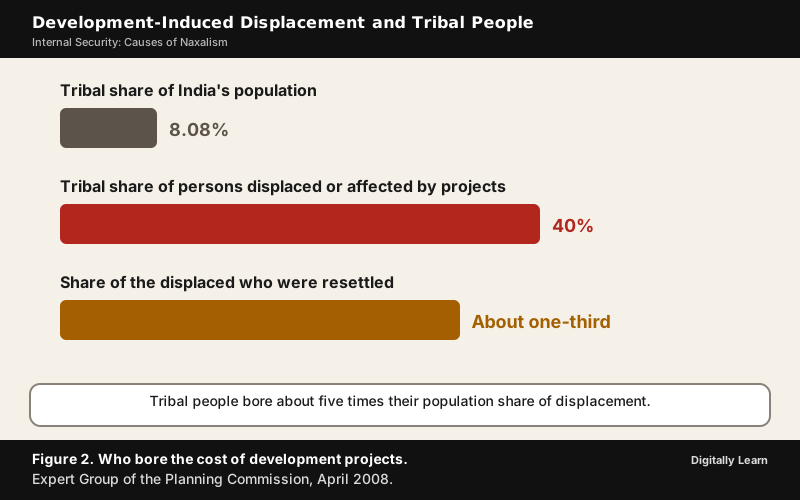
The burden has fallen disproportionately on tribal people. The Expert Group records that tribal people constitute 8.08 per cent of the country's population but 40 per cent of the displaced or affected persons, and that only about a third of the displaced of planned development have been resettled. Tribal areas are also rich in minerals, so mining projects proposed in Odisha, Jharkhand and Chhattisgarh threaten the existence of tribal communities and provoke protest, as at Kalinganagar and in the Kashipur movement against the Utkal Alumina project in Rayagada.
Malkangiri district in southern Odisha shows several of these pressures in one place. Carved out of Koraput on 2 October 1992, it had a Scheduled Tribe share of 57.83 per cent and a literacy rate of 49.49 per cent in the 2011 census, and in 2006 the Ministry of Panchayati Raj named it one of the country's 250 most backward districts.
Two large state projects were sited in Malkangiri. The Dandakaranya Project settled refugees from East Pakistan there from 1958 until 1988, and the Balimela reservoir on the Sileru, a joint project of Andhra Pradesh and Odisha, was completed in 1977. The district became a centre of Maoist activity, and in April 2025 it was still one of six Districts of Concern.
A further point is specific to Scheduled Areas. Unless tribal people are resettled within the same Scheduled Area, they lose the special rights that the Schedule gives them. For this reason the Group advised that projects causing displacement in notified areas be avoided and, where public interest makes a project inevitable, be undertaken with the prior consent of the Gram Sabhas. The Right to Fair Compensation and Transparency in Land Acquisition, Rehabilitation and Resettlement Act, 2013, later made social impact assessment and consent part of acquisition.
Forest Laws and the Historical Injustice to Forest Dwellers
Forest law created a third grievance. The Indian Forest Act, 1927, empowers the government to declare reserved, protected or village forests, and the Wild Life (Protection) Act, 1972, provides for national parks and sanctuaries. Both require a forest settlement officer to inquire into the claims of people living in the area and either allow them or extinguish them with compensation.
In many places the settlement was never carried out or was carried out poorly: 82.9 per cent of the forest blocks in undivided Madhya Pradesh had not been settled as of December 2003, and all the hilly tracts of Odisha were declared government forests without a survey. A family whose right was not recorded could be evicted at any time.
The Forest Rights Act, 2006, itself acknowledges the problem. Its preamble states that the forest rights on ancestral lands were not adequately recognised in the consolidation of State forests during the colonial period as well as in independent India, resulting in historical injustice to forest dwelling Scheduled Tribes and other traditional forest dwellers, who are integral to the survival and sustainability of the forest ecosystem. It adds that insecurity of tenurial and access rights had to be addressed, including for those forced to relocate because of State development interventions.
The consequences for security were direct. The Expert Group describes landless Muria and Gothi Koya adivasis of Chhattisgarh crossing into the forests of Khammam in Andhra Pradesh in search of land, with the support of the Naxalites, while forest and police departments set their hamlets on fire in incident after incident from 1989 until about 2002. Where the state appeared only in the form of a forest guard or a policeman, an armed group that sheltered evicted families gained a following. The Group therefore recommended the withdrawal of all petty cases registered against tribal people under forest legislation.
Fifth Schedule and PESA: Tribal Safeguards Left Unused
Article 244 and the Fifth Schedule: Governor and Tribes Advisory Council
Article 244 provides a special system of administration for certain areas. Clause (1) applies the Fifth Schedule to the administration and control of Scheduled Areas and Scheduled Tribes in any State other than Assam, Meghalaya, Tripura and Mizoram; those four States are covered by the Sixth Schedule, which provides for autonomous districts. The President declares an area to be a Scheduled Area by order, and can later alter, enlarge or rescind it in consultation with the Governor. Scheduled Areas are notified in 10 States, namely Andhra Pradesh, Chhattisgarh, Gujarat, Himachal Pradesh, Jharkhand, Madhya Pradesh, Maharashtra, Odisha, Rajasthan and Telangana.
Of the 38 districts on the April 2024 list of LWE-affected districts, 35 lay in the 10 States with Scheduled Areas; the other three were in Kerala and West Bengal.
The Schedule places a special responsibility on the Governor. The executive power of the State extends to its Scheduled Areas, but the Governor must report annually, or whenever the President requires, on their administration, and the executive power of the Union extends to giving directions to the State about them. Each such State must have a Tribes Advisory Council of up to 20 members, about three-fourths of them Scheduled Tribe representatives in the Legislative Assembly, which advises on matters of tribal welfare that the Governor refers to it.
Paragraph 5 gives the Governor two powers, the most important in the Schedule.
- Adapting laws: By public notification the Governor may direct that an Act of Parliament or of the State Legislature shall not apply to a Scheduled Area, or shall apply with exceptions and modifications, even with retrospective effect.
- Regulations: The Governor may make regulations for the peace and good government of a Scheduled Area that prohibit or restrict the transfer of land by or among Scheduled Tribe members, regulate the allotment of land to them, and regulate money-lending.
Such a regulation can repeal or amend an Act, is made after consulting the Tribes Advisory Council, and needs the President's assent.
The Constitution requires the President to appoint a commission on the administration of Scheduled Areas; two have been appointed, the Dhebar Commission in 1960 and the Bhuria Commission, chaired by Dilip Singh Bhuria, in 2002.
PESA 1996: Gram Sabha Powers Over Land and Minor Forest Produce
Part IX of the Constitution on Panchayats, added by the 73rd Amendment in 1993, did not by itself extend to the Fifth Schedule areas. Parliament enacted PESA (Act 40 of 1996) on 24 December 1996 to extend Part IX to those areas with exceptions and modifications. The Act uses the definition of Scheduled Areas in Article 244(1), and under it no State law on Panchayats may be inconsistent with the features of section 4.
Section 4 places the Gram Sabha at the centre of local government. State panchayat law must follow customary law and traditional management of community resources, and a village is ordinarily a habitation or hamlet managing its affairs by tradition. Every Gram Sabha is competent to safeguard traditions, cultural identity, community resources and customary dispute resolution; it approves plans, programmes and projects before the village Panchayat takes them up; it identifies beneficiaries under poverty alleviation programmes; and the village Panchayat must obtain from it a certification of the utilisation of funds. Seats for Scheduled Tribes must be at least one-half of the total in every Panchayat, and all Chairperson posts at every level are reserved for them.
The clauses on land and natural resources bear most directly on extremism. The Gram Sabha or Panchayat must be consulted before land is acquired in Scheduled Areas for development projects and before persons affected are resettled. Its recommendation is mandatory before a prospecting licence or mining lease for minor minerals is granted, and before a concession for minor minerals is auctioned.
The States must endow it with the power to enforce prohibition or to regulate or restrict the sale and consumption of any intoxicant, the ownership of minor forest produce, the power to prevent alienation of land and restore unlawfully alienated land, control of village markets and of money-lending to Scheduled Tribes, control over social-sector institutions, and control over local plans including tribal sub-plans.
Non-Implementation of the Fifth Schedule and the Growth of LWE
These safeguards were strong on paper but weak in practice. The Expert Group of 2008 wrote that the Fifth Schedule has great potential for a flexible and comprehensive frame of administration, but that this potential remains largely unexplored, and that instances of Governors using the paragraph 5(1) power to adapt laws are few and far between. On PESA it recorded that no worthwhile action had been taken by the States concerned on prevention of land alienation and the restoration of alienated land, and that no State had acted on the ownership of minor forest produce.
The Union also paid little attention to PESA. In 1997 only two ministries issued guidelines to the States, one on the Gram Sabha's role in land acquisition and one on leases for minor minerals, and no further action followed. Andhra Pradesh, the first State to frame rules under PESA, did so only in 2011.
These failures left a vacuum, and extremism grew in it. Where the Governor's regulations were not used, land flowed out of tribal hands. Where the Gram Sabha was ignored, mining leases and projects were decided far away, and displaced families had no forum. Where tribal complaints went unheard, an armed group that promised summary justice found support. The Group concluded that effective implementation of PESA, giving the Gram Sabha its rightful role, would remove much of the discontent among tribal people in the Scheduled Areas, and recommended that the entire Tribal Sub Plan area be brought under the Fifth Schedule. Non-implementation was a contributing cause rather than the only one, since the movement also had political aims.
| Instrument | What it provides | Who acts | Gap in practice |
|---|---|---|---|
| Fifth Schedule (Article 244(1)) | Governor's power to adapt or exclude laws; regulations on land transfer, allotment and money-lending; Tribes Advisory Council | Governor, with the Council, and the President's assent to regulations | Paragraph 5(1) used rarely; land-transfer laws had loopholes |
| PESA, 1996 | Gram Sabha powers to prevent land alienation, own minor forest produce, recommend on minor minerals, and be consulted on acquisition | State legislatures through their Panchayat laws; Gram Sabha | Rules framed late (Andhra Pradesh, the first State, in 2011); no State action on land alienation or minor forest produce by 2008 |
| Forest Rights Act, 2006 | Individual and community forest rights; rights over minor forest produce; the Gram Sabhas' written consent before resettlement from a critical wildlife habitat | Gram Sabha starts the claim; Sub-Divisional and District Level Committees decide | Clarifications in the draft Rules deleted from the final Rules of 1 January 2008; narrow State definition of affected people (Niyamgiri) |
Forest Rights Act 2006 and the Samatha Judgment
Individual and Community Forest Rights
The Scheduled Tribes and Other Traditional Forest Dwellers (Recognition of Forest Rights) Act, 2006 (Act 2 of 2007), was passed in December 2006, brought into force on 31 December 2007, and supplemented by Rules on 1 January 2008. Section 3(1) lists the forest rights, which secure individual or community tenure on all forest lands. They include the following rights:
- Land: To hold and live in forest land for habitation or self-cultivation.
- Community use: Nistar, the customary household use of the forest, and other community rights.
- Minor forest produce: Ownership of it, and access to collect, use and dispose of it.
- Grazing and fishing: The rights of pastoral and fishing communities.
- Habitat: Habitat rights for primitive tribal groups.
- Revenue villages: Conversion of pattas, the land-title deeds, and of forest villages into revenue villages.
- Community forest resource: The right to protect, regenerate, conserve or manage a community forest resource, the forest that a village has traditionally used and protected.
- Rehabilitation: A right to in situ rehabilitation for those illegally evicted before 13 December 2005.
No one may be resettled from a critical wildlife habitat without the free and informed consent of the Gram Sabhas, given in writing (section 4(2)).
The Expert Group of 2008 regretted that clarifications in the draft Rules, meant to ease the Act's implementation, had been deleted from the final Rules notified on 1 January 2008.
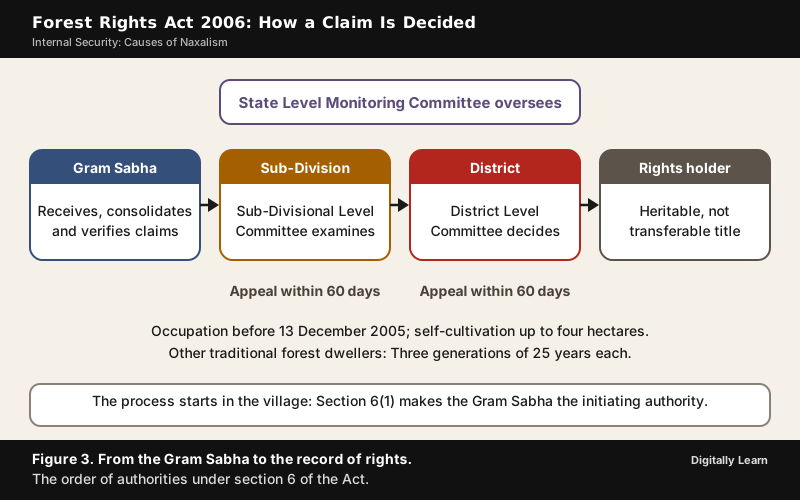
The Act sets specific limits. Rights are recognised only for those who occupied forest land before 13 December 2005. A person claiming as an other traditional forest dweller must have lived in the forest for at least three generations, a generation being 25 years. Land held for self-cultivation cannot exceed four hectares. A right is heritable but not alienable or transferable, and it is registered jointly in the names of both spouses. Rights are conferred without the need for clearance under the Forest (Conservation) Act, 1980, and no one may be evicted until recognition and verification are complete.
The procedure begins in the village. Under section 6(1), the Gram Sabha is the authority that initiates the process of determining the nature and extent of rights, by receiving claims, consolidating and verifying them and preparing a map. Appeals within 60 days go to a Sub-Divisional Level Committee and then a District Level Committee, whose decision is final and binding, and a State Level Monitoring Committee oversees the process. These committees consist of officers of the Revenue, Forest and Tribal Affairs departments and three members of Panchayati Raj Institutions, of whom two are Scheduled Tribe members and at least one is a woman.
Samatha 1997 and Niyamgiri 2013: Consent of the Gram Sabha
Two judgments connect these legal protections to the mining disputes that fuelled conflict. The Samatha judgment of 1997 (reported as Samatha v. State of Andhra Pradesh) decided a challenge by the organisation Samata to the leasing of tribal land in Scheduled Areas to private mining companies.
After the High Court dismissed the case, the matter went to the Supreme Court. In July 1997 a three-judge bench held that the word "person" in the law restricting land transfers in the Scheduled Areas covers natural persons, juristic persons such as companies, and the government itself. A lease by the government is therefore a transfer that the law controls, and the Court declared all lands leased by the government or its agencies to private mining companies in the Scheduled Areas null and void.
Leases to the government's own instrumentalities were not affected. The Andhra Pradesh government then moved its Tribes Advisory Council to amend the Land Transfer Regulation of 1959, and the Supreme Court later dismissed petitions of the State and Union governments seeking modification of the order. The Expert Group of 2008 treated Samatha as the guiding principle for mining in Scheduled Areas.
The Niyamgiri case followed 16 years later. In Orissa Mining Corporation v. Ministry of Environment and Forest, a three-judge bench heard the Corporation's challenge to the Environment Ministry's order of 24 August 2010 on a bauxite project in the Niyamgiri hills, which are home to the Dongria Kondh. On 18 April 2013 the Court directed Odisha to place the customary and religious claims of the Dongria Kondh and other forest dwellers before the Gram Sabhas, which were to decide within three months; a district judge observed the proceedings to ensure that they were independent of the project proponents and the governments.
- Gram Sabha vote: In all, 12 Gram Sabhas met, seven in Rayagada and five in Kalahandi, and all voted against the project.
- Affected people: The Court had observed that the State's narrow definition of Project Affected People ran contrary to the letter and spirit of the Forest Rights Act.
The Court did not itself ban the mine. It made the Gram Sabha the decision-maker on the claims, and the Ministry was to decide on the final clearance in the light of the Gram Sabha's decisions. The lesson for internal security is clear: Where the law is followed and villages are heard, a conflict can be settled by a vote rather than by force.
Development as Counter-Extremism: What Worked
Roads, Mobile Towers, Banking and Schools in Affected Districts
If isolation sustained the movement, connectivity is part of the remedy. The government holds that Naxalism prevented education, healthcare, connectivity, banking and postal services from reaching remote tribal villages, and it has responded with an infrastructure programme in the affected districts, on the following scale by 2026.
- Roads: A total of 15,189 km of roads has been built under the two LWE-specific schemes, the Road Requirement Plan and the Road Connectivity Project for LWE Affected Areas.
- Mobile towers: In all, 9,497 towers have been commissioned, and 96 per cent of villages in the areas that were most affected now have mobile connectivity.
- Banking: From April 2015 to March 2026, 1,804 bank branches were opened, 1,321 ATMs installed and 74,720 banking correspondents appointed, and 6,025 post offices with banking services were opened.
- Schools and skills: Of 259 Eklavya Model Residential Schools sanctioned, 179 are functional, and 47 Industrial Training Institutes and 49 Skill Development Centres were developed.
- Special funds: Special Central Assistance, which fills gaps in public infrastructure, allotted ₹30 crore to each most affected district and ₹10 crore to each District of Concern (April 2025). About ₹4,289.20 crore had been released under the scheme since 2017.
Development in these districts depended on security. The Special Infrastructure Scheme has funded State Special Forces, Special Intelligence Branches, district police and fortified police stations. The six Districts of Concern named in April 2025 included Kalahandi, Kandhamal and Malkangiri in Odisha, which shows that the work was unfinished even where the list of most affected districts had shrunk. The rest is the task of the civil administration, particularly the delivery of forest rights and PESA entitlements; the security forces create the conditions in which it can work.
Aspirational Districts and Saturation of Schemes
The Aspirational Districts Programme was launched in January 2018 and is anchored by NITI Aayog with the Union ministries, the States and district administrations. It covers 117 districts and tracks 49 key performance indicators under five themes, namely health and nutrition, education, agriculture and water resources, financial inclusion and skill development, and basic infrastructure. A public dashboard, Champions of Change, publishes the districts' progress. Several LWE-affected districts, such as Gadchiroli, are on the list. Mobile towers have been approved for the LWE-affected districts on the list under the 4G scheme for Aspirational Districts and a 4G saturation scheme; saturation means extending a scheme to every eligible village and household, not only to the most accessible ones.
The results against extremism can be measured in two ways. The first is geographical. The number of LWE-affected districts fell from 126 in 2014 to 38 in April 2024, and since April 2026 no district has been classed as LWE-affected. The second is the level of violence: Incidents fell from 1,936 in 2010 to 234 in 2025.
The Government had set 31 March 2026 as the target for ending LWE. Two watch categories remain outside that classification. In July 2026 the Home Ministry reported 37 Legacy and Thrust districts, no longer affected but still receiving security and development support, and one District of Concern, where violence has been contained but surveillance continues. The development schemes ran alongside a security strategy, from the National Policy and Action Plan of 2015 to the SAMADHAN doctrine of 2017, the Home Ministry's eight-point plan for security operations.
Two cautions complete the picture. First, a purely security-based approach has costs. The Supreme Court on 5 July 2011 declared the Salwa Judum militia in Chhattisgarh illegal and unconstitutional and ordered its disbandment, and the Expert Group had warned against vigilante groups that set tribal people against one another. Second, the gains will last only if rights are delivered. A road to a village is no substitute for a recognised forest right or for a Gram Sabha whose voice is heard.
Previous Year UPSC‑CSE Questions
Each Prelims question is explained option by option, and each Mains question comes with an answer outline.
- UPSC Prelims 2025With reference to the Constitution of India, if an area in a State is declared as Scheduled Area under the Fifth Schedule
- I. the State Government loses its executive power in such areas and a local body assumes total administration
- II. the Union Government can take over the total administration of such areas under certain circumstances on the recommendations of the Governor
Which of the statements given above is/are correct?
How to approach this Prelims question
Approach: Read the two statements against paragraphs 2 and 3 of the Fifth Schedule.
- Statement I is wrong because paragraph 2 says the executive power of a State extends to its Scheduled Areas; no local body takes over the administration.
- Statement II is wrong because paragraph 3 extends the executive power of the Union only to giving directions to the State about the administration of the areas; it provides for no Union takeover.
Trap to watch: Assuming that special protection means the State loses control of the area.
Why each option is right or wrong:
- (a) I only: Wrong. Paragraph 2 keeps the State's executive power in Scheduled Areas.
- (b) II only: Wrong. Paragraph 3 allows the Union to give directions, not to take over the administration.
- (c) Both I and II: Wrong. Neither statement matches the Schedule.
- (d) Neither I nor II: Correct. The State keeps executive power and the Union only gives directions.
Answer: (d) Neither I nor II. Paragraph 2 keeps the State's executive power and paragraph 3 allows only directions from the Union.
- UPSC Prelims 2022If a particular area is brought under the Fifth Schedule of the Constitution of India, which one of the following statements best reflects the consequence of it?
How to approach this Prelims question
Approach: The Fifth Schedule deals with the administration and control of Scheduled Areas and Scheduled Tribes. Its paragraph 5(2) empowers the Governor to make regulations that prohibit or restrict the transfer of land by or among members of Scheduled Tribes, regulate the allotment of land to them and regulate money-lending. The executive power of the State continues in the area (paragraph 2), the Union only gives directions (paragraph 3), and the Tribes Advisory Council only advises (paragraph 4).
Trap to watch: Mixing up the Fifth Schedule with the Sixth Schedule's autonomous district councils.
Why each option is right or wrong:
- (a) This would prevent the transfer of land of tribal people to non-tribal people: Correct. Paragraph 5(2) allows regulations restricting land transfer, the main protective consequence.
- (b) This would create a local self-governing body in that area: Wrong. The Tribes Advisory Council only advises; autonomous district councils belong to the Sixth Schedule.
- (c) This would convert that area into a Union Territory: Wrong. Under paragraph 2 the executive power of the State extends to Scheduled Areas.
- (d) The State having such areas would be declared a Special Category State: Wrong. The Schedule concerns the administration of Scheduled Areas and changes nothing in a State's category.
Answer: (a) This would prevent the transfer of land of tribal people to non-tribal people. The Governor's power under paragraph 5(2) allows regulations that restrict the transfer of tribal land.
- UPSC Prelims 2013Under the Scheduled Tribes and Other Traditional Forest Dwellers (Recognition of Forest Rights) Act, 2006, who shall be the authority to initiate the process for determining the nature and extent of individual or community forest rights or both?
How to approach this Prelims question
Approach: Section 6(1) of the Forest Rights Act names the Gram Sabha as the authority to initiate the process of determining the nature and extent of rights, by receiving claims, consolidating and verifying them and preparing a map. The Sub-Divisional Level Committee then examines its resolution, and the District Level Committee gives the final decision.
Trap to watch: Choosing an official because officials sit on the committees; the first step belongs to the village.
Why each option is right or wrong:
- (a) State Forest Department: Wrong. Forest officers sit on the committees, but the first step belongs to the Gram Sabha.
- (b) District Collector/Deputy Commissioner: Wrong. The District Level Committee decides at the end, after the Gram Sabha and the Sub-Divisional Level Committee.
- (c) Tahsildar/Block Development Officer/Mandal Revenue Officer: Wrong. None of these officers is named as the initiating authority.
- (d) Gram Sabha: Correct. Section 6(1) makes it the authority that initiates the process.
Answer: (d) Gram Sabha. Under section 6(1) the Gram Sabha initiates the process.
- UPSC Prelims 2012In the areas covered under the Panchayat (Extension to the Scheduled Areas) Act, 1996, what is the role/power of Gram Sabha?
- Gram Sabha has the power to prevent alienation of land in the Scheduled Areas.
- Gram Sabha has the ownership of minor forest produce.
- Recommendation of Gram Sabha is required for granting prospecting licence or mining lease for any mineral in the Scheduled Areas.
Which of the statements given above is/are correct?
How to approach this Prelims question
Approach: Check each statement against section 4 of PESA.
- Statement 1 matches section 4(m)(iii), the power to prevent alienation of land and restore unlawfully alienated land of a Scheduled Tribe.
- Statement 2 matches section 4(m)(ii), ownership of minor forest produce.
- Statement 3 is wrong because section 4(k) makes the Gram Sabha's recommendation mandatory for a prospecting licence or mining lease for minor minerals only, not for any mineral.
So statements 1 and 2 are correct.
Trap to watch: Reading "any mineral" as the Act's wording; the Act says minor minerals.
Why each option is right or wrong:
- (a) 1 only: Wrong. Statement 2 is also correct under section 4(m)(ii).
- (b) 1 and 2 only: Correct. Statements 1 and 2 follow section 4(m)(iii) and (ii); statement 3 fails because the mandatory recommendation covers minor minerals only.
- (c) 2 and 3 only: Wrong. It leaves out statement 1 and includes statement 3, which is too wide.
- (d) 1, 2 and 3: Wrong. Statement 3 says any mineral, but section 4(k) refers to minor minerals.
Answer: (b) 1 and 2 only. The Gram Sabha's mandatory recommendation applies to minor minerals, not to every mineral.
- UPSC Mains 2022 GS‑IIINaxalism is a social, economic and developmental issue manifesting as a violent internal security threat. In this context, discuss the emerging issues and suggest a multilayered strategy to tackle the menace of Naxalism.
Answer outline
The outline sets out what the question asks, the main arguments, relevant examples and the direction of the conclusion; it is not a full model answer.
Introduction: Naxalism grows from a chain of three links, namely a grievance, a governance failure that leaves it unanswered, and an armed group that exploits it.
Body (sub-themes to develop):
- Social and economic roots: Land alienation, displacement, unrecorded forest rights and the 2008 Expert Group's findings.
- Emerging issues: A shrunken map with districts still under watch, mining pressure on Scheduled Areas, and the delivery of forest rights and PESA in cleared districts.
- Layered strategy: Rights (Fifth Schedule, PESA, the Forest Rights Act, the Niyamgiri model), development (roads, towers, banking, schools, Aspirational Districts), security and governance through the Gram Sabha.
Conclusion: Durable peace depends on delivering rights as well as services.
- UPSC Mains 2020 GS‑IIIWhat are the determinants of left-wing extremism in Eastern part of India? What strategy should Government of India, civil administration and security forces adopt to counter the threat in the affected areas?
Answer outline
Introduction: Left-Wing Extremism spread across the forested tribal districts of eastern and central India.
Body (sub-themes to develop):
- Determinants: Land alienation and tenancy; displacement by mining and projects; unrecorded forest rights; unused Fifth Schedule and PESA; thin administration; an organised political movement.
- Government of India: Development schemes for affected districts, Special Central Assistance, Aspirational Districts, roads, towers and banking, funds for police infrastructure.
- Civil administration: Forest rights and PESA through Gram Sabhas, restoration of alienated land, resettlement of displaced families, delivery of services.
- Security forces: Special forces and intelligence branches, fortified police stations, and no vigilante militias, as the 2011 Salwa Judum judgment held.
Conclusion: Security creates the space; rights and development make the gains last.
- UPSC Mains 2015 GS‑IIIThe persisting drives of the Government for development of large industries in backward areas have resulted in isolating the tribal population and the farmers who face multiple displacements. With Malkangiri and Naxalbari foci, discuss the corrective strategies needed to win the Left Wing Extremism (LWE) doctrine affected citizens back into the mainstream of social and economic growth.
Answer outline
Introduction: Tribal people were 8.08 per cent of the population but 40 per cent of those displaced or affected by projects, and only about a third were resettled.
Body (sub-themes to develop):
- Naxalbari: The land seizure of 1967 that began the movement and the land question behind it.
- Malkangiri: A tribal district (57.83 per cent Scheduled Tribe, literacy 49.49 per cent in 2011) that received the Dandakaranya Project's refugees and the Balimela reservoir, became a centre of Maoist activity and was still a District of Concern in April 2025.
- Corrective strategies: Avoid displacement in Scheduled Areas, consult the Gram Sabha, resettle fairly, recognise forest rights, restore alienated land and bring roads and services.
Conclusion: Confidence is won back through rights and services, not force alone.
- UPSC Mains 2013 GS‑IIIArticle 244 of Indian Constitution relates to Administration of Scheduled areas and Tribal areas. Analyze the impact of non-implementation of the provisions of fifth schedule on the growth of Left-Wing Extremism.
Answer outline
Introduction: Article 244(1) applies the Fifth Schedule to the Scheduled Areas of every State other than Assam, Meghalaya, Tripura and Mizoram.
Body (sub-themes to develop):
- Provisions: The Governor's paragraph 5 powers to adapt laws and to regulate land transfer, allotment and money-lending; the Tribes Advisory Council; the Governor's report to the President.
- Non-implementation: Paragraph 5(1) rarely used; land alienation continued through debt and fraud; mining leases and projects displaced tribal people; PESA rights over land and minor forest produce not acted on.
- Link to LWE: Unanswered grievances and a governance vacuum gave armed groups an opening, though the movement also had political aims.
Conclusion: Bringing the whole Tribal Sub Plan area under the Fifth Schedule and delivering PESA and the Forest Rights Act through the Gram Sabha would remove the grievance.
Sources
- Constitution of India: Fifth Schedule (Ministry of Tribal Affairs)
- Government of India: The Provisions of the Panchayats (Extension to the Scheduled Areas) Act, 1996
- National Commission for Scheduled Tribes: The Scheduled Tribes and Other Traditional Forest Dwellers (Recognition of Forest Rights) Act, 2006
- Planning Commission: Development Challenges in Extremist Affected Areas, Report of an Expert Group (April 2008)
- NCERT: Class 12 Politics in India since Independence, Chapter 6
- Press Information Bureau: Naxal-Free India backgrounder (1 August 2026)
- Press Information Bureau: Status of Naxalism in the Country, Rajya Sabha reply (29 July 2026)
- Press Information Bureau: From Red Corridor to Naxal-Free Bharat (13 December 2025)
- Press Information Bureau: India's Decisive Battle Against Left Wing Extremism (April 2025)
- NITI Aayog: Aspirational Districts Programme
- Wikipedia: PESA Act, 1996
- Wikipedia: Forest Rights Act, 2006
- Wikipedia: Orissa Mining Corporation v. Ministry of Environment and Forest
- Wikipedia: Niyamgiri
- Wikipedia: Scheduled Areas
- Wikipedia: Salwa Judum
- Wikipedia: Land Acquisition, Rehabilitation and Resettlement Act, 2013
- UPSC: Civil Services Examination question papers
Editorial Disclaimer
This article draws on the Constitution, the Acts it names, the Planning Commission's Expert Group report, Home Ministry releases, NITI Aayog and the Supreme Court's judgments. Development figures are as the dated official releases give them.
See more of our UPSC articles in Google Search
Add to Preferred Sources

