


Overview
Housing for All across rural and urban India
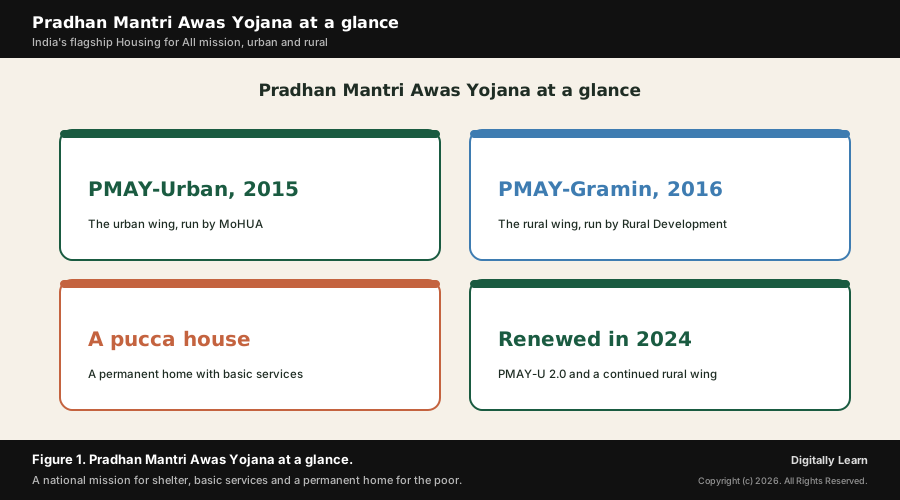
Pradhan Mantri Awas Yojana is India's flagship Housing for All mission, run as an urban wing (PMAY-Urban) under the Ministry of Housing and Urban Affairs and a rural wing (PMAY-Gramin) under the Ministry of Rural Development.
Pradhan Mantri Awas Yojana (PMAY) is the Government of India's flagship Housing for All mission, which aims to give every eligible poor family a pucca house with basic services. It runs through two wings. PMAY-Urban (PMAY-U), launched on 25 June 2015 and overseen by the Ministry of Housing and Urban Affairs, addresses the housing shortage of the urban poor and slum dwellers through four delivery options. PMAY-Gramin (PMAY-G), effective from 1 April 2016 and overseen by the Ministry of Rural Development, restructured the old Indira Awaas Yojana to build pucca rural homes, with beneficiaries drawn from the Socio Economic Caste Census. The mission has since been carried forward through PMAY-Urban 2.0, approved in 2024 to assist one crore more urban families, and a five-year continuation of PMAY-Gramin. It is a story of shelter, dignity and basic services as much as of houses.
What Pradhan Mantri Awas Yojana Is: A National Housing for All Mission
India's flagship housing mission and why it is in focus
Pradhan Mantri Awas Yojana is the Government of India's flagship effort to ensure that every poor household has a pucca house, a permanent home built of durable materials with basic services. The mission grew from a long-standing recognition that shelter is a foundation for health, education and a way out of poverty, and that a kutcha hut of mud and thatch leaves a family exposed to weather, disease and indignity. Its Housing for All promise places a finished home, not just a one-time grant, at the centre of welfare policy.
The mission runs through two wings that share one goal but face very different problems. PMAY-Urban, launched on 25 June 2015, is the urban wing, overseen by the Ministry of Housing and Urban Affairs, and it tackles the housing shortage of the urban poor, the slum dweller and the family that cannot afford a home in a costly city. PMAY-Gramin, effective from 1 April 2016, is the rural wing, overseen by the Ministry of Rural Development, and it builds pucca homes for rural families who live in kutcha or dilapidated houses.
Why it matters now is that the mission has been renewed and expanded rather than wound down. The urban wing has been recast as PMAY-Urban 2.0, approved in 2024 to assist one crore more urban families, while the rural wing has been continued for five more years with a fresh target of two crore additional houses. A flagship scheme that began in 2015 has thus become a long-running commitment, exactly the shift a good answer is expected to explore. The figure below sets out the headline facts.
PMAY-Urban: The Four Verticals, Income Categories and CLSS Interest Subsidy
In-Situ Slum Redevelopment, Credit Linked Subsidy, Affordable Housing in Partnership and Beneficiary-Led Construction
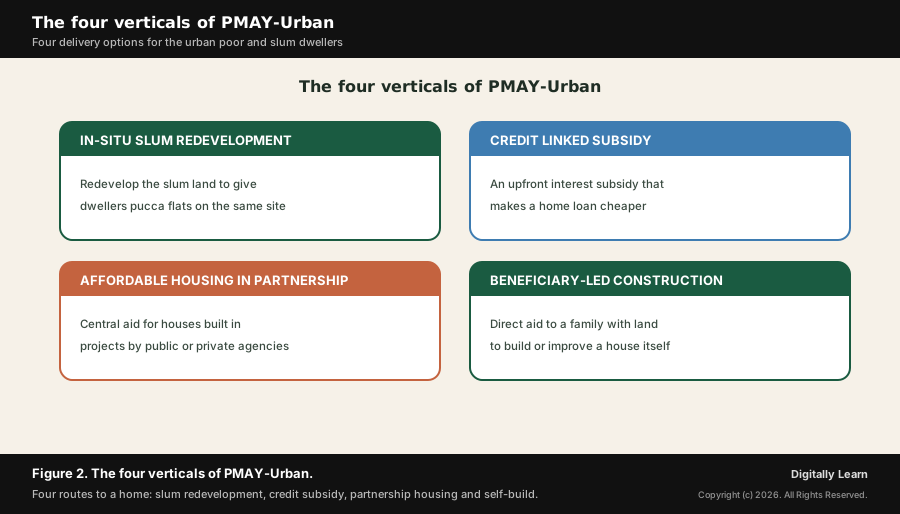
PMAY-Urban was designed around a simple insight: the urban poor are not one group, so one delivery model cannot reach them all. The mission therefore offered a basket of four verticals, letting a city or a family pick the route that fits its land, income and finance. The first, In-Situ Slum Redevelopment (ISSR), uses the land under a slum as a resource, redeveloping it with private participation to give slum dwellers pucca flats on the same site rather than displacing them.
The second vertical, the Credit Linked Subsidy Scheme (CLSS), made home loans cheaper through an upfront interest subsidy, the central instrument for households that could borrow but could not afford full market interest. The third, Affordable Housing in Partnership (AHP), gave central assistance for houses built in projects by public or private agencies, so that eligible families could buy a ready unit. The fourth, Beneficiary-Led Construction (BLC), gave direct assistance to a family with its own land to build or improve a house itself.
The mission sorts urban households by income into the Economically Weaker Section, the Low Income Group and the Middle Income Group, and tailors benefits to each. Under CLSS, the interest subsidy was 6.5 per cent for the weaker section and low-income group and a lower rate for the middle-income groups, on a loan of a defined size over a long tenure, worth up to 2.67 lakh rupees per house. The credit-subsidy windows have since closed and been replaced under PMAY-U 2.0, discussed below. The figure that follows maps the four verticals.
PMAY-Urban 2.0: One Crore More Families, the New Verticals and the Interest Subsidy Scheme
The urban wing has been recast as PMAY-Urban 2.0, approved by the Union Cabinet in 2024 to carry the Housing for All promise forward. Its headline is the assistance of one crore more urban poor and middle-class families to build, buy or rent a home, backed by a large package of central government assistance and a far larger total investment that draws in States, banks and beneficiaries' own contributions. The scheme thus widens the original mission from the poorest sections toward aspiring middle-class households too.
PMAY-U 2.0 is delivered through four verticals that update the original set. Three are familiar: Beneficiary-Led Construction and Affordable Housing in Partnership continue, each carrying central assistance of 2.50 lakh rupees per unit, while a new Affordable Rental Housing (ARH) vertical builds rental homes for urban migrants, working women, industrial workers and the urban poor who do not want to or cannot own. The fourth, an Interest Subsidy Scheme (ISS), revives credit support in a new form, with a subsidy on the first slice of a modest home loan over a fixed tenure.
The shift from the original credit-subsidy windows to the new Interest Subsidy Scheme shows how the mission has learned. The earlier scheme closed once its windows expired, and PMAY-U 2.0 replaced it with a tighter, capped subsidy for the weaker, low-income and middle-income groups. By adding a dedicated rental vertical, the new phase also recognises that ownership is not the only answer for a mobile urban workforce, which is a meaningful change in how Indian housing policy reads the city. The table later in this article contrasts the two wings.
PMAY-Gramin: From Indira Awaas Yojana, Beneficiary Selection, Unit Assistance and Convergence
The shift from Indira Awaas Yojana and how rural beneficiaries are selected
PMAY-Gramin did not begin from nothing; it restructured India's old rural housing programme, the Indira Awaas Yojana, which had run for decades but was faulted for weak targeting, small and unfinished houses, and leakages. Effective from 1 April 2016, the new scheme set an ambitious target of building close to three crore pucca houses for rural families living in kutcha and dilapidated homes, with a sharper focus on quality, completion and honest selection.
The most important reform was in beneficiary selection. Instead of relying on local lists open to favouritism, PMAY-Gramin drew its beneficiaries from the housing-deprivation data of the Socio Economic Caste Census of 2011, verified through Gram Sabhas and a mobile survey known as Awaas Plus. This data-driven selection, refreshed by a later Awaas Plus survey, was meant to ensure that the genuinely houseless and the worst-housed, not the well-connected, reached the front of the queue.
PMAY-Gramin also fixed the house itself. The minimum size of a unit was raised to 25 square metres, including a dedicated space for hygienic cooking, up from the smaller earlier norm, so that the home is genuinely liveable. Families are guided toward locally appropriate, disaster-resilient designs and are supported with technical help, while the release of money is tied to verified stages of construction. The mission thus promises not just a grant but a finished, durable house.
Unit assistance, convergence with other schemes and the continued rural wing
The core benefit of PMAY-Gramin is a unit assistance released in instalments. The amount is 1.20 lakh rupees in the plains and 1.30 lakh rupees in the hilly and North-Eastern States, the difficult areas and the Integrated Action Plan districts, where building costs are higher. This money is paid by Direct Benefit Transfer straight into the beneficiary's Aadhaar-linked bank account, so that it reaches the family rather than an intermediary.
A defining feature of the rural wing is convergence: the housing grant is deliberately stitched together with other welfare schemes so that the family gets a complete home, not bare walls. The toilet comes through the Swachh Bharat Mission, with assistance of twelve thousand rupees; unskilled labour days come through the rural employment guarantee programme, MGNREGS until the 2005 Act was repealed on 1 July 2026 and the VB-G RAM G scheme since; a cooking-gas connection comes through Ujjwala; and an electricity connection comes through the rural electrification programme. The house is thus the centre of a bundle of basic services.
The rural wing has been continued rather than closed. The Union Cabinet approved its extension for five more years, to assist the construction of two crore additional rural houses at the existing rates of assistance, with the eligible list refreshed by a new Awaas Plus survey to capture families left out earlier. This continuation, alongside PMAY-U 2.0, signals that the Housing for All goal is treated as unfinished and worth a renewed, multi-year commitment.
The Institutional and Financing Architecture: Two Ministries, Cost-Sharing and Monitoring
MoHUA and Rural Development, the Centre-State cost share and digital monitoring
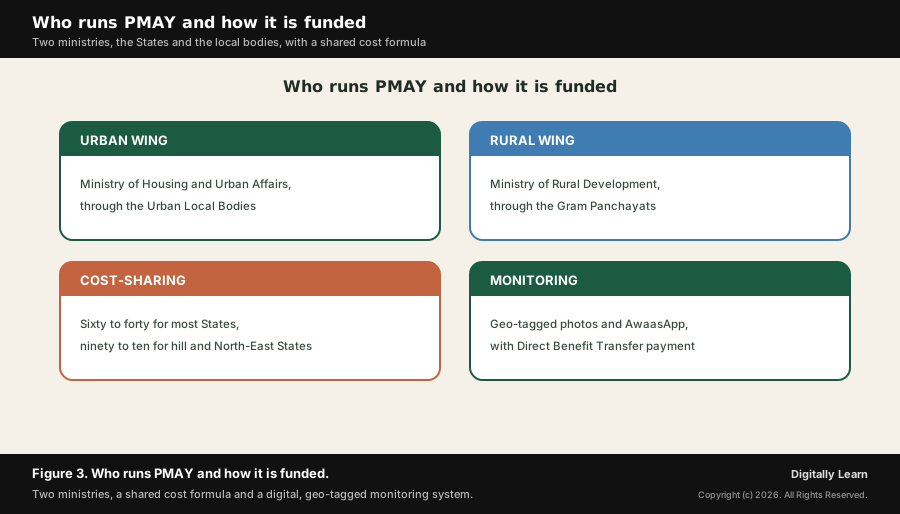
PMAY runs on a layered institutional architecture built on India's federal design, and its most distinctive feature is that the two wings sit in two different ministries. The urban wing is overseen by the Ministry of Housing and Urban Affairs, working through the States and the Urban Local Bodies that deliver civic services. The rural wing is overseen by the Ministry of Rural Development, working through the States and the Gram Panchayats. Each ministry frames guidelines, sets standards and routes funds, while the States and the local bodies are the implementing authorities on the ground.
The financing follows a Centre-State cost-sharing formula. Under PMAY-Gramin, the fund-sharing pattern is sixty to forty between the Centre and most States, and ninety to ten for the North-Eastern and Himalayan States, where capacity and revenues are thinner. The unit assistance, the toilet support and the convergence benefits are shared in these proportions, so that the Centre carries the larger burden but the State retains real ownership of delivery and accountability.
A modern strength of the mission is its digital monitoring. PMAY-Gramin is run end to end through the AwaasSoft management system and the AwaasApp, with each instalment released only after a geo-tagged, time-stamped photograph of the completed stage is uploaded, and payment made by Direct Benefit Transfer through the Aadhaar-based system. This technology backbone, mirrored on the urban side by online project tracking, is meant to cut leakage, prove that a house is real and let the public see progress.
PMAY-Urban and PMAY-Gramin Compared: How the Two Wings Differ
Ministry, delivery model, beneficiary basis and benefit form across the two wings
Setting the two wings side by side makes the design of the mission clear, because each wing answers a different housing problem. The urban wing must cope with scarce, costly land, dense slums and a workforce that often rents, so it leans on slum redevelopment, partnership projects, credit subsidy and now rental housing. The rural wing faces dispersed villages and families who usually own their plot, so it leans on direct assistance for a self-built pucca house, stitched to other welfare schemes.
| Aspect | PMAY-Urban | PMAY-Gramin |
|---|---|---|
| Nodal ministry | Ministry of Housing and Urban Affairs | Ministry of Rural Development |
| Launched / effective | 25 June 2015 | 1 April 2016 |
| Predecessor | Earlier urban housing schemes | The Indira Awaas Yojana |
| Delivery model | Four verticals: slum redevelopment, credit subsidy, partnership and self-build | Unit assistance for a self-built pucca house |
| Beneficiary basis | Urban poor and slum dwellers by income category | Housing deprivation in the Socio Economic Caste Census |
| Implementing body | States and Urban Local Bodies | States and Gram Panchayats |
Reading the rows together shows that the two wings are complementary, not duplicate. Both pursue the same Housing for All goal, both rely on the States and the local bodies to deliver, and both pay through Direct Benefit Transfer; but the urban wing is a menu of finance and partnership models for a costly, crowded city, while the rural wing is a direct grant for a family building its own home in the village. This division of labour is the heart of the mission's design.
Understanding the Significance: Shelter, Health, Women's Empowerment and Asset Creation
A pucca house as a base for health, dignity, the empowerment of women and an escape from poverty
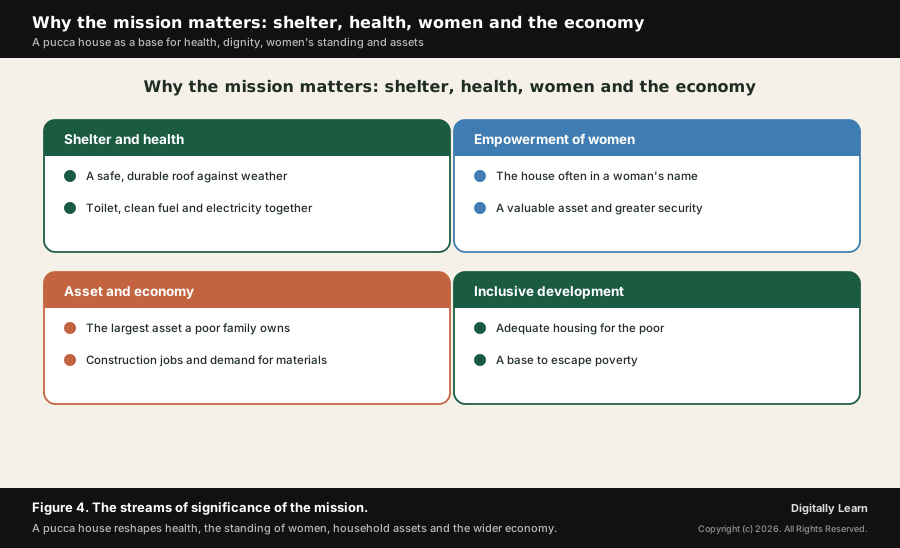
What is the significance of Pradhan Mantri Awas Yojana lies first in shelter and health. A kutcha hut leaves a family exposed to rain, heat and cold and to the disease that follows damp, smoke and overcrowding, while a pucca house with a toilet, clean cooking fuel and electricity is a safer, healthier place to live. By making the house the centre of a bundle of basic services, the mission attacks several deprivations at once and gives children a more stable base for school and growth.
Its second significance is the empowerment of women. The mission encourages that the new house be registered in the name of a woman of the household or jointly, so that a poor woman holds, often for the first time, a valuable asset in her own name. This ownership strengthens her standing within the family and her security, and, with a private toilet and a smoke-free kitchen, it eases the daily burden that falls most heavily on women. A house thus becomes an instrument of social empowerment, not only of shelter.
Its third significance is asset creation and the economy. For a poor family, the pucca house is usually the largest asset it will ever own, a buffer against shocks and a base from which to work and save. At a wider level, a mass housing programme generates employment in construction and demand for cement, steel and local materials, and advances the global goal of adequate housing for all. Shelter, health, the standing of women and economic security thus tie a welfare scheme to the broader project of inclusive development. The figure below maps these strands.
Challenges and Debates: Targeting, Urban Land and Cost, Quality, Vacancy and the Last Mile
Targeting errors, the urban land-and-cost problem, build quality, vacant homes and last-mile delivery
A balanced reading must weigh the debates around the mission, and the first is targeting. Even with a census-based list, independent observers caution that errors of exclusion and inclusion persist, so that some genuinely houseless families are left out while a few ineligible ones get in. Periodic re-surveys, such as the refreshed Awaas Plus exercise, are partly an admission that the original list missed deserving households, and getting the beneficiary list right remains a live concern.
A second cluster of concerns is specific to the cities: land and cost. Urban land is scarce and expensive, slum redevelopment is legally and socially complex, and the fixed central assistance often falls short of a city's high construction costs, which can slow the urban wing and push affordable homes to distant peripheries far from work. Closely linked is vacancy: some completed units, particularly partnership projects built far from livelihoods, lie unoccupied, a sign that location and transport matter as much as the house.
A third set of debates concerns quality and the last mile. Critics flag uneven build quality, delays between instalments that strand half-finished houses, and the burden on a poor family that must add its own money and labour to complete the home. On the central dispute, between those who stress the scale of houses sanctioned and built and those who stress unresolved targeting, urban cost, quality and vacancy, a careful answer presents both sides and treats the question as open rather than settled.
The Way Forward: Sharper Targeting, Affordable Urban Land and Finished, Liveable Homes
Better beneficiary selection, urban land and rental supply, build quality and convergence
The way forward for the mission follows directly from its debates. The first priority is sharper targeting: keeping the beneficiary list accurate and current through honest surveys and grievance redress, so that the genuinely deprived are reached and exclusion errors are corrected, since a housing scheme is only as fair as the list it builds from.
The second priority is to solve the urban problem of land and cost, by unlocking public land, enabling affordable projects near jobs and transport, and scaling the new rental vertical for a mobile workforce, so that homes are occupied rather than left vacant on the periphery. The third priority is to guarantee quality and completion, with timely instalments, technical support and strict use of geo-tagged monitoring, and to deepen convergence so that every house comes with a toilet, water, clean fuel and electricity. Pursued together, these turn a count of sanctioned houses into a stock of finished, liveable homes.
UPSC Relevance and Exam Focus
Where Pradhan Mantri Awas Yojana fits in the UPSC-CSE syllabus
This topic maps most directly to General Studies Paper II: welfare schemes for vulnerable sections, and the development and management of the social sector, since PMAY is a flagship welfare programme delivering a basic need to the poor. It also reaches General Studies Paper I, through urbanisation, slums and the role of women, and General Studies Paper III, through inclusive growth, infrastructure, employment and the Direct Benefit Transfer mode of delivery. Few schemes span the syllabus this widely.
For Prelims, hold the high-yield facts: PMAY runs as PMAY-Urban under the Ministry of Housing and Urban Affairs, launched on 25 June 2015, and PMAY-Gramin under the Ministry of Rural Development, effective from 1 April 2016; the urban wing has four verticals; the rural wing draws beneficiaries from the Socio Economic Caste Census, pays unit assistance of 1.20 and 1.30 lakh rupees, and converges with Swachh Bharat, the rural employment guarantee scheme (MGNREGS until 2026, VB-G RAM G since) and Ujjwala; and the mission has been carried forward through PMAY-Urban 2.0 and a continued rural wing.
For Mains, the recurring framing is to assess the mission's design and its delivery: how a flagship poverty-alleviation and welfare scheme is targeted, financed and monitored, how it advances shelter, health and the empowerment of women, and how far it has closed the gap between houses sanctioned and finished homes lived in. A strong answer treats PMAY as a case study in welfare delivery and cooperative federalism, weighing the genuine scale of the programme against the unresolved questions of targeting, urban cost, quality and vacancy.
Recurring linked concepts an aspirant should keep in working memory:
- The two wings: PMAY-Urban under the Ministry of Housing and Urban Affairs for cities and PMAY-Gramin under the Ministry of Rural Development for villages.
- The four verticals: In-Situ Slum Redevelopment, the Credit Linked Subsidy Scheme, Affordable Housing in Partnership and Beneficiary-Led Construction, with PMAY-U 2.0 adding Affordable Rental Housing and a new Interest Subsidy Scheme.
- Beneficiary selection: Housing deprivation in the Socio Economic Caste Census, refreshed by the Awaas Plus survey, is the basis for the rural list.
- Convergence and Direct Benefit Transfer: The housing grant is stitched to toilets, employment days, cooking gas and electricity, paid straight into an Aadhaar-linked account.
A common Prelims trap is to swap the two ministries or to confuse PMAY with sanitation or employment schemes; hold that the urban wing sits with MoHUA and the rural wing with Rural Development, and that PMAY is the housing mission, distinct from the sanitation and rural employment guarantee programmes, which it merely converges with.
A common Mains trap is to praise the number of houses sanctioned alone. The exam value lies in a balanced judgment: the genuine gains in shelter, health and the standing of women, set honestly against the open questions of targeting accuracy, urban land and cost, build quality, vacant units and last-mile delivery.
Previous Year UPSC-CSE Questions By the end you will be able to draft model answers for the following UPSC questions. Each question carries a collapsible framework showing how to approach it in the exam.
- UPSC Mains 2017 GS-IIDiscuss, with reference to the performance of a major poverty alleviation programme, whether poverty alleviation programmes in India remain mere showpieces unless backed by political will.
How to structure the answer in the exam
Body (sub-themes to develop):
- The programme and its promise: PMAY as a major poverty alleviation and welfare mission, its two wings under the Ministry of Housing and Urban Affairs and the Ministry of Rural Development, and the shelter, health, women's-empowerment and asset-creation gains a pucca house brings the poor.
- Evidence of substance, not mere showpiece: the scale of houses sanctioned and built, the census-based targeting, the convergence of toilets, employment days, fuel and electricity, the geo-tagged Direct Benefit Transfer monitoring, and the multi-year renewal of both wings as signs of sustained commitment.
- Where it risks becoming a showpiece: targeting errors of exclusion and inclusion, the urban land-and-cost problem, uneven build quality, vacant units far from jobs, and stalled half-finished houses, where outputs displayed outrun outcomes delivered.
- The decisive role of political will: financing through the Centre-State cost share, the choice to renew and expand rather than wind down, cross-ministry convergence and honest re-surveys, all of which need committed governmental will to translate sanctioned houses into finished, occupied homes.
- Balanced judgment: the programme is more than a showpiece where political will sustains targeting, financing, quality and convergence, and slips toward one where that will is absent.
Sources and Further Reading
- Ministry of Housing and Urban Affairs: Pradhan Mantri Awas Yojana (Urban)
- Pradhan Mantri Awas Yojana – Urban 2.0: scheme details
- Press Information Bureau: Cabinet approves Pradhan Mantri Awas Yojana-Urban 2.0 Scheme
- Press Information Bureau: Economically Weaker Sections including slum dwellers can avail benefit of PMAY-U through any vertical
- Ministry of Rural Development: Targets under Pradhan Mantri Awas Yojana-Gramin (PMAY-G)
- Press Information Bureau: Cabinet approves implementation of PMAY-Gramin during FY 2024-25 to 2028-29
- Press Information Bureau: Transparency and Accountability under Pradhan Mantri Awaas Yojana Gramin
- Pradhan Mantri Awaas Yojana – Gramin: official portal
- NITI Aayog: Sustainable Development Goals, water, sanitation and housing context
- Wikipedia: Pradhan Mantri Awas Yojana
- Wikipedia: Pradhan Mantri Gramin Awas Yojana
Editorial Disclaimer
This briefing is for UPSC preparation. Verify the facts and provisions against the official MoHUA, Ministry of Rural Development and PIB sources before relying on them.


