

Overview
Immunity is the body's overall ability to fight disease-causing organisms, conferred by the immune system. It is of two types: innate immunity, present from birth and non-specific, and acquired immunity, which is specific to each pathogen and remembers it, the property on which vaccines are built.
Immune System: Organs, Cells and Lines of Defence
What Immunity Is: Recognising Self and Non-Self
Every day the body meets a large number of infectious agents, yet only a few of these exposures cause disease, because the body can defend itself. This overall ability of the host to fight disease-causing organisms, conferred by the immune system, is called immunity.
The immune system is unique in that it recognises foreign antigens, responds to them and remembers them. It can tell the body's own cells, the self, from anything foreign, the non-self, and it also plays a part in allergies, autoimmune diseases and organ transplantation.
Lymphatic System and Lymphoid Organs: Bone Marrow, Thymus, Spleen and Lymph Nodes
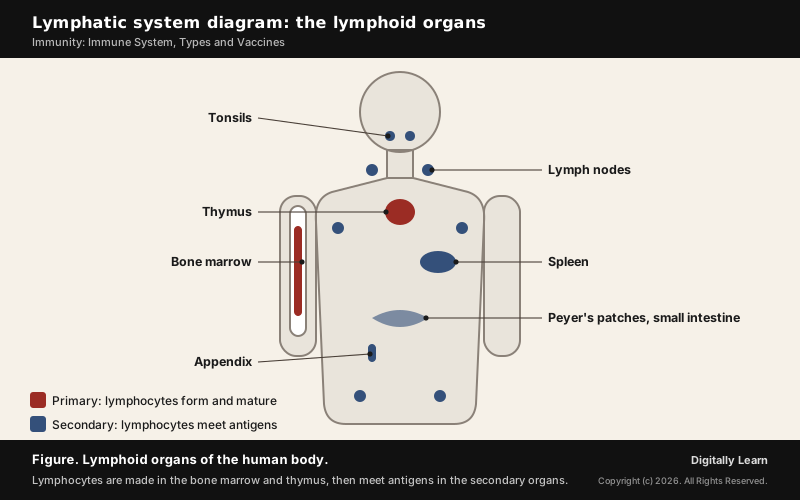
The immune system is made of lymphoid organs, tissues, cells and soluble molecules such as antibodies. Lymphoid organs are where lymphocytes arise, mature and multiply, and they come in two kinds.
- Primary lymphoid organs: The bone marrow and the thymus, where immature lymphocytes become antigen-sensitive lymphocytes. The bone marrow is the main lymphoid organ, where all blood cells, lymphocytes included, are produced.
- Secondary lymphoid organs: The spleen, lymph nodes, tonsils, Peyer’s patches of the small intestine and the appendix, where mature lymphocytes meet antigens and multiply into effector cells.
The thymus is a lobed organ near the heart, beneath the breastbone; it is large at birth and shrinks to a very small size by puberty, and it secretes the thymosins described in the endocrine system article. The spleen is a large bean-shaped organ that filters blood by trapping blood-borne microbes and holds a reservoir of red blood cells. Lymph nodes along the lymphatic system, which carries the lymph described in the circulatory system article, trap microbes that enter the lymph. Lymphoid tissue in the lining of the respiratory, digestive and urogenital tracts, called MALT, makes up about 50 per cent of the body's lymphoid tissue.
Types of Immunity: Innate and Acquired
Innate Immunity: Physical, Physiological, Cellular and Cytokine Barriers
The non-specific defence present from birth is innate immunity. It works by putting barriers in the way of foreign agents, and there are four kinds.
- Physical barriers: The skin is the main barrier, and mucus lining the respiratory, gastrointestinal and urogenital tracts traps microbes.
- Physiological barriers: Acid in the stomach, saliva in the mouth and tears from the eyes all prevent microbial growth.
- Cellular barriers: White blood cells such as neutrophils, monocytes and natural killer cells in the blood, and macrophages in the tissues, engulf and destroy microbes.
- Cytokine barriers: Cells infected by a virus secrete proteins called interferons, which protect uninfected cells from further viral infection.
Acquired Immunity: Antigens, Antibodies and Immunological Memory
The second line, acquired immunity, is specific to a pathogen and is marked by memory. The first meeting with a pathogen produces a primary response of low intensity; a later meeting with the same pathogen produces a highly intensified secondary, or anamnestic, response.
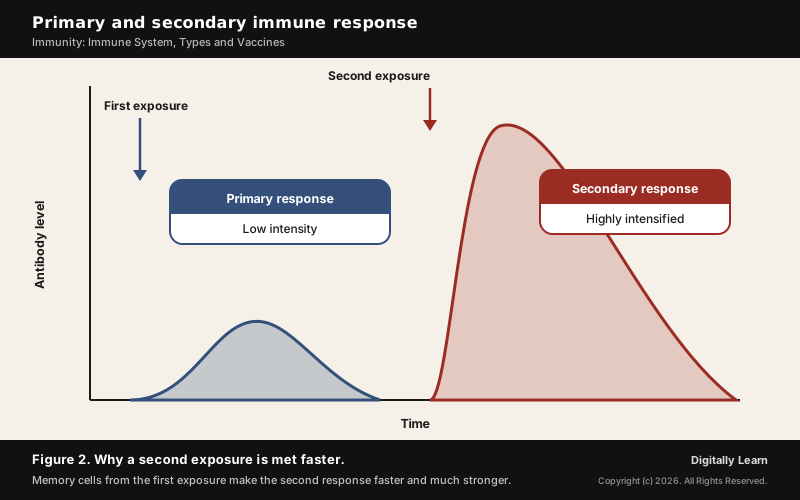
The difference comes from memory cells. After the primary response the body keeps antibody-producing memory cells alive, so on a second exposure the response is much faster and more effective.
B Cells and T Cells: Humoral and Cell-Mediated Immunity
Both responses are carried out by two special lymphocytes in the blood. B-lymphocytes produce an army of antibodies into the blood, while T-lymphocytes do not secrete antibodies themselves but help B cells to make them.
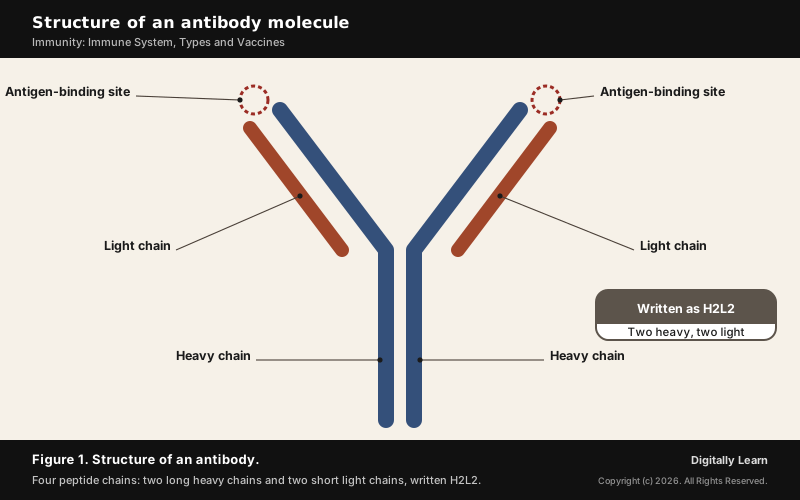
Each antibody made by B cells is a Y-shaped protein with two short light chains and two longer heavy chains, so it is written as H2L2. The body makes several types, among them IgA, IgM, IgE and IgG.
| Feature | Humoral immunity | Cell-mediated immunity |
|---|---|---|
| Carried out by | B-lymphocytes | T-lymphocytes |
| Works through | Antibodies in the blood | The cells themselves |
| Example | Neutralising a pathogen | Rejecting a transplanted organ |
Cell-mediated immunity explains graft rejection. A transplanted heart, liver or kidney from just any donor is rejected sooner or later, so tissue matching and blood group matching are essential, and even then the patient takes immunosuppressants for life.
Active and Passive Immunity
Active and Passive Immunity: Differences and Examples
Acquired immunity can also be sorted by where the antibodies come from. In active immunity the body makes its own antibodies after meeting antigens, living or dead microbes or other proteins, either in a natural infection or through deliberate immunisation.
| Feature | Active immunity | Passive immunity |
|---|---|---|
| Antibodies | Made by the body itself | Given ready-made |
| Speed | Slow to reach full effect | Quick, as needed in tetanus |
| Examples | Natural infection, vaccination | Colostrum, placenta, antitoxin |
In passive immunity ready-made antibodies are given directly to protect the body. It works at once, which is why it is used when a quick response is needed, as in tetanus or after a snakebite.
Colostrum, Antibodies Across the Placenta and Antivenom
A newborn relies on passive immunity from its mother. The yellowish colostrum secreted in the first days of breastfeeding is rich in antibodies of the IgA type, and the foetus also receives some antibodies across the placenta during pregnancy. These maternal antibodies protect only for the first few months of life, which is why babies need vaccines early.
When a deadly infection needs a quick response, as in tetanus, doctors inject preformed antibodies or an antitoxin. The injection given after a snakebite likewise contains preformed antibodies against the venom. This is called passive immunisation.
Vaccines: How They Work and Their Types
How Vaccines Work: Memory Cells and Herd Immunity
The principle of vaccination rests on the memory of the immune system. A vaccine introduces antigenic proteins of a pathogen, or the pathogen itself in an inactivated or weakened form, so the body makes antibodies and also memory B and T cells. On a later real infection these recognise the pathogen quickly and overwhelm it with a massive production of antibodies.
Because vaccines contain only killed or weakened germs or their parts, they do not cause the disease. Most are injected, some are given by mouth and some are sprayed into the nose. The idea is old: in 1796 Edward Jenner used pus from a milkmaid's cowpox blisters to protect a boy against smallpox, and the word vaccine comes from his term for cowpox, Variolae vaccinae.
Vaccines also protect people who cannot be vaccinated. When a large enough share of a population is immune, a contagious disease can no longer persist; this indirect protection is herd immunity, and the critical share is the herd immunity threshold. No vaccine gives 100 per cent protection, and herd immunity does not fully protect those who cannot be vaccinated, such as very young babies and the seriously ill.
Types of Vaccines: Live, Inactivated, Subunit, Vector and mRNA
All vaccines show the immune system an antigen without causing the disease, but they do it in different ways.
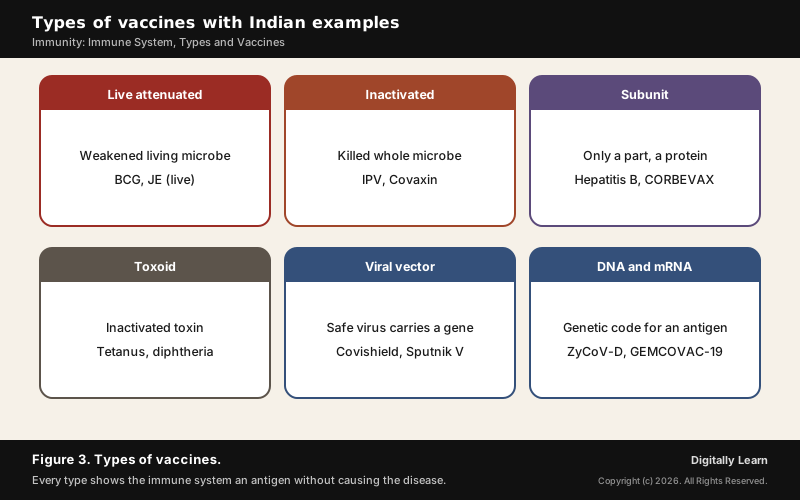
- Live attenuated: A weakened living microbe, such as BCG against tuberculosis; these usually give more durable immunity.
- Inactivated: A killed whole microbe, such as the inactivated polio vaccine or Covaxin.
- Toxoid: An inactivated form of the toxin that causes the illness, as in the tetanus and diphtheria vaccines.
- Subunit: Only a fragment of the pathogen, such as the surface protein in the hepatitis B vaccine.
- Viral and bacterial vector: A safe virus, or a bacterium, carries a pathogen gene into the body so that the body makes the antigen.
- Nucleic acid: An mRNA vaccine delivers a copy of messenger RNA that cells use as a blueprint to build a pathogen’s protein; a DNA vaccine delivers the gene as DNA.
Viral vector, RNA and DNA vaccines together are called genetic vaccines. Recombinant vector vaccines are made by genetic engineering, and both viruses and bacteria are used as the vectors.
Monoclonal Antibodies and Recombinant Vaccines
Recombinant DNA technology lets antigenic proteins of a pathogen be made in bacteria or yeast. Vaccines made this way can be produced on a large scale, so more people can be immunised; the hepatitis B vaccine produced from yeast is the standard example.
Man-made antibodies cloned from one unique parent white blood cell are called monoclonal antibodies. They are identical and bind only one part of one antigen. They are made by hybridoma technology, which fuses antibody-producing B cells with myeloma cells, cancerous B cells that divide endlessly, so the hybrid keeps making the same antibody.
Georges Köhler and César Milstein invented the method in 1975 and shared the 1984 Nobel Prize with Niels Jerne. Monoclonal antibodies are also being tested against infections: the m102.4 monoclonal antibody has been studied as a treatment for Nipah virus infection.
Vaccination in India: Universal Immunization Programme and COVID-19 Vaccines
Universal Immunization Programme and the National Immunization Schedule
India's Universal Immunization Programme (UIP) began in 1978 as the Expanded Programme on Immunization and took its present name in 1985, when it was extended from cities to rural areas. It gives vaccines free to about 2.9 crore pregnant women and 2.54 crore newborns every year, against 12 diseases: tuberculosis (severe childhood forms), diphtheria, pertussis, tetanus, polio, measles, rubella, hepatitis B, meningitis and pneumonia from Hib, rotavirus diarrhoea, pneumococcal pneumonia and Japanese encephalitis.
| Age | Vaccines given |
|---|---|
| Birth | BCG, oral polio vaccine (OPV) zero dose, hepatitis B birth dose |
| 6 weeks | OPV-1, pentavalent-1, rotavirus-1, fractional IPV-1, PCV-1 |
| 10 weeks | OPV-2, pentavalent-2, rotavirus-2 |
| 14 weeks | OPV-3, pentavalent-3, fractional IPV-2, rotavirus-3, PCV-2 |
| 9 to 12 months | Measles-rubella (MR)-1, JE-1 in endemic districts, PCV booster |
| 16 to 24 months | MR-2, JE-2, DPT booster-1, OPV booster |
| 5 to 6 years | DPT booster-2 |
| 10 and 16 years | Tetanus and adult diphtheria (Td) |
| Pregnant women | Td-1 and Td-2, or a Td booster |
The pentavalent vaccine combines DPT with hepatitis B and Hib. Newer vaccines joined the schedule in the last decade: IPV in 2015, rotavirus in 2016, measles-rubella in 2017 and the pneumococcal conjugate vaccine (PCV) in 2017, which became available nationwide in October 2021. Pneumococcus causes pneumonia, meningitis and sepsis, and by preventing infections such vaccines also cut the use of antibiotics and slow the spread of antimicrobial resistance.
Full immunisation coverage rose from 62 per cent in 2015 to 98.4 per cent in January 2026, and the share of zero-dose children in the population fell from 0.11 per cent in 2023 to 0.06 per cent in 2024. In 2026 the UIP added a nationwide HPV vaccination campaign for 14-year-old girls, against cervical cancer, and an indigenous Td vaccine made at the Central Research Institute, Kasauli.
Mission Indradhanush, Pulse Polio, Cold Chain and U-WIN
Mission Indradhanush, launched in December 2014, is a catch-up campaign under the UIP for areas of low coverage, reaching children and pregnant women who were missed or dropped out. Its twelve phases up to 2023 vaccinated 5.46 crore children and 1.32 crore pregnant women across 765 districts.
The Pulse Polio programme was launched in 1995, and India marks National Vaccination Day on 16 March for the first oral polio dose given that year. The last polio case was reported on 13 January 2011 in Howrah, West Bengal; India eliminated polio in 2014 and maternal and neonatal tetanus in 2015, and smallpox was eradicated in 1977.
- Cold chain: Vaccines lose their potency, for good, if they get too hot or too cold, so they are kept in a chain of nearly 30,000 cold chain points from national depots down to primary health centres.
- eVIN: The Electronic Vaccine Intelligence Network tracks vaccine stocks and storage temperatures in real time across all States and Union Territories.
- U-WIN: Launched in October 2024, it keeps a digital vaccination record for pregnant women and children and lets families book vaccination and find centres; CoWIN, launched on 16 January 2021, did the same for COVID-19 vaccines.
COVID-19 Vaccines Made in India: Covishield, Covaxin and New Platforms
India's COVID-19 vaccines show nearly every vaccine type at work. On 3 January 2021 the drug regulator's expert committee recommended emergency use of two vaccines, built on different platforms.
- Covishield: Made by the Serum Institute of India, Pune, with technology transfer from AstraZeneca and Oxford University; a recombinant chimpanzee adenovirus vector vaccine carrying the gene for the virus’s spike protein.
- Covaxin: Developed by Bharat Biotech with ICMR and the National Institute of Virology, Pune; a whole virion inactivated vaccine grown on a Vero cell platform.
- Sputnik V: A Russian adenovirus viral vector vaccine that uses two different adenoviruses for its two doses.
Under Mission COVID Suraksha, a Rs 900 crore mission led by the Department of Biotechnology, four more vaccines were developed: ZyCoV-D, described as the world's first DNA vaccine, which received emergency use authorisation on 20 August 2021 for people aged 12 and above; CORBEVAX, India's first protein subunit vaccine; GEMCOVAC-19, an mRNA vaccine; and iNCOVACC, an intranasal vaccine. More than 220 crore COVID-19 doses were given through CoWIN.
ICMR now aims to help India develop medical countermeasures within 100 days of any future pandemic, under the National One Health Mission, and is developing an indigenous two-dose inactivated vaccine for Kyasanur Forest Disease with Indian Immunologicals Limited and NIV.
When the Immune System Goes Wrong
Allergies and Autoimmune Diseases
An allergy is an exaggerated response of the immune system to certain antigens in the environment, called allergens, such as mites in dust, pollen and animal dander. The antibodies made are of the IgE type, and the symptoms come from chemicals such as histamine and serotonin released by mast cells.
- Symptoms: Sneezing, watery eyes, a running nose and difficulty in breathing.
- Diagnosis and treatment: The patient is exposed to tiny doses of possible allergens; anti-histamines, adrenalin and steroids quickly reduce the symptoms.
- Rising cases: More and more children in India’s metro cities suffer from allergies and asthma, possibly because of the protected environment they grow up in.
Sometimes, for genetic and other unknown reasons, the body attacks its own cells. This is an autoimmune disease, and rheumatoid arthritis is a common example.
Immunodeficiency: HIV and AIDS
AIDS, the Acquired Immuno Deficiency Syndrome, is a deficiency of the immune system acquired during life, not present from birth. It was first reported in 1981 and is caused by the Human Immunodeficiency Virus (HIV), a retrovirus with an RNA genome inside an envelope.
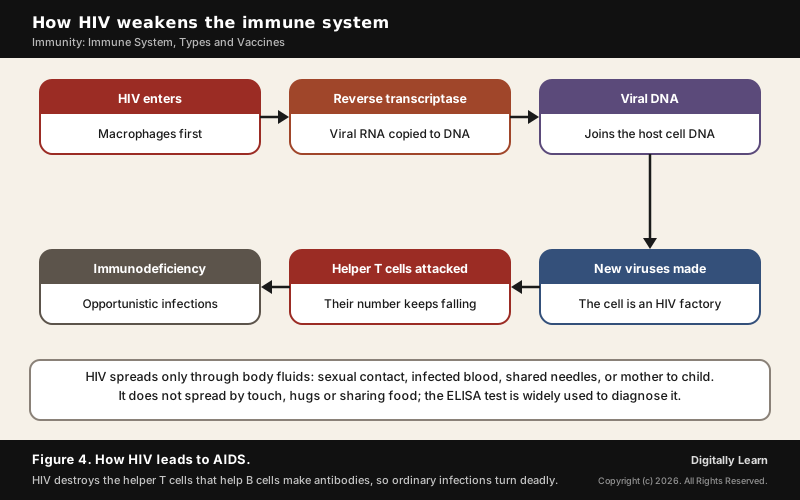
- Transmission: Sexual contact, transfusion of contaminated blood, sharing infected needles, and from an infected mother to her child; HIV spreads only through body fluids, not by touch or sharing food.
- Course: Symptoms appear after a gap of a few months to many years, usually 5 to 10 years, as helper T cells fall and infections such as those from Mycobacterium take hold.
- Diagnosis and treatment: The ELISA test is widely used; anti-retroviral drugs cannot cure AIDS, but WHO notes that with treatment HIV has become a manageable chronic condition.
At the end of 2025 about 41.0 million people were living with HIV, 1.2 million acquired it that year and 570,000 died from HIV-related causes. The world is close to the 95-95-95 targets, and SDG target 3.3 aims to end the HIV epidemic by 2030. In India the National AIDS Control Organisation (NACO), with NGOs, leads the effort to educate people, and prevention rests on safe blood, disposable needles, free condoms and control of drug abuse.
Previous Year UPSC-CSE Questions
Previous Year UPSC-CSE Questions By the end you will be able to draft model answers for the following UPSC questions. Each question carries a collapsible framework showing how to approach it in the exam.
- UPSC Mains 2022 GS-IIIWhat is the basic principle behind vaccine development? How do vaccines work? What approaches were adopted by the Indian vaccine manufacturers to produce COVID-19 vaccines?
How to structure the answer in the exam
Introduction: Vaccination rests on the memory of the immune system: a harmless form of an antigen trains the body to respond fast to the real pathogen.
Body (sub-themes to develop):
- Principle: antigenic proteins or an inactivated or weakened pathogen trigger antibodies and memory B and T cells.
- How vaccines work: the secondary response is faster and stronger; herd immunity protects those who cannot be vaccinated.
- Indian approaches: Covishield, chimpanzee adenovirus vector (Serum Institute); Covaxin, whole virion inactivated (Bharat Biotech with ICMR-NIV).
- Mission COVID Suraksha: ZyCoV-D DNA, CORBEVAX protein subunit, GEMCOVAC-19 mRNA, iNCOVACC intranasal.
- Delivery: cold chain, eVIN and CoWIN, over 220 crore doses.
Conclusion: Conclude that India used almost every vaccine platform, and that the 100-days countermeasure goal and the One Health Mission build on that experience.
- UPSC Prelims 2025 Prelims-GSWith reference to monoclonal antibodies, often mentioned in news, consider the following statements:
- I. They are man-made proteins.
- II. They stimulate immunological function due to their ability to bind to specific antigens.
- III. They are used in treating viral infections like that of Nipah virus.
Which of the statements given above are correct?
How to approach this Prelims question
Approach: Test each statement against what monoclonal antibodies are, how they bind and where they are used.
Trap to watch: Statement III looks too specific to be true, but monoclonal antibodies have been studied against Nipah.
Key facts to recall:
- (a) I and II only: wrong. It leaves out statement III, although monoclonal antibodies have been studied against Nipah.
- (b) II and III only: wrong. It leaves out statement I: monoclonal antibodies are man-made, identical antibodies from one parent cell.
- (c) I and III only: wrong. It leaves out statement II: each monoclonal antibody binds one specific antigen part.
- (d) I, II and III: right. They are man-made, they bind specific antigens, and one such antibody, m102.4, has been studied against Nipah.
Answer signal: All three statements are correct, so option (d) is the answer.
- UPSC Prelims 2022 Prelims-GSIn the context of vaccines manufactured to prevent COVID-19 pandemic, consider the following statements:
- The Serum Institute of India produced COVID-19 vaccine named Covishield using mRNA platform.
- Sputnik V vaccine is manufactured using vector based platform.
- COVAXIN is an inactivated pathogen based vaccine.
Which of the statements given above are correct?
How to approach this Prelims question
Approach: Match each vaccine to its platform before reading the options.
Trap to watch: Covishield is the trap: it is a viral vector vaccine, not mRNA.
Key facts to recall:
- (a) 1 and 2 only: wrong. Statement 1 is false: Covishield uses a recombinant chimpanzee adenovirus vector, not mRNA.
- (b) 2 and 3 only: right. Sputnik V uses an adenovirus vector and Covaxin is a whole virion inactivated vaccine.
- (c) 1 and 3 only: wrong. It includes the false statement 1.
- (d) 1, 2 and 3: wrong. It includes the false statement 1.
Answer signal: Statements 2 and 3 are correct, so option (b) is the answer.
- UPSC Prelims 2022 Prelims-GSWhich one of the following statements best describes the role of B cells and T cells in the human body?
How to approach this Prelims question
Approach: Recall what acquired immunity is for, then pick the option that states it.
Trap to watch: Allergens do involve the immune system, but that is an exaggerated response, not the role of B and T cells.
Key facts to recall:
- (a) Protecting the body from environmental allergens: wrong. An allergy is an exaggerated immune response, not the purpose of B and T cells.
- (b) Relieving pain and inflammation: wrong. That is not the role of lymphocytes, which fight pathogens.
- (c) Acting as immunosuppressants: wrong. It is the opposite: B and T cells carry out the immune response.
- (d) Protecting the body from diseases caused by pathogens: right. B cells produce antibodies and T cells help them, giving acquired immunity specific to pathogens.
Answer signal: Protection against pathogens, so option (d) is the answer.
- UPSC Prelims 2021 Prelims-GSWith reference to recent developments regarding 'Recombinant Vector Vaccines', consider the following statements:
- Genetic engineering is applied in the development of these vaccines.
- Bacteria and viruses are used as vectors.
Which of the statements given above is/are correct?
How to approach this Prelims question
Approach: Recall what a vector does, then who can act as one.
Trap to watch: Viral vectors are better known, but bacterial vectors exist too.
Key facts to recall:
- (a) 1 only: wrong. It leaves out statement 2: both bacteria and viruses serve as vectors.
- (b) 2 only: wrong. It leaves out statement 1: genetic engineering puts the pathogen's gene into the vector.
- (c) Both 1 and 2: right. A vector made by genetic engineering carries a pathogen gene into the body, and viral and bacterial vectors are both used.
- (d) Neither 1 nor 2: wrong. Both statements are true.
Answer signal: Both statements are correct, so option (c) is the answer.
- UPSC Prelims 2020 Prelims-GSWhat is the importance of using Pneumococcal Conjugate Vaccines in India?
- These vaccines are effective against pneumonia as well as meningitis and sepsis.
- Dependence on antibiotics that are not effective against drug-resistant bacteria can be reduced.
- These vaccines have no side effects and cause no allergic reactions.
Select the correct answer using the code given below:
How to approach this Prelims question
Approach: Accept what a vaccine prevents and its effect on antibiotics; reject any absolute claim.
Trap to watch: Statement 3 says no side effects at all: every vaccine can have mild side effects such as fever or pain at the injection site.
Key facts to recall:
- (a) 1 only: wrong. It leaves out statement 2: by preventing infections, vaccines reduce antibiotic use and slow drug resistance.
- (b) 1 and 2 only: right. Pneumococcus causes pneumonia, meningitis and sepsis, and vaccination cuts the need for antibiotics.
- (c) 3 only: wrong. Statement 3 is an absolute claim; vaccines can have side effects, which are generally mild.
- (d) 1, 2 and 3: wrong. It includes the false statement 3.
Answer signal: Statements 1 and 2 are correct, so option (b) is the answer.
- UPSC Prelims 2016 Prelims-GS'Mission Indradhanush' launched by the Government of India pertains to
How to approach this Prelims question
Approach: Link the name, a rainbow of vaccines, to immunisation.
Trap to watch: None of the other options has any link to vaccines.
Key facts to recall:
- (a) Immunisation of children and pregnant women: right. Mission Indradhanush, launched in December 2014, is a catch-up immunisation drive.
- (b) Smart cities: wrong. The mission has no link to urban construction.
- (c) Search for Earth-like planets: wrong. It has no link to space science.
- (d) New Educational Policy: wrong. It has no link to education policy.
Answer signal: Immunization of children and pregnant women, so option (a) is the answer.
- UPSC Prelims 2004 Prelims-GSIn which organ of the human body are the lymphocyte cells formed?
How to approach this Prelims question
Approach: Separate where lymphocytes are made from where they work.
Trap to watch: The spleen holds many lymphocytes, but it is a secondary organ; they are formed in the bone marrow.
Key facts to recall:
- (a) Liver: wrong. Lymphocytes, like all blood cells, are formed in the bone marrow, not the liver.
- (b) Long bone: right. The marrow of long bones is a primary lymphoid organ where lymphocytes are produced.
- (c) Pancreas: wrong. It is a composite gland that makes digestive juice and hormones such as insulin.
- (d) Spleen: wrong. It holds many lymphocytes, but it is a secondary lymphoid organ where they meet antigens, not where they are formed.
Answer signal: The long bone, whose marrow makes lymphocytes, so option (b) is the answer.
- UPSC Prelims 2001 Prelims-GSAntigen is a substance which
How to approach this Prelims question
Approach: Recall the definition of antigen, not of antibody.
Trap to watch: Destroying bacteria is what antibodies and phagocytes do, not antigens.
Key facts to recall:
- (a) Destroys harmful bacteria: wrong. That is what antibodies and phagocytes do, not antigens.
- (b) Used to treat poisoning: wrong. Antitoxins and antivenoms, which are ready-made antibodies, are used against poisons and venoms.
- (c) Lowers body temperature: wrong. It has nothing to do with body temperature.
- (d) Stimulates formation of antibody: right. An antigen is a substance that triggers the body to make antibodies.
Answer signal: It stimulates formation of antibody, so option (d) is the answer.
- UPSC Prelims 2000 Prelims-GSHybridoma technology is a new biotechnological approach for commercial production of
How to approach this Prelims question
Approach: Recall what a hybridoma cell makes.
Trap to watch: Antibodies is broadly right, but the specific product is monoclonal antibodies.
Key facts to recall:
- (a) Monoclonal antibodies: right. A hybridoma, a B cell fused with a myeloma cell, produces identical antibodies; the method was invented by Köhler and Milstein in 1975.
- (b) Interferon: wrong. Interferons are secreted by virus-infected cells, not made by hybridomas.
- (c) Antibodies: wrong. Broadly true, but the specific product of the technology is monoclonal antibodies.
- (d) Alcohol: wrong. Alcohol is made by fermentation with yeast, not by hybridoma cells.
Answer signal: Monoclonal antibodies, so option (a) is the answer.
- UPSC Prelims 1997 Prelims-GSA major health mission carried in 1996 was
How to approach this Prelims question
Approach: Place each option in time: smallpox was eradicated in 1977, so it cannot be a 1996 mission.
Trap to watch: Smallpox eradication is the famous trap; it was already achieved.
Key facts to recall:
- (a) War against leprosy: wrong. India's leprosy programme dates from 1955, and elimination at the national level came in 2005; it was not the 1996 mission.
- (b) Smallpox eradication: wrong. Smallpox's last natural case was in 1977; it was already eradicated by 1996.
- (c) Pulse polio immunisation: right. The Pulse Polio campaign was launched in 1995 and was the major health mission of that period.
- (d) Popularisation of oral rehydration therapy: wrong. It is not the mission the question points to; the major 1996 drive was pulse polio.
Answer signal: Pulse polio immunization, so option (c) is the answer.
Sources and Further Reading
- NCERT: Biology, Class 12, Chapter 7, Human Health and Disease
- World Health Organization: Vaccines and immunization, what is vaccination?
- World Health Organization: How do vaccines work?
- World Health Organization: HIV and AIDS, fact sheet
- World Health Organization: Better use of vaccines could reduce antibiotic use, 10 October 2024
- Press Information Bureau: Celebrating the Power of Vaccines, 17 March 2026
- Press Information Bureau: Update on Mission Indradhanush, 17 December 2024
- Press Information Bureau: nationwide expansion of the Pneumococcal Conjugate Vaccine, 29 October 2021
- Press Information Bureau: expert committee on Covishield and Covaxin, 3 January 2021
- Press Information Bureau: four vaccines under Mission COVID Suraksha, 27 January 2023
- National Health Mission: National Immunization Schedule
- Indian Council of Medical Research: ICMR Bulletin, first quarter 2026
- Wikipedia: Vaccine
- Wikipedia: Herd immunity
- Wikipedia: Monoclonal antibody
- Wikipedia: Hybridoma technology
- Wikipedia: mRNA vaccine
- Wikipedia: Sputnik V COVID-19 vaccine
- Wikipedia: Streptococcus pneumoniae
- Wikipedia: Nipah virus infection
- Wikipedia: Edward Jenner
Editorial Disclaimer
This article is for UPSC preparation and explains how immunity and vaccines work. It is not medical advice; follow the schedule and advice of a health worker for any vaccination.


