


Overview
Antimicrobial resistance (AMR) occurs when bacteria, viruses, fungi and parasites stop responding to the medicines used to treat them, making infections harder to cure. The Global Action Plan on Antimicrobial Resistance (GAP-AMR) is the World Health Organization's master framework for tackling it. At the 79th World Health Assembly in May 2026, member states adopted the updated plan for 2026 to 2036. It builds on the first plan of 2015, follows a One Health approach spanning people, animals and the environment, and aims to help cut bacterial AMR deaths in humans by 10 per cent by 2030.
Why the AMR action plan is in focus
A renewed global pact against superbugs
At the 79th World Health Assembly in Geneva in May 2026, member states adopted the updated Global Action Plan on Antimicrobial Resistance for 2026 to 2036. The decision was taken on 23 May 2026.
Antimicrobial resistance, or AMR, is the process by which bacteria, viruses, fungi and parasites stop responding to the medicines designed to kill them. It makes common infections harder, and sometimes impossible, to treat.
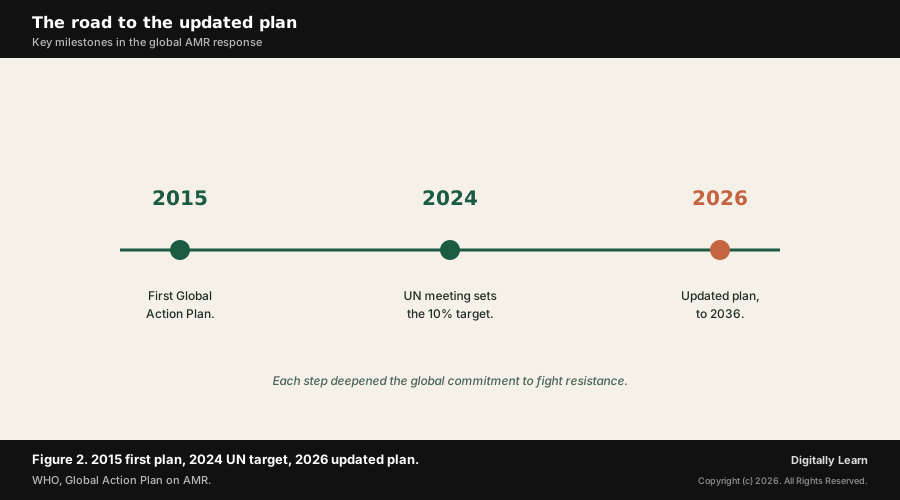
The new plan replaces the first Global Action Plan adopted in 2015. It reflects fresh evidence and the political commitments made at the 2024 United Nations high-level meeting on AMR.
The core features of the updated plan are:
- Adoption: agreed by the World Health Assembly for the decade 2026 to 2036.
- Approach: a strengthened One Health response across people, animals and the environment.
- Prevention first: infection control, clean water, vaccination and biosecurity come before cure.
- Target: help cut bacterial AMR deaths in humans by 10% by 2030.
Why the plan matters
A silent pandemic with a heavy toll
AMR is often called a silent pandemic. When antibiotics stop working, routine surgery, childbirth and cancer treatment all become far more dangerous, because infections can no longer be reliably cured.
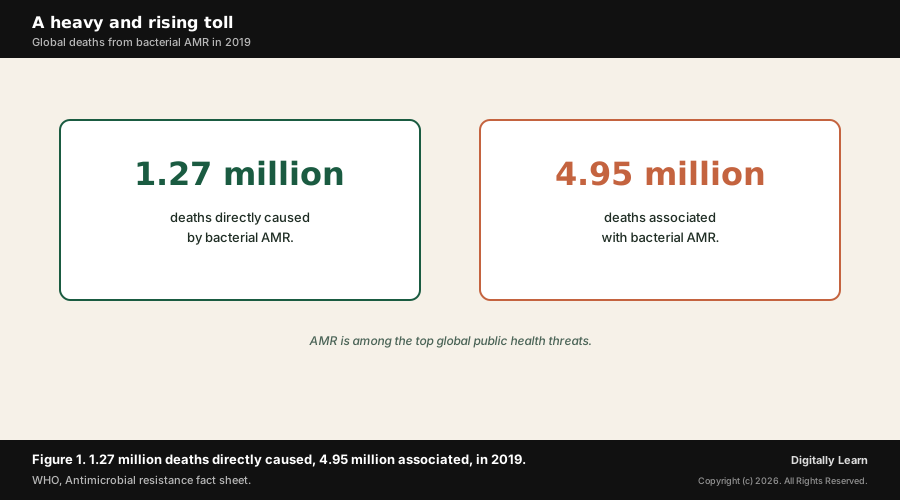
Bacterial AMR was directly responsible for about 1.27 million deaths in 2019 and was associated with about 4.95 million deaths, making it one of the leading global health threats.
It also matters because the threat keeps growing. Overuse of antibiotics in people, animals and farming speeds up resistance, so a renewed global plan is needed to slow the trend.
What the plan signifies
One Health, prevention first, and a hard target
Three threads carry the weight: the One Health approach, the shift to prevention, and a measurable target to anchor accountability.
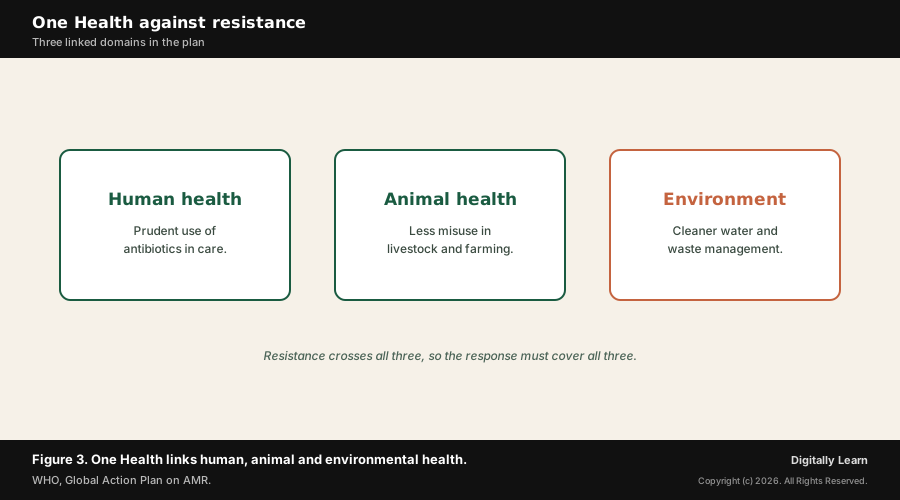
First, the One Health approach. AMR cannot be solved in clinics alone, so the plan links human medicine, animal health, food systems and the environment within a single framework.
Second, prevention first. The plan stresses stopping infections before they start through infection control, clean water and sanitation, vaccination and biosecurity, which reduce the need for antibiotics.
Third, a hard target. By 2030, it aims to help meet the 2024 United Nations goal of cutting bacterial AMR deaths in humans by 10 per cent, alongside lower antimicrobial use in farming.
Distinguishing features of the plan
The plan at a glance
The table sets out the key facts, so the scope and headline aims of the updated plan are visible at a glance.
| Feature | Detail |
|---|---|
| Adopted by | 79th World Health Assembly, May 2026 |
| Plan period | 2026 to 2036 |
| Builds on | First Global Action Plan of 2015 |
| Approach | One Health, prevention first |
| Headline target | Cut human AMR deaths 10% by 2030 |
Three features that define the plan
Three elements set the 2026 plan apart from the first plan of 2015:
- (i) A measurable goal. It carries a clear numerical target for cutting AMR deaths, not just broad aims.
- (ii) Stronger One Health design. It deepens links across human, animal, plant and environmental health.
- (iii) Accountability built in. It stresses monitoring, reporting, sustainable financing and cooperation.
Observable outcomes
Three trackable outcomes
The plan translates into three developments to watch in health and farming policy.
- (a) National action plans. Countries are expected to update their own AMR plans in line with the global one.
- (b) Curbs on misuse. Stronger rules on antibiotic sales and use in humans and livestock are likely to follow.
- (c) Better surveillance. More tracking of resistant infections and antibiotic use is needed to measure progress.
A plan sets direction; results depend on money and enforcement. Whether resistant-infection deaths actually fall is the real test of the new framework.
AMR, One Health and India
The SDGs, One Health and India's AMR effort
The fight against AMR supports Sustainable Development Goal 3 on good health, since untreatable infections threaten gains against many diseases at once.
It rests on the One Health idea, the recognition that human, animal and environmental health are linked, which also guides global work on emerging diseases and pandemics.
For India, the plan reinforces its own efforts, a national action plan on AMR, curbs on over-the-counter antibiotic sales, and surveillance networks that track resistant infections across the country.
UPSC relevance and exam focus
Where this fits in the UPSC-CSE syllabus
This topic maps to General Studies Paper II: issues relating to health and important international institutions, and to General Studies Paper III: science and technology and developments in biotechnology.
For Prelims, hold the high-yield facts: AMR as the failure of medicines against microbes, the World Health Assembly as WHO's decision-making body, the One Health approach, and the 2026 to 2036 plan.
For Mains, two framings recur: the causes and control of antibiotic resistance in India, and the role of global institutions in health security.
Recurring linked concepts an aspirant should keep in working memory:
- World Health Assembly: the decision-making body of the WHO.
- One Health: linking human, animal and environmental health.
- SDG 3: good health and well-being for all.
- National Action Plan on AMR: India’s own framework against resistance.
Antimicrobial resistance is a property of the microbe, not of the human body developing resistance to a drug. Confusing the two is a frequent error.
Do not treat AMR as only a medical issue. Its drivers in farming and the environment mean the remedy must be a One Health one.
Previous Year UPSC-CSE Questions By the end you will be able to draft model answers for the following UPSC questions. Each question carries a collapsible framework showing how to approach it in the exam.
- UPSC Mains 2014 GS-IIICan overuse and free availability of antibiotics without Doctor’s prescription, be contributors to the emergence of drug-resistant diseases in India? What are the available mechanisms for monitoring and control? Critically discuss the various issues involved.
How to structure the answer in the exam
Introduction: Open with AMR as a growing threat driven by misuse of antibiotics.
Body (sub-themes to develop):
- Drivers: over-the-counter sales, self-medication and incomplete courses.
- Use in livestock and farming as a major contributor.
- Control: prescription rules, stewardship programmes and surveillance.
- India's National Action Plan on AMR and its implementation gaps.
- The One Health response set out in the global plan.
Conclusion: Conclude that a One Health approach with strict regulation and surveillance is needed to contain resistance.
- UPSC Prelims 2020What is the importance of using Pneumococcal Conjugate Vaccines in India? Consider the following statements:
- These vaccines are effective against pneumonia as well as meningitis and sepsis.
- Dependence on antibiotics that are not effective against drug-resistant bacteria can be reduced.
- These vaccines have no side effects and cause no allergic reactions.
Select the correct answer using the code given below:
How to approach this Prelims question
Approach: Test each statement on the value of pneumococcal vaccines against the known facts.
Trap to watch: No vaccine is wholly free of side effects or allergic reactions, so statement 3 is wrong; only 1 and 2 hold.
Key facts to recall:
- Pneumococcal vaccines protect against pneumonia, meningitis and sepsis.
- By preventing infection, they reduce the need for antibiotics.
- No vaccine can be claimed to have no side effects at all.
Answer signal: Statements 1 and 2 are correct. Correct answer: 1 and 2 only.
Sources and Further Reading
- WHO: The World Health Assembly adopts updated Global Action Plan on Antimicrobial Resistance (2026-2036)
- WHO: Antimicrobial resistance (fact sheet)
- WHO: Antimicrobial resistance (health topic)
- WHO: Global leaders set first targets to control antimicrobial resistance crisis (2024)
- United Nations: Sustainable Development Goal 3
- Wikipedia: Antimicrobial resistance
Editorial Disclaimer
This article is compiled from the reference materials listed in the Sources section. It is an explainer for UPSC preparation and is not a substitute for primary documents (NCERTs, GoI ministry releases, IMD bulletins, RBI / CEA / MoEFCC publications, and Standing-Committee reports).


