

Overview
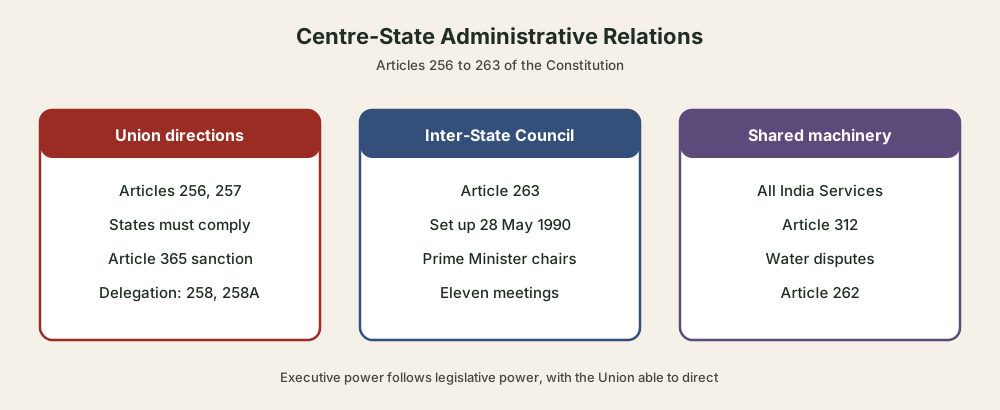
Centre-State administrative relations are governed mainly by Articles 256 to 263. The Union can direct the States to comply with its laws, the two can delegate functions to each other, and Article 263 provides for an Inter-State Council to advise on disputes and coordinate policy. The All India Services under Article 312 and the rules on inter-State water disputes complete the scheme.
Administrative Relations Between Centre and State: Articles 256 to 263
Distribution of Executive Power Between the Union and the States
Executive power follows legislative power. Under Article 73 the Union's executive power extends to every matter on which Parliament can make laws, and to rights exercised under treaties and agreements. A State's executive power covers its own territory for the matters in the State List.
The Concurrent List is the exception worth remembering. Although Parliament can legislate on it, the executive power on concurrent subjects stays with the States unless the Constitution or a law of Parliament expressly gives it to the Union. A central law on a concurrent subject is therefore usually carried out by State governments. How the lists divide law-making power is explained in the article on the Seventh Schedule.
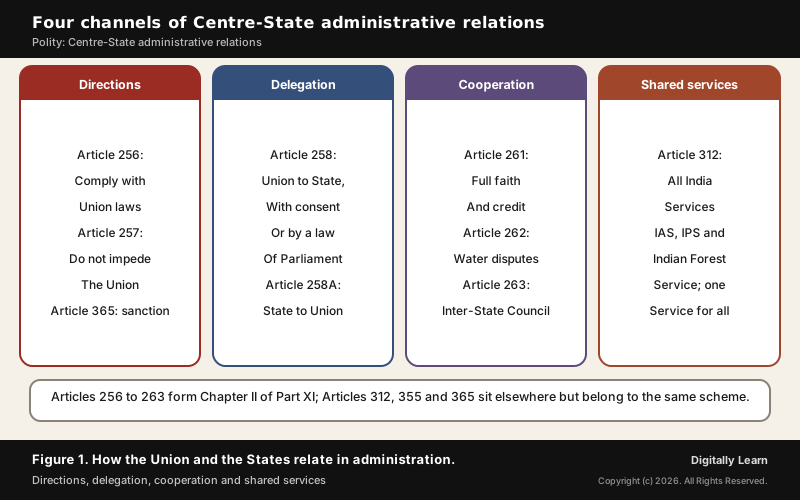
The Constitution deals with administrative relations in just eight articles, Articles 256 to 263, which form Chapter II of Part XI, though related provisions on the services, emergencies and the Governor appear elsewhere. The drafters paid little attention to the subject, on the view that once legislative powers were settled, administrative relations would follow.
Article 256 and Article 257: Union Directions to the States
Every State must, under Article 256, exercise its executive power so as to ensure compliance with laws made by Parliament and any existing laws that apply in the State. Article 257 adds that a State must not impede or prejudice the exercise of the Union's executive power. For both purposes the Union may give the State such directions as appear necessary.
- Communications: The Union may direct a State to build and maintain means of communication declared to be of national or military importance (Article 257(2)).
- Railways: It may direct the measures a State takes to protect railways within it (Article 257(3)); extra costs are paid by the Union, by agreement or as fixed by an arbitrator appointed by the Chief Justice of India.
- Mother tongue: It may direct facilities for instruction in the mother tongue at the primary stage for children of linguistic minorities.
- Scheduled Tribes: It may direct the drawing up and execution of schemes for the welfare of Scheduled Tribes in the State.
The sanction behind these directions is Article 365. If a State fails to comply with a direction given in the exercise of the Union's executive power, the President may hold that the State's government cannot be carried on in accordance with the Constitution, which opens the way to President's Rule under Article 356. President's Rule itself is explained in the article on the President's emergency powers.
Mutual Delegation of Functions: Articles 258 and 258A
Legislative powers cannot be delegated between the Union and the States, but executive functions can. The delegation softens the rigid division and prevents deadlock.
- Union to State by consent (Article 258(1)): The President may, with the consent of a State government, entrust to it or its officers, conditionally or unconditionally, any function to which the Union’s executive power extends.
- Union to State by law (Article 258(2)): A law of Parliament may confer powers and impose duties on a State or its officers, even on a matter outside the State’s legislative competence, and without the State’s consent; the Union pays any extra costs of administration.
- State to Union (Article 258A): A Governor may, with the Union government’s consent, entrust any State function to the Union or its officers. This was added by the Seventh Amendment in 1956.
| Route | Who hands over | Consent of the other side | Instrument |
|---|---|---|---|
| Article 258(1) | Union to a State | Needed | Order of the President |
| Article 258(2) | Union to a State | Not needed | Law made by Parliament |
| Article 258A | State to the Union | Needed | Order of the Governor |
Cooperation Mechanisms: Full Faith and Credit, Water Disputes and the Inter-State Council
Full Faith and Credit Under Article 261 and Other Cooperation Provisions
Each State's jurisdiction ends at its borders, so its acts and records might not be recognised in another State. Article 261 removes that difficulty: full faith and credit must be given throughout India to the public acts, records and judicial proceedings of the Union and of every State.
- Public acts: Both the legislative and the executive acts of a government.
- Proof and effect: How such acts, records and proceedings are proved, and their effect, is decided by law made by Parliament.
- Civil decrees: Final judgments or orders of civil courts can be executed anywhere in India; the rule does not require one State’s courts to enforce another State’s penal laws.
Two smaller provisions complete the scheme. Under Article 260 the Government of India may, by agreement with the government of a territory outside India, take over its executive, legislative or judicial functions. And Parliament may appoint an authority to carry out the constitutional provisions on freedom of inter-State trade, commerce and intercourse, though no such authority has been appointed so far.
Article 262 and Inter-State Water Disputes
Parliament may, under Article 262, provide by law for adjudicating any dispute over the use, distribution or control of the waters of an inter-State river or river valley, and may also bar the Supreme Court and every other court from hearing such a dispute. Parliament used this power in 1956 to pass the River Boards Act and the Inter-State River Water Disputes Act.
Under the 1956 Act the Union sets up an ad hoc tribunal for a dispute between States; its decision is final and binding, and no court has jurisdiction over a dispute referred to it. The reasoning was that rules of law built on private property in water are a poor basis for settling disputes in which the public interest in the proper use of water is at stake.
Disputes over river waters are more serious than border disputes, because they touch drinking water and agriculture in the States concerned. The Kaveri dispute between Tamil Nadu and Karnataka, where farmers in both States depend on Cauvery waters, reached the Supreme Court even though a tribunal had been set up to settle it.
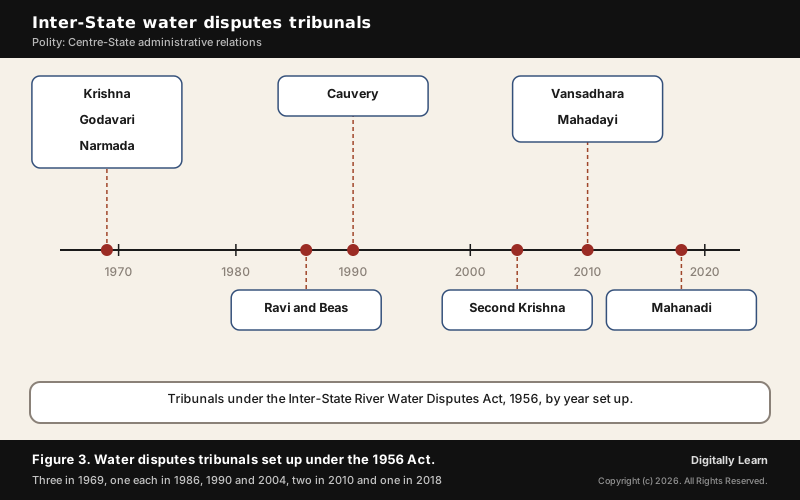
The machinery has worked slowly. The Punchhi Commission called the state of affairs dilatory, time-consuming and seldom settled, and asked for a change in the law and procedure. The Ravi and Beas tribunal, set up in 1986, has still not given its final report. A 2019 Bill proposed a Disputes Resolution Committee to negotiate first and a single tribunal with benches in place of the existing ones, but it lapsed with the dissolution of the Lok Sabha in 2024. The rivers and the disputes themselves are covered in the geography article on river linking and water disputes.
Inter-State Council Under Article 263: Composition and Functions
The President may, under Article 263, establish by order a Council if the public interest would be served, charged with three duties: inquiring into and advising on disputes between States; investigating and discussing subjects of common interest to the States or the Union; and making recommendations for better coordination of policy and action. The President defines its duties, organisation and procedure.
The Constitution only enables the Council; it was actually set up by a Presidential Order of 28 May 1990, after the Sarkaria Commission recommended a permanent body under Article 263, to be called the Inter-Governmental Council, with the duties in clauses (b) and (c). The Council is thus created under the Constitution but by executive order. The Prime Minister is its Chairman.
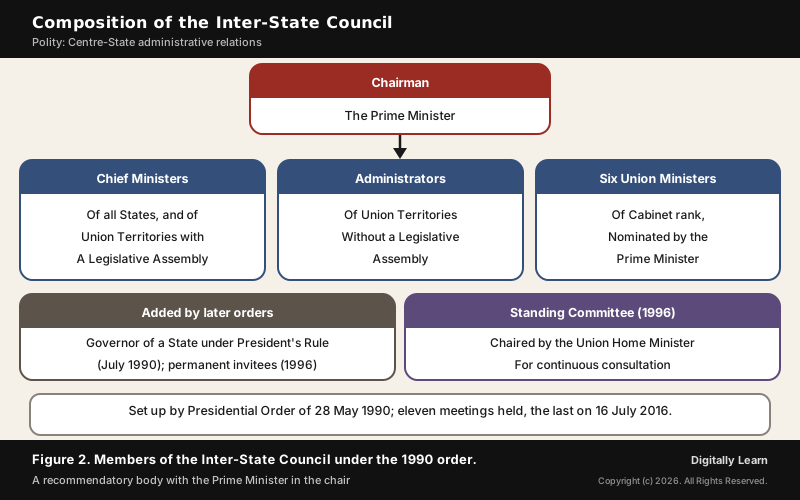
- Members: The Chief Ministers of all States; the Chief Ministers of Union Territories with a Legislative Assembly and the Administrators of those without one; and six Union Ministers of Cabinet rank nominated by the Prime Minister.
- Later additions: An order of 19 July 1990 let the Governor of a State under President’s Rule attend, and one of 24 December 1996 provided for permanent invitees from among other Union Ministers.
- Standing Committee: Set up in 1996 under the Union Home Minister for continuous consultation between meetings.
- Working method: A recommendatory body whose meetings are held in camera and whose decisions are taken by consensus.
Work of the Inter-State Council and Proposals to Strengthen It
The Council's early meetings worked through the Sarkaria Commission's report chapter by chapter: the first, on 10 October 1990, took up the report itself, and the second, in 1996, considered 179 recommendations on which its sub-committee had agreed. Later meetings turned to good governance and disaster management. The eleventh, on 16 July 2016, took up the Punchhi Commission's recommendations, Aadhaar, school education and internal security. The Council was last reconstituted in November 2024.
Article 263 has also been used for other councils, such as the Central Council of Health and the Central Council of Local Government and Urban Development. The Punchhi Commission strongly recommended strengthening and mainstreaming the Inter-State Council: giving it the dispute function in clause (a), expert staff, autonomy and regular meetings, and amending Article 263 to make it a credible, powerful and fair forum.
The Inter-State Council should not be confused with bodies the Constitution does not mention at all. The Zonal Councils were created by the States Reorganisation Act, 1956, one for each of five zones, as advisory bodies; the Planning Commission and the National Development Council were non-constitutional advisory bodies.
All India Services and Other Administrative Links
All India Services Under Article 312
The Union and the States each have their own services, but the All India Services are common to both. Their officers hold key posts under the Union and the States by turns; they are recruited and trained by the Union, but the States exercise immediate control and the Union ultimate control.
- The three services: The Indian Administrative Service and the Indian Police Service, which replaced the ICS and the Indian Police in 1947 and are deemed created under Article 312(2), and the Indian Forest Service, created in 1966.
- Creating a new service (Article 312(1)): Parliament may create one if the Rajya Sabha declares by a resolution of two-thirds of the members present and voting that it is necessary in the national interest.
- All India Judicial Service: Article 312 expressly allows one, not including any post below a district judge; the only All India Services today are the three above.
- One service everywhere: Each service has common rights, status and uniform scales of pay across the country.
The services restrict the States' autonomy and patronage, but they are defended because they keep standards of administration high, bring uniformity and help the Union and the States work together. Ambedkar argued in the Constituent Assembly that certain posts are strategic for the standard of administration, and should be filled from an all-India service with uniform pay and common qualifications.
Public Service Commissions, Integrated Judiciary and Emergency Provisions
- Public Service Commissions: A State PSC’s members are appointed by the Governor but can be removed only by the President; Parliament can create a Joint State PSC at the request of the States concerned; the UPSC may serve a State at the Governor’s request with the President’s approval.
- Independent judiciary: One of the features of any federation is an independent judiciary to prevent conflicts between the centre and the States, settling their legal disputes about the division of power.
- Integrated judiciary: Despite a dual polity there is one integrated system of courts, with the Supreme Court at the top, enforcing both Union and State laws; High Court judges are appointed by the President, as explained in the article on the High Courts.
- Governor: Appointed by the President and holding office during his pleasure, the Governor is both the State’s constitutional head and a link with the Union.
- Article 355: The Union must protect every State against external aggression and internal disturbance and ensure that each State’s government is carried on in accordance with the Constitution.
Emergencies tilt the balance further. During a National Emergency the Union can give directions to a State on any matter. Under President's Rule the President may assume the functions of the State government, and during a Financial Emergency the Union can direct States to observe canons of financial propriety. The 42nd Amendment of 1976 had added Article 257A, letting the Union deploy its armed forces in a State; the 44th Amendment omitted it in 1978.
Contested Areas: Central Agencies and Reform
State Demands for Administrative Autonomy
From time to time States have demanded more powers and more autonomy. Such demands grew from the mid-1960s, when Congress dominance declined and opposition parties came to power in a large number of States, which then protested against what they saw as interference from the centre.
- Administrative powers: One strand of the autonomy demands is administrative: States resent the centre’s control over the administrative machinery, including the All India Services.
- The Governor: The role of Governors has always been controversial, because the power to reserve State Bills gives the centre an opportunity to delay, examine and even veto them completely.
- Legal against political disputes: Legal disputes between the centre and the States can be settled by the judiciary, but demands for autonomy are political and have to be resolved through negotiation.
CBI Investigations and State Consent
Police and public order are State List subjects, which is why the Central Bureau of Investigation needs a State's consent to work inside it. The CBI was set up by a Government of India resolution of 1 April 1963 and draws its power to investigate from the Delhi Special Police Establishment Act, 1946.
- Union Territories: Section 2 of the Act gives the agency jurisdiction in the Union Territories only.
- States: The Union can extend its jurisdiction to a State under Section 5(1), but only if the State government consents under Section 6.
- General and specific consent: A general consent covers all cases until revoked; without it the CBI needs specific consent case by case. West Bengal, Maharashtra, Kerala, Punjab, Tamil Nadu and Karnataka are among the States that have withdrawn general consent.
The States' power is not absolute. On 17 February 2010 a five-judge Constitution Bench of the Supreme Court held that the High Courts and the Supreme Court, as protectors of civil liberties, can order a CBI investigation into an offence in a State without the State's consent.
Sarkaria and Punchhi Recommendations on Administrative Relations
Both commissions accepted the constitutional scheme but asked for it to be used with restraint and consultation. The Inter-State Council discussed the Sarkaria Commission's chapter on administrative relations at its sixth meeting in 2000 and again at its eighth in 2003.
- Directions: Keep Articles 256 and 257 as a safety valve, use them sparingly, and extend Article 257(3) to Union property of national importance (Punchhi).
- Inter-State Council: Set up a permanent council (Sarkaria, 1988); strengthen it with dispute-advice powers, expert staff and regular meetings (Punchhi).
- All India Services: Create new services in health, education, engineering and the judiciary, and an advisory council under the Cabinet Secretary for their management (Punchhi).
- Water disputes: Change the law and procedure, since adjudication has been dilatory and seldom settled (Punchhi).
Previous Year UPSC-CSE Questions
Previous Year UPSC-CSE Questions By the end you will be able to draft model answers for the following UPSC questions. Each question carries a collapsible framework showing how to approach it in the exam.
- UPSC Prelims 2013 Prelims-GSWhich of the following bodies does not/do not find mention in the Constitution?
- National Development Council
- Planning Commission
- Zonal Councils
Select the correct answer using the codes given below:
How to approach this Prelims question
Approach: Ask of each body whether an article of the Constitution creates or names it.
Trap to watch: The National Development Council sounds constitutional.
Key facts to recall:
- Zonal Councils: States Reorganisation Act, 1956.
- Planning Commission and NDC: non-constitutional advisory bodies.
Answer signal: All three, option (d).
- UPSC Prelims 2021 Prelims-GSWhich one of the following in Indian polity is an essential feature that indicates that it is federal in character?
How to approach this Prelims question
Approach: Ask which option is essential to a federation, not merely present in India.
Trap to watch: Elected representatives and enforceable rights exist in unitary states too.
Key facts to recall:
- An independent judiciary settles Centre-State disputes on the division of power.
Answer signal: Option (a).
- UPSC Mains 2021 GS-IIThe jurisdiction of the Central Bureau of Investigation (CBI) regarding lodging an FIR and conducting probe within a particular State is being questioned by various States. However, the power of the States to withhold consent to the CBI is not absolute. Explain with special reference to the federal character of India.
How to structure the answer in the exam
Introduction: Police and public order are State subjects, so the CBI, a Union agency working under the Delhi Special Police Establishment Act, 1946, needs a State's consent to investigate within it.
Body (sub-themes to develop):
- Legal basis: Sections 2, 5 and 6 of the DSPE Act; general and specific consent.
- Federal tension: several States have withdrawn general consent, alleging misuse.
- Limits: the 2010 Constitution Bench held that High Courts and the Supreme Court can order CBI probes without consent.
- Balance: cooperative mechanisms such as the Inter-State Council to settle such disputes.
Conclusion: Conclude that consent protects federal autonomy but cannot shield offences from constitutional courts.
- UPSC Mains 2013 GS-IIConstitutional mechanisms to resolve the inter- state water disputes have failed to address and solve the problems. Is the failure due to structural or process inadequacy or both? Discuss.
How to structure the answer in the exam
Introduction: Article 262 and the Inter-State River Water Disputes Act, 1956 provide for tribunals to adjudicate disputes over inter-State rivers, with the courts barred.
Body (sub-themes to develop):
- Structural: ad hoc tribunals, one per dispute; courts barred by Article 262(2); awards depend on Union notification.
- Process: decades-long adjudication, such as the Ravi and Beas tribunal of 1986 still without a final report.
- Reform: the 2019 Bill's Disputes Resolution Committee and single tribunal; the Punchhi Commission's call for new law and procedure.
- Cooperative routes: river boards and the Inter-State Council under Article 263(a).
Conclusion: Conclude that the failure is both structural and procedural, and that negotiation must come before adjudication.
Sources and Further Reading
- Legislative Department, Ministry of Law and Justice: The Constitution of India
- Inter-State Council Secretariat: Inter-State Council, Genesis
- Inter-State Council Secretariat: Inter-State Council, Composition
- Inter-State Council Secretariat: Inter-State Council, Meetings
- Inter-State Council Secretariat: Standing Committee, Composition
- Inter-State Council Secretariat: Zonal Councils, Genesis
- Inter-State Council Secretariat: Report of the Commission on Centre-State Relations (Punchhi), Volume II, March 2010
- NCERT: Indian Constitution at Work, Class 11, Chapter 7, Federalism
- Supreme Court of India: The Constitution (judiciary)
- Central Bureau of Investigation: About Us
- Wikipedia: All India Services
- Wikipedia: Interstate River Water Disputes Act, 1956
- Wikipedia: Central Bureau of Investigation
Editorial Disclaimer
This article explains Articles 256 to 263 and related provisions from the text of the Constitution and the other sources listed.


