


Overview
The human digestive system is the set of organs that breaks food into molecules small enough to be absorbed and then absorbs them. It is built around the alimentary canal, a long tube from the mouth to the anus, together with three accessory glands (the salivary glands, the liver and the pancreas), which pour their secretions into it. Food that is eaten is complex. Proteins, starch and fats are too large to pass through the lining of the gut, so enzymes break them down into amino acids, simple sugars, and fatty acids and monoglycerides, which the small intestine absorbs into the blood and lymph.
Nutrients, Energy and a Balanced Diet
Macronutrients, Micronutrients, Dietary Fibre and Water
Nutrients are the components of food that provide energy, support growth, repair the body, protect it from disease and maintain its functions. The major nutrients are carbohydrates, proteins, fats, vitamins and minerals. They fall into two groups by the quantity the body needs.
- Macronutrients: Carbohydrates, proteins and fats are needed in large amounts and supply the body's energy.
- Micronutrients: Vitamins and minerals are needed in small amounts. Vegetables and fruits, which supply many of them, are counted as sources of protective nutrients.
The three macronutrients differ in how much energy a gram of each releases. Carbohydrates and proteins each give 4 kilocalories per gram, while fats give 9 kilocalories per gram, more than twice as much. This is why fat raises the energy density of a food.
Two further components are essential although they are not counted as nutrients. Dietary fibre, also called roughage, provides no nutrients but helps the body get rid of undigested food and ensures the smooth passage of stools; green leafy vegetables, fresh fruits, whole grains, pulses and nuts are good sources. Water helps the body absorb nutrients from food and removes waste through sweat and urine.
A nutrient helps the body only once it has been digested and absorbed, so a diet can carry enough food and still leave a person short of a nutrient, which is how many deficiency diseases arise.
Balanced Diet Under the ICMR‑NIN Dietary Guidelines, 2024
A balanced diet provides all the essential nutrients in the right quantities, along with adequate roughage and water. Since no single food carries every essential nutrient, a balanced diet can be achieved only by eating a variety of foods. India's latest advice on how to do this is the Dietary Guidelines for Indians, 2024, issued by the ICMR-National Institute of Nutrition (ICMR‑NIN), Hyderabad, an institute of the Indian Council of Medical Research, which sets out 17 dietary guidelines.
The guidelines sort foods into 10 groups. These are cereals and millets; pulses; vegetables; nuts, oilseeds, oils and fats; green leafy vegetables; fruits; dairy; roots and tubers; flesh foods; and spices and herbs. The ICMR‑NIN's "My Plate for the Day", drawn for a 2,000-kilocalorie Indian diet, places vegetables, fruits, green leafy vegetables, roots and tubers on about half the plate. Cereals and millets take most of the remaining portion, followed by pulses, flesh foods, eggs, nuts, oilseeds and milk or curd.
The guidelines express a balanced diet as shares of the day's energy.
| Source of energy | Share of total energy per day |
|---|---|
| Cereals and millets | Not more than 45% |
| Pulses, beans and meat | Up to 15% |
| Nuts, oilseeds, milk and milk products | 8% to 10% |
| Total fat | 30% or less |
| Added sugar | Less than 5% |
Read as nutrients, the same plate gives 50 to 55 per cent of total energy from carbohydrates, 10 to 15 per cent from proteins and 20 to 30 per cent from dietary fats. At least half of the cereals eaten should be whole grains such as millets, which supply vitamins, minerals, fibre and antioxidants.
The guidelines add daily limits on three foods that raise the risk of disease when eaten in excess:
- Salt: Not more than 5 grams of salt a day, which is equivalent to 2 grams of sodium. High salt intake is associated with high blood pressure and related heart and blood vessel diseases.
- Sugar: For adults, sugar is avoided or restricted to 20 to 25 grams a day, and children under two years are given no added sugar at all.
- Cooking oil: Visible fat is limited to 20 to 50 grams a person a day depending on energy needs, and not more than 27 to 30 grams for a 2,000-kilocalorie diet. Ghee or butter is limited to one or two teaspoons a day.
The guidelines also ask people to avoid ultra-processed foods and foods high in fat, sugar and salt (HFSS). Junk foods such as these carry high levels of sugar and fat but little protein, few minerals and vitamins, and little dietary fibre.
Recommended Dietary Allowance and the Protein Requirement
Two numbers describe how much of a nutrient healthy people need. Requirements differ from one person to another, and the mean of that spread is the estimated average requirement (EAR), while its 97.5th percentile is the recommended dietary allowance (RDA). Diet planning for individuals and populations is based on the EAR; the RDA, set high enough to cover almost everyone, is meant for supervised supplementation in deficient individuals.
For protein, the guidelines set the estimated average requirement at 0.66 grams per kilogram of body weight a day and the recommended dietary allowance at 0.83 grams per kilogram a day for healthy men and women. For a person weighing 65 kilograms, this works out to an estimated average requirement of 43 grams of protein a day and a recommended allowance of 54 grams a day, regardless of physical activity or gender.
Because the allowance is fixed per kilogram, a heavier person needs more protein than a lighter one, and no single national figure fits everyone. Growing infants and children, adolescents, pregnant women and people with certain infections, illnesses or physical stress need more protein than the general allowance. The guidelines advise meeting the requirement from food: A combination of cereals with pulses in the ratio of 3:1, by raw weight, can meet the requirement of all the essential amino acids.
Parts of the Human Digestive System: The Alimentary Canal
Process of Digestion Along the Alimentary Canal
The alimentary canal is a long tube that runs from the mouth to the anus, and its different regions are specialised for different functions. Food is moved along it in a regulated manner. The lining of the canal has muscles that contract rhythmically to push the food forward, and these peristaltic movements occur all along the gut. At several points a ring of muscle, a sphincter, controls when food passes from one region to the next.
The parts of the human digestive system, taken in the order food meets them, are these:
- Mouth: Teeth crush and chew the food, saliva wets it and begins the digestion of starch, and the tongue mixes the food and pushes it back for swallowing.
- Pharynx: The swallowed food passes the back of the throat, where the epiglottis closes over the windpipe.
- Oesophagus: The food pipe carries the food to the stomach by peristalsis.
- Stomach: The stomach churns the food with gastric juice, and protein digestion begins in an acidic medium.
- Small intestine: Bile, pancreatic juice and intestinal juice complete the digestion of carbohydrates, proteins and fats, and the villi absorb the products.
- Large intestine: Water and some salts are absorbed from the undigested remainder, which becomes semi-solid stool.
- Rectum and anus: The stool is stored in the rectum and expelled through the anus, a process known as egestion.
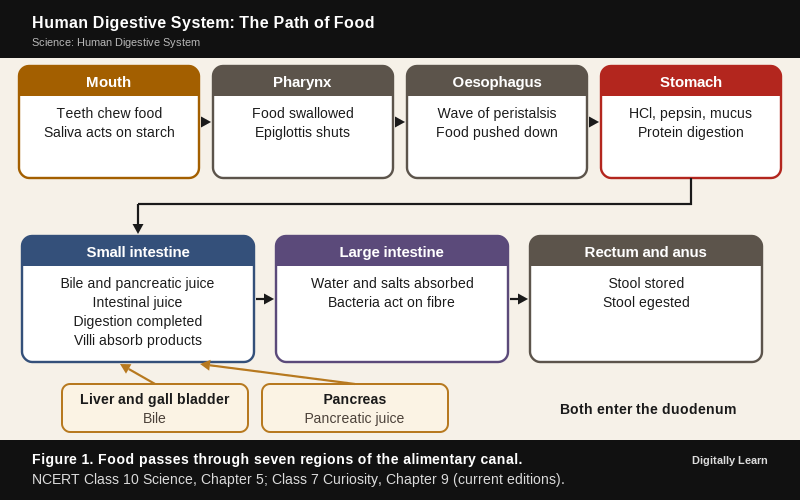
Digestion is of two kinds, and both run through this sequence. The breakdown of food into fine pieces by crushing and chewing is mechanical digestion. The breakdown of complex food components into simpler forms by enzymes is chemical digestion, which is what makes the food small enough to be absorbed.
Mouth, Teeth and Salivary Glands
The mouth begins both kinds of digestion. Humans have four types of teeth (incisors, canines, premolars and molars), each with a specific function. A person usually has 20 primary or milk teeth and later 32 permanent teeth.
Saliva comes from three pairs of major salivary glands (the parotid, submandibular and sublingual glands) as well as hundreds of minor salivary glands. Saliva wets the food so that it passes smoothly along the soft lining of the canal, and it contains the enzyme salivary amylase, which breaks down starch, a complex molecule, into smaller sugar chains and some simple sugar. The muscular tongue mixes the chewed food thoroughly with saliva.
The action of saliva on starch can be shown with a simple test. A starch solution mixed with saliva and left for 20 to 30 minutes no longer turns blue-black with dilute iodine, while starch solution left without saliva still does. The blue-black colour is the test for starch, and its loss shows that the starch has been broken down.
Teeth also show what happens when acid acts in the mouth. In dental caries, or tooth decay, bacteria acting on sugars produce acids that soften the enamel. Masses of bacteria and food particles stick to the teeth as dental plaque, and saliva cannot reach the tooth surface under the plaque to neutralise the acid. Brushing after eating removes the plaque before the bacteria produce acid.
Pharynx, Oesophagus and Peristalsis
Chewed food is swallowed through the pharynx, which also carries air to the windpipe. During swallowing the epiglottis tilts backwards and covers the larynx, which prevents food from entering the trachea and the lungs.
The oesophagus, or food pipe, is a muscular tube about 25 centimetres long in adults that carries food from the mouth to the stomach. Its walls contract and relax in a wave-like motion that pushes the food down into the stomach. This is the same peristalsis that moves food through the rest of the canal.
Stomach: Hydrochloric Acid, Pepsin and Mucus
The stomach is a large organ that expands when food enters it, and its muscular walls mix the food thoroughly with digestive juices. The gastric glands in the stomach wall release three secretions, each with its own task:
- Hydrochloric acid: It creates the acidic medium in which the stomach's enzyme acts, and it kills many harmful bacteria that arrive with food. The pH of the stomach is between 1 and 3.
- Pepsin: This protein-digesting enzyme is released as an inactive form, pepsinogen, which the hydrochloric acid converts into pepsin. Pepsin breaks proteins down into smaller peptides.
- Mucus: It protects the inner lining of the stomach from the action of the acid under normal conditions.
A typical adult stomach secretes about 1.5 litres of gastric juice a day. In the stomach the food is partially digested and turned into a semi-liquid mass called chyme. A sphincter muscle at the exit of the stomach, the pyloric sphincter, releases the chyme into the small intestine in small amounts.
A different enzyme, rennin (chymosin), curdles milk in the stomach of calves and other young ruminants. Humans carry only a non-working copy of its gene and digest milk with pepsin and lipase instead. Rennin must not be confused with renin, an enzyme secreted by the kidneys that breaks down angiotensinogen in the blood into angiotensin I and has no role in digestion.
Small Intestine: Duodenum, Jejunum and Ileum
The small intestine is the longest part of the alimentary canal, almost 6 metres long when stretched out, and it fits into the abdomen because it is extensively coiled. It is the site of the complete digestion of carbohydrates, proteins and fats. The length of the small intestine varies with an animal's diet: Herbivores eating grass need a longer small intestine to digest cellulose, while carnivores such as tigers have a shorter one.
The small intestine has three structural parts:
- Duodenum: The first and shortest part, 20 to 25 centimetres long and shaped like the letter C around the head of the pancreas. It receives chyme from the stomach together with bile from the liver and pancreatic juice from the pancreas, and its Brunner's glands produce an alkaline mucus containing bicarbonate.
- Jejunum: The middle part, about 2.5 metres long. Its circular folds and villi increase its surface, and most of the products of digestion are absorbed here. Sugars and amino acids pass into the blood, and fats into the lymph.
- Ileum: The final and longest part, about 3 metres long. It absorbs mainly vitamin B12 and bile acids, together with any nutrients the jejunum has not absorbed, and it joins the caecum of the large intestine.
In order of decreasing length, therefore, the parts run ileum, jejunum, duodenum. Two ducts open into the duodenum. The common bile duct brings bile from the liver and the gall bladder, and the pancreatic duct brings pancreatic juice. Neither opens into the stomach.
The walls of the small intestine also contain glands that secrete intestinal juice. Its enzymes finish the digestion of proteins into amino acids and of carbohydrates into simple sugars such as glucose; fats are broken down by lipase from the pancreas.
Villi, Microvilli and the Absorption of Digested Food
Absorption is the passage of digested nutrients from the small intestine into the blood present in the blood vessels in its walls. The inner lining of the small intestine has numerous finger-like projections called villi, which increase the surface area for absorption. The epithelial cells covering each villus carry still smaller projections, microvilli. The villi and the microvilli increase the absorptive surface about 40-fold and 600-fold respectively.
Each villus has a network of capillaries and fine lymphatic vessels called lacteals close to its surface. The cells of the villi pass amino acids and carbohydrates into the capillaries and lipids into the lacteals. The blood vessels then take the absorbed food to every cell of the body, where it is used to obtain energy, build new tissues and repair old ones.
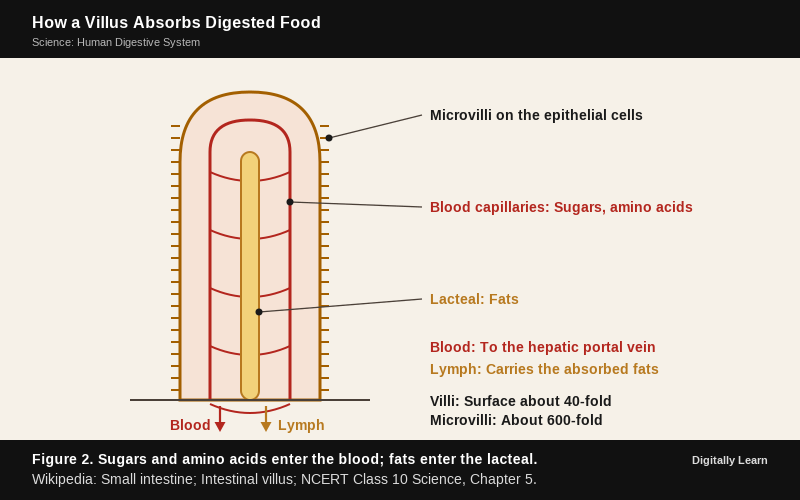
The blood that leaves the stomach and intestine does not go straight to the heart. The hepatic portal vein carries blood from the gastrointestinal tract, gall bladder, pancreas and spleen to the liver. This supplies the liver with nutrients and ensures that substances taken in are first processed by the liver before they reach the rest of the circulation. Blood then leaves the liver for the heart in the hepatic veins, while the hepatic artery brings the liver oxygen-rich blood from the aorta.
Large Intestine, Appendix and Gut Bacteria
The large intestine receives the undigested food that is left after most nutrients have been absorbed in the small intestine. It is about 1.5 metres long, shorter than the small intestine, and it is called large because it is wider. It begins with the caecum, to which the appendix, a finger-like tube closed at one end, is attached.
The large intestine absorbs water and some salts from the undigested food, which makes the waste semi-solid. This waste, called stool, is stored in the rectum, the lower part of the large intestine, until it is expelled through the anus. The exit of the waste is regulated by the anal sphincter. Fibre-rich foods such as fruits, vegetables and whole grains help the large intestine work properly by making the stool easier to pass.
The large intestine is also home to many bacteria and other small organisms that help in digestion. They break down undigested food, especially fibre, and produce essential nutrients. Fibre-rich foods and fermented foods such as curd, buttermilk, kanji and pickles help keep the digestive system healthy. Probiotics build on the same idea: They are live microorganisms taken to support the health of the host, and the idea of replacing harmful gut microbes with useful ones goes back to Élie Metchnikoff in 1907.
Accessory Digestive Glands: Liver, Gall Bladder and Pancreas
Liver and Bile: Emulsification Without an Enzyme
The liver is the heaviest internal organ and the largest gland in the human body. As an accessory digestive organ it produces bile, an alkaline fluid containing cholesterol and bile acids. About 400 to 800 millilitres of bile are produced each day. The gall bladder, a small hollow pouch under the right lobe of the liver, stores and concentrates the bile and releases it through the common bile duct into the duodenum.
Bile does two things in the small intestine:
- Alkaline medium: The food coming from the stomach is acidic and has to be made alkaline for the pancreatic enzymes to act, and bile accomplishes this.
- Emulsification: Fats reach the intestine as large globules, which makes it difficult for enzymes to act on them. Bile salts break them down into smaller globules and so increase the efficiency of enzyme action, much as soap emulsifies dirt.
Emulsification changes the physical state of fat, not its chemistry. Bile contains no digestive enzyme; the fat is broken down chemically afterwards by lipase from the pancreas. The liver is therefore essential to the digestion of fat while producing no fat-digesting enzyme of its own. The colour of bile comes from its two main pigments, bilirubin, which is orange-yellow, and its oxidised form biliverdin, which is green.
The liver has several other roles that touch digestion. Because the hepatic portal vein brings it the absorbed food first, it converts and stores nutrients such as glucose as glycogen. It also converts ammonia, a waste product of protein breakdown, into urea through the urea cycle, and the urea is excreted in the urine.
Pancreas: Exocrine Juice and Endocrine Islets
The pancreas works as two glands in one. As an exocrine gland it secretes pancreatic juice into the duodenum through the pancreatic duct. As an endocrine gland its clusters of cells called pancreatic islets, or islets of Langerhans, release hormones into the blood, chiefly insulin and glucagon, which regulate blood sugar. The pancreas therefore belongs to both the digestive system and the endocrine system.
Pancreatic juice is basic and helps neutralise the acid in the food arriving from the stomach. It carries enzymes for all three classes of food:
- Trypsin and chymotrypsin: These enzymes split proteins into smaller peptides. Trypsin is secreted as an inactive form, trypsinogen, which an enzyme of the intestinal lining, enteropeptidase, converts into trypsin; trypsin then activates the other pancreatic enzymes.
- Pancreatic amylase: It breaks starch down into shorter chains of sugar units.
- Pancreatic lipase: It breaks down emulsified fats, splitting triglycerides into free fatty acids and monoglycerides with the help of bile salts.
Pancreatic enzymes and bile enter the small intestine in response to the hormone cholecystokinin, which is produced when nutrients reach the duodenum.
Digestive Enzymes and Gut Hormones
Enzymes as Biological Catalysts: Active Site and Optimum pH
An enzyme is a biological catalyst. Almost all enzymes are proteins, although some nucleic acids, called ribozymes, also behave like enzymes. As the enzyme's protein chain folds upon itself it forms crevices or pockets, and one such pocket is the active site, into which the substrate fits.
An enzyme works in a cycle of four steps:
- The substrate binds to the active site of the enzyme.
- The binding makes the enzyme alter its shape and fit more tightly around the substrate.
- The active site breaks the chemical bonds of the substrate, and an enzyme-product complex forms.
- The enzyme releases the products and is free to bind another molecule of the substrate.
Enzymes speed up reactions by lowering the activation energy, the extra energy a substrate must gain to reach the transition state before it becomes the product. Because each active site fits its own substrate, an enzyme that digests starch does not digest protein.
Each enzyme shows its highest activity at a particular temperature and pH, called its optimum temperature and optimum pH, and its activity declines above and below these values. Low temperature keeps an enzyme temporarily inactive, whereas high temperature destroys its activity because the protein is denatured by heat. This is why pepsin works in the acid of the stomach while the pancreatic enzymes need the alkaline medium that bile and pancreatic juice create.
| Category | What it does | Example |
|---|---|---|
| Enzyme | Catalyses a chemical reaction | Pepsin, which digests protein in the stomach; trypsin |
| Hormone | Acts as an intercellular messenger, produced in trace amounts | Insulin; progesterone, a sex hormone; oxytocin, which stimulates contractions of the uterine muscle |
| Vitamin precursor | Is converted into a vitamin in the body | Beta-carotene, converted to vitamin A |
| Structural protein | Forms a structural material of the body | Keratin, which makes up hair, nails and the outer layer of skin |
Insulin, a hormone, and keratin, a structural protein, are proteins as well, so being a protein does not make a substance an enzyme. What makes an enzyme is that it catalyses a reaction; what makes a hormone is that it carries a message between cells.
Digestive Enzymes by Site, Substrate and Product
Each digestive enzyme acts at one site on one kind of substrate.
| Site and secretion | Enzyme | Acts on | Products |
|---|---|---|---|
| Mouth: Saliva | Salivary amylase (ptyalin) | Starch | Smaller sugar chains and some simple sugar |
| Stomach: Gastric juice | Pepsin (released as pepsinogen) | Proteins | Smaller peptides |
| Small intestine: Pancreatic juice | Trypsin (released as trypsinogen), chymotrypsin, carboxypeptidase | Proteins and peptides | Smaller peptides and amino acids |
| Pancreatic amylase | Starch | Smaller sugar chains | |
| Pancreatic lipase | Emulsified fats (triglycerides) | Free fatty acids and monoglycerides | |
| Small intestine: Intestinal lining | Aminopeptidase, dipeptidase | Peptides | Amino acids |
| Maltase, sucrase, lactase | Disaccharides and short sugar chains | Simple sugars (lactase gives glucose and galactose) |
The enzymes divide the work by site. Starch is acted on in the mouth and again in the small intestine, protein in the stomach and again in the small intestine, and fat only in the small intestine. The small intestine is the only region where all three are digested. Carbohydrates end as simple sugars such as glucose and proteins as amino acids, through the enzymes of the lining, while fats end as fatty acids and monoglycerides through pancreatic lipase.
Some carbohydrates, such as cellulose, are not digested at all in the small intestine and pass into the large intestine, where bacteria act on them.
Gut Hormones: Gastrin, Secretin, CCK and GIP
Digestion is coordinated by hormones as well as by enzymes. Endocrine cells in different parts of the gastrointestinal tract secrete four major peptide hormones, and each acts on a different organ:
- Gastrin: Released by G cells in the lower part of the stomach and in the duodenum, it acts on the gastric glands and stimulates the secretion of hydrochloric acid and pepsinogen.
- Secretin: Released by the S cells of the duodenum when acid chyme arrives from the stomach, it acts on the exocrine pancreas and stimulates the secretion of water and bicarbonate ions, which neutralise that acid. It also inhibits the secretion of gastric acid.
- Cholecystokinin (CCK): Secreted by cells in the duodenum, it acts on both the pancreas and the gall bladder and stimulates the secretion of pancreatic enzymes and bile.
- Gastric inhibitory peptide (GIP): Released in the duodenum, it inhibits gastric secretion and the movement of the stomach.
Enterogastrone is the general name for any hormone that the lining of the duodenum secretes in response to fats in the diet and that slows the forward movement of chyme. Its function is almost the same as that of gastric inhibitory peptide.
The four hormones regulate digestion but digest nothing themselves. Gastrin can be mistaken for a digestive enzyme because it comes from the stomach, yet it carries a message to the gastric glands rather than acting on food.
Carbohydrates, Proteins and Fats in Digestion and Diet
Carbohydrates: Sugars, Starch and Dietary Fibre
Carbohydrates are the major source of energy in all human diets and provide 4 kilocalories per gram. They are either simple or complex:
- Simple sugars: Glucose and fructose are found in fruits, vegetables and honey.
- Disaccharides: Sucrose, the table sugar, and lactose, the sugar of milk, are split into simple sugars by the enzymes of the intestinal lining.
- Complex carbohydrates: Starches and fibre are the two forms of complex carbohydrate, and both are found in plant foods such as cereals, millets, pulses, vegetables and tubers.
Polysaccharides are long chains of sugars. Starch is the form in which plant tissues store energy, and glycogen is the animal variant. Cellulose, which makes up plant cell walls, is a chain of only one kind of sugar, glucose. Starch also consists of numerous glucose units, but its chains coil into helices that can hold iodine, which is why starch turns blue-black with iodine; cellulose has no such helices and cannot hold iodine.
Human enzymes digest starch but not cellulose. Starch digestion begins in the mouth with salivary amylase and is completed in the small intestine. Cellulose passes through undigested because it is built from beta-glucose, whose bonds human enzymes cannot break. This indigestible part of vegetables, fruits, whole grains, pulses, nuts and seeds is dietary fibre.
Aspartame, an artificial sweetener, shows how a food can supply energy and still be low in calories. It is built from amino acids and releases about the same energy per gram as sucrose, 4 kilocalories. It is about 180 to 200 times sweeter than table sugar, so the quantity needed to sweeten food is so small that its contribution to calories is negligible.
Proteins and Essential Amino Acids
Proteins are complex molecules built from 20 different amino acids. They form muscle, bone, cartilage and skin, and they act as enzymes, hormones, antibodies and carriers of nutrients across the cell membrane. Used for energy, proteins give 4 kilocalories per gram.
Amino acids fall into two classes by whether the body can make them:
- Essential amino acids: Nine of the 20 amino acids cannot be synthesised in the human body and have to come from proteins in the diet. They are valine, isoleucine, leucine, methionine, phenylalanine, tryptophan, threonine, histidine and lysine.
- Non-essential amino acids: The rest can be synthesised in the body. Serine is one of them, and tyrosine is made from phenylalanine, although it is counted as conditionally essential for some groups, such as newborn infants.
Protein quality depends on how well a food supplies the essential amino acids. Animal proteins from milk, meat, fish and eggs are of high quality because they are bioavailable and provide all the essential amino acids in the right proportions. Plant proteins are lower in some of them: Cereals have lower levels of lysine but higher levels of methionine and cysteine, and pulses the reverse. A combination of cereals, millets and pulses therefore provides most of the amino acids, each making up what the other lacks.
Fats, Essential Fatty Acids and Trans Fats
Fats, also called lipids, are a concentrated source of energy that gives 9 kilocalories per gram. They carry the fat-soluble vitamins A, D, E and K and help their absorption, and they form part of cell membranes and many hormones. Fats such as vegetable oils, butter and ghee are visible fats, while the fat present within plant and animal foods is invisible fat.
Most fats in food are triglycerides, in which three fatty acids are joined to glycerol (glycerine), a trihydroxy propane. Fatty acids are grouped by their double bonds:
- Saturated fatty acids (SFA): These have no double bond. Coconut oil, palm oil, ghee, butter, milk, milk products and meat contain them.
- Monounsaturated fatty acids (MUFA): These have one carbon-carbon double bond.
- Polyunsaturated fatty acids (PUFA): These have more than one double bond. The omega‑6 (n‑6) and omega‑3 (n‑3) fatty acids belong here.
The double bonds make unsaturated fats more reactive than saturated ones. The more double bonds a fatty acid has, the more easily it is oxidised and turns rancid, which is why repeated heating of cooking oil oxidises its polyunsaturated fatty acids into harmful compounds.
The body can synthesise saturated and monounsaturated fatty acids, but it cannot make two polyunsaturated fatty acids: Linoleic acid (an omega‑6 fatty acid) and alpha-linolenic acid (an omega‑3 fatty acid). These two are the essential fatty acids and must come from food. Marine fish such as salmon, mackerel, trout and tuna are good sources of the long-chain omega‑3 fatty acids, and nuts, seeds, soyabeans, millets, green leafy vegetables and fenugreek seeds supply alpha-linolenic acid.
Trans fatty acids form when liquid vegetable oils are partially hydrogenated to make them solid. During hydrogenation the monounsaturated and polyunsaturated fatty acids are converted into saturated fatty acids and into isomers called trans fatty acids. Such fats are found in vanaspati, margarine, bakery shortenings and baked and fried foods. Their intake can increase the risk of heart disease and stroke, and they are more harmful than saturated fat.
The Food Safety and Standards Authority of India (FSSAI) limits industrial trans fatty acids in two steps:
| Date | Limit on industrial trans fatty acids |
|---|---|
| 1 January 2021 | Not more than 3% in all fats and oils |
| 1 January 2022 | Not more than 2% by mass of the total oils and fats present in the product |
The 2 per cent limit stands in Version XI of the FSSAI's consolidated Prohibition and Restrictions on Sales Regulations (2 April 2025). The regulation's definition of industrial trans fatty acids excludes the trans fatty acids that occur naturally in dairy, meat, fish and their products. Industrial trans fats are largely present in partially hydrogenated oils, so a food sold as free of trans fat avoids the fat most harmful to the heart; the claim says nothing about whether animal fat is present.
Common Disorders of the Digestive System
Indigestion, Peptic Ulcer and Helicobacter pylori
Indigestion, also called dyspepsia or upset stomach, is a condition of impaired digestion. During indigestion the stomach produces too much acid, which causes pain and irritation. Bases called antacids, such as magnesium hydroxide (milk of magnesia), neutralise the excess acid and relieve it.
A peptic ulcer is damage to the inner lining of the stomach, the first part of the small intestine or sometimes the lower oesophagus. An ulcer in the stomach is a gastric ulcer, and one in the first part of the intestine is a duodenal ulcer. Common causes include infection with the bacterium Helicobacter pylori and excessive use of non-steroidal anti-inflammatory drugs (NSAIDs). Barry Marshall and Robin Warren identified Helicobacter pylori as a cause of peptic ulcers and received the Nobel Prize in Physiology or Medicine in 2005 for the discovery.
The pain of an ulcer is usually caused by the ulcer itself, but it may be made worse when stomach acid comes into contact with the ulcerated area.
Jaundice, Diarrhoea, Constipation and Food Intolerances
Several other disorders follow from a fault at one point of the system:
- Jaundice: A yellowish pigmentation of the skin and the whites of the eyes due to high levels of bilirubin, the bile pigment. In adults it usually indicates an underlying disease involving abnormal haem metabolism, liver dysfunction or a blocked bile duct.
- Diarrhoea: The passing of three or more loose or liquid stools a day. It often lasts a few days and can cause dehydration through loss of fluid; oral rehydration solution, clean water with modest amounts of salts and sugar, is the treatment of choice.
- Constipation: Difficulty in passing stool. Drinking enough fluids, eating more dietary fibre and taking exercise are its treatment, because fibre keeps the stool soft and easy to pass.
- Lactose intolerance: The inability to digest lactose, the sugar of milk, because the small intestine lacks the enzyme lactase, which breaks lactose down into glucose and galactose.
- Coeliac disease: A condition in which the body reacts to gluten, a protein found in wheat, barley and rye. The reaction damages the inner lining of the small intestine where nutrients are absorbed, and the only way to manage it is to avoid foods that contain gluten. Millets such as jowar, bajra and ragi are naturally gluten-free alternatives.
Millets as Nutri-Cereals and Nutritional Security
Nutrient Profile of Millets: Calcium, Iron and Fibre
Millets are small-sized grains, such as jowar, bajra, ragi and sanwa, that have been an integral part of the Indian diet for centuries. They are good sources of vitamins, minerals such as iron and calcium, and dietary fibre, and for that reason they are also called nutri-cereals. Jowar is sorghum, bajra is pearl millet, ragi is finger millet and sanwa is barnyard millet; foxtail, proso, kodo and little millet are among the other millets that the Indian Council of Agricultural Research's Indian Institute of Millets Research lists.
| Millet | Protein (grams) | Fibre (grams) | Iron (mg) | Calcium (mg) |
|---|---|---|---|---|
| Sorghum | 10 | 4 | 2.6 | 54 |
| Pearl millet | 10.6 | 1.3 | 16.9 | 38 |
| Finger millet | 7.3 | 3.6 | 3.9 | 344 |
| Foxtail millet | 12.3 | 8 | 2.8 | 31 |
| Proso millet | 12.5 | 2.2 | 0.8 | 14 |
| Kodo millet | 8.3 | 9 | 0.5 | 27 |
| Little millet | 7.7 | 7.6 | 9.3 | 17 |
| Barnyard millet | 11.2 | 10.1 | 15.2 | 11 |
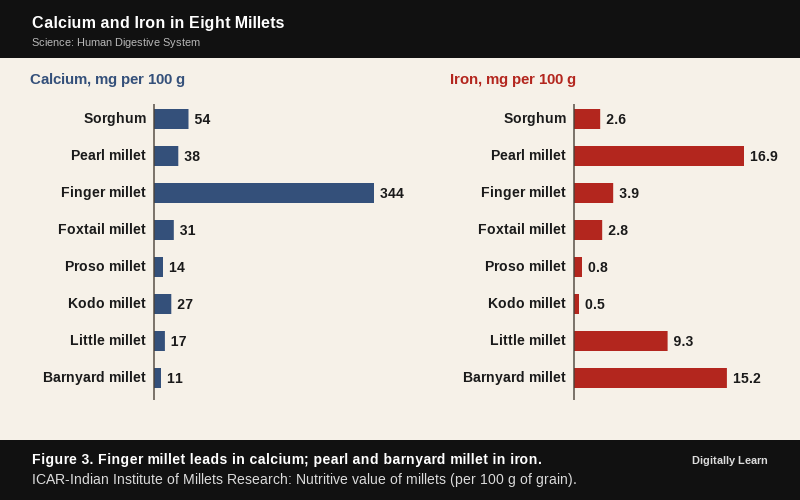
Three strengths stand out. Finger millet supplies 344 milligrams of calcium in 100 grams, far more than the other seven. Pearl millet, with 16.9 milligrams of iron, and barnyard millet, with 15.2 milligrams, are rich sources of iron. Barnyard millet, with 10.1 grams of fibre, and kodo millet, with 9 grams, are rich in fibre. Their protein content, between 7.3 and 12.5 grams, is in the same range as other major cereals rather than higher.
Millets for Health and Nutritional Security in India
Millets contribute to health in several ways that follow from their nutrients. Their iron and calcium help against deficiencies of these minerals, their fibre helps the large intestine and the passage of stool, and, as whole grains, they induce favourable changes in the gut microbiota. Because they are naturally gluten-free, they are a safe staple for people with coeliac disease.
Millets also make the supply of nutrition more secure. They can grow on arid lands with minimal inputs and are resilient to changes in climate, and they are highly tolerant of drought and other extreme weather. They are therefore important crops in the semi-arid tropics of Asia and Africa, and in India they are grown chiefly as dryland crops.
The 2024 guidelines, with their call for whole grains, give millets a larger place in the Indian diet and pair cereal-based diets with pulses for good-quality protein. At India's proposal, the United Nations General Assembly, at its 75th session in March 2021, declared 2023 the International Year of Millets, with the Food and Agriculture Organization as the lead agency, to draw attention to the nutritional and health benefits of millets and their suitability for adverse and changing climates.
Previous Year UPSC‑CSE Questions
Each Prelims question is explained option by option, and each Mains question comes with an answer outline.
- UPSC Prelims 2011A company marketing food products advertises that its items do not contain trans-fats. What does this campaign signify to the customers?
- The food products are not made out of hydrogenated oils.
- The food products are not made out of animal fats/oils.
- The oils used are not likely to damage the cardiovascular health of the consumers.
Which of the statements given above is/are correct?
How to approach this Prelims question
Approach: Trace each statement back to how industrial trans fats are made and what they do.
- Statement 1: Industrial trans fats form when vegetable oils are partially hydrogenated, so a product without them is not made from hydrogenated oil; correct.
- Statement 2: The FSSAI definition of industrial trans fatty acids excludes those of dairy, meat and fish, so the claim says nothing about animal fats; wrong.
- Statement 3: Trans fats raise the risk of heart disease and stroke, so their absence lowers the risk to the heart; correct.
Trap to watch: Statement 2 reads like part of a healthy label. A trans-fat claim concerns partial hydrogenation, not whether the fat came from an animal or a plant.
Why each option is right or wrong:
- (a) 1 only: Wrong. Statement 3 is also correct, because trans fats raise the risk of heart disease.
- (b) 2 and 3 only: Wrong. Statement 2 does not follow, because a trans-fat claim is not about animal fats.
- (c) 1 and 3 only: Correct. The product avoids partially hydrogenated oil and so carries less risk to the heart.
- (d) 1, 2 and 3: Wrong. A trans-fat-free label says nothing about animal fats.
Answer: (c) 1 and 3 only. Trans fats come from hydrogenated oil and harm the heart, but the label says nothing about animal fat.
- UPSC Prelims 2011Aspartame is an artificial sweetener sold in the market. It consists of amino acids and provides calories like other amino acids. Yet, it is used as a low-calorie sweetening agent in food items. What is the basis of this use?
How to approach this Prelims question
Approach: The stem already grants that aspartame yields calories like other amino acids, so the answer cannot deny its calories. It must turn on quantity. Aspartame releases about 4 kilocalories per gram, like sucrose, but it is about 180 to 200 times sweeter than table sugar, and so little is needed that its calories are negligible.
Trap to watch: Three options try to explain the calories away, which contradicts the stem. The low calorie count comes from the small amount used, not from any lack of energy in the molecule.
Why each option is right or wrong:
- (a) Aspartame is as sweet as table sugar, but unlike table sugar, it is not readily oxidized in human body due to lack of requisite enzymes: Wrong. Aspartame is far sweeter than table sugar, and it releases energy like sucrose.
- (b) When aspartame is used in food processing, the sweet taste remains, but it becomes resistant to oxidation: Wrong. Aspartame still yields calories; processing does not make it calorie-free.
- (c) Aspartame is as sweet as sugar, but after ingestion into the body, it is converted into metabolites that yield no calories: Wrong. It releases about 4 kilocalories per gram, like sucrose.
- (d) Aspartame is several times sweeter than table sugar, hence food items made with small quantities of aspartame yield fewer calories on oxidation: Correct. So little is needed to sweeten food that its calories are negligible.
Answer: (d) Aspartame is several times sweeter than table sugar, hence food items made with small quantities of aspartame yield fewer calories on oxidation. Aspartame is about 180 to 200 times sweeter than sugar, so the small quantity used adds few calories.
- UPSC Prelims 2010Which one of the following processes in the bodies of living organisms is a digestive process ?
How to approach this Prelims question
Approach: Test each option against the meaning of digestion, the breaking of complex food components into simpler forms that can be absorbed. Protein is a food component, and amino acids are the simple units into which pepsin, trypsin and the peptidases break it. Glucose has already been absorbed when it is broken into carbon dioxide and water inside cells, which is respiration. Glucose turned into glycogen in the liver is storage, and amino acids joined into proteins is synthesis, the reverse of digestion.
Trap to watch: Breaking glucose into carbon dioxide and water is a breakdown too, so it looks like digestion. It happens inside cells, after absorption, and releases energy, which makes it respiration.
Why each option is right or wrong:
- (a) Breakdown of proteins into amino acids: Correct. Digestive enzymes reduce dietary protein to amino acids so that it can be absorbed.
- (b) Breakdown of glucose into CO₂ and H₂O: Wrong. This is respiration, which releases energy from glucose inside the cells.
- (c) Conversion of glucose into glycogen: Wrong. This is the storage of absorbed glucose in the liver.
- (d) Conversion of amino acids into proteins: Wrong. This builds proteins from amino acids, the reverse of digestion.
Answer: (a) Breakdown of proteins into amino acids. Digestion breaks food into absorbable units, and proteins are broken into amino acids.
- UPSC Prelims 2008Consider the following Assertion (A) and Reason (R):
- Assertion (A): In human body, liver has an important role in fat digestion.
- Reason (R): Liver produces two important fat-digesting enzymes.
Select the correct answer using the code given below.
How to approach this Prelims question
Approach: Judge the two statements separately.
- Assertion: The liver's bile makes the food alkaline and emulsifies fat into small globules so that lipase can act, so the liver does have an important role in fat digestion.
- Reason: Bile contains no digestive enzyme, and the fat-digesting enzyme, lipase, comes from the pancreas, so the reason is false.
Trap to watch: The liver's real importance to fat digestion makes the reason look like its explanation. The liver acts through emulsification, a physical change, not through enzymes.
Why each option is right or wrong:
- (a) Both A and R are individually true and R is the correct explanation of A: Wrong. R is false, because the liver makes no fat-digesting enzyme.
- (b) Both A and R are individually true but R is not the correct explanation of A: Wrong. R is false.
- (c) A is true but R is false: Correct. Bile from the liver emulsifies fat, but lipase comes from the pancreas.
- (d) A is false but R is true: Wrong. The liver matters to fat digestion through bile, so A is true.
Answer: (c) A is true but R is false. Bile emulsifies fat but contains no enzyme, so the assertion holds and the reason does not.
- UPSC Prelims 2008Consider the following statements about probiotic food:
- Probiotic food contains live bacteria which are considered beneficial to humans.
- Probiotic food helps in maintaining gut flora.
Which of the statements given above is/are correct?
How to approach this Prelims question
Approach: Recall what a probiotic is and where it works.
- Statement 1: Probiotics are live microorganisms taken to support the health of the host, so the statement is correct.
- Statement 2: The large intestine carries bacteria that help digestion, and the idea behind probiotics is to replace harmful gut microbes with useful ones, so the statement is correct.
Trap to watch: Statement 2 can look like an advertising claim. Supporting the useful bacteria of the gut is the very purpose of probiotics.
Why each option is right or wrong:
- (a) 1 only: Wrong. Statement 2 is also correct, because probiotics support the useful bacteria of the gut.
- (b) 2 only: Wrong. Statement 1 is also correct, because probiotics are live microorganisms.
- (c) Both 1 and 2: Correct. Probiotic food carries live, useful microorganisms that support the bacteria of the gut.
- (d) Neither 1 nor 2: Wrong. Both statements describe probiotics correctly.
Answer: (c) Both 1 and 2. Probiotics are live, useful microorganisms that support the bacteria living in the gut.
- UPSC Prelims 2007Which of the following is not a digestive enzyme in the human system?
How to approach this Prelims question
Approach: Ask of each name whether it acts on a food. Trypsin acts on protein in the small intestine, ptyalin, the older name of salivary amylase, acts on starch in the mouth, and pepsin acts on protein in the stomach. Gastrin acts on no food; it is a hormone that makes the gastric glands secrete hydrochloric acid and pepsinogen.
Trap to watch: Gastrin is named after the stomach and is released there, so it is easily taken for the stomach's enzyme. The stomach's protein-digesting enzyme is pepsin.
Why each option is right or wrong:
- (a) Trypsin: Wrong. Trypsin is a pancreatic enzyme that splits proteins in the small intestine.
- (b) Gastrin: Correct. Gastrin is a hormone that stimulates the secretion of acid and pepsinogen, not an enzyme.
- (c) Ptyalin: Wrong. Ptyalin is salivary amylase, the enzyme that acts on starch in the mouth.
- (d) Pepsin: Wrong. Pepsin is the enzyme that breaks down proteins in the stomach.
Answer: (b) Gastrin. Gastrin is a gut hormone that regulates secretion and digests nothing.
- UPSC Prelims 2007Which one of the following is the correct sequence in order of decreasing length of the three structural parts given below of small intestine in the human body?
How to approach this Prelims question
Approach: Fix the two ends first. The duodenum, at 20 to 25 centimetres, is the shortest part, so it must come last. Of the other two, the ileum, about 3 metres, is longer than the jejunum, about 2.5 metres, so the ileum comes first.
Trap to watch: The duodenum comes first in the path of food, which tempts a student to put it first. The question asks for length, not for the order along the canal.
Why each option is right or wrong:
- (a) Jejunum – Duodenum – Ileum: Wrong. The duodenum is the shortest part and cannot stand in the middle, and the ileum is the longest.
- (b) Ileum – Duodenum – Jejunum: Wrong. The jejunum, about 2.5 metres, is longer than the duodenum.
- (c) Jejunum – Ileum – Duodenum: Wrong. The ileum, about 3 metres, is longer than the jejunum.
- (d) Ileum – Jejunum – Duodenum: Correct. The ileum is about 3 metres, the jejunum about 2.5 metres and the duodenum 20 to 25 centimetres.
Answer: (d) Ileum – Jejunum – Duodenum. The ileum is the longest part and the duodenum the shortest.
- UPSC Prelims 2007Production of which one of the following is a function of the liver?
How to approach this Prelims question
Approach: Assign each substance to the organ that makes it. Lipase comes from the pancreas, mucus and hydrochloric acid from the gastric glands of the stomach. The liver converts ammonia into urea through the urea cycle, and the urea is excreted in the urine.
Trap to watch: Lipase digests fat, and the liver is known for its role in fat digestion, so lipase looks like a liver product. The liver's contribution is bile, which has no enzyme; lipase comes from the pancreas.
Why each option is right or wrong:
- (a) Lipase: Wrong. Lipase is secreted by the pancreas in pancreatic juice.
- (b) Urea: Correct. The liver converts ammonia into urea through the urea cycle.
- (c) Mucus: Wrong. The mucus that protects the stomach comes from the gastric glands.
- (d) Hydrochloric acid: Wrong. Hydrochloric acid is released by the gastric glands of the stomach.
Answer: (b) Urea. The liver makes urea from ammonia, while lipase, mucus and acid come from the pancreas and the stomach.
- UPSC Prelims 2007In the human body, to which structure is the appendix attached?
How to approach this Prelims question
Approach: Place the appendix on the path of food. The ileum, the last part of the small intestine, joins the caecum, the first part of the large intestine, and the appendix is a finger-like tube closed at one end that is connected to the caecum.
Trap to watch: The appendix lies where the small intestine meets the large, so the small intestine is a tempting choice. It hangs from the caecum, which is part of the large intestine.
Why each option is right or wrong:
- (a) The large intestine: Correct. The appendix is connected to the caecum, the first part of the large intestine.
- (b) The small intestine: Wrong. The small intestine ends at the ileum, which joins the caecum; the appendix is not attached to it.
- (c) The gall-bladder: Wrong. The gall bladder lies under the liver and stores bile.
- (d) The stomach: Wrong. The stomach empties into the duodenum, at the other end of the small intestine from the caecum.
Answer: (a) The large intestine. The appendix hangs from the caecum of the large intestine.
- UPSC Prelims 2006What is the name of the vessel that delivers the nutrient-rich blood from the stomach and small intestine to the liver?
How to approach this Prelims question
Approach: Separate the vessels by direction and by what they carry. The hepatic arteries bring oxygen-rich blood from the aorta to the liver. The hepatic veins take blood out of the liver to the heart. Only the hepatic portal vein carries blood from the gastrointestinal tract into the liver, so that absorbed nutrients are processed there first.
Trap to watch: The hepatic vein and the hepatic portal vein have similar names. The hepatic vein drains the liver; it does not supply it.
Why each option is right or wrong:
- (a) Left hepatic artery: Wrong. The hepatic artery brings oxygen-rich blood from the aorta, not nutrient-rich blood from the gut.
- (b) Hepatic vein: Wrong. The hepatic vein carries blood out of the liver towards the heart.
- (c) Right hepatic artery: Wrong. It is a branch of the same arterial supply of oxygen-rich blood.
- (d) Hepatic portal vein: Correct. It carries blood from the gastrointestinal tract, gall bladder, pancreas and spleen to the liver.
Answer: (d) Hepatic portal vein. The hepatic portal vein brings the blood of the gut to the liver before it reaches the rest of the body.
- UPSC Prelims 2006Consider the following statements with reference to the human body:
- The common bile duct releases its contents into the stomach.
- The pancreatic duct releases its contents into the duodenum.
Which of the statements given above is/are correct?
How to approach this Prelims question
Approach: Name the one part of the canal into which each duct opens.
- Statement 1: The common bile duct releases bile into the duodenum, not the stomach, so it is wrong.
- Statement 2: The pancreatic duct carries pancreatic juice into the duodenum, so it is correct.
Trap to watch: Bile acts on the acidic food that has just left the stomach, so the stomach can seem its natural destination. Both ducts open one stage further on, into the duodenum.
Why each option is right or wrong:
- (a) 1 only: Wrong. The common bile duct opens into the duodenum, so statement 1 is wrong.
- (b) 2 only: Correct. The pancreatic duct opens into the duodenum, while the common bile duct does not open into the stomach.
- (c) Both 1 and 2: Wrong. Statement 1 is wrong.
- (d) Neither 1 nor 2: Wrong. Statement 2 is correct.
Answer: (b) 2 only. Both the common bile duct and the pancreatic duct open into the duodenum, so only the second statement holds.
- UPSC Prelims 2005Consider the following Assertion (A) and Reason (R):
- Assertion (A): All the proteins in our food are digested in small intestine only.
- Reason (R): The protein-digesting enzymes from pancreas are released into small intestine.
Select the correct answer using the code given below.
How to approach this Prelims question
Approach: Test the assertion against the stomach. Pepsin breaks proteins into smaller peptides in the stomach, so protein digestion does not happen in the small intestine only, and the word "only" makes the assertion false. The reason is true: Trypsin and chymotrypsin from the pancreas reach the small intestine through the pancreatic duct.
Trap to watch: The reason is true and sounds like support for the assertion. The word "only" in the assertion fails because pepsin begins protein digestion in the stomach.
Why each option is right or wrong:
- (a) Both A and R are individually true and R is the correct explanation of A: Wrong. A is false, because protein digestion begins in the stomach.
- (b) Both A and R are individually true but R is not the correct explanation of A: Wrong. A is false.
- (c) A is true but R is false: Wrong. A is false, and pancreatic trypsin does reach the small intestine.
- (d) A is false but R is true: Correct. Pepsin digests protein in the stomach, and pancreatic enzymes act in the small intestine.
Answer: (d) A is false but R is true. Pepsin digests protein in the stomach, so the assertion fails while the reason holds.
- UPSC Prelims 2004Consider the following Assertion (A) and Reason (R):
- Assertion (A): Fatty acids should be a part of the balanced human diet.
- Reason (R): The cells of the human body cannot synthesize any fatty acids.
Select the correct answer using the code given below.
How to approach this Prelims question
Approach: Judge the word "any" in the reason.
- Assertion: Linoleic acid and alpha-linolenic acid cannot be made in the body and must come from food, so fatty acids belong in a balanced diet; the assertion is true.
- Reason: The body can synthesise saturated and monounsaturated fatty acids, so it is false that it cannot synthesise any.
Trap to watch: The reason is nearly right for the two essential fatty acids, which makes it look true. The word "any" makes it false, because most fatty acids are made in the body.
Why each option is right or wrong:
- (a) Both A and R are individually true and R is the correct explanation of A: Wrong. R is false, because the body makes saturated and monounsaturated fatty acids.
- (b) Both A and R are individually true but R is not the correct explanation of A: Wrong. R is false.
- (c) A is true but R is false: Correct. Two essential fatty acids must come from food, but the body makes the others.
- (d) A is false but R is true: Wrong. A is true, because the essential fatty acids must be eaten.
Answer: (c) A is true but R is false. Only linoleic and alpha-linolenic acid must be eaten, so the reason's "any" is false.
- UPSC Prelims 2003With reference to normal human beings, consider the following statements:
- In response to the presence of HCl, secretin is produced from the duodenum
- Enterogastrone is produced in the small intestine in response to the presence of fatty acids
Which of these statements is/are correct?
How to approach this Prelims question
Approach: Check the site and the trigger of each hormone.
- Statement 1: Secretin is produced by the S cells of the duodenum and released when gastric acid reaches it, and it makes the pancreas release bicarbonate to neutralise that acid, so the statement is correct.
- Statement 2: Enterogastrone is secreted by the lining of the duodenum, the first part of the small intestine, in response to fats in the diet, so the statement is correct.
Trap to watch: The acid that triggers secretin comes from the stomach, which tempts a student to place the hormone's source there. Both hormones are made in the duodenum.
Why each option is right or wrong:
- (a) Only 1: Wrong. Statement 2 is also correct, because fat in the duodenum triggers enterogastrone.
- (b) Only 2: Wrong. Statement 1 is also correct, because acid reaching the duodenum triggers secretin.
- (c) Both 1 and 2: Correct. Secretin answers the stomach's acid and enterogastrone answers dietary fat, both from the duodenum.
- (d) Neither 1 nor 2: Wrong. Both statements describe the two hormones correctly.
Answer: (c) Both 1 and 2. Secretin and enterogastrone both come from the duodenum, triggered by acid and by fat respectively.
- UPSC Prelims 2003Consider the following Assertion (A) and Reason (R):
- Assertion (A): Unsaturated fats are more reactive compared with the saturated fats.
- Reason (R): Unsaturated fats have only single bonds in their structure.
Select the correct answer using the code given below.
How to approach this Prelims question
Approach: Recall what makes a fat unsaturated. Unsaturated fatty acids carry one or more carbon-carbon double bonds, and the more double bonds a fatty acid has, the more easily it is oxidised and turns rancid, so the assertion is true. Fats with only single bonds are saturated, so the reason describes saturated fats and is false.
Trap to watch: The reason uses the right words about bonds but gives them to the wrong fats. Single bonds only mark a saturated fat.
Why each option is right or wrong:
- (a) Both A and R are individually true and R is the correct explanation of A: Wrong. R is false, because unsaturated fats have double bonds.
- (b) Both A and R are individually true but R is NOT the correct explanation of A: Wrong. R is false.
- (c) A is true but R is false: Correct. Double bonds make unsaturated fats more reactive, and only saturated fats have single bonds alone.
- (d) A is false but R is true: Wrong. A is true, because double bonds make unsaturated fats easier to oxidise.
Answer: (c) A is true but R is false. Double bonds make unsaturated fats reactive, so the reason that they have only single bonds is false.
- UPSC Prelims 2002Consider the following Assertion (A) and Reason (R):
- Assertion (A): Human diet should compulsorily contain Glycerine, Serine and Tyrosine.
- Reason (R): Essential amino acids cannot be synthesised in the human body.
Select the correct answer using the code given below.
How to approach this Prelims question
Approach: Check the three names in the assertion against the list of essential amino acids.
- Glycerine: It is glycerol, a simple lipid, not an amino acid, so calling it essential is wrong.
- Serine: It is a non-essential amino acid that the body makes, so calling it essential is wrong.
- Tyrosine: The body makes it from phenylalanine, so calling it one of the nine essential amino acids is wrong.
- Reason: It correctly defines essential amino acids, so it is true.
Trap to watch: The reason is a true rule, so the assertion looks like an application of it. None of the three substances named is an essential amino acid.
Why each option is right or wrong:
- (a) Both A and R are individually true and R is the correct explanation of A: Wrong. A is false.
- (b) Both A and R are individually true but R is not a correct explanation of A: Wrong. A is false.
- (c) A is true but R is false: Wrong. A is false and R is true.
- (d) A is false but R is true: Correct. Glycerine, serine and tyrosine need not come from the diet, while essential amino acids cannot be made in the body.
Answer: (d) A is false but R is true. None of glycerine, serine and tyrosine is an essential amino acid, although the reason is true.
- UPSC Prelims 2001Match List I with List II and select the correct answer using the codes given below the Lists:List I (Substance)
- I. Ptyalin
- II. Pepsin
- III. Renin
- IV. Oxytocin
List II (Physiological role)
- A) Converts angiotensinogen in blood into angiotensin
- B) Digests starch
- C) Digests proteins
- D) Hydrolyses fats
- E) Induces contraction of smooth muscles
Codes:
How to approach this Prelims question
Approach: Place the two digestive enzymes first, then separate the kidney enzyme from the hormone.
- Ptyalin: Salivary amylase digests starch, so the pairing with B is correct.
- Pepsin: It digests proteins in the stomach, so the pairing with C is correct.
- Renin: The kidney enzyme breaks down angiotensinogen into angiotensin I, so the pairing with A is correct.
- Oxytocin: This hormone stimulates contractions of the smooth muscle of the uterus, so the pairing with E is correct. Role D, the hydrolysis of fats, belongs to lipase and is left unused.
Trap to watch: Renin sits among digestive enzymes and is easily confused with rennin, which curdles milk. Renin is a kidney enzyme that acts on angiotensinogen in the blood.
Why each option is right or wrong:
- (a) I‑B, II‑C, III‑A, IV‑E: Correct. Ptyalin digests starch, pepsin digests proteins, renin acts on angiotensinogen and oxytocin contracts smooth muscle.
- (b) I‑C, II‑D, III‑B, IV‑E: Wrong. Ptyalin digests starch, not proteins, and pepsin does not hydrolyse fats.
- (c) I‑B, II‑C, III‑E, IV‑A: Wrong. It gives renin the role of oxytocin and oxytocin the role of renin.
- (d) I‑C, II‑A, III‑B, IV‑D: Wrong. None of the four pairs matches.
Answer: (a) I‑B, II‑C, III‑A, IV‑E. Ptyalin digests starch, pepsin proteins, renin acts on angiotensinogen and oxytocin contracts smooth muscle.
- UPSC Prelims 1998Which one of the following statements regarding starch and cellulose is NOT correct?
How to approach this Prelims question
Approach: Test each shared property. Starch stores energy in plant tissues and cellulose makes up plant cell walls, so both are of plant origin. Both are polysaccharides, long chains of sugars, and both are built of glucose units. Only starch gives colour with iodine: Its helical chains hold iodine and turn blue-black, while cellulose has no such helices and cannot hold iodine.
Trap to watch: Both are glucose polymers, so a student may assume they behave alike with iodine. The iodine test depends on the shape of the chain, which differs.
Why each option is right or wrong:
- (a) Both of them are of plant origin: Wrong. This statement is correct, because starch stores energy in plants and cellulose forms plant cell walls.
- (b) Both of them are polymers: Wrong. This statement is correct, because both are polysaccharides, long chains of sugars.
- (c) Both of them give colour with iodine: Correct. Only starch turns blue-black with iodine; cellulose cannot hold iodine.
- (d) Both of them are made up of glucose molecules: Wrong. This statement is correct, because both are built from glucose units.
Answer: (c) Both of them give colour with iodine. Starch turns blue-black with iodine but cellulose does not, so this is the statement that is not correct.
- UPSC Prelims 1998Consumption of fish is considered to be healthy when compared to flesh of other animals because fish contains
How to approach this Prelims question
Approach: Ask what fish supplies that other flesh foods do not. Marine fish such as salmon, mackerel, trout and tuna are good sources of the long-chain omega‑3 fatty acids, which are polyunsaturated.
Trap to watch: Fish is a rich protein food, so option (d) is tempting, but it carries about 18.4 grams of protein per 100 grams against 20.8 grams in meat and poultry.
Why each option is right or wrong:
- (a) polyunsaturated fatty acids: Correct. Marine fish supply long-chain omega‑3 fatty acids, which are polyunsaturated.
- (b) saturated fatty acids: Wrong. The health value of fish lies in its polyunsaturated fatty acids, not in saturated fat.
- (c) essential vitamins: Wrong. Vitamins are not what sets fish apart from other flesh foods; its omega‑3 fatty acids are.
- (d) more carbohydrates and proteins: Wrong. Fish has less protein than meat and poultry, 18.4 grams per 100 grams against 20.8 grams.
Answer: (a) polyunsaturated fatty acids. Fish is valued for its polyunsaturated omega‑3 fatty acids.
- UPSC Prelims 1996Match List I with List II and select the correct answer using the codes given below the lists:List I
- I. Vitamin
- II. Enzyme
- III. Hormone
- IV. Protein
List II
- A. Pepsin
- B. Carotene
- C. Keratin
- D. Progesterone
How to approach this Prelims question
Approach: Begin with the surest pair, pepsin as the enzyme (II‑A). Carotene is converted to vitamin A in the body, so it goes with vitamin (I‑B). Progesterone is a sex hormone (III‑D). Keratin is the structural protein of hair, nails and the outer skin (IV‑C).
Trap to watch: Keratin and progesterone are the pair most often swapped. Keratin is a structural protein; progesterone is a hormone.
Why each option is right or wrong:
- (a) I – A, II – B, III – C, IV – D: Wrong. Pepsin is an enzyme, not a vitamin, and keratin is not a hormone.
- (b) I – B, II – A, III – D, IV – C: Correct. Carotene goes with vitamin, pepsin with enzyme, progesterone with hormone and keratin with protein.
- (c) I – B, II – A, III – C, IV – D: Wrong. It swaps the hormone, progesterone, with the protein, keratin.
- (d) I – A, II – B, III – D, IV – C: Wrong. It swaps the vitamin, carotene, with the enzyme, pepsin.
Answer: (b) I – B, II – A, III – D, IV – C. Carotene is a vitamin precursor, pepsin an enzyme, progesterone a hormone and keratin a structural protein.
- UPSC Mains 2024 GS‑IIIExplain the role of millets for ensuring health and nutritional security in India.
Answer outline
The outline sets out what the question asks, the main arguments, relevant examples and the direction of the conclusion; it is not a full model answer.
Introduction: Millets such as jowar, bajra and ragi are small-sized grains that have long been part of the Indian diet and are called nutri-cereals for their vitamins, minerals and dietary fibre.
Body (sub-themes to develop):
- Calcium: Finger millet supplies 344 milligrams of calcium per 100 grams, far more than sorghum (54 milligrams) or pearl millet (38 milligrams).
- Iron: Pearl millet supplies 16.9 milligrams and barnyard millet 15.2 milligrams of iron per 100 grams.
- Fibre and gut health: Barnyard millet carries 10.1 grams and kodo millet 9 grams of fibre per 100 grams; as whole grains, millets favour a healthy gut microbiota.
- Gluten-free grain: Millets are naturally gluten-free, a safe staple for people with coeliac disease.
- Protein with pulses: Millet protein, 7.3 to 12.5 grams per 100 grams, matches other cereals, and pairing with pulses supplies the essential amino acids.
- Security of supply: Millets grow on arid lands with minimal inputs and tolerate drought and extreme weather, which makes them important crops of India's semi-arid regions.
- Policy: The Dietary Guidelines for Indians, 2024, ask that at least half the cereals eaten be whole grains such as millets, and the UN declared 2023 the International Year of Millets at India's proposal.
Conclusion: Millets join nutrient density with a dependable harvest on dry land, which is why dietary guidance and international policy now place them on the plate.
Sources
- NCERT: Science, Class 10, Chapter 5, Life Processes (Reprint 2026‑27)
- NCERT: Science, Class 10, Chapter 2, Acids, Bases and Salts (Reprint 2026‑27)
- NCERT: Curiosity, Textbook of Science, Grade 7, Chapter 9, Life Processes in Animals
- NCERT: Curiosity, Textbook of Science, Grade 6, Chapter 3, Mindful Eating: A Path to a Healthy Body
- NCERT: Biology, Class 11, Chapter 9, Biomolecules
- NCERT: Biology, Class 11, Chapter 19, Chemical Coordination and Integration
- ICMR-National Institute of Nutrition: Dietary Guidelines for Indians, 2024
- Food Safety and Standards Authority of India: Press release on limiting trans fats, 8 February 2021
- Food Safety and Standards Authority of India: Prohibition and Restrictions on Sales Regulations, consolidated Version XI
- ICAR-Indian Institute of Millets Research: Millets information and nutritional benefits
- Food and Agriculture Organization: International Year of Millets 2023
- Consulate General of India (Sao Paulo): Ministry of Health and Family Welfare release, NFHS‑6 (2023‑24), Key Findings and Long-Term Trends
- Wikipedia: Small intestine
- Wikipedia: Large intestine
- Wikipedia: Hepatic portal vein
- Wikipedia: Liver
- Wikipedia: Bile
- Wikipedia: Gallbladder
- Wikipedia: Pancreas
- Wikipedia: Enteropeptidase
- Wikipedia: Gastric acid
- Wikipedia: Pepsin
- Wikipedia: Chyme
- Wikipedia: Chymosin
- Wikipedia: Renin
- Wikipedia: Human tooth
- Wikipedia: Salivary gland
- Wikipedia: Esophagus
- Wikipedia: Intestinal villus
- Wikipedia: Appendix (anatomy)
- Wikipedia: Probiotic
- Wikipedia: Gastrin
- Wikipedia: Secretin
- Wikipedia: Cholecystokinin
- Wikipedia: Enterogastrone
- Wikipedia: Starch
- Wikipedia: Aspartame
- Wikipedia: Essential amino acid
- Wikipedia: Glycerol
- Wikipedia: Unsaturated fat
- Wikipedia: Keratin
- Wikipedia: Progesterone
- Wikipedia: Oxytocin
- Wikipedia: Indigestion
- Wikipedia: Peptic ulcer disease
- Wikipedia: Helicobacter pylori
- Wikipedia: Jaundice
- Wikipedia: Diarrhea
- Wikipedia: Constipation
- Wikipedia: Lactose intolerance
- Wikipedia: Millet
- Wikipedia: International Year of Millets
Editorial Disclaimer
This article draws on the current NCERT science textbooks, the ICMR‑NIN dietary guidelines and the other sources listed. It explains how digestion works and is not medical advice.
See more of our UPSC articles in Google Search
Add to Preferred Sources

