


Overview
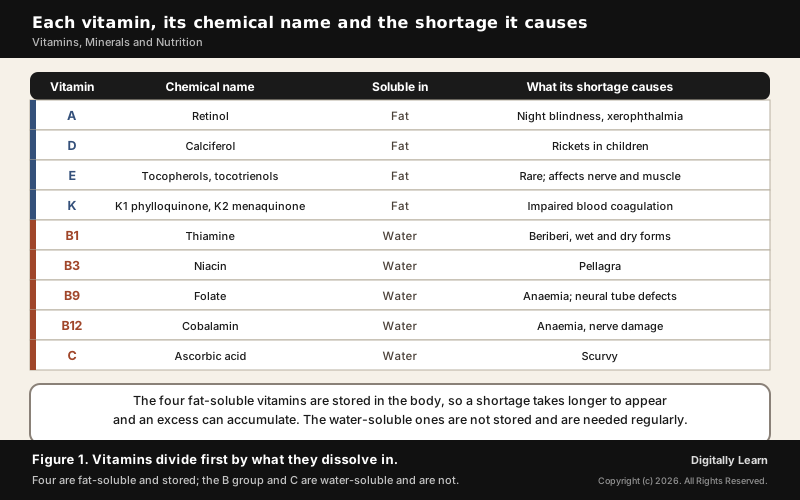
Vitamins and minerals are the micronutrients the body needs in milligrams or micrograms, and they supply no energy at all. A shortage of any one produces a specific deficiency disease, and because that shortage can sit inside a diet carrying enough calories, a person may be adequately fed and seriously deficient at the same time. The vitamin deficiency diseases, from night blindness and rickets to beriberi and scurvy, are also the starting point for how malnutrition is measured and for the fortification standards and statutory programmes built to close the gap.
Vitamin Deficiency Diseases and Mineral Deficiencies
Micronutrients: Why Milligrams Decide Health Outcomes
A micronutrient is a vitamin or a mineral the body needs in milligrams or micrograms rather than grams. It supplies no energy at all, which is what separates it from the macronutrients set out in the article on digestion and the macronutrients.
A shortage measured in milligrams produces a named disease, while the same diet may carry enough energy to leave body weight normal. A person can therefore be adequately fed and seriously deficient at once, which is why nutrition policy measures more than calories.
Worldwide, more than half of children under five, and over two-thirds of non-pregnant women of reproductive age, are deficient in at least one key micronutrient, most often iron, with effects that run from anaemia and scurvy through to cognitive impairment and neural tube defects.
Vitamins divide by one property before any other, which is what they dissolve in:
- Fat-soluble vitamins, namely A, D, E and K, are stored in the body. A shortage takes months to show, and an excess can accumulate to the point of harm.
- Water-soluble vitamins, the B group and C, are not stored in any quantity. They have to arrive regularly, and a surplus is largely excreted.
Fat-Soluble Vitamins A, D, E and K and Their Deficiency Diseases
The four vitamins that dissolve in fat travel with dietary fat and are stored in the liver and fatty tissue. That storage is why a deficiency develops slowly, and why an excess can accumulate, which is not a practical risk with the water-soluble group.
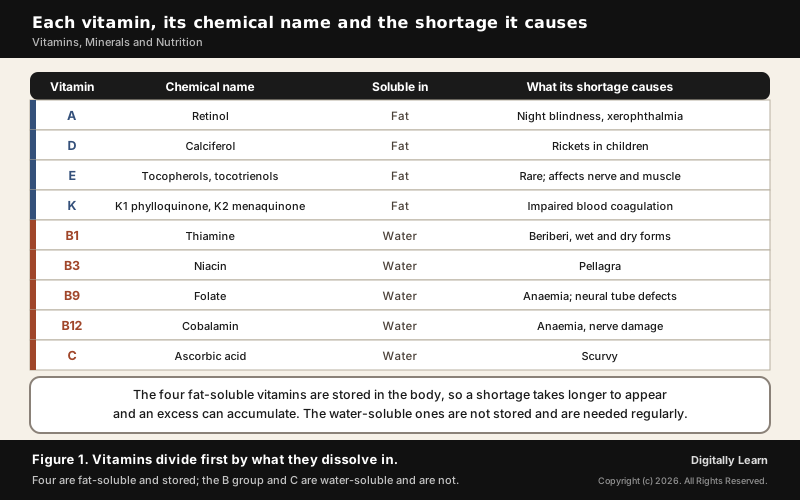
Vitamin A, whose circulating form is retinol, has the best-known deficiency. Xerophthalmia is the name for the whole clinical spectrum of eye changes that vitamin A deficiency produces, running from night blindness and Bitot spots through to corneal ulceration and keratomalacia.
Night blindness, the difficulty of seeing in low light, is the mildest of those stages and the earliest clinical sign. It is common in pregnancy in developing countries, which is why supplementation programmes target pregnant women and young children rather than the population at large.
The eye is where this deficiency declares itself, and the sequence runs one way. Only the first two stages can be undone; after that the damage to the cornea is permanent:
- Night blindness, difficulty seeing in low light, which is the earliest clinical sign and is reversible.
- Bitot spots, foamy patches on the conjunctiva, still reversible with treatment.
- Corneal xerosis and ulceration, as the cornea dries and breaks down.
- Keratomalacia, the softening and destruction of the cornea, which is not reversible and leaves the child blind.
The plant precursor needs care. Carotene is not vitamin A itself but has provitamin A activity, which the body converts, so carotene belongs to the category vitamin while retinol is vitamin A itself.
Vitamin D is a calciferol, and its shortage in children produces rickets, a condition of weak or soft bones with bowed legs and stunted growth. Vitamin E is a group of eight related compounds, four tocopherols and four tocotrienols, and vitamin K exists as two natural vitamers, both required for blood coagulation.
Water-Soluble Vitamins B and C and Their Deficiency Diseases
The water-soluble vitamins are not stored, so their deficiencies appear faster and respond faster to correction. Each of the classical deficiency diseases below is named against the vitamin whose absence produces it.
- Thiamine, vitamin B1, is the one whose severe chronic deficiency is called beriberi. Wet beriberi affects the cardiovascular system, producing a fast heart rate, breathlessness and swelling of the legs; dry beriberi affects the nerves. The risk rises on a diet of mostly polished white rice.
- Niacin, vitamin B3, is the vitamin whose lack causes pellagra.
- Folate, vitamin B9, and cobalamin, vitamin B12, both produce anaemia when short. Folate shortage in early pregnancy is also associated with neural tube defects.
- Ascorbic acid, vitamin C, is the one whose deficiency is scurvy, a deficiency disease and a state of malnutrition that results from a lack of vitamin C.
A vitamin, an enzyme and a hormone are three different categories of molecule: carotene is a vitamin precursor, pepsin an enzyme and progesterone a hormone. That classification is set out in the section on digestive enzymes of the article on digestion.
The B vitamins also work as coenzymes rather than as structural material. Niacin is the essential chemical component of the coenzymes NAD and NADP, which take part in a great many enzyme-catalysed reactions, so a shortage affects metabolism across the whole body rather than one organ.
Iron and Calcium: The Two Minerals Most Often Short
Minerals differ from vitamins in being elements rather than organic compounds, so no organism can synthesise them and they must come from soil, water or food. Two account for most of the deficiency burden the national surveys measure, and a third is dealt with separately below.
Iron is required to build haemoglobin, and its shortage is the commonest cause of anaemia. The National Family Health Survey puts it at 67.1 per cent of children and 59.1 per cent of adolescent girls, and three in four women have a low dietary iron intake.
| Mineral | What it does, and what its shortage causes | Good sources |
|---|---|---|
| Iron | Builds haemoglobin to carry oxygen; shortage: anaemia | Pulses, dark green leafy vegetables, pearl millet |
| Calcium | Builds and maintains bone, with vitamin D; shortage: weak bone; rickets alongside vitamin D shortage | Milk and milk products, finger millet |
| Iodine | Is a constituent of the thyroid hormones; shortage: goitre and impaired development | Iodised salt, marine foods |
Those figures place anaemia among the most widespread nutritional conditions measured anywhere. The dietary sources of iron are pulses, dark green leafy vegetables and millets, with pearl millet carrying 16.9 milligrams per 100 grams and barnyard millet 15.2.
Prevalence and priority are not the same. Xerophthalmia, the vitamin A deficiency, has a claim to priority for remedial action because its end stage is irreversible blindness in a child. Anaemia is commoner; blindness is worse.
Calcium builds and maintains bone and works with vitamin D, which is why the two deficiencies present together. Among cereal grains finger millet, or ragi, stands far above the rest at 344 milligrams per 100 grams, while polished rice carries almost none, a contrast developed in the article on millets in agriculture.
Milk is the other familiar source, and what it lacks matters as much as what it has. Besides protein and carbohydrate it supplies calcium and potassium in useful quantity, but it is a poor source of iron, which is why a milk-heavy diet can leave a child well grown and still anaemic.
Iodine, Thyroxine and the Case for Salt Iodisation
Iodine occupies a category of its own because its entire nutritional role runs through two molecules. It is an essential trace element present in the thyroid hormones, thyroxine and triiodothyronine, and that is the whole of why the body requires it.
The hormone that contains iodine is therefore thyroxine. The deficiency is geographical rather than dietary in origin: it occurs most often where there is little iodine in the diet, typically remote inland areas where no marine foods are eaten.
Measurement has shifted away from the visible sign. The median urinary iodine concentration is now the main indicator of iodine status for all age groups, because assessment of goitre by palpation or ultrasound becomes difficult to interpret once salt iodisation programmes have begun.
The policy answer is to iodise the one commodity almost everyone consumes. Salt carries 15 to 30 parts per million of iodine, a level the regulator amended in 2021 from the earlier 20 to 30, and coverage now reaches almost every household with young children.
Malnutrition in India and How It Is Measured
The Four Forms Malnutrition Takes, Counted Together
Malnutrition is not a synonym for hunger. As the World Health Organization defines it, it covers undernutrition, meaning wasting, stunting and underweight; inadequate vitamins or minerals; overweight and obesity; and the diet-related noncommunicable diseases that follow.
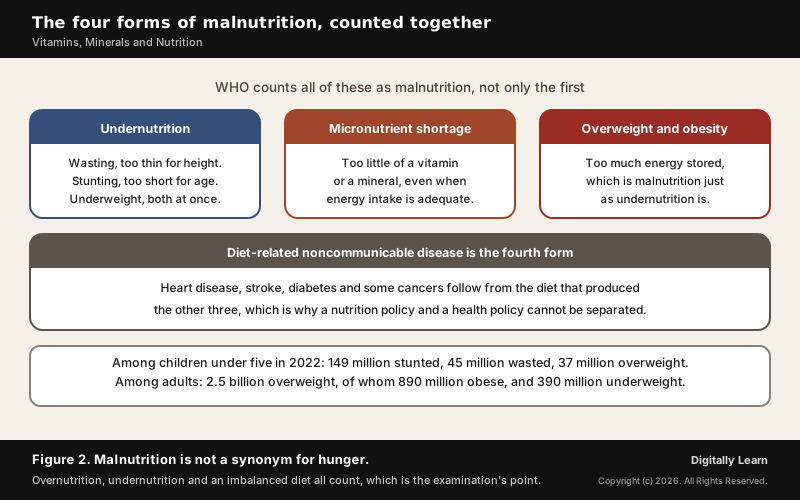
So overnutrition, undernutrition and an imbalanced diet all count as malnutrition, and reading it as a shortage of food alone is a mistake.
The scale of each is now comparable. In 2022, among children under five, 149 million were stunted, 45 million wasted and 37 million overweight. Among adults, 2.5 billion were overweight including 890 million living with obesity, against 390 million underweight.
The fourth form follows from the other three rather than sitting beside them. Heart disease, stroke, type 2 diabetes and some cancers are consequences of the diet that produced the first three, which is why a nutrition policy and a public health policy cannot sensibly be written apart.
Stunting, Wasting and Underweight: What Each One Measures
The three indicators of child undernutrition are used interchangeably in ordinary speech and mean quite different things. Each compares a child against a reference population on a different pair of measurements, and each tells a different story about when the deprivation happened.
| Indicator (what is compared) | What it indicates | Share of Indian children under five |
|---|---|---|
| Stunting (height for age) | Chronic undernutrition accumulated over time | 36 per cent |
| Wasting (weight for height) | Acute, recent undernutrition | 19 per cent |
| Underweight (weight for age) | A composite of both | 32 per cent |
| Overweight (weight for height, above the range) | Excess energy intake | 3 per cent |
The first of the three measures linear growth retardation and cumulative deficit, so stunting reflects deprivation sustained over months or years. Wasting reflects a recent and acute shortfall, which is why it can rise sharply in a drought or an epidemic and fall again when conditions improve.
The direction of travel is modestly favourable. Stunting fell from 38 per cent in the 2015 to 2016 round to 36 per cent in the latest, and underweight has also declined. Progress of two percentage points across a national round is real but slow against the size of the problem.
The distribution matters more than the average. Stunting runs at 46 per cent among children in the lowest wealth quintile against 23 per cent in the highest, and children born to mothers with no schooling are most likely to be undernourished, which is what makes this a question of equity and not only of food.
Protein-Energy Malnutrition: Marasmus and Kwashiorkor
Protein-energy malnutrition (PEM) is the severe end of undernutrition: a lack of dietary protein, of energy (calories), or of both, in varying proportions. It takes three clinical forms. Marasmus is a shortage of energy from all sources, protein included, which can cut body weight below 62 per cent of the expected weight for the age; kwashiorkor is mainly a shortage of protein, often with enough calories; and a child showing signs of both has marasmic kwashiorkor, sometimes described as the most severe form of malnutrition.
| Condition | What is short, when and the signs |
|---|---|
| Marasmus (Greek for 'withering') | Energy from all sources, including protein. Mostly before the age of one. No swelling; muscle wasting and loss of fat under the skin, so the ribs and joints protrude. |
| Kwashiorkor (Ga language of Ghana: 'the disease of the deposed child') | Mainly protein, with calories often adequate. After about 18 months, from weaning to about five. Swelling (oedema) of both feet, the defining sign; fatty, enlarged liver; distended abdomen; thin or depigmented hair; dermatitis. |
| Marasmic kwashiorkor | Both protein and energy; signs of both conditions together. |
The name of kwashiorkor explains its cause. The Jamaican paediatrician Cicely Williams first described it formally in 1933 and named it in 1935, from the Ga language of coastal Ghana. It develops in an older child weaned from the breast when a younger sibling arrives, and moved to a diet high in carbohydrates such as maize, cassava or rice, which lacks the amino acids that breast milk supplied.
Marasmus and kwashiorkor together make up severe acute malnutrition (SAM). Under the WHO and UNICEF criteria of 2009, a child aged 6 to 60 months has SAM if any one of three independent signs is present:
- Weight-for-height below minus 3 standard deviations of the WHO child growth standards, that is, severe wasting.
- A mid-upper arm circumference (MUAC) below 115 mm; the cut-off was raised from 110 mm in 2009.
- Bilateral oedema, the clinical sign of kwashiorkor.
In India the extreme forms are now rare. The national Dietary Guidelines for Indians of 2024 note that marasmus, kwashiorkor and keratomalacia have largely disappeared, while milder undernutrition and anaemia persist alongside rising overweight and obesity, a dual burden of malnutrition. Treating severe and moderate acute malnutrition (SAM and MAM) is one of the stated focuses of Poshan 2.0.
Anaemia and the 6X6X6 Strategy Built Against It
Anaemia is defined by a haemoglobin concentration below a threshold. It is the most prevalent nutritional condition the national survey measures, at 67.1 per cent of children, and the response to it is the most fully specified nutrition programme the country runs.
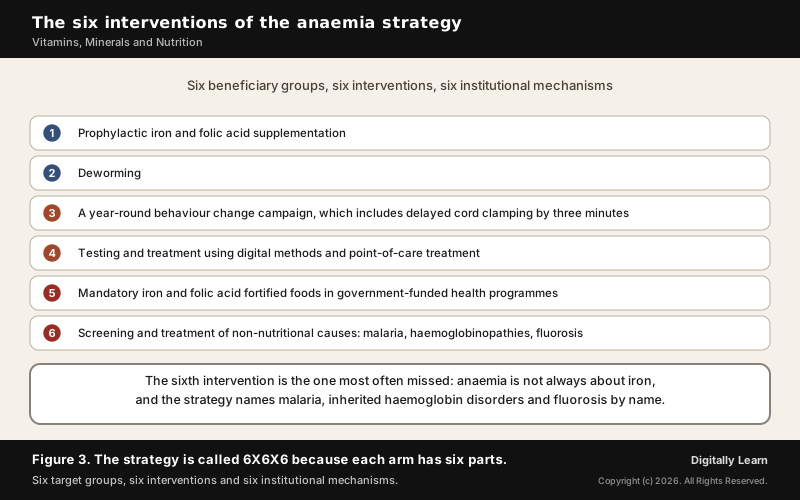
The strategy is named 6X6X6 because it has three arms of six: six target beneficiary groups, six interventions and six institutional mechanisms. Two of the six interventions are easy to miss.
The behaviour change campaign carries delayed cord clamping inside it, by three minutes after delivery in health facilities. That is an intervention against anaemia that involves no supplement and no food at all, which makes it easy to overlook.
The sixth intervention addresses causes that are not nutritional. It names malaria, haemoglobinopathies and fluorosis by name, in recognition that anaemia in an endemic pocket may have nothing to do with iron intake, and that supplementation alone will not move it.
Two further interventions complete the set: deworming, since intestinal parasites cause blood loss, and the mandatory provision of iron and folic acid fortified foods in government-funded health programmes, which connects this strategy to the fortification standards in the next section.
Global Hunger Index: Its Indicators and the Dispute Over It
The Global Hunger Index is a composite score published annually, computed by the International Food Policy Research Institute and released with two European organisations. India's position in it is contested by the Government, so both its composition and the objection matter.
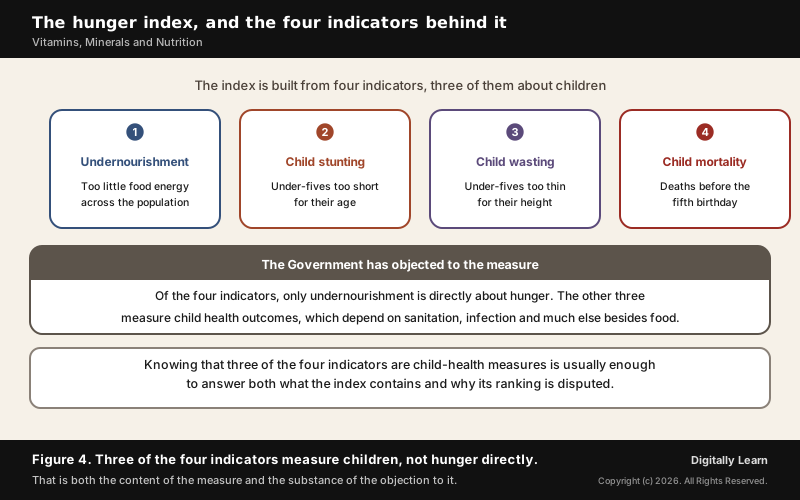
The index rests on four indicators: undernourishment, child stunting, child wasting and child mortality. Three of the four are measures of child health, and only the first is a direct measure of insufficient food intake across the population as a whole.
That composition is the basis of the objection. The Government has argued that the measure does not reflect the true picture because only one of its four indicators is directly related to hunger, while the other three turn on child health outcomes that depend on sanitation, infection and maternal health as much as on food.
Knowing that three of the four indicators are child-health measures explains both what the index contains and why its ranking is disputed, without taking a side.
Fortification, Biofortification and the Safety of Food
Food Fortification: Five Commodities and the Plus-F Mark
Adding a nutrient to a food during processing, in quantities set by regulation, is fortification. It reaches people through what they already eat rather than by asking them to change what they choose, which is what makes it effective against a deficiency that is widespread and quiet.
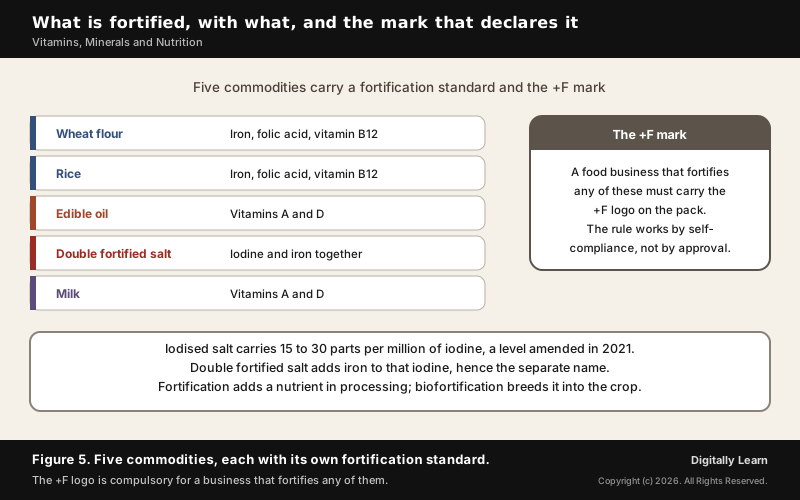
Five commodities carry a standard: wheat flour and rice with iron, folic acid and vitamin B12; edible oil and milk with vitamins A and D; and double fortified salt, which carries iron in addition to the iodine that ordinary iodised salt already has.
The declaration is made by a mark rather than a certificate. A food business that fortifies any of these commodities must carry the plus-F mark on the pack, a plus sign beside the letter F, and the procedure runs on self-compliance, which puts the obligation on the business and the verification on enforcement rather than on prior approval.
Iodised salt is the oldest and most complete of these programmes, carrying 15 to 30 parts per million of iodine since the 2021 amendment. Its near-universal reach among households with young children is the benchmark against which the newer fortification standards are measured.
Biofortification: Breeding the Nutrient Into the Crop Itself
Biofortification differs from fortification in where the nutrient enters. Fortification adds it to a processed food; biofortification breeds or engineers it into the growing crop, so the nutrient is present in the grain as harvested and survives without any processing step.
The consequence is a difference in reach. A fortified food depends on a processing industry and a distribution chain, so it can miss a household that mills its own grain. A biofortified crop carries the nutrient wherever the seed is sown, which suits the smallholder context where deficiency is worst.
Golden rice is the standard example: a vitamin A enriched rice, developed for the nutritional value of its grain. The engineered trait is vitamin A, not yield, not pest resistance and not drought tolerance.
The route is genetic rather than agronomic in that case, which places golden rice inside the wider debate over genetically modified crops. Conventional breeding achieves the same end in other crops, so biofortification is not always genetic modification.
Food Safety: Aflatoxins, Probiotics and the Regulator
Food can carry risk as well as nutrition, and two categories stand out. One arises from how food is stored, the other from what is deliberately added to it.
The first category is produced by moulds, which are fungi, growing on cereal grains and oilseeds that have been handled or stored improperly. These aflatoxins are a storage failure rather than a cultivation failure, they survive normal cooking, and the remedy is drying and handling rather than anything done in the field.
The second category is added on purpose. A probiotic is a live microorganism intended to support or improve the health of the host that consumes it, and two points in that definition matter: the organisms must be live, and they include yeasts as well as bacteria, which is why yoghurt, cheese and fermented foods all serve as vehicles.
These organisms also occur naturally in the gut. The gut carries its own microbiota, which is precisely what a probiotic is intended to manipulate, so a statement confining the organisms to ingested food is false.
- Aflatoxins are a contaminant. They arise from storage failure, survive normal cooking, and are prevented by drying and handling rather than treated afterwards.
- Probiotics are a deliberate addition. They must be live, they include yeasts as well as bacteria, and they act on a gut microbiota that is already there.
Standards for all of this sit with the Food Safety and Standards Authority, which sets the fortification levels above, the trans fat ceiling discussed in the article on digestion and fats in the diet, and the prohibitions that govern what may be sold. Its instrument is the regulation, and its mode is the numerical limit rather than the advisory.
The Programmes That Deliver Nutrition, and Their Legal Basis
National Food Security Act, 2013 and Its Entitlements
The National Food Security Act, 2013 received assent on 10 September 2013 as Act No. 20 of 2013. Its significance is that it converted a set of welfare schemes into legal entitlements, so that what had been a benefit administrators could adjust became a right a person could claim.
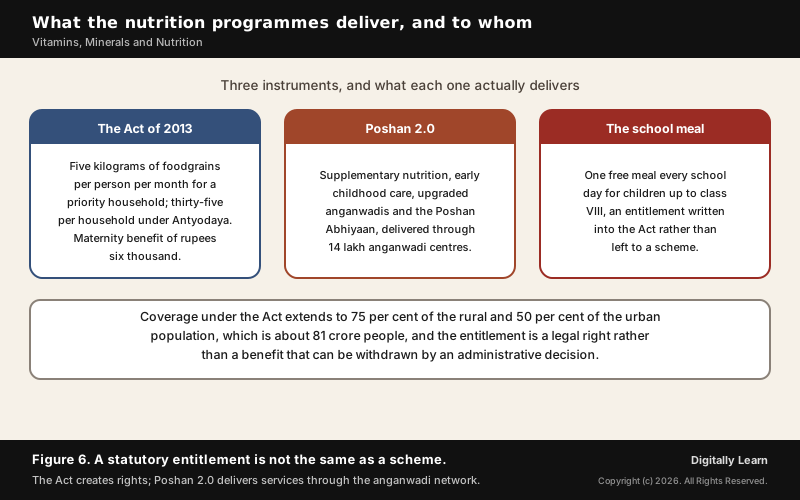
The quantities are written into the statute. A priority household receives five kilograms of foodgrains per person per month at subsidised prices, while a household covered by the Antyodaya Anna Yojana receives thirty-five kilograms per household per month, a flat quantity rather than a per-person one.
Coverage is set as a proportion rather than a number. The Act extends the entitlement to up to 75 per cent of the rural population and up to 50 per cent of the urban population, which works out at roughly 81 crore people and makes it among the largest food entitlement programmes anywhere.
The Act reaches beyond grain. Pregnant women and lactating mothers are entitled to a meal through the local anganwadi and to a maternity benefit of not less than six thousand rupees, and where the entitled quantity is not supplied the State owes a food security allowance in its place.
One provision rewrites who holds the entitlement. The Act directs that the eldest woman who is not less than eighteen years of age in every eligible household shall be head of the household for the purpose of issuing ration cards, which places the claim in a woman's name by default rather than by application.
Eligibility is also wider than the older category it replaced. The Act covers priority households and Antyodaya households identified by the States, not the below poverty line category alone, so restricting subsidised grain to BPL families describes the older system the Act replaced.
Two dates are often confused. The Act received assent on 10 September 2013; 5 July 2013 is the date of the Ordinance that preceded it.
Poshan 2.0 and the Anganwadi Network Behind It
Mission Saksham Anganwadi and Poshan 2.0 is the scheme through which most nutrition services actually reach people. It is delivered through a network of 14 lakh anganwadi centres, and it is issued under the provisions of the Act rather than standing separately from it.
The mission runs on four verticals rather than as a single programme:
- Nutrition support through the Supplementary Nutrition Programme, for children from six months to six years, pregnant women and lactating mothers, and adolescent girls aged 14 to 18 in aspirational districts and the North Eastern Region.
- Early childhood care and education for ages three to six, with early stimulation from birth to three.
- Anganwadi infrastructure, including the upgraded centres from which the Saksham element of the name comes.
- Poshan Abhiyaan, the mission that gives the scheme its monitoring and convergence machinery.
The supplementary nutrition is designed against a gap rather than an absolute. The guidelines state that it is meant to bridge the distance between the recommended dietary allowance and the average daily intake, which is why the norms are expressed as an addition to what a household already provides.
Those norms are set per beneficiary per day: 500 kilocalories and 12 to 15 grams of protein for a child aged six months to six years, 800 and 20 to 25 grams for a severely malnourished child, and 600 with 18 to 20 grams for pregnant women, nursing mothers and adolescent girls. The guidelines add that these norms are under revision.
PM POSHAN and the School Meal as a Statutory Right
A child up to class VIII, or within the age group of six to fourteen, is entitled to one free mid-day meal every day except on school holidays, in schools run by local bodies and in government and government-aided schools. The meal must meet the nutritional standards set out in Schedule II of the Act.
The legal form is what matters here. Because the entitlement sits in a statute rather than in an executive scheme, no administrator may withdraw it, and a failure to supply it triggers the food security allowance that the Act provides for any unmet entitlement.
The delivery vehicle is PM POSHAN, run by the Department of School Education and Literacy, which supplies the meal the statute requires. The right comes from the Act; the scheme only delivers it.
The three instruments fit together. The Act creates the entitlements, Poshan 2.0 delivers services through the anganwadi network, and PM POSHAN delivers the school meal; and the nutrient density discussed in the article on digestion and millets only reaches the diets that need it most by travelling through these three.
Previous Year UPSC-CSE Questions
Previous Year UPSC-CSE Questions By the end you will be able to draft model answers for the following UPSC questions. Each question carries a collapsible framework showing how to approach it in the exam.
- UPSC Prelims 2023 Prelims-GSConsider the following statements in the context of interventions being undertaken under Anaemia Mukt Bharat Strategy:
- It provides prophylactic calcium supplementation for pre-school children, adolescents and pregnant women.
- It runs a campaign for delayed cord clamping at the time of child-birth.
- It provides for periodic deworming to children and adolescents.
- It addresses non-nutritional causes of anaemia in endemic pockets with special focus on malaria, hemoglobinopathies and fluorosis.
How many of the statements given above are correct?
How to approach this Prelims question
Approach: Read the six interventions off the list and mark each statement present or absent. The count, not the identity, is what is asked.
Trap to watch: Statement 1 says calcium. The strategy supplements iron and folic acid, not calcium, and that single substitution is the whole of the error.
Key facts to recall:
- (a) Only one: wrong. Three of the four statements describe the strategy.
- (b) Only two: wrong. Delayed cord clamping, deworming and the non-nutritional causes are all in the strategy.
- (c) Only three: right. Statement 1 is wrong, since the supplementation is iron and folic acid, not calcium; statements 2, 3 and 4 are right.
- (d) All four: wrong. The strategy's prophylactic supplementation is iron and folic acid, not calcium.
Answer signal: Statements 2, 3 and 4 are correct and statement 1 is not, so option (c) is the answer.
- UPSC Prelims 2017 Prelims-GSWhich of the following are the objectives of 'National Nutrition Mission'?
- To create awareness relating to malnutrition among pregnant women and lactating mothers.
- To reduce the incidence of anaemia among young children, adolescent girls and women.
- To promote the consumption of millets, coarse cereals and unpolished rice.
- To promote the consumption of poultry eggs.
Select the correct answer using the code given below:
How to approach this Prelims question
Approach: Separate an objective of the mission from a policy that happens to be good nutrition. The mission's targets are outcomes, not menus.
Trap to watch: Statements 3 and 4 name specific foods. Encouraging millets is real policy, but it belongs to dietary guidance and agriculture, not to the mission's stated objectives.
Key facts to recall:
- (a) 1 and 2 only: right. Awareness among pregnant women and lactating mothers and a lower incidence of anaemia are both mission objectives.
- (b) 1, 2 and 3 only: wrong. Promoting millets and unpolished rice is dietary guidance, not a mission objective.
- (c) 1, 2 and 4 only: wrong. Promoting eggs is not a mission objective either.
- (d) 3 and 4 only: wrong. Both are commodity promotions, and it leaves out the real objectives.
Answer signal: Only the first two are objectives, so option (a) is the answer.
- UPSC Prelims 2016 Prelims-GSWhich of the following is/are the indicator/indicators used by IFPRI to compute the Global Hunger Index Report?
- Undernourishment
- Child stunting
- Child mortality
Select the correct answer using the code given below.
How to approach this Prelims question
Approach: Recall the full set of four indicators, then check each listed item against it. Everything offered here is on the list.
Trap to watch: The temptation is to reject child mortality as not being about hunger. It is an indicator of the index whatever one thinks of it, and that objection is the Government's argument, not the question's.
Key facts to recall:
- (a) 1 only: wrong. Child stunting and child mortality are indicators too.
- (b) 2 and 3 only: wrong. It leaves out undernourishment, the only indicator that covers the whole population.
- (c) 1, 2 and 3: right. All three are among the index's four indicators, with child wasting.
- (d) 1 and 3 only: wrong. It leaves out child stunting.
Answer signal: All three listed items are indicators, so option (c) is the answer.
- UPSC Prelims 2014 Prelims-GSConsider the following pairs of a vitamin and a deficiency disease:
- Vitamin C : Scurvy
- Vitamin D : Rickets
- Vitamin E : Night blindness
Which of the pairs given above is/are correctly matched?
How to approach this Prelims question
Approach: Take each pair separately. Two are standard and the third substitutes one fat-soluble vitamin for another.
Trap to watch: Night blindness belongs to vitamin A, not vitamin E. Vitamin E deficiency is rare and affects nerve and muscle rather than vision.
Key facts to recall:
- (a) 1 and 2 only: right. Scurvy comes from a lack of vitamin C and rickets from a lack of vitamin D.
- (b) 3 only: wrong. Night blindness comes from a lack of vitamin A, not vitamin E.
- (c) 1, 2 and 3: wrong. The third pair is wrongly matched.
- (d) None: wrong. The first two pairs are correct.
Answer signal: The first two pairs are correct and the third is not, so option (a) is the answer.
- UPSC Prelims 2013 Prelims-GSImproper handling and storage of cereal grains and oilseeds result in the production of toxins known as aflatoxins which are not generally destroyed by normal cooking process. Aflatoxins are produced by
How to approach this Prelims question
Approach: The stem supplies the condition, improper storage of grain. Ask which of the four kinds of organism grows on damp stored grain.
Trap to watch: Bacteria is the reflex answer for a food toxin. Aflatoxins are fungal, produced by moulds of the genus Aspergillus, and they survive normal cooking.
Key facts to recall:
- (a) bacteria: wrong. Aflatoxins are not bacterial toxins.
- (b) protozoa: wrong. Protozoa do not grow on stored grain to make these toxins.
- (c) moulds: right. Aflatoxins are made by moulds, which are fungi, on grain and oilseed stored damp or handled poorly.
- (d) viruses: wrong. Viruses do not produce toxins of this kind.
Answer signal: Moulds, so option (c) is the answer.
- UPSC Prelims 2010 Prelims-GSGenetically modified “golden rice” has been engineered to meet human nutritional requirements. Which one of the following statements best qualifies golden rice?
How to approach this Prelims question
Approach: Fix the trait first. Golden rice was engineered for a nutrient, not for yield, so the three options about yield, amino acids and vitamin D can go together.
Trap to watch: Two distractors offer other desirable traits, higher yield and complete protein. Both are plausible aims for a modified crop and neither is what golden rice does.
Key facts to recall:
- (a) three times higher yield: wrong. Golden rice was engineered for a nutrient, not for yield.
- (b) provitamin A converted to vitamin A: right. Its grains carry provitamin A, which the body turns into vitamin A.
- (c) all nine essential amino acids: wrong. The modification concerns provitamin A, not amino acids.
- (d) fortification with vitamin D: wrong. The nutrient is provitamin A, not vitamin D.
Answer signal: The provitamin A statement, so option (b) is the answer.
- UPSC Prelims 2006 Prelims-GSWhich one among the following is not a good source of nutritional calcium?
How to approach this Prelims question
Approach: Three of the four are standard calcium sources. Find the cereal that is not, which is the one eaten in the largest quantity.
Trap to watch: Rice is the staple, so its low calcium content is counter-intuitive. Quantity eaten and nutrient density are different things.
Key facts to recall:
- (a) Rice: right. Polished rice is a poor source of calcium.
- (b) Ragi: not the answer. Finger millet carries 344 milligrams of calcium per 100 grams, the most among cereal grains.
- (c) Skimmed milk: not the answer. Milk supplies calcium and potassium.
- (d) Egg: not the answer. The official key marks only rice as the poor source among the four.
Answer signal: Rice, so option (a) is the answer.
- UPSC Prelims 2004 Prelims-GSConsider the following statements:
- Non-function of lachrymal gland is an important symptom of deficiency of Vitamin A.
- Deficiency of Vitamin B1 can lead to indigestion and heart enlargement.
- Vitamin C deficiency can lead to pain in the muscles.
- Deficiency of Vitamin D causes increased loss of Ca++ in urine.
Which of these statements given above are correct?
How to approach this Prelims question
Approach: Work outward from the two you can place with certainty, the eye for vitamin A and the heart for thiamine, and be sceptical of the remaining two.
Trap to watch: Statements 3 and 4 are each half-plausible. The safest route is to confirm 1 and 2 positively rather than to adjudicate the other two.
Key facts to recall:
- (a) 1 and 2: right, as the official key gives it. Vitamin A deficiency shows in the eye, from the tear-producing tissue on, and thiamine deficiency (wet beriberi) affects the heart.
- (b) 2, 3 and 4: wrong. It leaves out statement 1, the vitamin A eye sign.
- (c) 1, 3 and 4: wrong. It leaves out statement 2, the effect of vitamin B1 deficiency on the heart.
- (d) 1, 2, 3 and 4: wrong. The key does not accept statements 3 and 4.
Answer signal: The first two statements are correct, so option (a) is the answer.
- UPSC Prelims 2018 Prelims-GSWith reference to the provisions made under the National Food Security Act, 2013, consider the following statements:
- The families coming under the category of 'below poverty line (BPL)' only are eligible to receive subsidised food grains.
- The eldest woman in a household, of age 18 years or above, shall be the head of the household for the purpose of issuance of a ration card.
- Pregnant women and lactating mothers are entitled to a 'take-home ration' of 1600 calories per day during pregnancy and for six months thereafter.
Which of the statements given above is/are correct?
How to approach this Prelims question
Approach: Check each statement against the text of the Act rather than against the scheme that preceded it.
Trap to watch: Statement 1 describes the system the Act replaced. Statement 3 attaches a specific calorie figure to an entitlement the Act frames as a meal meeting Schedule II standards plus a cash benefit.
Key facts to recall:
- (a) 1 and 2: wrong. Coverage runs to priority and Antyodaya households, up to 75 per cent rural and 50 per cent urban, not BPL families only.
- (b) 2 only: right. The eldest woman of 18 or above is head of the household for issuing ration cards.
- (c) 1 and 3: wrong. Both statements are false.
- (d) 3 only: wrong. Mothers are entitled to a meal through the anganwadi and a maternity benefit of not less than six thousand rupees, not a 1,600-calorie take-home ration.
Answer signal: Only the second statement is correct, so option (b) is the answer.
- UPSC Prelims 2022 Prelims-GSConsider the following statements in respect of probiotics:
- Probiotics are made of both bacteria and yeast.
- The organisms in probiotics are found in foods we ingest but they do not naturally occur in our gut.
- Probiotics help in the digestion of milk sugars.
Which of the statements given above is/are correct?
How to approach this Prelims question
Approach: Settle statement 2 first. If the organisms do occur naturally in the gut, options (b) and (d) both fall and only (a) and (c) remain.
Trap to watch: Statement 2 sounds cautious and is the false one. The gut has a resident microbiota; probiotics are intended to act on it, not to introduce something wholly foreign.
Key facts to recall:
- (a) 1 only: wrong. The official key accepts statement 3 as well.
- (b) 2 only: wrong. The organisms do occur naturally in the gut, which carries its own microbiota.
- (c) 1 and 3: right, as the official key gives it. Probiotics include yeasts as well as bacteria, and the key accepts their help in digesting milk sugars.
- (d) 2 and 3: wrong. Statement 2 is false.
Answer signal: Statements 1 and 3 are correct, so option (c) is the answer.
- UPSC Prelims 1996 Prelims-GSThe nutritional deficiency condition that needs to be given top priority for remedial action in India today is
How to approach this Prelims question
Approach: Rank the four by the severity and reversibility of their end stage, not by how many people have them.
Trap to watch: Prevalence and priority are different questions. Anaemia is far commoner, but it is not among the four options, and the option that ends in permanent blindness outranks the rest.
Key facts to recall:
- (a) Scurvy: wrong. Scurvy is treatable without permanent damage.
- (b) Rickets: wrong. Rickets is treatable too.
- (c) Xerophthalmia: right. Its end stage, keratomalacia, destroys the cornea and blinds for life.
- (d) Pellagra: wrong. Pellagra is treatable without permanent loss of sight.
Answer signal: Xerophthalmia, so option (c) is the answer.
- UPSC Prelims 1996 Prelims-GSWhich of the following would lead to 'malnutrition'?
- I. Overnutrition
- II. Undernutrition
- III. Imbalanced nutrition
Select the correct answer using the codes given below:
How to approach this Prelims question
Approach: Read the definition rather than the ordinary usage. If the definition includes overweight, then overnutrition is malnutrition.
Trap to watch: Ordinary speech treats malnutrition as too little food. The technical definition covers too much and the wrong mix as well, which is exactly what the question is checking.
Key facts to recall:
- (a) II alone: wrong. Malnutrition covers overweight and imbalance as well as undernutrition.
- (b) II and III: wrong. It leaves out overnutrition, which leads to overweight and obesity.
- (c) I and III: wrong. It leaves out undernutrition, the commonest form.
- (d) I, II and III: right. Malnutrition covers undernutrition, micronutrient imbalance and overweight.
Answer signal: All three lead to malnutrition, so option (d) is the answer.
- UPSC Prelims 1996 Prelims-GSBesides proteins and carbohydrates, other elements of nutritional value found in milk include
How to approach this Prelims question
Approach: Two of the three minerals offered are in milk and one is not. Identify the absent one and every option containing it falls.
Trap to watch: Iron is the distractor, and it appears in three of the four options. Milk is a poor iron source, which is a recognised cause of anaemia in milk-fed toddlers.
Key facts to recall:
- (a) calcium, potassium and iron: wrong. Milk is a poor source of iron.
- (b) calcium and potassium: right. Milk supplies both besides protein and carbohydrate.
- (c) potassium and iron: wrong. It leaves out calcium and includes iron.
- (d) calcium and iron: wrong. It includes iron and leaves out potassium.
Answer signal: Calcium and potassium, so option (b) is the answer.
- UPSC Prelims 1995 Prelims-GSWhich one of the following hormones contains iodine?
How to approach this Prelims question
Approach: Iodine has one nutritional role, and it runs entirely through the thyroid. Pick the thyroid hormone.
Trap to watch: The other three are well-known hormones from other glands, which makes the list look harder than it is. None involves iodine.
Key facts to recall:
- (a) Thyroxine: right. Iodine is part of thyroxine and triiodothyronine, the thyroid hormones.
- (b) Testosterone: wrong. It is not a thyroid hormone and contains no iodine.
- (c) Insulin: wrong. It is not a thyroid hormone and contains no iodine.
- (d) Adrenaline: wrong. It is not a thyroid hormone and contains no iodine.
Answer signal: Thyroxine, so option (a) is the answer.
- UPSC Mains 2024 GS-IIPoverty and malnutrition create a vicious cycle, adversely affecting human capital formation. What steps can be taken to break the cycle?
Answer outline: how to structure the answer
What the question asks, the main arguments, relevant examples and the direction of the conclusion. This is not a full model answer.
Introduction: State the cycle in one sentence, that poverty produces malnutrition and malnutrition depresses the capacity to escape poverty, then give one figure that shows the gradient before turning to remedies.
Body (sub-themes to develop):
- The cycle, evidenced: stunting runs at 46 per cent among children in the lowest wealth quintile against 23 per cent in the highest, and children of mothers with no schooling are the most likely to be undernourished.
- Why it damages human capital: stunting measures cumulative deficit and is largely irreversible after the early years, so childhood deprivation becomes a permanent ceiling on cognition and earnings.
- Step one, entitlements rather than schemes: the Act of 2013 makes foodgrain a legal claim for up to 75 per cent of the rural and 50 per cent of the urban population, with a food security allowance when it is not met.
- Step two, the first thousand days: supplementary nutrition and early childhood care through 14 lakh anganwadi centres under Poshan 2.0, targeted at the window in which stunting is still preventable.
- Step three, the specific deficiencies: the 6X6X6 anaemia strategy, and fortification of the five notified commodities so the nutrient arrives without requiring a change in what people buy.
- Step four, the mother: maternity benefit, take-home ration and the eldest-woman provision that puts the ration card in a woman's name, because maternal nutrition sets the child's starting point.
Conclusion: Close on the leverage point, that because the damage is concentrated in early childhood and is irreversible after it, the steps that break the cycle are the ones that arrive early and arrive reliably.
- UPSC Mains 2021 GS-IIIWhat are the salient features of the National Food Security Act, 2013? How has the Food Security Bill helped in eliminating hunger and malnutrition in India?
Answer outline: how to structure the answer
What the question asks, the main arguments, relevant examples and the direction of the conclusion. This is not a full model answer.
Introduction: Open on what the Act changed in kind, that it converted welfare schemes into legal entitlements, and date it to its assent on 10 September 2013 before listing the features.
Body (sub-themes to develop):
- Salient features, quantities: five kilograms of foodgrains per person per month for a priority household, thirty-five kilograms per household for an Antyodaya household, at the prices in Schedule I.
- Salient features, coverage: up to 75 per cent of the rural and 50 per cent of the urban population, about 81 crore people.
- Salient features, beyond grain: a meal and a maternity benefit of not less than six thousand rupees for pregnant women and lactating mothers, and one free mid-day meal for children up to class VIII.
- Salient features, rights architecture: the eldest woman of eighteen or above as head of household for the ration card, and a food security allowance from the State when an entitlement is not met.
- Assessment, what it changed: an entitlement cannot be withdrawn administratively, which shifts the question from whether the benefit exists to whether delivery works.
- Assessment, what it has not solved: 36 per cent of children under five remain stunted and 67.1 per cent of children are anaemic, so calorie entitlement has not by itself closed the micronutrient gap, which is why fortification and the anaemia strategy sit alongside it.
Conclusion: Conclude that the Act settled the question of entitlement and left the question of nutrition open, which is why the later instruments address micronutrients rather than quantity of grain.
Sources and Further Reading
- ICMR-National Institute of Nutrition: Dietary Guidelines for Indians, 2024
- World Health Organization: Vitamin A deficiency, Nutrition Landscape Information System
- World Health Organization: Iodine deficiency, Nutrition Landscape Information System
- World Health Organization: Malnutrition, fact sheet
- World Health Organization: Anaemia, fact sheet
- World Health Organization: Healthy diet, fact sheet
- Press Information Bureau: Union Health Ministry releases NFHS-5 findings
- Press Information Bureau: India's Fight Against Anemia, April 2025
- Ministry of Health and Family Welfare: Anaemia Mukt Bharat, operational guidelines
- Press Information Bureau: Global Hunger Index 2021, Government response
- Ministry of Law and Justice: The National Food Security Act, 2013, Gazette of India
- Ministry of Women and Child Development: Mission Saksham Anganwadi and Poshan 2.0, scheme guidelines
- Food Safety and Standards Authority: Fortification of Foods Regulations, consolidated
- Department of School Education and Literacy: Guidelines on the PM POSHAN Scheme
- NCERT: Biology, Class 12, Chapter 10, Biotechnology and its Applications
- Wikipedia: Scurvy
- Wikipedia: Rickets
- Wikipedia: Thiamine deficiency
- Wikipedia: Probiotic
- WHO and UNICEF: Child growth standards and the identification of severe acute malnutrition, joint statement, 2009
- Wikipedia: Marasmus
- Wikipedia: Kwashiorkor
- Wikipedia: Protein-energy malnutrition
Editorial Disclaimer
This article is for UPSC preparation and explains micronutrients, deficiency diseases and the nutrition programmes that address them. Figures follow the official sources cited and are not medical or dietary advice for any individual.


