


Overview
Immunity is the body's overall ability to fight disease-causing organisms, conferred by the immune system. It is of two types: Innate immunity, present from birth and non-specific, and acquired immunity, which is specific to each pathogen and remembers it. That memory is the property on which vaccines are built.
Immune System: Organs, Cells and Lines of Defence
What Immunity Is: Recognising Self and Non-Self
Every day the body meets a large number of infectious agents, yet only a few of these exposures cause disease, because the body can defend itself.
The immune system is unique in that it recognises foreign antigens, responds to them and remembers them. It can tell the body's own cells, the self, from anything foreign, the non-self, and it also plays a part in allergies, autoimmune diseases and organ transplantation.
Lymphatic System and Lymphoid Organs: Bone Marrow, Thymus, Spleen and Lymph Nodes
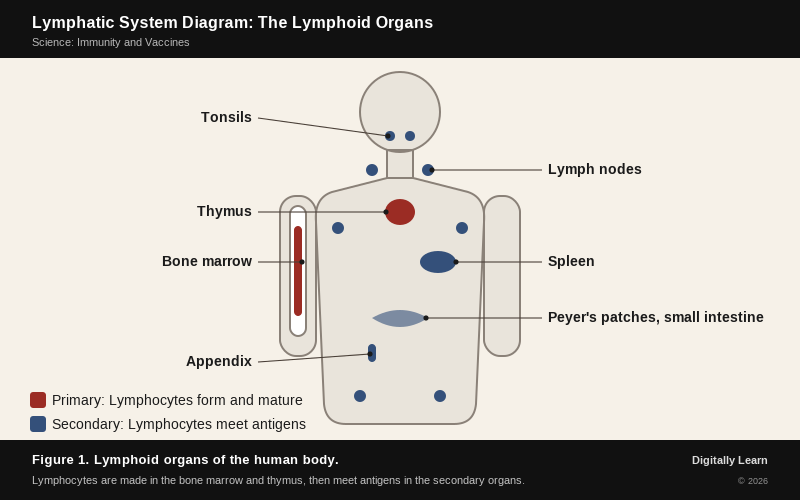
The immune system is made of lymphoid organs, tissues, cells and soluble molecules such as antibodies. Lymphoid organs are where lymphocytes arise, mature and multiply, and they come in two kinds.
- Primary lymphoid organs: The bone marrow and the thymus, where immature lymphocytes become antigen-sensitive lymphocytes. The bone marrow is the main lymphoid organ, where all blood cells, lymphocytes included, are produced. Both organs provide the setting in which T-lymphocytes develop and mature.
- Secondary lymphoid organs: The spleen, lymph nodes, tonsils, Peyer's patches of the small intestine and the appendix, where mature lymphocytes meet antigens and multiply into effector cells.
Blood-forming red marrow lies mainly in the bones of the central skeleton, such as the pelvis, sternum and ribs, and, to a varying extent, in the ends of long bones such as the femur and humerus. The thymus is a lobed organ near the heart, beneath the breastbone; it is large at birth and shrinks to a very small size by puberty, and it also secretes the peptide hormones called thymosins.
The spleen is a large bean-shaped organ, made up mainly of lymphocytes and phagocytes, that filters blood by trapping blood-borne microbes and holds a reservoir of red blood cells. Lymph nodes are small solid structures placed along the lymphatic system, which carries lymph. They trap microbes and other antigens that enter the lymph, and the trapped antigens activate the lymphocytes there. Lymphoid tissue in the lining of the respiratory, digestive and urogenital tracts, called mucosa-associated lymphoid tissue (MALT), makes up about 50 per cent of the body's lymphoid tissue.
Types of Immunity: Innate and Acquired
Innate Immunity: Physical, Physiological, Cellular and Cytokine Barriers
The non-specific defence present from birth is innate immunity. It works by putting barriers in the way of foreign agents, and there are four kinds.
- Physical barriers: The skin is the main barrier, and mucus lining the respiratory, gastrointestinal and urogenital tracts traps microbes.
- Physiological barriers: Acid in the stomach, saliva in the mouth and tears from the eyes all prevent microbial growth.
- Cellular barriers: White blood cells such as neutrophils, monocytes and natural killer cells in the blood, and macrophages in the tissues, engulf and destroy microbes.
- Cytokine barriers: Cells infected by a virus secrete proteins called interferons, which protect uninfected cells from further viral infection.
Acquired Immunity: Antigens, Antibodies and Immunological Memory
The second line, acquired immunity, is specific to a pathogen and is marked by memory. The first meeting with a pathogen produces a primary response of low intensity; a later meeting with the same pathogen produces a highly intensified secondary, or anamnestic, response.
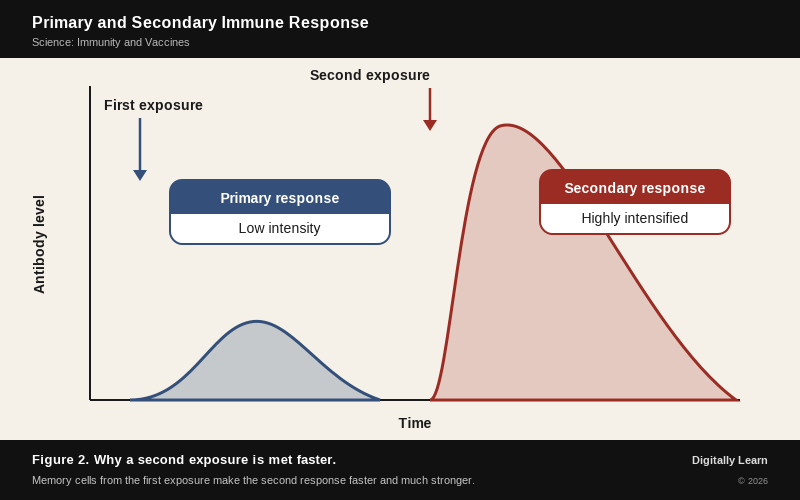
The difference comes from memory cells. After the primary response the body keeps antibody-producing memory cells alive, so on a second exposure the response is much faster and more effective.
B Cells and T Cells: Humoral and Cell-Mediated Immunity
Both responses are carried out by two special lymphocytes in the blood. B-lymphocytes produce an army of antibodies into the blood, while T-lymphocytes do not secrete antibodies themselves but help B cells to make them.
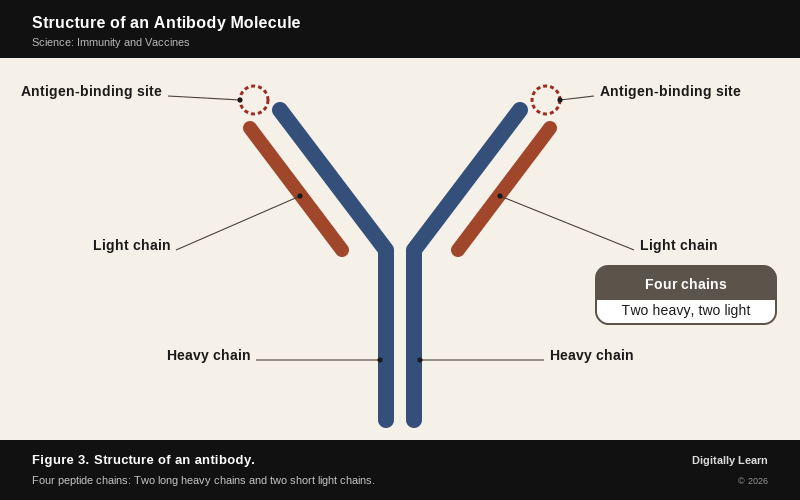
Each antibody made by B cells is a Y‑shaped protein with two short light chains and two longer heavy chains, so it is written as H2L2. The body makes several types, among them IgA, IgM, IgE and IgG.
| Feature | Humoral immunity | Cell-mediated immunity |
|---|---|---|
| Carried out by | B-lymphocytes | T-lymphocytes |
| Works through | Antibodies in the blood | The cells themselves |
| Example | Neutralising a pathogen | Rejecting a transplanted organ |
Cell-mediated immunity explains graft rejection. A transplanted heart, liver or kidney from just any donor is rejected sooner or later, so tissue matching and blood group matching are essential, and even then the patient takes immunosuppressants for life.
Active and Passive Immunity
Natural Infection, Vaccination and Ready-Made Antibodies
Acquired immunity can also be sorted by where the antibodies come from. In active immunity the body makes its own antibodies after meeting antigens, living or dead microbes or other proteins, either in a natural infection or through deliberate immunisation.
In passive immunity ready-made antibodies are given directly to protect the body. It works at once.
| Feature | Active immunity | Passive immunity |
|---|---|---|
| Antibodies | Made by the body itself | Given ready-made |
| Speed | Slow to reach full effect | Quick, as needed in tetanus |
| Examples | Natural infection, vaccination | Colostrum, antibodies across the placenta, antitoxin |
Colostrum, Antibodies Across the Placenta and Antivenom
A newborn relies on passive immunity from its mother. The yellowish colostrum secreted in the first days of breastfeeding is rich in antibodies of the IgA type, and the foetus also receives some antibodies across the placenta during pregnancy. These maternal antibodies protect only for the first few months of life, which is why babies need vaccines early.
When a deadly infection needs a quick response, as in tetanus, doctors inject preformed antibodies or an antitoxin. The injection given after a snakebite, called antivenom, likewise contains preformed antibodies against the venom. This is called passive immunisation.
Vaccines: How They Work and Their Types
How Vaccines Work: Memory Cells and Herd Immunity
The principle of vaccination rests on the memory of the immune system. A vaccine introduces antigenic proteins of a pathogen, or the pathogen itself in an inactivated or weakened form, so the body makes antibodies and also memory B and T cells. On a later real infection these recognise the pathogen quickly and overwhelm it with a massive production of antibodies.
Because vaccines contain only killed or weakened germs or their parts, they do not cause the disease. Most are injected, some are given by mouth and some are sprayed into the nose. Childhood vaccines alone save over 4 million lives every year.
Vaccination began in 1796, when Edward Jenner used pus from a milkmaid's cowpox blisters to protect a boy against smallpox; the word vaccine comes from his term for cowpox, Variolae vaccinae.
Vaccines also protect people who cannot be vaccinated. When a large enough share of a population is immune, a contagious disease can no longer persist; this indirect protection is herd immunity, and the critical share is the herd immunity threshold. No vaccine gives 100 per cent protection, and herd immunity does not fully protect those who cannot be vaccinated, such as very young babies and the seriously ill.
Types of Vaccines: Live, Inactivated, Subunit, Vector and mRNA
All vaccines show the immune system an antigen without causing the disease, but they do it in different ways.
| Type | What the vaccine contains | Examples |
|---|---|---|
| Live attenuated | A weakened living microbe; usually gives more durable immunity | BCG (Bacillus Calmette-Guérin) against tuberculosis; measles and rubella vaccines |
| Inactivated | A killed whole microbe | Inactivated polio vaccine (IPV); Covaxin |
| Toxoid | An inactivated form of the toxin that causes the illness | Tetanus and diphtheria vaccines |
| Subunit | Only a fragment of the pathogen, such as a surface protein | Hepatitis B vaccine; CORBEVAX |
| Viral or bacterial vector | A safe virus or bacterium that carries a pathogen gene into the body, so the body makes the antigen | Covishield; Sputnik V |
| Nucleic acid | A copy of messenger RNA (mRNA), or the gene as DNA, which cells use as a blueprint to build a pathogen's protein | GEMCOVAC‑19 (mRNA); ZyCoV-D (DNA) |
Viral vector, RNA and DNA vaccines together are called genetic vaccines. A recombinant vector vaccine combines one microorganism, the vector, with DNA from another, the pathogen. Creating such recombinant DNA is a technique of genetic engineering, and both viruses and bacteria are used as vectors. Covishield and Sputnik V both use an adenovirus as the vector. Adenoviruses carry a single piece of double-stranded DNA and cause illnesses ranging from the common cold in young children to life-threatening disease in people with weakened immunity.
Many vaccines also contain an adjuvant, a substance that boosts the immune response. India's indigenous tetanus and adult diphtheria (Td) vaccine, for example, adsorbs purified diphtheria and tetanus toxoids onto aluminium phosphate, which acts as its adjuvant.
Monoclonal Antibodies and Recombinant Vaccines
Recombinant DNA technology lets antigenic proteins of a pathogen be made in bacteria or yeast. Vaccines made this way can be produced on a large scale, so more people can be immunised; the hepatitis B vaccine produced from yeast is the standard example.
Man-made antibodies cloned from one unique parent white blood cell are called monoclonal antibodies. They are identical and bind only one part of one antigen. They are made by hybridoma technology, which fuses antibody-producing B cells with myeloma cells, cancerous B cells that divide endlessly, so the hybrid keeps making the same antibody.
Georges Köhler and César Milstein invented the method in 1975 and shared the 1984 Nobel Prize with Niels Jerne. Monoclonal antibodies are also used to treat infections: Sotrovimab, for example, targets the spike protein of the virus that causes COVID‑19, and the m102.4 monoclonal antibody has been used in people against Nipah virus infection on a compassionate-use basis in Australia.
Vaccination in India: Universal Immunization Programme and COVID‑19 Vaccines
Universal Immunization Programme and the National Immunization Schedule
India's Universal Immunization Programme (UIP) began in 1978 as the Expanded Programme on Immunization and took its present name in 1985, when it was extended from cities to rural areas. It gives vaccines free to about 2.9 crore pregnant women and 2.54 crore newborns every year, against 12 diseases:
- Tuberculosis (severe childhood forms)
- Diphtheria
- Pertussis
- Tetanus
- Polio
- Measles
- Rubella
- Hepatitis B
- Meningitis and pneumonia from Haemophilus influenzae type b (Hib)
- Rotavirus diarrhoea
- Pneumococcal pneumonia
- Japanese encephalitis (JE)
The JE vaccine is given only in endemic districts; the others are given nationwide.
Besides BCG at birth, the schedule uses these vaccines:
- Polio: The oral polio vaccine (OPV), with a fractional dose of the injected inactivated polio vaccine (fIPV).
- Pentavalent: One vaccine that joins diphtheria, pertussis and tetanus (DPT) with hepatitis B and Hib.
- Rotavirus and pneumococcal: The rotavirus vaccine and the pneumococcal conjugate vaccine (PCV).
- Measles and rubella: The measles-rubella (MR) vaccine.
- Tetanus and diphtheria: The Td vaccine, for adolescents and pregnant women.
| Age or group | Vaccines given |
|---|---|
| Birth | BCG, OPV zero dose, hepatitis B birth dose |
| 6 weeks | OPV‑1, pentavalent‑1, rotavirus‑1, fIPV‑1, PCV‑1 |
| 10 weeks | OPV‑2, pentavalent‑2, rotavirus‑2 |
| 14 weeks | OPV‑3, pentavalent‑3, fIPV‑2, rotavirus‑3, PCV‑2 |
| 9 to 12 months | MR‑1, JE‑1, PCV booster |
| 16 to 24 months | MR‑2, JE‑2, DPT booster‑1, OPV booster |
| 5 to 6 years | DPT booster‑2 |
| 10 and 16 years | Td |
| Pregnant women | Td‑1 and Td‑2, or a Td booster if vaccinated in the previous three years |
Newer vaccines joined the schedule in the last decade: IPV in 2015, rotavirus in 2016, measles-rubella in 2017 and PCV in 2017, which became available nationwide in October 2021. Pneumococcus (Streptococcus pneumoniae) causes pneumonia, meningitis and sepsis, and by preventing infections such vaccines also cut the use of antibiotics and slow the spread of antimicrobial resistance.
New vaccines join the UIP on the advice of the National Technical Advisory Group on Immunization (NTAGI), the apex advisory body set up by the Government of India to make recommendations on immunisation and on the introduction of new vaccines. Its recommendations added the Hib component of the pentavalent vaccine and replaced the tetanus toxoid (TT) vaccine with the Td vaccine for all age groups, pregnant women included. It has also recommended the human papillomavirus (HPV) vaccine, with a one-time catch-up for girls aged 9 to 14 and routine use at 9 years.
Full immunisation coverage rose from 62 per cent in 2015 to 98.4 per cent in January 2026, and the share of zero-dose children in the population fell from 0.11 per cent in 2023 to 0.06 per cent in 2024.
Mission Indradhanush, Pulse Polio and the Cold Chain
Mission Indradhanush, launched in December 2014, is a catch-up campaign under the UIP for areas of low coverage, reaching children and pregnant women who were missed or dropped out. Its 12 phases up to 2023 vaccinated 5.46 crore children and 1.32 crore pregnant women across 765 districts.
The Pulse Polio programme was launched in 1995, and India marks National Vaccination Day on 16 March for the first oral polio dose given that year. The last polio case was reported on 13 January 2011 in Howrah, West Bengal; India was certified polio-free on 27 March 2014 and eliminated maternal and neonatal tetanus in 2015. Smallpox had been eradicated in 1977.
- Cold chain: Vaccines lose their potency permanently if they are exposed to heat or freezing, so they are kept in a chain of nearly 30,000 cold chain points from national depots down to primary health centres.
- eVIN: The Electronic Vaccine Intelligence Network tracks vaccine stocks and storage temperatures in real time across all States and Union Territories.
- U‑WIN: The Universal Immunization Programme's digital platform, launched in October 2024, keeps a digital vaccination record for pregnant women and children and lets families book vaccination and find centres; CoWIN, the COVID Vaccine Intelligence Network launched on 16 January 2021, did the same for COVID‑19 vaccines.
COVID‑19 Vaccines Made in India: Covishield, Covaxin and New Platforms
India's COVID‑19 vaccines show nearly every vaccine type at work. At meetings on 1 and 2 January 2021, the Subject Expert Committee of the drug regulator recommended restricted emergency use of two vaccines built on different platforms, Covishield and Covaxin, and the recommendations were made public on 3 January 2021.
- Covishield: Made by the Serum Institute of India, Pune, with technology transfer from AstraZeneca and Oxford University; a recombinant chimpanzee adenovirus vector vaccine carrying the gene for the virus's spike protein.
- Covaxin: Developed by Bharat Biotech with the Indian Council of Medical Research (ICMR) and the National Institute of Virology, Pune; a whole virion inactivated vaccine grown on a Vero cell platform.
Sputnik V, a Russian vaccine, is also an adenovirus vector vaccine, but it uses two different adenoviruses for its two doses.
Under Mission COVID Suraksha, a ₹900 crore mission led by the Department of Biotechnology, four more vaccines were developed: ZyCoV-D, the world's first DNA vaccine against COVID‑19, which received emergency use authorisation on 20 August 2021 for people aged 12 and above; CORBEVAX, India's first protein subunit vaccine; GEMCOVAC‑19, an mRNA vaccine; and iNCOVACC, an intranasal vaccine. More than 220 crore COVID‑19 doses were given through CoWIN.
ICMR now aims to help India develop medical countermeasures within 100 days of any future pandemic, under the National One Health Mission, and is developing an indigenous two-dose inactivated vaccine for Kyasanur Forest Disease with Indian Immunologicals Limited and the National Institute of Virology.
Vaccine Regulation and Safety in India: CDSCO, CDL and AEFI
Vaccine Approval: CDSCO, the Drugs Controller General and Batch Release at Kasauli
Vaccines in India are regulated as drugs under the Drugs and Cosmetics Act, 1940. The Central Drugs Standard Control Organisation (CDSCO), which works under the Directorate General of Health Services of the Ministry of Health and Family Welfare, approves new drugs, regulates clinical trials and lays down drug standards, while the States regulate the manufacture, sale and distribution of most drugs. Its head, the Drugs Controller General of India (DCGI), approves licences for specified categories of drugs, among them vaccines, sera, blood products and intravenous fluids.
Trials and approvals follow the New Drugs and Clinical Trials Rules, 2019, made under the 1940 Act. Under these rules, and on the advice of its Subject Expert Committee, CDSCO allowed Covishield and Covaxin restricted use in emergency situations, with conditions, during the COVID‑19 pandemic.
An approved vaccine is still tested batch by batch. The Central Drugs Laboratory (CDL), Kasauli, is the national control laboratory for vaccines and antisera for human use; it tests vaccines made in India for the home market, the Government's immunisation programme and export, as well as imported vaccines, and receives about 7,000 batches a year for testing or certification before release.
CDL is a regulator's laboratory, separate from the Central Research Institute (CRI), Kasauli, which makes vaccines and antisera under the Directorate General of Health Services. The Td vaccine launched at CRI on 21 February 2026 went through the full regulatory route, with some steps waived: Developmental studies and a test licence, waivers of preclinical studies and of Phase I, II and III clinical trials, then marketing authorisation, a manufacturing licence and release by CDL before supply to the UIP.
Vaccine Safety: AEFI Surveillance, Side Effects and Vaccine Hesitancy
An adverse event following immunization (AEFI) is any untoward medical occurrence that follows vaccination and does not necessarily have a causal relationship with the vaccine. Deaths, hospitalisations and events causing disability or concern after any vaccination are classed as serious or severe and are investigated at the district level, while causality, whether the vaccine caused the event, is assessed at the State and national levels. A death or hospitalisation after vaccination is therefore not assumed to be caused by the vaccine until the AEFI committees have investigated it. The National AEFI Committee is headed by an independent expert from outside the government.
Most side effects of vaccines are mild, such as fever, pain around the injection site and muscle aches; a few people are allergic to an ingredient of a vaccine, and severe side effects are extremely rare.
Public trust is the other half of vaccine safety. Vaccine hesitancy, the reluctance or refusal to vaccinate despite the availability of vaccines, was one of the ten threats to global health that the World Health Organization named for 2019. Complacency, inconvenience in reaching vaccines and lack of confidence are key reasons for it, and health workers, especially those in communities, remain the most trusted advisers on vaccination.
Disorders of Immunity: Allergy, Autoimmunity and Immunodeficiency
Allergies and Autoimmune Diseases
An allergy is an exaggerated response of the immune system to certain antigens in the environment, called allergens, such as mites in dust, pollen and animal dander. The antibodies made are of the IgE type, and the symptoms come from chemicals such as histamine and serotonin released by mast cells.
- Symptoms: Sneezing, watery eyes, a running nose and difficulty in breathing.
- Diagnosis and treatment: To find the cause, the patient is exposed to tiny doses of possible allergens and the reactions are studied; anti-histamines, adrenalin and steroids quickly reduce the symptoms.
- Rising cases: More and more children in India's metro cities suffer from allergies and asthma, possibly because of the protected environment they grow up in.
Sometimes, for genetic and other unknown reasons, the body attacks its own cells. This is an autoimmune disease, and rheumatoid arthritis is a common example.
Immunodeficiency: HIV and AIDS
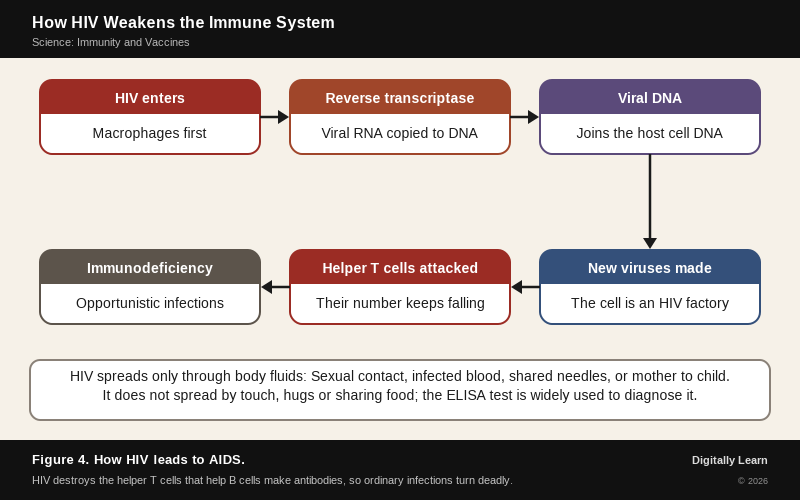
AIDS, the Acquired Immunodeficiency Syndrome, is a deficiency of the immune system acquired during life, not present from birth. It was first reported in 1981 and is caused by the Human Immunodeficiency Virus (HIV), a retrovirus whose genome of single-stranded RNA lies inside an envelope; inside a host cell the enzyme reverse transcriptase copies this RNA into DNA.
- Transmission: Sexual contact, transfusion of contaminated blood, sharing infected needles, and from an infected mother to her child across the placenta, at birth or through breastfeeding. HIV spreads only through body fluids; it does not spread by touch, kisses, hugs or sharing food, and it cannot survive in mosquitoes or other insects.
- Course: Symptoms appear after a gap of a few months to many years, usually 5 to 10 years, as helper T cells fall; swollen lymph nodes, weight loss, fever, diarrhoea and cough follow, and infections such as those from Mycobacterium take hold.
- Diagnosis and treatment: The enzyme-linked immunosorbent assay (ELISA) is a widely used test. Anti-retroviral therapy (ART) cannot cure the infection, but with treatment HIV has become a manageable chronic condition, and people on ART whose viral load is undetectable do not pass HIV to their sexual partners.
Worldwide, about 41.0 million people were living with HIV at the end of 2025; in 2025 about 1.2 million people acquired HIV and about 0.57 million died from HIV-related causes. Against the 95‑95‑95 targets, 88 per cent of people living with HIV knew their status in 2025, 89 per cent of those diagnosed were receiving ART, and 95 per cent of those on ART had suppressed viral loads.
HIV in India: NACO, NACP and the HIV/AIDS Act, 2017
India's response is led by the National AIDS Control Organisation (NACO), set up in 1992 under the Ministry of Health and Family Welfare, which runs the National AIDS and STD Control Programme (NACP) with non-governmental organisations. Prevention rests on safe blood from blood banks, disposable needles and syringes, free condoms, control of drug abuse and regular testing of people at risk.
The programme has run in five phases since 1992. Its fifth phase, for 2021 to 2026, is a Central Sector Scheme with an outlay of ₹15,471.94 crore that aims to end HIV/AIDS as a public health threat by 2030, in support of Sustainable Development Goal (SDG) target 3.3.
India's adult HIV prevalence fell from 0.33 per cent in 2010 to 0.20 per cent in 2024, against a global average of 0.7 per cent. New infections fell from 1.25 lakh in 2010 to 64,500 in 2024, and AIDS-related deaths from 1.73 lakh to 32,200 over the same years. Free ART reached more than 18 lakh people living with HIV by 2025.
The HIV/AIDS (Prevention and Control) Act, 2017, prohibits discrimination against people living with HIV, protects the confidentiality of their status and requires informed consent for testing and treatment.
Previous Year UPSC‑CSE Questions
Each Prelims question is explained option by option, and each Mains question comes with an answer outline.
- UPSC Prelims 2025With reference to monoclonal antibodies, often mentioned in news, consider the following statements:
- I. They are man-made proteins.
- II. They stimulate immunological function due to their ability to bind to specific antigens.
- III. They are used in treating viral infections like that of Nipah virus.
Which of the statements given above are correct?
How to approach this Prelims question
Approach: Test each statement against what monoclonal antibodies are, how they bind and where they have been used. Statement I is true, because they are made in the laboratory from one cloned cell; statement II is true, because each binds one specific part of an antigen; statement III is true, because monoclonal antibodies are used to treat viral infections, and the m102.4 antibody has been used in people against Nipah virus infection on a compassionate-use basis.
Trap to watch: Students drop statement III as too specific, but monoclonal antibodies are used to treat viral infections, Nipah among them on a compassionate-use basis.
Why each option is right or wrong:
- (a) I and II only: Wrong. It leaves out statement III, although monoclonal antibodies are used to treat viral infections such as Nipah.
- (b) II and III only: Wrong. It leaves out statement I, yet monoclonal antibodies are man-made antibodies cloned from one parent cell.
- (c) I and III only: Wrong. It leaves out statement II, yet each monoclonal antibody binds one specific part of an antigen.
- (d) I, II and III: Correct. They are man-made, they bind specific antigens, and they are used to treat viral infections, m102.4 against Nipah among them.
Answer: (d) I, II and III. Monoclonal antibodies are man-made, bind one specific antigen part, and are used to treat viral infections such as Nipah.
- UPSC Prelims 2022In the context of vaccines manufactured to prevent COVID‑19 pandemic, consider the following statements:
- The Serum Institute of India produced COVID‑19 vaccine named Covishield using mRNA platform.
- Sputnik V vaccine is manufactured using vector based platform.
- COVAXIN is an inactivated pathogen based vaccine.
Which of the statements given above are correct?
How to approach this Prelims question
Approach: Match each vaccine to its platform before reading the options. Covishield is a recombinant chimpanzee adenovirus vector vaccine, so statement 1 is false; Sputnik V is an adenovirus vector vaccine, so statement 2 is true; Covaxin is a whole virion inactivated vaccine, so statement 3 is true.
Trap to watch: Students accept statement 1 because mRNA vaccines were in the news, but Covishield is a viral vector vaccine.
Why each option is right or wrong:
- (a) 1 and 2 only: Wrong. Statement 1 is false, because Covishield uses a recombinant chimpanzee adenovirus vector, not mRNA.
- (b) 2 and 3 only: Correct. Sputnik V uses an adenovirus vector and Covaxin is a whole virion inactivated vaccine.
- (c) 1 and 3 only: Wrong. It includes the false statement 1 and leaves out the true statement 2.
- (d) 1, 2 and 3: Wrong. It includes the false statement 1, about Covishield's platform.
Answer: (b) 2 and 3 only. Sputnik V is a vector vaccine and Covaxin an inactivated one, while Covishield is a viral vector vaccine, not an mRNA vaccine.
- UPSC Prelims 2022Which one of the following statements best describes the role of B cells and T cells in the human body?
How to approach this Prelims question
Approach: Recall what acquired immunity is for, then pick the option that states it. B cells make antibodies and T cells help them and carry out cell-mediated immunity, so both serve to defend the body against pathogens.
Trap to watch: Students pick (a) because allergies involve the immune system, but an allergy is an exaggerated response, not the role of B and T cells.
Why each option is right or wrong:
- (a) They protect the body from environmental allergens: Wrong. An allergy is an exaggerated immune response, not the purpose of B and T cells.
- (b) They alleviate the body's pain and inflammation: Wrong. Lymphocytes fight pathogens; relieving pain is not their role.
- (c) They act as immunosuppressants in the body: Wrong. B and T cells carry out the immune response; they do not suppress it.
- (d) They protect the body from the diseases caused by pathogens: Correct. B cells produce antibodies and T cells help them, giving acquired immunity specific to pathogens.
Answer: (d) They protect the body from the diseases caused by pathogens. B cells and T cells are the working cells of acquired immunity, which protects the body against pathogens.
- UPSC Prelims 2021With reference to recent developments regarding 'Recombinant Vector Vaccines', consider the following statements:
- Genetic engineering is applied in the development of these vaccines.
- Bacteria and viruses are used as vectors.
Which of the statements given above is/are correct?
How to approach this Prelims question
Approach: Recall how a vector vaccine is made, then which organisms can serve as the vector. The vector carries DNA from the pathogen, and creating such recombinant DNA is a technique of genetic engineering, so statement 1 is true; both viruses and bacteria are used as vectors, so statement 2 is true.
Trap to watch: Students know viral vectors from the COVID‑19 vaccines and drop statement 2, but bacterial vectors exist too.
Why each option is right or wrong:
- (a) 1 only: Wrong. It leaves out statement 2, yet both bacteria and viruses serve as vectors.
- (b) 2 only: Wrong. It leaves out statement 1, yet the vector is made by creating recombinant DNA, a technique of genetic engineering.
- (c) Both 1 and 2: Correct. A vector made by genetic engineering carries a pathogen gene into the body, and viral and bacterial vectors are both used.
- (d) Neither 1 nor 2: Wrong. Both statements are true.
Answer: (c) Both 1 and 2. Recombinant vector vaccines are made by genetic engineering, and both viruses and bacteria are used as vectors.
- UPSC Prelims 2021Consider the following statements:
- Adenoviruses have single-stranded DNA genomes whereas retroviruses have double-stranded DNA genomes.
- Common cold is sometime caused by an adenovirus whereas AIDS is caused by a retrovirus.
Which of the statements given above is/are correct?
How to approach this Prelims question
Approach: Recall the genome of each virus family, then the diseases each causes. An adenovirus carries one piece of double-stranded DNA and a retrovirus carries single-stranded RNA, so statement 1 is false on both counts; adenoviruses cause illnesses as mild as the common cold, and HIV, the cause of AIDS, is a retrovirus, so statement 2 is true.
Trap to watch: Students accept statement 1 because both viruses are linked with DNA, adenoviruses as vaccine vectors and retroviruses through reverse transcriptase, but neither has the genome the statement gives.
Why each option is right or wrong:
- (a) 1 only: Wrong. Statement 1 is false, because adenoviruses have double-stranded DNA and retroviruses single-stranded RNA.
- (b) 2 only: Correct. Adenoviruses can cause the common cold, and AIDS is caused by HIV, a retrovirus.
- (c) Both 1 and 2: Wrong. It includes the false statement 1.
- (d) Neither 1 nor 2: Wrong. Statement 2 is true.
Answer: (b) 2 only. An adenovirus can cause the common cold and HIV is a retrovirus, but the genomes in statement 1 are the wrong way round.
- UPSC Prelims 2020What is the importance of using Pneumococcal Conjugate Vaccines in India ?
- These vaccines are effective against pneumonia as well as meningitis and sepsis.
- Dependence on antibiotics that are not effective against drug-resistant bacteria can be reduced.
- These vaccines have no side effects and cause no allergic reactions.
Select the correct answer using the code given below :
How to approach this Prelims question
Approach: Accept what a vaccine prevents and its effect on antibiotics, and reject any absolute claim. Pneumococcus causes pneumonia, meningitis and sepsis, so statement 1 is true; preventing infections cuts antibiotic use, so statement 2 is true; vaccines can have mild side effects and a few people are allergic to an ingredient, so statement 3 is false.
Trap to watch: Students accept statement 3 because vaccines are safe, but "no side effects and no allergic reactions" is an absolute claim no vaccine meets.
Why each option is right or wrong:
- (a) 1 only: Wrong. It leaves out statement 2, yet by preventing infections vaccines reduce antibiotic use and slow drug resistance.
- (b) 1 and 2 only: Correct. Pneumococcus causes pneumonia, meningitis and sepsis, and vaccination cuts the need for antibiotics.
- (c) 3 only: Wrong. Statement 3 is an absolute claim; vaccines can cause mild side effects such as fever, and some people are allergic to an ingredient.
- (d) 1, 2 and 3: Wrong. It includes the false statement 3.
Answer: (b) 1 and 2 only. The vaccines protect against pneumonia, meningitis and sepsis and reduce reliance on antibiotics, but they are not free of side effects.
- UPSC Prelims 2016'Mission Indradhanush' launched by the Government of India pertains to
How to approach this Prelims question
Approach: Link the name to its purpose before reading the options. Mission Indradhanush, launched in December 2014, is a catch-up vaccination campaign for children and pregnant women in areas of low coverage.
Trap to watch: The name Indradhanush, a rainbow, gives no hint of vaccines, so a student who has not met the scheme may link it with the sky and pick the search for Earth-like planets.
Why each option is right or wrong:
- (a) immunization of children and pregnant women: Correct. Mission Indradhanush, launched in December 2014, is a catch-up immunisation drive.
- (b) construction of smart cities across the country: Wrong. The mission has no link to urban construction.
- (c) India's own search for the Earth-like planets in outer space: Wrong. It has no link to space science.
- (d) New Educational Policy: Wrong. It has no link to education policy.
Answer: (a) immunization of children and pregnant women. Mission Indradhanush is a catch-up immunisation campaign for children and pregnant women under the UIP.
- UPSC Prelims 2004In which organ of the human body are the lymphocyte cells formed?
How to approach this Prelims question
Approach: Separate where lymphocytes are made from where they work. The bone marrow, found in the ends of long bones among other places, is the main lymphoid organ where all blood cells are produced, while the spleen is a secondary organ where lymphocytes meet antigens.
Trap to watch: Students pick the spleen because it holds many lymphocytes, but it is a secondary organ; lymphocytes are formed in the bone marrow.
Why each option is right or wrong:
- (a) Liver: Wrong. Lymphocytes, like all blood cells, are formed in the bone marrow, not the liver.
- (b) Long bone: Correct. The red marrow in the ends of long bones is part of the bone marrow, the primary lymphoid organ where lymphocytes are produced.
- (c) Pancreas: Wrong. The pancreas secretes pancreatic juice and the hormone insulin; it does not form lymphocytes.
- (d) Spleen: Wrong. It holds many lymphocytes, but it is a secondary lymphoid organ where they meet antigens, not where they are formed.
Answer: (b) Long bone. Lymphocytes are produced in the bone marrow, which lies in the ends of long bones among other sites.
- UPSC Prelims 2001Antigen is a substance which
How to approach this Prelims question
Approach: Recall the definition of an antigen, and keep it apart from the definition of an antibody. An antigen is the part of a pathogen that causes the body to form antibodies.
Trap to watch: Students pick (a) because destroying bacteria sounds like immunity, but that is the work of antibodies and phagocytes, not antigens.
Why each option is right or wrong:
- (a) destroys harmful bacteria: Wrong. That is what antibodies and phagocytes do, not antigens.
- (b) is used to treat poisoning: Wrong. Antitoxins and antivenoms, which are ready-made antibodies, are used against poisons and venoms.
- (c) lowers body temperature: Wrong. An antigen triggers antibody formation; it has no role in lowering body temperature.
- (d) stimulates formation of antibody: Correct. An antigen is a substance that triggers the body to make antibodies.
Answer: (d) stimulates formation of antibody. An antigen is the substance that causes the body to form antibodies.
- UPSC Prelims 2000Hybridoma technology is a new biotechnological approach for commercial production of
How to approach this Prelims question
Approach: Recall what a hybridoma cell makes. A hybridoma, a B cell fused with a myeloma cell, keeps producing one identical antibody, a monoclonal antibody.
Trap to watch: Students pick (c) because antibodies is broadly right, but the specific product of the technology is monoclonal antibodies.
Why each option is right or wrong:
- (a) monoclonal antibodies: Correct. A hybridoma, a B cell fused with a myeloma cell, produces identical antibodies; Köhler and Milstein invented the method in 1975.
- (b) interferon: Wrong. Interferons are secreted by virus-infected cells, not made by hybridomas.
- (c) antibodies: Wrong. Broadly true, but the specific product of the technology is monoclonal antibodies.
- (d) alcohol: Wrong. Hybridoma cells make antibodies, not alcohol.
Answer: (a) monoclonal antibodies. Hybridoma technology fuses B cells with myeloma cells to produce monoclonal antibodies.
- UPSC Prelims 1997A major health mission carried in 1996 was
How to approach this Prelims question
Approach: Place each option in time and ask which was a national campaign of the mid-1990s. Pulse Polio was launched in 1995 to vaccinate all children under five, while India had eradicated smallpox in 1977.
Trap to watch: Students pick smallpox eradication because it is the most famous campaign, but it was achieved in 1977, long before 1996.
Why each option is right or wrong:
- (a) war against leprosy: Wrong. Leprosy had its own long-running elimination programme; the campaign of 1995 and 1996 was Pulse Polio.
- (b) small-pox eradication: Wrong. India eradicated smallpox in 1977, so it could not be a 1996 mission.
- (c) pulse polio immunization: Correct. The Pulse Polio programme, launched in 1995, vaccinated all children under five against polio in mass rounds.
- (d) popularisation of oral rehydration therapy: Wrong. Oral rehydration therapy treats dehydration from diarrhoea; it was not the national mission of 1996.
Answer: (c) pulse polio immunization. Pulse Polio, launched in 1995, was the major national health campaign of 1996.
- UPSC Prelims 1996Consider the following statements:AIDS is transmitted -
- I. By sexual intercourse.
- II. By blood transfusion.
- III. By mosquitoes and other blood-sucking insects.
- IV. Across the placenta.
Of these statements:
How to approach this Prelims question
Approach: Test each route against the rule that HIV passes only in body fluids. Sexual intercourse, blood transfusion and the placenta all pass body fluids or blood, so statements I, II and IV are true; HIV cannot survive in insects, so statement III is false.
Trap to watch: Students accept statement III because malaria and dengue spread by mosquito bites, but HIV does not survive in insects.
Why each option is right or wrong:
- (a) I, II and III are correct: Wrong. It includes the false statement III and leaves out the placenta.
- (b) I, II and IV are correct: Correct. HIV passes through sexual contact, contaminated blood and from mother to child across the placenta.
- (c) I, III and IV are correct: Wrong. It includes the false statement III and leaves out blood transfusion.
- (d) I and III are correct: Wrong. It includes the false statement III and leaves out two true routes.
Answer: (b) I, II and IV are correct. HIV spreads through body fluids, by sex, blood and across the placenta, but not through mosquitoes or other insects.
- UPSC Mains 2022 GS‑IIIWhat is the basic principle behind vaccine development? How do vaccines work? What approaches were adopted by the Indian vaccine manufacturers to produce COVID‑19 vaccines?
Answer outline
The outline sets out what the question asks, the main arguments, relevant examples and the direction of the conclusion; it is not a full model answer.
Introduction: Vaccination rests on the memory of the immune system. A harmless form of an antigen trains the body to respond fast to the real pathogen.
Body (sub-themes to develop):
- Principle: Antigenic proteins or an inactivated or weakened pathogen trigger antibodies and memory B and T cells.
- How vaccines work: The secondary response is faster and stronger; herd immunity protects those who cannot be vaccinated.
- Indian approaches: Covishield, a chimpanzee adenovirus vector vaccine (Serum Institute); Covaxin, a whole virion inactivated vaccine (Bharat Biotech with ICMR and the National Institute of Virology).
- Mission COVID Suraksha: ZyCoV-D (DNA), CORBEVAX (protein subunit), GEMCOVAC‑19 (mRNA) and iNCOVACC (intranasal).
- Regulation: Restricted emergency use under the New Drugs and Clinical Trials Rules, 2019, on the advice of CDSCO's Subject Expert Committee.
- Delivery: Cold chain, eVIN and CoWIN, with more than 220 crore doses given.
Conclusion: India used almost every vaccine platform against COVID‑19, from viral vectors to the world's first DNA vaccine against the disease, and ICMR's goal of medical countermeasures within 100 days of a future pandemic builds on that experience.
Sources
- NCERT: Biology, Class 12, Chapter 7, Human Health and Disease
- NCERT: Biology, Class 11, Chapter 19, Chemical Coordination and Integration
- NCERT: Biology, Class 12, Chapter 9, Biotechnology: Principles and Processes
- NCERT: Science, Class 10, Chapter 5, Life Processes
- NCERT: Science, Class 10, Chapter 6, Control and Coordination
- World Health Organization: Vaccines and immunization, what is vaccination?
- World Health Organization: How do vaccines work?
- World Health Organization: HIV and AIDS, fact sheet
- World Health Organization: Better use of vaccines could reduce antibiotic use, 10 October 2024
- World Health Organization: Ten threats to global health in 2019
- Press Information Bureau: Celebrating the Power of Vaccines, 17 March 2026
- Press Information Bureau: India's Immunization Drive, 9 November 2024
- Press Information Bureau: Update on Mission Indradhanush, 17 December 2024
- Press Information Bureau: Nationwide expansion of the Pneumococcal Conjugate Vaccine, 29 October 2021
- Press Information Bureau: Vaccines in the Universal Immunization Programme
- Press Information Bureau: Prevention of cervical cancer, 22 December 2022
- Press Information Bureau: Td vaccine at the Central Research Institute, Kasauli, 20 February 2026
- Press Information Bureau: Nationwide HPV vaccination drive from Ajmer, 28 February 2026
- Press Information Bureau: 80 lakh HPV vaccine doses, 11 September 2026
- Press Information Bureau: Expert committee on Covishield and Covaxin, 3 January 2021
- Press Information Bureau: COVID‑19 vaccines under the New Drugs and Clinical Trials Rules, 2019, 9 March 2021
- Press Information Bureau: Four vaccines under Mission COVID Suraksha, 27 January 2023
- Press Information Bureau: AEFI surveillance, 15 June 2021
- Press Information Bureau: Strengthening AEFI monitoring
- Press Information Bureau: World AIDS Day, 30 November 2025
- Central Drugs Standard Control Organisation: Functions
- Central Drugs Standard Control Organisation: Central Drugs Laboratory, Kasauli
- National AIDS Control Organisation: Handbook for HIV and STI Counsellors, October 2023
- Indian Council of Medical Research: ICMR Bulletin, first quarter 2026
- Wikipedia: Vaccine
- Wikipedia: Herd immunity
- Wikipedia: Monoclonal antibody
- Wikipedia: Hybridoma technology
- Wikipedia: Messenger RNA (mRNA) vaccine
- Wikipedia: Sputnik V COVID‑19 vaccine
- Wikipedia: Adenoviridae
- Wikipedia: Retrovirus
- Wikipedia: Streptococcus pneumoniae
- Wikipedia: Nipah virus infection
- Wikipedia: Edward Jenner
- Wikipedia: Bone marrow
- Wikipedia: Drugs Controller General of India
- Wikipedia: Central Research Institute, Kasauli
- Wikipedia: Pulse Polio
- Wikipedia: CoWIN
- Wikipedia: Leprosy in India
- Wikipedia: Oral rehydration therapy
- UPSC: Previous year question papers
Editorial Disclaimer
This article is for UPSC preparation and explains how immunity and vaccines work. It is not medical advice; follow the schedule and advice of a health worker for any vaccination.
See more of our UPSC articles in Google Search
Add to Preferred Sources

