


Overview
The President of India holds three powers that allow the Union to act when its ordinary processes cannot. The pardoning power of the President under Article 72 can relieve a convicted person of a sentence, even one confirmed by the Supreme Court. The ordinance-making power under Article 123 lets the executive make law while Parliament is not in session. The emergency powers under Articles 352, 356 and 360 meet a threat to the security of India, the breakdown of constitutional government in a State and a threat to the country's financial stability. The President exercises every one of them on the advice of the Council of Ministers, as Article 74 requires.
Pardoning Power of the President Under Article 72
Five Forms of Clemency: Pardon, Commutation, Remission, Respite and Reprieve
Article 72(1) empowers the President "to grant pardons, reprieves, respites or remissions of punishment or to suspend, remit or commute the sentence of any person convicted of any offence". The power is an executive one and is independent of the judiciary, but the President does not sit as a court of appeal. It exists for two purposes, to correct a judicial error that the ordinary process could not undo and to relieve a convict of a sentence the President regards as unduly harsh.
Each word in Article 72 names a different kind of relief.
| Form | What it does | Example |
|---|---|---|
| Pardon | Removes both the sentence and the conviction, and frees the convict from all punishments and disqualifications | The convict is treated as if never convicted |
| Commutation | Substitutes a lighter form of punishment | Death sentence commuted to rigorous imprisonment |
| Remission | Reduces the period of a sentence without changing its character | Two years of rigorous imprisonment reduced to one year |
| Respite | Awards a lesser sentence because of a special fact about the convict | Physical disability of a convict or pregnancy of a woman offender |
| Reprieve | Stays the execution of a sentence, especially a death sentence, for a time | Time for the convict to seek a pardon or commutation |
Scope of Article 72 and the Governor's Power Under Article 161
The President's pardoning power covers three classes of case under Article 72(1):
- Courts martial: Every punishment or sentence passed by a court martial, although officers of the Armed Forces keep any power the law gives them to suspend, remit or commute such a sentence.
- Union laws: Every punishment or sentence for an offence against a law on a matter to which the executive power of the Union extends.
- Death sentences: Every sentence of death, whichever law imposed it.
The Governor of a State holds a parallel power under Article 161, but it reaches only offences against laws on matters to which the executive power of the State extends. A Governor cannot pardon a death sentence, even one imposed under a State law; Article 72(3) preserves only the Governor's power to suspend, remit or commute it. The President and the Governor therefore share the power to suspend, remit or commute a death sentence, while only the President can pardon it.
| Case | President (Article 72) | Governor (Article 161) |
|---|---|---|
| Sentence by a court martial | Can grant every form of clemency | No power |
| Offence against a Union law | Can grant every form of clemency | No power |
| Offence against a State law | No power, except for a death sentence | Can grant every form of clemency |
| Death sentence | Can pardon, suspend, remit or commute | Can suspend, remit or commute, but cannot pardon |
Mercy Petitions on Ministerial Advice: Maru Ram, Kehar Singh and Epuru Sudhakar
The pardoning power is exercised on the aid and advice of the Council of Ministers. Article 74(1) binds the President to that advice, and the Supreme Court has described clemency under Articles 72 and 161 as a constitutional duty, "neither a matter of grace nor a matter of privilege". In practice, a mercy petition is examined by the Ministry of Home Affairs, whose recommendation goes to the President.
Three judgments shape the law on clemency:
- Maru Ram v. Union of India (1980): The Court held that the power must not be exercised mala fide and recommended that guidelines be framed for its use.
- Kehar Singh v. Union of India (1989): A Constitution Bench held that the President may examine the record of evidence and go into the merits of a case already decided by the Supreme Court. It found that specific guidelines need not be spelled out, because the power is "of the widest amplitude".
- Epuru Sudhakar v. Government of Andhra Pradesh (2006): The Court quashed a clemency order granted by the Governor of Andhra Pradesh to a convicted Congress activist and listed the grounds on which such an order can be challenged.
Limited judicial review is the position that runs through these cases. The power itself is above judicial review, but the manner of its exercise is not. A court may set aside a clemency order that was passed without application of mind, passed mala fide, passed on extraneous or wholly irrelevant considerations, passed after keeping relevant material out of consideration, or that suffers from arbitrariness. The court does not substitute its own view of whether mercy should be shown. The petitioner has no right to an oral hearing, and the President is not bound to give reasons for the decision.
Delay in Deciding Mercy Petitions: Shatrughan Chauhan (2014)
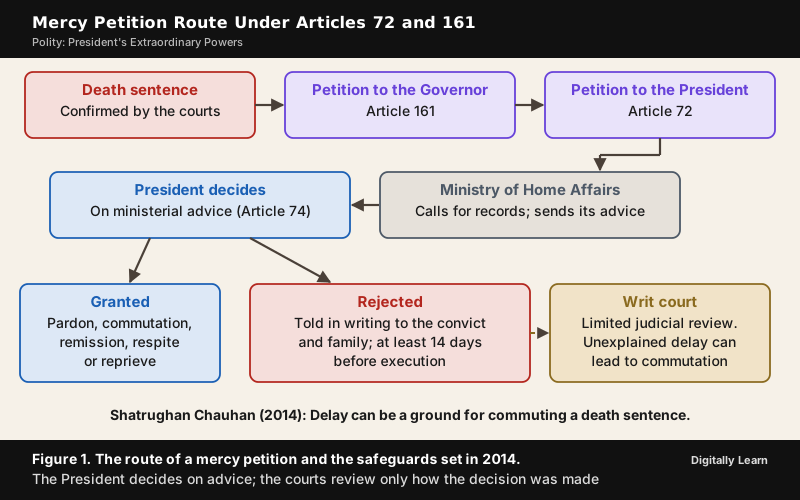
Delay in deciding mercy petitions became a ground for relief in Shatrughan Chauhan v. Union of India, decided on 21 January 2014 by Chief Justice P. Sathasivam and Justices Ranjan Gogoi and Shiva Kirti Singh. The Court held that undue, inordinate and unreasonable delay in disposing of a mercy petition is a supervening circumstance, an event after the final judgment that makes carrying out the death sentence unjust under Article 21. It commuted the death sentences of the petitioners before it to imprisonment for life, and it also recognised insanity and solitary confinement as supervening circumstances.
The Court then framed guidelines for the procedure that surrounds a mercy petition:
- Records: The Ministry of Home Affairs must call for all police records and judgments at once and send its recommendation to the President within a reasonable time.
- Communication: A rejection by the Governor or by the President must be communicated to the convict and the family in writing.
- Copy of the order: Death convicts are entitled as a right to a copy of the rejection.
- Notice: At least 14 days must separate the communication of a rejection and the date of execution.
- Legal aid and health: Legal aid must be available at every stage, and death-row convicts must receive regular mental health evaluation.
Time Limit for Deciding Mercy Petitions
A fixed time limit for the President to decide a mercy petition does not exist. The framers set no outer limit, and the Court held in 2014 that a petition must therefore be decided within a reasonable time. It chose not to fix a deadline itself. When delay is unreasonable, unexplained and exorbitant, the remedy is judicial review and commutation.
A statutory deadline would bring certainty for the convict and the victim's family, and it would hold the Ministry of Home Affairs to account for delays such as the six years it took in one of the cases decided in 2014. A deadline could, however, force a hurried decision in a complex case, and the President, acting on ministerial advice, cannot decide faster than the Ministry prepares the file.
The Court has also criticised delay by a Governor. In 2022 it ordered the release of A. G. Perarivalan, convicted in the Rajiv Gandhi assassination case, after criticising the Governor of Tamil Nadu for sitting on the State government's recommendation of remission for almost two and a half years.
Pardoning Power of the President in India and the United States
The pardoning power of the President of the United States comes from Article II, Section 2 of the US Constitution, which gives the President "Power to grant Reprieves and Pardons for Offenses against the United States, except in Cases of impeachment". It extends to all federal offences and to courts martial, but not to crimes under State law, which State governors or pardon boards handle, and it includes the power to commute sentences. The power is considered plenary, which means Congress and the courts generally cannot restrict or modify it.
A preemptive pardon is a pardon granted before any charge is filed or any conviction is recorded; a US federal pardon can be issued at that stage. Article 72 is written for a person convicted of an offence, although the Punchhi Commission on Centre-State Relations (2010) noted that clemency in India may also be given before conviction, as an amnesty to an accused or under-trial prisoner.
President Gerald Ford pardoned Richard Nixon on 8 September 1974 for all federal offences he "has committed or may have committed" between 20 January 1969 and 9 August 1974, although no indictment had been issued. On 20 January 2025, hours before his term ended, President Joe Biden pardoned Anthony Fauci, retired general Mark Milley and members of the House committee that had investigated the attack of 6 January 2021 on the Capitol, and in his last minutes in office he pardoned five members of his own family. The legal effect of such preemptive pardons has not been tested in the US courts, and whether a President may pardon himself is an unresolved question.
| Feature | India (Article 72) | United States (Article II, Section 2) |
|---|---|---|
| Who decides | The President, bound by the advice of the Council of Ministers | The President personally; the Pardon Attorney only advises |
| Offences covered | Union laws, courts martial and every death sentence | Federal offences and courts martial; not State crimes |
| Stage | A person "convicted of any offence" | At any stage, even before a charge is filed |
| Express exclusion | None in the text | Cases of impeachment |
| Review by courts | Limited judicial review of the manner of exercise | Treated as plenary; preemptive pardons untested in court |
The two countries follow different designs. India keeps the power within parliamentary government, where the decision belongs to ministers answerable to the Lok Sabha and the courts can examine whether it was taken properly. The United States gives the President a personal power whose main check is political, as the public disapproval of Ford's pardon of Nixon showed.
Ordinance-Making Power of the President Under Article 123
Conditions for Promulgating an Ordinance Under Article 123
An ordinance is a temporary law that the President promulgates when Parliament cannot legislate in time. Article 123(1) permits it "at any time, except when both Houses of Parliament are in session", if the President is satisfied that circumstances exist which render immediate action necessary. Three conditions follow from the text:
- Recess: An ordinance can be made when Parliament is not in session, or when only one House is sitting, because a Bill needs both Houses. An ordinance made while both Houses are in session is void.
- Satisfaction: The President must be satisfied that immediate action is necessary, and the President promulgates or withdraws an ordinance only on the advice of the Council of Ministers.
- Competence: An ordinance may only make a provision that Parliament itself could enact; under Article 123(3), any provision beyond that is void.
Article 74(1) allows the President to send the advice back once for reconsideration, but the President must act on the advice tendered after reconsideration.
The power to make ordinances is not found in most democratic constitutions, including those of the United States and the United Kingdom. B. R. Ambedkar defended it in the Constituent Assembly as a way for the executive to meet a situation that may arise suddenly and immediately when Parliament is not in session. The power has no necessary link with an emergency, and an ordinance can be issued in peacetime.
Governors hold a matching power under Article 213, with one addition. Under the proviso to Article 213(1), a Governor needs instructions from the President before promulgating an ordinance where a Bill with the same provisions would have needed the President's previous sanction, would have been reserved for the President, or would be invalid without the President's assent.
Life of an Ordinance and the Six-Week Rule
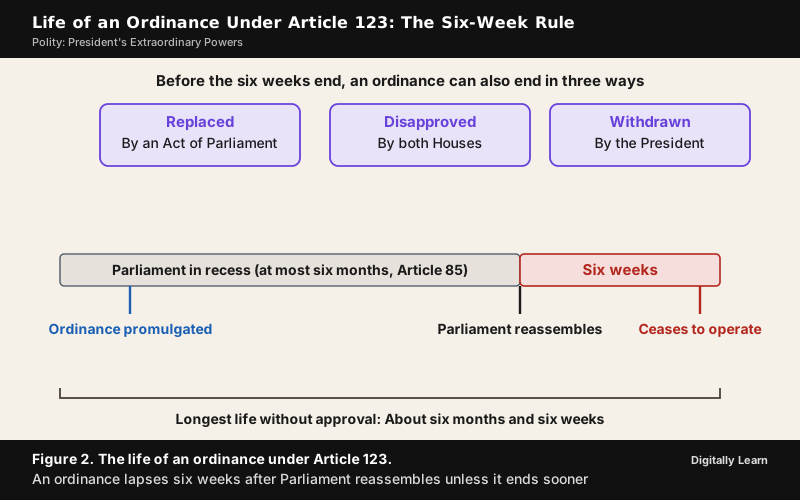
Article 123(2) gives an ordinance "the same force and effect as an Act of Parliament", but only for a limited time. Every ordinance must be laid before both Houses when Parliament reassembles, and it ends in one of four ways:
- Lapse: It ceases to operate at the end of six weeks from the reassembly of Parliament. When the two Houses reassemble on different dates, the six weeks run from the later date.
- Disapproval: It ceases earlier if both Houses pass resolutions disapproving it, on the passing of the second resolution.
- Withdrawal: The President, on advice, may withdraw it at any time.
- Replacement: Parliament enacts an Act with the same or amended provisions and repeals the ordinance.
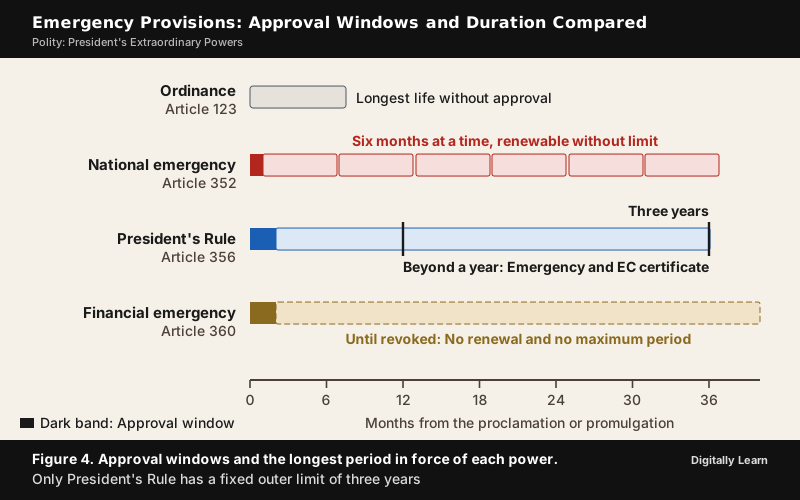
Because Article 85(1) allows no more than six months between the last sitting of one session and the first sitting of the next, an ordinance that Parliament never approves can survive for at most about six months and six weeks. A recent example shows the usual path. Parliament replaced the Supreme Court (Number of Judges) Amendment Ordinance, 2026, with the Supreme Court (Number of Judges) Amendment Act, 2026, which raised the number of judges in the Act from 33 to 37. The Act received the President's assent on 11 August 2026, repealed the ordinance, saved everything done under it and was deemed to have come into force on 16 May 2026.
What an Ordinance Can and Cannot Do
An ordinance has the same reach as an Act of Parliament, which makes it a strong instrument. It can come into force from a back date, modify or repeal any Act of Parliament or another ordinance, and alter or amend a tax law. Two further limits, besides the legislative competence already noted, stop it from going further:
- The Constitution: An ordinance cannot be issued to amend the Constitution.
- Fundamental Rights: Article 13(3)(a) includes "any Ordinance" in the meaning of "law", and Article 13(2) bars the State from making any law that takes away or abridges the Fundamental Rights. An ordinance that abridges a Fundamental Right is void to that extent.
Between 1950 and 2014, 679 ordinances were issued at the Centre. Numbers on this scale explain why the power is debated, since a provision meant for unforeseen situations became a regular route for legislation.
Judicial Review of the President's Satisfaction: Cooper to Krishna Kumar Singh
The President's satisfaction that immediate action is needed has moved, over five decades, from a near-political judgment to one the courts can examine. In R. C. Cooper v. Union of India (1970), a bench of 11 judges described the power as exercisable in extraordinary situations demanding immediate law and noted that the President's determination of those circumstances "is not declared final", without settling how far the courts could examine it. The 38th Amendment, in force from 1 August 1975 during the internal emergency, then made the satisfaction of the President "final and conclusive" and placed it beyond question "in any court on any ground".
The 44th Amendment deleted that clause with effect from 20 June 1979. In A. K. Roy v. Union of India (1982), a Constitution Bench held that whether the preconditions of Article 123 are satisfied "cannot be regarded as a purely political question".
In Krishna Kumar Singh v. State of Bihar (2017), a bench of seven judges set the present test. The satisfaction of the President under Article 123, and of the Governor under Article 213, is not immune from judicial review. A court asks whether the satisfaction is based on some relevant material; it will not judge whether that material was sufficient or adequate, but it will strike down a satisfaction that is a fraud on power or actuated by an oblique motive.
Re-promulgation of Ordinances as a Fraud on the Constitution
Re-promulgation means issuing an ordinance again, with the same text, after it has lapsed, without placing it before the legislature or enacting it. The practice came to light in Bihar, where the Governor promulgated and re-promulgated 256 ordinances between 1967 and 1981, some of them kept alive for up to 14 years. In D. C. Wadhwa v. State of Bihar, decided on 20 December 1986, a Constitution Bench held the practice to be in disregard of constitutional limitations. An exceptional power for extraordinary situations had taken over the primary law-making function of the legislature.
Bihar repeated the practice within three years. A chain of ordinances from 1989 to 1992, taking over Sanskrit schools, was never placed before the State legislature. In Krishna Kumar Singh, decided on 2 January 2017, Justice D. Y. Chandrachud wrote the judgment signed by five of the seven judges. It held that laying an ordinance before the legislature is a mandatory constitutional obligation, and that re-promulgation is "a fraud on the Constitution and a sub-version of democratic legislative processes". Every ordinance in that chain was declared to have no legal effect, although the Court moulded the relief so that salaries already paid to the employees would not be recovered.
Ordinances and the Separation of Powers
The Krishna Kumar Singh judgment explains the separation of powers concern behind these rulings. Re-promulgation is an effort to overreach the legislature, the primary source of law-making in a parliamentary democracy, and it threatens the sovereignty of Parliament and the State legislatures. A law passed after open debate in the legislature is transparent and accountable, the Court said, while an ordinance is made in secrecy.
The case for keeping the power rests on genuine urgency, since Parliament cannot always be summoned in time to meet a sudden need. The case for restraint rests on numbers and on practice, since a power used hundreds of times can let a government avoid debate on contested measures. The courts have not removed the power. Their rulings require that the legislature see every ordinance, that the satisfaction rest on relevant material and that re-promulgation end, which keeps the power for genuine urgency and denies it as a substitute for legislation.
National Emergency Under Article 352
Grounds for a National Emergency and the Written Cabinet Decision
A national emergency is a proclamation under Article 352(1) that the security of India, or of any part of its territory, is threatened by war, external aggression or armed rebellion. The President may issue it before the war, aggression or rebellion actually occurs, if satisfied that there is imminent danger of it, and may confine it to a specified part of India. A proclamation on the ground of war or external aggression is often called an external emergency, and one on the ground of armed rebellion an internal emergency.
Two of today's safeguards came from the 44th Amendment, in force from 20 June 1979. The words "armed rebellion" replaced "internal disturbance", the vaguer ground on which the emergency of 1975 was proclaimed. Under Article 352(3), the President cannot issue or vary a proclamation unless the decision of the Union Cabinet, meaning the Prime Minister and the Ministers of Cabinet rank, has been communicated in writing. The safeguard answered the events of 1975, when the Prime Minister advised the proclamation without consulting the Cabinet, which was informed only after it had been made.
Parliamentary Approval, Duration and Revocation of a National Emergency
Parliament controls a national emergency at every stage. A proclamation must be laid before each House and ceases to operate after one month unless both Houses approve it. Each resolution of approval needs a special majority, meaning a majority of the total membership of the House and a majority of not less than two-thirds of the members present and voting. An approved proclamation lasts six months from the second resolution and can be continued for further periods of six months by fresh resolutions, with no limit on the number of renewals.
The Rajya Sabha keeps a proclamation alive when the Lok Sabha has been dissolved. If the Rajya Sabha has approved it and the Lok Sabha has not, the proclamation survives until 30 days after the reconstituted Lok Sabha first sits. The President may revoke a proclamation at any time by a later proclamation, and the Lok Sabha alone can force a revocation. The President must revoke a proclamation if the Lok Sabha passes a resolution disapproving it, and members numbering not less than one-tenth of the total membership of the Lok Sabha can require a special sitting within 14 days to consider such a resolution. A resolution of disapproval needs only a simple majority.
Effects on Centre-State Relations, the Lok Sabha and Revenues
A proclamation of emergency can turn India's federal system into a highly centralised one without any formal amendment. Its effects reach the executive, legislative and financial relations between the Union and the States, and the life of the Lok Sabha:
- Executive directions: Under Article 353, the Union may direct any State on the manner in which its executive power is to be exercised. The State governments continue, but under the Union's direction.
- Laws on State subjects: Under Article 250, Parliament may make laws on any matter in the State List, and such laws cease to have effect six months after the proclamation ends. Article 353 also lets these laws confer powers and duties on Union authorities for matters outside the Union List.
- Revenues: Under Article 354, the President may modify the distribution of revenues under Articles 268 to 279 until the end of the financial year in which the proclamation ceases. Each such order is laid before Parliament.
- Term of the Lok Sabha: Under the proviso to Article 83(2), Parliament may extend the life of the Lok Sabha by law for not more than one year at a time, and never beyond six months after the proclamation has ceased to operate.
The power to legislate on State subjects also exists in ordinary times, but in a narrower form. Under Article 249, Parliament may make such laws only after the Rajya Sabha declares, by a resolution supported by two-thirds of the members present and voting, that it is necessary in the national interest. That resolution lasts one year at a time.
Fundamental Rights During an Emergency: Articles 358 and 359
Two Articles decide what happens to Fundamental Rights during a national emergency, and the 44th Amendment narrowed both. Article 358 frees the State from the restrictions of Article 19 as soon as a proclamation on the ground of war or external aggression is in operation; no separate order is needed. Article 359 lets the President, by order, suspend the right to move any court to enforce the rights named in the order. Since 1979 neither Article protects a law that does not recite that it is related to the emergency, and no order under Article 359 can touch Articles 20 and 21.
| Feature | Article 358 | Article 359 |
|---|---|---|
| Rights affected | Article 19 only | Rights named in the President's order, except Articles 20 and 21 |
| How it operates | Automatically, when the proclamation is in operation | Only through a Presidential order laid before Parliament |
| Grounds of emergency | War or external aggression only | Any ground of national emergency |
| Period | Whole duration of the emergency | Duration of the emergency or a shorter period in the order |
| Laws protected | Only laws reciting their link with the emergency | Only laws reciting their link with the emergency |
National Emergencies Proclaimed in 1962, 1971 and 1975
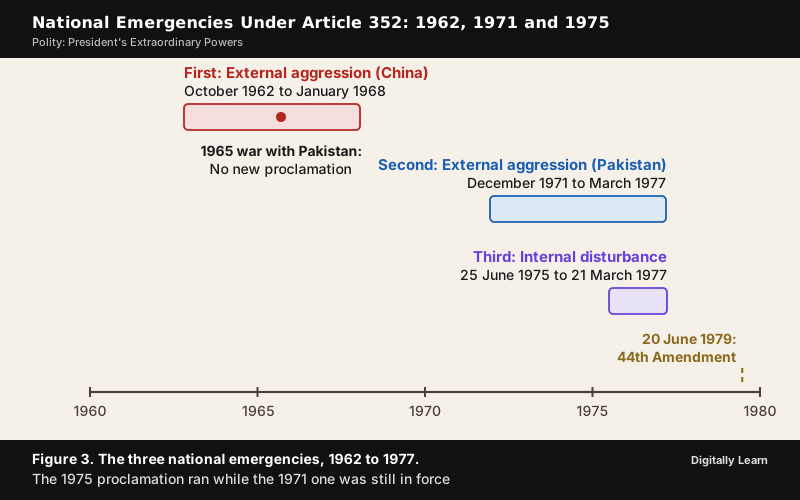
A national emergency has been proclaimed three times. The first was proclaimed in October 1962 during the Chinese aggression in the North-East Frontier Agency, now Arunachal Pradesh, and remained in force until January 1968, so no fresh proclamation was needed for the war with Pakistan in 1965. The second was proclaimed in December 1971, when Pakistan attacked India.
While the second was still in force, President Fakhruddin Ali Ahmed proclaimed a third on the ground of internal disturbance, in effect from 25 June 1975. The second and third proclamations were both revoked in March 1977, and the emergency of 1975 ended on 21 March 1977. The Shah Commission, appointed after the Emergency of 1975 to 1977 to examine the circumstances of the proclamation, found that it was not justified, and the 44th Amendment of 1978 followed.
President's Rule in the States Under Article 356
Failure of Constitutional Machinery: Grounds and Consequences
President's Rule is the proclamation under Article 356 by which the Union takes over the government of a State. The President may issue it if satisfied, "on receipt of a report from the Governor of a State or otherwise", that the government of the State cannot be carried on in accordance with the Constitution.
Article 365 adds a second route. When a State fails to comply with directions given by the Union in the exercise of its executive power, the President may hold that such a situation has arisen. Both rest on Article 355, which makes it the duty of the Union to protect every State against external aggression and internal disturbance and to ensure that its government is carried on in accordance with the Constitution.
A proclamation under Article 356(1) may do three things:
- Executive: The President assumes all or any of the functions of the State government and the powers of the Governor or any other State authority, except the legislature. The State Council of Ministers is dismissed, and the Governor runs the State on the President's behalf.
- Legislative: The President declares that the powers of the State legislature are exercisable by or under the authority of Parliament. Under Article 357, Parliament may confer the power to make laws for the State on the President, who may delegate it, and such laws continue after the proclamation ends until altered or repealed.
- Incidental: The President may suspend provisions of the Constitution relating to any body or authority in the State.
Article 356 itself bars the President from assuming any power of a High Court or suspending any provision relating to High Courts. The Assembly is not automatically dissolved; it may be kept in suspended animation, which keeps it alive but unable to function until it is revived or dissolved. Nor does a proclamation dissolve panchayats or municipalities, which continue for five years unless dissolved under a law.
Approval and Duration of President's Rule: Six Months to Three Years
A proclamation of President's Rule must be approved by both Houses within two months, by a simple majority of members present and voting. Once approved, it lasts six months from the date of issue and can be continued six months at a time by fresh resolutions, but never for more than three years. The rule on a dissolved Lok Sabha is the same as for a national emergency, so the Rajya Sabha's approval keeps the proclamation alive until 30 days after the new Lok Sabha first sits. The President may revoke it at any time without Parliament's approval.
Since the 44th Amendment, a resolution continuing President's Rule beyond one year from the date of issue can be passed only if two conditions are both met:
- A national emergency is in operation in the whole of India or in the whole or any part of the State.
- The Election Commission certifies that continuance is necessary because of difficulties in holding elections to the State Assembly.
The only exception written into the Constitution is the proclamation of 11 May 1987 for Punjab, for which the three-year limit was read as five years and the two conditions were not applied.
S. R. Bommai Case and Judicial Review of President's Rule
The courts' control of Article 356 rests on S. R. Bommai v. Union of India, decided by a bench of nine judges on 11 March 1994. The case arose from dismissals of State governments, among them S. R. Bommai's own government in Karnataka in 1989. The Court laid down principles that still govern every proclamation:
- Judicial review: A proclamation under Article 356 is subject to judicial review.
- Relevant material: The President's satisfaction must rest on relevant material, and the burden lies on the Union to show that such material existed. The court will not judge the adequacy of the material, but it will strike down a proclamation based on irrelevant or extraneous grounds, or one that is mala fide or perverse.
- Floor test: Whether a ministry has lost the confidence of the Assembly must be decided on the floor of the House, and until then the ministry should not be unseated.
- No dissolution before approval: The Assembly should be dissolved only after Parliament approves the proclamation; until then it can only be suspended, and it revives if Parliament does not approve.
- Restoration: If the proclamation is held invalid, the court may restore the dismissed government and revive the Assembly.
- Secularism: Secularism is a basic feature of the Constitution, so a State government pursuing anti-secular politics is liable to action under Article 356.
The judgment applied these principles to the proclamations before it. It upheld the proclamations of 1992 in Madhya Pradesh, Himachal Pradesh and Rajasthan, issued after those governments were accused of not sincerely implementing the Union's ban on religious organisations, but it did not uphold those in Nagaland in 1988, Karnataka in 1989 and Meghalaya in 1991.
Use of Article 356 From 1951 to the Mid-1990s
President's Rule has been imposed more than 130 times since 1950. It was first used in Punjab on 20 June 1951, then in the Patiala and East Punjab States Union in 1953 and in Kerala in 1959, where an elected government with a majority was dismissed. It was used sparingly until 1967, but more often after that year, when many States had non-Congress governments while the Congress governed at the Centre. The Janata government that took office in 1977 imposed it in nine Congress-ruled States, and the Congress, returning in 1980, did the same in nine States. By the time of the Sarkaria Commission, Article 356 had been brought into action not less than 75 times in 37 years.
Why President's Rule Became Rarer After the Mid-1990s
The use of Article 356 fell sharply after the mid-1990s, for legal and political reasons that reinforced each other.
- Judicial review after Bommai: A proclamation could now be struck down, and a dismissed government restored, if the material was irrelevant or the majority untested on the floor. In 2016 the Uttarakhand High Court set aside President's Rule in Uttarakhand; the Supreme Court stayed that order, and after a floor test held on 10 May 2016 the Harish Rawat government returned to office.
- No dissolution before Parliament approves: Because an Assembly can only be suspended until both Houses approve, a doubtful proclamation can be undone without a fresh election.
- Commission recommendations: The Sarkaria Commission recommended that Article 356 be used "very sparingly, in extreme cases, as a measure of last resort". The Punchhi Commission of 2010 recommended writing the Bommai guidelines into the Constitution and proposed a framework for a "localised emergency" under Articles 355 and 356, under which the State government would continue to function.
- The Rajya Sabha's approval: Every proclamation needs the approval of both Houses, so a Union government without a majority in the Rajya Sabha cannot sustain one. President's Rule imposed in Bihar on 12 February 1999 was revoked on 8 March 1999 because the governing coalition did not have a majority in the Rajya Sabha.
- The President's own scrutiny: President K. R. Narayanan returned the Cabinet's advice to impose President's Rule in Uttar Pradesh on 22 October 1997 and in Bihar on 25 September 1998, citing the Bommai judgment. The Cabinet dropped the Uttar Pradesh proposal; on Bihar it repeated the advice months later.
The provision has not disappeared, but a proclamation now has to rest on a breakdown that can be shown to a court rather than on a political dispute between the Centre and a State.
Financial Emergency Under Article 360
Grounds, Approval and Duration of a Financial Emergency
A financial emergency is a proclamation under Article 360(1) that the financial stability or credit of India, or of any part of its territory, is threatened. The proclamation must be laid before each House and ceases to operate after two months unless both Houses approve it, with the usual rule that the Rajya Sabha's approval keeps it alive until 30 days after a reconstituted Lok Sabha first sits. A simple majority of members present and voting is enough for approval.
Once approved, a financial emergency continues until it is revoked. It needs no periodic renewal and has no maximum period, which sets it apart from the other two emergencies. The 38th Amendment of 1975 made the President's satisfaction under Article 360 final and conclusive, and the 44th Amendment omitted that clause in 1979. No financial emergency has ever been declared, not even during the financial crisis of 1991.
Consequences of a Financial Emergency for the States and the Union
A financial emergency gives the Union control over the finances of the States. Under Article 360(3) and (4), while the proclamation is in operation:
- Canons of financial propriety: The executive authority of the Union extends to directing any State to observe the canons of financial propriety specified in the direction, and to any other direction the President considers necessary.
- State salaries: A direction may require the reduction of salaries and allowances of all or any class of persons serving the State.
- State Money Bills: A direction may require all Money Bills and other financial Bills passed by the State legislature to be reserved for the President's consideration.
- Union salaries and judges: The President may direct the reduction of salaries and allowances of all or any class of persons serving the Union, including the judges of the Supreme Court and the High Courts.
The last power is notable because the salaries of judges are otherwise protected. They cannot be varied to a judge's disadvantage after appointment, except during a financial emergency. B. R. Ambedkar explained in the Constituent Assembly that the Article followed the pattern of the National Recovery Act of 1933 in the United States, passed to meet the Great Depression. H. N. Kunzru saw in it a serious threat to the financial autonomy of the States.
Comparing the Three Emergencies and the 44th Amendment Safeguards
National Emergency, President's Rule and Financial Emergency Compared
The three emergencies differ in their grounds, in the majority Parliament needs and in how long they can last. A national emergency is the strongest of the three: It needs a special majority, can be renewed without limit and alone affects the Fundamental Rights. President's Rule needs only a simple majority but has an outer limit of three years, while a financial emergency, once approved, needs no renewal at all. Only a national emergency can be ended by a resolution of the Lok Sabha.
| Feature | National emergency (Article 352) | President's Rule (Article 356) | Financial emergency (Article 360) |
|---|---|---|---|
| Ground | War, external aggression or armed rebellion | Government of a State cannot be carried on in accordance with the Constitution | Threat to the financial stability or credit of India |
| Approval by both Houses | Within one month | Within two months | Within two months |
| Majority needed | Special majority | Simple majority | Simple majority |
| Duration once approved | Six months at a time, without limit | Six months at a time, up to three years | Until revoked |
| Revocation by the Lok Sabha | Yes, by a resolution of disapproval | No | No |
| Effect on Fundamental Rights | Articles 358 and 359 apply | None | None |
| Use since 1950 | Three proclamations | More than 130 times | Never |
Safeguards Added by the 44th Amendment, 1978
The 44th Amendment, in force from 20 June 1979, rebuilt the controls around these powers after the emergency of 1975 to 1977:
- Ground: Armed rebellion replaced internal disturbance as a ground for a national emergency.
- Cabinet: A national emergency can be proclaimed only on the written decision of the Union Cabinet.
- Approval: Both Houses must approve a national emergency within one month instead of two, by a special majority, and renew it every six months.
- Lok Sabha control: The President must revoke a proclamation that the Lok Sabha disapproves, and one-tenth of its members can force a special sitting.
- Rights: Articles 20 and 21 can no longer be suspended, and Article 358 applies only to war or external aggression.
- President's Rule: Continuance beyond one year needs a national emergency and a certificate from the Election Commission.
- Judicial review: The clauses that made the President's satisfaction under Articles 123, 352 and 360 final were removed.
- Advice: The President may return ministerial advice once for reconsideration and is then bound by the reconsidered advice.
Criticism and Defence of the Emergency Provisions
The emergency provisions were contested from the start. In the Constituent Assembly, critics argued that they would destroy the federal character of the Constitution, concentrate power in the Union executive, nullify the financial autonomy of the States and make Fundamental Rights meaningless. H. V. Kamath warned that the chapter could lay the foundation of "a totalitarian state, a police state".
Ambedkar's defence was that the Constitution could work as a federal system in normal times and as though it were unitary in an emergency, a flexibility other federal constitutions lack. Experience has borne out both sides. The emergency of 1975 showed how far the powers could be misused, and President's Rule was used for decades against elected governments. The response, through the 44th Amendment, the Bommai judgment and the Krishna Kumar Singh ruling, has been to keep the powers but to subject each use to Parliament and to the courts.
Previous Year UPSC‑CSE Questions
Each Prelims question is explained option by option, and each Mains question comes with an answer outline.
- UPSC Prelims 2025Consider the following statements with regard to pardoning power of the President of India:
- I. The exercise of this power by the President can be subjected to limited judicial review.
- II. The President can exercise this power without the advice of the Central Government.
Which of the statements given above is/are correct?
How to approach this Prelims question
Approach: Test each statement against what the Supreme Court has held about how the power is used, not against the wide words of Article 72.
- Statement I: The Supreme Court has consistently held that the power under Articles 72 and 161 is above review, but the manner of its exercise is open to limited judicial review on grounds such as non-application of mind, mala fides, extraneous considerations and arbitrariness; correct.
- Statement II: Article 74(1) binds the President to act on the advice of the Council of Ministers, and the Court has held that the pardoning power is exercised on that advice; wrong.
Trap to watch: Students who read Article 72 alone see no mention of advice and mark statement II true, forgetting that Article 74(1) governs every function of the President.
Why each option is right or wrong:
- (a) I only: Correct. Limited judicial review applies, and the power is not exercised without advice.
- (b) II only: Wrong. Statement II is false, because the President exercises the power on the advice of the Council of Ministers.
- (c) Both I and II: Wrong. Statement II is false.
- (d) Neither I nor II: Wrong. Statement I is true, as Kehar Singh, Epuru Sudhakar and Shatrughan Chauhan show.
Answer: (a) I only. The manner of exercising the pardoning power is open to limited judicial review, and the President acts on the advice of the Council of Ministers.
- UPSC Prelims 2025With reference to the Indian polity, consider the following statements:
- I. An Ordinance can amend any Central Act.
- II. An Ordinance can abridge a Fundamental Right.
- III. An Ordinance can come into effect from a back date.
Which of the statements given above are correct?
How to approach this Prelims question
Approach: Start from Article 123(2), which gives an ordinance the same force and effect as an Act of Parliament, and then apply the limits that bind every Act.
- Statement I: An ordinance can modify or repeal any Act of Parliament, as an Act can; correct.
- Statement II: Article 13(3)(a) includes an ordinance in "law", and Article 13(2) bars any law that takes away or abridges the Fundamental Rights; wrong.
- Statement III: Like any other law, an ordinance can be retrospective and come into force from a back date; correct.
Trap to watch: Students who remember that an ordinance has "the same force" as an Act often extend it to Fundamental Rights, forgetting that an Act of Parliament cannot abridge them either.
Why each option is right or wrong:
- (a) I and II only: Wrong. Statement II is false, because an ordinance is "law" under Article 13 and cannot abridge a Fundamental Right.
- (b) II and III only: Wrong. Statement II is false, and statement I, which is true, is left out.
- (c) I and III only: Correct. An ordinance can amend a Central Act and can operate from a back date.
- (d) I, II and III: Wrong. Statement II is false.
Answer: (c) I and III only. An ordinance has the force of an Act, so it can amend a Central Act and take effect from a back date, but as "law" under Article 13 it cannot abridge a Fundamental Right.
- UPSC Prelims 2022Which of the following is/are the exclusive power(s) of Lok Sabha?
- To ratify the declaration of Emergency
- To pass a motion of no-confidence against the Council of Ministers
- To impeach the President of India
Select the correct answer using the code given below:
How to approach this Prelims question
Approach: For each power, ask whether the Constitution gives a role to the Rajya Sabha.
- Ratifying an emergency: Article 352(4) needs resolutions of both Houses, so it is not exclusive; wrong.
- No-confidence motion: The Council of Ministers is collectively responsible to the House of the People under Article 75(3), so only the Lok Sabha can pass it; correct.
- Impeachment: Under Article 61, either House prefers the charge and the other investigates it, so it is not exclusive; wrong.
Trap to watch: Students who remember that the Lok Sabha alone can disapprove an emergency mark item 1 as exclusive, though ratification needs both Houses.
Why each option is right or wrong:
- (a) 1 and 2: Wrong. Ratifying an emergency needs both Houses.
- (b) 2 only: Correct. Only the no-confidence motion belongs to the Lok Sabha alone.
- (c) 1 and 3: Wrong. Both powers need the two Houses.
- (d) 3 only: Wrong. Impeachment involves both Houses, and the no-confidence motion is left out.
Answer: (b) 2 only. The Council of Ministers is responsible only to the Lok Sabha, while approving an emergency and impeaching the President need both Houses.
- UPSC Prelims 2018If the President of India exercises his power as provided under Article 356 of the Constitution in respect of a particular State, then
How to approach this Prelims question
Approach: Read each option against the text of Articles 356 to 358. Option (a) is wrong, because the Assembly may be kept in suspended animation and is dissolved only after Parliament approves. Option (b) is correct, because Article 356(1)(b) lets the President declare that the State legislature's powers are exercisable by or under the authority of Parliament. Option (c) is wrong, because Article 358 frees the State from Article 19 only during a national emergency on the ground of war or external aggression. Option (d) is wrong, because the President makes laws for the State only if Parliament confers that power under Article 357(1)(a).
Trap to watch: Option (d) looks right because President's Acts are common, but the power comes from Parliament's delegation under Article 357, not from the proclamation itself.
Why each option is right or wrong:
- (a) the Assembly of the State is automatically dissolved: Wrong. It may be kept in suspended animation.
- (b) the powers of the Legislature of that State shall be exercisable by or under the authority of the Parliament: Correct. These are the words of Article 356(1)(b).
- (c) Article 19 is suspended in that State: Wrong. That is an effect of a national emergency under Article 358, not of President's Rule.
- (d) the President can make laws relating to that State: Wrong. The President gains that power only when Parliament delegates it under Article 357.
Answer: (b) the powers of the Legislature of that State shall be exercisable by or under the authority of the Parliament. A proclamation transfers the State legislature's powers to Parliament, while the Assembly is not automatically dissolved, Article 19 is untouched and the President legislates only by Parliament's delegation.
- UPSC Prelims 2017Which of the following are not necessarily the consequences of the proclamation of the President's rule in a State?
- Dissolution of the State Legislative Assembly
- Removal of the Council of Ministers in the State
- Dissolution of the local bodies
Select the correct answer using the code given below:
How to approach this Prelims question
Approach: Separate what always follows a proclamation from what may follow it.
- Assembly: It may be kept in suspended animation, and under the Bommai judgment it should be dissolved only after Parliament approves the proclamation. Its dissolution is therefore not a necessary consequence, and item 1 belongs in the answer; correct.
- Council of Ministers: The President assumes the functions of the State government and the State Council of Ministers is dismissed. Its removal does follow, and item 2 does not belong in the answer; wrong.
- Local bodies: Panchayats and municipalities continue for five years unless dissolved under a law. Their dissolution is therefore not a necessary consequence, and item 3 belongs in the answer; correct.
Trap to watch: The question asks what is "not necessarily" a consequence; students who answer what is a consequence pick option (c).
Why each option is right or wrong:
- (a) 1 and 2 only: Wrong. Removal of the Council of Ministers does follow, so item 2 does not belong.
- (b) 1 and 3 only: Correct. Neither dissolution of the Assembly nor dissolution of local bodies follows necessarily.
- (c) 2 and 3 only: Wrong. Item 2 is a consequence, and item 1 is left out.
- (d) 1, 2 and 3: Wrong. Item 2 is a consequence.
Answer: (b) 1 and 3 only. The Assembly can be kept in suspended animation and local bodies continue for their term, while the State Council of Ministers is removed.
- UPSC Prelims 2007Consider the following statements in respect of Financial Emergency under Article 360 of the Constitution of India:
- A proclamation of Financial Emergency issued shall cease to operate at the expiration of two months unless before the expiration of that period it has been approved by resolutions of both Houses of Parliament.
- If any proclamation of Financial Emergency is in operation, it is competent for the President of India to issue directions for the reduction of salaries and allowances of all or any class of persons serving in connection with the affairs of the Union, but excluding the judges of the Supreme Court and the High Courts.
Which of the statements given above is/are correct?
How to approach this Prelims question
Approach: Compare each statement with the words of Article 360.
- Statement 1: Article 360(2)(c) says the proclamation ceases to operate at the end of two months unless both Houses approve it; correct.
- Statement 2: Article 360(4)(b) allows directions to reduce the salaries of persons serving the Union "including" the judges of the Supreme Court and the High Courts; the word "excluding" makes the statement wrong.
Trap to watch: Students who know that judges' salaries are protected in ordinary times assume they are protected in a financial emergency too, which is exactly the exception Article 360 makes.
Why each option is right or wrong:
- (a) 1 only: Correct. The two-month approval period is right, and the judges are included, not excluded.
- (b) 2 only: Wrong. Statement 2 is false, and statement 1 is true.
- (c) Both 1 and 2: Wrong. Statement 2 is false.
- (d) Neither 1 nor 2: Wrong. Statement 1 is true.
Answer: (a) 1 only. A financial emergency must be approved within two months, and its salary directions reach the judges of the Supreme Court and the High Courts.
- UPSC Prelims 2006Consider the following statements:
- The Rajya Sabha alone has the power to declare that it would be in the national interest for Parliament to legislate with respect to a matter in the State List.
- Resolutions approving the Proclamation of Emergency are passed only by the Lok Sabha.
Which of the statements given above is/are correct?
How to approach this Prelims question
Approach: Identify which House acts in each case.
- Statement 1: Under Article 249, the Council of States declares by a two-thirds resolution of members present and voting that Parliament should legislate on a State List matter in the national interest; correct.
- Statement 2: Article 352(4) requires resolutions of both Houses to approve a proclamation of emergency; wrong.
Trap to watch: Students who know that only the Lok Sabha can disapprove an emergency carry that over to its approval, which needs both Houses.
Why each option is right or wrong:
- (a) 1 only: Correct. The Rajya Sabha alone passes the Article 249 resolution, and both Houses approve an emergency.
- (b) 2 only: Wrong. Statement 2 is false, and statement 1 is true.
- (c) Both 1 and 2: Wrong. Statement 2 is false.
- (d) Neither 1 nor 2: Wrong. Statement 1 is true.
Answer: (a) 1 only. Only the Rajya Sabha passes the Article 249 resolution, while a national emergency must be approved by both Houses.
- UPSC Prelims 2003Under which Article of the Indian Constitution did the President give his assent to the ordinance on electoral reforms when it was sent back to him by the Union Cabinet without making any changes (in the year 2002)?
How to approach this Prelims question
Approach: Identify the Article that empowers the President to promulgate ordinances; the return of advice under Article 74(1) only explains why the President had to sign the second time.
- Article 121: It bars discussion in Parliament of a judge's conduct except on a motion for removal; wrong.
- Article 122: It bars courts from inquiring into proceedings of Parliament; wrong.
- Article 123: It empowers the President to promulgate ordinances when Parliament is not in session; correct.
- Article 124: It establishes the Supreme Court; wrong.
Trap to watch: Students who recall that the President was bound to accept the Cabinet's reconsidered advice may look for Article 74, which is not among the options; the question asks under which Article the ordinance itself was made.
Why each option is right or wrong:
- (a) Article 121: Wrong. It restricts discussion in Parliament on the conduct of judges.
- (b) Article 122: Wrong. It keeps courts from inquiring into the validity of proceedings in Parliament.
- (c) Article 123: Correct. It is the source of the President's power to promulgate ordinances, including the ordinance on electoral reforms of 2002.
- (d) Article 124: Wrong. It establishes and constitutes the Supreme Court.
Answer: (c) Article 123. Article 123 is the President's ordinance-making power, and Article 74(1) obliged the President to act on the advice once the Cabinet returned it unchanged.
- UPSC Prelims 2003Which one of the following Articles of the Indian Constitution provides that 'It shall be the duty of the Union to protect every State against external aggression and internal disturbance'?
How to approach this Prelims question
Approach: Match the quoted duty to the Article in Part XVIII that states it.
- Article 215: It makes every High Court a court of record; wrong.
- Article 275: It provides grants-in-aid from the Union to States in need; wrong.
- Article 325: It provides for one general electoral roll for each constituency; wrong.
- Article 355: It states the Union's duty to protect every State against external aggression and internal disturbance; correct.
Trap to watch: Students who link "internal disturbance" with Article 356 may hesitate, but the duty itself is in Article 355, which comes just before it.
Why each option is right or wrong:
- (a) Article 215: Wrong. It concerns High Courts as courts of record.
- (b) Article 275: Wrong. It concerns grants-in-aid to States.
- (c) Article 325: Wrong. It concerns the general electoral roll.
- (d) Article 355: Correct. It states the Union's duty to protect the States and ensure constitutional government in them.
Answer: (d) Article 355. Article 355 makes it the duty of the Union to protect every State against external aggression and internal disturbance.
- UPSC Prelims 2002With reference to Indian Polity, which one of the following statements is correct?
How to approach this Prelims question
Approach: Check each statement against the Constitution or the body's actual composition.
- Planning Commission: It was set up in 1950 as an arm of the Central Government reporting to the Prime Minister, not created by the Constitution or a statute; wrong.
- Ordinance: Article 123(1) allows an ordinance at any time except when both Houses are in session, which means only when at least one House is not sitting; correct.
- Age of judges: Article 124(3) prescribes citizenship and judicial or professional experience but no minimum age; wrong.
- National Development Council: It comprised the Prime Minister, the Union Cabinet Ministers, the Chief Ministers of all States, representatives of the Union territories and the members of the Planning Commission; wrong.
Trap to watch: Students who read "either of the two Houses" as "both Houses" reject option (b), though it restates Article 123(1) exactly.
Why each option is right or wrong:
- (a) Planning Commission is accountable to Parliament: Wrong. It was an executive body of the Central Government, reporting to the Prime Minister.
- (b) President can make ordinance only when either of the two Houses of Parliament is not in session: Correct. Article 123(1) excludes only the time when both Houses are in session.
- (c) The minimum age prescribed for appointment as a Judge of the Supreme Court is 40 years: Wrong. Article 124(3) prescribes no minimum age.
- (d) National Development Council is constituted of Union Finance Minister and the Chief Ministers of all the States: Wrong. The Council was presided over by the Prime Minister and included all Union Cabinet Ministers.
Answer: (b) President can make ordinance only when either of the two Houses of Parliament is not in session. Article 123(1) allows an ordinance except when both Houses are in session, so an ordinance can be made whenever either House is not sitting.
- UPSC Prelims 2002The term of the Lok Sabha
How to approach this Prelims question
Approach: Apply the proviso to Article 83(2), which allows Parliament, while a Proclamation of Emergency is in operation, to extend the term by law for not more than one year at a time and not beyond six months after the proclamation ends.
- Option (a): Wrong, because the proviso permits an extension.
- Option (b): Wrong, because the unit is one year, not six months.
- Option (c): Correct.
- Option (d): Wrong, because two years exceeds the one-year limit.
Trap to watch: The six-month figure in Article 83(2) belongs to the period after the emergency ends, so option (b) misplaces it.
Why each option is right or wrong:
- (a) cannot be extended under any circumstances: Wrong. Article 83(2) allows an extension during an emergency.
- (b) can be extended by six months at a time: Wrong. Six months is the limit after the emergency ends, not the unit of extension.
- (c) can be extended by one year at a time during the proclamation of emergency: Correct. This is the proviso to Article 83(2).
- (d) can be extended for two years at a time during the proclamation of emergency: Wrong. Each extension is limited to one year.
Answer: (c) can be extended by one year at a time during the proclamation of emergency. During a Proclamation of Emergency, Parliament may extend the Lok Sabha's term by law one year at a time, up to six months after the proclamation ends.
- UPSC Mains 2025 GS‑IICompare and contrast the President's power to pardon in India and in the USA. Are there any limits to it in both the countries? What are 'preemptive pardons'?
Answer outline
The outline sets out what the question asks, the main arguments, relevant examples and the direction of the conclusion; it is not a full model answer.
Introduction: Both Presidents can pardon, but India's power under Article 72 works within parliamentary government, while the US power under Article II, Section 2 is a personal power of an elected executive.
Body (sub-themes to develop):
- Similarities: Both cover pardons, reprieves and commutations, and both extend to courts martial.
- Differences: India's President acts on the advice of the Council of Ministers; the US President decides personally and may pardon before any charge.
- Limits in India: Union-law offences, courts martial and death sentences only; limited judicial review on grounds such as mala fides, non-application of mind and arbitrariness (Epuru Sudhakar, 2006).
- Limits in the USA: Federal offences only and no pardon in cases of impeachment; otherwise treated as plenary, with self-pardon unresolved.
- Preemptive pardons: Pardons before charge or conviction, such as Ford's pardon of Nixon in 1974 and Biden's pardons of 20 January 2025; Article 72 speaks of a person "convicted of any offence", so the Indian power is framed for convicts, although the Punchhi Commission noted that clemency may also be given before conviction, as an amnesty to an accused or under-trial prisoner.
Conclusion: India's model trades the speed of personal clemency for accountability through ministerial advice and judicial review, which guards against the partisan use that preemptive pardons have drawn in the United States.
- UPSC Mains 2023 GS‑IIAccount for the legal and political factors responsible for the reduced frequency of using Article 356 by the Union Governments since mid 1990s.
Answer outline
Introduction: Article 356 lets the President take over a State's government when it cannot be carried on in accordance with the Constitution; it has been used more than 130 times since 1950, often against opposition governments.
Body (sub-themes to develop):
- Judicial review: S. R. Bommai (1994) made proclamations reviewable for relevant material and mala fides, made the floor of the House the test of majority and barred dissolution before Parliament's approval.
- Restoration and time limits: Courts have restored governments, as after the floor test in Uttarakhand in 2016, and the 44th Amendment conditions limit continuance beyond one year.
- Rajya Sabha arithmetic: A Union government without a Rajya Sabha majority cannot sustain a proclamation, as in Bihar in 1999, where President's Rule was revoked within a month.
- Presidential scrutiny: Presidents examined the advice; K. R. Narayanan returned it on Uttar Pradesh in 1997 and on Bihar in 1998, citing Bommai.
- Commission recommendations: Sarkaria called for use as a last resort, and Punchhi proposed writing the Bommai guidelines into the Constitution and a "localised emergency" under Article 355.
Conclusion: Judicial review and the arithmetic of Parliament together turned Article 356 from a political weapon into a remedy for a demonstrable breakdown, closer to the framers' intention.
- UPSC Mains 2018 GS‑IIUnder what circumstances can the Financial Emergency be proclaimed by the President of India? What consequences follow when such a declaration remains in force?
Answer outline
Introduction: Article 360 allows the President to proclaim a financial emergency when satisfied that the financial stability or credit of India or any part of it is threatened.
Body (sub-themes to develop):
- Approval by both Houses within two months by a simple majority, with the Rajya Sabha rule when the Lok Sabha is dissolved; once approved it continues until revoked.
- The Union may direct any State to observe canons of financial propriety and give any other direction the President considers necessary.
- Directions may reduce the salaries of State employees and require State Money Bills and financial Bills to be reserved for the President.
- The President may reduce the salaries of persons serving the Union, including the judges of the Supreme Court and the High Courts.
Conclusion: A financial emergency has never been declared, even in 1991, but it remains the Constitution's last resort for fiscal discipline, at the cost of the financial autonomy of the States.
- UPSC Mains 2015 GS‑IIResorting to ordinances has always raised concern on violation of the spirit of separation of powers doctrine. While noting the rationales justifying the power to promulgate ordinances, analyze whether the decisions of the Supreme Court on the issue have further facilitated resorting to this power. Should the power to promulgate ordinances be repealed?
Answer outline
Introduction: Article 123 lets the President promulgate an ordinance when both Houses are not in session and immediate action is needed; it has the force of an Act but lapses six weeks after Parliament reassembles.
Body (sub-themes to develop):
- Rationale: Parliament cannot always be summoned in time, and Ambedkar defended the power as a means to meet situations that arise suddenly when Parliament is not in session.
- Separation of powers concern: 679 ordinances were issued between 1950 and 2014, and Bihar re-promulgated 256 ordinances between 1967 and 1981, letting the executive legislate without debate.
- Earlier rulings: Cooper (1970) noted that the satisfaction was not declared final, A. K. Roy (1982) held it not purely political, and D. C. Wadhwa (1986) held re-promulgation to be in disregard of constitutional limits.
- Krishna Kumar Singh (2017): The Court held that laying is mandatory, that re-promulgation is a fraud on the Constitution and that the satisfaction can be reviewed for relevant material, fraud on power and oblique motive; it rejected the theory that rights under a lapsed ordinance always endure.
- Limits of review: Courts do not judge the sufficiency of the material, so the decisions have checked abuse rather than made the power easier to use.
Conclusion: Repeal would leave no means to meet genuine urgency; the better course is restraint in practice, laying of every ordinance before the legislature and prompt replacing legislation.
- UPSC Mains 2014 GS‑IIInstances of President's delay in commuting death sentences has come under public debate as denial of justice. Should there be a time limit specified for the President to accept/reject such petitions? Analyse.
Answer outline
Introduction: Article 72 lets the President pardon, commute or remit any sentence, including a death sentence, on the advice of the Council of Ministers, and the Constitution sets no time limit for deciding a mercy petition.
Body (sub-themes to develop):
- Delay prolongs the agony of a death-row convict, and in Shatrughan Chauhan (2014) the Supreme Court held undue, inordinate and unreasonable delay to be a supervening circumstance under Article 21 that justifies commutation.
- A fixed deadline would bring certainty for the convict and the victim's family and would hold the Ministry of Home Affairs to account.
- A rigid deadline could also force a hurried decision in a complex case, and the President, acting on advice, depends on the Ministry's processing.
- Instead of a deadline, the Court laid down procedural safeguards, under which records are called for at once, a rejection is communicated in writing with a copy of the order, and at least 14 days must pass before execution.
- The Court has also criticised delay by a Governor, ordering the release of A. G. Perarivalan in 2022 after the Governor of Tamil Nadu sat on a remission recommendation for almost two and a half years.
Conclusion: Judicially enforced reasonable time, backed by commutation for unexplained delay, protects the convict without binding the President to an arbitrary date; a time-bound procedure for the Ministry of Home Affairs would address the main source of delay.
Sources
- Legislative Department, Ministry of Law and Justice: The Constitution of India
- Supreme Court of India: Shatrughan Chauhan v. Union of India, judgment of 21 January 2014
- Supreme Court of India: Krishna Kumar Singh v. State of Bihar, judgment of 2 January 2017
- Supreme Court of India: S. R. Bommai v. Union of India, judgment of 11 March 1994
- Gazette of India: The Supreme Court (Number of Judges) Amendment Act, 2026
- Inter-State Council Secretariat: Report of the Sarkaria Commission, Chapter VI, Emergency Provisions
- Inter-State Council Secretariat: Report of the Commission on Centre-State Relations, Volume II
- NCERT: Class 11 Political Science: Indian Constitution at Work, Chapter 7
- All India Radio News: President's Rule revoked in Manipur, 4 February 2026
- Wikipedia: President's rule
- Wikipedia: Ordinance (India)
- Wikipedia: The Emergency (India)
- Wikipedia: Pardon
- Wikipedia: Federal pardons in the United States
- Wikipedia: A. G. Perarivalan
- Wikipedia: K. R. Narayanan
- Wikipedia: 2016 Uttarakhand political crisis
- Wikipedia: Planning Commission (India)
- Wikipedia: National Development Council (India)
- UPSC: Civil Services Examination question papers
Editorial Disclaimer
This article draws on the text of the Constitution, the judgments and reports listed above and the current NCERT textbook. Constitutional provisions are given as currently in force.
See more of our UPSC articles in Google Search
Add to Preferred Sources

