


Overview
The Self-Reliant India vision and the 2020 economic package
Atmanirbhar Bharat Abhiyan, announced on 12 May 2020 and coordinated by the Ministry of Finance, paired a call for a self-reliant India with a package of about Rs 20 lakh crore. It rests on five pillars, was delivered in five tranches, and defines self-reliance as global integration rather than isolation.
Atmanirbhar Bharat Abhiyan, the Self-Reliant India mission, is the policy vision and the COVID-era economic package announced on 12 May 2020 and coordinated by the Ministry of Finance. It paired a clarion call for a self-reliant India with a headline of about Rs 20 lakh crore, close to 10 per cent of GDP, a figure that combined fiscal, monetary and earlier steps rather than a single outlay. The vision rests on five pillars: the economy, infrastructure, a technology-driven system, vibrant demography and demand. The package was delivered in five tranches and carried structural reforms, the new MSME definition, agriculture and labour reforms, the opening of coal, defence and space, the production-linked incentives and vocal for local. Crucially, self-reliance here means global integration, not protectionist isolation.
What Atmanirbhar Bharat Is: The Self-Reliant India Vision and the 2020 Economic Package
The COVID-19 shock, the call for a self-reliant India and the meaning of self-reliance through global integration
Atmanirbhar Bharat Abhiyan, the Self-Reliant India mission, is the policy vision and the COVID-era economic package through which the Indian state set out to rebuild the economy after the pandemic and to make the country a stronger, more self-sufficient part of the world economy.
It was announced by the Prime Minister on 12 May 2020, in the middle of the COVID-19 lockdown. It came as both a clarion call for a self-reliant India and a headline economic package of about Rs 20 lakh crore, a figure placed at close to 10 per cent of the country's gross domestic product.
The package was not all fresh spending. It combined new fiscal measures with the liquidity steps already taken by the Reserve Bank and with earlier relief, so the headline number is best read as a combined total rather than a single budget outlay.
The context gives the mission its urgency. The pandemic and the national lockdown had frozen output, broken supply chains and thrown millions of migrant workers out of work, and this came on top of a pre-existing slowdown in which growth had already been softening for several quarters. Why it matters is that the economy needed both an immediate lifeline and a longer plan to grow on its own strength, and Atmanirbhar Bharat was framed to do both at once.
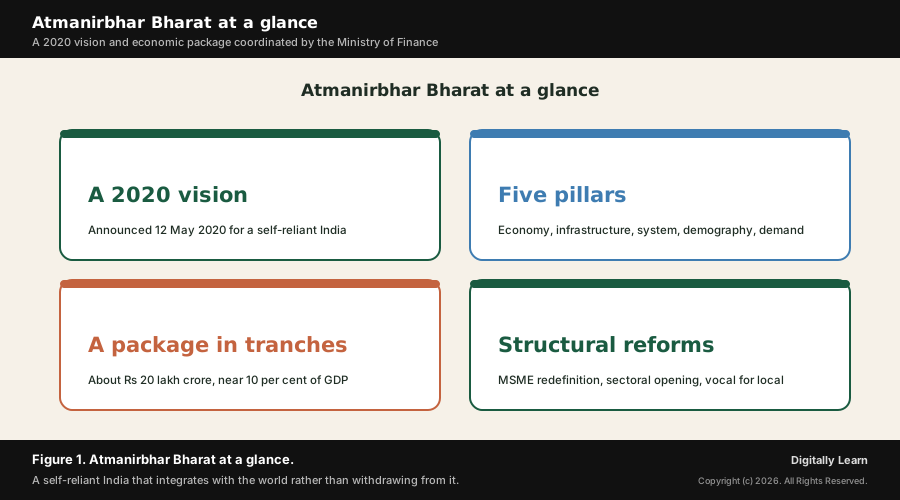
The most important idea to fix is what self-reliance means here. The government was explicit that Atmanirbharta does not mean turning inward: it is not protectionist, not exclusionist and not isolationist. The stated aim is the opposite, to make India a larger and more important part of the world economy by becoming more capable at home and more competitive abroad, so self-reliance is pursued through global integration rather than against it.
This reading separates the mission from the old idea of import substitution and self-sufficiency behind high walls that India tried in earlier decades. The slogan vocal for local captures the spirit: back Indian products and Indian makers, but help those local products become global, so that domestic capability and world markets reinforce each other instead of pulling apart.
The mission is coordinated by the Ministry of Finance, whose Finance Minister set out the detailed measures, while the wider vision was given by the Prime Minister and carried by many ministries. The package is best understood not as one scheme but as an umbrella of relief, liquidity and structural reform delivered together, which the figure above sets out in outline.
The Five Pillars: Economy, Infrastructure, a Technology-Driven System, Vibrant Demography and Demand
The economy as a quantum jump, infrastructure as the identity of India, a 21st-century system, demography as energy and demand as strength
The vision rests on five pillars, the load-bearing columns the Prime Minister named for a self-reliant India. The first pillar is the economy, but an economy that takes a quantum jump rather than an incremental change, growing fast enough to lift incomes and absorb a young workforce.
The second pillar is infrastructure, of a kind modern enough to become the very identity of India, since reliable roads, power, ports and digital networks are what let firms compete and let reforms reach the ground. The third pillar is the system, a 21st-century, technology-driven set of governance arrangements, so that the state delivers through modern, digital and rule-based methods rather than old and discretionary ones.
The fourth pillar is vibrant demography, India's large and youthful population, treated as the source of energy for a self-reliant nation if it is skilled and employed. The fifth pillar is demand, the idea that the strength of the country's own demand and its supply chains should be put to full use, with Indian production meeting Indian consumption and then reaching beyond.
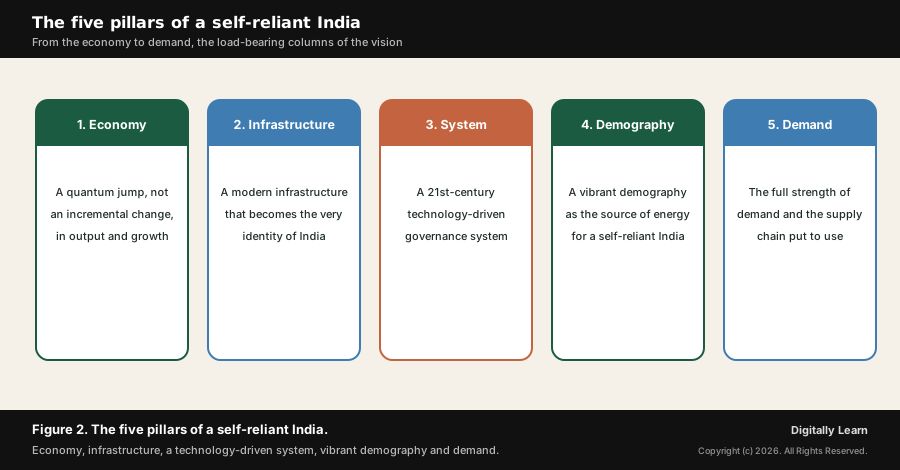
Read together, the five pillars set the frame rather than the detail: they say a self-reliant India needs a fast-growing economy, world-class infrastructure, a modern governance system, a productive young population and strong, well-used demand. Why this matters is that the package and the reforms that followed are best understood as attempts to build these five columns, and the figure above names each one with what it stands for.
The Five Tranches of the May 2020 Package: From MSME Relief to Government and Public-Sector Reforms
Businesses and MSMEs, the poor and migrants, agriculture, new horizons of structural reform, and government and PSU reforms
The Finance Minister set out the detailed package in a series of press conferences from 13 to 17 May 2020, organised as five tranches, each aimed at a different part of the economy. The first tranche was for businesses, especially MSMEs, and carried collateral-free loans for small firms, equity support, and the new definition of a micro, small or medium enterprise that this article explains below.
The second tranche reached the poor, migrant workers and small farmers, with measures such as free food grain for the vulnerable, working credit for street vendors and support for small and marginal farmers, so that the relief was not only for firms but for the people hit hardest by the lockdown. The third tranche was for agriculture, funding farm-gate infrastructure and, alongside it, the marketing and law reforms meant to free farm trade.
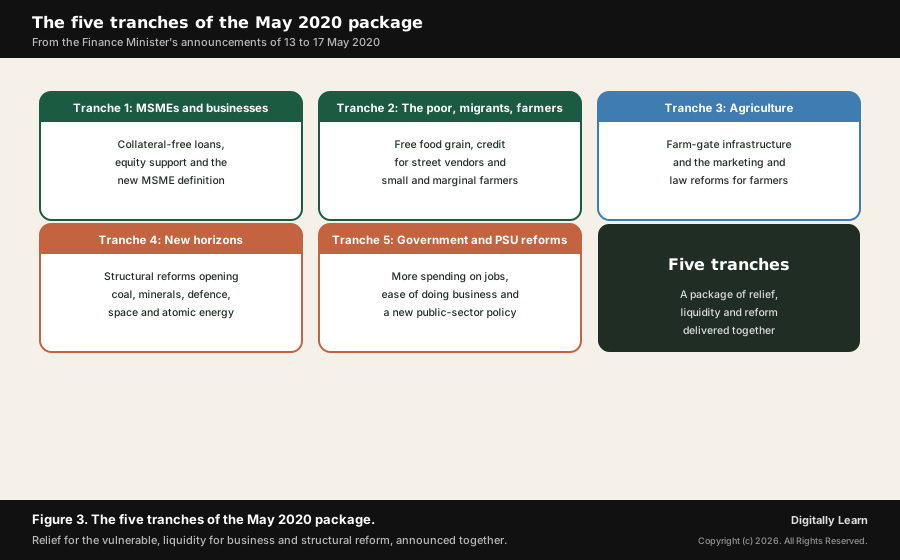
The fourth tranche, titled new horizons of growth, was the most structural: it opened several sectors to greater private participation and competition, including coal and minerals, defence production, civil aviation, the power sector, space and atomic energy. The fifth and final tranche covered government and public-sector reforms, with more spending on employment, steps to ease doing business, support to the states and a new policy on the role of public-sector enterprises.
Taken together, the five tranches show the package's logic: immediate relief for the vulnerable, liquidity and credit for businesses to survive, and structural reform to grow stronger afterwards. Why this matters for the exam is that the package was not a single cheque but a layered mix of relief, credit and reform, and the table below sets each tranche beside what it carried.
| Tranche | Who it was for | What it carried |
|---|---|---|
| Tranche 1 | Businesses and MSMEs | Collateral-free loans, equity support and the new MSME definition |
| Tranche 2 | The poor, migrants and small farmers | Free food grain, credit for street vendors and support for small farmers |
| Tranche 3 | Agriculture | Farm-gate infrastructure and the agriculture-marketing and law reforms |
| Tranche 4 | New horizons of growth | Structural reforms opening coal, defence, civil aviation, power, space and atomic energy |
| Tranche 5 | Government and public-sector reforms | More spending on jobs, ease of doing business, support to states and a new public-sector policy |
Each tranche maps onto the five pillars: the business and agriculture measures feed the economy and demand, the sectoral opening builds infrastructure and capacity, and the governance steps build the system. The detail of how much was fresh fiscal spending and how much was liquidity is taken up in the critiques section below.
The New MSME Definition: A Composite Investment-and-Turnover Test for Micro, Small and Medium Enterprises
From an investment-only test to a higher composite ceiling identical for manufacturing and services
The single most-cited structural reform in the package is the new definition of an MSME, the micro, small and medium enterprise. To see why it mattered, hold the old test first. Under the MSMED Act of 2006, a firm was classified only by its investment in plant and machinery, with separate, lower thresholds for manufacturing and for services, and the medium-enterprise ceiling sat at a modest level.
That old test had a perverse effect: a small firm that grew, or that bought better machines, could cross the ceiling and lose its MSME benefits, so the rule quietly discouraged firms from expanding and from investing in productivity. It also treated a manufacturer and a service firm differently for no strong reason.
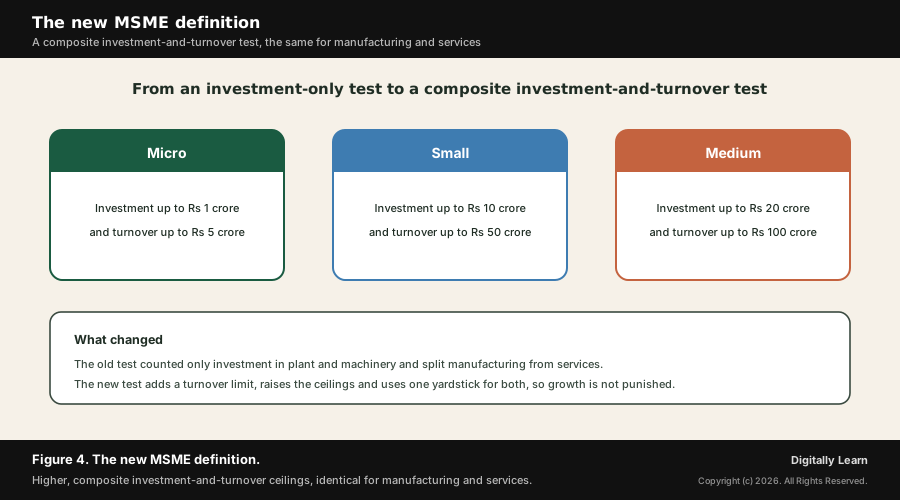
The Atmanirbhar package replaced it with a composite test that uses both investment and annual turnover, raises the ceilings, and applies the same yardstick to manufacturing and to services. The new norms took effect from 1 July 2020.
Under the revised norms a micro unit is one with investment up to Rs 1 crore and turnover up to Rs 5 crore. A small unit is one up to Rs 10 crore of investment and Rs 50 crore of turnover, and a medium unit one up to Rs 20 crore of investment and Rs 100 crore of turnover.
Why this matters is twofold. The higher, growth-friendly ceilings let a successful firm scale up without abruptly losing support, which addresses the long-standing problem of Indian small firms staying small. And by widening the band, the change brought many more enterprises within reach of MSME schemes and of priority-sector bank credit, on which the linked exam question below turns.
Agriculture-Marketing, Labour and Sectoral Reforms: The Deeper Changes and Their Later Status
The farm-marketing ordinances, the four labour codes and the opening of coal, defence, space and atomic energy, with their accurate later status
Beyond the MSME redefinition, the package carried three further families of reform, and the exam value lies in stating their later status accurately rather than as they stood in May 2020. The first family is the agriculture-marketing reform. In 2020 the government brought in ordinances, later passed as the three farm laws, to let farmers sell outside the regulated market yards, to enable contract farming and to ease stock limits.
Their fate is part of the story. After sustained farmer protests, all three farm laws were repealed in 2021, so a careful answer presents the agriculture-marketing reform as one that was enacted and then withdrawn, not as settled law. The second family is labour reform: the consolidation of many central labour statutes into four labour codes, on wages, industrial relations, social security and occupational safety.
Here too the status must be exact. The four codes were enacted, but their rules and full coming-into-force were staggered and rolled out over the following years rather than switched on at once, so the codes should be described as passed but phased in, with implementation continuing after 2020. The third family is the sectoral opening, the structural heart of the fourth tranche.
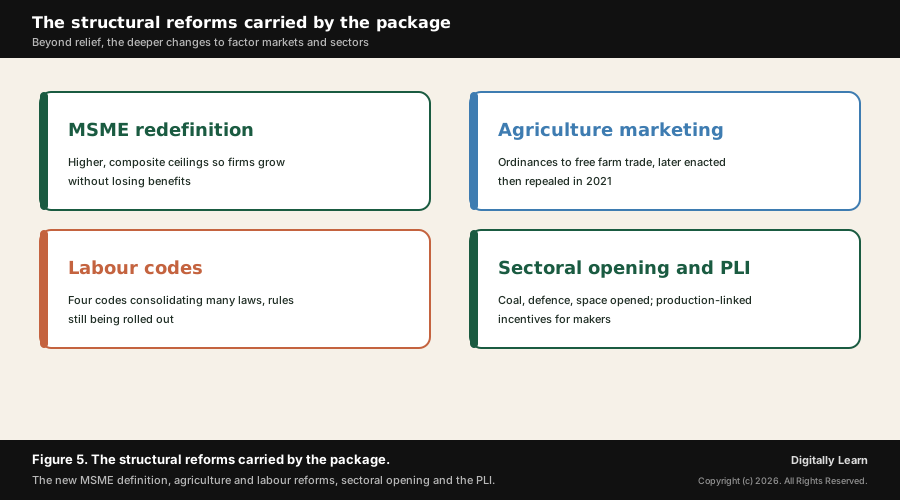
The sectoral reforms opened areas long dominated by the state to greater private participation and competition: commercial coal mining on a revenue-sharing basis, a higher role for private firms and indigenisation in defence production, the entry of private players into the space sector, and a wider role in atomic energy and the power and civil-aviation sectors. The aim was to raise investment and capability in sectors central to a self-reliant economy.
Running through all of these is the link to the production-linked incentive scheme and to Make in India, treated in their own articles. The PLI offers makers an incentive tied to extra output in chosen sectors, and it is the chief instrument through which vocal for local and the manufacturing pillar were given money and method, so the structural reforms here and the PLI form one connected push for domestic capability that still trades with the world.
Vocal for Local, the Production-Linked Incentives and the Link to Make in India
Backing local products for global markets, the PLI as the manufacturing instrument and the Make in India lineage
The popular face of the mission is the slogan vocal for local, the call to take pride in and buy Indian products. Read carefully, it is not a call to shun imports behind a wall; the fuller phrase is to be vocal about local products and to help them become global, so the slogan is about building Indian brands strong enough to export, not about closing the market.
The serious economic instrument behind that slogan is the production-linked incentive scheme, covered in its own article and referenced here as one link. A PLI pays a manufacturer an incentive calculated on its extra production in a chosen sector, which is meant to draw both Indian and foreign firms to make goods in India at scale, raise exports and reduce dependence on imports in areas such as electronics and pharmaceuticals.
This connects Atmanirbhar Bharat to the older Make in India initiative of 2014, also its own article. Make in India set the goal of raising manufacturing's share of the economy and making India a manufacturing hub, and Atmanirbhar Bharat can be read as its deepening under the pressure of the pandemic, adding money through the PLI and a sharper case for resilient supply chains after global chains broke in 2020.
Why this matters is that vocal for local, the PLI and Make in India together show the mission's true shape: an attempt to make India a maker as well as a market, integrated with global value chains rather than walled off from them. The semiconductor and chip-making push, also a separate article, is one prominent example of this manufacturing strategy in a strategic sector.
Outcomes and Assessment: Liquidity Delivered, Reforms Mixed and Growth Recovered
The credit and food-relief that reached firms and the poor, the uneven fate of the reforms and the qualitative recovery
Any honest assessment separates what the package delivered from what remains contested. The clearest delivery was in credit and relief. The flagship credit line for small firms channelled collateral-free loans to a very large number of MSMEs and other businesses, and the free food-grain support reached hundreds of millions of vulnerable people through the public distribution system, so the immediate liquidity and survival goals were substantially met.
The exact rupee totals of loans guaranteed, beneficiaries fed and incentives disbursed move across official reports and vintages, so this section keeps them qualitative rather than fixing a single figure. The direction, however, is not in doubt: a large volume of cheap, guaranteed credit reached small business, and a wide net of food relief reached the poor, in the worst months of the crisis.
The reforms had a more mixed fate, which a balanced answer states plainly. The MSME redefinition took hold and is now the settled classification. The sectoral openings in coal, defence and space have advanced, and the labour codes are being phased in. The farm laws, by contrast, were repealed in 2021, so the agriculture-marketing leg of the reform agenda did not survive.
On the wider economy, the recovery after the deep contraction of 2020 was real but is best read as the product of many forces, the package among them, rather than of this package alone. Why this matters is that the package's record is genuinely uneven: strong on liquidity and relief, partial on structural reform, and that mixed picture is exactly what the independent critiques below probe.
The Critiques and Debates: Fiscal Size, the Demand Gap, Protectionism and Implementation
How much was new fiscal stimulus, the demand-side gap, the self-reliance-versus-protectionism question and the reform and federalism friction
A balanced reading sets the gains against four critiques, presented here as they are argued by independent economists and analysts rather than as settled fact. The first and most discussed concerns the size of the fiscal stimulus. Critics pointed out that although the headline package was put at about 10 per cent of GDP, a large part of it was liquidity and credit provided by the central bank and through guarantees, not direct government spending.
On these estimates the genuinely new fiscal outlay was a much smaller share of the economy, with several analysts placing the direct fiscal impulse at only a low single-digit fraction of GDP. The government's answer was that combining fiscal and monetary measures was the right design and that other countries did the same; the debate is over whether the spending was large enough, not over the arithmetic.
The second critique follows from the first and concerns the demand-side gap. Because so much of the package worked through credit, critics argued it helped firms borrow but did less to put money directly into people's hands to spend, at a time when collapsing demand was the binding problem, so a more cash-transfer-heavy package might have revived consumption faster.
The third debate is over self-reliance versus protectionism. While the government framed Atmanirbharta as outward-looking, some economists warned that pairing it with higher tariffs on certain imports risked sliding towards the very import-substitution the mission claimed to reject, and that genuine competitiveness comes from openness, not from shielding domestic firms. Supporters reply that selective support for nascent industries is standard and is matched by export ambition.
The fourth cluster is about implementation and federalism. The reforms that needed the states or that touched their subjects, above all the farm laws, ran into friction, and the repeal of those laws is read by critics as a lesson in reforming without consultation. On the central question, whether Atmanirbhar Bharat was a turning point or an overstated package, a careful answer treats the matter as open and weighs both the delivered relief and the uneven reform record.
Understanding the Significance: Crisis Response, Structural Reform and a Redefined Self-Reliance
A lifeline in the pandemic, a vehicle for factor-market reform and a new, outward-looking idea of self-reliance
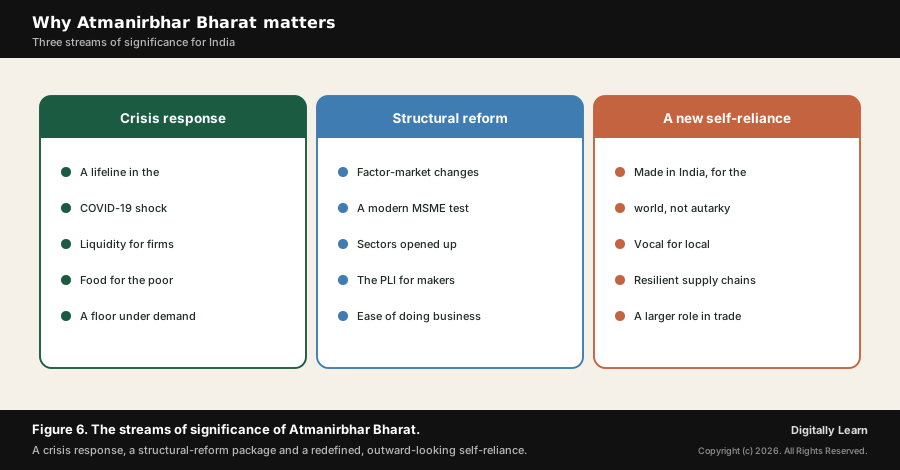
What is the significance of Atmanirbhar Bharat lies first in its role as a crisis response. In the worst economic shock in decades, it put a floor under collapsing firms and households through guaranteed credit and food relief, and it gave the country a single, confidence-building narrative at a moment of fear, which in itself had value beyond the rupees spent.
Its second significance is as a vehicle for structural reform. Bundled into a relief package were changes to factor markets and sectors that governments often find hard to make in normal times: the modern MSME definition, the opening of coal, defence and space, the labour-code consolidation and the attempted farm-marketing reform. Whatever their mixed fate, these mark Atmanirbhar Bharat as more than a stimulus, a piece of reform attempted under cover of crisis.
Its third and most lasting significance is conceptual: it redefined self-reliance for India. By insisting that self-reliance means becoming a stronger, more competitive part of the world economy, integrated through trade and investment rather than withdrawn behind walls, it broke with the older autarkic idea and tied national strength to global engagement, supply-chain resilience and the ambition to make for the world.
Read together, the crisis response, the reform vehicle and the new self-reliance are why Atmanirbhar Bharat is treated as a landmark in recent economic policy, and the figure above maps these three streams, even as its critics keep the question of its real impact honestly open.
The Way Forward: Deepening Reform, Closing the Demand Gap and Genuine Competitiveness
Carrying the surviving reforms through, supporting demand and pursuing self-reliance through openness rather than protection
The way forward follows from the critiques. The first priority is to carry the surviving reforms through: to bed down the labour codes with their rules, to sustain the sectoral openings in coal, defence and space, and to revisit farm-marketing reform through genuine consultation with farmers and states so that a needed change is not lost to the manner of its making.
The second priority is to support demand alongside supply. Since the sharpest criticism was that a credit-heavy package did too little for consumption, a durable recovery asks for steps that put money into the hands of those who will spend it, through employment, transfers and public investment, so that the supply-side reforms meet matching demand rather than idle capacity.
The third priority is to make self-reliance rest on competitiveness rather than protection. The lasting test of Atmanirbhar Bharat is whether Indian firms become good enough to win in open markets, which argues for skills, infrastructure, ease of doing business and selective, time-bound support that tapers, not for permanent tariff walls that breed inefficiency.
Pursued together, these measures would move the mission towards its own stated promise: not a closed economy, but a capable and confident one that makes more at home, trades more with the world, and reaches its young people with the jobs that a self-reliant India is meant to create.
UPSC Relevance and Exam Focus
Where Atmanirbhar Bharat fits in the UPSC-CSE syllabus
This topic maps most directly to General Studies Paper III: the Indian economy, mobilisation of resources, growth and development; and government budgeting and policies for various sectors, since Atmanirbhar Bharat is a major economic package and reform agenda whose design, delivery and limits are routinely examined.
It also links to General Studies Paper III on industrial policy, growth and employment, and on liberalisation and its effects on the economy, where the MSME redefinition, the production-linked incentives and the self-reliance-versus-openness debate are core themes, and it supplies rich material on the trade-off between relief and reform in a crisis.
For Prelims, hold the high-yield facts about the mission, its package and its reforms. The list below sets out the points most often tested, from the launch and the coordinating ministry to the five pillars, the five tranches and the new MSME definition, so an aspirant can revise them at a glance before moving to the Mains framing.
- A 2020 vision and package: Announced 12 May 2020, coordinated by the Ministry of Finance, with a headline of about Rs 20 lakh crore, near 10 per cent of GDP, combining fiscal, monetary and earlier measures.
- Five pillars: Economy, infrastructure, a 21st-century technology-driven system, vibrant demography and demand.
- Five tranches: Businesses and MSMEs, the poor and migrants and farmers, agriculture, new horizons of structural reform, and government and public-sector reforms.
- The new MSME definition: A composite investment-and-turnover test with higher ceilings, identical for manufacturing and services.
- Self-reliance as openness: Not protectionist or isolationist; vocal for local, with the PLI and Make in India as the manufacturing link.
For Mains, the recurring framing is to assess whether Atmanirbhar Bharat made India genuinely more self-reliant and competitive: how the pillars and tranches set the design, how the structural reforms changed factor markets and sectors, and how far the fiscal-size, demand-gap, protectionism and implementation critiques limit the claim.
A strong answer treats the mission as a case study in crisis-era reform and self-reliance, weighing its real delivery in credit and relief and its lasting MSME and sectoral reforms against the open questions of stimulus size, demand support and the repealed farm laws. The points below name the concepts that recur across the economy papers.
- Self-reliance through global integration: The idea that national economic strength comes from being a stronger, more competitive part of the world economy, not from withdrawing from it.
- The composite MSME definition: The investment-and-turnover classification that lets small firms grow without abruptly losing benefits, central to formalisation and credit.
- Production-linked incentives and vocal for local: The output-linked subsidy and the slogan through which the manufacturing pillar and Make in India were funded and pushed.
- Fiscal versus liquidity stimulus: The distinction between direct government spending and central-bank liquidity and guarantees, on which the size-of-package debate turns.
A common Prelims trap is to confuse the package's parts; hold that Atmanirbhar Bharat is coordinated by the Ministry of Finance, that the headline figure combines fiscal, monetary and earlier measures, that the farm laws were repealed in 2021 while the MSME redefinition stands, and that the PLI, Make in India and the semiconductor push are linked instruments rather than the umbrella mission itself.
A common Mains trap is to list the five pillars and five tranches and stop there. The exam value lies in a balanced judgment: the genuine relief and the lasting MSME and sectoral reforms set honestly against the smaller-than-headline fiscal stimulus, the demand-side gap and the reforms, above all the farm laws, that did not survive.
Previous Year UPSC-CSE Questions By the end you will be able to draft model answers for the following UPSC questions. Each question carries a collapsible framework showing how to approach it in the exam.
- UPSC Prelims 2023 GS Paper IConsider the following statements with reference to India :
- According to the 'Micro, Small and Medium Enterprises Development (MSMED) Act, 2006', the 'medium enterprises' are those with investments in plant and machinery between Rs 15 crore and Rs 25 crore.
- All bank loans to the Micro, Small and Medium Enterprises qualify under the priority sector.
Which of the statements given above is/are correct?
How to approach this Prelims question
Approach: Read the question against the old MSMED-2006 definition and the priority-sector rule. Statement 1 is incorrect: under the original Act of 2006 a medium enterprise was classified by investment in plant and machinery alone, with a modest ceiling, not the Rs 15 crore to Rs 25 crore band stated; the much higher composite ceilings came only with the Atmanirbhar Bharat redefinition of 2020. Statement 2 is correct: bank loans to micro, small and medium enterprises qualify under the priority sector, which is exactly why widening the MSME definition extended priority-sector credit to many more firms. Hence the answer is statement 2 only.
Trap to watch: The trap is to assume the high investment figure quoted for the medium-enterprise band describes the 2006 Act, when in fact the old Act used a far lower, investment-only ceiling and it was the 2020 Atmanirbhar redefinition that raised the limits and added turnover; mixing the new ceilings into the old definition makes statement 1 look right.
Key facts to recall:
- Under the original MSMED Act of 2006 a firm was classified only by investment in plant and machinery, with a modest medium-enterprise ceiling, not Rs 15 crore to Rs 25 crore.
- The Atmanirbhar Bharat redefinition of 2020 introduced a higher composite investment-and-turnover test, identical for manufacturing and services.
- Bank loans to micro, small and medium enterprises qualify under the priority sector, so the wider definition extended priority-sector credit to many more firms.
Answer signal: The giveaway is that the high Rs 15 crore to Rs 25 crore band belongs to no version of the medium-enterprise definition, so statement 1 is false while the priority-sector statement is true, making the answer statement 2 only.
Relevance to this topic. The new MSME definition is one of the headline structural reforms of Atmanirbhar Bharat, so a question on the MSMED Act classification and on priority-sector credit for MSMEs tests the very concept this article explains, the move from the old investment-only test of 2006 to the composite investment-and-turnover test that the package introduced.
Sources and Further Reading
- Press Information Bureau: PM gives a clarion call for Atmanirbhar Bharat and lays down the five pillars
- Press Information Bureau: Finance Minister announces new horizons of growth, structural reforms across sectors under Aatma Nirbhar Bharat
- Press Information Bureau: Ministry of MSME gears up to implement the new norms of classification of MSMEs
- Press Information Bureau: Aatma Nirbhar Bharat Package, progress so far
- Ministry of Finance: Atmanirbhar Bharat Package portal
- Reserve Bank of India: Frequently Asked Questions on Priority Sector Lending and MSME credit
- Department for Promotion of Industry and Internal Trade: Make in India and the manufacturing push
- Ministry of Labour and Employment: the four new Labour Codes
- Wikipedia: Atmanirbhar Bharat
- Wikipedia: Micro, Small and Medium Enterprises Development Act, 2006
Editorial Disclaimer
This briefing is for UPSC preparation. Verify the facts and figures against the official Ministry of Finance and Press Information Bureau sources before relying on them.


