


Overview
India's First Underground Mine
Production began in May 2026 in Madhya Pradesh, marking the first underground mine under India's commercial coal auction regime.
Commercial coal mining in India refers to the post-2020 regime under which private companies bid for coal blocks at competitive auction, mine the coal, and sell it on the open market without end-use restriction. The Coal Mines (Special Provisions) Amendment Act, 2020 ended Coal India Limited's nationalised monopoly on commercial coal production. The Urtan mine in Anuppur district, Madhya Pradesh, and the Dhirauli mine in Singrauli district, Madhya Pradesh, started commercial production in May 2026, with Urtan being the first underground mine under the auction regime.
Why this is in the news in May 2026
Production starts at Urtan and Dhirauli
The Ministry of Coal announced in May 2026 that commercial production has commenced at two new coal mines in Madhya Pradesh. Production at Urtan in Anuppur district began on 15 May 2026, and production at Dhirauli in Singrauli district began on 17 May 2026. The mines were allocated to M/s JMS Mining Private Limited (Urtan) and M/s Mahan Energen Limited (Dhirauli) under the post-2020 commercial-auction regime.
Urtan is notable as the first underground coal mine to commence production under the commercial-auction regime. The earlier batches of commercial-auction mines, since the regime opened in 2020, had all been open-cast mines. Underground mining requires shaft sinking, mechanised face equipment, and ventilation engineering that raise the capital threshold and the development time. Urtan's commencement signals that the auction regime is now financing the technically harder underground category.
Definition: Commercial coal mining in India refers to the post-2020 regime under which private companies bid for coal blocks at competitive auction, mine the coal, and sell it on the open market without end-use restriction. The Coal Mines (Special Provisions) Amendment Act, 2020 ended Coal India Limited's nationalised monopoly on commercial coal production. The regime is administered by the Ministry of Coal through the Nominated Authority who conducts the auctions.
Why these mines matter for India's coal sector
The commercial-mining reform in operational terms
Why it matters: The commercial coal mining reform of 2020 broke a five-decade Coal India Limited monopoly that the Coal Mines (Nationalisation) Act of 1973 had created. The reform's stated objective was threefold: to raise domestic coal output and reduce import dependence, to introduce competition in a sector that nationalisation had insulated, and to channel private capital into a capital-intensive industry that the public sector alone could not finance at scale. Urtan and Dhirauli are recent operational instances of the reform delivering output.
The technical significance of underground mining matters because India's underground reserves are deep and difficult, while the open-cast share of national production is heavily concentrated in fewer, easier seams. Coal India's underground share has fallen below 5 per cent of total output over the past decade. Urtan represents private-sector capital flowing into the harder mining category, which the commercial-auction regime now incentivises through end-use freedom and on-market pricing.
Significance for India's energy and mining policy
The significance of this milestone
What is the significance of this issue: The dual commencement matters across three policy domains. The first is energy security: India imported roughly 250 million tonnes of coal in recent years even while domestic production crossed 900 million tonnes, and reducing the import share requires expanded indigenous capacity of which the commercial-auction mines are now a growing component. The second is mining-sector reform: the regime extends competition into a sector that the Coal Mines (Nationalisation) Act of 1973 had closed, completing a reform trajectory that the Mines and Minerals (Development and Regulation) Amendment Acts of 2015, 2020, and 2023 also advance. The third is the transition trade-off: every additional tonne of domestic coal capacity must coexist with India's renewable-energy expansion and the Nationally Determined Contributions under the Paris Agreement.
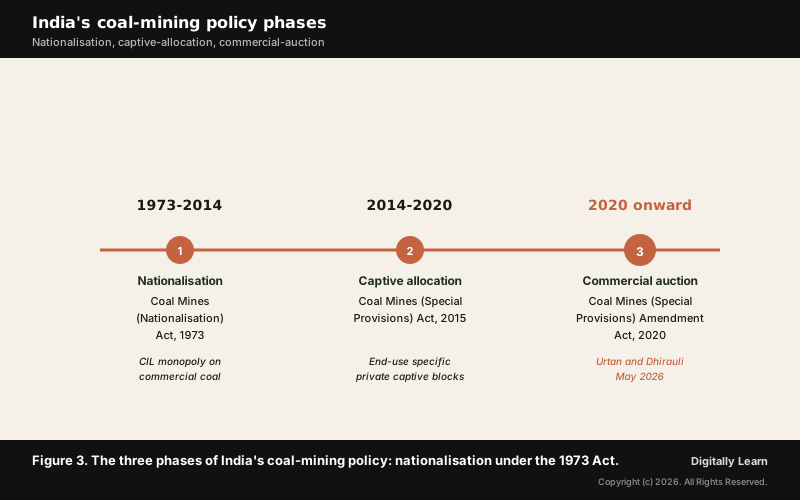
Structural reading: India's coal-mining reform has followed three sequential phases. The nationalisation phase from 1973 to 2014 vested commercial production in Coal India Limited and its subsidiaries. The captive-mining phase from 2014 to 2020 allowed end-use specific captive blocks following the Supreme Court's 2014 allocation cancellations. The commercial-auction phase from 2020 onwards removes the end-use restriction, opens competitive bidding to any Indian private entity (with foreign-investment provisions), and allows on-market sale of mined output.
Distinguishing features of the two mines
What makes the Urtan-Dhirauli launch a turning point
Distinguishing features: Three features distinguish the Urtan-Dhirauli commencement from earlier commercial-auction commissionings.
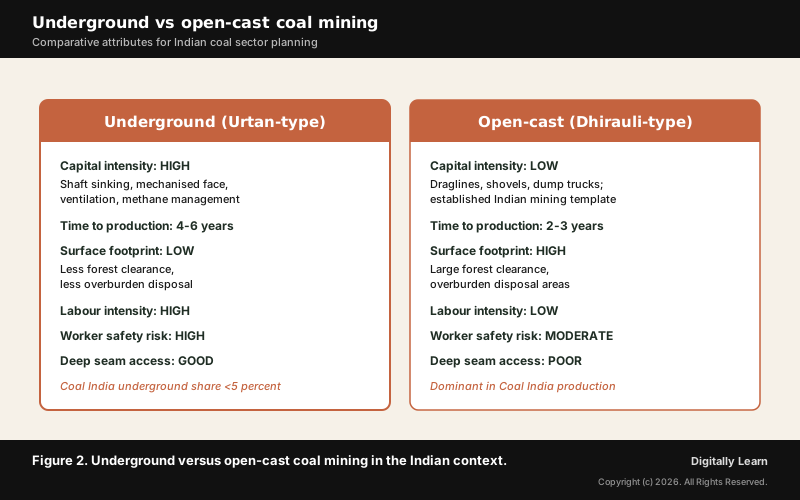
- (i) First underground commercial mine. Urtan is the first underground coal mine to start production under the commercial-auction regime. The technical challenges of shaft sinking, mechanised face equipment, ventilation, and methane management make underground mining capital-intensive and slow to commission. Underground operations now access the deeper Gondwana coal seams that surface mining cannot economically extract.
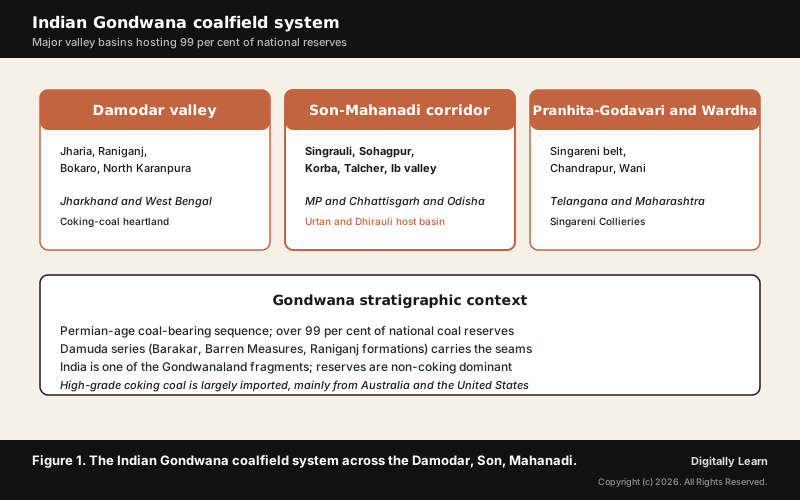
- (ii) Gondwana coalfield concentration. Both mines sit within the Indian Gondwana sequence, which accounts for over 99 per cent of national coal reserves. The Singrauli coalfield (Dhirauli) and the Sohagpur coalfield (Urtan, in the Anuppur district) are part of the Damodar-Son-Mahanadi-Pranhita-Godavari Gondwana basin chain that runs across central and eastern India.
- (iii) Madhya Pradesh as a commercial-mining frontier. Madhya Pradesh is a leading state in coal-block awards under the commercial-auction regime, with Singrauli and Sohagpur coalfields both contributing. The dual commissioning in May 2026 reinforces the state’s position in the new architecture alongside Jharkhand, Chhattisgarh, and Odisha.
The Urtan and Dhirauli underground-mine commencement in numbers
| Mine attribute | Urtan | Dhirauli |
|---|---|---|
| District | Anuppur, Madhya Pradesh | Singrauli, Madhya Pradesh |
| Coalfield | Sohagpur (Gondwana sequence) | Singrauli (Gondwana sequence) |
| Mine type | Underground | Open-cast |
| Production-start date | 15 May 2026 | 17 May 2026 |
| Allottee | JMS Mining Private Limited | Mahan Energen Limited |
| Regime | Commercial-auction (post-2020) | Commercial-auction (post-2020) |
| Significance | First underground commercial mine under the regime | Adds capacity to the Singrauli supply chain |
Observable outcomes to track over the next eighteen months
What to watch through the next coal-auction cycle
Observable outcomes: Six outcomes connect the May 2026 commencement to the broader commercial-mining trajectory.
- (a) Annual output from the two mines. Combined annual tonnage from Urtan and Dhirauli at full ramp-up; baseline against the 2026-27 commercial-mine output total.
- (b) Underground share of commercial-auction output. The proportion of total commercial-auction production that comes from underground mines; baseline against Coal India Limited’s declining underground share.
- (c) Coal import substitution. Year-on-year change in coking and non-coking coal imports as a function of expanding commercial-auction output.
- (d) Coal-block auction velocity. Number of commercial blocks auctioned per annum and the share of successful blocks reaching production within the contracted timeline.
- (e) Environmental-clearance throughput. Time from auction award to environmental clearance and to production; baseline of friction in the post-award implementation pathway.
- (f) State revenue from commercial coal. Madhya Pradesh’s revenue share from royalty, district mineral foundation contribution, and the auction-premium revenue under the new regime.
Contemporary linkages
Mining reform, energy transition, and just-transition policy
Contemporary linkages: Three threads connect the May 2026 commencement to wider Indian policy currents. The first is the mining-reform track: the commercial-auction regime under the Coal Mines (Special Provisions) Amendment Act, 2020 completes a sequence that the Mines and Minerals (Development and Regulation) Amendment Acts of 2015, 2020, and 2023 advance for non-coal minerals. The second is the energy-transition track: expanding coal capacity coexists uneasily with the 500-gigawatt-non-fossil-by-2030 target and with the Nationally Determined Contributions, and the trade-off is governed by the National Electricity Plan generation mix and the Production Linked Incentive for advanced chemistry cell storage. The third is the just-transition track: coal-dependent districts in Madhya Pradesh, Jharkhand, and Odisha face the long-term challenge of livelihoods transition, addressed in part through the District Mineral Foundation framework and the proposed Just Transition Mechanism.
UPSC Relevance
Where the commercial-mining milestone sits in the UPSC syllabus
UPSC context: The Urtan and Dhirauli commencement falls within General Studies Paper III under the syllabus heads on infrastructure, including energy, on indigenisation of technology and developing new technology, and on conservation, environmental pollution and degradation, environmental impact assessment. The topic also touches General Studies Paper I on distribution of key natural resources across the world (including South Asia and the Indian sub-continent).
Prelims relevance: The Prelims surface includes the Coal Mines (Nationalisation) Act, 1973 as the founding statute of public-sector dominance, the Coal Mines (Special Provisions) Act, 2015 that followed the 2014 Supreme Court cancellations, the Coal Mines (Special Provisions) Amendment Act, 2020 that opened commercial auctions, the location of the Singrauli and Sohagpur coalfields in the Gondwana sequence, the Damuda series stratigraphy carrying the Barakar formation that hosts the major seams, the Damodar, Son, Mahanadi, Pranhita-Godavari, and Wardha valleys as the major coal corridors, and the District Mineral Foundation framework that channels mining-royalty receipts to affected districts.
Mains relevance: The strongest Mains framing is the mining-reform-versus-energy-transition question: how does India scale up coal capacity through commercial auctions while simultaneously meeting its 500-gigawatt-non-fossil-by-2030 target. A second framing is the indigenisation-of-mining-technology question: how does the commercial-auction regime channel private-sector capital into underground mining, where Coal India's share has been falling, and what role do mechanised face equipment, long-wall mining technology, and methane management play. A third framing is the just-transition question: how do coal-dependent districts in Madhya Pradesh, Jharkhand, Chhattisgarh, and Odisha plan livelihoods transition over a multi-decade horizon.
Mains practice question: A focused fifteen-mark question would read: Examine the commercial coal mining reform of 2020 and its current state through the Urtan and Dhirauli commencement of May 2026. How does the regime fit within India's wider energy-transition strategy and the just-transition challenge? A well-constructed answer would treat the reform's three-phase trajectory, the underground-versus-open-cast technology shift, and the transition trade-off as the three spokes.
- Past Mains linkage. 2020 GS-III: Despite India being one of the countries of Gondwanaland, its mining industry contributes much less to its Gross Domestic Product (GDP) in percentage. Discuss. The commercial-auction regime is the operational response to that under-contribution; Urtan and Dhirauli are early outputs of the response.
- Past Mains linkage. 2018 GS-III: What are the impediments in disposing the huge quantities of discarded solid wastes which are continuously being generated? How do we remove safely the toxic wastes that have been accumulating in our habitable environment? Coal-mining overburden disposal, fly-ash management at coal-fired power plants, and abandoned-mine restoration sit within the same waste-management policy frame.
- Adjacent linkage. 2014 Prelims tested on coalfields and their states; the Singrauli (MP-UP border) and Sohagpur (MP) locations are recurring Prelims facts.
Previous Year UPSC-CSE Questions By the end you will be able to draft model answers for the following UPSC questions. Each question carries a collapsible framework showing how to approach it in the exam.
- UPSC Mains 2020 GS-IIIDespite India being one of the countries of Gondwanaland, its mining industry contributes much less to its Gross Domestic Product (GDP) in percentage. Discuss.
How to structure the answer in the exam
Introduction: Open with India's Gondwana stratigraphic inheritance (Damodar Valley coalfields, Son-Mahanadi corridor, Pranhita-Godavari belt), state the puzzle (mining contributes about 2 per cent of GDP), and frame the answer through four explanatory lenses ending in the commercial-auction reform.
Body (sub-themes to develop):
- Resource geography: Gondwana coal in the Damodar, Son, Mahanadi, Pranhita-Godavari, and Wardha valleys; iron-ore in Jharkhand, Odisha, Chhattisgarh, Karnataka, and Goa; bauxite in eastern Ghats; the relative paucity of high-grade ores compared with Australia and Brazil.
- Regulatory framework: Coal Mines (Nationalisation) Act 1973 created a five-decade CIL monopoly; Mines and Minerals (Development and Regulation) Amendment Acts of 2015, 2020, and 2023 progressively liberalised; Coal Mines (Special Provisions) Amendment Act 2020 opened commercial auctions.
- Ease-of-doing-business friction: forest-clearance overlays in resource-bearing districts; PESA 1996 interface; Forest Rights Act 2006; environmental-clearance bottlenecks.
- Global commodity-price exposure: coking coal imports from Australia and the United States; thermal-coal demand under the renewable-energy transition; the captive-mine model and the 2020 commercial-coal-block auctions.
- Commercial-auction regime operational outputs: Urtan (15 May 2026, first underground mine, Anuppur, Madhya Pradesh) and Dhirauli (17 May 2026, Singrauli, Madhya Pradesh) commencement as the May 2026 milestone in the post-2020 reform trajectory.
Conclusion: Conclude that the under-contribution puzzle reflects geological grade distribution, regulatory legacy, clearance friction, and commodity-price cyclicality together, but that the commercial-auction reform of 2020 is the operational mechanism through which the share of mining in GDP is now expected to rise, with Urtan and Dhirauli the most recent evidence of the regime delivering output.
Urtan and Dhirauli are the most direct illustration of the 2020 question's call to action. The three-phase reform trajectory covered earlier supplies the body sub-theme on the regulatory framework, and the Distinguishing-features discussion of the first-underground-mine milestone is the operational evidence the question asks examinees to cite.
- UPSC Mains 2018 GS-IIIWhat are the impediments in disposing the huge quantities of discarded solid wastes which are continuously being generated? How do we remove safely the toxic wastes that have been accumulating in our habitable environment?
How to structure the answer in the exam
Introduction: Open with the scale of India's solid-waste generation across municipal, industrial, mining, and toxic streams, name the four waste streams (municipal, hazardous, biomedical, mining and industrial), and frame the answer as stream-specific impediments and remediation.
Body (sub-themes to develop):
- Coal-mining overburden disposal: every tonne of open-cast coal extracted requires removal and storage of several tonnes of overburden; underground mining (Urtan-type) sharply reduces this footprint relative to open-cast (Dhirauli-type).
- Fly-ash management: coal-fired thermal power plants generate large fly-ash volumes; the Ministry of Environment, Forest and Climate Change fly-ash utilisation rules mandate 100 per cent utilisation, with cement, brick, and road construction as principal end-uses.
- Hazardous-waste disposal: Hazardous and Other Wastes (Management and Transboundary Movement) Rules, 2016; common treatment, storage, and disposal facilities.
- Abandoned-mine restoration: District Mineral Foundation and Pradhan Mantri Khanij Kshetra Kalyan Yojana frameworks for funding restoration of mined-out areas; the Coal India Limited mine-closure-plan obligation.
- Toxic-site remediation: the Polluter Pays principle in the M. C. Mehta line; National Green Tribunal directions on legacy industrial and mining sites.
Conclusion: Conclude that India's waste-management regime has matured on stream-specific rules but suffers from enforcement and infrastructure gaps, that the coal-mining expansion under the commercial-auction regime (Urtan and Dhirauli being May 2026 examples) introduces fresh overburden and fly-ash management challenges, and that the circular-economy framing including mine-restoration funds offers the most promising forward architecture.
Commercial coal mining expansion under the 2020 reform directly enlarges the overburden disposal and fly-ash management waste streams that the 2018 question targets. Urtan's underground design substantially reduces surface waste relative to open-cast, while Dhirauli's open-cast operation adds to the overburden disposal load. The body sub-theme on coal-mining overburden disposal supplies the operational connection from the 2018 framing to the article's evidence on mine-type comparison and the just-transition track.
Sources
- Coal Production commences from Urtan and Dhirauli Mines in Madhya Pradesh
- Coal Mines (Special Provisions) Amendment Act, 2020
- Coal India Limited
- Pradhan Mantri Khanij Kshetra Kalyan Yojana (PMKKKY) and District Mineral Foundation
- Central Mine Planning and Design Institute (CMPDI)
- Wikipedia: Coal mining in India
- First underground commercial coal mine begins production in Madhya Pradesh
Editorial Disclaimer
This article is compiled from the reference materials listed in the Sources section. It is an explainer for UPSC preparation and is not a substitute for primary documents (NCERTs, GoI ministry releases, IMD bulletins, RBI / CEA / MoEFCC publications, and Standing-Committee reports).


