


Overview
The 125-day guarantee that replaced MGNREGA
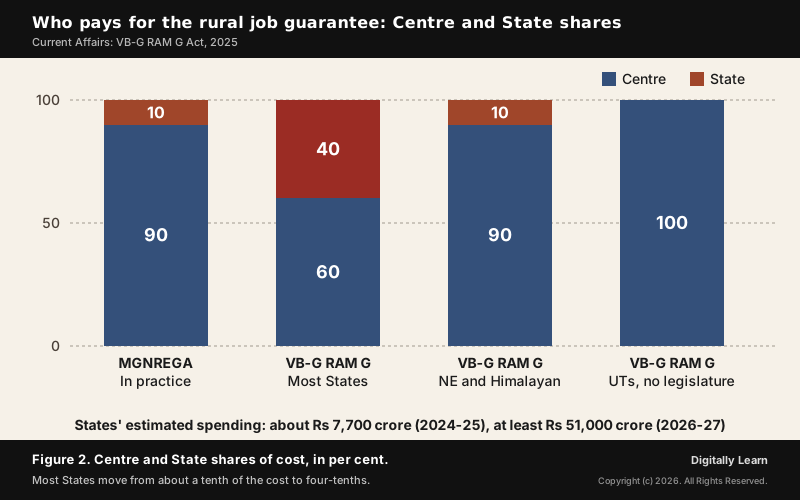
The VB-G RAM G Act, the Viksit Bharat-Guarantee for Rozgar and Ajeevika Mission (Gramin) Act, 2025, is the law that replaced MGNREGA on 1 July 2026. It guarantees 125 days of wage employment a year to every rural household whose adult members volunteer for unskilled manual work, is run by the States as a VB-G RAM G scheme with the cost shared 60:40 in most States, and funds each State through a normative allocation fixed by the Centre.
MGNREGA Replaced by the VB-G RAM G Act from 1 July 2026
Commencement, National Launch and the First Instalment
The national launch took place on 2 July 2026 at Mukkavaripalli village in Tirupati district, Andhra Pradesh. Rural Development Minister Shivraj Singh Chouhan and Chief Minister N. Chandrababu Naidu laid the foundation stone of a farm pond, launched the VB-G RAM G portal and handed out the first Gramin Rozgar Guarantee Cards, the new job cards. Until those cards reach every household, job cards of the old scheme that are verified by e-KYC remain valid.
Money followed in two steps. The Centre made an interim allocation of Rs 95,692.31 crore to States and Union Territories for 2026-27, the highest budget estimate ever for rural employment, and on 5 July released the first instalment, called the Mother Sanction, of Rs 25,863 crore. Uttar Pradesh received the most, Rs 3,210.76 crore, followed by Andhra Pradesh and Rajasthan. By the eve of the launch 24 States had notified their own VB-G RAM G schemes, as the Act requires each State to do.
From the December 2025 Bill to the Rules of 2026
The Bill was passed by Parliament in December 2025, and the President's assent was announced on 21 December 2025. The Rural Development Minister had said the switch would happen on 1 April 2026, but the Rules were not ready: draft VB-G RAM G Rules were released for public consultation only on 22 May 2026, final Rules came at the end of June, and the new wage rates were notified on 30 June. From April to June the old scheme continued by default.
States were divided. Punjab's Assembly passed a unanimous resolution against the Act in December 2025, yet the State notified its own VB-G RAM G scheme on 26 June 2026, ready for 1 July. A right to information reply showed that of the 13 States whose comments the Centre shared, Bihar, Madhya Pradesh and Jharkhand had asked it to reconsider the new funding pattern, five had asked for higher wages and four had objected to the pause in peak farming season.
VB-G RAM G Scheme Details: Key Provisions of the Act
The 125-Day Guarantee, the Fifteen-Day Rule and Unemployment Allowance
The core of the Act is Section 5(1): a statutory guarantee of not less than 125 days of wage employment in each financial year to every rural household whose adult members volunteer to do unskilled manual work. The entitlement belongs to the household and has no condition of caste or poverty line, as under the 2005 Act.
- Work on demand: When a worker asks for work, it must be given within 15 days; otherwise the State must pay an unemployment allowance. The Act removes the old grounds on which a worker could be disentitled from that allowance.
- Wages on time: Wages are to be paid every week, and in any case within 15 days of the work (Section 5(3)). For any delay beyond that, compensation is payable under Schedule II.
- Payment route: Wages go straight into workers’ bank accounts through the National Electronic Fund Management System and Direct Benefit Transfer, tracked on an online management information system.
- Wage rates: The Centre specifies the wage for unskilled manual work; until it did, the old rates applied.
Four Thematic Areas of Works and the Viksit Gram Panchayat Plan
Every day of work is meant to build a durable asset. Section 4(2), read with Schedule I, names four priority areas, and every asset created is entered in the Viksit Bharat National Rural Infrastructure Stack, a single national record of rural assets.
- Water security: Conservation structures, irrigation support, groundwater recharge, rejuvenation of water bodies, watershed development and afforestation.
- Core rural infrastructure: Rural roads, public buildings, school infrastructure, sanitation, renewable energy facilities and housing works under Central schemes.
- Livelihood infrastructure: Assets for agriculture, livestock, fisheries, storage, markets, skill development and the circular economy.
- Extreme weather works: Shelters, embankments, flood management, rehabilitation works and forest fire management.
Works come from a Viksit Gram Panchayat Plan (VGPP), prepared by the gram panchayat and approved by the Gram Sabha (Sections 4(1) to 4(3)). The planning starts with an inventory of every asset in the panchayat, mapped on Yuktdhara, the Indian Space Research Organisation's GIS planning portal, and on PM Gati Shakti, so that gaps can be identified; States may grade panchayats into categories and give more funds to those lagging behind. In August 2026 a parliamentary committee on forest fires recommended listing the collection of pine needles (pirul) as extreme-weather work under the Act.
The Sixty-Day Pause in Peak Agricultural Seasons
Section 6 is new. It lets each State notify in advance a period aggregating to 60 days in a financial year, covering peak sowing and harvesting, during which no work is undertaken under the Act. The aim is to keep labour available for farms at the busiest time; the 125-day guarantee is to be met in the rest of the year.
States may tailor the period to their own crop calendars and notify it district by district, or even for blocks and gram panchayats. Supporters see a better fit between public works and farming. Critics say the pause weakens workers' bargaining power just when farm wages are highest, and Punjab, which depends heavily on agriculture, was among the four States that objected.
Gramin Rozgar Guarantee Councils, Social Audit and Technology
The Act sets up a Central Gramin Rozgar Guarantee Council and State Councils to review and monitor implementation, and steering committees at both levels to advise on normative allocations and convergence. Sections 16 to 19 give the planning, implementation and monitoring roles to panchayats, Programme Officers and district authorities.
- Social audit: Section 20 strengthens social audits by Gram Sabhas, in which villagers check the records of works and payments in public.
- Technology: Sections 23 and 24 provide for biometric authentication, geo-tagging of works and real-time dashboards; face authentication of workers at the worksite is being enforced.
- Administrative cost: The ceiling on administrative expenditure rises from 6 to 9 per cent, and more than Rs 13,000 crore is earmarked for the salaries of Gram Rozgar Sahayaks, mates and other field staff.
- Relaxations: In natural calamities or extraordinary circumstances the Centre may relax the norms temporarily.
VB-G RAM G vs MGNREGA: What Changed in the Employment Guarantee
Demand-Driven Funding to Normative Allocation
Under MGNREGA the money followed the work: whatever workers demanded, the Centre funded its share. The new Act replaces this with a normative allocation (Sections 4(5) and 22(4)), a budget fixed by the Centre for each State every year on objective parameters set out in the Rules; the draft Rules proposed the parameters the 16th Finance Commission recommended for sharing taxes among States. Anything a State spends beyond its allocation, and the unemployment allowance and delay compensation, fall on the State.
| Feature | MGNREGA, 2005 | VB-G RAM G Act, 2025 |
|---|---|---|
| Days guaranteed | 100 a year per household | 125 a year per household |
| Coverage | All rural areas | Rural areas the Centre notifies; all notified from 1 July 2026 |
| Funding model | Demand-driven | Normative allocation fixed by the Centre |
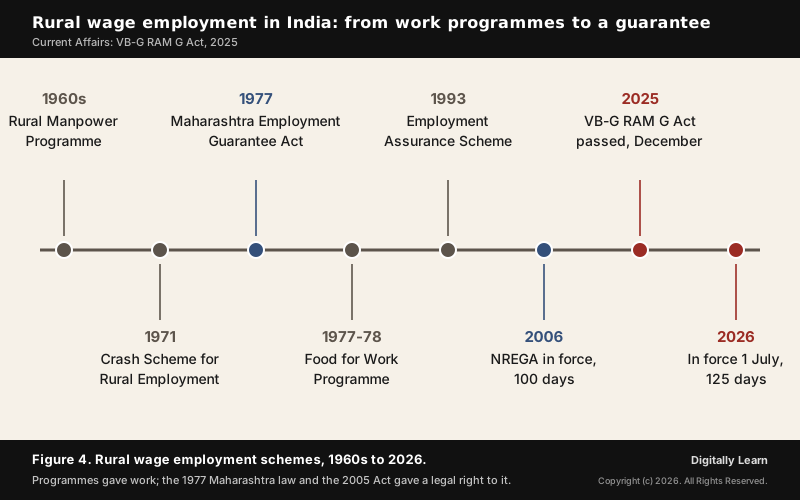
| Cost sharing | Centre: all wages, 75 per cent of materials (about 90:10) | 60:40; 90:10 in north-eastern and Himalayan States; Centre alone in UTs without a legislature |
| Pause | None | Up to 60 days in peak sowing and harvesting |
| Administrative ceiling | 6 per cent | 9 per cent |
| Planning | Gram panchayat plans | Viksit Gram Panchayat Plans linked to PM Gati Shakti |
The Government's case is predictability: a known budget, rule-based allocation and assets planned for saturation. Critics, from opposition parties to activists and economists, say a capped budget turns a demand-driven right into a supply-driven scheme, because when the State's money runs out, so does the work.
Wage Employment Programmes in India Before and After 2005
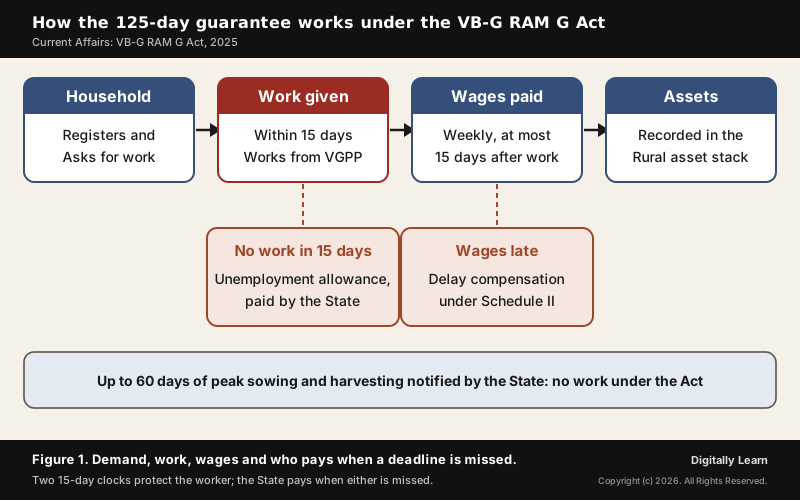
Public works for the rural poor are older than any guarantee. The Rural Manpower Programme of the 1960s and the Crash Scheme for Rural Employment of 1971 were followed by the Food for Work Programme of 1977-78. In the 1980s the National Rural Employment Programme and the Rural Landless Employment Guarantee Programme ran in parallel, and the Employment Assurance Scheme of 1993 offered work in the lean farm season.
None of these created a legal right. The first was the Maharashtra Employment Guarantee Act of 1977, which gave adult members of every rural household in the State a right to work. The national law came in 2005: the National Rural Employment Guarantee Act received assent on 5 September 2005, came into force on 2 February 2006 in 200 districts, and promised 100 days of work, with an unemployment allowance if the government failed to provide it.
Funding VB-G RAM G: 60:40 Cost Sharing, Wages and the Burden on States
The 60:40 Cost Sharing and State Spending
The Act is run as a Centrally Sponsored Scheme: the Centre and the States share the cost, and each State notifies and runs its own scheme within the Act. For 2026-27 the central share is Rs 95,692.31 crore; with the States' share the outlay is expected to exceed Rs 1.51 lakh crore, and the Centre has set a target of Rs 7.5 lakh crore over five years across 2.86 lakh gram panchayats.
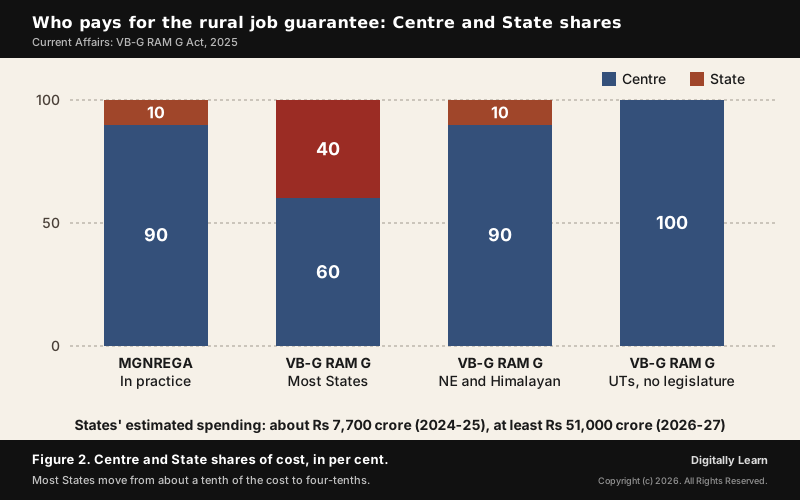
For most States the change is large. Under MGNREGA they paid about a tenth of the cost; now they pay four-tenths, plus any spending beyond the normative allocation. An estimate based on 2024-25 spending puts the States' share at no less than Rs 51,000 crore in 2026-27, against about Rs 7,700 crore in 2024-25, a rise of nearly 600 per cent; Uttar Pradesh, Tamil Nadu and Bihar face increases of 600 to 800 per cent. The Centre also owed States Rs 20,422 crore in pending dues for 2025-26.
Rs 300 Interim Base Wage and the New Wage Rates
The wage notification of 30 June 2026 introduced an interim base wage of Rs 300 a day: no notified wage may be lower. Before it, the lowest notified wage was Rs 241, and 21 States, Union Territories and administrative units have been brought up to the new floor. The national average notified wage rose from Rs 298.8 to Rs 327.4 a day, an increase of Rs 28.6, or more than 10 per cent.
- Largest gains: Arunachal Pradesh and Nagaland, nearly 24.5 per cent; Uttar Pradesh up Rs 48, Bihar Rs 45 and Madhya Pradesh Rs 39 a day.
- Above Rs 400: Haryana (Rs 409), Goa (Rs 406), Kerala (Rs 401) and high-altitude gram panchayats of Sikkim (Rs 450).
- Smallest gains: States already above Rs 300; Telangana rose by Rs 1, from Rs 307 to Rs 308.
The wage remains contested. An expert committee headed by Anoop Satpathy recommended a national minimum wage floor of Rs 375 a day in 2019, Bihar asked for Rs 413, and critics note that Rs 300 today is worth much the same as the old MGNREGA norm of Rs 100 a day at 2009-10 prices.
First Months of VB-G RAM G: Employment, e-KYC and Worker Records
Person-Days Generated in July and August 2026
A person-day is one person's work for one day, the standard measure of employment under the scheme. In its first month the new scheme generated 9.18 crore person-days, 48.01 per cent fewer than the 17.65 crore of July 2025. August was better, 11.03 crore against 12.12 crore, a fall of 9.01 per cent; over the two months the total fell 32.13 per cent, from 29.78 crore to 20.21 crore. The gap may be wider, as West Bengal, where the old scheme was frozen in 2022, generated no person-days in 2025.
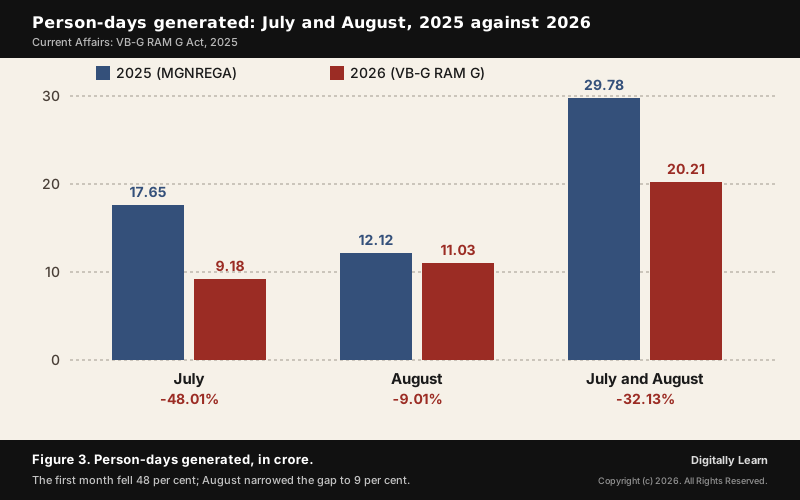
Officials said it was too early to judge and that the 60-day pause had cut work. Independent scholars traced the fall to the transition itself: from April to July, normally the peak months, the old and new schemes together generated only 70 crore person-days, against 128 crore and 119 crore in the same months of the two previous years, a fall of 43 per cent. In 10 of 19 major States the decline was 60 to 85 per cent, and work almost stopped in Madhya Pradesh, Uttar Pradesh and Jharkhand.
e-KYC, Face Authentication and the Fall in Registered Workers
Digital checks have shaped who stays on the rolls. In the fortnight after the switch, registered workers fell from 27 crore to 26.33 crore and active workers, those who had worked at least once in three years, from 10.84 crore to 10.57 crore. The Ministry disputed the reading, calling worker numbers a dynamic figure that changes as States update records. Researchers counted it as the fourth large fall in worker numbers to follow a digital rule, after Aadhaar-based payments in 2022-23, compulsory e-KYC in 2025 and face-recognition attendance in 2026.
By the end of August e-KYC had been completed for 15.89 crore workers, including 10.27 crore of the 10.84 crore active workers, about 95 per cent; that still left about 57 lakh active workers unverified. The Ministry then said that every registered MGNREGA worker had been carried over to VB-G RAM G, that pending e-KYC does not stop anyone from demanding or receiving work, and that about 2.11 crore workers had been offered employment.
Right to Work, Federalism and the Debate Over the New Law
Right to Work Under Article 41 and the Supreme Court Hearing
The Constitution's Article 41, a Directive Principle of State Policy, says the State shall, within the limits of its economic capacity and development, make effective provision for securing the right to work. In the Constituent Assembly K.T. Shah wanted it made a fundamental right; B.R. Ambedkar held that its immediate, universal enforcement was not fiscally or institutionally viable, so it was placed among the Directive Principles.
The question returned on 21 August 2026. A three-judge Bench led by Chief Justice Surya Kant, hearing a petition by Aruna Roy on delayed wages and compensation under MGNREGA, called the repealed scheme good and effective, "neither a freebie nor exploitation". Justice Joymalya Bagchi observed that the Constitution does not make the right to work a fundamental right, but treats it as an aspiration under Part IV. The Bench asked for a fresh petition examining the issues under the new law.
Arguments For and Against the VB-G RAM G Framework
- More days and better assets: 125 days instead of 100, works tied to four priority areas and one national asset stack, and convergence with other schemes through the village plan.
- Stronger administration: A 9 per cent ceiling to pay field staff, social audit, geo-tagging and biometric checks against fraud, and a wage floor of Rs 300.
- A capped right: Critics say normative allocation ends demand-driven funding, so the guarantee depends on a budget fixed in Delhi.
- Burden on States: States now fund 40 per cent, the unemployment allowance and delay compensation, which poorer States can least afford.
- Centralised planning: Activists describe GIS-led planning as top-down, and digital checks such as e-KYC and face authentication as barriers for the poorest workers.
VB-G RAM G Act for UPSC: GS Paper II and III Links
Where the VB-G RAM G Act Sits in the UPSC Syllabus
The Act belongs to General Studies Paper II, under welfare schemes for vulnerable sections and their performance, and under the issues of a federal structure, here the sharing of a scheme's cost between the Centre and the States. It reaches GS Paper III through inclusive growth and employment, and GS Paper IV through the probity of public programmes; state PCS papers ask the same facts.
- Prelims facts: 125 days; work within 15 days of demand; wages within 15 days; 60-day pause under Section 6; 60:40 and 90:10 sharing; Rs 300 interim base wage; in force from 1 July 2026; MGNREGA in force from 2 February 2006; Article 41.
- Mains analysis: Demand-driven against normative funding, fiscal federalism and Centrally Sponsored Schemes, the right to work, digital governance and exclusion, social audit.
- Current data: Person-days in July and August 2026, e-KYC coverage, the Supreme Court hearing of 21 August 2026.
Previous Year UPSC-CSE Questions By the end you will be able to draft model answers for the following UPSC questions. Each question carries a collapsible framework showing how to approach it in the exam.
- UPSC Mains 2013 GS-IIThe Central Government frequently complains of the poor performance of the State Governments in eradicating suffering of the vulnerable sections of the society. Restructuring of Centrally sponsored schemes across the sectors for ameliorating the cause of vulnerable sections of population aims at providing flexibility to the States in better implementation. Critically evaluate.
Answer outline: how to structure the answer
What the question asks, the main arguments, relevant examples and the direction of the conclusion. This is not a full model answer.
Introduction: Define Centrally Sponsored Schemes as schemes run by States with shared central funding, and note the Centre's complaint that States underperform in reaching the vulnerable.
Body (sub-themes to develop):
- Flexibility gained: States notify their own schemes, choose the 60-day pause by crop calendar, grade panchayats and plan works through village plans approved by the Gram Sabha.
- Cost shifted: the VB-G RAM G Act moves most States from about a tenth of the cost to 40 per cent, and puts spending beyond the normative allocation, the unemployment allowance and delay compensation on them.
- Control retained: the Centre fixes each State's normative allocation on its own parameters and specifies the wage rate.
- Evidence: Bihar, Madhya Pradesh and Jharkhand sought a review of the funding pattern; pending central dues; the fall in person-days in July 2026.
Conclusion: Conclude that flexibility helps only when funds and timely releases match it; otherwise restructuring transfers the burden, not the capacity, to States.
- UPSC Mains 2025 GS-IVMahatma Gandhi National Rural Employment Guarantee Program, MGNREGA was earlier known as National Rural Employment Scheme, NREGA. It is an Indian Social Welfare Program that aimed at fulfilling the 'Right to Work' provisions made in the Constitution. MGNREGA was launched in 2006 under Rural Employment Sector by the Ministry of Rural Development. Main objective of the program is to give legal guarantee of wage employment to the adult members of rural households who are willing to do unskilled manual labour work subject to a maximum of 100 days per year for every household. Every rural household has the right to register under the scheme, job card is issued to the registered, Job Card holder can seek employment; State Government shall pay 25% of minimum wage for the first 30 days as compensatory daily unemployment allowance to the families and of wage for remaining period of the year. MGNREGA work was undertaken by various Gram Panchayats. You have been appointed as an Administrator Incharge of the District. You have been given the responsibility of monitoring MGNREGA work undertaken by various Gram Panchayats. You are also given the authority to give technical sanctions to all MGNREGA works. In one of the Panchayats in your jurisdiction, you notice that your predecessor has mismanaged the Program in terms of: (i) Money not disbursed to actual job-seekers. (ii) Muster Rolls of the Labourers not properly maintained. (iii) Mismatch between the work done and payments made. (iv) Payments made to fictitious persons. (v) Job Cards were given without looking into the need of person. (vi) Mismanagement of funds and to the extent of siphoning of funds. (vii) Approved works that never existed. (a) What is your reaction to the above situation and how do you restore the proper functioning of MGNREGA Program in this regard? (b) What actions would you initiate to solve the various issues listed above? (c) How would you deal with the above situation?
Answer outline: how to structure the answer
What the question asks, the main arguments, relevant examples and the direction of the conclusion. This is not a full model answer.
Introduction: State the stakes: the programme is a statutory right of the rural poor, and the lapses deny them wages and assets while wasting public money.
Body (sub-themes to develop):
- Reaction: integrity, accountability to workers, empathy for those denied wages; no cover-up of the predecessor's lapses.
- Actions on records: verify muster rolls and job cards, delete fictitious names after Gram Sabha verification, check every work on the ground with geo-tagged photographs.
- Actions on money: pay wages only by direct transfer to verified accounts, recover siphoned funds, report misappropriation to the competent authority.
- Prevention: regular social audits by the Gram Sabha, biometric attendance with an exception route so that genuine workers are not excluded, public display of works and payments.
Conclusion: Conclude that restoring the programme means restoring workers' trust, through transparency the community can see and correction that does not punish the poor.
- UPSC Prelims 2011 Prelims-GSAmong the following who are eligible to benefit from the “Mahatma Gandhi National Rural Employment Guarantee Act”?
How to approach this Prelims question
Approach: Step 1: the guarantee is to every rural household whose adult members volunteer for unskilled manual work. Step 2: no caste, BPL or backward-class condition appears. So adult members of any household.
Trap to watch: Many welfare schemes target BPL or SC/ST households; this guarantee is self-targeting through unskilled manual work, not through a list.
Key facts to recall:
- (a) Adult members of only SC and ST households: wrong. The Act has no caste condition.
- (b) Adult members of BPL households: wrong. Being below the poverty line is not a condition.
- (c) Adult members of households of all backward communities: wrong. No community condition applies.
- (d) Adult members of any household: right. Any rural household whose adults volunteer for unskilled manual work is covered.
Answer signal: Adult members of any household: option (d), the official answer.
Sources
- PIB: President gives assent to the VB-G RAM G Bill, 2025 (21 December 2025)
- PIB: Backgrounder on the VB-G RAM G Bill, 2025 (December 2025)
- PIB: VB-G RAM G Act to come into force from 1 July 2026 (30 June 2026)
- PIB: Revised wage rates under the VB-G RAM G Act, 2025 (30 June 2026)
- PIB: Nationwide launch of the VB-G RAM G Mission (2 July 2026)
- PIB: First instalment of Rs 25,863 crore released to States (5 July 2026)
- PIB: Employment generation under the VB-G RAM G scheme, Rajya Sabha reply (24 July 2026)
- PIB: 412th Report of the Parliamentary Standing Committee on forest fires in the Himalayan region (7 August 2026)
- India Code: The Viksit Bharat-Guarantee for Rozgar and Ajeevika Mission (Gramin) Act, 2025 (Act 36 of 2025)
- NCERT: Understanding Economic Development (Class X), Chapter 2, Sectors of the Indian Economy
- The Hindu, Delhi, 28 June 2026: States seek review of wages, funding pattern for new rural job scheme
- The Hindu, Delhi, 30 June 2026: Why are States opposing VB-G RAM G (explainer)
- The Hindu, Delhi, 2 July 2026: Centre fixes wage; VB-G RAM G to offer minimum Rs 300 a day; Under VB-G RAM G, States' expenditure could go up six-fold (Data Point)
- The Hindu, Delhi, 3 and 6 July 2026: Govt. rolls out VB-G RAM G scheme from A.P. village; Govt. releases Rs 25,863 cr. for VB-G RAM G scheme
- The Hindu, Delhi, 16 July 2026: Marginal dip in number of rural job scheme workers
- The Hindu, Delhi, 19 August 2026: Employment guarantee has slipped into limbo (op-ed)
- The Hindu, Delhi, 22 August and 1 September 2026: SC lauds scrapped MGNREGA as a 'good, effective scheme'; the right to work (Data Point)
- The Hindu, Delhi, 29 and 31 August 2026: e-KYC of rural job scheme workers; All workers shifted to VB-G RAM G
- The Hindu, Delhi, 16 September 2026: VB-G RAM G scheme trails MGNREGS by 9% in August
- Wikipedia: Mahatma Gandhi National Rural Employment Guarantee Act, 2005
- UPSC: Civil Services Examination question papers
Editorial Disclaimer
This article draws on the PIB releases on the Act, the PIB backgrounder and the other sources listed on this page.


