


Overview
The four Labour Codes are the consolidated framework that replaces 29 central labour laws with four statutes: the Code on Wages, 2019, the Industrial Relations Code, 2020, the Code on Social Security, 2020, and the Occupational Safety, Health and Working Conditions (OSH) Code, 2020. The Codes came into force on 21 November 2025, and the Centre has since notified the corresponding central rules to operationalise them. Together they introduce a universal floor for wages, extend social security to gig and platform workers, and standardise safety and compliance for employers.
Why the Labour Codes are in focus
From four enacted Codes to a working framework
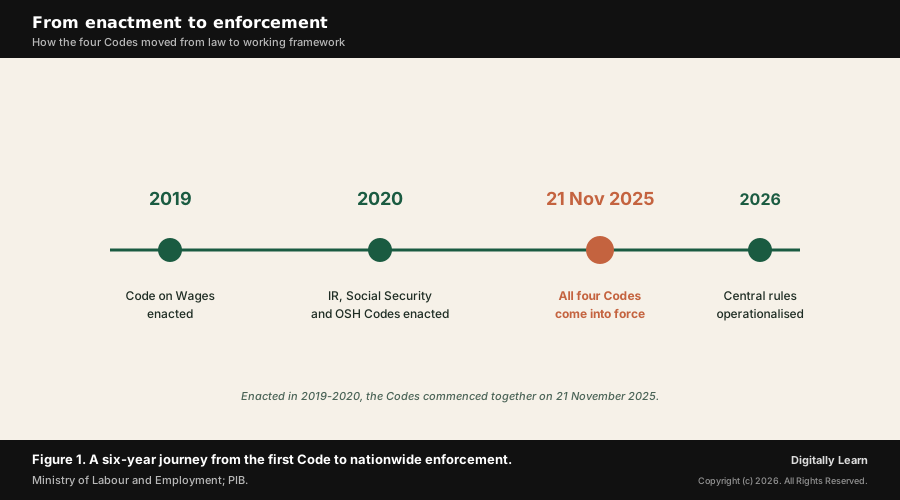
The four Labour Codes came into force on 21 November 2025, and the Centre has since notified the corresponding central rules that make them operational. This completes a reform that had been pending since the Codes were passed between 2019 and 2020.
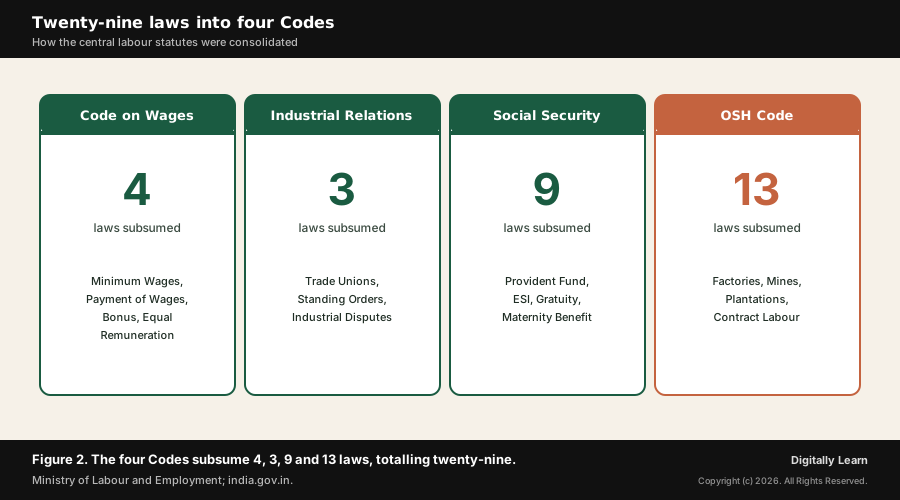
The Codes consolidate 29 fragmented central labour laws into four statutes covering wages, industrial relations, social security, and occupational safety. The aim is a single, simplified framework for both workers and employers, replacing a patchwork of overlapping Acts.
Labour appears in the Concurrent List, so both the Union and the States legislate on it. The Centre has framed the model central rules, and the States are framing their own rules, which is why uniform implementation across the country is being phased in rather than switched on at one stroke.
The four Codes and the laws they replace are:
- Code on Wages, 2019: merges four wage laws, including the Minimum Wages Act and the Payment of Wages Act.
- Industrial Relations Code, 2020: merges three laws on trade unions, standing orders and dispute resolution.
- Code on Social Security, 2020: merges nine laws on provident fund, insurance, gratuity and maternity benefit.
- OSH Code, 2020: merges thirteen laws on factory, mine and worksite safety and working conditions.
Why the Codes matter for workers and employers
A single framework for a fragmented system
For decades, labour protection in India was spread across dozens of Acts with differing definitions, thresholds and registers. The Codes give a common vocabulary and fewer compliances, which matters for the ease of doing business and for the clarity of worker rights.
The reform also widens coverage. A statutory floor wage and a single definition of wages apply across the country, while social security is extended to categories of workers, such as gig and platform workers, who were earlier outside the formal net.
The timing is significant too. Because the Codes were enacted in 2019 and 2020 but commenced only on 21 November 2025, the gap reflects the long process of stakeholder consultation and rule-making that a reform of this scale requires.
What the Codes signify for labour governance
Floor wage, social security and simpler compliance
Three threads carry the weight: a universal wage floor, the extension of social security to new categories of workers, and a lighter compliance load for employers.
First, the wage floor. The Code on Wages makes the right to minimum wages and timely payment universal, beyond the earlier scheduled employments. It also fixes the definition of wages so that basic pay is at least 50 per cent of total remuneration, which lifts the base for provident fund and gratuity.
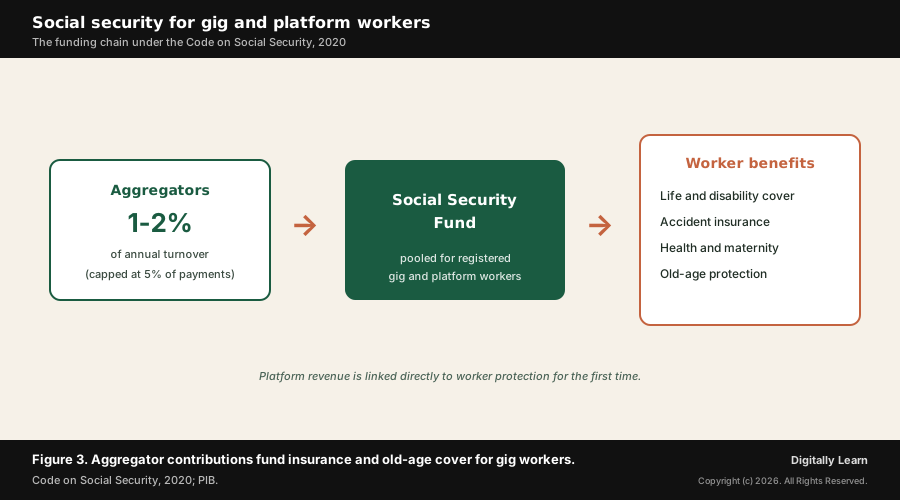
Second, social security widens. For the first time, the Code on Social Security defines gig workers and platform workers and provides for schemes covering life and disability cover, accident insurance, and old-age protection for them.
Third, compliance simplifies. A single registration, a single licence and a single return replace multiple filings under the old Acts. The intent is to reduce the cost of compliance while widening the protection that reaches the worker.
Distinguishing features of the four Codes
What each Code covers
The table sets out each Code, the number of earlier laws it subsumes, and a representative example, so the structure of the consolidation is visible at a glance.
| Labour Code | Laws subsumed | Representative earlier law |
|---|---|---|
| Code on Wages, 2019 | 4 | Minimum Wages Act, 1948 |
| Industrial Relations Code, 2020 | 3 | Trade Unions Act, 1926 |
| Code on Social Security, 2020 | 9 | Employees' Provident Funds Act, 1952 |
| OSH Code, 2020 | 13 | Factories Act, 1948 |
Three features that define the framework
Three design choices set the Codes apart from the laws they replace:
- (i) Consolidation. Twenty-nine central Acts collapse into four Codes, with harmonised definitions of terms such as wages, employee and establishment.
- (ii) Universalisation. The floor wage, the right to timely payment, and appointment letters extend to all employees, not just those in notified industries.
- (iii) New worker categories. Gig, platform and unorganised workers are defined in statute and brought within a social security framework for the first time.
Observable outcomes of the roll-out
Three trackable outcomes
The roll-out translates into three visible changes for workers and firms.
- (a) Restructured pay slips. As basic pay rises towards half of total remuneration, provident fund and gratuity contributions increase, while take-home pay may adjust.
- (b) Wider social security. Gig and platform workers begin to be registered for schemes funded partly by aggregator contributions to a social security fund.
- (c) Simpler compliance. Employers move to single registration, single licence and single return, with appointment letters and annual health check-ups becoming standard.
Because labour is a Concurrent subject, the pace of change depends on each State notifying its own rules, so the worker experience will vary across States during the transition.
Labour reform and the wider economy
Gig economy, formalisation and the federal balance
The Codes sit inside a wider push to formalise the workforce. The most-watched element is the gig and platform economy, where the Code on Social Security creates the first statutory route to insurance and old-age cover.
The funding mechanism is novel. Aggregators are required to contribute between 1 and 2 per cent of their annual turnover, capped at 5 per cent of the amount payable to gig and platform workers, into a Social Security Fund. This links platform revenue directly to worker protection.
The reform also tests cooperative federalism. Because both the Union and the States must notify rules, the Codes only deliver uniform protection when State governments complete their own rule-making, which connects labour reform to Centre-State coordination.
UPSC relevance and exam focus
Where this fits in the UPSC-CSE syllabus
This topic maps to General Studies Paper II: government policies and interventions for development in various sectors, and to General Studies Paper III: issues relating to employment, growth and the formalisation of the workforce.
For Prelims, hold the high-yield facts: the four Codes and their years, the consolidation of 29 central laws, the in-force date of 21 November 2025, the 50 per cent definition of wages, and the aggregator contribution of 1 to 2 per cent of turnover.
For Mains, two framings recur: the merits and demerits of the Codes for labour-market reform, and how the new social security architecture addresses the gig and platform economy.
Recurring linked concepts an aspirant should keep in working memory:
- Concurrent List: labour falls under both Union and State jurisdiction, shaping implementation.
- Definition of wages: basic pay at least 50 per cent of total remuneration.
- Floor wage: a national minimum below which State minimum wages cannot fall.
- Gig and platform workers: defined in statute under the Code on Social Security, 2020.
Do not assume all four Codes were enacted in the same year. The Code on Wages was passed in 2019, while the other three Codes were passed in 2020.
Avoid framing the Codes only as deregulation. They both ease employer compliance and widen worker protection, so a balanced answer must weigh flexibility against security.
Previous Year UPSC-CSE Questions By the end you will be able to draft model answers for the following UPSC questions. Each question carries a collapsible framework showing how to approach it in the exam.
- UPSC Prelims 2021With reference to casual workers employed in India, consider the following statements:
- All casual workers are entitled to Employees' Provident Fund coverage.
- All casual workers are entitled to regular working hours and overtime payment.
- The government can, by notification, specify that an establishment or industry shall pay wages only through its bank account.
Which of the statements given above are correct?
How to approach this Prelims question
Approach: Check each entitlement against what the law guarantees to casual workers as a class.
Trap to watch: Statement 1 is the trap: provident fund coverage is not automatic for every casual worker, so the word 'all' makes it incorrect.
Key facts to recall:
- Provident Fund coverage depends on thresholds, so not all casual workers are covered.
- Regular hours and overtime payment are general entitlements for workers.
- Wage payment can be mandated through bank accounts by notification.
Answer signal: Statements 2 and 3 are correct; statement 1 is not. Correct answer: 2 and 3 only.
- UPSC Mains 2024 GS-IIIDiscuss the merits and demerits of the four 'Labour Codes' in the context of labour market reforms in India. What has been the progress so far in this regard?
How to structure the answer in the exam
Introduction: Open with the consolidation of 29 central labour laws into four Codes and their commencement on 21 November 2025.
Body (sub-themes to develop):
- Merits: simplified compliance, a universal floor wage, and the 50 per cent definition of wages.
- Merits: social security extended to gig, platform and unorganised workers for the first time.
- Demerits: fears of weaker job security and easier retrenchment thresholds under the IR Code.
- Demerits: concerns from trade unions over the dilution of collective bargaining.
- Progress: Codes in force from 21 November 2025, with central rules notified and States framing their own rules.
Conclusion: Conclude that the Codes can balance flexibility with security only if State rule-making and enforcement keep pace.
Sources and Further Reading
- Ministry of Labour and Employment: Labour Codes
- Press Information Bureau: Government makes the four Labour Codes effective to simplify and streamline labour laws
- National Portal of India: New Labour Code for New India
- India Code: the four Labour Codes (Acts text)
- International Labour Organization: India
- Wikipedia: Indian labour law
Editorial Disclaimer
This article is compiled from the reference materials listed in the Sources section. It is an explainer for UPSC preparation and is not a substitute for primary documents (NCERTs, GoI ministry releases, IMD bulletins, RBI / CEA / MoEFCC publications, and Standing-Committee reports).


