


Overview
Opening the space sector to private players
India has opened its space sector to private companies and set up IN-SPACe, a single-window body in the Department of Space, to promote and authorise their activities alongside ISRO, NSIL and the Indian Space Policy 2023.
IN-SPACe, the Indian National Space Promotion and Authorisation Centre, is a single-window, autonomous body in the Department of Space set up to promote, enable, authorise and supervise the space activities of private companies, which the government calls Non-Government Entities or New Space Entities. It is the centrepiece of a wider space-sector reform that the Union Cabinet approved on 24 June 2020 to open a field run almost entirely by the state to private players. Under the reform ISRO moves toward advanced research and deep-space missions, the commercial arm NSIL takes Indian space technology to market, and the Indian Space Policy 2023 sets out a level playing field for private firms across the value chain. The aim is to build a much larger Indian space industry that serves the country's development.
What IN-SPACe Is and Why the Space-Sector Reform Is in the News
IN-SPACe: a single-window promoter and regulator for private space activity
IN-SPACe, the Indian National Space Promotion and Authorisation Centre, is a single-window, autonomous body under the Department of Space for the private space industry. Its task is to promote, enable, authorise and supervise the space activities of private companies, which the government calls Non-Government Entities or New Space Entities. Before IN-SPACe, a private firm had no clear public agency to approach; now it has one front door for permissions and support.
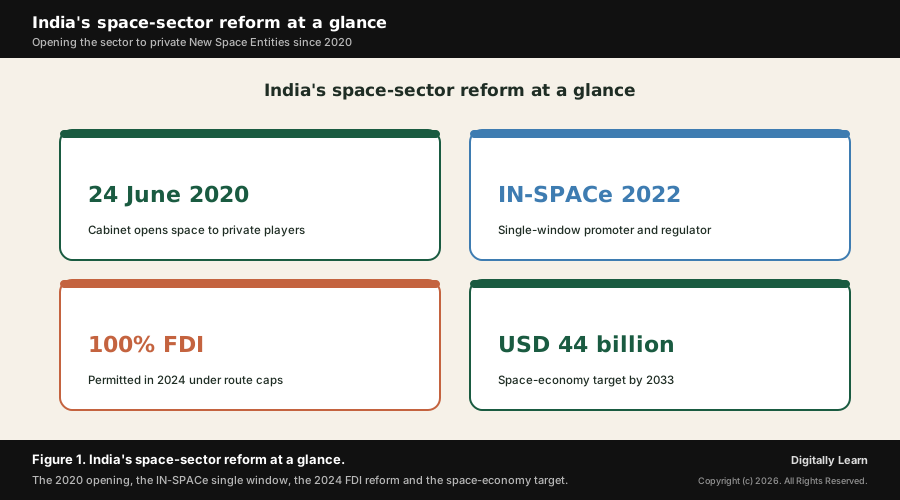
The body was created as the heart of the space-sector reforms that the Union Cabinet approved on 24 June 2020. Its headquarters at Bopal in Ahmedabad was inaugurated on 10 June 2022, giving the reform a physical home. IN-SPACe is best understood as both a promoter, encouraging private firms into space, and a regulator, authorising and supervising what they do, so that private activity grows in an orderly and safe way.
This dual role is what makes IN-SPACe central. It sits between ISRO and the private sector, giving companies access to ISRO's facilities, data and expertise while making sure their plans meet national rules on safety, security and international obligations. By giving private players a single, predictable point of contact, IN-SPACe lowers the barrier to entry that long kept the sector closed. The figure below sets out the headline facts of the reform.
Why the reform is in the news: a state-run sector opens to industry
Why it matters now is a deliberate change of model. For decades India's space programme was run almost entirely by the government through ISRO, with private firms acting only as suppliers of parts. The 2020 reform reversed that logic, inviting private companies to build, launch and operate space systems in their own right, and the steady roll-out of its pieces, IN-SPACe, the commercial arm, the space policy and the foreign-investment rules, keeps the subject live.
The shift is also visible in the numbers. The count of Indian space startups has risen sharply, from single digits around 2020 to roughly 189 in 2023 and about 400 in 2024-25, per the cited government releases. This fast growth of a private space industry, and the policy framework built to support it, is exactly why the reform has become an important theme for the examination.
The 2020 Reform: Why India Opened the Space Sector to Private Players
From a state monopoly to a government-private partnership
The case for opening the sector rests on a simple problem of scale. Demand for space services, communications, navigation, earth observation and launch, is growing far faster than any single state agency can meet alone. By keeping ISRO as the only builder and operator, India risked leaving much of this demand, and the jobs and exports with it, to firms abroad. Opening the field lets many private firms add their capital and ideas.
The reform therefore reframes space as a partnership rather than a monopoly. The public sector remains the enabler and the guardian of safety and national interest, while the private sector becomes the engine of scale and innovation. ISRO is freed to concentrate on the hardest, most advanced work, deep-space missions and new technology, while routine manufacturing and the operation of established services move toward industry, which can often do them faster and at lower cost.
Crucially, the reform was designed so that opening up does not mean letting go of oversight. The state still authorises and supervises every private activity through IN-SPACe, sets the policy through the Department of Space, and keeps a commercial channel through NSIL. This balance, encouraging private enterprise while keeping clear public rules, is the heart of the model and the reason it is studied as an example of productive government-private collaboration.
The Four-Actor Architecture: ISRO, IN-SPACe, NSIL and Private Firms
ISRO as the research engine and IN-SPACe as the single window
The reformed sector is best understood through its four actors, each with a distinct job, and the examination rewards knowing exactly who does what. The first is ISRO, the Indian Space Research Organisation, the national space agency. Under the new model ISRO steps back from routine manufacturing and the operation of mature services and concentrates on advanced research and development, deep-space and planetary missions and the hardest frontier technologies that only a national agency can pursue.
The second actor is IN-SPACe, the single-window promoter and regulator described above. It is the agency through which a private firm gains permission to carry out a space activity, books time on ISRO facilities, or seeks support, and it is also the body that supervises that activity against national rules. In effect IN-SPACe is the hinge of the whole reform: it connects the public and private sides and makes the government's role as enabler and overseer concrete and approachable.
NSIL as the commercial arm and the private New Space Entities
The third actor is NSIL, NewSpace India Limited, a public-sector company incorporated on 6 March 2019 as the commercial arm of the Department of Space. NSIL takes ISRO's proven technology to the market: it transfers technology to industry, carries out launches on a commercial basis, and is tasked with productionising launch vehicles such as the PSLV and the smaller SSLV through Indian industry, so that manufacturing moves out of the government and into the private sector.
The fourth actor is the set of private firms themselves, the Non-Government Entities or New Space Entities, ranging from young startups to established manufacturers. Under the reform they may design, build, own and operate satellites, launch vehicles, ground stations and space-based services, subject to authorisation by IN-SPACe. They are the innovation and scale engine of the new system, the players expected to grow the industry, create jobs and win export business.
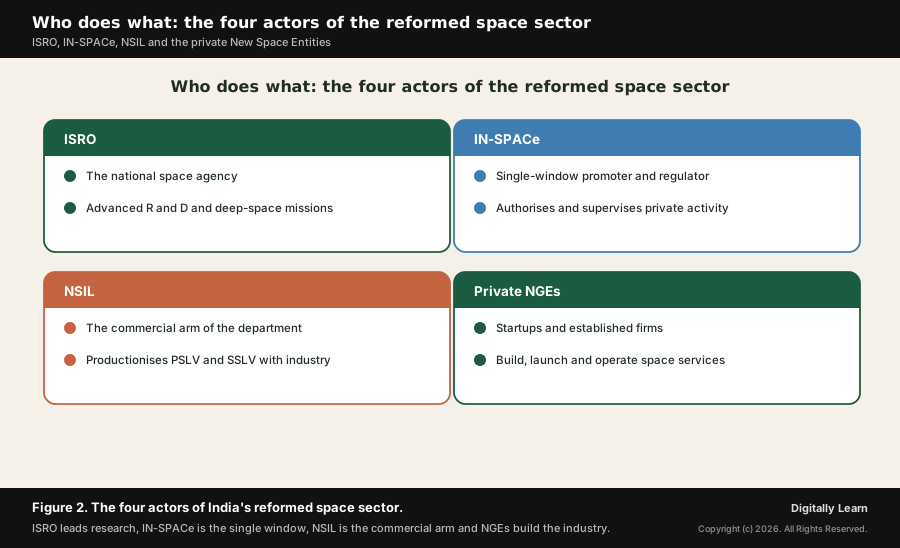
Read together, the four roles describe a clear division of labour: ISRO does the advanced research, IN-SPACe is the single window that promotes and authorises, NSIL commercialises the technology, and private firms build the industry at scale. This is the concrete shape of the government-private partnership at the centre of the reform. The table and figure below map the four actors.
| Actor | Type | Role in the reformed sector |
|---|---|---|
| ISRO | National space agency | Advanced research and development, deep-space and frontier missions |
| IN-SPACe | Single-window body, Department of Space | Promotes, enables, authorises and supervises private activity |
| NSIL | Public-sector commercial arm | Commercialises ISRO technology, productionises the PSLV and SSLV |
| Private NGEs | Startups and established firms | Build, launch and operate satellites, vehicles and space services |
The Indian Space Policy 2023: A Level Playing Field for Private Firms
How the 2023 policy delineates roles and opens the value chain
The Indian Space Policy 2023 is the document that turned the 2020 decision into a clear rulebook. Its first achievement is to delineate the roles of each actor, ISRO, IN-SPACe, NSIL, the Department of Space and the private New Space Entities, so that everyone knows who is responsible for what. By removing the earlier uncertainty about whether private firms were even allowed into a given activity, the policy gave the industry the confidence it needs to invest.
The policy's second achievement is to grant private firms a level playing field across the end-to-end value chain. New Space Entities are permitted to take part in the full range of space activity, from building satellites and launch vehicles to operating them and offering services and data, rather than being confined to the role of suppliers. This is the legal expression of the partnership idea: the private sector is a genuine participant, not a junior contractor.
The policy's third achievement concerns ISRO's own role. It states that ISRO will transition out of routine operational and manufacturing activities, handing established work to industry, and focus instead on research and development of advanced space technologies and on demanding missions. This is what allows the division of labour to work in practice: as ISRO lets go of the routine, private firms have the room, and the official mandate, to take it up.
The 2024 FDI Liberalisation: Inviting Global Capital under Clear Routes
Up to 100% FDI under differentiated automatic-route thresholds
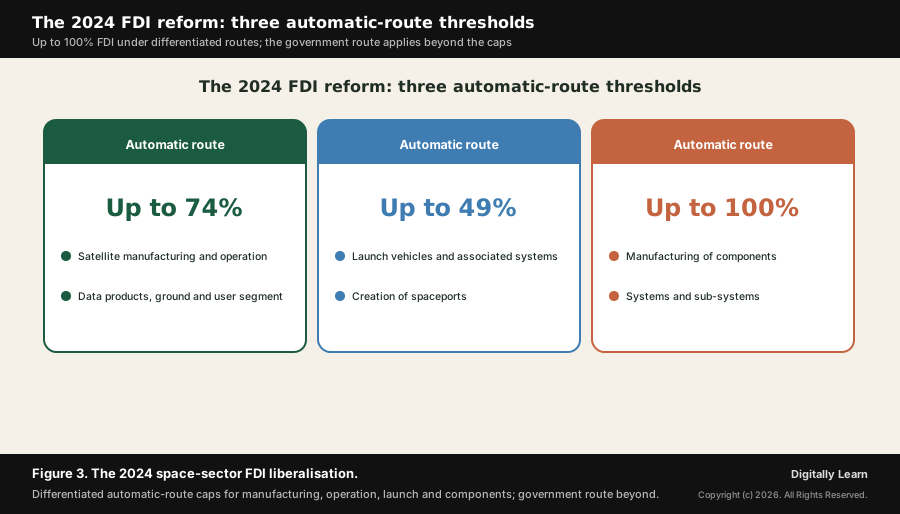
A reform that invites private firms must also let them raise capital, and the costliest space work needs a great deal of it. To meet this, the Union Cabinet amended the foreign direct investment policy for the space sector on 21 February 2024, with the gazette notification on 16 April 2024. The amended policy permits up to 100% FDI, but through carefully differentiated routes rather than a single blanket rule.
The thresholds reflect how sensitive each activity is. Up to 74% FDI is allowed under the automatic route for satellite manufacturing and operation, data products and the ground and user segment. Up to 49% is allowed for launch vehicles and associated systems and for spaceports. And up to 100% is allowed for the manufacturing of components and sub-systems. Beyond each threshold, investment needs prior clearance under the government route.
The design is deliberate. The most strategically sensitive activity, building launch vehicles and spaceports, carries the lowest automatic cap, while the least sensitive, making components, is fully open. By letting global capital and partners in under clear, predictable rules, the reform aims to bring investment, technology and demand to Indian firms while keeping national-security concerns in view. The figure below sets out the three automatic-route thresholds.
The Startup Ecosystem and India's Space-Economy Aspiration
From a handful of startups to a multi-billion-dollar space economy
The clearest sign that the reform is working is the startup ecosystem. The number of Indian space startups has climbed from single digits, around 54, in 2020 to roughly 189 in 2023 and about 400 in 2024-25, per the cited government releases. These young firms work across the value chain, building small satellites, launch vehicles, propulsion systems, ground stations and data services, and their rapid rise shows that private enterprise has responded to the opening.
To support these firms, IN-SPACe runs hand-holding measures and a dedicated venture-capital fund of Rs 1,000 crore to help startups bridge the gap between an idea and a commercial product. This risk-sharing role matters because space ventures are capital-hungry and slow to mature, and many startups would struggle to raise private money alone. By absorbing some of the early risk, the public side acts as a patient backer while the firms supply the innovation.
The larger goal is a much bigger space economy. India's space economy is currently about USD 8.4 billion, roughly 2% of the global total, and the stated target is to grow it about fivefold to around USD 44 billion by 2033, with about USD 11 billion in exports and a 7 to 8% world share, per the cited releases. Reaching that scale is what the government-private partnership is built to achieve, linking the reform to jobs and growth.
How the Collaboration Serves Socio-Economic Development
Space applications for connectivity, agriculture, disaster response and inclusion
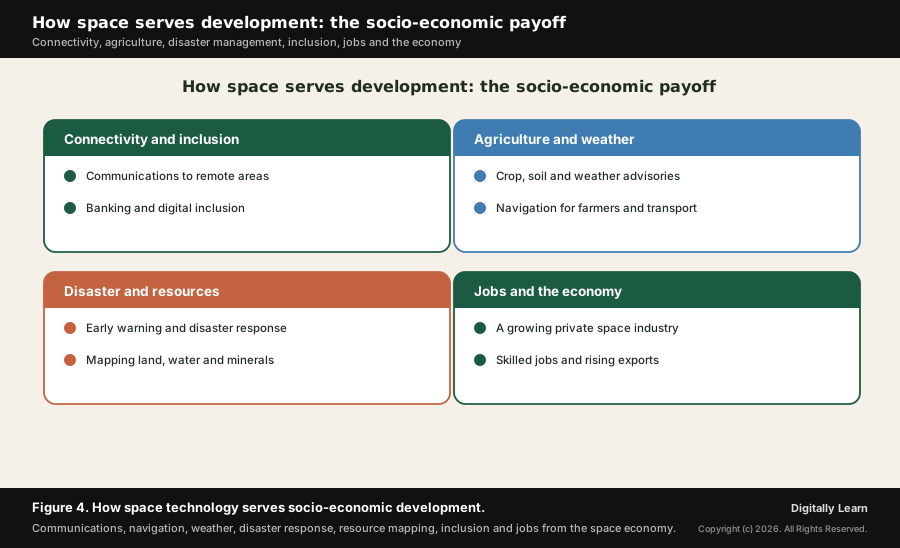
The deepest reason this reform matters is that space technology serves development, and a larger, faster-moving space sector can spread those benefits more widely. The most direct gain is communications and connectivity. Satellites carry telephone, internet and broadcast signals to remote villages, hills, islands and forests that cables cannot reach, narrowing the digital divide and supporting tele-education and tele-medicine for communities that the formal economy has long left out.
A second set of gains comes from navigation, weather and agriculture. Satellite positioning guides transport, fishing fleets and field operations, while weather and earth-observation satellites feed crop, soil and weather advisories that help farmers decide when to sow, irrigate and harvest. For an economy where so many livelihoods depend on the monsoon and the land, these space-based advisories are a practical tool for raising incomes and reducing risk in the countryside.
A third set of gains is in disaster management and resource mapping. Earth-observation satellites give early warning of cyclones and floods, track their path, and guide relief after they strike, saving lives and property; they also map land, water, forests and minerals for planning. Space services further support financial and digital inclusion, carrying banking and government payments to places without branches, so that welfare and credit reach the poor more reliably. The figure below groups these development gains.
A productive, transferable government-private collaboration model
Seen whole, the reform answers a broader question of development policy: what kind of government-private collaboration is most productive in tackling socio-economic problems. The public sector acts as the enabler and guardian, ISRO supplying research and proven technology, IN-SPACe giving a single window and clear authorisation, and the state sharing early risk. The private sector acts as the innovation and scale engine, bringing capital, speed and fresh ideas to deliver services at a reach the state alone could not.
This pairing is productive because it plays to each side's strength. The government does what only it can do, set the rules, guarantee safety and national security, fund the deepest research and back early-stage risk, while industry does what it does best, innovate, compete and scale. The partnership delivers jobs, exports and a growing space economy, and it channels the resulting technology, connectivity, advisories, disaster warning, inclusion, toward the development problems the public sector exists to solve.
That is why the reform is read as a transferable template. The same design, the state as an enabler with clear rules and risk-sharing, and the private sector as the scale-and-innovation partner, can be applied to other development sectors where the state cannot meet demand alone. The space sector simply shows the model at work: a well-governed collaboration that keeps public oversight while letting private enterprise widen the reach of a public good.
Challenges and Open Questions in the Space-Sector Reform
Level playing field, funding, regulation and liability, and technology access
A balanced view must weigh the challenges, which are best stated in neutral terms. The first concerns the level playing field between ISRO and private firms. ISRO is both a partner that shares facilities and a body whose own arms operate in the market, and some observers ask how an even field is kept when the national agency holds deep expertise and assets. Giving private firms fair access without weakening ISRO is a continuing task.
A second challenge is funding. Space ventures need patient, large-scale capital, and although the FDI reform and the venture-capital fund help, many startups still find it hard to raise the long-horizon money that hardware and launch programmes demand. A third challenge is regulation and liability: as private firms launch and operate space objects, clear rules are needed on authorisation, safety, the handling of liability for damage, and India's obligations under international space law.
A fourth challenge is technology access and intellectual property. Much advanced space capability sits with ISRO, so the terms on which it is transferred to industry, and how the resulting intellectual property is shared, shape how far private firms can climb the value chain. These are genuine open questions; the reform's direction is widely welcomed while its detailed rules on access, funding and liability are still being settled, and should be watched rather than assumed.
Significance and the Road Ahead for the Space-Sector Reform
Firm rules, deeper private capacity and a development-focused space economy
What is the significance of this space-sector reform is that it changes how India builds and uses space power. By turning a state monopoly into a government-private partnership, it lets ISRO concentrate on advanced research and deep-space missions while private firms scale up services, and it sets out, through IN-SPACe and the Indian Space Policy 2023, the clear rules an industry needs to invest. The promise is a larger space economy whose benefits reach ordinary citizens.
The way forward has clear steps. India can complete the regulatory framework, settling firm rules on authorisation, liability and its international obligations, possibly through a dedicated space law. It can deepen funding for startups, ensure a fair level field between ISRO and industry, and set clear terms for technology transfer. Handled carefully, the reform can make India both a stronger space power and a country that turns space into a practical tool for development.
UPSC Relevance and Exam Focus
Where the space-sector reform fits in the UPSC-CSE syllabus
This topic maps most directly to General Studies Paper III: developments in science and technology and their applications, and awareness in the field of space, and to the role of the private sector and the economy. It also connects strongly to governance and economic development, because the reform is a leading example of a government-private partnership built to serve socio-economic goals, which is the angle the recent Mains question rewards.
For Prelims, hold the high-yield facts: IN-SPACe is a single-window, autonomous body in the Department of Space that promotes and authorises private space activity, set up in the 2020 reform with its headquarters at Ahmedabad; NSIL is the commercial arm of the Department of Space; the Indian Space Policy 2023 gives private firms a level playing field; and in 2024 the government permitted up to 100% FDI under differentiated routes.
For Mains, the recurring framing is to assess this reform as a model of government-private collaboration for development, and to weigh its gains against the open questions. A strong answer explains IN-SPACe's single-window promoter-and-regulator design, ISRO's transition to advanced work, NSIL's commercial role and the level field for private firms, and then ties the space economy to development uses such as connectivity, agriculture, disaster management and inclusion. The recurring linked concepts below are worth holding in working memory:
- IN-SPACe and NSIL: The single-window promoter and regulator and the commercial arm through which India’s space-sector reform operates.
- Indian Space Policy 2023: The policy that delineates roles and gives private New Space Entities a level playing field across the value chain.
- FDI reform 2024: Up to 100% foreign direct investment in the space sector under differentiated automatic-route thresholds.
- Space economy and applications: The multi-billion-dollar economy and the use of space for connectivity, agriculture, disaster response and inclusion.
A common Prelims trap is to confuse the roles of IN-SPACe and NSIL, or to call IN-SPACe a regulator only; hold that IN-SPACe is both a promoter and a regulator in the Department of Space, while NSIL is the commercial arm, and that ISRO remains the research agency.
A common Mains trap is to treat the reform as a pure privatisation. Its exam value lies in a balanced judgment: the genuine gains of a shared government-private model that grows the space economy and serves development, set honestly against the open questions of a fair level field, funding, regulation and liability, and technology access, with public oversight retained throughout.
Previous Year UPSC-CSE Questions By the end you will be able to draft model answers for the following UPSC questions. Each question carries a collapsible framework showing how to approach it in the exam.
- UPSC Mains 2024 GS-IExplain what kind of collaboration between the government and the private sector would be most productive in dealing with the socio-economic issues of development.
How to structure the answer in the exam
Body (sub-themes to develop):
- What kind of collaboration is most productive: the public sector as enabler and guardian (clear rules, safety and national interest, funding the deepest research, sharing early risk) and the private sector as the innovation-and-scale engine (capital, speed, competition and reach), rather than either a pure state monopoly or a pure privatisation.
- A single-window, level-playing-field design: a body like IN-SPACe that promotes and authorises private activity gives industry one predictable point of contact and the confidence to invest, while a policy that delineates roles treats private firms as genuine participants across the value chain.
- Risk-sharing and hand-holding: tools such as a venture-capital fund, access to public facilities and technology transfer through a commercial arm (NSIL) help capital-hungry ventures bridge from idea to product, which is essential where the private sector alone would underinvest.
- Serving socio-economic development: the collaboration must channel its output to development, in the space case communications and connectivity, agriculture and weather advisories, disaster management, resource mapping, and financial and digital inclusion, plus jobs and exports.
- Safeguards and balance: clear regulation and liability rules, a fair level field, transparent technology-access terms and retained public oversight keep the partnership productive and accountable; the space-sector reform is a transferable template for other sectors.
Sources and Further Reading
- Indian National Space Promotion and Authorisation Centre (IN-SPACe): About IN-SPACe
- Press Information Bureau: Union Cabinet reforms opening the space sector to private players (24 June 2020)
- ISRO: Indian Space Policy 2023
- Press Information Bureau: Indian Space Policy 2023 approved by the Union Cabinet
- Press Information Bureau: Cabinet amends the FDI policy on the space sector (21 February 2024)
- Press Information Bureau: Liberalised FDI in the space sector and the space economy
- ISRO: NewSpace India Limited (NSIL), the commercial arm of the Department of Space
- Department of Space: Organisations and the space-sector reform framework
- NITI Aayog: Innovation, the digital economy and the role of the private sector
- Wikipedia: Indian National Space Promotion and Authorisation Centre
Editorial Disclaimer
This briefing is for UPSC preparation. Verify the facts and provisions against the official IN-SPACe, ISRO and PIB sources before relying on them.


