

Overview
India's universal household-electrification mission
SAUBHAGYA, the Pradhan Mantri Sahaj Bijli Har Ghar Yojana launched on 25 September 2017 by the Ministry of Power, set out to carry electricity the final stretch into every willing un-electrified household, free for the poor and low-cost for others, moving the national goal from lighting up villages to lighting up every home.
SAUBHAGYA, the Pradhan Mantri Sahaj Bijli Har Ghar Yojana, is India's universal household-electrification mission, launched on 25 September 2017 by the Ministry of Power to give an electricity connection to every willing un-electrified household in the country. Its purpose was to carry power the final stretch into the home rather than merely to the village, providing a free connection to poor households identified through the Socio-Economic and Caste Census of 2011 and a low-cost connection of five hundred rupees in instalments to those not so identified. The work is delivered through the State distribution companies, with REC as the nodal agency, and where the grid cannot reach a remote home a stand-alone solar power pack is provided instead. Building on the network laid under DDUGJY and IPDS, the mission shifted the national goal from village electrification to household electrification and SDG-7 energy access.
What SAUBHAGYA Is: A National Mission to Carry Electricity the Last Mile into Every Home
The 2017 household-electrification mission and the meaning of last-mile connectivity
The Pradhan Mantri Sahaj Bijli Har Ghar Yojana, known as SAUBHAGYA, is the programme through which the Indian state set out to put an electricity connection in every home that still lacked one. It was launched on 25 September 2017 as a mission of the Ministry of Power, and it is carried out on the ground by the State distribution companies, the utilities that own and run the wires in each State. Its purpose was stated plainly: to achieve universal household electrification by reaching every willing un-electrified household in rural areas and every poor household in the towns.
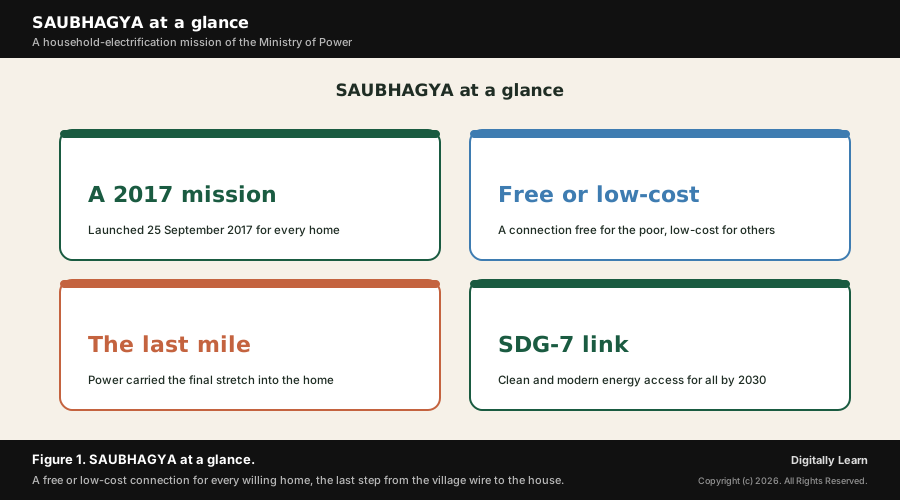
The idea at the heart of SAUBHAGYA is last-mile connectivity, the act of carrying power the final stretch from the distribution pole into the individual house. For decades India had measured progress by the village: a settlement counted as electrified once a wire reached its public places and a small share of its homes. Yet a lit village could still hold many dark houses, families who had never had a meter of their own. SAUBHAGYA was built to close exactly this gap, treating the unconnected household, not the village, as the unit of the task, which the next sections examine in detail. The figure below sets out the headline features of the mission before the detail that follows.
Why it matters is that a connection of one's own changes daily life in ways a distant village wire never could. Electric light lets a child study after dark and a household work into the evening, a fan and a television ease the day and connect the home to the world, and a power point lets a phone be charged at home rather than at a shop. By making the free or low-cost connection the first step, the mission aimed to draw every dark house onto the grid and to make a service the towns had long enjoyed reach the last village home. The headline design that delivers this is summarised in the figure that follows.
The Electrification Problem: Why Lighting Villages Left Many Homes Still Dark
The gap between village electrification and household electrification and why the last mile is hard
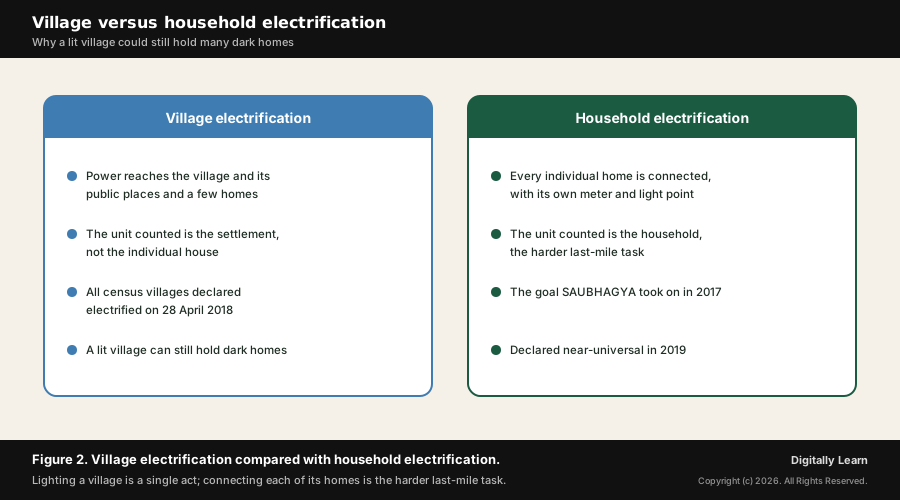
To grasp why SAUBHAGYA was needed, one must first see the gap it was built to close. For most of the period after independence, India tracked its progress by the electrified village, and the definition was a generous one: a village counted as electrified once power had reached its public buildings and a small fraction of its houses. By this measure the map filled in steadily, yet behind a village marked as lit could stand a great many un-electrified households, families whose own home had never been wired to the line that ran through their settlement.
This is the difference between village electrification and household electrification, and it is the hinge of the whole story. Carrying a high-voltage line into a village is a single, visible act; connecting each of its scattered houses is a slow and costly one, requiring a service wire, a meter and an internal point for every separate home. The poorest families were the last to be reached, because the cost of the connection and the paperwork around it fell hardest on them, so that the final stretch from the village pole to the individual house became the most stubborn part of the task.
The last mile is hard for reasons that compound one another. Many of the remaining homes lay in remote or scattered habitations, in hills, forests or islands where extending the grid was slow and dear. Others sat in areas troubled by conflict, where work could not safely proceed. And the very poorest often hesitated to ask for a connection at all, fearing the upfront cost and the monthly bill, so that demand itself had to be drawn out. Closing this gap therefore needed a scheme aimed squarely at the household and the final stretch, which is what SAUBHAGYA set out to be. The figure below sets out the contrast between the two ideas of electrification.
The Design of SAUBHAGYA: Free and Low-Cost Connections, Eligibility and the Components Given
The free connection for the poor, the five-hundred-rupee connection for others and how beneficiaries are identified
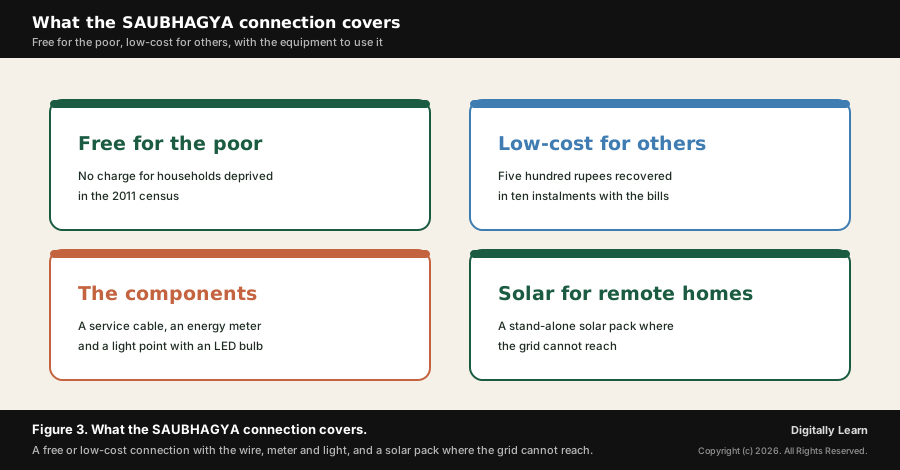
The core of SAUBHAGYA is the connection itself, designed so that cost would not keep any willing household off the grid. For a poor household the connection is given free of charge, the government meeting the cost so the family pays nothing to be wired. For a household that is not poor the connection still comes cheaply, at a charge of five hundred rupees recovered in ten instalments along with the electricity bills, so that even the modest fee need not be found all at once. The scheme thus removed both the cost and the lump-sum hurdle that had left so many homes unconnected.
Who counts as poor is settled by data rather than discretion. The free connection is given to households identified as deprived in the Socio-Economic and Caste Census of 2011, the nationwide survey that ranks rural households by markers of deprivation, so that the benefit is targeted at the genuinely needy without a fresh round of means-testing. A household not found in that list of the deprived is treated as the paying category and offered the five-hundred-rupee connection, while in the towns the scheme is aimed at the poor households that the urban network had left out. This use of an existing census kept the targeting objective and the process quick.
To bring the connection to the doorstep, the scheme leaned on camps in the village. Rather than wait for a family to travel to a distant office, the distribution utilities held electrification camps in the habitation itself, where an applicant could be registered on the spot, often with the help of the local gram panchayat and public representatives, and her details captured then and there. This camp model turned a forbidding bureaucratic errand into a visit to the village, and it was central to reaching households that would never have come forward on their own. The figure below sets out exactly what the SAUBHAGYA connection offers each household.
The service cable, meter and light point, and the stand-alone solar pack for homes the grid cannot reach
A connection is of no use without the means to draw on it, so SAUBHAGYA gave each household the physical equipment to switch the power on. The utility drew a service cable from the nearest pole to the house, fitted an energy meter to record the consumption, and provided the internal wiring for a single light point with an LED bulb, along with a point for a mobile charger. With this modest kit a family that had never had power could, on the day the connection was made, light a room and charge a phone, which is what turned a line on a map into a working circuit in the home.
For the homes the grid simply could not reach, the scheme provided a different answer: a stand-alone solar power pack. In remote and scattered habitations, in hills, forests and islands where extending a wire was neither feasible nor affordable, the household was given a small solar photovoltaic system with a battery bank, sized to run a few LED lights and a charging point and to store the day's sun for use after dark. This off-grid route meant that distance from the network was no longer a sentence to remain unlit, and it carried the promise of electrification to the very last and hardest homes.
Together the two routes, the grid connection for most and the solar pack for the few, let the mission claim that no willing household need be left out for want of a wire. The grid extension did the bulk of the work, reaching the great majority of homes through the strengthened network, while the off-grid solar systems mopped up the remainder in places the line could not go. This pairing of on-grid and off-grid delivery is a defining feature of SAUBHAGYA, and it is the practical reason the scheme could aim at the word universal in universal household electrification rather than settle for most.
Village Electrification, DDUGJY and IPDS: The Schemes That Built the Network SAUBHAGYA Used
DDUGJY for rural distribution, IPDS for the towns and the precise dates of village and household electrification
SAUBHAGYA did not stand alone; it sat on top of a network that two earlier schemes had built and strengthened. The first is the Deen Dayal Upadhyaya Gram Jyoti Yojana, known as DDUGJY, the Ministry of Power's scheme for the countryside launched in 2014. Its task was the rural distribution backbone: electrifying villages, separating the agricultural and non-agricultural feeders so that homes could draw steady power while farm supply was managed separately, and strengthening the sub-transmission and distribution lines, substations and transformers on which any household connection must ultimately hang.
The matching scheme for the towns is the Integrated Power Development Scheme, or IPDS. Where DDUGJY worked the rural network, IPDS strengthened the urban distribution system, building and upgrading the sub-transmission and distribution infrastructure of the cities and towns and putting in metering so that urban supply could be measured and managed. Between them, DDUGJY in the villages and IPDS in the towns laid down the wires and substations, the trunk and the branches, that a last-mile household connection then taps into. SAUBHAGYA, in this picture, is the leaf at the end of the branch, the final link from that network into the individual home.
The dates must be stated with care, because two different milestones are easily confused. Under the village-focused effort, India declared that all its census villages had been electrified on 28 April 2018, when Leisang in Manipur, the last unelectrified census village, was connected. That milestone was about villages, not homes. The separate goal of household electrification under SAUBHAGYA was declared near-universal as on 31 March 2019, when the States reported that almost all willing un-electrified households had been connected, save a small number in conflict-hit pockets. The table below sets out how these schemes divide the work.
| Scheme | Where it works | What it does |
|---|---|---|
| DDUGJY (from 2014) | Rural areas | Electrifies villages, separates agricultural and non-agricultural feeders, and strengthens the rural distribution network; census villages declared electrified on 28 April 2018 |
| IPDS | Urban areas | Strengthens the town distribution system, builds and upgrades sub-transmission and distribution infrastructure, and adds metering |
| SAUBHAGYA (from 2017) | Rural and urban households | Gives the last-mile connection from that network into every willing home; universal household electrification declared near-complete as on 31 March 2019 |
The Delivery Architecture: The Ministry, REC the Nodal Agency, the State DISCOMs and the Camp Model
The Ministry of Power, REC as nodal agency, the State distribution companies and the village-camp model of enrolment
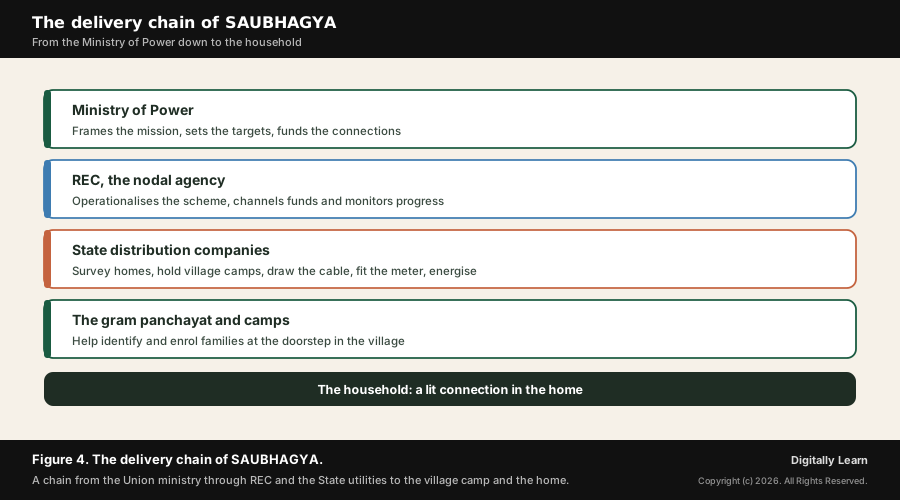
SAUBHAGYA is delivered through a chain that runs from a Union ministry to the village house, and understanding that chain is essential to judging the scheme. At the top is the Ministry of Power, the Union ministry in charge of electricity, which frames the mission, sets the targets and provides the central funds that meet the cost of the connections. It is a scheme driven through administrative machinery rather than a single statute, so the ministry's task is to steer the power sector it oversees towards the goal of an electricity connection for every willing home.
The work is coordinated by a nodal agency. REC, the public-sector power-finance company under the Ministry of Power, was made the nodal agency for the scheme, charged with operationalising it across the country, channelling the funds, running the monitoring dashboard and reporting progress. REC does not itself wire the houses; rather it is the central spine that ties the ministry's policy to the States' execution, so that a national target is broken into State plans and tracked house by house. This coordinating role is what allowed a single mission to move in step across very different State utilities.
The actual connecting of homes is done by the State distribution companies, the utilities, often called DISCOMs, that own the wires and bill the consumer in each State. They survey the un-electrified households, hold the electrification camps in the villages, draw the service cable, fit the meter and energise the connection. Working alongside them, the gram panchayat and local representatives help identify and reassure the families, so that the camp model brings registration to the doorstep. This State utility, with the panchayat beside it, is the true last mile of the mission, the point at which a national policy becomes a lit bulb in a poor home. The figure below maps this delivery chain from the ministry to the household.
The Outcomes: Households Connected, Near-Universal Access and the Reach to the Poor
Crores of households connected, the declaration of universal access and the gains for study, work and dignity
The first and most visible outcome of SAUBHAGYA is the sheer number of households connected. Over the years of the mission, a large number of un-electrified homes, in the order of two and a half crore and more, were given a connection, an indicative scale rather than a fixed figure since the running count moves with each official report. The drive drew into the grid families that the ordinary commercial connection had never reached, so that a service once concentrated in towns and better-off villages now extended into the last and poorest homes.
The second outcome is the declaration of near-universal household access. As on 31 March 2019, the States reported that almost every willing un-electrified household had been connected, with only a small number left in conflict-affected pockets, and the achievement of universal household electrification was certified by the States. This is the result that ties SAUBHAGYA to SDG-7, the global goal of modern energy access for all, since carrying electricity to the last home is exactly the kind of progress that goal measures. The depth of that access, however, turns on the quality of supply, which is why a connection and reliable power must be read together.
The third outcome lies in the change to daily life. A connected home gains electric light for a child to study and a household to work after dark, the means to run a fan or a television, and a point to charge the phone that links a family to markets, schemes and kin. Beyond these uses there is a quieter gain in dignity, the sense of being counted into a service the rest of the country took for granted. These gains are real and widely felt, even as their full measure depends on how steady and affordable the power proves once the connection is made.
The Critiques and Debates: Connection Versus Reliable Supply, DISCOM Health and Affordability
Hours of supply and reliability, the finances and losses of the DISCOMs, the cost of bills and the missed households
A balanced reading sets the gains against persistent critiques, presented here as they are argued by independent researchers, economists and audit bodies. The most common concern is the gap between a connection and reliable supply: critics point out that a meter on the wall is not the same as power in the wire, and that many newly connected homes still face long outages and few assured hours of supply. On this view, counting connections can run ahead of the real experience of usable, round-the-clock electricity in the home.
A second debate is over the financial health of the DISCOMs. The State distribution companies that must supply the new homes are in many places loss-making, burdened by high aggregate technical and commercial losses, the power that is lost in the wires or billed but never paid for, and by tariffs that do not cover the cost of supply. Adding crores of low-paying rural consumers can deepen that strain unless the losses are cut, so critics argue that the durability of SAUBHAGYA's gains rests on the distribution reform that the later Revamped Distribution Sector Scheme was meant to drive.
Further concerns cluster around affordability and the missed households. A poor family may hold a connection yet hesitate to use it freely, fearing a monthly bill it cannot easily meet, so that the meter turns slowly and the promised benefit is only partly drawn. Critics also press on the counting of beneficiaries, asking whether every willing household was truly reached and whether some who declined at first were later left out. On the central question, whether SAUBHAGYA has turned near-universal connection into reliable, affordable power in every home, a careful answer treats the matter as open and weighs both sides.
The Wider Linkages: SDG-7, Power for All and the Distribution Reform Agenda
SDG-7 energy access, the 24×7 Power for All vision and the place of SAUBHAGYA in distribution reform and RDSS
SAUBHAGYA sits inside a set of larger themes that an examiner expects a candidate to connect. The first is SDG-7, the United Nations goal of ensuring access to affordable, reliable, sustainable and modern energy for all by 2030, whose first target is universal access to electricity. A national mission that carries a connection to the last home is among the most direct ways a country can advance that target, and India's near-universal household electrification is read internationally as a notable step towards the energy-access side of the goal.
The second linkage is to the vision of round-the-clock power. SAUBHAGYA's connection is the entry point to the wider promise of 24×7 Power for All, the State-and-centre plans to assure every consumer reliable, good-quality supply at all hours. A connection without dependable power is only half the promise, so the household drive is understood as one limb of a larger effort whose other limbs are generation, transmission and, above all, a distribution network strong enough to keep the lights on. The two must move together if the connection is to mean what it says.
The third linkage is to distribution reform. Because the lasting value of a connection depends on a utility that can supply it reliably and recover its costs, SAUBHAGYA is studied alongside the schemes that try to fix the DISCOMs: the strengthening of the network under DDUGJY and IPDS, and the later Revamped Distribution Sector Scheme with its push to cut losses, install smart meters and tie central support to measurable improvement. Read this way, SAUBHAGYA is one stage in a continuing project to turn the right to a connection into the reality of reliable, affordable power for every home.
Understanding the Significance: Last-Mile Access, Social Equity and Energy Justice
A last-mile access intervention, a measure of social equity and a step in energy justice
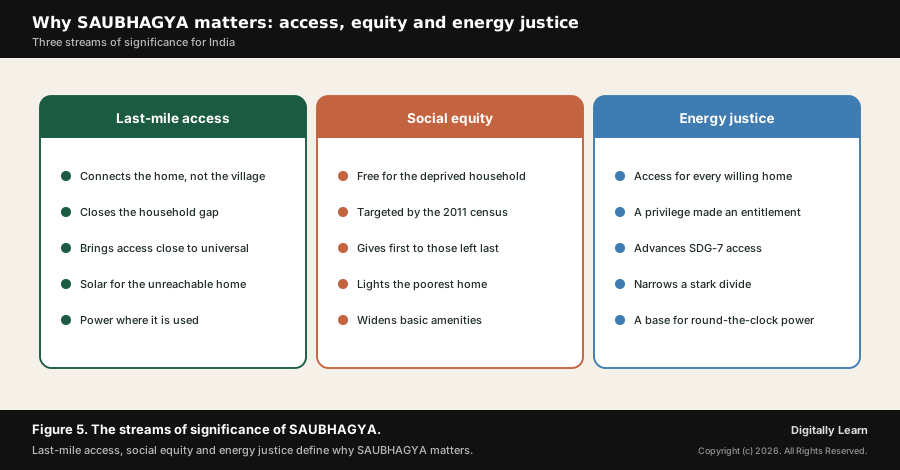
What is the significance of SAUBHAGYA lies first in its character as a last-mile access intervention rather than a network-building one. By treating the unconnected household, not the village, as the unit of the task, the mission closed the very gap that decades of village electrification had left open, and so brought the count of access close to the word universal. This makes SAUBHAGYA more than an addition to the grid; it is the act that turned a service reaching the village into a service reaching the home, which is where electricity is actually used.
Its second significance is as a measure of social equity. Because the free connection was targeted at the households marked deprived in the 2011 census and at the urban poor, the mission carried a clear redistributive meaning: it gave first to those the market had left last, and it placed in the poorest home a service the better-off had long enjoyed. Read this way, SAUBHAGYA belongs with the policies that try to widen the floor of basic amenities, lighting the home of a labourer or a tribal family on the same terms as any other.
Its third significance is as a step in energy justice and the meeting of SDG-7. Electric power had long divided the connected from the unconnected, and the mission's deepest claim is that it makes a household connection the entitlement of every willing family rather than a privilege of the reachable few, narrowing one of the starkest gaps in daily life. By advancing the energy-access side of SDG-7 on a vast scale, SAUBHAGYA is treated as a landmark in India's social and energy policy. The figure below maps these strands of significance.
The Way Forward: From Connection to Reliable Supply, Healthier DISCOMs and Affordable Power
Turning connections into round-the-clock supply, mending the distribution companies and keeping power affordable
The way forward follows directly from the critiques. The first priority is to move from the connection to reliable supply: to ensure that the homes already connected receive steady, good-quality power through the day and night, by strengthening the distribution network, cutting outages and metering supply honestly, so that a connection given on paper becomes a dependable circuit in fact and the experience of power catches up with the count of meters.
The second priority is to mend the distribution companies and keep power affordable. A utility crushed by losses and unpaid bills cannot supply its new consumers reliably, so the reform agenda, cutting aggregate technical and commercial losses, installing smart and prepaid meters and rationalising tariffs under the Revamped Distribution Sector Scheme, is the foundation on which SAUBHAGYA's gains must rest. At the same time, lifeline tariffs and targeted support can keep the monthly bill within reach of the poorest, so that a family connected at last is not priced back into the dark.
The third priority is to deepen actual use rather than rest on the connection count. Reaching the last missed and conflict-area households, maintaining the solar systems given to remote homes so they keep working, and raising awareness so that a connected family draws fully on its power, would turn the mission from a drive that handed out connections into one that genuinely lit every home. Pursued together, these measures would move SAUBHAGYA closer to its founding promise: not merely a meter in every home, but reliable, affordable electricity that the family can count on.
UPSC Relevance and Exam Focus
Where SAUBHAGYA fits in the UPSC-CSE syllabus
This topic maps most directly to General Studies Paper II: government policies and interventions for development in various sectors, and issues arising out of their design and implementation; and welfare schemes for vulnerable sections, since SAUBHAGYA is a flagship welfare mission whose targeting and delivery are routinely examined. It also links strongly to General Studies Paper III, where energy security, infrastructure and the health of the power sector are core themes, and it supplies rich material on last-mile service delivery, the difference between village and household electrification, and the reform of the distribution companies.
For Prelims, hold the high-yield facts: SAUBHAGYA is a 2017 household-electrification mission launched on 25 September 2017 by the Ministry of Power; its aim is universal household electrification through a last-mile connection to every willing un-electrified home; the connection is free for households marked deprived in the 2011 census and costs five hundred rupees in ten instalments for others; REC is the nodal agency and the State distribution companies do the connecting; and a stand-alone solar pack is given where the grid cannot reach.
For Mains, the recurring framing is to assess the scheme as a study in welfare design and last-mile delivery: how the targeted free connection carried power to the poorest home, how SAUBHAGYA completed the shift from village to household electrification on top of DDUGJY and IPDS, and how far weak supply, loss-making distribution companies and the cost of bills have limited the real benefit of a connection. A strong answer treats SAUBHAGYA as a case study in welfare delivery and infrastructure reform, weighing its real gains in access against the unresolved questions of reliability and affordability.
Recurring linked concepts an aspirant should keep in working memory:
- Village versus household electrification: The distinction between lighting a settlement, declared complete on 28 April 2018, and connecting every home, the goal SAUBHAGYA took on.
- DDUGJY and IPDS: The rural and urban schemes that built and strengthened the distribution network into which SAUBHAGYA’s last-mile connection plugs.
- SDG-7: The United Nations goal of affordable, reliable, sustainable and modern energy access for all by 2030, whose electricity-access target SAUBHAGYA advances.
- DISCOM health and distribution losses: The financial weakness of the distribution companies, with high aggregate technical and commercial losses, that decides whether a connection turns into reliable supply, addressed through distribution reform.
A common Prelims trap is to confuse the schemes and the bodies; hold that SAUBHAGYA is run by the Ministry of Power with REC as the nodal agency, that it gives household connections while DDUGJY built the rural network and electrified villages, and that the connection is free only for the poor identified in the 2011 census, costing five hundred rupees in instalments for others rather than being free for everyone.
A common Mains trap is to praise the connection count and stop there. The exam value lies in a balanced judgment: the real achievement in near-universal access, set honestly against the open problems of unreliable supply, loss-making distribution companies and the affordability of bills that decide whether the power is truly used.
Previous Year UPSC-CSE Questions By the end you will be able to draft model answers for the following UPSC questions. Each question carries a collapsible framework showing how to approach it in the exam.
- UPSC Mains 2023 GS-IIExamine the claim that development and welfare schemes for the vulnerable are, by their very nature, discriminatory in approach, that is, whether deliberately targeting a benefit at one identified group rather than giving it to everyone alike is a defensible form of positive discrimination or a problematic one, and give reasons for the position taken.
How to structure the answer in the exam
Body (sub-themes to develop):
- What discriminatory by nature means: a welfare scheme for the vulnerable selects a group and treats it differently, as SAUBHAGYA does by giving a free connection to the deprived household while charging others five hundred rupees in instalments.
- The case for positive discrimination: targeting the poor identified by the objective 2011 census is what carried electricity to the poorest and most remote homes and narrowed a stark divide, an equity gain a universal flat benefit could not have delivered as sharply.
- The case against and the risks: targeting by an older census can miss genuinely poor households not captured in it, and a counted family may still lack reliable, affordable supply, so the discrimination is only as fair as the data and the delivery behind it.
- Safeguards that make the discrimination defensible: objective and updated identification, inclusion of the truly needy who are missed, the camp model that brings the benefit to the doorstep, and reliable, affordable supply that makes the connection meaningful.
- Reasoned judgment: welfare schemes for the vulnerable are necessarily selective, but this selectivity is a justified positive discrimination when the targeting is objective, inclusive and backed by dependable delivery, as the SAUBHAGYA experience both shows and qualifies.
Sources and Further Reading
- Ministry of Power: Saubhagya, Pradhan Mantri Sahaj Bijli Har Ghar Yojana
- Ministry of Power: Guidelines of SAUBHAGYA
- Ministry of Power: Deen Dayal Upadhyaya Gram Jyoti Yojana, overview
- Saubhagya Dashboard, household-electrification progress
- Press Information Bureau: SAUBHAGYA, electrification of all un-electrified households
- Press Information Bureau: Deen Dayal Upadhyaya Gram Jyoti Yojana for rural electrification works
- NITI Aayog: SDG Goal 7, ensure access to affordable, reliable, sustainable and modern energy for all
- World Bank: Reinvigorating India's electricity distribution for access, reliability and digitalization
- United Nations: Sustainable Development Goal 7, energy
- Wikipedia: Saubhagya scheme
- Wikipedia: Deen Dayal Upadhyaya Gram Jyoti Yojana
Editorial Disclaimer
This briefing is for UPSC preparation. Verify the facts and figures against the official Ministry of Power, SAUBHAGYA and PIB sources before relying on them.


