


Overview
Rural tap water, the community model and the functionality debate
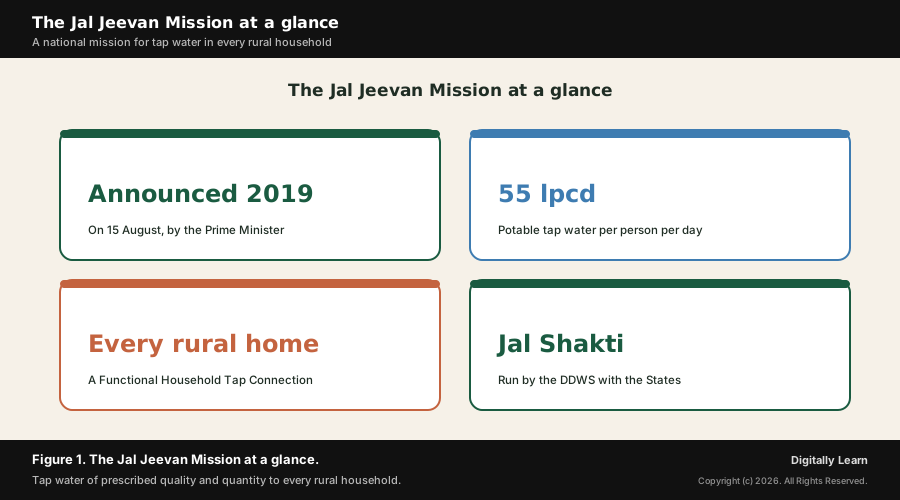
The Jal Jeevan Mission, announced on 15 August 2019 under the Ministry of Jal Shakti, aims to provide a Functional Household Tap Connection delivering potable water at 55 litres per capita per day to every rural household.
The Jal Jeevan Mission (JJM), branded Har Ghar Jal or 'water to every home', is India's flagship programme to bring safe piped drinking water to rural households. Announced on 15 August 2019 and run by the Department of Drinking Water and Sanitation in the Ministry of Jal Shakti, with the States, it aims to give every rural household a Functional Household Tap Connection (FHTC). The word functional is central: a tap is counted only when it delivers potable water of prescribed quality at 55 litres per capita per day (lpcd) on a regular, long-term basis, with the original target year of 2024. Crucially, the mission rests on a decentralised, demand-driven and community-managed model in which the village itself plans, runs and maintains its supply, making it as much a story of local governance and women's lives as of pipes and pumps.
What the Jal Jeevan Mission Is: Tap Water as a Right of Every Rural Home
A national mission for a functional tap connection in every rural household
The Jal Jeevan Mission, known as Har Ghar Jal, is the Government of India's flagship effort to deliver safe piped drinking water to every rural household. Announced on 15 August 2019, it is implemented by the Department of Drinking Water and Sanitation (DDWS) in the Ministry of Jal Shakti, working in partnership with the States and Union Territories, which actually build and run the schemes on the ground.
The mission's defining promise is a Functional Household Tap Connection (FHTC). The choice of the word functional is deliberate and exam-relevant. A tap connection is counted as functional only when it supplies water of adequate quantity, a minimum of 55 litres per capita per day, and of prescribed quality following the BIS drinking-water standard, on a regular and long-term basis. A pipe that reaches a wall but runs dry, or carries unsafe water, does not count.
The original target was to reach every rural household by 2024. At the mission's launch in August 2019, only a small minority of rural households had a tap connection, leaving the great majority to be connected within a few years. That scale, every village across a vast and varied countryside, is why the design of the mission, and not only its budget, matters so much. The figure below sets out the headline facts.
Why the Mission Is in Focus: From a 2024 Deadline to a Service-Delivery Reset
The original 2024 target, the coverage push and the shift toward lasting service
Why it matters now is that the Jal Jeevan Mission has moved from a sprint to lay pipes toward the harder task of keeping the water flowing. After several years of rapid expansion that connected a very large number of rural households, attention has turned from how many taps were installed to whether they remain functional: whether the supply is regular, the water safe, and the village system well maintained. This is the live question for the exam and for policy alike.
Reflecting that shift, the mission has been restructured and extended, with the Union Cabinet approving its continuation up to December 2028 and reorienting it from a focus on infrastructure creation toward service delivery, supported by stronger drinking-water governance and institutions. The change of emphasis, from building connections to sustaining them, is exactly the tension a good answer on this scheme is expected to explore.
Understanding the Significance of Tap Water for Health, Women and Equity
Public health, the reduction of women's drudgery and a fairer reach
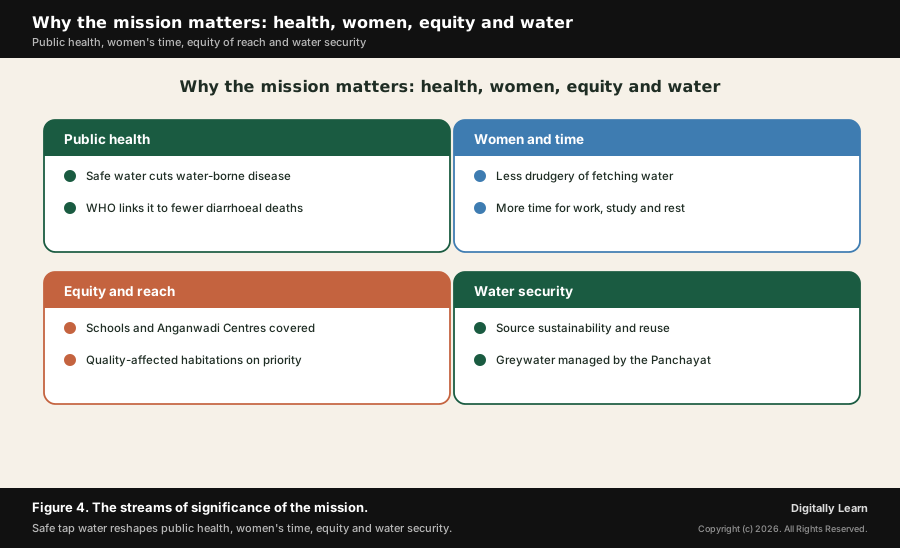
What is the significance of the Jal Jeevan Mission lies first in public health. Unsafe drinking water is a major route for water-borne diseases such as diarrhoea, cholera and typhoid, which fall hardest on children. By delivering tested, potable water to the home, the mission attacks this burden at its source. The World Health Organization has projected that universal, safely managed drinking water for all Indian households could prevent close to four lakh deaths from diarrhoeal diseases, a striking measure of what safe water can do.
Its second significance is the reduction of women's drudgery. In countless villages it is women and girls who walk long distances to fetch water, hours of unpaid labour that drain their health and crowd out school, work and rest. A tap in the home returns that time and dignity to them, which is why the mission is read not only as a water programme but as a step toward the empowerment of rural women, who are also placed at the centre of running and testing the village supply.
Its third significance is equity of reach. The mission deliberately reaches beyond the average household to schools and Anganwadi Centres, so that children get safe water where they learn and are fed, and it gives priority to water-quality-affected habitations and to disadvantaged and disease-prone districts. Safe water thus becomes a lever for child health, education and a fairer distribution of a basic service. The figure below maps these strands of significance.
Objectives and the Functional Tap Connection: Quality, Quantity and Service
The 55 lpcd potable-water standard and what functionality really means
The core objective of the mission is simple to state and demanding to deliver: assured, regular supply of potable piped water to every rural household at a service level of 55 litres per capita per day on a long-term basis. Around that sit linked objectives, to prioritise quality-affected areas and disadvantaged groups, to bring tap water to public institutions such as schools and Anganwadi Centres, to promote and ensure the long-term sustainability of supply and its sources, and to build the capacity of communities to run their own systems.
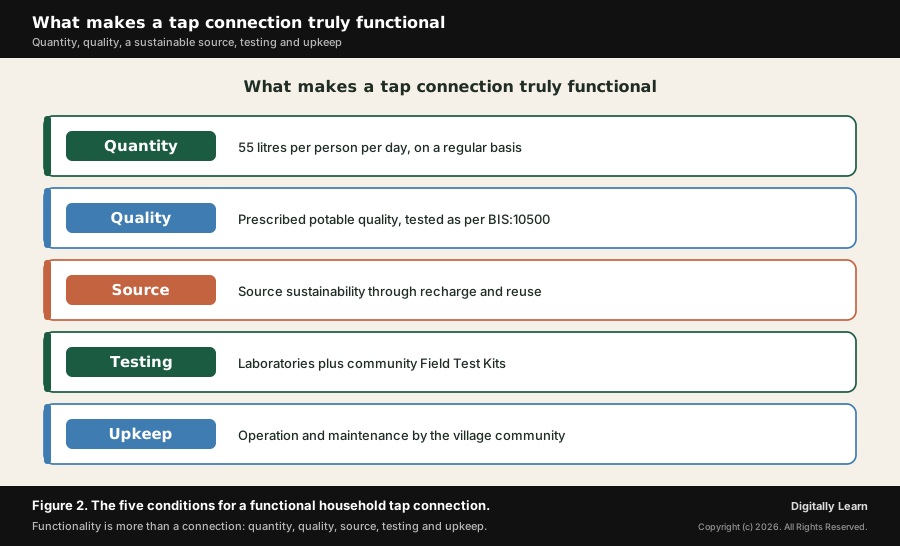
The idea of functionality ties these objectives together and is the single most testable concept in the topic. Functionality has more than one dimension: adequate quantity (the 55 lpcd benchmark), acceptable quality (water that meets the prescribed potable standard), and regularity (supply on a dependable, long-term basis rather than once in a while). A connection that fails on any of these is not truly functional, however impressive the count of installed taps may look.
This is why critics and supporters alike treat functionality and sustainability, rather than the raw number of connections, as the true test of the mission. The distinction between a tap that exists and a tap that reliably delivers safe water is the heart of every serious debate about the scheme, and the figure below unpacks what a functional connection actually requires.
| Dimension | Benchmark | Why it matters |
|---|---|---|
| Quantity | At least 55 lpcd per person | Enough water for drinking, cooking and basic hygiene |
| Quality | Prescribed potable standard (BIS) | Water that is safe and free of harmful contaminants |
| Regularity | Supply on a long-term basis | A dependable tap, not an occasional one |
| Source | Sustained over time | The aquifer or source does not run dry or degrade |
| Upkeep | Operation and maintenance in place | The village can keep the system running for years |
Reading the rows together makes the point plain: a household tap is a means, not the end. The end is safe water, in sufficient quantity, flowing reliably for years, which is a far harder thing to guarantee than a one-time connection.
How the Mission Works: The Decentralised, Community-Managed Model
Gram Panchayats, the Pani Samiti and the Village Action Plan, explained
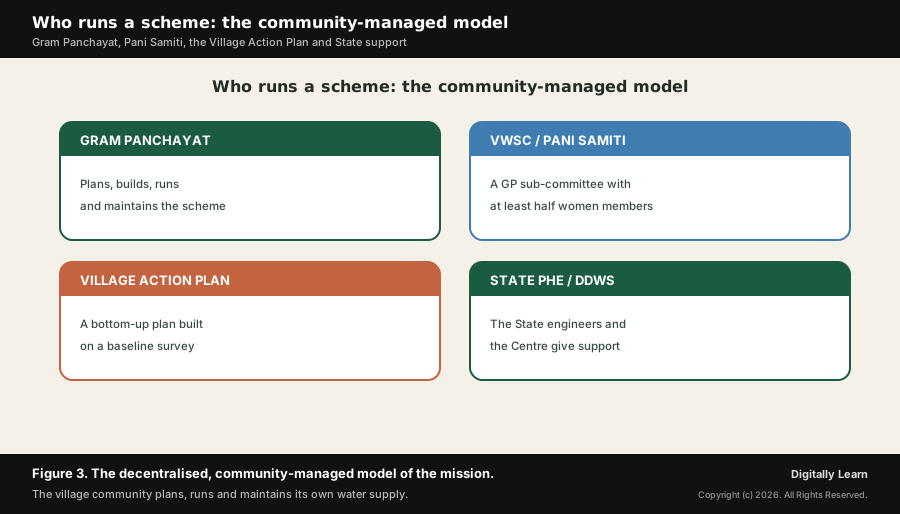
The most distinctive feature of the Jal Jeevan Mission is its decentralised, demand-driven and community-managed design, built on bottom-up planning. Rather than a scheme handed down and operated by a distant department, the mission places the local village community at the centre of planning, building, running, operating and maintaining its own in-village water supply. The intention is that villagers treat the system as their own, which is meant to be the key to keeping it working.
The institution through which the village acts is the Gram Panchayat and, within it, a dedicated sub-committee: the Village Water and Sanitation Committee (VWSC), also called the Pani Samiti or user group. To root the scheme in the people it most affects, this committee is to have at least fifty per cent women members, a design choice that connects the water mission directly to the role of women in local governance. The committee leads the village's water work and represents its users.
The community plans through a Village Action Plan (VAP), prepared by the Gram Panchayat or its sub-committee on the basis of a baseline survey, resource mapping and the felt needs of the village, with technical help from Implementation Support Agencies and the State engineers. The State Public Health Engineering or Rural Water Supply Department and the District Water and Sanitation Mission provide design, funds and supervision, while schemes themselves may be single-village or, where local sources are weak, multi-village systems drawing on a shared source. The figure below sets out who does what.
Water-quality testing, Field Test Kits and source sustainability
Because the promise is potable water, water-quality testing is built into the model on two levels. At the formal level, a network of laboratories at the State, regional, district, sub-division and block levels tests samples using standard methods. At the community level, the mission promotes Field Test Kits (FTKs) for surveillance at the points where water is delivered, including the village, schools and Anganwadi Centres; an FTK checks several parameters such as pH, chloride, nitrate, hardness, fluoride, iron and residual chlorine, and adverse results are confirmed in a laboratory.
Strikingly, it is largely women who have been trained to use these Field Test Kits, so that the people who most depend on safe water also watch over its quality. This puts women not only at the receiving end of the scheme but in charge of one of its most important safeguards, reinforcing the link between the mission and women's participation in village affairs.
The mission also takes seriously the sustainability of the source, recognising that a tap is only as good as the water behind it. It promotes source sustainability through recharge and reuse, water conservation and rainwater harvesting, often in convergence with wider water campaigns. A particular emphasis falls on greywater management, the collection, treatment and reuse of domestic non-fecal wastewater, which makes up the bulk of household wastewater and which the Gram Panchayat is responsible for managing, so that used water is recycled rather than allowed to stagnate.
The Institutional and Funding Architecture: Who Pays and Who Delivers
Centre, States and Gram Panchayats, and how the costs are shared
The mission runs on a layered institutional architecture. At the top, the Department of Drinking Water and Sanitation in the Ministry of Jal Shakti sets the policy, the operational guidelines and the funds. The States and Union Territories, through their Public Health Engineering or Rural Water Supply Departments and a State Water and Sanitation Mission, are the implementing authorities, and below them District Water and Sanitation Missions coordinate the work on the ground. At the base, the Gram Panchayat and its Pani Samiti plan, run and maintain the village system.
The financing follows a cost-sharing formula between the Centre and the States. The fund-sharing pattern is 90:10 for the North-Eastern and Himalayan States and for Union Territories with a legislature, 50:50 for the rest of the States, and 100 per cent central funding for Union Territories without a legislature. Within the central allocation, the bulk is earmarked for building water-supply infrastructure, with smaller shares set aside for support activities and for water-quality monitoring and surveillance.
This architecture is meant to combine central funding and standards with State delivery and village ownership. It mirrors India's federal design for social-sector schemes, where the Union sets the framework and provides money, the States execute, and the third tier of local government is expected to operate and sustain the asset. How well that chain holds together, from the Centre's grant to the village tap, is a recurring theme in any assessment of the mission.
Convergence: How the Mission Links to Other Programmes
Sanitation, rural employment, water conservation and child welfare
Contemporary linkages place the Jal Jeevan Mission within a wider family of rural development efforts, and much of its design assumes convergence with them. Safe water sits naturally alongside sanitation: clean water and clean toilets together drive down disease, and the water mission complements the country's rural sanitation drive in the larger goal of water, sanitation and hygiene. The two are partners, not rivals, in protecting health.
The mission also leans on programmes for rural works and water conservation. Source-strengthening structures, recharge works and greywater systems can be built using rural employment and watershed programmes, while campaigns for rainwater harvesting and reviving water bodies support the sustainability of the sources that feed the taps. Convergence here turns a water-supply scheme into part of a broader effort at water security.
Finally, the mission connects to child welfare and education through its coverage of schools and Anganwadi Centres, linking safe water to nutrition, mid-day meals, handwashing and the wider early-childhood and school systems. Read together, these linkages show the mission as a node in India's social-sector network rather than a stand-alone pipe-laying exercise. The figure below groups its main streams of significance and convergence.
Challenges and Debates: Functionality, Sustainability, Equity and Quality
Connection versus functionality, lasting upkeep and a fair, safe supply
A balanced reading must weigh the debates around the mission, and the first is the gap between a connection and true functionality. A tap on the wall is easy to count; a tap that delivers enough safe water every day is much harder to guarantee. Critics caution that headline coverage figures can outrun real service, and that the meaningful test is how many connections are genuinely functional, the very reason the programme has been reoriented toward service delivery.
The second debate is operation, maintenance and sustainability after construction. Once pipes are laid, someone must run the pumps, repair leaks, pay for electricity and replace ageing parts for years to come, and the model rests on the village community and its Pani Samiti to do so. Where local capacity, funds or motivation fall short, schemes can fall into disrepair, which makes institutional strengthening and steady financing for upkeep as important as the original construction.
A third cluster of concerns is equity and quality. Reaching remote hamlets, the poorest households and water-quality-affected habitations, where the groundwater itself may carry fluoride, arsenic, salinity or iron, is harder and costlier than connecting easier villages, so there is a risk that the last and most disadvantaged are left behind. Sustaining a safe source against falling water tables and contamination, and keeping the testing regime honest, are continuing challenges. On the central dispute, between those who stress the achievement of mass coverage and those who stress unresolved functionality and sustainability, a careful answer presents both sides and treats the question as open rather than settled.
The Way Forward: From Building Taps to Sustaining a Service
Service delivery, source security and stronger village institutions
The way forward for the mission follows directly from its central tension. The first priority is to complete the shift from counting connections to guaranteeing service, treating functionality, regular supply, safe quality and dependable hours, as the real measure of success, and building the monitoring to track it honestly at the household level.
The second priority is sustainability, of both the source and the system. That means strengthening aquifers and surface sources through recharge, reuse and greywater management, and putting in place reliable operation and maintenance, with trained operators, steady funds and empowered Pani Samitis able to run and repair their schemes. The third priority is equity and quality: reaching the hardest habitations and the most disadvantaged groups first, and being uncompromising on water testing in quality-affected areas. Pursued together, these turn a one-time achievement of taps into a lasting public service.
UPSC Relevance and Exam Focus
Where the Jal Jeevan Mission fits in the UPSC-CSE syllabus
This topic maps most directly to General Studies Paper II: welfare schemes for vulnerable sections, and issues relating to the development and management of the social sector relating to health, since safe drinking water is a determinant of public health and a flagship welfare programme. It also touches the role of women in General Studies Paper I, through the reduction of drudgery and women's place in the village water committees, and links to rural development and water resources.
For Prelims, hold the high-yield facts: JJM, Har Ghar Jal, was announced on 15 August 2019 under the Ministry of Jal Shakti (the Department of Drinking Water and Sanitation); it aims at a Functional Household Tap Connection of 55 lpcd potable water for every rural household with an original 2024 target; it is decentralised and community-managed through Gram Panchayats and Village Water and Sanitation Committees (Pani Samitis) with at least half women members; quality is checked through laboratories and Field Test Kits; and the fund-sharing pattern is 90:10, 50:50 or 100 per cent depending on the State or UT.
For Mains, the recurring framing is to assess the mission's design and its outcomes: how a community-managed model is meant to deliver a lasting service, how it advances public health and the empowerment of women, and how far it has closed the gap between connections and genuine functionality and sustainability. A strong answer treats the scheme as a case study in social-sector service delivery and in cooperative federalism, balancing real achievements against unresolved challenges of upkeep, equity and water quality.
Recurring linked concepts an aspirant should keep in working memory:
- Functional Household Tap Connection: Tap water of adequate quantity (55 lpcd) and prescribed quality on a regular, long-term basis, the test of functionality.
- Community-managed model: The Gram Panchayat and the Village Water and Sanitation Committee or Pani Samiti planning, running and maintaining the village supply.
- Source sustainability and greywater: Recharge, reuse and the management of domestic wastewater so that the source and the service last.
- Water, sanitation and hygiene: Safe water alongside sanitation and hygiene as the joint route to better public health.
A common Prelims trap is to confuse the Jal Jeevan Mission with river-cleaning or general water-conservation programmes, or to misstate the service level; hold that JJM is about rural household tap water at 55 lpcd under the Ministry of Jal Shakti, distinct from river rejuvenation and from urban water schemes.
A common Mains trap is to praise coverage numbers alone. The exam value lies in a balanced judgment: the genuine gains in access, women's time and public health, set honestly against the open questions of functionality, operation and maintenance, equity for the hardest habitations, and the safety and sustainability of the source.
Previous Year UPSC-CSE Questions By the end you will be able to draft model answers for the following UPSC questions. Each question carries a collapsible framework showing how to approach it in the exam.
- UPSC Mains 2017 GS-IIExamine how effective implementation of water, sanitation and hygiene (WASH) policy depends on identifying the right beneficiary segments and synchronising this with the anticipated outcomes.
How to structure the answer in the exam
Body (sub-themes to develop):
- Effective implementation: the decentralised, demand-driven, community-managed model, the Gram Panchayat and the Village Water and Sanitation Committee or Pani Samiti, the Village Action Plan, State engineering departments and District Water and Sanitation Missions, and Centre-State cost-sharing, as the machinery that makes or breaks delivery.
- Identifying the beneficiary segments: targeting every rural household while prioritising water-quality-affected habitations, SC/ST majority and disadvantaged villages, disease-prone districts, and the coverage of schools and Anganwadi Centres, so that the right groups are reached first.
- Synchronising with anticipated outcomes: defining success as a functional tap connection of 55 lpcd of safe water on a regular, long-term basis, backed by laboratory and Field Test Kit quality testing and source sustainability, rather than counting connections.
- The anticipated outcomes themselves: reduced water-borne disease and better public health, the reduction of women's drudgery and their empowerment through the water committees, and equity of access for the most disadvantaged.
- Where synchronisation breaks down: the gap between connection and functionality, weak operation and maintenance after construction, equity gaps for the hardest habitations, and the challenge of sustaining a safe source, which the shift toward service delivery seeks to address.
Sources and Further Reading
- Jal Jeevan Mission: About JJM and the Functional Household Tap Connection
- Department of Drinking Water and Sanitation: Operational Guidelines for the implementation of Jal Jeevan Mission (Har Ghar Jal)
- Jal Jeevan Mission: Community ownership of the water supply
- Press Information Bureau: Jal Jeevan Mission, Ensuring Tap Water for 15 Crore Rural Families
- Press Information Bureau: Field Testing Kits under JJM for community water monitoring
- Press Information Bureau: 100-days Campaign for potable piped water in Schools and Anganwadi Centres
- Press Information Bureau: Cabinet approves extension of Jal Jeevan Mission up to December 2028
- NITI Aayog: Composite Water Management Index
- Ministry of Finance: Economic Survey, Social Sector chapter on rural drinking water
- Wikipedia: Jal Jeevan Mission
Editorial Disclaimer
This briefing is for UPSC preparation. Verify the facts and provisions against the official Ministry of Jal Shakti and PIB sources before relying on them.


