


Overview
One State One USP Pilot
Rs 167 crore convergence mission to brand Arunachal Organic Kiwi for export; first operational One-State-One-USP case.
The Arunachal Kiwi Mission is a cluster-based cultivation and value-chain development mission for kiwi (Actinidia deliciosa) in Arunachal Pradesh, launched by the Union Government on 20 May 2026 with an outlay of approximately 167 crore rupees. Designed under a whole-of-government convergence model, the mission builds on scientific cultivation, post-harvest management, cold storage, processing, traceability, and exports, with the policy objective of positioning Arunachal Organic Kiwi as an international brand.
Why this is in the news on 21 May 2026
The New Delhi launch and the headline outcome
On 20 May 2026, Union Minister of Development of North Eastern Region (DoNER) Jyotiraditya Scindia launched the Mission on Arunachal Kiwi: The USP of Arunachal Pradesh at New Delhi. The launch is the first instance of the Government's announced One State One USP framework reaching operational mission status.
Definition: The Arunachal Kiwi Mission is a cluster-based cultivation-and-value-chain programme for kiwi (Actinidia deliciosa). The outlay is approximately 167 crore rupees across the mission cycle. The convergence model brings together eight Central institutions with the State Government and private investors.
Three headline outcomes define the launch:
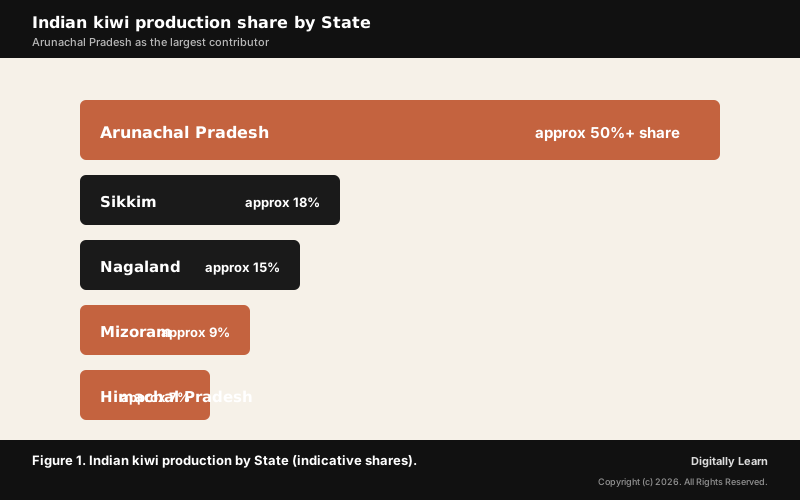
- (i) Production-share signal. Arunachal Pradesh is India’s largest kiwi-producing State and the first State in India to receive organic kiwi certification under the Mission Organic Value Chain Development for North Eastern Region (MOVCD-NER) in 2020.
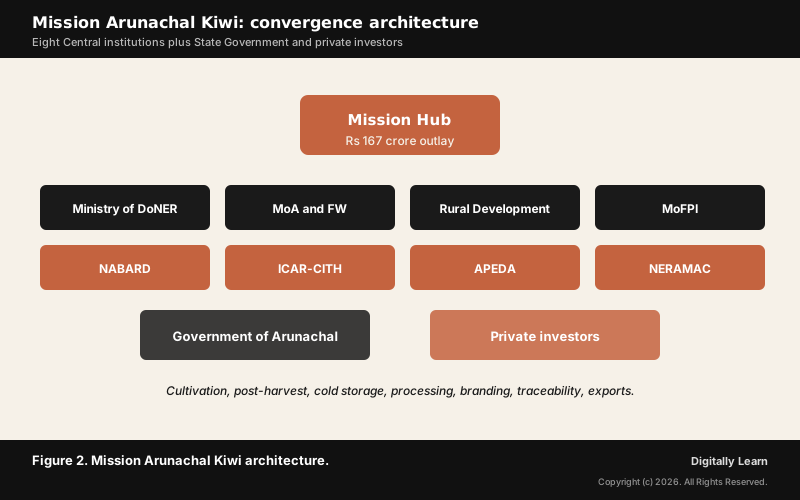
- (ii) Convergence architecture. The mission is operated through a whole-of-government convergence: Ministry of DoNER, Ministry of Agriculture and Farmers Welfare, Ministry of Rural Development, Ministry of Food Processing Industries, NABARD, the ICAR-Central Institute of Temperate Horticulture (ICAR-CITH), APEDA, the North Eastern Regional Agricultural Marketing Corporation (NERAMAC), and private investors.
- (iii) Value-chain coverage. The mission spans scientific cultivation, post-harvest management, cold storage, processing, branding, traceability, exports, and agri-tourism; the policy objective is to restore National Programme for Organic Production (NPOP) certification and brand Arunachal Organic Kiwi internationally.
Why kiwi as a USP for Arunachal matters for the North-East economy
Production-share, climate-suitability, and price-realisation
Why it matters: Arunachal Pradesh accounts for the largest share of kiwi production in India among State producers, with growing clusters in West Kameng, Lower Subansiri, Shi Yomi, and Dibang Valley districts. The State's altitude band of 900-1,800 metres and acidic forest soils suit kiwi vines and create a natural-climate moat that low-altitude States cannot replicate at scale.
The mission also matters because kiwi commands a premium price over apple, citrus, and pineapple in domestic mandis and the export gate. The 167 crore rupees outlay seeks to convert the existing production base into a price-realisation-bearing brand rather than a raw-fruit commodity. The brand strategy mirrors the Darjeeling tea and Kashmir saffron GI-and-organic playbook in fruit horticulture.
Significance for India's organic and horticulture strategy
What the Arunachal Kiwi Mission means for organic exports and the North-East
What is the significance of this issue: The Arunachal Kiwi Mission carries three significances for India's organic and horticulture strategy:
- (i) Organic-and-NPOP signal. The mission targets restoration of the NPOP certification on Arunachal kiwi clusters, building on the MOVCD-NER 2020 organic-kiwi-certification base. NPOP is the certification standard recognised by the European Union, Switzerland, and the United Kingdom for organic-equivalence, which makes it the prerequisite for premium-tier export.
- (ii) Value-chain-and-export signal. The convergence with APEDA, NERAMAC, and MoFPI mounts the mission on the existing agri-export and food-processing ecosystem (Operation Greens, PM Kisan Sampada Yojana). Cold-storage and post-harvest losses are the binding constraint, and the mission outlay targets that constraint directly.
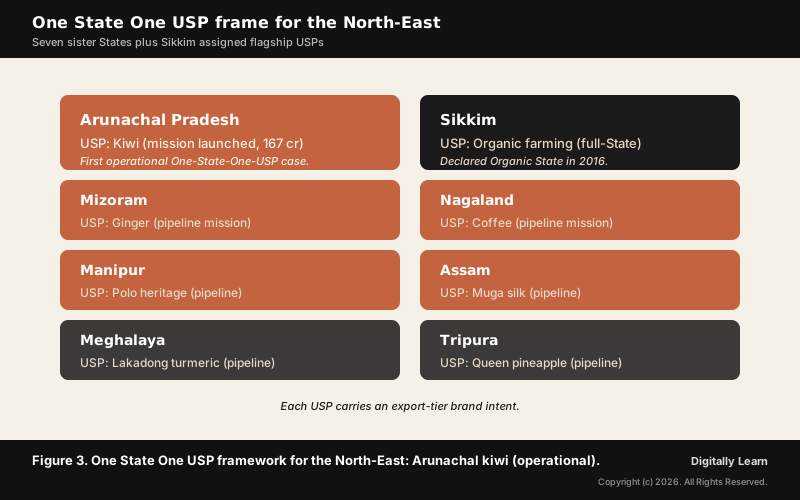
- (iii) North-East-development signal. The mission is the operational pilot of the One State One USP frame, with each North-East State assigned a flagship product (Mizoram ginger, Nagaland coffee, Sikkim organic farming, Manipur polo heritage, Assam muga silk, Meghalaya Lakadong turmeric). The Arunachal kiwi case is the first to reach mission status with named institutional partners and an outlay number.
Structural reading: The mission sits inside a longer trajectory: the National Horticulture Mission (2005-06) and its successor Mission for Integrated Development of Horticulture (MIDH, 2014); the MOVCD-NER launched in 2015-16; the Sikkim Organic State declaration of 2016; and the post-2020 organic-export push under APEDA. The Arunachal mission converts a State-level production-leadership claim into an operational national-flagship instrument.
Distinguishing features of the mission architecture
How the eight-institution convergence model is structured
Distinguishing features: Three institutional pillars define the operational shape of the mission:
- (i) Convergence over single-line implementation. Eight Central institutions (DoNER, Agriculture and Farmers Welfare, Rural Development, MoFPI, NABARD, ICAR-CITH, APEDA, NERAMAC) and the State Government, with private investors, jointly operate the mission. The convergence model is the structural innovation; earlier horticulture missions ran through MIDH alone.
- (ii) Cluster-based geography. Production clusters are concentrated in West Kameng, Lower Subansiri, Shi Yomi, and Dibang Valley districts, where altitude (900-1,800 m), forest-derived acidic soils (pH 5.5-6.5), and seasonal-rainfall pattern create kiwi-suitable agro-climatic envelopes.
- (iii) Brand-and-traceability layer. The mission adds a traceability and branding layer on top of cultivation: NPOP-certification restoration, GI-tag pathway, blockchain-based origin tracing, and the Arunachal Organic Kiwi brand identity for export markets.
The Arunachal Kiwi Mission at a glance
| Mission parameter | Detail | Significance |
|---|---|---|
| Launch | 20 May 2026, New Delhi | First operational One-State-One-USP mission |
| Launching authority | Union Minister DoNER, Jyotiraditya Scindia | Cabinet-level lead Ministry |
| Outlay | Approximately 167 crore rupees | Cluster-based cultivation and value-chain development |
| Lead crop | Kiwi (Actinidia deliciosa) | Identified as USP of Arunachal Pradesh |
| Production-share status | Arunachal Pradesh: India's largest kiwi-producing State | Basis for the brand strategy |
| Organic certification base | MOVCD-NER organic-kiwi certification (2020) | First State in India with this certification |
| Target certification | NPOP restoration; international brand | Export-equivalence with EU, UK, Switzerland |
| Production cluster districts | West Kameng, Lower Subansiri, Shi Yomi, Dibang Valley | Altitude 900-1,800 m; acidic forest soils |
| Convergence partners | DoNER, MoA-FW, Rural Dev, MoFPI, NABARD, ICAR-CITH, APEDA, NERAMAC | Eight Central institutions with State Government and private investors |
Observable outcomes to track over the mission cycle
What to watch on NPOP certification and export shipments through 2030
Observable outcomes: Six outcomes frame the mission trajectory between 2026 and 2030:
- (a) NPOP certification restoration. Whether the targeted Arunachal kiwi clusters recover full NPOP certification within the first two years of the mission cycle.
- (b) Cold-storage and post-harvest capacity. Specific cold-chain investments under the convergence model with MoFPI and NERAMAC, measured by tonnes-per-day handling capacity added.
- (c) Export trajectory under APEDA. Shipped tonnage and FOB value of Arunachal Organic Kiwi to EU, UK, West Asia, and South-East Asia markets.
- (d) Cluster-yield productivity. Average yield per hectare in West Kameng, Lower Subansiri, Shi Yomi, and Dibang Valley against the ICAR-CITH technology-adoption benchmarks.
- (e) GI-tag pathway. Progress on a Geographical Indication application for Arunachal Kiwi through the GI Registry, Chennai.
- (f) Replication to other One-State-One-USP missions. Mizoram ginger, Nagaland coffee, Meghalaya Lakadong turmeric, and Assam muga silk follow-on mission notifications and outlays.
Threads connecting the mission to wider Indian agriculture policy
How the mission links MOVCD-NER, MIDH, and the One-State-One-USP frame
Contemporary linkages: Three threads connect the Arunachal Kiwi Mission to wider Indian agriculture policy.
The first is the organic-farming-policy thread. The MOVCD-NER scheme (2015-16) for the North-East, Paramparagat Krishi Vikas Yojana (PKVY) for the rest of India, the NPOP standard recognised by EU and Switzerland, and the India Organic certification mark together compose the organic-policy stack. The Arunachal kiwi case operationalises the export-tier dimension of this stack.
The second is the horticulture-mission thread. The National Horticulture Mission (2005-06) and its successor Mission for Integrated Development of Horticulture (MIDH, 2014) frame the cluster-based-development model on which the Arunachal mission sits. The MIDH horticulture cluster approach is the procedural template; the convergence layer is the new addition.
The third is the North-East-USP thread. The One State One USP frame assigns each North-East State a flagship product or strength. Mizoram on ginger, Nagaland on coffee, Sikkim on organic farming, Manipur on polo heritage, Assam on muga silk, and Meghalaya on Lakadong turmeric. The Arunachal kiwi case is the first to reach operational mission status, and its success or failure will shape the architecture of the follow-on missions.
UPSC Relevance
Where the mission sits in the UPSC syllabus
UPSC context: The Arunachal Kiwi Mission falls within General Studies Paper III under the heads major crops, cropping patterns, storage, transport and marketing of agricultural produce, economics of animal-rearing (adjacent), food processing and related industries in India, and land reforms in India. The North-East development dimension also touches General Studies Paper II under welfare schemes for vulnerable sections.
Prelims relevance: The Prelims surface includes the Mission Organic Value Chain Development for North Eastern Region (MOVCD-NER, 2015-16), the Paramparagat Krishi Vikas Yojana (PKVY), the National Programme for Organic Production (NPOP), the National Horticulture Mission (NHM, 2005-06) and its successor Mission for Integrated Development of Horticulture (MIDH, 2014), the ICAR-Central Institute of Temperate Horticulture (ICAR-CITH, Srinagar), APEDA, NERAMAC, the India Organic certification mark, and the Geographical Indications of Goods (Registration and Protection) Act, 1999.
Mains relevance: Two framings dominate the Mains-paper surface:
- (i) Organic-State framing. The benefits, ecological and economic, of an organic-farming push. The Arunachal kiwi case provides a State-level commodity-specific instance to complement the State-level full-coverage Sikkim case.
- (ii) Horticulture-mission framing. The role of the National Horticulture Mission and MIDH in boosting production, productivity, and farmer income. The Arunachal kiwi mission is the latest convergence-model expansion of the horticulture-mission family.
Mains practice question: A focused fifteen-mark question would read: The Arunachal Kiwi Mission of May 2026 is the first operational instance of the One State One USP frame for the North-East. Examine its design under the convergence model and discuss its significance for India's organic-farming and horticulture-export strategy.
- Past Mains linkage. 2018 GS-III: Sikkim is the first ‘Organic State’ in India. What are the ecological and economical benefits of Organic State? The Arunachal kiwi case operationalises the organic-State frame on a single commodity rather than the whole-State Sikkim model.
- Past Mains linkage. 2018 GS-III: Assess the role of National Horticulture Mission (NHM) in boosting the production, productivity and income of horticulture farms. How far has it succeeded in increasing the income of farmers? The convergence architecture of the kiwi mission extends the NHM-MIDH line.
- Adjacent linkage. Prelims questions on PKVY, MOVCD-NER, NPOP, APEDA, and the GI Act, 1999 test the institutional surface that the kiwi mission sits within.
Previous Year UPSC-CSE Questions By the end you will be able to draft model answers for the following UPSC questions. Each question carries a collapsible framework showing how to approach it in the exam.
- UPSC Mains 2018 GS-IIISikkim is the first ‘Organic State’ in India. What are the ecological and economical benefits of Organic State?
How to structure the answer in the exam
Introduction: Open with Sikkim's 2016 Organic State declaration, frame the question through the National Programme for Organic Production (NPOP) standard recognition, and structure the answer through ecological and economic benefit buckets.
Body (sub-themes to develop):
- Ecological benefit 1: Soil-health restoration through composting and biological inputs; reduction in synthetic-fertiliser-induced soil-acidification and salinisation; carbon sequestration in agricultural soils.
- Ecological benefit 2: Biodiversity protection through diversified cropping; reduced pesticide-residue load on pollinators; on-farm habitat for native species.
- Ecological benefit 3: Water quality through reduced agro-chemical runoff into Teesta and other river systems; reduced contamination of groundwater nitrates.
- Economic benefit 1: Premium-price realisation in domestic mandis (Sikkim cardamom, large cardamom, ginger) and the export gate (NPOP-certified products gain EU and Switzerland equivalence).
- Economic benefit 2: Agri-tourism dimension; certified organic products attract value-added tourism flows; farm-stays and farmgate sales channels.
- Economic benefit 3: Farmer-income stability through long-term contract farming with exporters; reduced exposure to fertiliser-price volatility; remunerative price-floors.
- Commodity-vs-State track: The May 2026 Arunachal Kiwi Mission operationalises the organic frame on a single commodity (kiwi) and a single State (Arunachal) rather than the whole-State Sikkim approach, broadening the policy menu.
Conclusion: Conclude that the ecological-and-economic benefits of an Organic State run through three ecological channels (soil, biodiversity, water) and three economic channels (price, tourism, stability), that the Sikkim 2016 declaration validates the whole-State track, and that the May 2026 Arunachal Kiwi Mission extends the menu to a commodity-specific track.
The Arunachal Kiwi Mission of May 2026 is the commodity-specific counterpart to the Sikkim whole-State Organic State track that the 2018 GS-III question asks about. The body sub-theme on commodity-vs-State track supplies the leading 2026-current evidence pillar.
- UPSC Mains 2018 GS-IIIAssess the role of National Horticulture Mission (NHM) in boosting the production, productivity and income of horticulture farms. How far has it succeeded in increasing the income of farmers?
How to structure the answer in the exam
Introduction: Open with NHM 2005-06 launch, frame the assessment through MIDH 2014 succession, and structure the answer through production, productivity, and farmer-income lenses.
Body (sub-themes to develop):
- Production lens: Indian horticulture output crossed 320 million tonnes by the mid-2020s; India is the world's second-largest producer of fruits and vegetables after China; cluster-based area expansion under NHM-MIDH.
- Productivity lens: Yield-per-hectare improvements in apple (Himachal-Jammu and Kashmir), banana (Tamil Nadu-Maharashtra), and mango (Uttar Pradesh-Andhra Pradesh) under NHM-MIDH; technology adoption through ICAR-CITH and State Horticulture Missions.
- Farmer-income lens: Price-realisation through Operation Greens (TOP crops), e-NAM, FPOs; cold-chain expansion under PM Kisan Sampada Yojana; export under APEDA.
- Success markers: Mission for Integrated Development of Horticulture (MIDH) cluster-development; the One State One USP frame; the Arunachal Kiwi Mission of May 2026 as the latest convergence-model expansion.
- Shortfall markers: Post-harvest losses persist at 5-15 per cent across categories; cold-storage capacity gap; price-realisation volatility for perishables; small-and-marginal farmer access constraints.
- Way-forward: convergence architecture (Arunachal kiwi case); commodity-specific missions; NPOP-and-export-tier brand strategy; GI-tag pathway for high-value horticulture.
Conclusion: Conclude that NHM-MIDH has succeeded materially on production volumes and partially on productivity per hectare, that farmer-income gains are uneven across crops and States, and that the May 2026 Arunachal Kiwi Mission convergence model offers the latest template for the income-uplift agenda.
The Arunachal Kiwi Mission is the latest convergence-model expansion of the NHM-MIDH horticulture-mission family that the 2018 GS-III question assesses. The body sub-theme on success markers cites the mission as the latest evidence the answer must include.
Sources
- PIB release: Union Minister Scindia launches Mission on Arunachal Kiwi
- Ministry of DoNER: institutional materials on One State One USP frame
- MOVCD-NER scheme guidelines and operational manual
- APEDA: National Programme for Organic Production (NPOP) page
- ICAR-Central Institute of Temperate Horticulture (ICAR-CITH), Srinagar
- NABARD: Rural infrastructure and value-chain financing
- Mission for Integrated Development of Horticulture (MIDH) page
- Wikipedia: Kiwifruit
Editorial Disclaimer
This article is compiled from the reference materials listed in the Sources section. It is an explainer for UPSC preparation and is not a substitute for primary documents (NCERTs, GoI ministry releases, IMD bulletins, RBI / CEA / MoEFCC publications, and Standing-Committee reports).


