


Overview
India's urban water-supply, sewerage and water-security mission
AMRUT, the Atal Mission for Rejuvenation and Urban Transformation, launched on 25 June 2015 by the Ministry of Housing and Urban Affairs, is India's first focused national water mission for towns and cities, now carried forward by AMRUT 2.0 toward universal tap water in every statutory town.
AMRUT, the Atal Mission for Rejuvenation and Urban Transformation, is the Government of India's flagship urban-infrastructure programme for water supply and sewerage, launched on 25 June 2015 in 500 selected cities and towns by the Ministry of Housing and Urban Affairs. Described as India's first focused national water mission, it set out to give every urban household an assured tap and a sewerage connection. Its successor, AMRUT 2.0, launched on 1 October 2021, widens the goal to universal coverage of tap water in all statutory towns and full sewerage in the 500 AMRUT cities, while making cities water secure through the circular economy of water. Because urban services are run by States and their Urban Local Bodies under the spirit of the 74th Constitutional Amendment, AMRUT is as much a story of municipal capacity as of pipes and pumps.
What AMRUT Is: India's First Focused National Water Mission for Cities
The Atal Mission for urban water supply and why it is in focus
The Atal Mission for Rejuvenation and Urban Transformation, known as AMRUT, is the Government of India's flagship effort to build basic urban infrastructure, above all assured water supply and sewerage, in the country's towns and cities. It was launched on 25 June 2015 in 500 selected cities and towns, generally those of one lakh population and above, and is run by the Ministry of Housing and Urban Affairs. Officials describe it as India's first focused national water mission for urban areas.
The mission's core purpose is plain and citizen-facing. It aims to ensure that every urban household has access to a tap with an assured supply of water and to a sewerage connection, to make cities cleaner and more liveable, and to cut pollution by improving drainage and public and non-motorised transport. AMRUT therefore tackles the basic services that decide the daily quality of urban life, the water people drink and the way a city handles its used water.
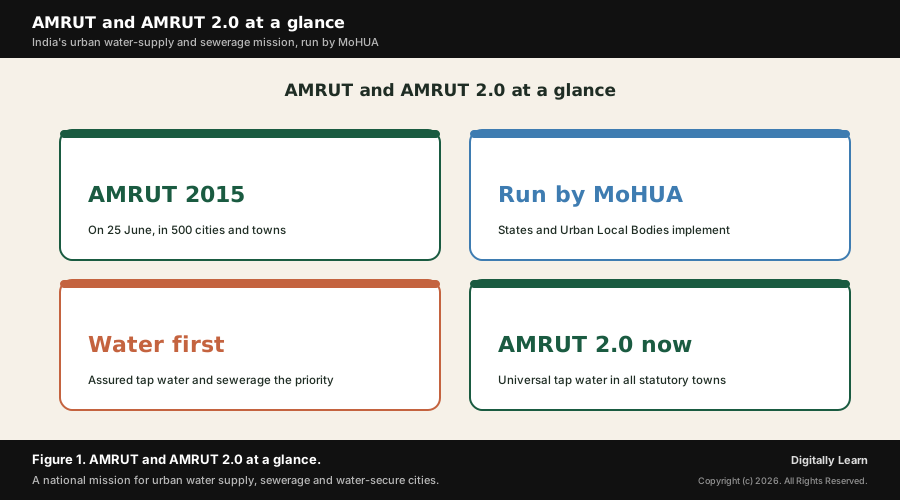
Why it matters now is that the mission has moved into a second and far more ambitious phase. The first AMRUT, to 2021, built water and sewerage infrastructure in 500 cities; the second, AMRUT 2.0, launched in 2021, widens the goal to universal tap-water coverage in every statutory town and to making cities water secure, exactly the shift a strong answer is expected to explore. The figure below sets out the headline facts.
AMRUT 1.0 (2015-2021): The 500 Cities, Thrust Areas and the Reform Agenda
The five thrust areas and how the 500 cities were chosen
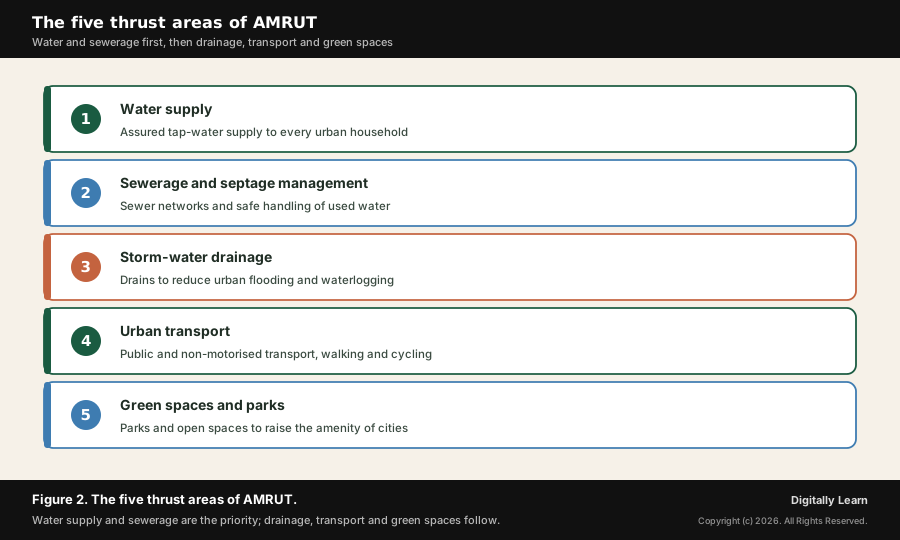
The first AMRUT, launched in 2015, concentrated its money and effort on a defined set of basic services rather than spreading thinly. Its thrust areas were, in order of priority, water supply; sewerage and septage management; storm-water drainage to reduce urban flooding; urban transport, including non-motorised options such as walking and cycling; and the development of green spaces and parks. Water supply and sewerage were given the top priority, because they shape public health most directly.
The mission covered 500 selected cities and towns, chosen mainly on population, generally those of one lakh and above, along with certain capital, heritage and hill and tourist towns. Together these accounted for a large share of India's urban population, so the mission's footprint, though limited to 500 cities, reached well beyond them in the people served. This selective, infrastructure-first design set AMRUT apart from broader urban-renewal schemes.
AMRUT also broke with the practice of approving individual projects from the centre. Instead, each State or Union Territory prepared a State Annual Action Plan, pooling its cities' proposals into one State-level plan that the Ministry approved as a whole. This shifted real planning to the States and made the mission a study in cooperative federalism: the Centre sets the framework and the funds, while the States and local bodies choose and execute the projects. The figure below sets out the thrust areas.
AMRUT's reform agenda and the strengthening of municipal finance
AMRUT was never only about pipes. A defining feature was its reform agenda, a set of governance changes that cities had to pursue alongside their projects, designed to make Urban Local Bodies more capable and financially sound. The reforms covered e-governance and online municipal services, an online building-permission system, an energy audit of water and other pumps to cut electricity waste, professional town planning, and the modernising of municipal accounts.
The most distinctive reforms aimed at municipal finance. Cities were pushed to obtain a credit rating, an independent assessment of their financial health, and the stronger among them were encouraged to raise money from the market by issuing municipal bonds. The logic was that a city which can be rated and can borrow is a city that can finance and sustain its own infrastructure, rather than depend wholly on grants from above. AMRUT thus tried to build not just assets but the institutional strength to run them.
These reforms were tied to incentives. A portion of the mission's funds was set aside to reward States and cities that completed reforms on time, turning governance change into a competitive, fund-linked goal rather than an optional add-on. The reform agenda is important for the exam because it shows that AMRUT understood the real bottleneck in Indian cities: not only a shortage of money, but the weak capacity of municipal bodies to plan, fund and maintain services over the long term.
AMRUT 2.0: Universal Tap-Water Coverage and the Circular Economy of Water
Universal water supply in all statutory towns and full sewerage in AMRUT cities
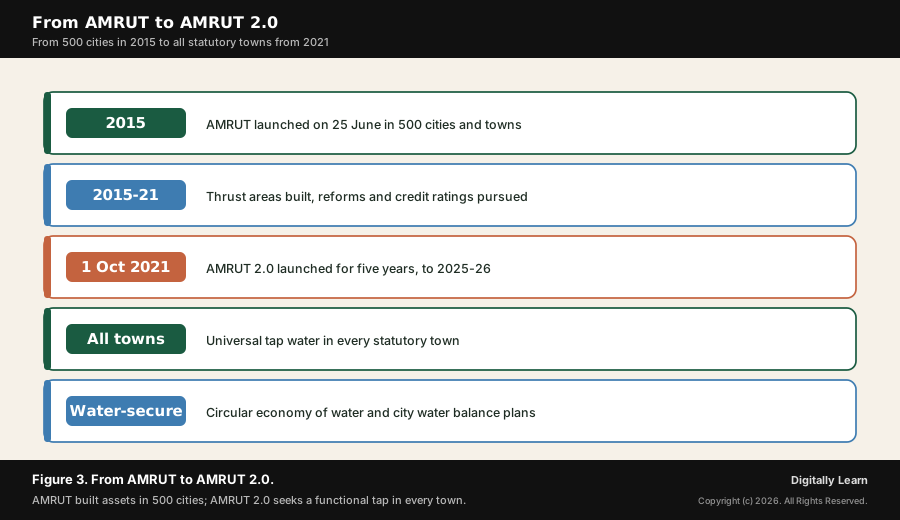
Building on the first phase, AMRUT 2.0 was launched on 1 October 2021 for five years, from 2021-22 to 2025-26, with a far wider ambition than its predecessor. Where the first AMRUT worked in 500 cities, the second aims at universal coverage: a functional tap-water connection to every household in all the country's statutory towns, of which there are roughly 4,800, and full sewerage and septage management in the 500 cities already covered under the first phase.
The scale of the targets marks the change. AMRUT 2.0 set out to add crores of new household tap connections and crores of new sewer connections across the towns of India, moving water coverage from a few hundred cities to all statutory towns. The mission carries a large total outlay running into several lakh crore rupees over its five years, the bulk of it the share of the States, with a central allocation supporting it. This makes AMRUT 2.0 one of the country's largest urban-service commitments.
The phase also embeds equity and inclusion in its design, with attention to the water needs of the urban poor, of women and of informal settlements, so that universal coverage means coverage of the households most often left out. Read together, the move from 500 cities to all statutory towns, and from building assets to guaranteeing a functional tap in every home, is the central story of the second phase. The table below contrasts the two phases.
| Aspect | AMRUT (2015-2021) | AMRUT 2.0 (from 2021) |
|---|---|---|
| Coverage | 500 selected cities and towns | All statutory towns (about 4,800) |
| Water-supply goal | Assured tap water in the 500 cities | Universal functional tap water in every town |
| Sewerage goal | Sewerage and septage in the 500 cities | Full sewerage and septage in the 500 AMRUT cities |
| Defining idea | Basic infrastructure and reforms | Water-secure cities and the circular economy of water |
| Monitoring tool | Reform incentives and progress review | Pey Jal Survekshan, the drinking-water survey |
Reading the rows together makes the shift plain: the first phase built water and sewerage assets in a chosen set of cities, while the second seeks a functional tap in every home across all towns and treats the city's whole water cycle as one system. The figure below traces how the two phases fit together.
The circular economy of water, city water balance plans and used-water reuse
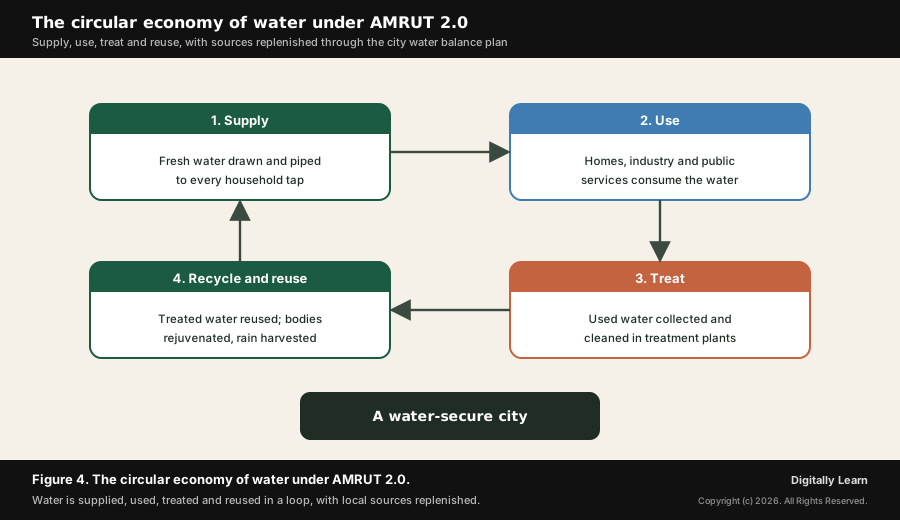
The intellectual heart of AMRUT 2.0 is the idea of a circular economy of water. Instead of treating water as a one-way flow, drawn from a source, used once and discarded as sewage, the mission asks each city to treat water as a loop, in which used water is cleaned and put back to work and local sources are protected and replenished. The aim is to make every city water secure, able to meet its needs without endlessly drawing down rivers and groundwater.
The instrument for this is the city water balance plan, which every city must prepare. It accounts for all the water a city receives and uses, and then identifies how to close the gap through the recycle and reuse of treated used water, the rejuvenation of water bodies such as lakes, ponds and wells, and water conservation. Treated used water can serve industry, gardening and other non-drinking needs, freeing fresh water for drinking, while reviving local water bodies recharges the ground beneath the city.
Two further features support this design. The mission promotes rainwater harvesting and aquifer recharge so that cities capture rain rather than let it run off, helping to reverse falling groundwater. And a Technology Sub-Mission scouts proven and promising water technologies, both Indian and global, and encourages start-ups working on low-cost equipment, so that cities adopt better ways to treat and reuse water. The figure below sets out the circular economy of water.
To drive performance, AMRUT 2.0 introduced Pey Jal Survekshan, a drinking-water survey of the AMRUT cities that ranks them on the quality, quantity and coverage of their water supply, their sewerage and septage, and their reuse of used water and care of water bodies. Conducted through self-assessment, ground inspection of treatment plants and water bodies, and citizen feedback, it turns water service into a public, competitive ranking, much as the cleanliness survey did for solid waste.
The Institutional and Financing Architecture: MoHUA, States, ULBs and the 74th Amendment
Who runs AMRUT, the role of Urban Local Bodies and how the costs are shared
AMRUT runs on a layered institutional architecture that mirrors India's federal design. At the top, the Ministry of Housing and Urban Affairs frames the mission, issues guidelines and releases central funds. Below it, the States and Union Territories, through their urban-development departments and the State-level mission machinery, approve and steer the work, and at the base the Urban Local Bodies, the municipal corporations, councils and Nagar Panchayats, are the bodies that actually build and run the water and sewerage systems.
This base layer rests on the 74th Constitutional Amendment of 1992, which gave municipalities a constitutional status and listed in the Twelfth Schedule the functions that may be devolved to them, among them water supply, sewerage and the regulation of land use. AMRUT works through these Urban Local Bodies and, through its reform agenda, tries to make them stronger, because the constitutional promise of empowered city governments has in practice often been limited by weak functional and financial devolution from the States.
The financing follows a cost-sharing pattern between the Centre and the States, with central assistance graded by the size of the city, so that smaller towns, which can raise less of their own money, receive a larger central share than the big cities. AMRUT 2.0 carries a large overall outlay over its five years, most of it the share of the States and Union Territories, supported by a central allocation. The design intends that convergence of these funds gives cities the steady money that running water and sewerage systems, not just building them, requires.
Understanding the Significance: Water Security, Public Health and Urban Governance
Water security, public health and the strengthening of city governments
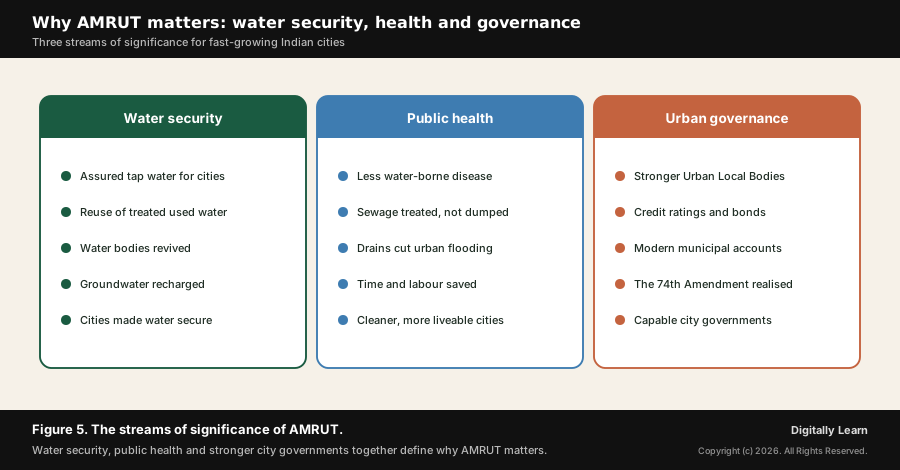
What is the significance of AMRUT lies first in urban water security. India's cities are growing fast and many face acute water stress, drawing down rivers and groundwater faster than these can recharge. By pushing assured tap water, the reuse of treated used water and the revival of local water bodies, the mission attacks the urban water problem on both the supply and the conservation side, which is why AMRUT 2.0's circular economy of water is read as a direct response to looming urban water scarcity.
Its second significance is public health and liveability. Safe piped water and proper sewerage reduce water-borne disease and stop untreated sewage from fouling rivers and groundwater, while storm-water drains lessen the urban flooding that paralyses cities in the monsoon. A household tap also saves time and labour, much of it women's, that would otherwise go into fetching and storing water, so the gain is to daily life as much as to health and the environment.
Its third significance is for urban governance. Because AMRUT works through and seeks to strengthen Urban Local Bodies, with credit ratings, municipal bonds and modern accounts, it is also an effort to make the constitutional vision of empowered city governments real. In a country urbanising rapidly, building capable, financially sound municipal bodies is itself a development goal, and AMRUT ties the delivery of water to the deeper task of city government reform. The figure below maps these strands.
Challenges and Debates: ULB Capacity, Service Sustainability and Groundwater Stress
Municipal capacity, non-revenue water, operation and maintenance, and equity
A balanced reading must weigh the debates around the mission, and the first concerns the capacity of Urban Local Bodies. Building water and sewerage systems demands technical, financial and managerial strength that many municipal bodies lack, partly because States have been slow to devolve full functions, funds and staff to them. Where city governments are weak, projects can be delayed or run poorly, which is why observers stress that the mission's reform and capacity-building side is as important as its construction side.
The second debate is the gap between building a system and running it. A pipeline or a treatment plant is easy to count once built; ensuring that it delivers continuous, good-quality water for years, with leaks fixed and bills collected, is much harder. A persistent problem is high non-revenue water, the share of treated water lost to leaks and theft before it reaches paying users, which strains both the supply and the finances. Weak operation and maintenance can leave assets underused, so sustained service, not project completion, is the true measure of success.
A third cluster of concerns is equity and groundwater stress. Universal coverage must genuinely reach the urban poor, informal settlements and smaller towns, not only the better-served areas, if it is to mean anything. At the same time, many cities still lean heavily on groundwater that is being depleted, so the success of the circular economy of water turns on whether reuse, water-body revival and rainwater harvesting actually relieve that stress. On the central question, whether AMRUT can convert assets into lasting, equitable service, a careful answer presents both sides and treats the issue as open rather than settled.
The Way Forward: From Building Assets to Sustained, Equitable Urban Water Services
Stronger city governments, lower non-revenue water and a working circular economy of water
The way forward for the mission follows directly from its central tension. The first priority is to strengthen Urban Local Bodies, with fuller devolution of functions, funds and staff under the spirit of the 74th Amendment, professional municipal cadres, and the credit ratings and own revenues that let a city finance and maintain its own services rather than wait on grants.
The second priority is to make the systems work and last: to cut non-revenue water through metering and leak repair, to fund operation and maintenance so that taps actually run, and to make the circular economy of water real through the reuse of treated used water, the revival of water bodies and rainwater harvesting, so that cities become genuinely water secure. The third priority is to keep coverage equitable, reaching the urban poor, informal settlements and smaller towns, so that universal tap water is universal in fact. Pursued together, these turn one-time assets into a lasting culture of reliable urban water service.
UPSC Relevance and Exam Focus
Where AMRUT fits in the UPSC-CSE syllabus
This topic maps most directly to General Studies Paper II: government policies and interventions for development in various sectors, and issues arising out of their design and implementation; and the functioning of local self-government, since AMRUT is a flagship urban scheme delivered through Urban Local Bodies. It also links to General Studies Paper I, urbanisation and its problems, and to General Studies Paper III, infrastructure and conservation, through urban water security and the management of water resources.
For Prelims, hold the high-yield facts: AMRUT was launched on 25 June 2015 in 500 cities by the Ministry of Housing and Urban Affairs; its thrust areas are water supply, sewerage and septage, storm-water drainage, urban transport and green spaces, with water and sewerage the priority; AMRUT 2.0 was launched on 1 October 2021 for universal tap water in all statutory towns and a circular economy of water through the city water balance plan; and Pey Jal Survekshan is its drinking-water survey, distinct from the Swachh Survekshan cleanliness survey.
For Mains, the recurring framing is to assess the mission's design and outcomes: how a scheme run through Urban Local Bodies can deliver assured water at scale, how the circular economy of water responds to urban water stress and depleting groundwater, and how far AMRUT has closed the gap between assets built and services delivered. A strong answer treats it as a case study in urban governance and cooperative federalism, balancing achievements against unresolved questions of municipal capacity, sustainability and equity.
Recurring linked concepts an aspirant should keep in working memory:
- Circular economy of water: Treating a city’s water as a loop, in which used water is treated and reused and local sources are protected, so that the city becomes water secure rather than drawing endlessly on fresh sources.
- City water balance plan: The plan every AMRUT 2.0 city prepares to account for all its water and to close the gap through reuse, water-body revival and conservation.
- Urban Local Bodies and the 74th Amendment: The municipal corporations, councils and Nagar Panchayats that deliver urban services, given constitutional status by the 74th Amendment, through whom AMRUT works.
- Non-revenue water: The share of treated water lost to leaks and theft before reaching paying users, a key measure of how well a water system is run.
A common Prelims trap is to confuse AMRUT with the Smart Cities Mission, launched the same day, or with the rural water mission; hold that AMRUT is the urban water-supply and sewerage mission under MoHUA, with Pey Jal Survekshan its survey, distinct from Smart Cities and from the rural drinking-water programme.
A common Mains trap is to recite targets and outlays alone. The exam value lies in a balanced judgment: the genuine gains in urban water and sewerage infrastructure and in the idea of water-secure cities, set honestly against the open questions of municipal capacity, non-revenue water, operation and maintenance, equity and groundwater stress.
Previous Year UPSC-CSE Questions By the end you will be able to draft model answers for the following UPSC questions. Each question carries a collapsible framework showing how to approach it in the exam.
- UPSC Mains 2018 GS-IExamine whether water harvesting is the ideal solution to India's depleting groundwater, and discuss how such a system can be made effective specifically in urban areas.
How to structure the answer in the exam
Body (sub-themes to develop):
- The problem: fast urbanisation and over-extraction deplete urban groundwater faster than it recharges, making cities water-stressed and unsustainable.
- Water harvesting as a solution: capturing rainwater and recharging aquifers so that cities retain rather than lose rain, as AMRUT 2.0 promotes through rainwater harvesting and aquifer recharge.
- Embedding harvesting in a circular economy of water: the city water balance plan, the reuse of treated used water for non-drinking needs, and the rejuvenation of water bodies, wells and ponds that recharge the ground.
- Making it effective in urban areas: stronger Urban Local Bodies under the 74th Amendment, the cutting of non-revenue water, funded operation and maintenance, and the Technology Sub-Mission that brings proven water technologies.
- Equity and sustainability: extending harvesting and recharge across all statutory towns and to the urban poor and informal settlements, so that the gains are universal and lasting.
Sources and Further Reading
- Ministry of Housing and Urban Affairs: The Mission, Atal Mission for Rejuvenation and Urban Transformation
- Atal Mission for Rejuvenation and Urban Transformation: About Reforms
- Press Information Bureau: AMRUT Scheme
- Press Information Bureau: Prime Minister launches AMRUT 2.0 and Swachh Bharat Mission-Urban 2.0
- Press Information Bureau: AMRUT 2.0 aims to provide water supply through functional taps to all households in statutory towns
- Press Information Bureau: AMRUT 2.0 envisages to make cities water secure through the circular economy of water
- Press Information Bureau: Ministry of Housing and Urban Affairs starts ground survey of Pey Jal Survekshan under AMRUT 2.0
- Ministry of Housing and Urban Affairs: AMRUT 2.0 Operational Guidelines
- Ministry of Housing and Urban Affairs: The Constitution (74th Amendment) Act, 1992, Background
- NITI Aayog: SDG Goal 6, ensure availability and sustainable management of water and sanitation for all
- National Portal of India: The Constitution (Seventy-fourth Amendment) Act, 1992
- Wikipedia: Atal Mission for Rejuvenation and Urban Transformation
- Wikipedia: Seventy-fourth Amendment of the Constitution of India
Editorial Disclaimer
This briefing is for UPSC preparation. Verify the facts and provisions against the official MoHUA, AMRUT and PIB sources before relying on them.


