


Overview
Sanitation, an open defecation free India and the move to ODF Plus
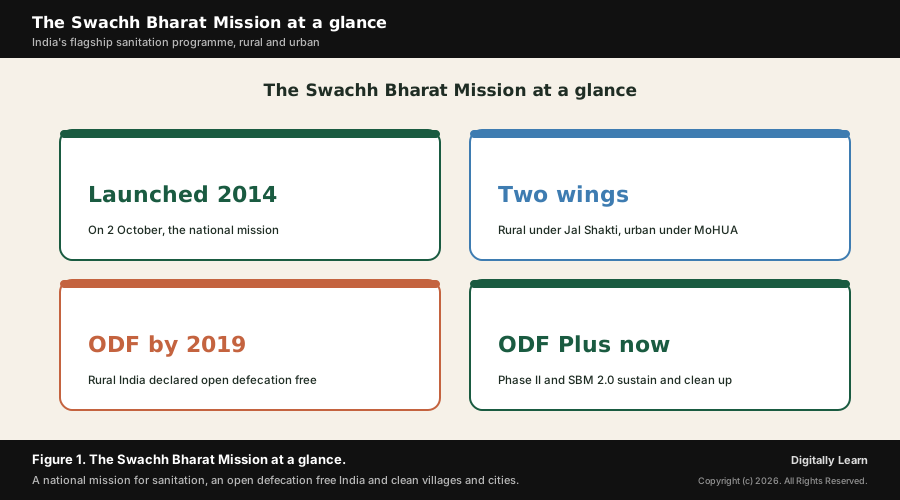
The Swachh Bharat Mission, launched on 2 October 2014, is India's flagship sanitation programme, run as a rural wing under the Ministry of Jal Shakti and an urban wing under the Ministry of Housing and Urban Affairs.
The Swachh Bharat Mission (SBM), or Clean India Mission, is the Government of India's flagship sanitation programme, launched on 2 October 2014. It runs through two wings: Swachh Bharat Mission-Gramin (SBM-G), the rural wing under the Department of Drinking Water and Sanitation in the Ministry of Jal Shakti, and Swachh Bharat Mission-Urban (SBM-U), the urban wing under the Ministry of Housing and Urban Affairs. Its first phase set out to end open defecation through household and community toilets and behaviour change, and on 2 October 2019 rural India declared itself Open Defecation Free (ODF). Its second phase, SBM 2.0, has shifted from building toilets to sustaining that gain and managing solid, liquid, plastic and faecal-sludge waste, toward 'ODF Plus' villages and garbage-free cities. It is as much a story of public health and dignity, especially for women, as of toilets.
What the Swachh Bharat Mission Is: A National Drive for a Clean India
India's flagship sanitation mission and why it is in focus
The Swachh Bharat Mission, or Clean India Mission, is the Government of India's flagship effort to make the country clean and free of open defecation. Launched on 2 October 2014, the birth anniversary of Mahatma Gandhi, it set out to give every household a toilet, change the habits that kept open defecation alive, and manage the waste villages and cities generate. It is one of the largest sanitation programmes ever attempted.
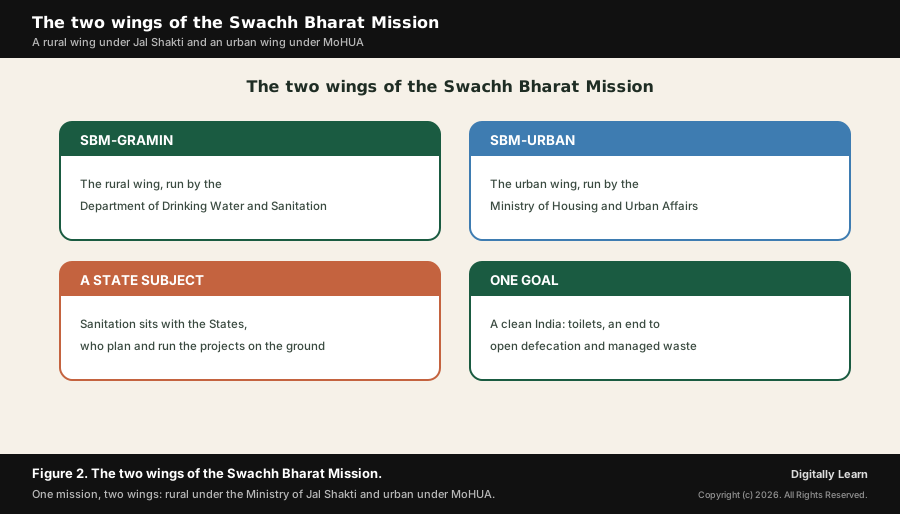
The mission runs through two wings that share one goal. Swachh Bharat Mission-Gramin (SBM-G) is the rural wing, run by the Department of Drinking Water and Sanitation in the Ministry of Jal Shakti, and Swachh Bharat Mission-Urban (SBM-U) is the urban wing, run by the Ministry of Housing and Urban Affairs. Because sanitation is a State subject under the Seventh Schedule, the States and the local bodies plan, build and run the work, with the Centre setting the framework and the funds.
Why it matters now is that the mission has moved through two distinct phases. Its first phase, to 2019, was a sprint to end open defecation, and on 2 October 2019 rural India declared itself open defecation free. Its second phase, SBM 2.0, has turned to the harder task of sustaining that gain and cleaning up the country's waste, exactly the shift a good answer is expected to explore. The figure below sets out the headline facts.
The Two Wings: SBM-Gramin and SBM-Urban
How the rural and urban wings divide the work of sanitation
The mission's design rests on a clear division of labour between its two wings. SBM-Gramin, the rural wing, carries the heaviest historical burden, because open defecation was concentrated in the countryside. Run by the Department of Drinking Water and Sanitation under the Ministry of Jal Shakti, with the State rural development and panchayat machinery, it works through the Gram Panchayat and the village community to build toilets, drive behaviour change and manage rural waste.
SBM-Urban, the urban wing, addresses the distinct problems of towns and cities, where the challenge is less about a single household toilet and more about community and public toilets, the daily collection and scientific processing of municipal waste, and the cleanliness of dense, built-up areas. Run by the Ministry of Housing and Urban Affairs, it works through the Urban Local Bodies, the municipal corporations and councils that deliver civic services.
Holding the two wings together is the constitutional fact that sanitation is a State subject. The Union government frames the mission, sets the standards and provides a large part of the money, but the States and the local bodies, rural and urban, are the implementing authorities who plan, design, execute and operate the projects. This makes the mission a study in cooperative federalism as much as in sanitation. The figure below sets out the two wings.
Phase I (2014-2019): Toilets, Behaviour Change and the ODF Declaration
Building toilets, changing behaviour and the 2 October 2019 ODF milestone
The first phase, from 2014 to 2019, had a single, focused aim: to make India Open Defecation Free (ODF) by 2 October 2019, the 150th birth anniversary of Mahatma Gandhi. The chosen instrument was the toilet: Individual Household Latrines for families and Community Sanitary Complexes where households could not build their own. To make a toilet affordable, SBM-Gramin offered an incentive of twelve thousand rupees for each rural latrine built by an eligible family.
Crucially, the planners understood that building toilets alone had failed before, and that the real obstacle was behaviour. Earlier sanitation programmes had focused on construction with little stress on changing habits, and many toilets went unused. SBM therefore put behaviour-change communication at its centre, becoming the world's largest such programme, with mass campaigns, village-level motivators known as Swachhagrahis, and community-led efforts to make open defecation socially unacceptable rather than merely to hand out subsidies.
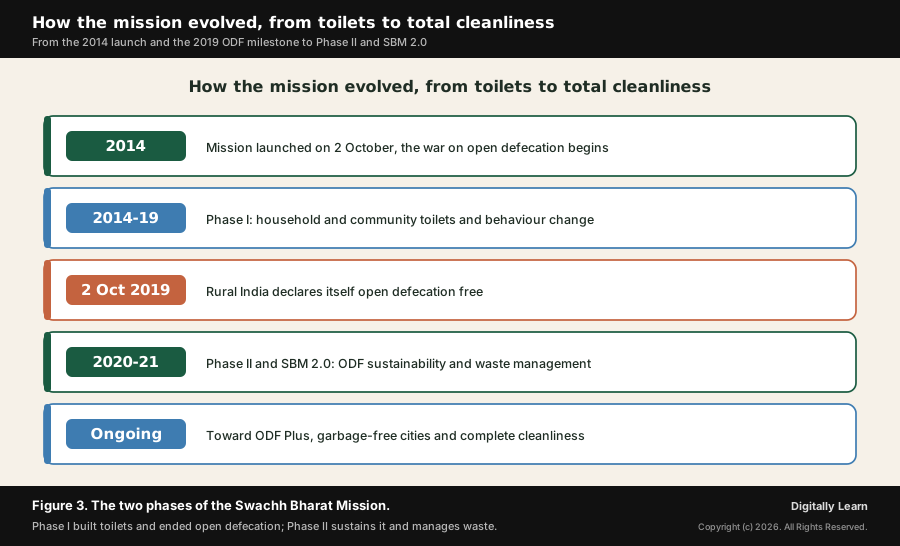
Phase I also carried a deeper social aim: the eradication of manual scavenging, the degrading and hazardous manual handling of human waste, by promoting safe, twin-pit toilet designs that do not require it. On 2 October 2019, the mission reached its headline milestone when rural India was declared open defecation free, which the government has presented as reached eleven years ahead of the global sanitation deadline. A figure later in this article traces the two phases.
It is important to read this milestone with care. The declaration of ODF status was a genuine achievement in access and behaviour, but, as the debates section sets out, critics caution that a declaration is not the same as permanent, universal usage. The honest reading is that Phase I dramatically widened access to toilets and shifted social norms, while leaving the questions of lasting usage and sustainability for the second phase to answer.
Phase II and SBM 2.0 (from 2020-21): ODF Plus, Waste and Garbage-Free Cities
SBM-Gramin Phase II, ODF Plus and the waste-management verticals
Having ended open defecation in name, the mission entered a second phase from 2020-21 that is far harder and longer. SBM-Gramin Phase II, with a large outlay, rests on two pillars: ODF sustainability, keeping villages genuinely free of open defecation, and solid and liquid waste management, so that villages are not just toilet-equipped but visibly clean. The guiding vision is what the government calls Sampoorna Swachhata, or complete cleanliness.
The phase introduces the idea of an ODF Plus village, with three progressive stages. An ODF Plus Aspiring village sustains its ODF status and manages either solid or liquid waste; an ODF Plus Rising village manages both; and an ODF Plus Model village manages both, achieves visual cleanliness with minimal litter, stagnant water and plastic, and displays cleanliness messages. This ladder lets a village move up step by step rather than face a single, distant target.
Underneath these stages sit the waste-management verticals that do the real work: biodegradable solid waste management, plastic waste management, greywater or liquid waste management, and faecal-sludge management, supported by the GOBARdhan programme that turns cattle and organic waste into biogas and compost, and by continued information and behaviour-change work. The table below contrasts the focus of the two phases.
| Aspect | Phase I (2014-2019) | Phase II / SBM 2.0 (from 2020-21) |
|---|---|---|
| Core aim | End open defecation | Sustain ODF status and manage waste |
| Headline goal | Open Defecation Free India | ODF Plus villages and garbage-free cities |
| Main instrument | Household and community toilets | Waste-management systems and behaviour change |
| Rural marker | ODF declaration | ODF Plus: Aspiring, Rising and Model |
| Urban marker | Toilets and ODF status | Source segregation and scientific processing |
Reading the rows together makes the shift plain: the first phase was about access and ending open defecation, while the second is about sustaining that gain and cleaning up the waste a clean India must still manage. The figure below shows how the two phases fit together.
SBM-Urban 2.0, garbage-free cities and used-water management
In the cities, SBM-Urban 2.0 was launched on 1 October 2021 for five years, with a large outlay of around one lakh forty-one thousand crore rupees. Its central vision is the garbage-free city: every city handling all its waste cleanly, through complete source segregation of waste at the household, door-to-door collection, and scientific processing of every fraction of municipal solid waste using the principles of reduce, reuse and recycle.
A major new task in the urban phase is the remediation of legacy dumpsites, the old mountains of mixed garbage that scar many cities, by clearing and reclaiming them as green land. Alongside this, the phase introduces dedicated used-water management, the safe handling of faecal sludge, septage and wastewater, especially in smaller cities, and an intensified drive on plastic-waste management, so that the urban environment is cleaned at source as well as at the dump.
To drive performance, the urban mission relies heavily on Swachh Survekshan, an annual cleanliness survey of urban local bodies conducted through independent assessment, which has grown into one of the world's largest such surveys and turns cleanliness into a public, competitive ranking among cities. Together, ODF Plus in the villages and garbage-free status in the cities define what the mission's second phase means by a genuinely clean India.
The Institutional and Financing Architecture: Who Runs It and Who Pays
Centre, States and local bodies, and how the costs are shared
The mission runs on a layered institutional architecture that mirrors India's federal design. At the top, the Department of Drinking Water and Sanitation runs the rural wing and the Ministry of Housing and Urban Affairs runs the urban wing, each setting policy, guidelines and funds. Below them, the States and Union Territories, through their sanitation departments and State-level missions, are the implementing authorities, and at the base the Gram Panchayats in villages and the Urban Local Bodies in towns deliver and operate the work.
The financing follows a cost-sharing formula between the Centre and the States. Under SBM-Gramin the fund-sharing pattern is ninety to ten for the North-Eastern and Himalayan States and the Union Territory of Jammu and Kashmir, sixty to forty for the other States, and one hundred per cent central funding for the other Union Territories. The household-toilet incentive in rural areas was set at twelve thousand rupees, shared in these proportions, putting real money behind each new latrine.
A distinctive feature of the second phase is its reliance on convergence rather than a single budget line. SBM-Gramin Phase II dovetails several funding sources: its own grants, the Fifteenth Finance Commission grants tied to sanitation for rural local bodies, and the rural employment guarantee programme for waste-management assets. This pooling is meant to give villages the steady money that operation and maintenance, not just one-time construction, require, a lesson in financing a welfare mission for the long term.
Understanding the Significance: Public Health, Dignity, Women and the SDGs
Health, the dignity and safety of women, and the Sustainable Development Goals
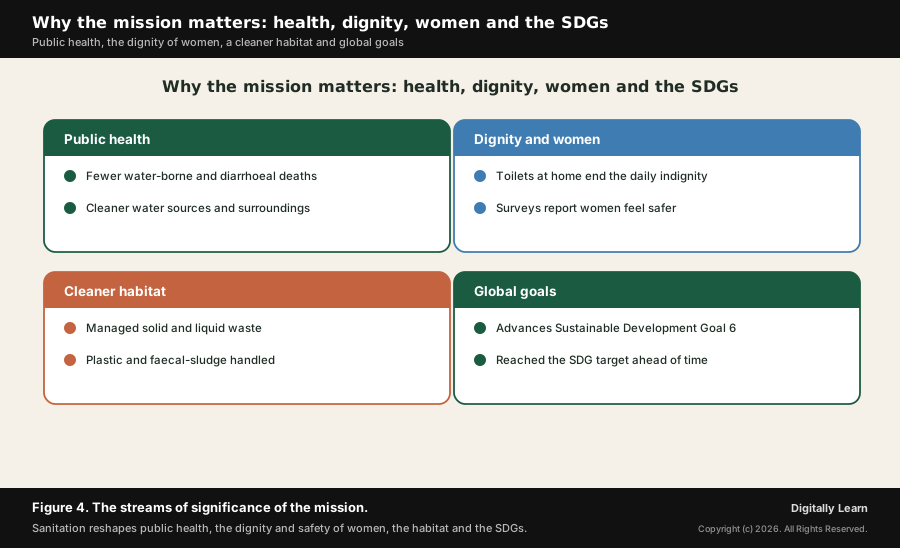
What is the significance of the Swachh Bharat Mission lies first in public health. Open defecation spreads disease through contaminated water and soil, driving diarrhoea, cholera and other infections that fall hardest on children and stunt their growth. By moving households to safe toilets, the mission attacks this burden at its source; the World Health Organization has linked the programme to a large fall in diarrhoeal deaths, stating that it averted a great many such deaths in rural India.
Its second significance is dignity, and here the gain to women is central. Where there is no toilet, women and girls must wait for darkness and walk to the fields, an indignity that also exposes them to harassment and forces them to suppress basic needs. A toilet at home restores their privacy and safety; surveys under the mission report that the great majority of women felt safer once their household had one, which is why it is read as much a question of social empowerment as of sanitation.
Its third significance is its place in global development goals. Sanitation for all is Sustainable Development Goal 6.2, and the mission is India's principal vehicle for reaching it; the government has presented India as attaining that sanitation target well ahead of the United Nations' 2030 deadline, and UNICEF has described SBM as one of the world's largest sanitation drives. Clean surroundings and the dignity of a household toilet thus tie a national mission to the world's shared goals. The figure below maps these strands.
Challenges and Debates: Usage, Sustainability, Manual Scavenging and Waste
Usage versus construction, ODF sustainability and the waste-management gaps
A balanced reading must weigh the debates around the mission, and the first is the gap between a toilet built and a toilet used. A latrine on the ground is easy to count; ensuring that every household member actually uses it, day after day, is much harder, because usage is a matter of behaviour and of having water and upkeep. Critics caution that construction figures and ODF declarations can outrun real, sustained usage, which is why the second phase shifted attention to sustainability and behaviour.
The second debate is ODF sustainability after the headline declaration. Keeping villages and cities genuinely free of open defecation requires that toilets be maintained, that pits be safely emptied, that water be available, and that new households and growing populations be covered. Where local capacity, funds or motivation fall short, places declared ODF can slip back, which is why institutional strengthening and steady financing for upkeep matter as much as the original construction drive.
A third cluster of concerns is manual scavenging and waste management. Despite the law against it and the mission's promotion of safe toilet designs, the hazardous manual handling of human waste has not been fully ended, a continuing stain on the sanitation effort. Beyond toilets, the management of solid, liquid, plastic and faecal-sludge waste, the core of the second phase, remains uneven. On the central dispute, between those who stress mass access and ODF status and those who stress unresolved usage, sustainability and waste gaps, a careful answer presents both sides and treats the question as open rather than settled.
The Way Forward: From Building Toilets to Sustaining a Clean India
Usage, ODF sustainability, waste management and the end of manual scavenging
The way forward for the mission follows directly from its central tension. The first priority is to complete the shift from counting toilets to guaranteeing their use, sustaining behaviour change so that every household uses a safe toilet every day, supported by water, upkeep and continued community motivation rather than one-time subsidy.
The second priority is to make ODF Plus real: to sustain open defecation free status and build the full set of waste-management systems in every village, and the garbage-free city, with source segregation, scientific processing and the clearing of legacy dumpsites, in every town. The third priority is to end manual scavenging for good through safe technology and rehabilitation, and to keep financing steady through convergence so that operation and maintenance are paid for. Pursued together, these turn a one-time milestone of toilets into a lasting culture of cleanliness.
UPSC Relevance and Exam Focus
Where the Swachh Bharat Mission fits in the UPSC-CSE syllabus
This topic maps most directly to General Studies Paper II: welfare schemes for vulnerable sections, and issues relating to the development and management of the social sector relating to health, since sanitation is a determinant of public health and SBM is a flagship welfare programme. It also touches the role of women and social empowerment in General Studies Paper I, through the dignity and safety that a household toilet gives, and links to governance and cooperative federalism.
For Prelims, hold the high-yield facts: SBM was launched on 2 October 2014; it runs as SBM-Gramin under the Ministry of Jal Shakti and SBM-Urban under the Ministry of Housing and Urban Affairs; sanitation is a State subject; rural India was declared open defecation free on 2 October 2019; and Phase II and SBM 2.0 focus on ODF sustainability and waste management, with the ODF Plus categories of Aspiring, Rising and Model, the urban vision of garbage-free cities and the Swachh Survekshan survey.
For Mains, the recurring framing is to assess the mission's design and its outcomes: how a behaviour-change and community-driven model delivers lasting sanitation, how it advances public health and the dignity of women, and how far it has closed the gap between toilets built and toilets used. A strong answer treats it as a case study in social-sector delivery and cooperative federalism, balancing achievements against unresolved usage, sustainability, manual scavenging and waste.
Recurring linked concepts an aspirant should keep in working memory:
- Open Defecation Free and ODF Plus: An ODF area is free of open defecation; an ODF Plus area also sustains that status and manages its solid and liquid waste, across the Aspiring, Rising and Model stages.
- Behaviour-change communication: The mass effort, through campaigns and village-level Swachhagrahis, to make people use toilets and reject open defecation, not merely to build latrines.
- The two wings: SBM-Gramin under the Ministry of Jal Shakti for villages and SBM-Urban under the Ministry of Housing and Urban Affairs for towns and cities.
- Sustainable Development Goal 6: The global goal of clean water and sanitation for all, which the mission is India’s principal vehicle to advance.
A common Prelims trap is to confuse SBM with river-cleaning or pure waste-regulation programmes, or to mix up its two wings; hold that SBM is the sanitation mission, distinct from river rejuvenation, with a rural wing under Jal Shakti and an urban wing under MoHUA.
A common Mains trap is to praise toilet-construction numbers alone. The exam value lies in a balanced judgment: the genuine gains in access, public health and the dignity of women, set honestly against the open questions of usage, ODF sustainability, the persistence of manual scavenging and the gaps in solid, liquid and plastic waste management.
Previous Year UPSC-CSE Questions By the end you will be able to draft model answers for the following UPSC questions. Each question carries a collapsible framework showing how to approach it in the exam.
- UPSC Mains 2019 GS-IIDiscuss whether the weak performance of welfare schemes for vulnerable sections is due to the absence of beneficiaries' awareness and their active involvement at all stages of the policy process.
How to structure the answer in the exam
Body (sub-themes to develop):
- The scheme and its beneficiaries: SBM as a welfare and social-sector mission reaching households that lacked toilets, including the rural poor, women and the disadvantaged, with public-health, dignity and women's-safety stakes.
- Why awareness is decisive: earlier construction-only sanitation programmes failed for lack of behaviour change, so SBM placed behaviour-change communication, the world's largest such programme, and village-level Swachhagrahis at its centre to make people use toilets rather than merely receive them.
- Active involvement at all stages: the community-led, demand-driven model through Gram Panchayats and Urban Local Bodies, community participation in planning and in declaring and verifying ODF status, and the move to community ownership.
- Effectiveness and its limits: genuine gains in access and the 2019 ODF declaration set against the gap between toilets built and toilets used, ODF sustainability and the waste-management gaps that the second phase addresses.
- Where involvement was absent: the lesson that toilets built without awareness and ownership go unused, manual scavenging persists and ODF status can slip, confirming that beneficiary participation is central to performance.
Sources and Further Reading
- Press Information Bureau: Year End Review, Department of Drinking Water and Sanitation, Ministry of Jal Shakti
- Press Information Bureau: Objectives Achieved under the Swachh Bharat Mission
- Ministry of Jal Shakti, Press Information Bureau: Swachh Bharat Mission-Grameen factsheet
- Press Information Bureau: Garbage Free Cities under SBM-Urban 2.0
- Press Information Bureau: Criteria to declare ODF Plus villages
- Press Information Bureau: Cabinet approves the continuation of Swachh Bharat Mission (Urban) till 2025-26
- Department of Drinking Water and Sanitation: Swachh Bharat Mission-Grameen Phase II Guidelines
- Ministry of Housing and Urban Affairs: Swachh Bharat Mission-Urban
- NITI Aayog: SDG Goal 6, water and sanitation for all
- Ministry of Finance: Economic Survey 2019-20, An Analysis of the Swachh Bharat Mission
- Wikipedia: Swachh Bharat Mission
- Wikipedia: Open defecation
Editorial Disclaimer
This briefing is for UPSC preparation. Verify the facts and provisions against the official Ministry of Jal Shakti, MoHUA and PIB sources before relying on them.


