

Overview
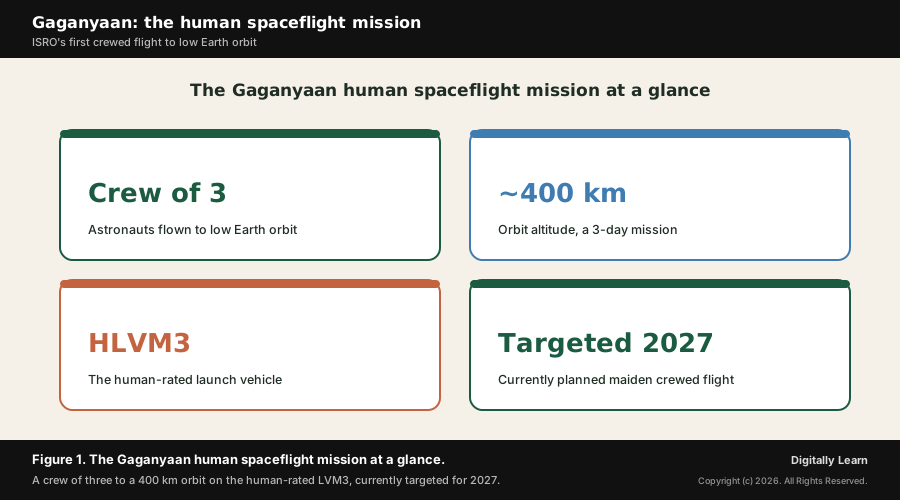
Gaganyaan is India's first human spaceflight mission, run by the Indian Space Research Organisation, ISRO. Its objective is to demonstrate human spaceflight capability by launching a crew of three to a low Earth orbit of about 400 km for a three-day mission, and bringing them back safely with a splashdown in Indian sea waters. The crew flies on the human-rated launch vehicle, the LVM3, in an orbital module made up of a crew module and a service module, protected by a crew escape system. The programme builds toward a maiden crewed flight, currently targeted for 2027, after a sequence of abort tests and an uncrewed orbital flight.
What Gaganyaan Is: India's First Human Spaceflight Mission
ISRO's plan to send a crew of three to low Earth orbit
Gaganyaan, from the Sanskrit for sky craft, is India's first human spaceflight mission. It is led by the Indian Space Research Organisation, ISRO, and its stated objective is to demonstrate that India can launch human beings into space and bring them home safely. Achieving this would place India among a small group of nations with an independent human-spaceflight capability.
The mission profile is precise. ISRO plans to launch a crew of three astronauts into a low Earth orbit of about 400 km, for a mission of up to three days, and then return them to Earth. The crew comes back by splashdown, with the cabin descending under parachutes for a landing in Indian sea waters, a method chosen for a gentler, safer recovery.
Gaganyaan is therefore a capability demonstration first of all. It proves the full chain of human spaceflight: a human-rated rocket, a habitable capsule, life support, a way to abort safely in an emergency, and a controlled return. The figure below sets out the mission at a glance.
Why Gaganyaan Is in the News: The Programme Enters Its Final Phase
The uncrewed flight campaign and an Indian on the space station
Why it matters now is that the Gaganyaan programme has, in the words of the Department of Space, entered its final phase. The launch campaign for the first uncrewed orbital flight, known as G1, has commenced at the Satish Dhawan Space Centre at Sriharikota, where the human-rated LVM3 is being assembled. This is the last major rehearsal before astronauts fly.
A second milestone has sharpened the spotlight. In 2025, Group Captain Shubhanshu Shukla, one of the Gaganyaan astronaut-designates, flew to the International Space Station on the Axiom-4 mission, becoming the first ISRO astronaut aboard the station. The flight, of about eighteen days, gave India direct, first-hand experience of crewed operations ahead of Gaganyaan.
Together these events signal that Gaganyaan has moved from design and ground testing toward real flight. With the uncrewed campaign under way and an Indian freshly returned from orbit, the maiden crewed mission, currently targeted for 2027, is now in clear view, which is why the programme keeps returning to the news.
Understanding the Significance of Gaganyaan for India
Self-reliant technology, an ecosystem and national prestige
What is the significance of Gaganyaan lies first in self-reliance. Mastering human-rated launch, life support and crew-escape technology gives India an indigenous capability that very few countries possess, and that cannot simply be bought. It would make India only the fourth nation, after the former Soviet Union, the United States and China, to fly humans on its own rockets.
Its second significance is the high-technology ecosystem the mission builds. Human-rating a rocket and a capsule demands advances in materials, electronics, life-support engineering and quality control, and these spin-offs flow into industry, start-ups and academia. A crewed programme also draws young people into science, a powerful source of inspiration.
Beyond that, Gaganyaan carries weight as national prestige and as a stepping stone. A successful human flight signals India's arrival as a front-rank space power and lays the groundwork for larger ambitions, an Indian space station and, in time, a crewed lunar mission. It also deepens international cooperation, seen in the Axiom partnership with NASA.
How Gaganyaan Works: The Human-Rated LVM3, Orbital Module and Crew Escape System
The human-rated LVM3 launch vehicle
Gaganyaan flies on the LVM3, the Launch Vehicle Mark-3, ISRO's most powerful and reliable heavy-lift rocket, already proven on missions such as Chandrayaan. For a crewed flight, however, every system must be made far safer, a process called human-rating, and the upgraded rocket is christened the Human Rated LVM3, or HLVM3.
Human-rating means re-configuring the launch vehicle to much tighter margins of reliability and redundancy, so that a single failure is far less likely to endanger the crew, and adding the ability to sense trouble and respond in an instant. The rocket carries the orbital module to orbit and must protect the astronauts from lift-off through ascent.
The spacecraft: a habitable cabin joined to a support section
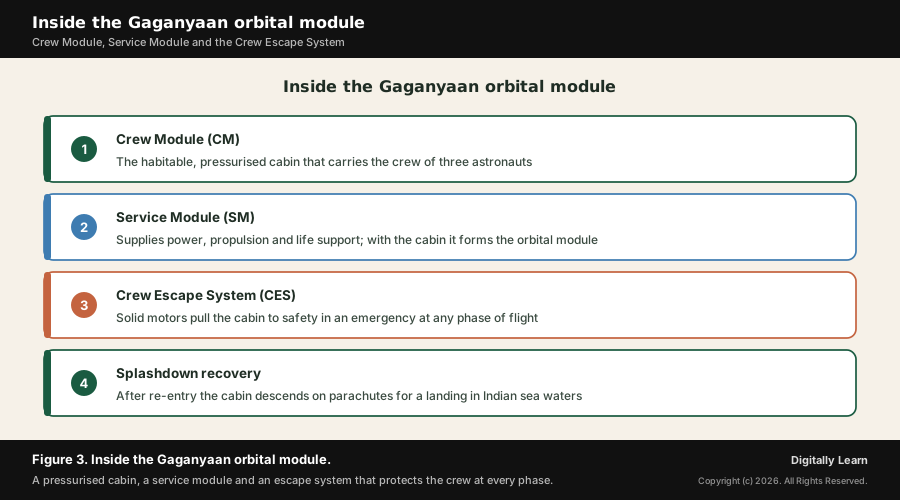
The spacecraft that goes into orbit is the orbital module, made of two joined parts. The Crew Module, or CM, is the habitable, pressurised cabin in which the three astronauts live and work; it is the part that re-enters the atmosphere and returns to Earth. It must hold a breathable, controlled environment throughout the flight.
Attached to it is the Service Module, or SM, which supplies power, propulsion, and the life-support resources the crew needs, and which is discarded before re-entry. Together the crew module and the service module make up the orbital module. The table below sets out the main parts of the spacecraft and their roles.
| Element | What it is | Main role |
|---|---|---|
| Crew Module (CM) | Pressurised, habitable cabin | Carries and protects the crew; re-enters and returns to Earth |
| Service Module (SM) | Unpressurised support section | Provides power, propulsion and life-support resources in orbit |
| Crew Escape System (CES) | Solid-motor escape tower | Pulls the crew module to safety in an emergency |
Read together, the three rows show the logic of the design: a protected cabin for the crew, a support section that does the work of keeping them alive in orbit, and an escape system that guards them when things go wrong.
The Crew Escape System, life support and a safe return
The single most important safety feature is the Crew Escape System, or CES. It is a set of quick-acting solid motors that can pull the crew module, with the astronauts inside, to a safe distance in case of any emergency, whether on the launch pad or during the ascent. This ability to abort at any phase of flight is what makes a rocket fit to carry people.
Keeping the crew alive in orbit is the job of the life-support system, which maintains breathable air, the right pressure and temperature, and manages carbon dioxide and humidity inside the cabin. ISRO lists life support and crew escape among the major new technologies the programme had to develop, since neither is needed for an ordinary satellite launch.
The flight ends with a controlled return. The crew module separates, re-enters the atmosphere protected by a heat shield, and descends under parachutes to a splashdown in the sea, where recovery teams retrieve the cabin. The figure below shows the parts of the orbital module and how the crew is protected.
The Gaganyaan Roadmap: From Abort Tests to the Crewed Flight
Abort tests, an uncrewed flight and the crewed mission
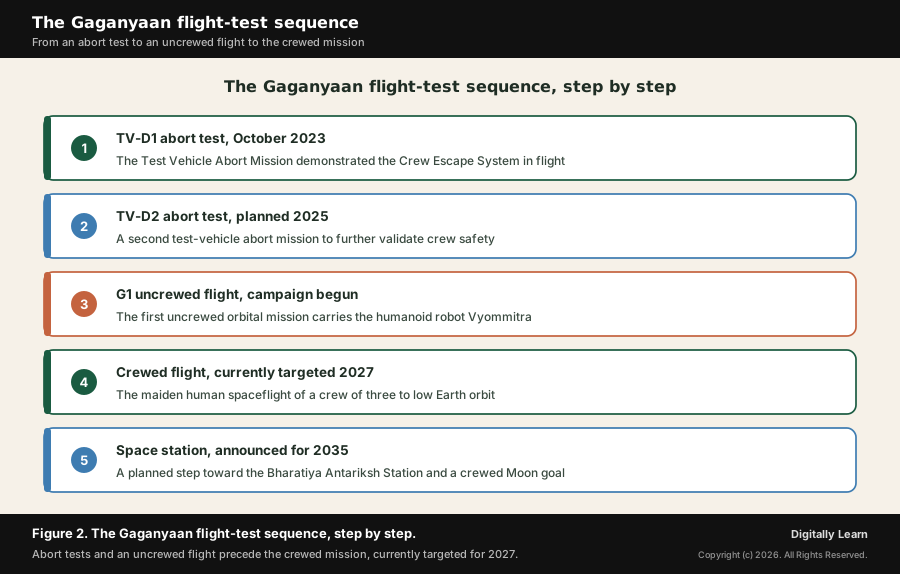
Gaganyaan is being built up through a careful sequence of tests, each proving one more piece before astronauts fly. The first major step, the Test Vehicle Abort Mission known as TV-D1, was conducted successfully in October 2023. A single-engine test rocket carried a crew-module model aloft and demonstrated the Crew Escape System in flight, with the cabin separating and being recovered safely.
Further abort tests follow, including a second test-vehicle mission, TV-D2, planned for 2025, to validate crew safety across more conditions. After these come the uncrewed orbital flights. The first, G1, whose launch campaign has begun, will fly the full spacecraft without a crew to prove the rocket, the capsule and the return work end to end before anyone is aboard.
The first uncrewed flight carries an unusual passenger: Vyommitra, a female-looking humanoid robot built by ISRO. Vyommitra is designed to mimic human functions, interact with the life-support system and report how the cabin behaves, acting as a stand-in crew member so that engineers can study the conditions a human would face. The figure below lays out the test sequence.
The Gaganyatris: India's first astronaut-designates
The people who will fly are already chosen. Four Indian Air Force test pilots, the Gaganyatris, have been selected as astronaut-designates and are in training, having completed an initial phase abroad and now undergoing mission-specific preparation in India. Their health, fitness and operational readiness are assessed continuously at the astronaut training facility.
One of the four, Group Captain Shubhanshu Shukla, gained real spaceflight experience ahead of the mission by flying to the International Space Station on the Axiom-4 mission in 2025, the first ISRO astronaut to reach the station. His roughly eighteen-day flight, covering hundreds of orbits, lets India learn crewed operations directly before Gaganyaan flies its own crew.
Benefits and Challenges of Gaganyaan: Technology, Economy and the Debate
The technological and economic benefits of a manned mission
The technological benefits of a crewed mission are substantial. Human-rating a rocket and a capsule forces breakthroughs in life support, escape systems, reliable avionics, advanced materials and rigorous quality control. These hard-won capabilities flow outward as spin-offs, in medicine, robotics, materials and software, much as earlier space programmes seeded technologies now used on the ground.
A crewed platform also opens a unique scientific dividend in microgravity research. As NASA Science notes for the International Space Station, the weightless environment lets researchers observe biological and physical processes that gravity normally masks, advancing life sciences and medicine in ways not possible on Earth. The Axiom-4 flight that took Group Captain Shubhanshu Shukla to the station gave India direct entry into this kind of orbital experimentation, a capability Gaganyaan will carry forward.
The economic benefits follow from that ecosystem. A human-spaceflight programme creates high-skill jobs, draws private industry and start-ups into a growing space economy, and builds an indigenous capability that reduces dependence on others and can eventually be offered as a service. It also strengthens India's hand in the commercial market for launches and space technology.
There are softer gains too. A successful crewed flight is a powerful source of inspiration for students and a magnet for talent into science and engineering, and it lifts national morale and standing. Together the technological, economic and inspirational returns are the core case for why a country undertakes the difficult, costly step into human spaceflight.
The challenges: cost, safety and the road ahead
A balanced view must weigh the challenges, the more so because UPSC rewards critical examination. The first is safety and complexity: human-rating is extraordinarily demanding, since a failure that would merely lose a satellite could cost lives. This is the main reason the maiden crewed flight has slipped from earlier targets to its current aim of 2027; the schedule is driven by safety, not haste.
The second is the cost-benefit debate. Critics ask whether a crewed mission justifies its expense when robotic missions, such as the low-cost Mars Orbiter Mission and Chandrayaan, already deliver world-class science far more cheaply. Supporters answer that human spaceflight builds capabilities, an ecosystem and strategic standing that robots cannot, and that the spin-offs repay the investment over time.
Third are the logistical and sustainability hurdles: training and protecting astronauts, building recovery and ground infrastructure, and then keeping the programme funded and staffed over many years. A single crewed flight is only the beginning; the harder task is sustaining the ecosystem through later missions toward a space station, which is a long and expensive road.
Gaganyaan in Context: Space Station 2035, the Moon by 2040 and India's Space Arc
The vision beyond Gaganyaan and the wider space programme
Contemporary linkages tie Gaganyaan to a much larger vision. The Government has announced that India aims to build its own space station, the Bharatiya Antariksh Station, by 2035, and to land an Indian on the Moon by 2040. Gaganyaan is the foundation for both: a crewed station and a lunar mission are impossible without first mastering human spaceflight in low Earth orbit.
The mission also fits the long arc of India's space programme, which has moved from early launch vehicles and communication satellites to deep-space missions such as Chandrayaan and the Mars Orbiter Mission, and now to flying humans. Gaganyaan marks the transition from sending machines into space to sending people, a different order of difficulty.
It connects, too, to a wider story of international cooperation and a fast-growing private space sector. The Axiom-4 flight of an Indian astronaut, in partnership with NASA, and an arrangement with the Australian Space Agency to support crew recovery, show how India draws on global experience while building its own capability, and the human-spaceflight push is opening opportunities for Indian industry and start-ups in the space economy.
- Bharatiya Antariksh Station: India’s own space station, announced for 2035, building directly on the human-spaceflight capability that Gaganyaan proves.
- Crewed Moon mission: An Indian crewed lunar landing announced as a goal for 2040, with Gaganyaan and later missions as the stepping stones.
- International cooperation: The Axiom-4 partnership with NASA gave an Indian astronaut ISS experience ahead of Gaganyaan.
- A growing space economy: Human spaceflight draws private industry and start-ups into a widening high-technology sector.
Finally, Gaganyaan sits within the long memory of Indians in space. The only Indian to fly before this era was Rakesh Sharma, who in 1984 reached orbit aboard a Soviet Soyuz spacecraft. Gaganyaan would be the first time India sends its own citizens to space on its own rocket, closing a circle four decades in the making.
UPSC Relevance and Exam Focus
Where this fits in the UPSC-CSE syllabus
This topic maps to General Studies Paper III: science and technology and developments in space, with links to indigenisation of technology, the role of the space sector in the economy, and India's scientific achievements. It also touches international relations through space cooperation with the United States.
For Prelims, hold the high-yield facts: Gaganyaan is ISRO's first human spaceflight mission, sending a crew of three to a roughly 400 km orbit on the human-rated LVM3 (HLVM3); the orbital module is a crew module plus a service module; the Crew Escape System protects the crew; TV-D1 in 2023 demonstrated the abort system; and Vyommitra is the humanoid robot on the uncrewed flight.
For Mains, the recurring framing is to examine, critically, the technological and economic case for human spaceflight against the cost-benefit and safety debate, and to link Gaganyaan to self-reliance, the space economy and India's wider space vision. A strong answer weighs the spin-offs and prestige against the expense and the value of robotic missions.
Recurring linked concepts an aspirant should keep in working memory:
- Human-rating: Re-engineering a launch vehicle to far higher reliability and redundancy so it can safely carry people.
- Crew Escape System (CES): Solid-motor system that pulls the crew module clear in an emergency at any phase of flight.
- Orbital module: The crew module plus the service module, the spacecraft that orbits Earth.
- Low Earth orbit (LEO): An orbit a few hundred kilometres high, here about 400 km, where Gaganyaan will fly.
A common Prelims trap is to confuse the parts of the spacecraft. The crew module is the habitable cabin that returns to Earth; the service module supplies power and propulsion and is discarded before re-entry; the crew escape system is the emergency tower, not a part the crew lives in.
A common Mains trap is to praise Gaganyaan uncritically. The exam reward, exactly as the 2017 question asks, lies in examining both sides: the genuine technological and economic benefits set honestly against the high cost, the safety burden and the argument that robotic missions deliver science more cheaply.
Previous Year UPSC-CSE Questions By the end you will be able to draft model answers for the following UPSC questions. Each question carries a collapsible framework showing how to approach it in the exam.
- UPSC Mains 2017 GS-IIIIndia has achieved remarkable successes in unmanned space missions including the Chandrayaan and Mars Orbiter Mission, but has not ventured into manned space missions, both in terms of technology and logistics. Examine critically.
How to structure the answer in the exam
Body (sub-themes to develop):
- Technological demands: human-rating a launch vehicle (the HLVM3), a habitable crew module and service module, a crew escape system, life support and a safe splashdown return, none of which an unmanned mission requires.
- Logistical demands: a long sequence of abort and uncrewed test flights, astronaut selection and training, recovery and ground infrastructure, and sustained funding and management over many years.
- The case for it: self-reliant capability, a high-technology ecosystem with spin-offs, jobs and a space economy, national prestige and inspiration, and a foundation for a space station and a crewed Moon mission.
- The critical counter-view: human spaceflight is expensive and risky, and robotic missions such as the low-cost Mars Orbiter Mission and Chandrayaan already deliver world-class science far more cheaply, raising a genuine cost-benefit question.
- Balance: the benefits of capability, ecosystem and strategic standing are real but must be weighed against cost and safety, which is why the schedule is cautious and the crewed flight is currently targeted only for 2027.
Prelims MCQ practice
Each question below tests one specific concept on the topic. Click to reveal the answer and a full option-wise explanation.
Q1. The 'Gaganyaan' mission, recently in the news, is best described as:
- A Mars orbiter mission of ISRO
- India's first human spaceflight mission to low Earth orbit
- An Indian navigation-satellite system
- A lunar sample-return mission
Show answer and explanation
Answer: India's first human spaceflight mission to low Earth orbit
Explanation.
Option (b) is correct. Gaganyaan is India's first human spaceflight mission, run by ISRO, to send a crew of three to a low Earth orbit of about 400 km and return them safely. It is not a Mars, navigation or lunar sample-return mission. Hence option (b).
Q2. Which one of the following is the launch vehicle used for the crewed Gaganyaan mission?
- The PSLV in its standard configuration
- The human-rated LVM3 (HLVM3)
- The GSLV Mark-1
- The Small Satellite Launch Vehicle
Show answer and explanation
Answer: The human-rated LVM3 (HLVM3)
Explanation.
Option (b) is correct. Gaganyaan flies on the human-rated version of the LVM3, christened HLVM3, ISRO's heavy-lift rocket re-configured to meet human-rating requirements. The PSLV, GSLV Mark-1 and SSLV are not used for the crewed mission. Hence option (b).
Q3. With reference to the Gaganyaan orbital module, consider the following statements:
- It comprises a Crew Module and a Service Module.
- The Crew Module is the pressurised cabin that returns to Earth.
- The Service Module re-enters the atmosphere with the crew.
Which of the statements given above are correct?
- 1 and 2 only
- 2 and 3 only
- 1 and 3 only
- 1, 2 and 3
Show answer and explanation
Answer: 1 and 2 only
Explanation.
Statements 1 and 2 are correct: the orbital module is the crew module plus the service module, and the crew module is the pressurised cabin that re-enters and returns. Statement 3 is wrong: the service module supplies power and propulsion and is discarded before re-entry. Hence option (a).
Q4. The 'Crew Escape System' (CES) of Gaganyaan is designed mainly to:
- Generate electric power for the cabin in orbit
- Pull the crew module to safety in an emergency during launch or ascent
- Slow the spacecraft for docking
- Provide breathable air to the astronauts
Show answer and explanation
Answer: Pull the crew module to safety in an emergency during launch or ascent
Explanation.
Option (b) is correct. The Crew Escape System is a set of quick-acting solid motors that pull the crew module, with the crew, to a safe distance in case of any emergency on the launch pad or during ascent. Power and air come from other systems. Hence option (b).
Q5. Consider the following with reference to the Gaganyaan programme:
- The first Test Vehicle Abort Mission (TV-D1) demonstrated the Crew Escape System.
- A humanoid robot named Vyommitra is to fly on an uncrewed orbital flight.
- The crew returns to Earth by a splashdown in Indian sea waters.
How many of the above statements are correct?
- Only one
- Only two
- All three
- None
Show answer and explanation
Answer: All three
Explanation.
All three are correct. TV-D1 in 2023 demonstrated the Crew Escape System; the humanoid robot Vyommitra is to fly on the first uncrewed orbital flight; and the crew returns by a splashdown in Indian sea waters. Hence all three.
Q6. Who was the first Indian to travel to space, decades before the Gaganyaan programme?
- Kalpana Chawla
- Rakesh Sharma
- Shubhanshu Shukla
- Sunita Williams
Show answer and explanation
Answer: Rakesh Sharma
Explanation.
Option (b) is correct. Rakesh Sharma, in 1984, became the first Indian to travel to space, aboard a Soviet Soyuz spacecraft. Shubhanshu Shukla flew much later, in 2025; Kalpana Chawla and Sunita Williams flew as astronauts of the United States. Hence option (b).
Sources and Further Reading
- ISRO: Gaganyaan programme
- ISRO: Gaganyaan TV-D1 mission (Crew Escape System abort test)
- ISRO: Gaganyaan-G1 launch campaign commences (human-rated LVM3)
- ISRO: Axiom-4 mission concluded, Gaganyatri Shubhanshu Shukla
- PIB: India's Gaganyaan programme enters its final phase
- PIB: Bharatiya Antariksh Station and the human spaceflight programme
- NASA: Fourth NASA-enabled private flight to the space station (Axiom-4)
- DST: India's space vision, space station by 2035 and Moon by 2040
- ISRO: ISRO and the Australian Space Agency sign an Implementing Arrangement for Gaganyaan
- NASA Science: Biological and physical sciences, microgravity research aboard the International Space Station
- Wikipedia: Rakesh Sharma
Editorial Disclaimer
This briefing is for UPSC preparation. Schedule dates such as the crewed-flight target are subject to revision; verify mission details against the official ISRO and Department of Space sources before relying on them.