


Overview
India's Crewed Life Support
ISRO detailed the indigenous life-support system for Gaganyaan: open-loop oxygen, CO2, water and waste for low-Earth orbit.
The Environmental Control and Life Support System (ECLSS) is the cluster of subsystems on a crewed spacecraft that maintains a habitable cabin atmosphere, supplies drinking water, manages metabolic waste, regulates temperature and humidity, and protects the crew and onboard electronics from the harsh space environment. For the Gaganyaan crewed mission, ISRO has designed and built the ECLSS indigenously at the Vikram Sarabhai Space Centre (VSSC), Thiruvananthapuram, using an open-loop architecture suited to short-duration low-Earth-orbit missions.
Why this is in the news on 22 May 2026
The ECLSS architecture detailed and the Gaganyaan-1 timeline
On 22 May 2026, ISRO surfaced a detailed technical briefing on the Environmental Control and Life Support System (ECLSS) developed for the Gaganyaan crewed orbital mission. The briefing coincided with the ISRO Chief V. Narayanan's update that the uncrewed Gaganyaan-1 mission is on track for second half of 2026, with the first crewed flight slated for the first quarter of 2027.
Definition: The ECLSS is the integrated cluster of subsystems on a crewed spacecraft that maintains a habitable cabin atmosphere, supplies water, manages metabolic waste, controls temperature and humidity, and protects crew physiology and onboard electronics. Indian ECLSS for Gaganyaan was designed and built at Vikram Sarabhai Space Centre (VSSC).
Three structural pillars define the Indian ECLSS:
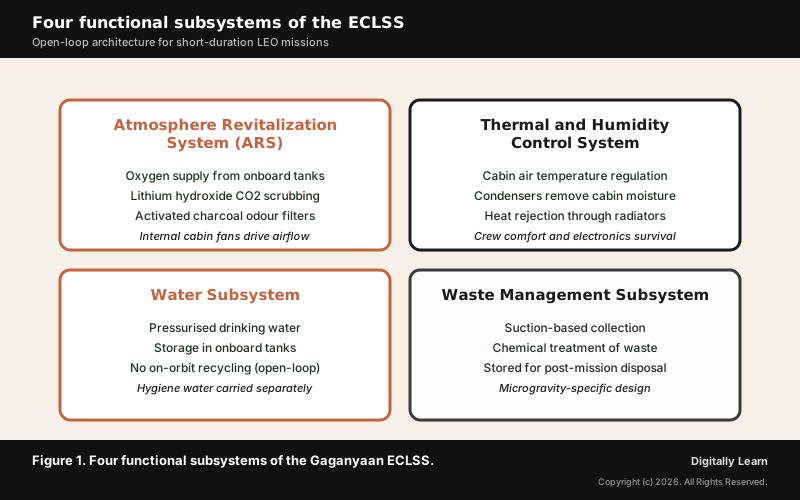
- (i) Open-loop architecture. All human supplies (oxygen, water, food) are carried from Earth at launch, and metabolic waste is collected, stabilised, and stored for post-mission disposal. The open-loop design is appropriate for short-duration missions; closed-loop systems with on-orbit recycling are reserved for long-duration platforms such as the International Space Station.
- (ii) Four functional subsystems. The Atmosphere Revitalization System (ARS) supplies oxygen and scrubs carbon dioxide. The Thermal and Humidity Control System manages cabin temperature and moisture via fans and condensers. The Water Subsystem stores and delivers pressurised drinking water. The Waste Management Subsystem uses suction-based collection with chemical treatment in microgravity.
- (iii) Mission-target envelope. The crew capsule supports a three-member crew in a 400 kilometre low-Earth-orbit (LEO) trajectory for a three-day mission duration. The ECLSS is qualified for this envelope; longer durations or higher altitudes would require an upgraded closed-loop architecture.
Why an indigenous ECLSS matters for India's crewed-spaceflight capability
Strategic-autonomy in human-spaceflight technology
Why it matters: An indigenous ECLSS matters because crewed-spaceflight life support is the highest-criticality space subsystem: a failure does not produce a lost satellite but a lost crew. Only three space agencies have flown indigenous crewed life-support systems: NASA (Mercury through Artemis), the Soviet Union and Russia (Vostok through Soyuz), and China (Shenzhou). India joins this short list with Gaganyaan.
The system also matters because life-support technology has spin-off applications in submarine life support, high-altitude aviation, biosafety laboratory containment, and tunnel-and-mine ventilation. The ECLSS development cycle deepens the Indian aerospace-life-sciences set of capabilities beyond the immediate Gaganyaan use case.
Significance for India's space-station programme and human-spaceflight ladder
What the ECLSS milestone signals for the Bharatiya Antariksha Station and the crewed-Moon track
What is the significance of this issue: The ECLSS readiness milestone carries three significances for India's human-spaceflight strategy:
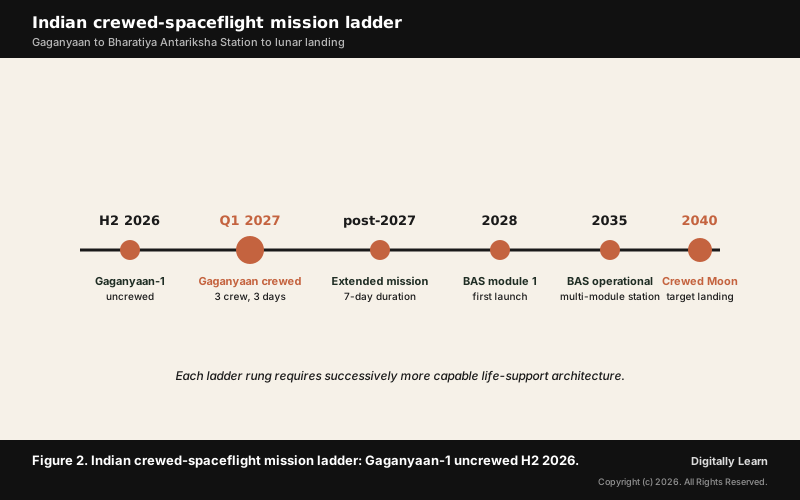
- (i) Space-station-programme signal. The Indian Bharatiya Antariksha Station (BAS) announced in 2024 targets first-module launch by 2028 and full operational status by 2035. Closed-loop ECLSS is a precondition for a multi-week BAS deployment; the open-loop Gaganyaan ECLSS is the foundational competence on which the closed-loop upgrade builds.
- (ii) Crewed-mission-ladder signal. ISRO’s manned-mission roadmap moves from Gaganyaan (3-day LEO, 2026-27) through a seven-day extended mission in the post-2027 window to BAS module-tending crewed flights by the early 2030s, and a crewed lunar landing by the 2040 target. Each ladder rung requires a successively more capable ECLSS.
- (iii) Indigenisation-and-export signal. ECLSS hardware sits in the Defence Acquisition Procedure’s positive-indigenisation trajectory; aerospace-life-sciences capabilities are spin-off enablers for submarine atmospheres, high-altitude UAV payloads, and biosafety-level-4 (BSL-4) laboratory containment systems.
The Indian crewed-spaceflight mission ladder
Distinguishing features of the Gaganyaan ECLSS
The three engineering pillars of the Gaganyaan ECLSS
Distinguishing features: Three engineering pillars define the ECLSS implementation:
- (i) Pressure and atmosphere envelope. The cabin holds a sea-level-equivalent pressure (101.3 kilopascals nominal) with a nitrogen-oxygen mixture at near-Earth ratios. Partial-pressure of oxygen and carbon-dioxide are monitored continuously; the ARS responds dynamically to crew metabolic load.
- (ii) Lithium-hydroxide carbon-dioxide scrubbing. Crew CO2 exhalation is absorbed by lithium hydroxide (LiOH) canisters via the irreversible reaction 2 LiOH and CO2 yields Li2CO3 and H2O. Spent canisters are stored; this is the open-loop signature.
- (iii) Microgravity waste-management. Suction-airflow draws metabolic waste into containment; chemical fixatives stabilise the waste for the duration of the mission. The architecture mirrors the Soyuz toilet system but uses indigenous valves, pumps, and consumables.
The Gaganyaan ECLSS specifications at a glance
| Specification | Detail | Significance |
|---|---|---|
| System | Environmental Control and Life Support System (ECLSS) | ISRO indigenous design at VSSC |
| Architecture | Open-loop (single-use consumables) | Suited to short-duration missions |
| Subsystems | ARS, Thermal-and-Humidity, Water, Waste Management | Four functional clusters |
| CO2 scrubbing | Lithium hydroxide (LiOH) canisters | Irreversible reaction; canisters stored |
| Cabin pressure | Sea-level equivalent 101.3 kPa nominal | Crew physiology comfort |
| Mission target | Three-member crew; 400 km LEO; three-day duration | Gaganyaan mission envelope |
| Uncrewed milestone | Gaganyaan-1 in H2 2026 | Qualification flight |
| Crewed milestone | First crewed flight Q1 2027 (planned) | First Indian crewed orbital flight |
| ISRO Chief briefing | V. Narayanan, May 2026 update | Programme status confirmation |
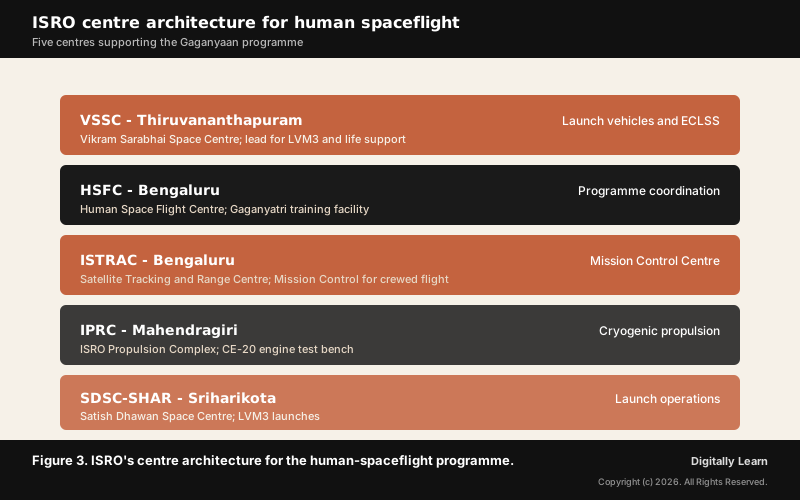
| Design centre | Vikram Sarabhai Space Centre (VSSC), Thiruvananthapuram | ISRO lead centre for launch vehicles and life support |
Observable outcomes to track from now to first crewed flight
What to watch from H2 2026 through the first crewed flight
Observable outcomes: Five outcomes frame the trajectory from the present to the first crewed flight:
- (a) Gaganyaan-1 uncrewed launch. Whether the uncrewed flight in H2 2026 clears the launch-vehicle, crew-module, and ECLSS qualification campaign on the planned timeline.
- (b) Crew Escape System. Demonstrated performance of the abort sequence under simulated launch-failure conditions; pad-abort tests completed and high-altitude abort tests planned.
- (c) Crew training certification. Completion of Gaganyatri training cycles for the four selected astronauts at the Indian Astronaut Training Facility, IISc Bengaluru, and partner facilities in Russia.
- (d) Service Module readiness. Propulsion and avionics integration of the Service Module that supplies power, thermal control, and propulsion to the Crew Module.
- (e) Mission Control Centre infrastructure. Crewed-mission communication and tracking architecture across the Indian Deep Space Network at Byalalu, the Mission Control Centre at ISTRAC Bengaluru, and partner ground stations.
Threads connecting ECLSS to wider human-spaceflight policy
How ECLSS connects to BAS, the Chandrayaan lunar track, and international partnerships
Contemporary linkages: Three threads connect the ECLSS readiness milestone to wider Indian human-spaceflight policy.
The first is the Bharatiya Antariksha Station thread. The BAS announced in 2024 by the Prime Minister targets a first-module launch in 2028 and operational status by 2035. Closed-loop ECLSS for multi-week occupancy is the technical precondition that the present open-loop Gaganyaan ECLSS leads into.
The second is the Chandrayaan-lunar-landing thread. The Indian crewed Moon-landing target of 2040 requires a deep-space-capable ECLSS with redundancy, radiation protection, and longer mission-duration buffers. The Chandrayaan-3 south-pole landing of 2023 seeded the planetary-surface operations heritage; ECLSS adds the human-survival layer.
The third is the international-partnership thread. The NASA-ISRO Axiom-4 partnership flew Indian astronaut Group Captain Shubhanshu Shukla to the International Space Station in 2025 for a short-duration mission; the experience informs Indian ECLSS design choices and crew training protocols. Russian-Roscosmos partnership on Gaganyatri training is the other operating partnership.
UPSC Relevance
Where the ECLSS readiness sits in the UPSC syllabus
UPSC context: The ECLSS readiness milestone falls within General Studies Paper III under awareness in the fields of IT, Space, Computers, robotics, nano-technology, bio-technology, and achievements of Indians in science and technology; indigenization of technology and developing new technology. The crewed-mission dimension also touches security challenges and their management in border areas through ISRO's geospatial capabilities.
Prelims relevance: The Prelims surface includes ECLSS full form (Environmental Control and Life Support System), the four subsystems (ARS, Thermal and Humidity, Water, Waste Management), the open-loop architecture, the lithium hydroxide CO2 scrubbing chemistry, the 400 kilometre LEO target, the three-day duration, Gaganyaan-1 uncrewed H2 2026, crewed flight Q1 2027, and the Bharatiya Antariksha Station 2028 first-module and 2035 operational targets.
Mains relevance: Two framings dominate the Mains-paper surface:
- (i) Space-station-and-benefits framing. India’s plan to have its own space station (Bharatiya Antariksha Station) and the benefits for the space programme. ECLSS is the foundational life-support competence the BAS programme builds on.
- (ii) Subsystems-and-launch-architecture framing. The subsystems on Indian crewed and uncrewed missions. The Gaganyaan Crew Module, Service Module, and ECLSS together compose the crewed-mission subsystem stack.
Mains practice question: A focused fifteen-mark question would read: The Environmental Control and Life Support System (ECLSS) developed by ISRO for the Gaganyaan mission is the foundational life-support competence for India's crewed-spaceflight ladder. Examine its open-loop architecture and discuss its role in the Bharatiya Antariksha Station programme.
- Past Mains linkage. 2019 GS-III Q6: What is India’s plan to have its own space station and how will it benefit our space programme? The ECLSS for Gaganyaan is the foundational competence for the BAS programme that the 2019 question anticipated.
- Past Mains linkage. 2023 GS-III Q16: What is the main task of India’s third moon mission which could not be achieved in its earlier mission? List the countries that have achieved this task. Introduce the subsystems in the spacecraft launched and explain the role of the ‘Virtual Launch Control Centre’ at the Vikram Sarabhai Space Centre which contributed to the successful launch from Sriharikota. The subsystem-introduction frame extends naturally to the Gaganyaan ECLSS as the crewed-mission counterpart.
- Related-mission linkage. Prelims questions on Chandrayaan-3, Aditya-L1, Shukrayaan, and LVM3 test the institutional surface that Gaganyaan and ECLSS sit within.
Previous Year UPSC-CSE Questions By the end you will be able to draft model answers for the following UPSC questions. Each question carries a collapsible framework showing how to approach it in the exam.
- UPSC Mains 2019 GS-IIIWhat is India’s plan to have its own space station and how will it benefit our space programme?
How to structure the answer in the exam
Introduction: Open with the 2024 announcement of the Bharatiya Antariksha Station (BAS), name the 2028 first-module-launch and 2035 operational-status targets, and frame the answer through plan architecture and benefit channels.
Body (sub-themes to develop):
- Plan architecture: BAS as a five-module low-Earth-orbit space station; first module BAS-01 of approximately 10 tonnes launched on LVM3 in 2028, building to a full assembled mass near 52 tonnes; orbit altitude in the 400-450 km LEO band; remaining modules added through the Next Generation Launch Vehicle.
- Supporting infrastructure: ECLSS (Environmental Control and Life Support System) developed at VSSC for Gaganyaan as the foundational life-support competence; closed-loop ECLSS upgrade for multi-week BAS occupancy; CE-20 cryogenic upper stage upgraded and human-rated.
- Partnership ecosystem: NASA-ISRO Axiom-4 mission of 2025 with Group Captain Shubhanshu Shukla to the ISS; Russian Roscosmos support for Gaganyatri training; potential ESA and JAXA module partnerships for BAS.
- Benefit channel 1 (technology): closed-loop life-support, on-orbit assembly, long-duration crew operations; spin-off applications in submarine life support, biosafety containment.
- Benefit channel 2 (employment): high-skill aerospace employment across VSSC, HSFC, ISTRAC; private-sector NewSpace India Ltd subcontracting cycle.
- Benefit channel 3 (science): microgravity experiments in materials, life sciences, plasma physics; Earth observation and astronomy missions hosted on the platform.
- Benefit channel 4 (strategic): India joins the small set of countries with own space stations (USA via ISS leadership, Russia via ROSS, China via Tiangong).
Conclusion: Conclude that India's space-station plan rests on a modular LEO architecture targeting 2028 first-module and 2035 full operation, that the Gaganyaan ECLSS is the foundational life-support competence the BAS builds on, and that benefits span technology, employment, science, and strategic-autonomy channels.
The Gaganyaan ECLSS is the foundational life-support competence that the Bharatiya Antariksha Station 2024-announced plan builds on. The body sub-theme on supporting infrastructure supplies the leading 2026-current evidence pillar.
- UPSC Mains 2023 GS-IIIWhat is the main task of India’s third moon mission which could not be achieved in its earlier mission? List the countries that have achieved this task. Introduce the subsystems in the spacecraft launched and explain the role of the ‘Virtual Launch Control Centre’ at the Vikram Sarabhai Space Centre which contributed to the successful launch from Sriharikota.
How to structure the answer in the exam
Introduction: Open with the Chandrayaan-3 mission of July 2023, name the lunar south-pole soft-landing goal that Chandrayaan-2 of 2019 could not achieve, and frame the answer through task-country-subsystem-VLCC components.
Body (sub-themes to develop):
- Main task: lunar south-pole soft landing; achieved on 23 August 2023 at the Shiv Shakti Point (latitude approximately 69 degrees south).
- Earlier-mission failure: Chandrayaan-2 lander Vikram crashed on 6 September 2019 due to a thrust-and-orientation control-loop issue during the final descent.
- Countries that have achieved lunar soft landing: USA, USSR/Russia, China, and now India (USA and USSR achieved it in the 1960s-70s, China with Chang'e-3 in 2013, India with Chandrayaan-3 in 2023).
- Chandrayaan-3 subsystems: Lander Vikram with redundant sensors and four-throttleable engines; Rover Pragyan with six-wheel drive and onboard payloads (APXS, LIBS); Propulsion Module that ferried the lander-rover to lunar orbit and now serves as a relay platform.
- Virtual Launch Control Centre (VLCC) at VSSC: digital-twin simulation of the LVM3 launch vehicle and the spacecraft, used for pre-launch dry-run rehearsals and contingency planning; reduces launch-day risk through scenario-coverage.
- Bridge to Gaganyaan: the subsystem-introduction frame extends naturally to the Gaganyaan ECLSS as the crewed-mission life-support counterpart that VSSC also developed.
Conclusion: Conclude that Chandrayaan-3 achieved the lunar south-pole soft-landing task Chandrayaan-2 missed, that the subsystems and VLCC together composed the mission stack, and that the next step on the Indian space ladder is Gaganyaan with the ECLSS as the headline crewed-mission subsystem.
The Gaganyaan ECLSS is the crewed-mission counterpart of the Chandrayaan-3 subsystem stack the 2023 GS-III question asks examinees to introduce. The body sub-theme on bridge to Gaganyaan supplies the 2026-current extension.
Sources
- ISRO Vikram Sarabhai Space Centre: ECLSS technical materials
- ISRO: Gaganyaan programme page
- Press Information Bureau: ISRO Chief V. Narayanan statements on Gaganyaan
- Department of Space: human-spaceflight programme materials
- Bharatiya Antariksha Station programme briefings
- NASA-ISRO Axiom-4 mission documentation
- Indian Astronaut Training Facility, IISc Bengaluru
- Wikipedia: Gaganyaan-1
Editorial Disclaimer
This article is compiled from the reference materials listed in the Sources section. It is an explainer for UPSC preparation and is not a substitute for primary documents (NCERTs, GoI ministry releases, IMD bulletins, RBI / CEA / MoEFCC publications, and Standing-Committee reports).


