


Overview
India's first private orbital rocket
The Vikram‑1 rocket, built by Hyderabad's Skyroot Aerospace, became the first privately developed Indian rocket to reach orbit on 18 July 2026, under Mission Aagaman from Sriharikota. A four-stage launcher for small satellites, it made India the third country, after the United States and China, whose private industry can reach orbit on its own rocket.
Vikram‑1 Launch: India's First Private Orbital Rocket, July 2026
Mission Aagaman: The Flight of 18 July 2026 and Its Payloads
At 12.05 p.m. on 18 July 2026 the Vikram‑1 rocket, built by the Hyderabad firm Skyroot Aerospace, lifted off from ISRO's First Launch Pad at the Satish Dhawan Space Centre, Sriharikota, after a hold from its original time of 11.30 a.m. A little over 15 minutes later it placed its payloads in an orbit roughly 450 km above the earth.
The mission, named Aagaman ("arrival"), made India only the third country, after the United States and China, whose private industry can reach orbit on its own launch vehicle. Until then every orbital rocket India had launched was state-funded and led by ISRO. The launch came 46 years to the day after SLV‑3 lifted off from the same spaceport on 18 July 1980, making India the sixth space-faring nation.
- A developmental flight: It was flown to test the rocket itself, covering stage separation, propulsion, guidance and navigation, structures, avionics, fairing deployment and orbital insertion; Skyroot said every principal milestone was met.
- The road to service: The company plans two more developmental flights before the rocket is deemed market-ready, with full commercial flights after that.
- The people: A team of over a thousand, with an average age of 28, and close to 400 suppliers.
The rocket carried technology demonstrators from Indian and foreign firms, along with tributes to India's scientific heritage.
- EMBRACE: A robotic-arm demonstration by Cosmoserve Space aimed at grabbing space debris; the arm stayed attached to the payload deck.
- SOLARAS: A nano-satellite from Grahaa Space.
- SCOPE: Skyroot's own experimental satellite.
- uD3PP and mD3RN: Deployable-technology demonstrators from the German firm Dcubed.
- Tributes: A lab-grown diamond lotus and an 18-carat gold micro-rocket bearing micro-sculptures of C.V. Raman, Vikram Sarabhai and A.P.J. Abdul Kalam, each smaller than a grain of rice, the names Skyroot gives its rockets and engines; a handwritten postcard from the Prime Minister also flew.
What Is Vikram‑1: Design, Stages and New Manufacturing
Four Stages, Carbon-Composite Body and 3D-Printed Engines
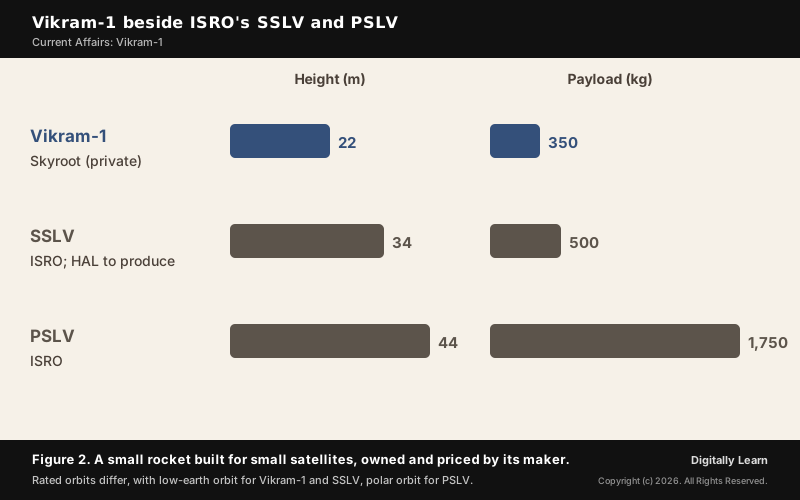
Vikram‑1 is a four-stage small-satellite launch vehicle about 22 metres tall, roughly seven storeys. Its first three stages burn solid fuel and the fourth is a liquid stage, the Orbital Adjustment Module, which can be restarted for precise orbital insertion, a miniature cousin of the PSLV's fourth stage. It can carry about 350 kg to a 500 km low-earth orbit, less to a sun-synchronous orbit.
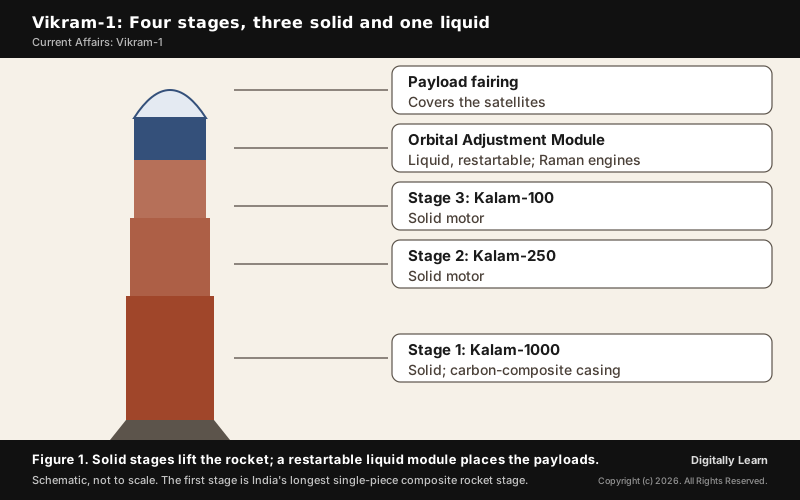
- Carbon-composite airframe: Carbon fibre in resin gives strength per unit weight many times that of aerospace aluminium or steel, and every kilogram of structure saved is a kilogram of satellite gained; Vikram‑1's first stage is India's longest single-piece composite rocket stage.
- 3D-printed engines: A laser fuses metal powder layer by layer, so an engine printed in one piece sheds the joints where conventional engines leak and fail; when Skyroot test-fired its Raman engine in 2020, it said the printed injector halved the mass and cut components and lead time by 80%.
- The trade-offs: Composites are costly and can hide damage below a perfect surface, and printed parts can suffer porosity and batch-to-batch variation, so both demand strict quality control.
Vikram‑1 Compared with SSLV and PSLV
The nearest ISRO analogue is the Small Satellite Launch Vehicle (SSLV). Both stack three solid stages under a small restartable liquid module and are meant for small satellites at short notice. The SSLV lifts more, 500 kg to low-earth orbit, but Vikram‑1's all-carbon airframe is leaner. The PSLV is a 44-metre, 320-tonne workhorse that lifts 1,750 kg to a sun-synchronous polar orbit of 600 km.
The deeper difference is ownership. The SSLV was designed by the state and its production licensed to Hindustan Aeronautics Limited for Rs 511 crore; Vikram‑1 is owned outright by its maker, financed by venture capital and priced by the market, offering what Skyroot calls a "cab service" that lets customers pick their orbit.
India's Launch Vehicles: PSLV, GSLV, LVM3, SSLV and the Private Rockets
ISRO's Launchers and the Orbits They Serve
ISRO lists three operational launch vehicles, the PSLV, the GSLV and the LVM3. The SSLV completed its last development flight on 16 August 2024 and its production is passing to industry. Each vehicle is matched to a kind of orbit.
| Vehicle | Main use | Key facts |
|---|---|---|
| PSLV | Earth-observation satellites to sun-synchronous polar orbits; also geostationary and navigation payloads | Four stages; 1,750 kg to a 600 km sun-synchronous polar orbit; first flight 1993; ISRO's workhorse |
| GSLV | Communication satellites | Indigenous cryogenic upper stage; 2-tonne class communication satellites |
| LVM3 (GSLV Mk III) | Heavier communication satellites; crewed flight | Three stages: Two solid boosters, a liquid core and the C25 cryogenic upper stage; 4-tonne class communication satellites, 10 tonnes to low-earth orbit |
| SSLV | Small satellites on demand | 500 kg to low-earth orbit; production licensed to HAL |
| Vikram‑1 (Skyroot) | Small satellites, commercially | Four stages; about 350 kg to a 500 km low-earth orbit |
Orbit decides use. A satellite in a geostationary orbit circles in the earth's equatorial plane once every 24 hours, at a height of about 35,800 km, so it appears fixed above a point on earth; India's INSAT satellites use this orbit for telecommunications. Polar satellites fly low, at 500 to 800 km, north to south over the poles, and view the earth strip by strip over a day, which makes them useful for remote sensing, meteorology and environmental studies.
Skyroot Aerospace and India's Private Space Sector
Skyroot Aerospace: Founders, Vikram-S and the Road to Vikram‑2
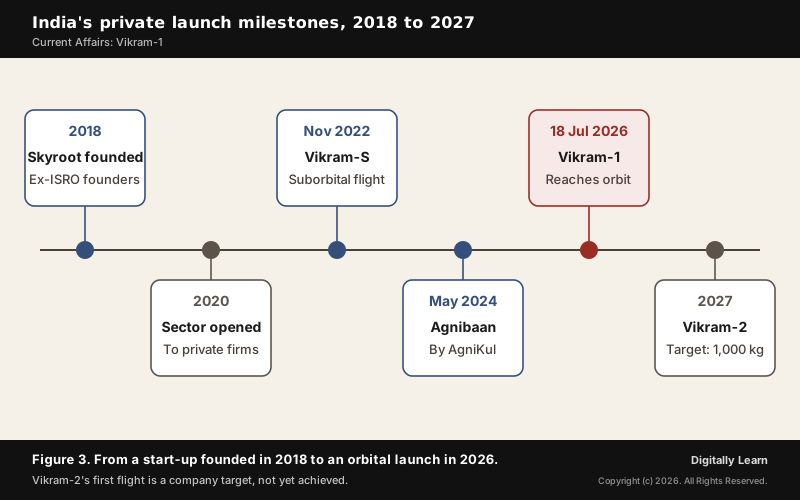
Skyroot Aerospace was founded in 2018 by Pawan Kumar Chandana and Naga Bharath Daka, both former ISRO engineers. Its first milestone came on 18 November 2022, when Vikram-S under mission Prarambh became the first privately developed Indian rocket to fly, on a suborbital path. Vikram‑1 made it the first to reach orbit.
- Production: Once manufacturing is streamlined, the company says it can build one rocket a month.
- Next rockets: Vikram‑2, able to carry up to 1,000 kg to low-earth orbit, is targeted for a maiden flight in 2027, followed by a fully reusable launcher with a recoverable booster and upper stage.
- Funding: India's space-tech firms had raised about $871 million by July 2026, the top ten taking over 60% of it, led by Skyroot at $150 million; yearly funding rose from $43 million in 2021 to $200 million in 2025.
Private Rocket Launch in India: Reforms, IN-SPACe and Rivals
Since 2020 the Centre has opened the space sector to private firms, allowing companies to build launch vehicles and use ISRO's facilities; the number of space start-ups has grown from a handful to more than 400.
The Indian National Space Promotion and Authorisation Centre (IN-SPACe) is an autonomous, single-window agency in the Department of Space, formed after the reforms. It promotes, authorises and supervises the space activities of non-government entities, including building launch vehicles, and acts as their interface with ISRO. Through its digital platform, the Department has even invited expressions of interest for transferring PSLV technology to industry.
Chennai's AgniKul Cosmos, incubated at IIT-Madras, flew its Agnibaan SOrTeD vehicle on a suborbital flight in May 2024 from India's first private launchpad, on the world's first single-piece 3D-printed engine, and is working towards reusability.
- Price pressure: Small satellites increasingly fly as rideshares on larger rockets, especially SpaceX's Falcon 9, which has cut launch fees sharply; a dedicated small launcher must justify a premium with flexibility of orbit.
- Shifting demand: Demand has concentrated in satellite constellations, and launch revenues have grown more slowly than satellite manufacturing.
- Competition: Start-ups in Europe, the US, China, Japan and Australia build small launchers, many have folded, and Vikram‑1 will also compete with ISRO's SSLV.
- Advantages: Lower manufacturing and labour costs, access to ISRO's infrastructure and a growing domestic satellite industry.
Vikram‑1 for UPSC: GS Paper III Links
Space Technology in the UPSC and PCS Syllabus
Vikram‑1 belongs to General Studies Paper III, under awareness in the field of space and indigenisation of technology. State PCS papers ask about the same space programme.
- Prelims facts: 18 July 2026, Sriharikota; Mission Aagaman; Skyroot Aerospace, Hyderabad, founded 2018; four stages, three solid and one liquid; about 350 kg to low-earth orbit; India third after the US and China; Vikram-S suborbital flight, November 2022; geostationary satellites appear fixed; LVM3 has three stages.
- Mains analysis: Private participation in space, the economics of small launchers, the role of IN-SPACe and ISRO, and technologies such as composites and 3D printing.
Previous Year UPSC‑CSE Questions
Each question comes with an explanation of how to approach it.
- UPSC Prelims 2018With reference to India's satellite launch vehicles, consider the following statements:
- PSLVs launch the satellites useful for Earth resources monitoring whereas GSLVs are designed mainly to launch communication satellites.
- Satellites launched by PSLV appear to remain permanently fixed in the same position in the sky, as viewed from a particular location on Earth.
- GSLV Mk III is a four-staged launch vehicle with the first and third stages using solid rocket motors; and the second and fourth stages using liquid rocket engines.
Which of the statements given above is/are correct?
How to approach this Prelims question
Approach:
- Step 1: Statement 1: The PSLV mainly launches earth-observation satellites and the GSLV communication satellites; right.
- Step 2: Statement 2: A satellite appears fixed only in a geostationary orbit about 35,800 km up; PSLV payloads mostly go to low polar orbits, so wrong.
- Step 3: Statement 3: The GSLV Mk III (LVM3) has three stages, two solid boosters, a liquid core and a cryogenic upper stage, not four; wrong.
Only 1.
Trap to watch: The four-stage vehicle with alternating solid and liquid stages is the PSLV, not the GSLV Mk III.
Why each option is right or wrong:
- (a) 1 only: Right. The PSLV and GSLV roles are stated correctly; statements 2 and 3 are false.
- (b) 2 and 3: Wrong. Polar satellites move across the sky, and the LVM3 has three stages.
- (c) 1 and 2: Wrong. Statement 2 describes a geostationary satellite, not a PSLV one.
- (d) 3 only: Wrong. The LVM3 is a three-stage vehicle.
Answer: (a) 1 only.
Sources
- ISRO: Launchers
- ISRO: Polar Satellite Launch Vehicle
- ISRO: Indian National Space Promotion and Authorization Center (IN-SPACe)
- Department of Space, Government of India
- NCERT: Physics, Part I (Class XI), Chapter 8, Gravitation
- Wikipedia: Skyroot Aerospace
- Wikipedia: Vikram (rocket family)
- Wikipedia: LVM3; Small Satellite Launch Vehicle
- The Hindu: Vikram‑1's launch window and payloads, Delhi, 3 and 7 July 2026
- The Hindu: India's first privately made orbital rocket Vikram‑1 places payloads into orbit, Delhi, 19 July 2026
- The Hindu: Explainer on India's first private orbital launch, Delhi, 19 July 2026
- The Hindu: Editorial and Science page on Vikram‑1, Delhi, 20 July 2026
- The Hindu: Indian space technology firms' funding, Delhi, 29 July 2026
- UPSC: Civil Services Examination question papers
Editorial Disclaimer
This article draws on ISRO, the Department of Space and the other sources listed in the Sources section.


