


Overview
Artemis II is the first crewed mission of the United States' Artemis programme, a NASA-led effort to return humans to the Moon. In April 2026, it carried a four-member crew on a roughly ten-day loop around the Moon and back, the first crewed lunar flyby in about fifty years. India is connected to this effort as a signatory of the Artemis Accords, the principles that frame the civil exploration of space, even as it pursues its own Moon and human spaceflight programmes.
What the Artemis II Mission Did
A crewed loop around the Moon
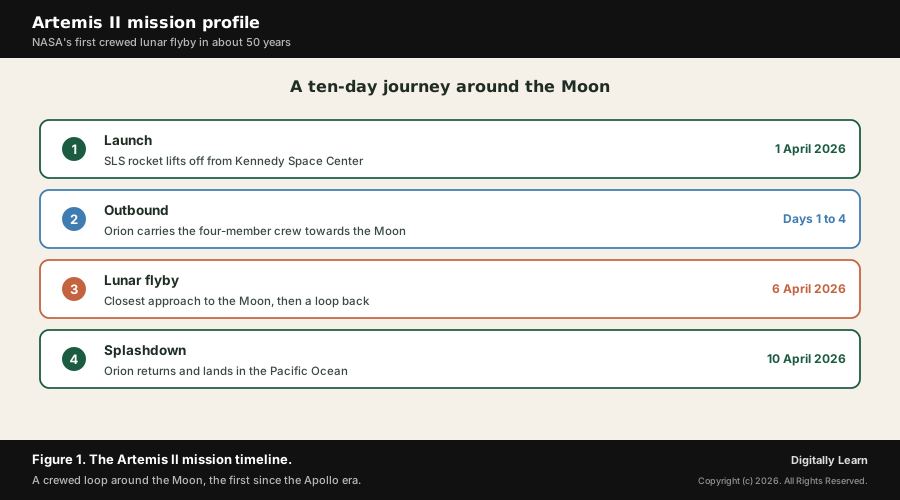
In April 2026, NASA's Artemis II mission carried four astronauts on a journey around the Moon and back. It launched on the Space Launch System rocket, with the crew riding in the Orion spacecraft, and lasted about ten days.
The crew did not land on or orbit the Moon; they flew past it in a wide loop, the first time humans have travelled to the Moon since the Apollo missions ended in the early 1970s. The flight tested the rocket, the spacecraft and the life-support systems with people aboard for the first time.
Why a Return to the Moon Matters
The first crewed lunar mission in five decades
Why it matters is that no human had travelled to the Moon for about fifty years. Artemis II proves that the rocket and spacecraft can carry a crew safely on a lunar journey, which is the essential step before any attempt to land.
It also marks a renewed contest among major powers to reach and use the Moon, with the United States, China and others setting out lunar plans. Space is becoming a field of both cooperation and competition, and India has a growing stake in how its rules are written.
From a Flyby Towards a Lunar Landing
What the mission signifies for lunar exploration
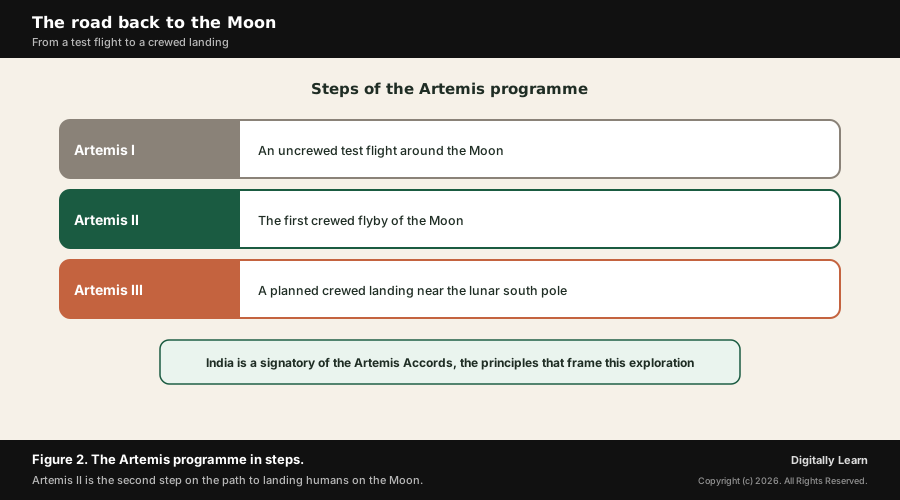
What is the significance of this mission lies in its place in a sequence. Artemis I was an uncrewed test flight; Artemis II is the first crewed flyby; and Artemis III is planned as a crewed landing near the lunar south pole, a region of interest because of suspected water ice.
Each step builds the confidence and the hardware for a sustained human presence on and around the Moon, which NASA and its partners see as a stepping stone for deeper space exploration, including towards Mars.
Distinguishing features of the mission
The mission at a glance
The table sets out the key features of the flight and what each one means. Together they show a test mission with a crew, designed to prove the system before a landing is attempted.
Read together, the rows show a carefully staged step: a crewed flyby rather than a landing, on hardware built for missions deeper into space.
| Feature | Detail |
|---|---|
| Mission type | A crewed flyby of the Moon, not a landing or an orbit |
| Crew | Four astronauts, including one from the Canadian Space Agency |
| Launch vehicle | The Space Launch System rocket |
| Spacecraft | The Orion crew capsule |
| Duration | About ten days, from launch to splashdown |
India's link through the Artemis Accords
India is connected to the Artemis effort not as a crew member but through the Artemis Accords, a set of principles for the peaceful and transparent civil use of space. India signed the Accords in 2023, becoming the twenty-seventh country to do so.
Signing the Accords does not make India a part of the NASA-led Artemis Programme, but it allows India to collaborate in lunar and deep-space exploration under shared rules. It also sits alongside growing cooperation between the Indian Space Research Organisation and NASA on missions such as the joint earth-observation satellite NISAR.
What to Watch in the New Moon Race
Three things to track from here
Artemis II points to three developments worth tracking, since a single flyby is the start of a longer effort rather than its conclusion.
- (a) The road to a landing. Whether Artemis III achieves a crewed landing near the lunar south pole on schedule.
- (b) India’s own missions. Whether India’s Gaganyaan human spaceflight and future Moon missions stay on track.
- (c) The rules of the Moon. Whether the Artemis Accords and other frameworks shape how states use lunar resources.
The real test is whether the renewed interest in the Moon leads to lasting cooperation rather than a contest that leaves space less stable.
India's Space Programme and Space Diplomacy
How Artemis connects to India's space effort
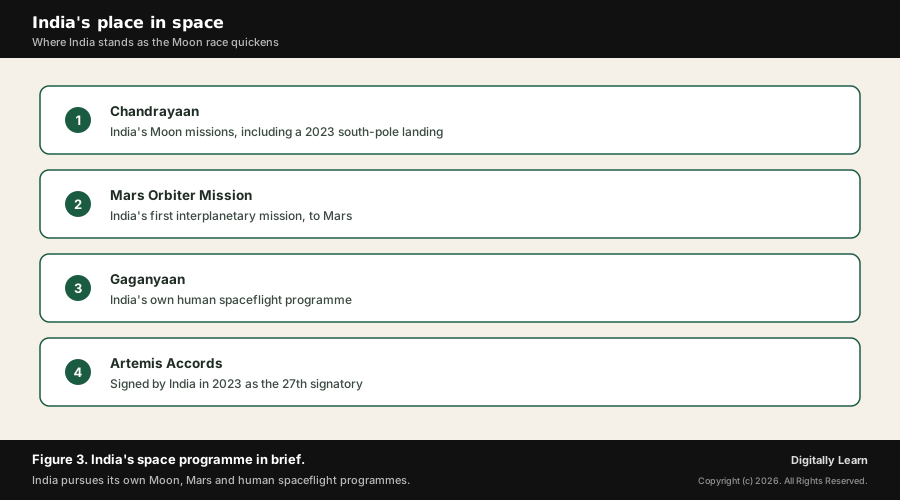
Contemporary linkages tie Artemis II to India's own space programme, which has grown from satellite launches to a Moon landing and an interplanetary mission. India landed near the lunar south pole with Chandrayaan in 2023 and reached Mars with its Mars Orbiter Mission.
India is now building towards human spaceflight through the Gaganyaan programme and has announced plans for its own space station, built on the Gaganyaan base. Such a station would give India a platform for microgravity research and technology development, and the strategic self-reliance and standing that come from a permanent national presence in orbit.
These benefits explain why a space station matters for India's programme: it would let Indian scientists run long-duration experiments in microgravity, support the development of life-support and other crewed-flight technologies, and anchor India's long-term ambitions in human spaceflight rather than leaving them dependent on others.
The Artemis Accords place India within the emerging framework of space diplomacy, where rules on transparency, safety and the use of space resources are being negotiated among a growing group of countries.
UPSC relevance and exam focus
Where this fits in the UPSC-CSE syllabus
This topic maps to General Studies Paper III: developments in science and technology and their applications, with links to international relations in Paper II through space diplomacy and the Artemis Accords.
For Prelims, hold the high-yield facts: Artemis II as the first crewed flyby, the Space Launch System and the Orion spacecraft, the Artemis Accords and India's 2023 signing, and India's own missions such as Chandrayaan, the Mars Orbiter Mission and Gaganyaan.
For Mains, two framings recur: India's progress from unmanned missions towards human spaceflight, and India's plan for its own space station and the benefits it brings.
Recurring linked concepts an aspirant should keep in working memory:
- Artemis Accords: principles for the peaceful civil use of space, signed by India in 2023.
- Gaganyaan: India’s human spaceflight programme.
- NISAR: the joint NASA-ISRO earth-observation satellite.
- Lunar south pole: a region of interest because of suspected water ice.
A common Prelims trap is to confuse the Artemis Accords with the Artemis Programme; the Accords are a set of principles India has signed, while the Programme is the NASA-led mission series, in which India is not a participant.
A common Mains trap is to treat space purely as cooperation. It is also a field of competition over technology, resources and prestige, which India must navigate.
Previous Year UPSC-CSE Questions By the end you will be able to draft model answers for the following UPSC questions. Each question carries a collapsible framework showing how to approach it in the exam.
- UPSC Mains 2017 GS-IIIIndia has achieved remarkable successes in unmanned space missions including the Chandrayaan and Mars Orbitter Mission, but has not ventured into manned space missions. What are the main obstacles to launching a manned space mission, both in terms of technology and logistics? Examine critically.
How to structure the answer in the exam
Introduction: Open with India's record in unmanned missions and the step up to human spaceflight.
Body (sub-themes to develop):
- Successes: Chandrayaan Moon missions and the Mars Orbiter Mission.
- The gap: human spaceflight needs life support, crew safety and recovery systems.
- The response: the Gaganyaan programme and cooperation with agencies such as NASA.
- Challenges: cost, technology and the logistics of crewed flight.
Conclusion: Conclude that Gaganyaan marks India's move from unmanned success towards human spaceflight.
- UPSC Mains 2019 GS-IIIWhat is India's plan to have its own space station and how will it benefit our space programme?
How to structure the answer in the exam
Introduction: Open with India's move from satellites towards a crewed presence in orbit.
Body (sub-themes to develop):
- The plan: an Indian space station built on the Gaganyaan programme.
- Scientific benefits: microgravity research and technology development.
- Strategic benefits: self-reliance and a seat at the table in space governance.
- Economic benefits: a base for industry and international collaboration.
Conclusion: Conclude that a space station would anchor India's long-term human spaceflight programme.
Sources and Further Reading
- NASA: Artemis II, NASA's First Crewed Lunar Flyby in 50 Years
- NASA: Artemis II News and Updates
- Press Information Bureau: Artemis Accords signed during PM Modi's US visit
- Press Information Bureau: Parliament Question on the Artemis Programme
- Indian Space Research Organisation: International Cooperation
- Indian Space Research Organisation
Editorial Disclaimer
This briefing is for UPSC preparation. Verify mission details against NASA and provisions against the official Indian government sources before relying on them.


