


Overview
India's first dengue vaccine
The Qdenga dengue vaccine (TAK‑003), made by Takeda, became India's first approved dengue vaccine in July 2026, for people aged 4 to 60. It is a live-attenuated vaccine given in two doses three months apart and designed to protect against all four dengue serotypes, though its protection is uneven across them.
Is There a Vaccine for Dengue? Qdenga's Approval in India, July 2026
Takeda Dengue Vaccine Approved for Ages 4 to 60: What Was Cleared
Yes. In July 2026 the Drug Controller General of India granted market authorisation to Qdenga (TAK‑003), made by Takeda Biopharmaceuticals India, the first dengue vaccine to be approved in the country. It is cleared for people aged four to 60 and is given as two doses three months apart.
- Vaccine design: A live-attenuated, tetravalent vaccine designed to protect against all four dengue virus serotypes; it is built on a dengue virus type 2 backbone carrying components of the other three.
- No screening: It can be given whether or not a person has had dengue before, without a test for past infection.
- Evidence: Takeda's programme of 19 trials with over 28,000 participants, including a pivotal phase 3 trial of more than 20,000 in eight dengue-endemic countries, and a phase 3 trial in India in people aged 4 to 60.
- Reach: Approved in 43 countries across Asia, Latin America and Europe, with more than 32 million doses distributed; it also has WHO prequalification.
The company reports an efficacy of 80.2% against laboratory-confirmed dengue 12 months after the second dose and 90.4% against dengue-related hospitalisation at 18 months. The World Health Organization recommends it only for those aged 6 to 16 in high-transmission settings, and in India it is expected first through private providers in the first half of 2027.
Dengue Fever in India: The Virus, the Aedes Mosquito and the Burden
Dengue Fever: Four Serotypes, Symptoms and Treatment
Dengue is a viral infection spread to people through the bite of infected female mosquitoes, chiefly Aedes aegypti, which bite mostly during the day. The virus has four serotypes, DENV‑1 to DENV‑4, and all four circulate in India.
- Common symptoms: High fever, severe headache, pain behind the eyes, muscle and joint pain, nausea, vomiting, swollen glands and rash; most people recover in one to two weeks, and many have no symptoms at all.
- Severe dengue: Severe abdominal pain, persistent vomiting, rapid breathing, bleeding gums or nose and blood in vomit or stool; people infected a second time are at greater risk.
- Treatment: There is no specific treatment; pain is managed with paracetamol, and ibuprofen and aspirin are avoided because they raise the risk of bleeding.
The same Aedes mosquitoes carry other viral diseases. Zika virus is mainly transmitted by them, and sexual transmission of Zika has been confirmed as another route; chikungunya is also an Aedes-borne disease in India. Control has therefore relied on stopping mosquito breeding and preventing bites.
Dengue Vaccine India Context: Cases, Serotypes and Spread
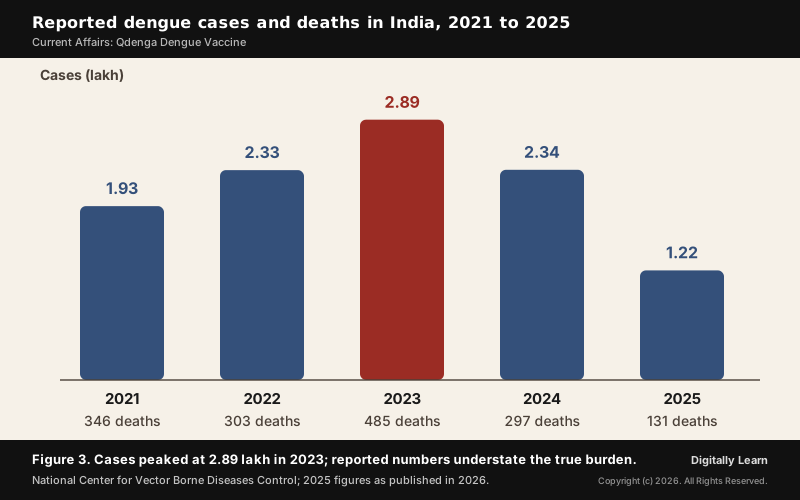
India accounts for nearly one-third of the global dengue burden, and reported cases have risen nearly elevenfold over two decades. Official figures show 2.89 lakh cases and 485 deaths in 2023, the peak of recent years, though modelling suggests true infections are far higher than reported. Worldwide, cases reported to WHO rose from about 5 lakh in 2000 to 14.6 million in 2024, with more than 12,000 deaths.
A nationwide study by the ICMR's Virus Research and Diagnostic Laboratory network analysed 6,889 confirmed samples from 45 laboratories in 25 States and Union Territories for 2023 to 2025. DENV‑2 caused over half of infections, but eight States and UTs had all four serotypes circulating and 15 had three; about 7% of patients carried two or more serotypes at once, and such patients were more likely to develop severe dengue. The mosquitoes are also spreading into semi-urban and rural districts, where vector control is harder to sustain.
Why a Dengue Vaccine Is Hard: Antibody-Dependent Enhancement and Dengvaxia
Antibody-Dependent Enhancement and the Dengvaxia Controversy of 2017
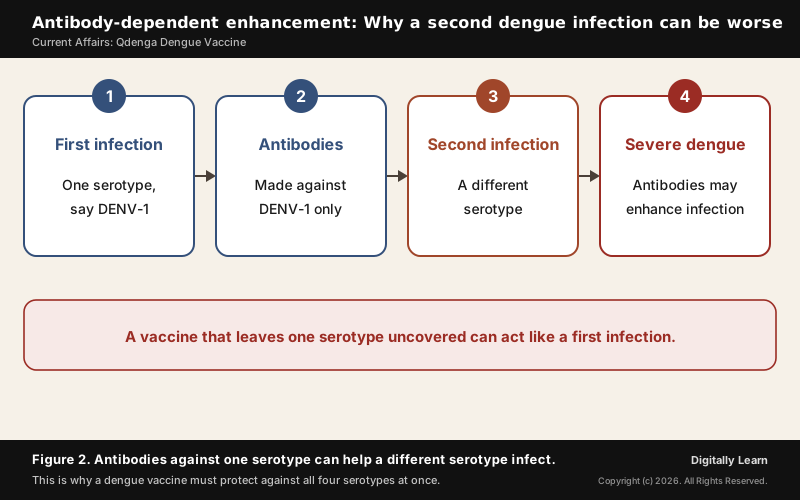
A person who has had dengue carries antibodies to that serotype and is called seropositive; a person never infected is seronegative. When a seropositive person catches a different serotype, the antibodies from the first infection may actually enhance the second, raising the chance of severe dengue. This is antibody-dependent enhancement (ADE).
ADE shapes the whole problem of a dengue vaccine. A vaccine that protects against some serotypes but not others can behave like a first infection, leaving the recipient more exposed if a missing serotype arrives later. Safety and efficacy are therefore two sides of one coin. The vaccine must protect against all four serotypes, and equally.
The first licensed dengue vaccine, Sanofi Pasteur's Dengvaxia (CYD‑TDV), is a live attenuated tetravalent vaccine given as three injections at 0, 6 and 12 months. It was built by replacing two structural genes of the yellow fever 17D vaccine strain with those of the four dengue serotypes, and became available in 2016 in 11 countries.
It proved partly effective but raised the risk of severe disease in people never infected before, probably through ADE. In the Philippines, schoolchildren were vaccinated in a public programme that was stopped in 2017 when the maker warned of that risk, and the controversy made regulators far more cautious. In the United States Dengvaxia is not approved for people who have not been infected before, and researchers proposed testing for past infection before use, whereas Qdenga's different design allows use without screening.
Qdenga Vaccine Efficacy: Strong Overall, Uneven by Serotype
Phase 3 Results by Serotype and Prior Infection
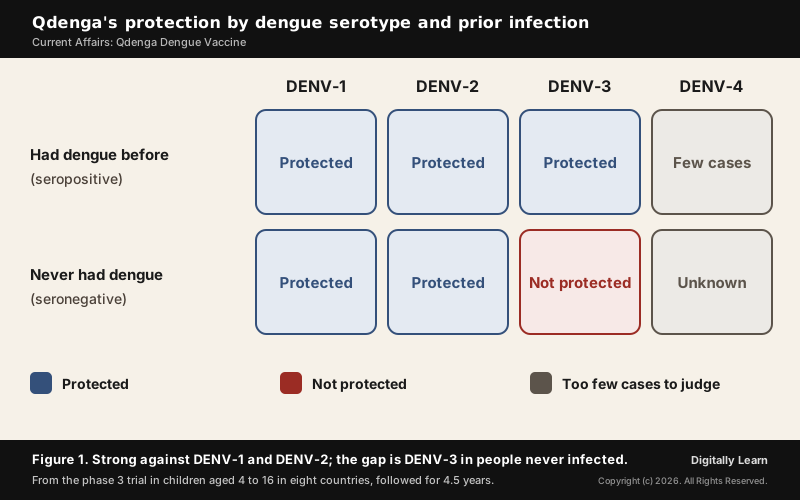
The pivotal phase 3 trial enrolled about 20,000 healthy children aged 4 to 16 in eight endemic countries of Latin America and Asia; two-thirds received the vaccine and one-third a saline placebo. In the vaccinated group 5 children per 1,000 caught dengue, against 24 per 1,000 among the unvaccinated, an overall efficacy of about 80%, roughly 82% in seropositive and 75% in seronegative children.
- After 4.5 years: About 61% against confirmed dengue and 84% against hospitalisation overall; in seronegative children, 54% and 79%.
- By serotype: High against DENV‑1 and DENV‑2 regardless of prior infection.
- DENV‑3: No protection in seronegative children; vaccinated seronegative children were about 25% more likely to catch DENV‑3 than unvaccinated ones, a pattern the investigators called a "numerical imbalance".
- DENV‑4: Too few cases occurred to judge efficacy at all.
Concerns for India: Screening, the Second Dose and Price
The gaps matter more in India because DENV‑3 is becoming more common even though DENV‑2 dominates. Critics argue that the safety signal in seronegative children should not be ignored, given an estimated 40 million children of whom fewer than 30% may be seropositive.
- Screening: A modelling study by Imperial College London, published in Nature Medicine on 25 July, concluded it would be safer to screen seronegative recipients, especially children, before vaccination.
- Timing and the second dose: The first dose protects unevenly, so in a person never infected, a dose taken at the start of the monsoon may not prevent severe illness from DENV‑3 a month later; ensuring that a mobile migrant workforce gets the second dose will be hard.
- Tiered pricing: Under Takeda's tiered pricing the vaccine may be too costly for people in dense urban slums, so the government would need to negotiate a lower price.
Experts also call for the vaccine to be brought into public health programmes, first in endemic areas, alongside the routine work against mosquito breeding and continuous surveillance of serotypes.
How Vaccines Work: Live Attenuated and Other Vaccine Platforms
Immunological Memory, Live Attenuated Vaccines and Other Platforms
Vaccination rests on the memory of the immune system. A vaccine introduces antigenic proteins of a pathogen, or the pathogen itself in inactivated or weakened form; the body makes antibodies that would neutralise the real pathogen, and memory B and T cells that recognise it quickly on later exposure. This is active immunity; injecting ready-made antibodies, as with antitoxin for tetanus or anti-venom for snakebite, is passive immunisation.
A live attenuated vaccine, the kind Qdenga is, uses a weakened but still living pathogen. It gives a stronger and longer-lasting response than a killed, inactivated vaccine, but is generally avoided in pregnancy and in people with severe immune deficiency.
Vaccines differ in what they put into the body, and India's COVID‑19 vaccines used several of these platforms.
| Platform | What it contains | Indian example |
|---|---|---|
| Live attenuated | A weakened but living pathogen | Qdenga (dengue) |
| Inactivated | A whole pathogen that has been killed | Covaxin, by Bharat Biotech with ICMR's National Institute of Virology |
| Viral vector | A harmless virus carrying genetic code for an antigen | Covishield (Oxford-AstraZeneca, chimpanzee adenovirus ChAdOx1), made by Serum Institute of India; Sputnik V (adenovirus) |
| Protein subunit | A purified protein of the pathogen | Corbevax (Biological E); hepatitis B vaccine produced in yeast |
| DNA | A DNA plasmid coding for an antigen | ZyCoV-D by Zydus, the world's first DNA-based COVID‑19 vaccine, given emergency approval in August 2021 |
Recombinant DNA technology lets antigenic proteins be produced in bacteria or yeast, allowing large-scale production; the hepatitis B vaccine made from yeast is the classic example.
Dengue Vaccine UPSC: GS Paper II and III Links
Health and Biotechnology in the UPSC and PCS Syllabus
Qdenga belongs to General Studies Paper III, science and technology and biotechnology, and to Paper II, health. State PCS papers ask about the same diseases and vaccines.
- Prelims facts: Qdenga (TAK‑003) by Takeda, approved July 2026 for ages 4 to 60; two doses three months apart; live attenuated, tetravalent; four serotypes DENV‑1 to DENV‑4; vector Aedes aegypti, which also carries Zika; Dengvaxia (Sanofi, three doses) raised the risk of severe dengue in people never infected.
- Mains analysis: How vaccines work, why dengue is hard (ADE), efficacy against safety, and the public health choices of screening, price and coverage.
Previous Year UPSC‑CSE Questions
Each question comes with an explanation of how to approach it.
- UPSC Mains 2022 GS‑IIIWhat is the basic principle behind vaccine development? How do vaccines work? What approaches were adopted by the Indian vaccine manufacturers to produce COVID‑19 vaccines?
Answer outline
The outline sets out what the question asks, the main arguments, relevant examples and the direction of the conclusion; it is not a full model answer.
Introduction: Introduce vaccination as training the immune system in advance, the idea behind the eradication of smallpox.
Body (sub-themes to develop):
- Principle: Immunological memory; a vaccine presents antigens, or a weakened or killed pathogen, so the body makes antibodies and memory B and T cells.
- How vaccines work: On real exposure the memory cells respond fast with a large antibody response; active immunity, unlike passive immunisation with ready-made antibodies.
- Indian COVID‑19 approaches: Inactivated whole virus (Covaxin, Bharat Biotech with ICMR‑NIV); viral vector (Covishield, made by Serum Institute of India; Sputnik V); protein subunit (Corbevax, Biological E); DNA plasmid (ZyCoV-D, Zydus, the world's first DNA COVID‑19 vaccine).
- Recent example: Qdenga, a live attenuated tetravalent dengue vaccine approved in 2026.
Conclusion: Conclude that platform choice trades speed, safety and strength of response, and that India's capacity across platforms is now a strategic asset.
- UPSC Prelims 2005Consider the following statements:
- Dengue is a protozoan disease transmitted by mosquitoes.
- Retro-orbital pain is not a symptom of Dengue.
- Skin rash and bleeding from nose and gums are some of the symptoms of Dengue.
Which one of the following statements is/are correct?
How to approach this Prelims question
Approach:
- Step 1: Statement 1: Dengue is caused by a virus, so it is not a protozoan disease; wrong.
- Step 2: Statement 2: Pain behind the eyes (retro-orbital pain) is a common symptom; wrong.
- Step 3: Statement 3: Rash and bleeding from the gums or nose are among the symptoms; right.
Only 3.
Trap to watch: Malaria is the protozoan mosquito-borne disease; dengue is viral.
Why each option is right or wrong:
- (a) 1 and 2: Wrong. Both statements are false. Dengue is viral, and pain behind the eyes is a symptom.
- (b) 3 only: Right. Rash and bleeding from the nose and gums are symptoms of dengue.
- (c) 2 only: Wrong. Retro-orbital pain is a symptom, so statement 2 is false.
- (d) 1 and 3: Wrong. Statement 1 is false because dengue is caused by a virus.
Answer: (b) Only statement 3.
- UPSC Prelims 2017Consider the following statements:
- In tropical regions, Zika virus disease is transmitted by the same mosquito that transmits dengue.
- Sexual transmission of Zika virus disease is possible.
Which of the statements given above is/are correct?
How to approach this Prelims question
Approach:
- Step 1: Statement 1: Zika is mainly transmitted by Aedes mosquitoes, the dengue vector; right.
- Step 2: Statement 2: Sexual transmission of Zika has been confirmed; right.
Both.
Trap to watch: Statement 2 looks odd for a mosquito-borne virus, but Zika also spreads sexually.
Why each option is right or wrong:
- (a) 1 only: Wrong. Statement 2 is also correct; sexual transmission of Zika is confirmed.
- (b) 2 only: Wrong. Statement 1 is also correct; Aedes carries both viruses.
- (c) Both 1 and 2: Right. Aedes transmits both, and Zika also spreads sexually.
- (d) Neither 1 nor 2: Wrong. Both statements are correct.
Answer: (c) Both statements.
- UPSC Prelims 2022In the context of vaccines manufactured to prevent COVID‑19 pandemic, consider the following statements:
- The Serum Institute of India produced COVID‑19 vaccine named Covishield using mRNA platform.
- Sputnik V vaccine is manufactured using vector based platform.
- COVAXIN is an inactivated pathogen based vaccine.
Which of the statements given above are correct?
How to approach this Prelims question
Approach:
- Step 1: Statement 1: Covishield, made by Serum Institute of India, is a viral vector vaccine using a chimpanzee adenovirus, not an mRNA vaccine; wrong.
- Step 2: Statement 2: Sputnik V is an adenovirus viral vector vaccine; right.
- Step 3: Statement 3: Covaxin is a whole inactivated virus vaccine; right.
So 2 and 3 only.
Trap to watch: Covishield was the most widely used vaccine in India, but it is vector-based, not mRNA.
Why each option is right or wrong:
- (a) 1 and 2 only: Wrong. Statement 1 is false, since Covishield is a viral vector vaccine.
- (b) 2 and 3 only: Right. Sputnik V is vector-based and Covaxin is inactivated.
- (c) 1 and 3 only: Wrong. Statement 1 is false and statement 2 is true.
- (d) 1, 2 and 3: Wrong. Statement 1 is false.
Answer: (b) 2 and 3 only.
Sources
- World Health Organization: Dengue and severe dengue, fact sheet
- World Health Organization: Zika virus, fact sheet
- National Center for Vector Borne Diseases Control: Dengue situation in India
- NCERT: Biology (Class XII), Chapter 8, Human Health and Disease
- Wikipedia: Dengue vaccine
- Wikipedia: Attenuated vaccine
- Wikipedia: COVID‑19 vaccination in India
- Wikipedia: Covaxin; Oxford-AstraZeneca COVID‑19 vaccine; Sputnik V; Corbevax
- The Hindu: India approves first dengue vaccine for persons aged 4-60, Delhi, 21 July 2026
- The Hindu: Editorial, On guard, Delhi, 25 July 2026
- The Hindu: Science page on Qdenga's trial data, Delhi, 27 July 2026
- The Hindu: Study finds multiple dengue virus serotypes circulating, Delhi, 29 July 2026
- UPSC: Civil Services Examination question papers
Editorial Disclaimer
This article draws on WHO, the national vector-borne disease programme and the other sources listed in the Sources section.


