


Overview
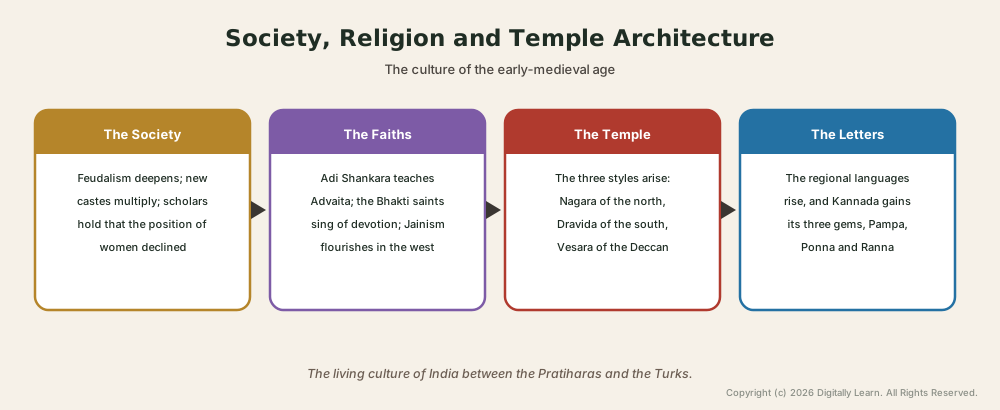
The early-medieval age was not only a time of war but of a rich and changing culture. Its society grew more feudal and caste-bound; its faith was renewed by Adi Shankara and the Advaita Vedanta and by the devotional Bhakti saints, while Jainism flourished in the west; and its kings raised the great temples in the three classic styles, the Nagara of the north, the Dravida of the south and the Vesara of the Deccan. This part covers the society and economy, the religion, the temple architecture and the exam focus of the age.
Early-Medieval Society and Economy
The Deepening of Feudalism and the Caste Order
What is the significance of early-medieval society: it was the age in which the feudal order matured, the caste system grew more rigid, and the temple became a centre of economic as well as religious life.
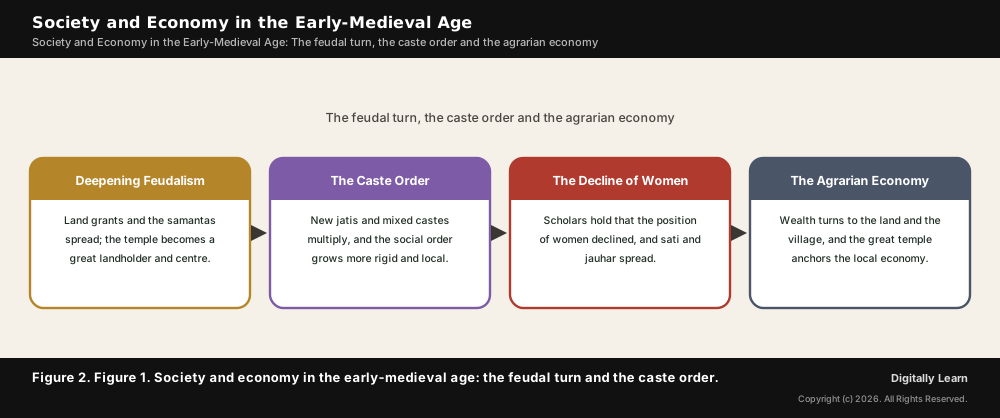
The feudal order deepened. The land grants that had begun under the Guptas multiplied, and a hierarchy of samantas and lesser lords stood between the king and the peasant. The great temple, endowed with villages, became a major landholder and the hub of the local economy, employing priests, artisans and labourers alike.
Society grew more complex and more rigid. New jatis, or sub-castes, multiplied as crafts and communities hardened into birth-groups, and the order of caste tightened its hold. Scholars hold that the position of women declined in these centuries, and that practices such as sati, and among the Rajput warrior clans jauhar, became more common.
Religion in the Early-Medieval Age
Adi Shankara and the Revival of Brahmanism
What is the significance of Adi Shankara: he gave Hinduism its most influential philosophy, the Advaita Vedanta, and set up the monastic centres that anchored the faith across India.
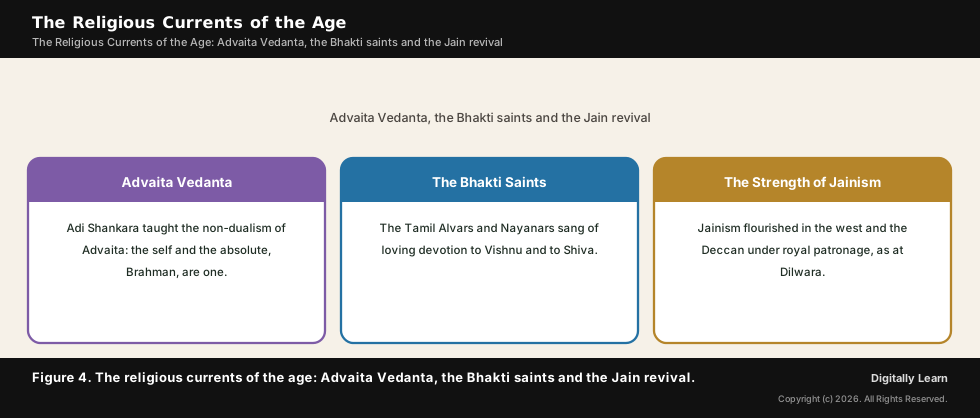
Adi Shankara, the great teacher of the age, expounded the Advaita Vedanta, the doctrine of non-dualism, which holds that the individual self and the absolute, Brahman, are in truth one and the same. By his learning and his debates he did much to revive the Brahmanical faith against the older Buddhism and Jainism.
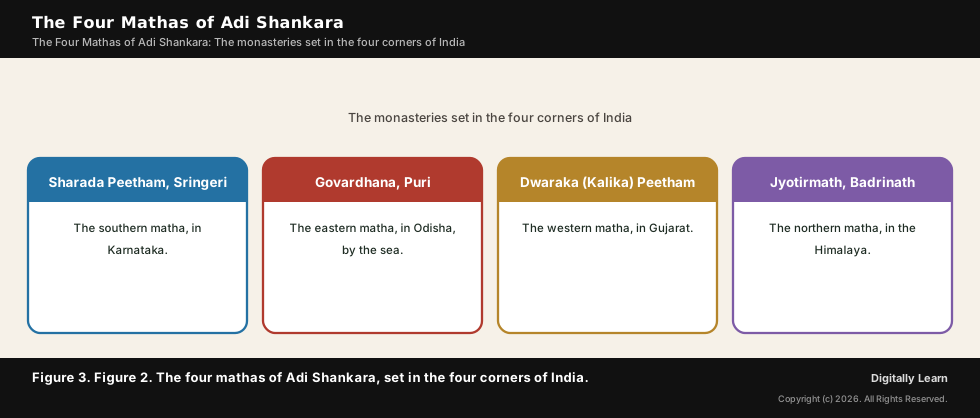
To bind the faith together, Shankara is said to have founded four mathas, or monasteries, in the four quarters of India: Sringeri in the south, Puri in the east, Dwaraka in the west and Badrinath in the north, and to have organised the Dashanami order of monks. His traditional dates are about 788 to 820, though recent scholarship questions them.
The Bhakti Saints and the Strength of Jainism
Distinguishing the other currents: besides the philosophy of Shankara, the age knew the warmth of devotional religion and the continued strength of Jainism.
The Bhakti tradition of loving devotion ran strong, above all in the Tamil south, where the Alvars, the saints of Vishnu, and the Nayanars, the saints of Shiva, sang their hymns of devotion. Their poetry, in the people's own tongue, spread a religion of the heart that would in time sweep the whole of India.
Jainism, meanwhile, kept its strength in the west and the Deccan, under the patronage of the Solanki and Rashtrakuta kings. The Jain scholar Hemachandra adorned the Solanki court, and the faith raised such monuments as the Dilwara temples at Mount Abu and the colossus at Shravanabelagola.
The Temple Architecture of the Age
The Three Styles: Nagara, Dravida and Vesara
What is the significance of the temple styles: the early-medieval age fixed the three classic forms of the Indian temple, and an aspirant must be able to tell them apart.
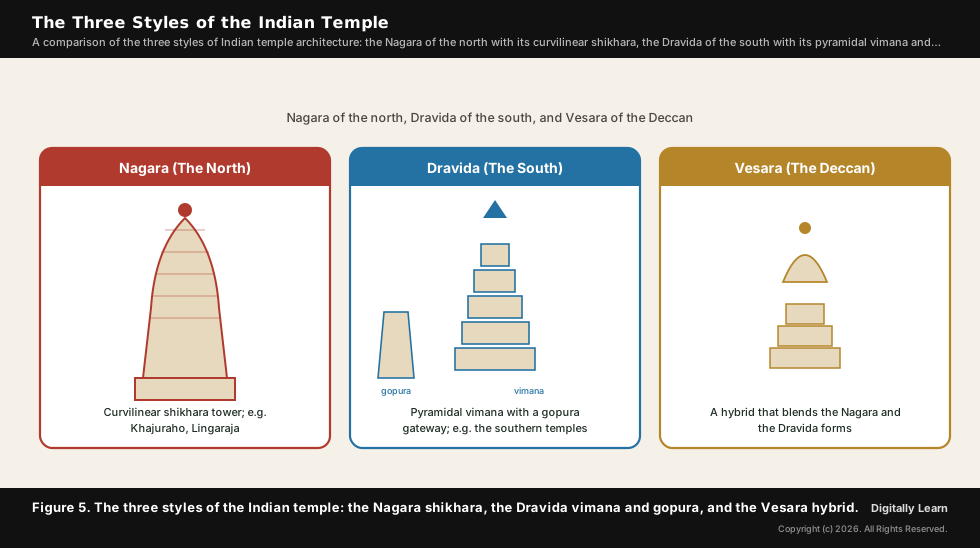
The Nagara style of the north is known by its curving tower, the shikhara, that rises like a beehive over the shrine; the temples of Khajuraho and the Lingaraja of Bhubaneswar are its great examples. The Dravida style of the south is known by its stepped, pyramidal tower, the vimana, over the shrine, and by the towering gateway, the gopura, that guards the temple wall.
The Vesara style, of the Deccan, is a hybrid that blends and bridges the two: it joins the plan and feeling of the Dravida with elements of the Nagara, and is seen in the temples of the Deccan kingdoms. Together these three, the Nagara, the Dravida and the Vesara, are the classic styles of the Indian temple.
The Great Temples and the Rise of Regional Languages
Distinguishing the achievement: the age is known both for the temples in which its styles found form and for the regional languages that came of age within it.
The great temples of the age belong to these styles: the Nagara of Khajuraho and of the Sun temples, the Dravida of the southern kingdoms, and the Vesara of the Deccan. The table below sets out the three styles, their regions and their marks, with an example of each.
| Style | Region | Mark and example |
|---|---|---|
| Nagara | The north | Curvilinear shikhara; Khajuraho, Lingaraja. |
| Dravida | The south | Pyramidal vimana and gopura gateway; the southern temples. |
| Vesara | The Deccan | A hybrid of Nagara and Dravida; the Deccan temples. |
In letters, the age saw the rise of the regional languages. Kannada came of age under the Rashtrakutas, with the three gems, Pampa, Ponna and Ranna, and the early forms of the other regional tongues, in Apabhramsa and the rest, began to bear their own literatures.
UPSC Relevance and Exam Focus
Where This Theme Fits in the UPSC-CSE Syllabus
This topic belongs to General Studies Paper I: Indian art and culture and early-medieval history, and the temple styles in particular are a favourite ground for Prelims questions.
The questions most often test the three temple styles and the religious teachers: the Nagara, Dravida and Vesara styles, and the place of Adi Shankara among the teachers of Hinduism.
Several linked points recur and are worth holding in working memory:
- The three styles: Nagara of the north, Dravida of the south, Vesara of the Deccan.
- The shikhara and the vimana: The Nagara tower and the Dravida tower.
- Adi Shankara: The teacher of Advaita and founder of the four mathas.
- The Alvars and Nayanars: The Tamil Bhakti saints of Vishnu and Shiva.
- The four mathas: Sringeri, Puri, Dwaraka and Badrinath.
A 2012 question asked what the Nagara, the Dravida and the Vesara are; the answer is the three main styles of Indian temple architecture, not racial, linguistic or musical divisions.
A 2004 question set three teachers in order; the correct chronology is Shankaracharya, then Ramanuja, then Chaitanya, for Shankara of the early-medieval age came first, Ramanuja later, and Chaitanya later still.
Previous Year UPSC-CSE Questions
Previous Year UPSC-CSE Questions By the end you will be able to draft model answers for the following UPSC questions. Each question carries a collapsible framework showing how to approach it in the exam.
- UPSC Prelims 2012 GS-IThe Nagara, the Dravida and the Vesara are the
How to approach this Prelims question
Approach: Recall that Nagara, Dravida and Vesara are the three styles of Hindu temple architecture, by tower form and region; reject the racial, linguistic and musical distractors.
Trap to watch: The terms sound like they could be racial or linguistic groups; they are in fact temple-architecture styles.
Key facts to recall:
- Nagara is the northern style, with a curvilinear shikhara.
- Dravida is the southern style, with a pyramidal vimana and a gopura.
- Vesara is the Deccan hybrid of the two.
Answer signal: Three main styles of Indian temple architecture.
- UPSC Prelims 2004 GS-IWhich one of the following sequences indicates the correct chronological order?
How to approach this Prelims question
Approach: Date each: Shankara (early-medieval, c.8th-9th c.), Ramanuja (11th-12th c.), Chaitanya (15th-16th c.); then order them Shankara, Ramanuja, Chaitanya.
Trap to watch: Do not put Ramanuja before Shankara; Shankara of the Advaita came first, and Ramanuja of the Vishishtadvaita followed.
Key facts to recall:
- Adi Shankara taught Advaita in the early-medieval age (c. 8th-9th century).
- Ramanuja taught Vishishtadvaita in the 11th-12th century.
- Chaitanya, the Bhakti saint, came in the 15th-16th century.
Answer signal: Shankaracharya, Ramanuja, Chaitanya.
Sources and Further Reading
Editorial Disclaimer
This article is for UPSC preparation. The account of early-medieval society follows the standard scholarship, and the traditional dates of Adi Shankara are debated among historians.