


Overview
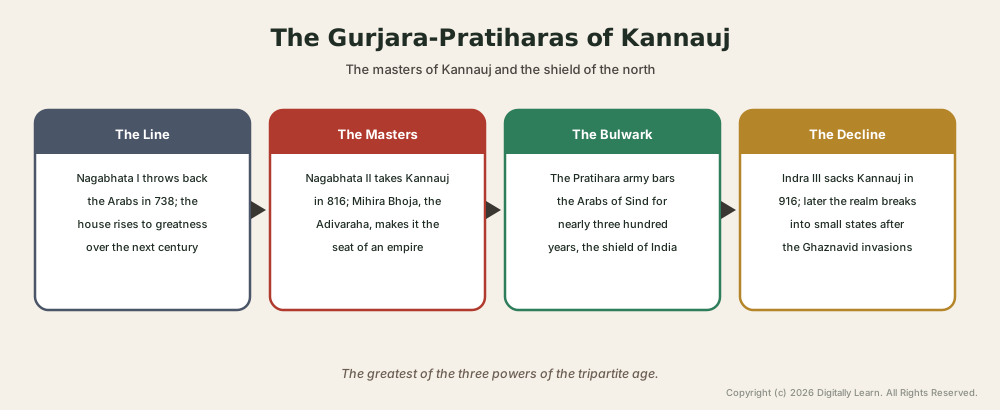
The Gurjara-Pratiharas were the greatest of the three powers of the tripartite age, the masters of Kannauj and the shield of northern India. From the founder Nagabhata I, who threw back the Arabs of Sind in 738, to Nagabhata II, who won Kannauj in 816, and above all to the great Mihira Bhoja, the Adivaraha, the dynasty rose to rule a wide empire from the Ganga plain. Their army formed the bulwark that barred the Arabs from advancing into India for nearly three centuries. This part covers the line of kings, the empire and the Arab frontier, the bulwark, the decline and the exam focus.
The Rise of the Gurjara-Pratiharas
Nagabhata I and the Founding of the House
What is the significance of the Pratiharas: they were the strongest of the three powers of the age, and their story opens with a victory that gave them their lasting fame, the turning back of the Arabs.
The Gurjara-Pratiharas rose in the eighth century in western India, in Rajasthan and Malwa. Their founder, Nagabhata I, won the dynasty its first renown by defeating the Arab army of the Caliphate, under its general Junaid, that had pushed out of Sind in 738; from that day the Pratiharas were the shield of the north.
From this western base the house grew steadily in power. Its early kings spread their rule across Rajasthan and toward the Ganga, until they were strong enough to enter the great contest for Kannauj that would define the age.
The Pratihara Empire and the Arab Frontier
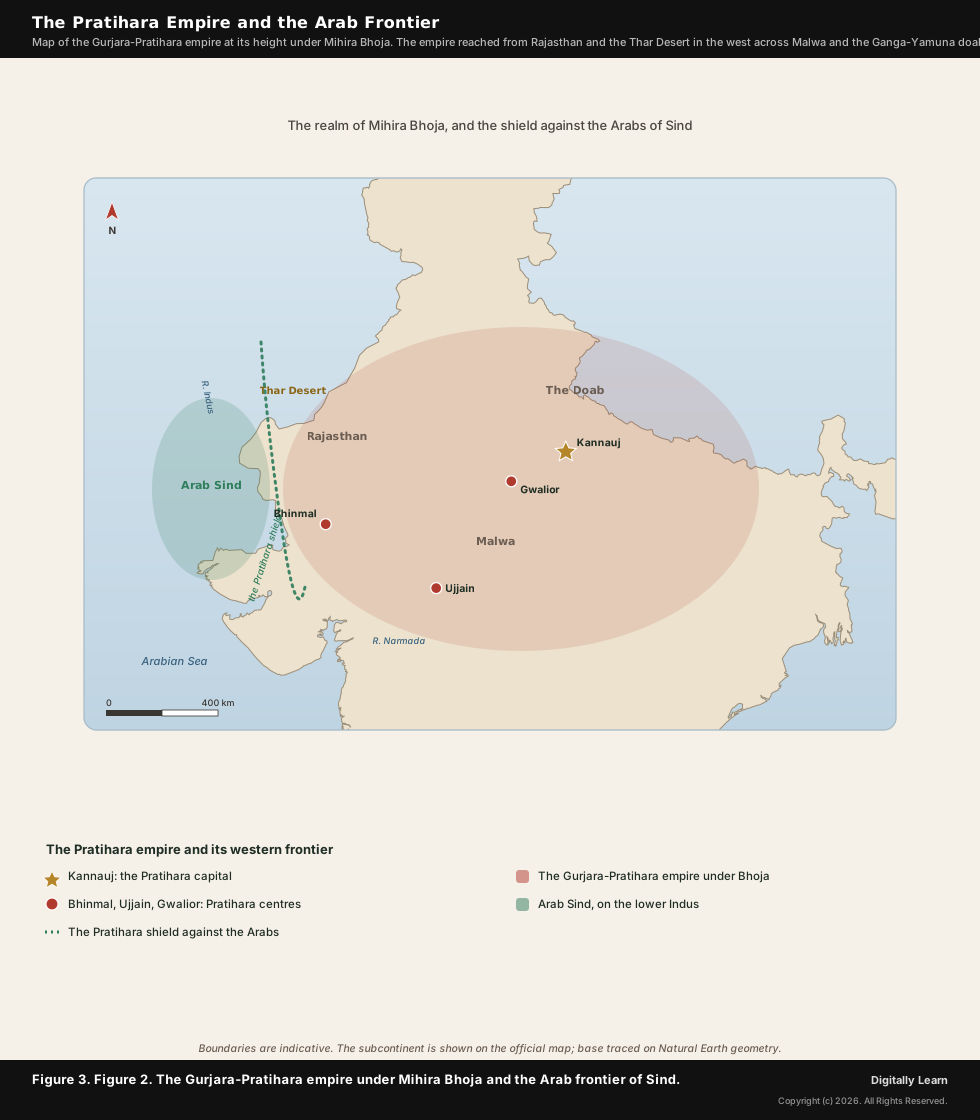
Distinguishing the empire: at its height the Pratihara realm stretched across the whole of the north, with its capital at Kannauj and its western edge facing the Arabs of Sind.
The empire reached from the Thar Desert and Rajasthan in the west, across Malwa, to the Ganga-Yamuna doab and the city of Kannauj, with its power felt as far as the borders of Bengal. On the west it stood against the Arab governors of Sind, on the lower Indus, and it was here that the Pratihara army earned its name as a bulwark.
The map sets out the realm of Mihira Bhoja and the western frontier. It is worth marking that the Pratiharas, unlike the Rashtrakutas, were a northern power whose heart lay in this very country, and so they held Kannauj as a homeland, not a distant conquest.
The Great Kings of the Dynasty
Vatsaraja and Nagabhata II
What is the significance of these two kings: they carried the Pratiharas into the first rank of Indian powers and won them the prize of Kannauj.
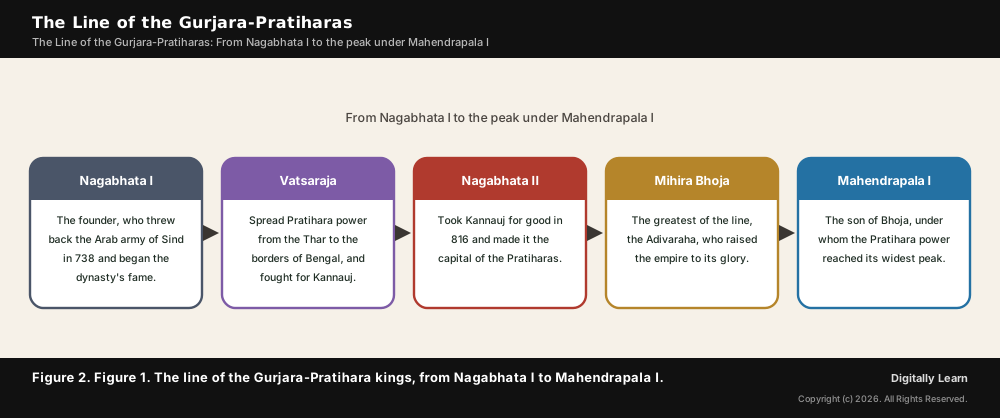
Vatsaraja, in the later eighth century, spread Pratihara power from the Thar in the west toward the frontiers of Bengal, and made the first Pratihara bid for Kannauj in the opening round of the tripartite struggle. Though checked by the Rashtrakuta Dhruva, he set the dynasty on its imperial path.
Nagabhata II, his successor, completed the work. In 816 he took Kannauj for good, defeated the Pala vassal who held it, and made the city the Pratihara capital. From his reign the Pratiharas were the foremost power of the north.
| Ruler | Note |
|---|---|
| Nagabhata I | The founder; defeated the Arab army of Sind in 738. |
| Vatsaraja | Spread power from the Thar toward Bengal; fought for Kannauj. |
| Nagabhata II | Took Kannauj in 816 and made it the Pratihara capital. |
| Mihira Bhoja (Bhoja I) | The greatest; the Adivaraha; raised the empire to its height. |
| Mahendrapala I | Son of Bhoja; the Pratihara power at its widest peak. |
Mihira Bhoja, the Greatest of the Pratiharas
Distinguishing the greatest king: Mihira Bhoja, who ruled for some fifty years in the ninth century, raised the Pratihara empire to its glory and ranks among the great kings of the age.
Mihira Bhoja, also called Bhoja I, was a general and empire-builder set beside the Rashtrakuta Dhruva and the Pala Dharmapala as one of the masters of the age. He ruled from Kannauj, and on some of his coins he took the title Adivaraha, the primeval boar, a form of Vishnu, a mark of his imperial claim.
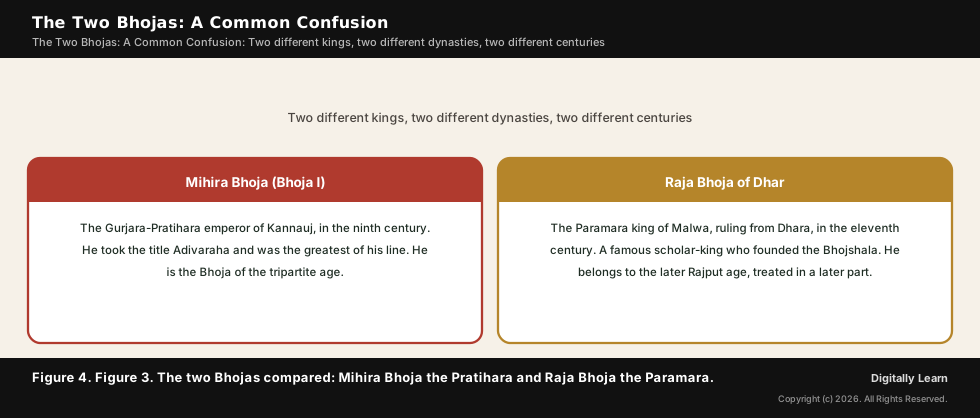
Here a caution is needed. This Mihira Bhoja, the Pratihara of Kannauj, must not be confused with the later Raja Bhoja of Dhar, the Paramara scholar-king of Malwa, who lived two centuries afterwards. The two Bhojas belong to different dynasties, regions and ages, and the figure compares them.
The Bulwark Against the Arabs
The Pratihara Shield and Sulaiman's Witness
What is the significance of the bulwark: the Pratiharas' greatest service to Indian history was to hold the western gate, barring the Arabs of Sind from the heart of the country for centuries.
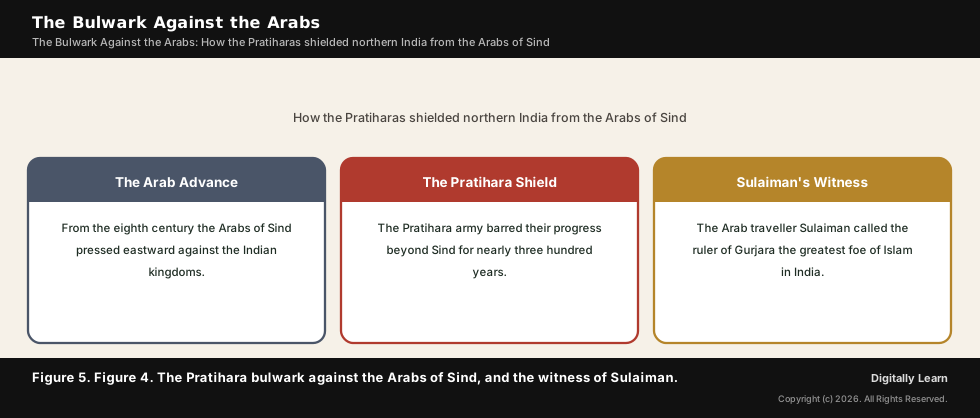
From the eighth century the Arabs who held Sind pressed eastward against the Indian kingdoms. It was the power of the Pratihara army, standing on the western frontier, that barred their progress beyond the confines of Sind for nearly three hundred years, a shield behind which the north grew and flourished.
The Arab writers themselves bear witness. The traveller Sulaiman, writing in the ninth century, said that the ruler of Gurjara kept fine forces and a matchless cavalry, and that among the princes of India there was no greater foe of the faith of Islam than he, a tribute from the enemy to the Pratihara shield.
The Decline of the Pratiharas
The Sack of 916 and the Long Fragmentation
What is the significance of the decline: the fall of the Pratiharas opened the way for the rise of the Rajput kingdoms, and it came in two distinct stages, a sudden blow and a slow breaking.
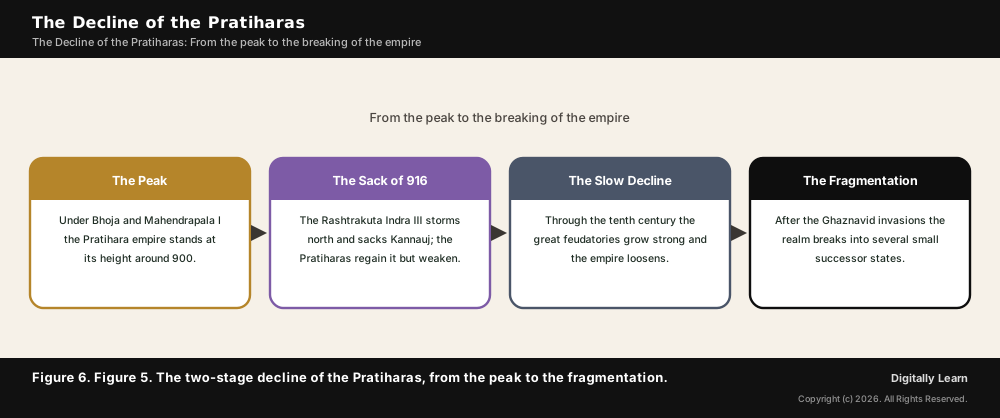
The first blow fell about 916, when the Rashtrakuta Indra III swept up from the Deccan and sacked Kannauj itself. The Pratiharas regained their capital, but the shock began a weakening from which the empire never fully recovered, and through the tenth century its great feudatories grew ever more independent.
The final breaking came later still. After the Ghaznavid invasions of the early eleventh century, the loosened empire fragmented into a cluster of small successor states, among them the Rajput kingdoms that the later parts will follow. The two stages, the sack of 916 and the much later fragmentation, should be kept apart.
UPSC Relevance and Exam Focus
Where the Gurjara-Pratiharas Fit in the UPSC-CSE Syllabus
This topic belongs to General Studies Paper I: early-medieval Indian history, and the Pratiharas are a frequent ground for matching and statement questions.
The questions most often test the great kings and the dynasty's role: Nagabhata II and the winning of Kannauj, Mihira Bhoja the Adivaraha, and the Pratihara bulwark against the Arabs of Sind.
Several linked points recur and are worth holding in working memory:
- Nagabhata I: The founder, who defeated the Arabs of Sind in 738.
- Nagabhata II: Took Kannauj in 816 and made it the capital.
- Mihira Bhoja: The greatest king, who took the title Adivaraha.
- The bulwark: The Pratihara shield that barred the Arabs for centuries.
- The two Bhojas: Mihira Bhoja the Pratihara, not Raja Bhoja the Paramara.
A 2022 question asked how many king-and-dynasty pairs were correct, among them Nagabhata II with the Gurjara-Pratiharas, which is right, and Bhoja with the Rashtrakutas, which is wrong, for Bhoja was a Pratihara. Nannuka belongs to the Chandelas and Jayashakti also to the Chandelas, not the Paramaras, so only two of the four pairs match.
A common trap pairs Bhoja with the Rashtrakutas; Mihira Bhoja was a Gurjara-Pratihara, and no Bhoja was a Rashtrakuta. Another confuses the sack of 916 with the final fall; the sack only began the decline, and the realm broke up much later, after the Ghaznavid invasions.
Previous Year UPSC-CSE Questions
Previous Year UPSC-CSE Questions By the end you will be able to draft model answers for the following UPSC questions. Each question carries a collapsible framework showing how to approach it in the exam.
- UPSC Prelims 2022 GS-IConsider the following pairs of a king and his dynasty: 1. Nannuka and the Chandela; 2. Jayashakti and the Paramara; 3. Nagabhata II and the Gurjara-Pratihara; 4. Bhoja and the Rashtrakuta.
- Nannuka and the Chandela dynasty
- Jayashakti and the Paramara dynasty
- Nagabhata II and the Gurjara-Pratihara dynasty
- Bhoja and the Rashtrakuta dynasty
How many pairs given above are correctly matched?
How to approach this Prelims question
Approach: Test each pair: Nannuka-Chandela (correct), Jayashakti-Paramara (wrong, he was a Chandela), Nagabhata II-Gurjara-Pratihara (correct), Bhoja-Rashtrakuta (wrong, Bhoja was a Pratihara or a Paramara). Two are correct.
Trap to watch: Bhoja was never a Rashtrakuta; Mihira Bhoja was a Gurjara-Pratihara and Raja Bhoja a Paramara. Jayashakti was a Chandela, not a Paramara.
Key facts to recall:
- Nagabhata II was a Gurjara-Pratihara who took Kannauj in 816.
- Mihira Bhoja was a Gurjara-Pratihara; Raja Bhoja a Paramara; neither a Rashtrakuta.
- Nannuka and Jayashakti both belonged to the Chandela dynasty.
Answer signal: Only two pairs.
Sources and Further Reading
Editorial Disclaimer
This article is for UPSC preparation. The dates of the Pratihara kings are approximate, and the account follows the standard scholarship on early-medieval north India.