


Overview
Bindusara was the second emperor of the Mauryan dynasty of Magadha, ruling roughly from c. 297 to c. 273 BCE. He was the son of Chandragupta Maurya, who founded the empire, and the father of Ashoka, its most famous ruler. Greek writers knew him as Amitrochates, a form of the Sanskrit title Amitraghata, "slayer of enemies". His reign sits between two much better documented rulers, so a student meets him mostly through brief references, which is why the exam facts about him are few and fixed.
Sources for Bindusara and the Mauryan Succession
Reign and Succession: Two Parts of One Story
The period has two parts that must be kept apart. The first is the reign itself, which covers the empire inherited from Chandragupta, the diplomatic exchanges with the Hellenistic kingdoms and the unrest at Taxila. The second is the accession of Ashoka, the contested succession that followed Bindusara's death. The first part rests on a small set of Greek and Indian notices. The second rests on contradictory Buddhist traditions and on Ashoka's own inscriptions, which say almost nothing about the struggle.
Buddhist, Jain and Greek Sources on Bindusara
Most of what is written about Bindusara comes from accounts composed long after his death. Buddhist works such as the Divyavadana (with the Ashokavadana), the Dipavamsa and the Mahavamsa, Jain works such as Hemachandra's Parishishta-Parvan, the Puranas and a few Greek writers all mention him. The Jain and Buddhist narratives were written centuries later and were interested in Chandragupta and Ashoka, not in Bindusara himself. Much of their detail is legend, such as miraculous weapons, gods who crown a prince and a birth story involving poison.
A careful student therefore holds three tiers. The firm tier is what Greek writers record about envoys and gifts, and what Ashoka's own inscriptions confirm, such as the existence of a prince-viceroy at Ujjain. The middle tier is what several independent traditions agree on, such as Ashoka being Bindusara's son. The weak tier is a single late story, such as the miraculous crowning or the pit of charcoal.
Bindusara's Names, Family and Origins
Names and the Title Amitraghata
The name appears, with small spelling changes, in Buddhist texts (Bindusaro), Jain texts and the Vishnu Purana (Vindusara). Other Puranas give different forms such as Bhadrasara or Nandasara, which appear to be scribal errors.
The title Amitraghata (Sanskrit for "slayer of enemies") is recorded in the Mahabhashya, and the Greek writers Strabo and Athenaeus preserve it as Allitrochades and Amitrochates. One scholar derived the Greek form instead from Amitrakhada, "devourer of enemies", a title of Indra. The title shows how a Greek writing about India in the third century BCE rendered a Sanskrit epithet into his own language, and the same pair of names is used to identify him in the Greek record of envoys.
A Jain text gives his birth name as Simhasena. The title and the Greek forms are what an examinee needs.
Parents, Queens and Sons
Chandragupta is named as his father by the Puranas and the Mahavamsa, while the Dipavamsa and the Ashokavadana give different ancestries that omit Chandragupta. This disagreement is why the Buddhist genealogies cannot be used to fix his lineage on their own. The Jain Parishishta-Parvan names his mother as Durdhara. Chandragupta's marriage alliance with the Seleucids has led to speculation that she was Greek, but there is no evidence for it.
Both Buddhist and Jain tradition explain his name through a story. Chanakya mixed small doses of poison into Chandragupta's food to build his immunity. The emperor shared a meal with his pregnant queen, and Chanakya cut the unborn child out of her womb. In the Buddhist version the child was kept in the belly of a goat, which gave his body spots ("bindu") of blood. In the Jain version a drop of poison had touched the baby's head, which gave "the strength of the drop". These are folk etymologies, not history.
Bindusara's sons are named differently in different texts. The prose Ashokavadana lists Sushima, Ashoka and Vigatashoka, with Ashoka and Vigatashoka born to Subhadrangi, the daughter of a Brahmin of Champa. The Mahavamsa speaks of 101 sons by 16 women, the eldest Sumana (Sushima) and the youngest Tishya (Tissa), with Ashoka and Tishya born to the same mother. The number is a conventional large figure and not a count.
Reign of Bindusara: Territory, Ministers and Unrest
Southern Extent of the Mauryan Empire Under Bindusara
Historians disagree about whether Bindusara added territory. The Tibetan author Taranatha, writing in the 16th century, says that Chanakya, one of Bindusara's "great lords", destroyed the nobles and kings of sixteen towns and made him master of the land between the western and eastern seas. Some read this as a conquest of the Deccan, others as only the suppression of revolts.
Three views exist. One holds that Bindusara only kept what Chandragupta had won, because the empire already stretched from the Arabian Sea to the Bay of Bengal and Ashoka's inscriptions in the south do not mention any conquest by his father. A second view holds that the empire reached as far as Mysore, with the southernmost kingdoms acknowledging its suzerainty without being part of it. A third view says that Bindusara inherited the Deccan and brought the Chera, Chola and Satyaputra kingdoms under nominal control. Tamil literature refers to a Mauryan invasion (Vamba Moriyar), without details.
Ashoka's own empire is better documented, and it covered almost the whole subcontinent except the far south, including present-day Bangladesh and Pakistan and parts of Afghanistan. For the exam, treat Bindusara as the emperor who held the inheritance together and possibly pushed it south, with the Deccan claim marked as disputed.
Ministers and the Revolts at Taxila
Chanakya, the adviser of Chandragupta, is linked to Bindusara's reign in the traditions, but the traditions disagree. The Jain Parishishta-Parvan keeps Chanakya as prime minister under Bindusara and gives a legend of his death in which a jealous minister named Subandhu tricks Bindusara and later burns Chanakya. The Jain Rajavali-Katha says instead that Chanakya went with Chandragupta to the forest when the emperor retired. Neither version is contemporary evidence.
The Ashokavadana says Bindusara had 500 royal councillors. It names two officials, Khallataka, the prime minister, and Radhagupta, who helped Ashoka become emperor after his father's death. These are figures from the succession story, so they appear again below.
Taxila (Takshashila) was a prosperous and strategically placed city on the Uttarapatha route connecting the Mauryan capital Pataliputra with the northwest. Pataliputra, which Chandragupta Maurya had made his capital, kept that status under the Mauryas, and Ashoka later administered his empire from it. The Mauryan Empire had five major provincial centres: Pataliputra, Taxila, Ujjayini, Tosali and Suvarnagiri, all mentioned in Ashokan inscriptions. Taxila and Ujjayini were chosen because they lay on important long-distance trade routes.
Buddhist tradition says Taxila revolted twice in Bindusara's time. The first revolt was caused by the misrule of his oppressive ministers (another account blames the maladministration of Sushima), and Ashoka was sent to settle it. The citizens told him that they opposed only the evil ministers, not the emperor or the prince, and he entered the city without a fight. The second revolt came shortly before Bindusara's death, when Sushima was sent and failed to subdue it. The tradition of a Taxila revolt is not independently confirmed by a contemporary source, which is the point to remember.
Bindusara and the Ajivika Sect
Patronage and the Prophecy about Ashoka
The Ajivika sect, led by Makkhali Gosala and holding the doctrine of niyati, rigid determinism, flourished in this period. Later Buddhist tradition links Bindusara and his chief queen with the Ajivikas. The Divyavadana preserves the story of an Ajivika wanderer, Pingalavatsa (named Janasana in the Pali commentary), who examined the princes and judged that Ashoka was the best fit to rule. He would not say so openly because Ashoka was not the emperor's favourite, and he left the kingdom after telling the queen. Scholars such as A. L. Basham have concluded from these stories that Bindusara patronised the Ajivikas.
The Buddhist works also call Bindusara a "Brahmana bhatto", a votary of the Brahmanas, so the evidence points to a court open to more than one tradition. A fragmentary inscription at Sanchi might refer to Bindusara and so to a link with the Buddhist order, though this is uncertain.
The Mauryas and the Hellenistic World
Deimachus, the Successor of Megasthenes
Seleucus sent Megasthenes to the court of Chandragupta. His successor in the role was Deimachus (Deimachos) of Plataeae, sent by the Seleucid king Antiochus I Soter to Bindusara at Pataliputra. The geographer Strabo records both missions in one line: Megasthenes to Sandrocottus (Chandragupta) and Deimachus to Allitrochades, his son. Deimachus seems to have written a treatise "On Piety", and his works on India survive only in quoted fragments. Strabo considered both men unreliable because of the fables they repeated.
For the examination, three connected facts cover this ground: Megasthenes under Chandragupta, Deimachus under Bindusara, and the Seleucid king's friendly diplomatic relations with Bindusara.
Dionysius and the Question of His Reign
The Roman writer Pliny the Elder records that the Ptolemaic king Philadelphus (Ptolemy II) sent an ambassador named Dionysius to India. Pliny places Dionysius among the Greek writers who lived at Indian courts and wrote about the power of the Indian kings. The same Ptolemy II is named among the kings in Ashoka's inscriptions to whom his messengers went.
The Request for Wine, Figs and a Sophist
The best known story about the diplomatic contact is preserved by the Greek writer Athenaeus, who drew it from Hegesander. Bindusara asked Antiochus to send him sweet wine, dried figs and a sophist (a philosopher). Antiochus replied that he would send the wine and the figs, but that Greek law did not allow a sophist to be sold. The request is read as a sign of the emperor's interest in Greek philosophy.
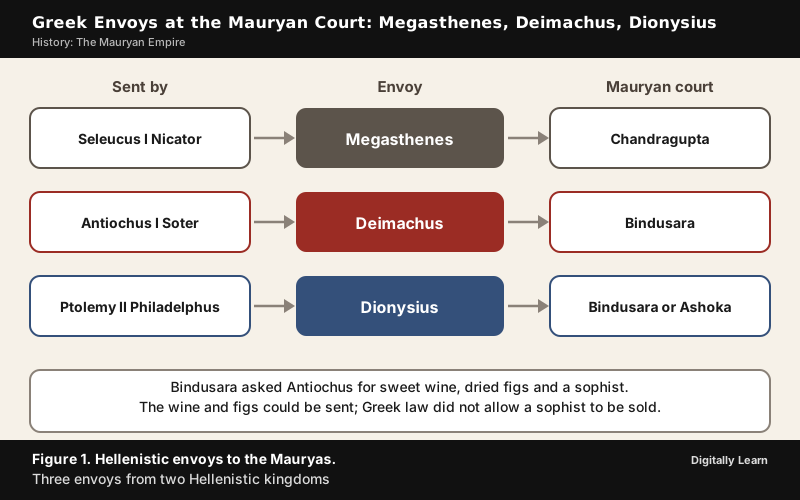
The three envoys can be placed side by side.
| Envoy | Sent by | To the court of | Reign |
|---|---|---|---|
| Megasthenes | Seleucus I Nicator (Seleucid) | Chandragupta | Founder of the dynasty |
| Deimachus | Antiochus I Soter (Seleucid) | Bindusara | Second emperor |
| Dionysius | Ptolemy II Philadelphus (Ptolemaic Egypt) | The Mauryan court | Bindusara or Ashoka, disputed |
Ashoka Before the Throne
Ashoka as Viceroy at Ujjain
The Sri Lankan tradition says Bindusara appointed Ashoka viceroy of Avantirashtra, with the city of Ujjain as its centre. Ujjain was an important administrative and commercial province in central India and lay on a major trade route. This account has two supports outside the Buddhist texts. The Saru Maru inscription in central India records that he visited the place as a prince, and one of Ashoka's own rock edicts mentions a prince-viceroy stationed at Ujjain during his reign.
The Mahavamsa adds that during his time in Ujjain Ashoka met Devi, the daughter of a merchant of Vidisha, who bore his son Mahinda and, two years later, a daughter, Sanghamitta. These later became central to the story of Buddhism in Sri Lanka. Sanchi in Madhya Pradesh, which grew into a great Buddhist centre, was founded in the 3rd century BCE by Ashoka. The same Sri Lankan chronicle, the Dipavamsa, gave George Turnour in 1837 the key that tied the inscriptions to Ashoka. It describes Piyadassi as the grandson of Chandragupta, the son of Bindusara and at that time viceroy of Ujjayani.
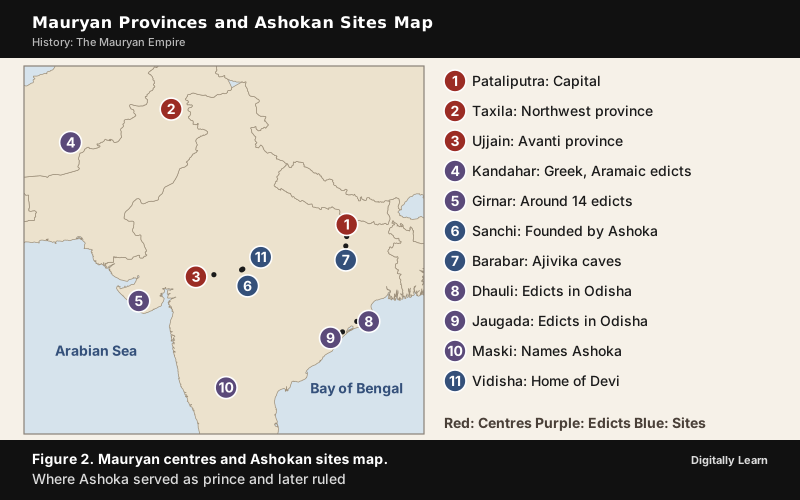
The Taxila Mission and Ashoka's Training
The northern tradition gives Ashoka a different early posting. In the Ashokavadana, Bindusara sends him with a fourfold army to put down the Taxila revolt, and the story says Bindusara refused to give him weapons. Other Buddhist texts (the Ashoka-sutra and Kunala-sutra) describe Ashoka as a viceroy in Gandhara, where Taxila lay. The weapons that "appeared" from the earth are a miracle story, a way of marking Ashoka as a chosen ruler.
The two traditions do not conflict if Ashoka held both posts at different times, and what they agree on is the fact that matters: Bindusara trusted him with provincial responsibility even though, in the stories, he disliked him. Two further pieces of evidence support a Taxila link. An Aramaic inscription found at Sirkap near Taxila contains a name beginning "prydr", restored by most scholars as "Priyadarshi", and the Dharmarajika Stupa near the city has a name that suggests Ashoka. No Mauryan record shows that he visited the city himself.
The Succession Struggle and Ashoka's Accession
Two Accounts of the Succession
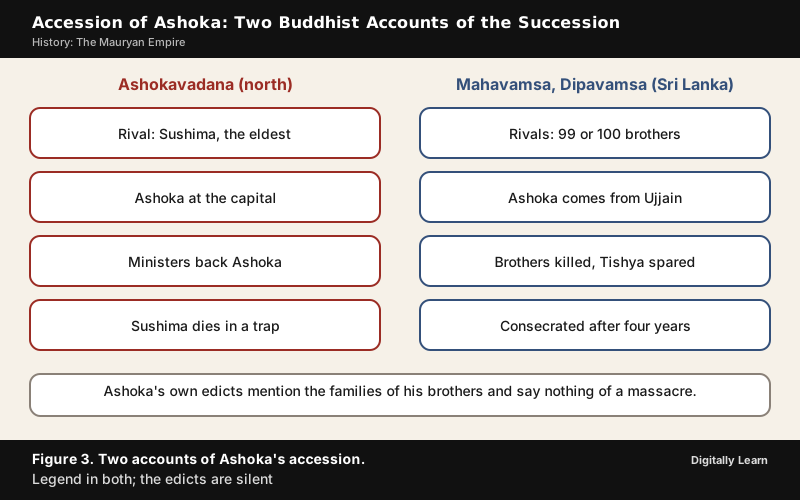
The traditions agree that Ashoka was not the crown prince and that his accession was disputed, but they tell the story differently. The table compares the two.
| Point | North Indian tradition (Ashokavadana) | Sri Lankan tradition (Mahavamsa, Dipavamsa) |
|---|---|---|
| Rival | Sushima (Susima), the eldest son | Eldest brother and 99 half-brothers (100 in the Dipavamsa) |
| Ashoka's position | At the capital, backed by 500 ministers | Viceroy of Ujjain, who hurried to Pataliputra |
| How he won | Gods crown him as Bindusara dies | Seized the capital and killed his brothers |
| Fate of the rival | Sushima killed by Radhagupta's trick (a pit of burning charcoal) | Eldest brother killed by Ashoka |
| Brother spared | Not stressed | Tishya (Tissa), his full brother |
| Delay before consecration | Not stressed | About four years |
The Ashokavadana says the minister Khallataka (with Radhagupta) supported Ashoka after Sushima had thrown his gauntlet at him in play and the minister judged him unfit to rule. When Bindusara fell ill, Sushima was away in Taxila. The ministers suggested crowning Ashoka temporarily, Bindusara refused, and Ashoka declared that if the throne was his by right, the gods would crown him. The Mahavamsa says Ashoka came from Ujjain and killed 99 brothers; the Dipavamsa says 100. Another source, the Brahmanda Purana, says Bindusara himself crowned Ashoka.
What Ashoka's Own Inscriptions Show
Ashoka's inscriptions are the earliest self-representations of imperial power in the subcontinent and among the most valuable sources for Mauryan history. Most are in the Prakrit language, written mostly in Brahmi, with Kharosthi in the northwest and Greek and Aramaic in Afghanistan, and they stand on rocks and polished pillars from the northwest frontier to Andhra, Odisha and Uttarakhand. Near Junagadh in Gujarat, for example, around fourteen edicts are carved in Brahmi on a huge stone on the route to the Girnar hills. The inscriptions name the five provincial centres of the empire, tell us what the king wished his subjects and officials to follow, and, through the Hellenistic kings they name, let historians fix his date.
They are also limited. They concern dhamma and do not describe his youth or his ancestors, and they cannot be taken at face value because they present a favourable image of the king. They say nothing about a massacre of brothers. One edict, Rock Edict 5, mentions officers who look after the welfare of "the families of his brothers, sisters, and other relatives", which suggests that more than one brother survived, though some scholars read it as referring only to the families.
The sensible reading is that Ashoka probably was not the heir and probably removed at least one rival, while the Buddhist figures of 99 or 100 victims were exaggerated to portray him as wicked before his turn to Buddhism. For the full study of the edicts, see the page on the Edicts of Ashoka.
Dating the Accession and the Gap Before Coronation
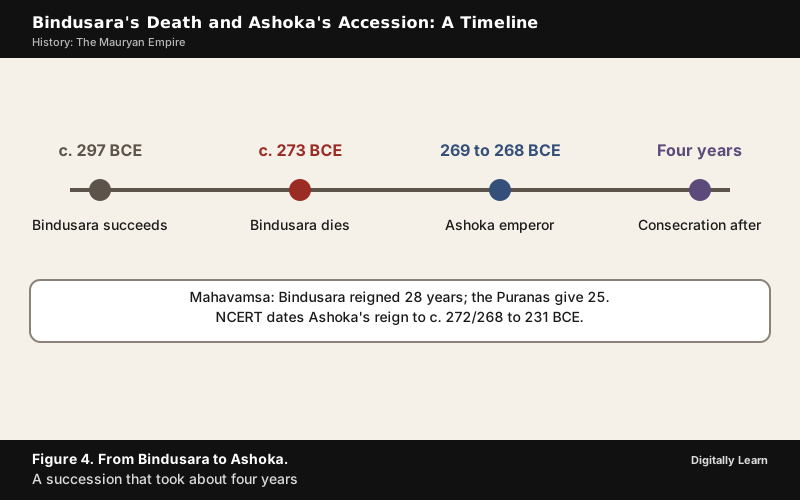
Historians place Bindusara's death around 273 BCE (some say 274 or 273 to 272). One scholarly reconstruction puts a four-year struggle after his death, with Ashoka becoming emperor in 269 to 268 BCE. The Mahavamsa and Dipavamsa say he consecrated himself four years after becoming sovereign, which fits the gap between the death of Bindusara and the formal coronation and is read as a war of succession among Bindusara's sons.
The reign length of Bindusara is itself disputed. The Mahavamsa gives 28 years and the Puranas 25. The Sri Lankan chronicles put Ashoka's accession 218 years after the Buddha's death and give a reign of 37 years, and the date depends on when the Buddha is placed.
The inscriptions help to fix the date indirectly. Ashoka names contemporary Hellenistic rulers, among them Antiochus II Theos, Ptolemy II Philadelphus, Antigonus II Gonatas, Magas of Cyrene and Alexander, whose dates are known with more certainty, which places him in the 3rd century BCE.
Ashoka's Names and Titles in the Inscriptions
Ashoka's inscriptions mostly do not use his personal name. They call the ruler Devanampiya ("beloved of the gods") and Piyadassi ("pleasant to behold", or Priyadarshin in Sanskrit). The name Ashoka appears in some other inscriptions that carry the same titles, notably the Maski Minor Rock Edict, and after comparing content, style, language and script, epigraphists concluded that all were issued by one ruler.
The identification has its own history. James Prinsep deciphered the Brahmi and Kharosthi scripts in the 1830s and found that most of the inscriptions mentioned a king called Piyadassi. He first identified this king with a Sri Lankan king, Devanampiya Tissa. In 1837 Turnour's Sri Lankan manuscript linked Piyadassi with Ashoka, and the Maski inscription later named Ashoka together with the title Devanampiya.
Previous Year UPSC‑CSE Questions
Each question comes with an explanation of how to approach it.
- UPSC Prelims 1995The name by which Asoka is generally referred to in his inscriptions is
How to approach this Prelims question
Approach: Ask what the inscriptions call the king. They use a title, not the personal name, and the title is Piyadassi (Priyadarshin), "pleasant to behold".
Trap to watch: Chakravarti and Dharma titles sound royal and Buddhist, but they are not the names the edicts use.
Why each option is right or wrong:
- (a) Chakravarti: Wrong. It is a general term for a universal ruler, and it is not the name used in the edicts.
- (b) Dharmadeva: Wrong. The inscriptions use Devanampiya and Piyadassi, and this is not among the titles.
- (c) Dharmakirti: Wrong. It is not among the titles of the inscriptions either.
- (d) Priyadarshini: Right. It is the form of Piyadassi (Priyadarshin) that the inscriptions use for the king, together with Devanampiya.
Answer: (d) Priyadarshini. The edicts name the ruler by the title Piyadassi.
- UPSC Prelims 1997Which one of the following edicts mentions the personal name of Asoka?
How to approach this Prelims question
Approach: Ashoka's inscriptions mostly do not use his personal name and call him by his titles. The name Ashoka appears in a few minor inscriptions, and the Maski Minor Rock Edict is the one that names Ashoka together with the title Devanampiya.
Trap to watch: Kalsi and the Kalinga edicts are famous Ashokan inscriptions, but fame is not the test; the personal name is.
Why each option is right or wrong:
- (a) Kalsi: Wrong. It is one of the major rock edicts, which call the king by his titles rather than by his personal name.
- (b) Rummindei: Wrong. It is the Lumbini pillar inscription, and it is not the inscription that gives the personal name.
- (c) Special Kalinga Edict: Wrong. The Kalinga edicts belong to the major series, which use the titles.
- (d) Maski: Right. The Maski Minor Rock Edict names Ashoka together with the title Devanampiya.
Answer: (d) Maski. Maski names Ashoka with the title Devanampiya.
- UPSC Mains 2026 GS‑IAnalyze the importance of Ashokan inscriptions for reconstructing Mauryan history.
Answer outline
The outline sets out what the question asks, the main arguments, relevant examples and the direction of the conclusion; it is not a full model answer.
Introduction: Ashokan inscriptions are the earliest self-representations of imperial power in the subcontinent and among the most valuable sources for Mauryan history.
Body (sub-themes to develop):
- Spread and script: On rocks and pillars across the empire, mostly in Prakrit in Brahmi, with Kharosthi in the northwest and Greek and Aramaic in Afghanistan.
- Content: The king's own policy of dhamma, his officials and the five provincial centres.
- Chronology: The Hellenistic rulers named in the edicts fix his date; the Maski inscription ties the titles to the name Ashoka.
- Limits: Nothing on his youth, his ancestors or the succession, and a favourable image of the king.
- Literary traditions: Buddhist, Jain, Puranic and Greek accounts fill the gaps, but must be read with caution.
Conclusion: The inscriptions are the firm frame of Mauryan history, and the literary traditions fill it in only where they agree with it.
Sources
- NCERT: Themes in Indian History I (Class XII), Kings, Farmers and Towns
- NCERT: Exploring Society, India and Beyond (Class VII), The Rise of Empires
- NCERT: An Introduction to Indian Art (Class XI), Mauryan Art
- NCERT: Themes in Indian History I (Class XII), Thinkers, Beliefs and Buildings
- District Patna (Government of Bihar): History
- District Junagadh (Government of Gujarat): Ashok Shilalekh
- Incredible India (Ministry of Tourism): Sanchi
- Wikipedia: Bindusara
- Wikipedia: Ashoka
- Wikipedia: Maurya Empire
- Wikipedia: Ajivika
- Wikipedia: Deimachus
- Wikipedia: Antiochus I Soter
- Wikipedia: Megasthenes
- Wikipedia: Dionysius (ambassador)
- Wikipedia: Ptolemy II Philadelphus
- Wikipedia: Chanakya
- Wikipedia: Taxila
- Wikipedia: Ashokavadana
- UPSC: Civil Services Examination question papers
Editorial Disclaimer
This article draws on the NCERT history textbooks, district and tourism pages of the Government of India and the States, and the other sources listed in the Sources section. Much of the literary tradition on Bindusara is legend and is marked as such.